I say ‘NO’ to Sinha-Le AND to Sinhale-Bashers

March 3rd, 2016

MALINDA SENEVIRATN​E

Whenever a majority in any social context flexes muscles minority entities become wary.  This is a verifiable fact.  Whether or not the muscle-flexing entity is justified in doing so (for example, as response-flex, let’s say) is a different matter.  The bottom line is that anxiety levels rise.  And it doesn’t have to be muscle-flexing either.  Even a simple matter of identity assertion (again, for whatever reason, including response to in-your-face identity assertion by minority entities and continuous and pernicious name-calling and vilification) can send shivers up some backs and that’s something to be worried about because things can grow and can be made to grow in grotesque ways even with the best of intentions.
 sinhale+new
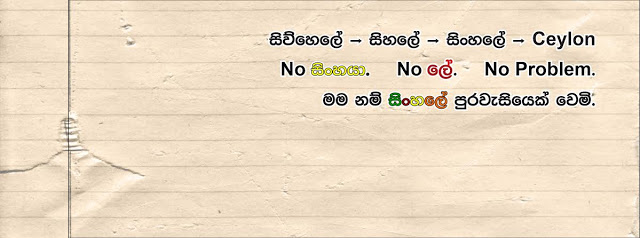
“Sivhele to Sihale to Sinhale to Ceylon.  No lion.  No blood. No problem.  I am a citizen of Sinhale.”

This seems to be what has happened to Jehan Perera and others over the sudden appearance of ‘Sinha-Le’ (literally ‘Blood of the Lion’) stickers.  Jehan (see ‘Sinha Le’ hate campaign must be dealt with by new laws”), speaking for the National Peace Council, claims that the stickers was a part of an organized political campaign that seeks to exploit nationalist emotions”.  Nothing wrong in nationalist emotions of course, and they are exploited by all kinds of individuals and organizations, for example to promote products and position brands.  The problem is not the sticker or the wording, but its associations with organizations that are racist and intolerant of other groups.  There is also the problem of the word in its ahistorical break (i.e. Sinha-Le instead of Sinhale, ‘le’ meaning ‘blood’ and its depiction in red which is obviously associated with violence).  There is legitimate anxiety which spills into fear and even fuels extremism (latent or otherwise) among other groups when the word, either in its integrity or break, is painted on the walls of buildings owned by or associated with those in other communities.

That said, you really cannot ‘ban’ a word.  You can indulge in ‘hate’ discourse with specific actions, ideological positions and intentions stated but when it comes to prohibition you are on shaky ground.  If Jehan were to read the Bible and Quran he will realize that both texts are full of what he might call ‘hate speech’ far worse than anything so far uttered by those waving the ‘Sinha-Le’ flag, so to speak.  Sure, such wording ideally has to be read and accepted in terms of the overall context in which they were spoken or written, but ‘bad wording’ is always ‘bad’ because frail human beings will read them out of context or draw them selectively.  Like Jehan does.

A quick example would help sort him out.  Jehan claims, The term Sinhale” was used during the period of Western colonial invasion that began in the 16th century to represent that part of the country that remained free of colonial rule”.  Is this ignorance or deliberate misrepresentation?

In the early 19th Century, the great Indian writer, poet, journalist, independence activist and social reformed from Tamil Nadu, Chinnaswami Subramania Bharadiyar, penned the following lines in the song Bharatha Desam” (Land of Bharat)

சிங்களத் தீவினுக்கோர் பாலம் அமைப்போம்,
சேதுவை மேடுறுத்தி வீதி சமைப்போம்

[Let us build a bridge to the Island of Sinhala, Let us call it Sethu]

Want to go back further?  Well, way back in the 10th Century, Raja Raja 1, during whose time the Chola empire reached its zenith of glory, not only invaded but plundered and bragged about the plundering.

The Archaeological Survey of India, for example, includes reference to inscriptions at various Hindu temples built with the wealth looted from lands conquered by Raja Raja 1.  These inscriptions list the names of lands he conquered and refers to the island we today call Sri Lanka as ‘Ila-Mandalam’. ‘Ila’ is a corruption of ‘Hela’.  Another translation of a Raja Raja inscription has the island as ‘The land of the war-like Sinhalas’.

 chola+inscription
Stone inscriptions at the Kailasanathar temple at Uttaramerur, 90 km from Chennai. The 1,200-year-old temple, built by the Pallava King Dantivarman has inscriptions of the Chola kings Raja Raja Chola, Rajendra Chola, and Vijayanagara king Krishnadevaraya. Photo: S. Thanthoni, courtesy ‘The Hindu’

There’s no sinhaya (lion) or le (blood) in ‘Sinhale’.  It derives from ‘Hela’ and expands through the acknowledgement of the four constituent entities Yaksha, Naga, Deva and Raksha, each associated with a vocational sphere, and which therefore make up the siv (four) helas.  Sivhela became Sinhala and its corruption gave us ‘Ceylon’.  And that was long before the European invasions where Jehan would like to believe the noun was born and worse in marginal and fragmented form (part of the country that remained free of colonial rule”).  Now that kind of mangling of historical record is pernicious.  If we use the liberties that Jehan avails himself of we might even call it ‘hate speech’!

Vinod Moonesinghe offers a far more sober reading: The Sinha-Le sticker was a fairly unobtrusive bit of identity-establishment, no different from those which say “Masha Allah” or “Jesus is King” or “Proud to be a Thomian”. The inordinate attacks on them have made it into an issue, causing divisions where there were none.  Most of the problem has been caused by people who don’t realise that it is simply a meme. People don’t actually, in this day and age, believe that they are descended from a lion, any more than people believe that they are descended from a couple called Adam and Eve who were made out of mud and dust. Sinhalese nationalism does not rely on the Mahawamsa story, but rather on the fusion of four tribes, the “Siu Hela” to form a single “Sihela” identity. Neither does it rely on a concept of race. Sinhaleseness is a cultural concept. After all, the kingdom of Sinhalay encompassed Tamils, Moors, Portuguese and whatnot. The last King of Sinhalay was Tamil. Every rebellion until 1848 had a Tamil pretender.
People should try and understand what they criticize.”

Krishantha Sri Bhaggiyadatta add this: Nobody taught us in school that there was a country called Zimbabwe, all we knew of was ‘Rhodesia’, named after a white mass murderer who gives prizes…in the same way no one told us that our own country was called ‘Sinhale’….(and that this included the last kings of Sinhale who were ‘Tamil’, etc.)….instead we were given the sibilant exonym ‘Ceylon’ (presumably a hack Portuguese/Dutch/English hack on Sinhale) and now ‘Lanka’ (i.e. the Tamil word for island)…and then, ironically, the splittist Eelam (which means, land of the Sinhala people) hence the modifier Tamil Eelam…”

The Sinha+Le, quite apart from being an ahistorical postulate, as Jehan has correctly pointed out, has intimidating overtones (even if there was no vandalism involved).  Using that to mis-define and footnote (or even dismiss) the ‘Sinhala’ story as per the derivation from the integrative thrust (siv + hela) is mischievous and even obnoxious.  It cannot help reconciliation.

The Indians got it right.  India, since Independence, has re-named those states that had colonial names. That’s recovery as well as assertion of pride in history and heritage.   Pre-colonial names have replaced the colonial names of cities; 13 in Andhra Pradesh 3 in Assam 5 in Gujarat, 2 in Himachal Pradesh, 2 in Goa, 13 in Karnataka, 18 in Kerala, 11 in Madhya Pradesh, 5 in Maharashtra, 2 in Puducherry, 4 in Punjab, 2 in Rajasthan, 13 in West Bengal, 7 in Telangana, 6 in Uttar Pradesh and 14 in Tamil Nadu.

The Indians got it right.  We got it wrong.  We never had anything called Sinha-Le.  We had and are ‘Sinhale’ and that’s not about those who speak the Sinhala language or think of themselves as being Sinhalese who are different from Tamils, but about a history of embrace, of accommodation, respect and cultural cross-nourishment.  That’s far more wholesome than ‘Lanka’ (with or without the ‘Sri’) or the corrupt ‘Ceylon’.

Names are important.  They are political.  They are about assertion and they can be about chauvinistic strutting (or read as such) as in the case of ‘Sinha-Le’.  Their erasure (e.g. the marginalizing, footnoting and summary dismissal of ‘Sinhale’ or ‘Sinhala’) is about violation and violence.  Therefore anyone interested in reconciliation and nation-building exercises that make for unity and dignity has to object to both the butchering of ‘Sinhale’ in its Sinha-Le fracture as well as its attempted dismissal by the likes of Jehan Perera.  Sinhale-bashing in the guise of Sinha-Le bashing is out of order.  Will not help.

We are about to celebrate 68 years of ‘independence’ (quotes deliberate).  If post-war reconciliation is about recovering identity, dignity and embrace, then we need to revisit our names.  ‘Sinhale’ is and will continue to be relevant.  Its corruption should be resisted.

පෙරදිගට ගමනක් – 3-සාර්ලිස් මාස්ටර් ඇඳපු සාරිය …

March 3rd, 2016

වරුණ චන්ද්‍රකීර්ති

ඉන්දියාව කියන අලූත් රට” හැදීම නිසා බොහෝ ජාතීන්ට තමන් ගේ රටවල් අහිමි වූ ආකාරය අපි පසුගිය ලිපි දෙකෙන් විමසා බැලූවා. ඒත් දුර ඉඳලා මේ රට” දිහා බලන කෙනෙකුට හිතෙන්න පුළුවන් මේ විදිහට විවිධ ජාතීන් එකලස් කරලා තියෙන්නේ පොදු සංස්කෘතික පදනමක් උඩ නේ ද කියලා. අවුරුදු දහස් ගණනක් තිස්සේ ඉදිරියට වර්ධනය වෙමින් ගලාගෙන ආ පොදු ඉන්දියානු” සංස්කෘතියක්, මහා සංස්කෘතියක් ගැන කතා පතුරුවලා තියෙන සංදර්භයක් ඇතුළේ එහෙම හිතෙන එක ගැන පුදුමවෙන්න ඕන නෑ. අනිත් කාරණේ තමයි අපිටත් පෙන්නලා තියෙනවානේ ඒ වගේ පොදු” දේවල් – පොදු” සංස්කෘතික අංගවල දීර්ඝ” ඉතිහාසය.

මේ පොදු” අංග අතර ඉදිරියෙන් ම තියෙන්නේ අවුරුදු දහස් ගණනක්” තිස්සේ පැවැත එන හින්දු ආගම. මේ කතාව ඇත්තක් ද? හින්දු ආගම කියන්නේ අවුරුදු දහස් ගණනක් තිස්සේ පැවැත ආ ආගමක් ද? බුදුන් දවස පැවැති බ‍්‍රාහ්මණ ආගමත්” දැන් පවතින හින්දු ආගමත් එක ම ද? බුදුන් දවස තිබුණේ දහස් ගණනින් ගව මහීෂාදීන් ගිනි දෙවියන්ට පුදන, බිලිදෙන බ‍්‍රාහ්මණයන් ගේ ආගමක්. දැන් ඇත්තේ ගවයින්ට වඳින පුදන, ගව ඝාතනයට විරුද්ධ ආගමක්. වේදාන්ත සූත‍්‍ර, උපනිෂද් සහ භගවත් ගීතාව ඉස්සර ඉඳලා ම තිබිච්ච බවට සාක්ෂි තියෙනවා. ඒත්, මේ සූත‍්‍ර ඉගැන්වීම් අද පිළිගන්න විදිහට අර්ථදක්වලා තියෙන්නේ, අටුවා ලියලා තියෙන්නේ ඒ තරම් ඈත කාලයක නෙවෙයි. ඒ ඉතිහාසය නිර්ගුණ බ‍්‍රාහ්මණ් ගැන කියපු ආදී සංකරගෙන් ඔබ්බට යන්නේ නෑ. ආදී සංකර ජීවත්වුනා කියලා සළකන්නේ මීට අවුරුදු 1300 කට විතර කලින්. ඒ, ඉපැරැණි චේර රටේ. දැන් ඒ රට කේරල කියන ප‍්‍රාන්තය විදිහට මේ ඉන්දියාව කියන අලූත් රටට අමුණලා. අනික් අතට, පානිනී වැනි ඉපැරැණි රචකයන් (බොහෝ දුරට ක‍්‍රිස්තු පූර්ව 4 වැනි සියවසේ ජීවත්වෙන්න ඇති කියලා හිතන) ගැන විතරක් නෙවෙයි පතංජලී වැනි පසු කාලීන රචකයන් ගැන පවා හරි හමන් විස්තරයක් හොයාගන්න එක ලේසි පහසු වැඩක් නෙවෙයි. තියෙන තරමක් තියෙන්නේ අනුමාන. ඊට අමතර ව, මේ වගේ පුද්ගලයින් ගේ චරිත කතා පවා බොහෝ දුරට තියෙන්නේ ප‍්‍රබන්ධ විදිහට. එහෙම වෙලා තියෙන්නේ ඇයි?

අනෙක් වැදගත් කාරණය තමයි එක ආගමක් ඇදැහීම සමාන ජාතිකත්වයක් උරුමකර දෙන හේතුවක් විදිහට සළකන්න බැරිකම. ඒකට උදාහරණයක් විදිහට පෙන්නන්න පුළුවන් ඉන්දියාව කඩලා හදපු” නැගෙනහිර පකිස්ථානයේ (දැන් බංග්ලාදේශයේ) සහ බටහිර පකිස්ථානයේ (දැන් පකිස්ථානයේ) ඉන්න ඉස්ලාම් ආගම අදහන ජනයා ගේ වෙනස. ඒ විතරක් නෙවෙයි. අද පවා මේ ඉන්දියාව කියන රට” පුරා ම හින්දු ආගම එක ම විදිහට අදහන්නේ නෑ. දකුණට වෙන්න – ඒ කියන්නේ ඉපැරැණි චෝල හා පාණ්ඩ්‍ය රාජ්‍ය නැතිකරලා හදපු තමිළ්නාඩු ප‍්‍රාන්තය ආශ‍්‍රිතව; හනුමන් දෙවියන්ට ලොකු තැනක් දීලා තියෙනවා. ඒත් ඉපැරැණි වංග දේශයේ කොටසක හදපු බටහිර බෙංගාල ප‍්‍රාන්තයේ හනුමන් දෙවියන් දකින්න නෑ. එහෙ මුල් තැන දීලා තියෙන්නේ කාලී දෙවියන්ට.

භාෂාවේ තියෙන වෙනස්කම් ගැන නම් අමුතුවෙන් කියන්න ඕන නෑ. ඒක අපි කවුරුත් දන්න එකක්. මේ ඉන්දියාව” කියලා හදලා තියෙන රටේ එක ප‍්‍රාන්තයක ඉඳලා තව ප‍්‍රාන්තයකට යනකොට ඒක හරියට එක රටක ඉඳලා තව රටකට යනවා වගේ. ඉතිහාසයට ගරුකරනවා නම්, ඒ ඒ ප‍්‍රාන්තවල” ජීවත්වෙන අයට තමන් ගේ රටවල් හදාගන්න ඉඩදෙන්න ඕන. ඒත් එහෙම කටයුත්තකට මොන විදිහකින්වත් ඉඩක් දෙන්නේ නෑ. ඒ හින්දා – ඒ කියන්නේ භාෂා විසමතාව” හින්දා ඇතිවෙලා තියෙන ගැටලූ මගහරවා ගන්න පොදු භාෂා” විදිහට හින්දි සහ ඉංග‍්‍රීසි යොදාගන්න බලකරලා තියෙනවා. ඒත් හැමෝ ම හින්දි දන්නෙත් නෑ, ඉංග‍්‍රීසි දන්නෙත් නෑ. සාක්ෂරතාව සියයට පනහක් විතර වෙච්ච රටක අති බහුතරයක් ඉංග‍්‍රීසි දන්නවා කියලා හිතන්න පුළුවන් නම් ඒ විදිහට හිතන අය ගැන අමුතුවෙන් කතාකරන්න ඕන නෑ. සාක්ෂරතාව නෑ කියන්නේ තමන් ගේ භාෂාවවත් හරියට ලියන්න, කියවන්න බෑ කියන එක. ඉතින් කොහොම ද අනුන් ගේ හින්දි හරි ඉංග‍්‍රීසි හරි පුළුවන් වෙන්නේ? ඉතින් මුම්බායිවල ඉන්න බොලිවුඞ් කට්ටිය රෑ දවල් මහන්සිවෙනවා හින්දි භාෂාව ප‍්‍රචලිත කරන්න. බොලිවුඞ් කට්ටිය පතුරවන්නේ බොම්බේ (බම්බයියා) හින්දි බව ඇත්ත. ඒත් අපි සෑහෙන දෙනෙක් දන්නවා මේ ඉන්දියාව” කියන රටේ ඉන්න දෙමළ ජනතාව හින්දි භාෂාව භාවිතාකරන්න දක්වන අකමැත්ත. හින්දි භාෂාවෙන් මාර්ග පුවරුවක්වත් දානවට ඒ අය කැමැති නෑ. ඒ වගේ ම, තමන් ගේ අතීත උරුමය මත පදනම්වෙලා, තමන් ගේ ම කියලා සිනමා කර්මාන්තයක් පවා ගොඩනගාගන්න ඒ අයට පුළුවන්වෙලා තියෙනවා. මලයාලම් භාෂාව කතාකරන කේරළේ අයට, කන්නඩ භාෂාව කතාකරන කර්නාටක ප‍්‍රාන්තයේ අයට, තෙළිඟු භාෂාව කතාකරන ආන්ද්‍රා ප‍්‍රදේශයේ අයටත් යම් ප‍්‍රමාණයකට තමන් ගේ සිනමා කර්මාන්ත ගොඩනගාගන්න පුළුවන්වෙලා තියෙනවා. ඒත්, ඒ අය ගේ සිනමා නිර්මාණ දෙමළ සිනමාව තරම් ශක්තිමත්” නෑ. ඒ අය බොහෝ දුරට බොලිවුඞ් ආක‍්‍රමණයට යටවෙලා ඉන්නේ. ඔරියා, මරාටි, ගුජරාටි, මනිපූරි වගේ වෙනත් භාෂාවලින් පවත්වාගෙන යන සිනමා කර්මාන්ත ගැන කතාකරන්න ඕන නෑ.

තව වැදගත් දෙයක් තියෙනවා. ඒ තමයි, හින්දි භාෂාවේ සැබෑ ඉතිහාසය දේවනාගරි අක්ෂර භාවිතයෙන් වහලා තියෙන්නේ කියන එක ගැන අපි වැඩි දෙනෙක්ට අවබෝධයක් නැතිකම. හින්දි සහ උර්දු භාෂා දෙකට ම” කියන්නේ හින්දුස්ථානි කියලා. හින්දුස්ථාන් කියන්නේ ම පර්සියානු වචනයක්. ඉන්දීය උපමහාද්වීපයේ වයඹ සහ උතුරු ප‍්‍රදේශ පර්සියානුවන් හඳුන්වලා තියෙන්නේ ඒ විදිහට. දිල්ලි සුල්තාන්ලා, මූගල් අධිරාජ්‍යයේ කට්ටිය මේ හැඳින්වීම දිගින් දිගට ම යොදාගත්තා. ඇත්තට ම හින්දුස්ථානි (හින්දි සහ” උර්දු) කියන්නේ දිල්ලිය අවට භාවිතාවෙච්ච කරිබෝලි භාෂාවේ වර්ධනයක්. හැබැයි ඒක පානිනී කියපු අපභ‍්‍රංශ භාෂාවේ පරිණාමිත අවස්ථාවක් විදිහට සළකන්න අමාරුයි. මොකද කරිබෝලි භාෂාව පර්සියානු, අරාබි, තුර්කි වදන් සහ යෙදුම්වලින් සෑහෙන්න පෝෂණය වෙලා තියෙන හින්දා. මේක දැන් අමුතු ම භාෂාවක්.

මේ විදිහට වර්ධනය වෙච්ච මේ කලවම් භාෂාව මූගල් පාලකයෝ උර්දු කියලා නම්කළා. ඒ වචනයේ තේරුම තමයි රාජ්‍ය සභාවේ භාෂාව” කියන එක. ඉතින් ඒ නම්කිරීම ගැන කාටවත් ගැටලූවක් තිබුණේ නෑ. හැබැයි පෙරදිග ඉන්දීය වෙළෙඳ සමාගම විසින් උර්දු අකුරුවලින් ලියන හින්දුස්ථානි භාෂාව නිල භාෂාව (කොම්පැනි රාජ් කාලයේ නිල වශයෙන් පිළිගත්ත භාෂාවකට රාජ්‍ය භාෂාවක් කියන්න පුළුවන් ද?) විදිහට පිළිගැනීමත් එක්ක ගැටලූවක් මතුවුනා. ඉංග‍්‍රීසින් කරපු මේ වැඩේට හින්දු ආගම අදහන ඇතැම් පිරිස් කැමැති වුනේ නෑ. ඉතින් දේවනාගරි අකුරුවලින් ලියන හින්දුස්ථානි භාෂාවට තැනක් ඉල්ලලා ඒ අය නැගී හිටියා. අන්තිමට ඒ අවස්ථාව පිරිනැමුනේ 1900 අවුරුද්දේ දී. උර්දු අකුරින් ලියන උර්දු භාෂාවටත්, දේවනාගරී භාෂාවෙන් ලියන හින්දි භාෂාවටත් සමතැන ලැබුණා. හැබැයි ඒ දෙක ම” ඒ වන විටත් එක ම එක භාෂාවක්.

මේ භාෂා දෙක” නිල වශයෙන් පාරවල් දෙකක යන්න පටන්ගත්තේ ඉන්දියාව” සහ පකිස්ථානය කියන රටවල් දෙක පිහිටුවලා බි‍්‍රතාන්‍ය පාලකයෝ ආපහු ගියාට පස්සේ. මේ වෙන්කිරීමෙන්” පස්සේ ඉන්දියාවේ කට්ටිය අධ්‍යාපන, විද්‍යාත්මක, ආර්ථික සහ පරිපාලන වැඩවලට උවමනා කරන අලූත් පාරිභාෂික වචන සංස්කෘත භාෂාවේ ආභාෂයෙන් නිපදවලා ජනතාවට බෙදලා දෙනවා. (අපි ඒ වචන අපේ සිංහල පාරිභාෂික වචන හදාගන්න කොපි කරගන්නවා). පකිස්ථානයේ කට්ටිය පරණ කරපු විදිහට ම අරාබි, පර්සියානු භාෂාවල ආභාෂයෙන් අලූත් පාරිභාෂික වචන හදනවා. ඒත් තවමත් එදිනෙදා වහරන භාෂාවේ වෙනසක් නෑ. උර්දු දන්න අයට හින්දි තේරෙනවා. හින්දි දන්න අයට උර්දු තේරෙනවා. ඒත් අපිට?

මට මේ අපභ‍්‍රංශ තේරෙන්නේ නැති හින්දා හින්දි ගැන අවබෝධයක් තියෙන කෙනෙක්ට කියලා බොහොම ජනප‍්‍රිය හින්දි සිංදුවක කොටසක් සිංහල අකුරින් ලියවාගත්තා.

දිවානා හුවා බාදල්

සාවන් කි ඝටා චායි

යේ දේඛ්කේ දිල් ජූමා

ලි ප්යාර් නෙ අංඩායී

දිවානා හුවා බාදල්

මේ පදවල සංස්කෘත සම්බන්ධයක් ගෑවිලාවත් තියෙනවා ද? මේවා දේවනාගරි අකුරුවලින් ලියන හින්දා අපිට මේ වචනවල පර්සියානු, අරාබි සහ තුර්කි සම්බන්ධය පේන්නේ නැතිවෙන්න පුළුවන්. ඒත් ඇත්ත ඒක නෙවෙයි.

ඉන්දියාව” කියන රටේ ඉන්න ජනතාව ගේ පොදු සංස්කෘතික උරුමය” ගැන කියන මේ කතාව පැහැදිළි කරගන්න සාරිය ගැනත් යමක් නොකියා බෑ. දැන් සාරිය මේ ඉන්දියාව” කියන රටේ විතරක් නෙවෙයි, පකිස්ථානය, නේපාලය, බංග්ලාදේශය සහ අපේ රටෙත් සංස්කෘතික උරුමයක් බවට පත්වෙලා. සාරියේ ඉතිහාසය කොච්චර නම් ඈතට හොයාගන්න පුළුවන් ද? මේ ගැන තියෙන පොත පත කියෙව්වා ම නම් අපිට ඒත්තු යයි මේ ඇඳුම මහා භාරතය කාලයේ ඉඳලා පැවත එන එකක් කියලා. මෙහෙම කියන අය අපිට අජන්තා බිතු සිතුවම්වලත් සාරි පෙන්නනවා. රාජා රවි වර්මා ගේ චිත‍්‍රවල නම් අපිට සාරි දකින්න පුළුවන්. ඒත් ඈත ඉතිහාසයේ සිතුවම්වල, කැටයම්වල, මූර්තිවල මේ විදිහේ ඇඳුමක් දකින්න තියෙනවා ද? අපි දැකලා තියෙනවා ඉන්දිරා ගාන්ධි වගේ අය ඔළුව පවා වැහෙන්න සාරි පොට දාගෙන ඉන්නවා. මේක ඉන්දිරා ගාන්ධිට විතරක් සීමාවෙච්ච දෙයක් නෙවෙයි. රාජස්ථාන්, උත්තර් ප‍්‍රදේශ්, හර්යානා, මහාරාෂ්ඨ‍්‍ර, ගුජරාට් වගේ ප‍්‍රාන්තවල” කාන්තාවෝ සාරිය අඳින්නේ ඒ විදිහට. මේ මොන විදිහේ සංස්කෘතික අභාෂයක් ද?

මේ වගේ ඇඳුමක ඉතිහාසය අජන්තා සිතුවම්වල හොයනවාට වඩා පර්සියානු, අරාබි සහ තුර්කි සංස්කෘතික බලපෑම් ඇතුළේ හොයාගන්න එක පහසු නැති ද? ඒක-දේව සංස්කෘතික පසුබිමක් ඇතුළේ නිර්මාණය කරගත්ත ඒකාකාරි හිජාබය බහු-දේව සංස්කෘතික පසුබිමක් තුළ විචිත‍්‍ර වූ සාරියක් බවට පරිවර්තනය වුනා කියලා හිතන්න බැරි ද? මේ වගේ ඇඳුමක් ගැන ඉතිහාසය දිල්ලි සුල්තාන්-මූගල් යුගයට පෙර සිතුවම්, කැටයම්වලින් හොයන එක කරන්න පුළුවන් වැඩක් නෙවෙයි. මේ ගැන හිතන්න, හොයලා බලන්න අපේ පර්යේෂකයන්ට පුළුවන්. කොහොම වුනත් අපි හැමෝ ම එක දෙයක් පැහැදිළි ව දන්නවා. ඒ තමයි සාර්ලිස් මාස්ටර්ට කලින් හිටිය අපේ චිත‍්‍ර ශිල්පියෝ මහාමායා දේවියට, යසෝදරාවට සාරි අන්දවපු නැති බව. සාර්ලිස් මාස්ටර් මේ විදිහේ චිත‍්‍ර අඳින්න ආභාෂය ලබාගන්න ඇත්තේ ග‍්‍රෑන්ඞ්පාස්වල තියෙන ජයතිලකාරාමයේ චිත‍්‍ර ඇඳපු රිචඞ් හෙන්රිකස්ගෙන් වෙන්න ඇති. මොන විදිහෙන් හරි අලූත් බෞද්ධ චිත‍්‍ර කලාවක් අපේ රටට ලැබුණා. සාර්ලිස් මාස්ටර් ඇඳපු චිත‍්‍ර ජර්මනියේ මුද්‍රණයකරලා ගෙන්න ගන්න පුළුවන් වෙච්ච හින්දා ඒවා රාමුකරලා අපේ ගෙවල්වල පවා ඒවා ප‍්‍රදර්ශනය කරගන්න අවස්ථාවක් අපිට හිමිවුනා.

ඒත් මේ සාරිය කියන ඇඳුම අපේ රටට, බෞද්ධ සංස්කෘතියට අලූත් එකක් නෙවෙයි ද? මේ හැම දෙයක් ම මේ විදිහට පැතිරෙන්න ගත්තේ දිල්ලි සුල්තාන් – මූගල් උරුමය පදනම් කරගෙන බි‍්‍රටිෂ් රාජ් යුගයේ දී බෙදා හදාගත්ත පොදු සංස්කෘතිය” කියන ලේබලය අලවලා හදපු ඉන්දියාව කියන රට” නිසා නෙවෙයි ද? මේ කාරණය තවදුරටත් පැහැදිළි කරගන්න පුළුවන් කාරණයක් මී ළඟ ලිපියෙන් පෙන්නලා දෙන්නම්.

වරුණ චන්ද්‍රකීර්ති෴

Govt. should get its act together to avert economic collapse

March 3rd, 2016

By A Special Correspondent Courtesy The Island

The Fitch Rating Agency has downgraded Sri Lanka’s international sovereign rating from BB- to B+ and outlook negative. The rating agency concluded that refinancing risks for the maturing debt is on the rise in the wake of weaker government budget and falling foreign exchange reserves .The rating agency also downgraded local currency bonds as well as country ceiling to B+ from BB-. This is a clear indication that the country is heading towards a virtual economic collapse.

article_image

The reasons are obvious.

The new government increased public sector salaries by Rs. 10,000 per mensum, pension allowance by Rs.1,000, reduced motor vehicle duties, and removed custom based taxes on essential food items and administered fuel prices including LPG prices and public transport fares to provide relief to the consumers. This raised Government current expenditure to a record high of RS. 1,929 billion.

Export income registered around a 10 percent reduction in agricultural exports, around 1 percent reduction in textile and apparel exports, and a 12 percent reduction in rubber based industrial exports.

The suspension of Foreign Direct Investment Projects such as the Port City created uncertainties with regard to the investment climate in the country. Foreign Direct Investments declined to around USD 500 Million in 2015.

Foreign holdings of Treasury bills and bonds declined from over USD 3,500 Million to USD 2,100 Million during the same period.

The Stock Market lost 1,385 points in the All Share Price Index. Equity sales by foreign shareholders exceeded purchases from June through December of 2015 leading to a net outflow of LKR 9,576 Million. Consequently, the net outflows amounted to LKR 5,371 Million in 2015 as against a net inflow of LKR 21,217 Mln. in 2014.

Despite such weakening in financial conditions, the Central Bank engaged in defensive actions on exchange rate management by injecting foreign exchange to the market throughout the 12 months ending 2015 resulting in a net outflow of USD 3,250 Mn. Consequently official international reserves declined to a level of USD 7,304 Mn. in 2015 from USD 8.2 bn in 2014.

Unsuccessful reserve injections did not help to defend the Exchange Rate which increased to LKR 144.01/USD in 2015. The exchange rate had remained stable at an average of LKR 130.56/USD throughout 2014. Official reserves have further eroded to USD 6.3 Bn. in January, 2016.

Sri Lanka being an oil import dependent economy, benefited from falling oil prices from over USD 90/bbl in January 2015 to around USD 30/bbl in December 2015 bringing down fuel import costs to USD 2,797 Mn in 2015 from USD 4,597 Mn in 2014. Tourism revenue increased from US$ 2,431 Mn. in 2014 to US$ 2,863 Mn. in 2015. In spite of a slowdown in inflows, worker remittances were still a buffer to the Island nation raising USD 6,980 Mn. in 2015 in comparison to USD 7,018 Mn. in 2014.

Favorable rainfall throughout the year helped use hydro power capacity to the maximum and the low cost 900MW coal power generation capacity, reduced reliance on fuel based power generation. Rains also blessed the cultivation of rice – the country’s main staple food during both Yala and Maha seasons in 2015 reducing import requirement of rice. However, depressed producer prices for tea and rubber throughout the year and reduced export earnings and adversely affected the plantation economy.

Despite all such fortunes, the economy seems to have slowed down with a GDP growth below 5 percent in 2015. The weakening economic outlook is visible in the reduced profits of Sri Lanka Telecom. Inflation and the international reserve outlook is worrying. The unemployment rate has increased from 4.3 percent in 2014 to 5 percent by the 3rd quarter of 2015.

Meanwhile, the Rupee remains vulnerable to further pressures in the coming months since global investors continue to relocate assets out of emerging markets.

The Deputy Governor of the Central Bank, Dr. Nandalal Weerasinghe has told The Island Financial Review that monetary supply (M2b) has increased by 17.8 percent in 2015 in comparison to 13.4 percent in 2014.

Private sector credit has surged by 25.1 percent in comparison to 8 percent in 2014. This fueled the import of motor vehicles, consumer durables and food items consuming over and above the savings on oil imports during 2015.

Core inflation continued to rise reaching 4.6 percent in January 2016 from 0.8 percent recorded in February, 2014.

Commercial banks have raised the Average Weighted Prime Lending Rate (AWPR) to 8.35 percent this week. It was 8.11 percent a week ago and 6.40 percent a year ago. The Central Bank has already increased the Statutory Reserve Ratio to 7.5 percent in mid January, 2016 and the policy rate by 50 basis points in mid February 2016. Dr. Weerasinghe has indicated to The Island Financial Review that policy rates will increase further in March as certain risks to macro-economic stability continue.

Government Revenue is already lagging behind the 2016 Budget as several revenue proposals have been withdrawn, revised or suspended. The Government also removed the VAT on supermarkets and reduced income taxes.

The Fitch Rating Agency has stated that the 2016 Budget has done little to address government revenue concerns and predicted continued fiscal slippage over 2016 and 2017. It explained that Sri Lanka’s government debt has increased to more than 75 percent of GDP by end 2015 up from 71 percent at the end of 2014.

Although the government raised USD 650 Mn. in September 2015 and a further USD 1,500 Mn. in October 2015 through the issuance of Sovereign Bonds and a further USD 1.500 Mn. through bilateral SWAP arrangement with other Central banks in the Second half of 2015, Fitch does not view that this to be sustainable way to improve the stability of external finance.

Current expenditure on salaries and pension payments are likely to increase by a further LKR 50 billion in view of the recent salary circular to absorb allowances into the basic salary structure. Interest payments are likely to exceed budget limits as rating agencies have downgraded government bonds. Projected public investments are likely to suffer due to tight cash operations.

The budget deficit is likely to be 7.2 percent of GDP in 2015 exceeding the Parliamentary approved limit of 6 percent of GDP. The deficit in 2016 is likely to remain high on account of inadequate revenue to meet recurrent expenditure unless the Government raises VAT and income tax before April 2016.

As stated in the Sunday Times last week, the IMF has suggested that the Government increase the VAT rate from 11 percent to 15 percent, and extend it to retail and wholesale trade, remove many exemptions and reverse the income tax proposals in the 2016 budget.

The post conflict GDP growth in Sri Lanka has been around 7 percent per annum. The unemployment rate declined to 4 percent. Headline inflation had averaged 3.3 percent. The one year Treasury bill interest rate was 6.01 percent. The prime lending rate (AWPR) was 6.26 percent. The exchange rate remained stable at Rs.130/USD throughout 2014. Remittance inflows had reached USD 7 billion (USD 7,018 mn). Tourism income had reached USD 2,431 million. International Reserve Assets totaled USD 9.5 bn of which USD 8.2 bn was official reserve assets.

The downgrade debacle by Fitch is a reflection that Sri Lanka’s economy has failed under the Unity Government within one year. Instead of blaming the past any further, the government must at least now get its act together and focus on the economy. They must now admit that they have created an economic mess by granting unsustainable salary increases to an overblown public service and giving unsustainable price reductions on popular consumer items. They have used the country’s foreign exchange to meet import demand created by bad economic management. The Government has not used oil savings or revenue from tourism or even the borrowings of over USD 4 billion by issuing sovereign bonds and SWAP during 2015 for the strengthening of the economy.

The 2016 budget was a further disaster in this journey as virtually all proposals were withdrawn. Now we have the fertilizer fiasco where price controls reminiscent of pre-1977 policies have been brought back. This is similar to price controls introduced during 2015 on tea and hoppers! The country loosing its investment grade is a real blow to foreign investments. In fact, this downgrading is taking place against the backdrop of President’s visits to Germany and Austria, The PM’s participation in the World Economic Forum, the Finance Minister’s assurance of USD 1 billion from a well known Belgian investor, the pledging of USD 2 billion by the ADB President and an LKR 1 trillion loan from IMF as mentioned by the Finance Minister. All we have now is a sovereign grade showing a country carrying junk bonds.

Jt. Opp asks police, human rights commission to step in to see justice is done

March 3rd, 2016

Alleged police cover-up of hit-and-run accident: 

By Shamindra Ferdinando Courtesy The Island

The Joint Opposition yesterday said that it wanted the National Police Commission (NPC) to inquire into serious accusations directed against the police in respect of the cover-up of a recent accident in which Megapolis and Western Development Minister Patali Champika Ranawaka was allegedly involved in.

A senior Joint Opposition spokesperson told The Island that the NPC could initiate an inquiry even without having received a complaint as in the case of the brutal police attack on HNDA (Higher National Diploma in Accountancy) students last year.

article_image

Twenty-four year old motorcyclist Sadim Sampath, an old boy of D.S. Senanayake, College, injured in Sunday’s accident is being treated at the National Hospital in a critical condition.

The National Police Commission (NPC) comprises Senior Prof. of Sociology of the University of Colombo Prof. Siri Hettige, Senior Administrative Officer, Thilak Kollure, former IGP Frank Silva, P.H. Manatunga, Savithri Wijesekara, Y. L.M. Zawahir and Anton Jeyanathan, also formerly of the police.

Former External Affairs Minister Prof. G. L. Peiris told The Island that it would be the NPC’s responsibility to ensure an impartial investigation into allegations. “We’ll be following police investigation and action taken by the NPC,’ Prof. Peiris said.

National Freedom Front (NFF) leader Wimal Weerawansa, MP, yesterday told The Island that the Joint Opposition would raise the issue in Parliament unless the police and the NPC acted in a fair and just manner. The NPC as well as the Human Rights Commission of Sri Lanka could seek an explanation from police headquarters in this regard, MP Weerawansa said.

The Colombo District MP pointed out that the NPC and HRCSL had summoned police in respect of several cases including the alleged ill-treatment of two persons falsely arrested in connection with the killing of five-year-old girl in the Kotadeniyawa police area, killing of a person allegedly by the police in the Embilipitiya police area as well as the attack on HNDA students.

MP Weerawansa said the NPC and the HRCSL came under the scrutiny of the 10-member Constitutional Council headed by Speaker Karu Jayasuriya.

Responding to a query, MP Weerawansa said the conduct of those who had been at the Borella police station at the time a person surrendered to police claiming responsibility for the accident should be investigated. The MP said that the conduct of officers at the Welikada police, too, was questionable. Having recorded statements from two youth who had identified the driver of the hit-and-run jeep as Minister Ranawaka, the Welikada police didn’t allow them to read statements that they signed, MP Weerawansa said.

Secretary to the NPC Ariyadasa Cooray told The Island that the issue had not been brought to their notice. The NPC regularly meets on Thursdays to discuss developments as well as progress in ongoing inquiries and other related matters. Cooray said the matter was likely to be taken up next Tuesday.

HRCSL spokesperson attorney-at-law Saliya Peiris told The Island that the Commission couldn’t act only on the basis of media reports.

HRCSL comprises Dr. Deepika Udagama (Chairperson), Hamid Ghazali Hussain, Saliya Pieris, Ambika Satkunanathan and Dr. Upananda Vidanapthirana

The spokesman said the HRCSL hadn’t received a complaint as yet and in case it received a credible complaint action could be taken. Peiris said that it would be impossible for the HRCSL to investigate all media reports pertaining to the police.

UPFA MP Udaya Gammanpila told The Island that Independent Commissions should safeguard the rights of the people without giving excuses. The former JHU heavyweight and attorney-at-law said that the police in spite the accident leaving the victim in a critical condition produced in court the purported driver who was released him on personal bail of Rs 500,000.

There will be consequences, says Gotabaya

March 3rd, 2016

Former Defence Secretary Gotabaya Rajapaksa today said that the present rulers of the country may also be in hot water in future, as it happened to them.

The observation was made while responding to the media personnel after arriving at the Presidential Commission of Inquiry (CoI) this afternoon.

I’m not disappointed. It is the nature here, after serving the country we have to face allegations as well,” he added.

He went on to say the present leaders may have to face even tough allegations in future as well.

Executive Magic

March 3rd, 2016

Editorial Courtesy The Island

Lacille de Silva, the ardent campaigner for good governance, did not know what really hit him. On Tuesday he was unceremoniously removed as the secretary to the Presidential Commission of Inquiry to Investigate and Inquire into Serious Acts of Fraud, Corruption and Abuse of Power, State Resources and Privileges. He has chosen to remain tight-lipped about his termination for obvious reasons.

Lacille is not alone in this predicament. The same fate befell the then Prime Minister D. M. Jayaratne immediately after the Jan. 08, 2015 presidential election. The newly elected President Sirisena waved his executive magic wand and, hey presto, Jayaratne was gone and there appeared a new Prime Minister, beaming from ear to ear. The then Chief Justice Mohan Peiris was also made to disappear from the Supreme Court in a similar manner; in walked Dr. Shirani Bandaranayake, a victim of a witch hunt under the previous government. No sooner had she entered than she left. It was decreed that Peiris, who headed the judiciary, heard many cases, gave judgments and made vital decisions for the apex court, had never been the CJ! Next to disappear was the parliamentary Opposition.

More recently, the senior most official at the Attorney General’s Department was overlooked when a new Attorney General was appointed. The Constitutional Council merely rubber-stamped a presidential decision for which no reason was given. People were left racking their brains, trying to figure out why on earth the acting Attorney General had been denied the coveted post.

The government tells us that the Right to Information Bill, currently being licked into shape, will be presented to Parliament shortly. Never does it miss an opportunity to make a public display of its commitment to good governance, of which transparency is an integral part. Good governance means different things to different people. It is one of the most misconstrued, misunderstood and abused political terms.

Even those who do not see eye to eye with the World Bank on its draconian economic policies will agree with it that good governance ‘entails sound public sector management (efficiency, effectiveness and economy), accountability, exchange and free flow of information (transparency), and a legal framework for development (justice, respect for human rights and liberties).’ There cannot be good governance without transparency.

President Sirisena has made many a revelation before and after the last presidential election. He has told us about a despicable attempt by the tobacco industry to give him a huge bribe, the Rajapaksas’ palomino steed, Lamborghinis etc and the ‘presidential jet’ ordered for his immediate predecessor’s use etc. So, it is puzzling why the outspoken President has not revealed why he decided to remove the PRECIFAC Secretary. The rumour mill has gone into overdrive. Speculation is rife in political circles that Lacille, a prolific writer, who does not pull punches, may have ruffled a government bigwig’s feathers and paid the price for that.

When officials are appointed and sacked according to the whims and fancies of powers that be, institutions concerned naturally lose legitimacy and suffer a severe erosion of public confidence therein. The government will do well to explain why Lacille was got rid of without further delay.

Some of the good governance campaigners have censured the government for the deplorable manner in which Lacille was axed. This kind of mild rebuke won’t do. They are floating like bees and stinging like butterflies, so to speak. It is a case of all bark and no bite. What would Ven. Maduluwawe Sobitha Thera say if he were alive today? The rebel monk who played a pivotal role in effecting last year’s regime change was dejected and disillusioned at the time of his untimely demise as his successor has revealed.

In trying to make sense out of what is being done in the name of good governance, let us put on our thinking caps and apply the ‘science of deduction’ a la Sherlock Holmes; we will have to take as the truth what remains after the impossible are eliminated however absurd it may look. There seems to be no other way. Welcome to the world of executive magic!

FOREIGN SEAGULL EXPEDITIONS THAT DISTRUPTS SRILANKAN DEVELOPMENT

March 3rd, 2016

Kanthar Balanathan, Australia

 The sovereignty, democracy, national security, reconciliation process are growing to be under threat as a result of significant number of unnecessary, churlish, rash actions by India, the West and the UN. This is not a contention, but looking on a lateral view: political analysts, learned people will agree that foreign sinusoidal seagull intrusions could retard the reconciliation process in SL.

Over the last few years, and mostly after the 8th January 2015, frequent visits by foreign political troops, the purpose of those visits is under the carpet, can cause disturbances in the minds of the Tamils. The purpose of the defeat of LTTE is lost by these frequent intrusions by foreign political troops.

The Government of SL has the responsibility to find an agreed solution that will suit the republic. GOSL cannot dance to the tunes of foreign political troops. The Tamil politicians behave like imbecile, where they take frequent visits to Swiss, UK, USA, UN, and India. It is unknown whether they take these trips to fools the general public or take commands from western troops as they have a submissive attitude towards the west.

India

India has no right to criticize the British, SriLanka or any other nation on HR violation, democracy and any principle on the democratic spectrum. The reason is that about 1800 years ago BC, the uncivilized Aryans flooded the Indus Valley with their two wheel chariots, and massacred all living things, which they believed will be a threat to their survival. During the massacre, history states that the Harappa’s, Dravidians were murdered and driven down South. Not only these Aryans slaughtered Dravidians, but they navigated into the South Asian countries like Indonesia etc.

Subsequently the Arabs invaded Indus Valley and India, murdered both Aryans and Dravidians. The victims of the incursions are the Dravidians. The Arabs established countries of their own called Afghanistan and Pakistan, and for Aryans a country called India. The Dravidians became slaves to the Aryans. The Tamils who were driven down South, were picked up for labor work by the British to their colonies like, Seychelles, Mauritius, Fiji, SL, South Africa, etc. To date Tamil Nadu people live as minorities performing virtual slave labor work.

As far as SriLanka (SL) is concerned we are one race, one people. We are all Dravidians. India’s political strategy, to keep SL under their control, created and supported the outfit called LTTE and was responsible for all the destructions. India has its own problems in Assam, Nagaland, Panjab, Kashmir, Manipur, Tamil Nadu, and the Naxalites who are unknown. The murders and human rights violation that are being carried out even now in these states are made imperceptible through redirection of attentiveness of the UN, and other nations, to elsewhere.

The political culture of India is the worst in the whole world, with corruption, bribery, and hoarding. The politicians themselves evade taxation by hoarding personal funds in foreign banks. How many of the politicians are honest? What happened to the case against Kanimozhi”, the daughter of MK Karunanithi and Jayalalithaa, the woman who is the figurehead of Tamil Nadu corruption? The case against Jayalalithaa is still open.

With all this grubby podium, it is bizarre to note as to why Sushma Swaraj takes seagull visits to SL and particularly Jaffna. She meets Sambanthar and Co. According to the media, she holds the hands of Sambanthar. Hasn’t Sushma Swaraj got any other duties to perform, which may better India’s growth.

Hon Narendra Modi is a smart PM India has produced, however, may be some of the acts by the secret service and EA ministry are being masked from the PM. The PM should address whether the visits by Madam SS will give better output to India or bring ill fate to India.

If India thinks that the peanut North should get autonomous full state power, then they should give the said states: Assam, Nagaland, Panjab, Kashmir, Manipur and Tamil Nadu full freedom and allow them to become republic. Tamil Nadu floods over 70 million Tamil speaking people. Would not a state of 70 million concentrated in TN need a separate country (Republic)? India could easily declare TN as a republic.

The detrimental effect of India’s political dignitary frequent visits like seagulls into SL is causing disturbances in the minds of the Tamils, and disrupts reconciliation and the development program. Some imbecile Tamil politicians and civilians think that India has the right to invade SL, divide and give north the freedom, which is the worst fatuous imagination. Sambanthar and Co should refrain from meeting Indian politicians, as they took oaths in the SL parliament. If Sambanthar cannot accept this fact, then it is beyond imagination that he and his regime is an imprudent regime.

India should refrain attempting to become neo-colonialist by commercially invading SL. India has all the chances of developing their own states, where people sleep on the road, excrete publicly and drink contaminated water. They cannot force SL to build a bridge for their attempt to colonize SL. Today SL has a copycat of all possible Indian style bribery, corruption and illegal activities. Drugs are being smuggled from Kerala to Jaffna.

Well India, please DO NOT TELL the world that you are an honest beautiful country with eminent and illustrious people.

If India wants, they could design and construct a reservoir with large catchment area in the Vallai/Thondaimannar region for our farmers to have a continuous agricultural program.

US Visits

 US has overstaffed its administration with Secretaries, Asst. Secretaries for all region around the world for no reason thinking they control the planet, when they are unable to manage their own affairs. Madam Nisha Desai Biswal (NDB) an Indian-American who is the Assistant Secretary of State for South and Central Asian Affairs in the United States Department of State, seems to have a love towards SL, where she is another lady who flies in and out like a seagull.

The question: Is South and Central Asia comes under the political governance of the US or the administration of the US. NDB flies into SL to have discussion with GOSL and the Tamil politicians. It seems ridiculous that an Indian American who knows nothing about the SL’s political, and civil culture trying to invade into the affairs of the country. Could someone think that NDB is incompetent in performing any other function in the US or India? If NDB is that an intellectual, then India should appoint NDB into a better position to serve her own country, which is India.

It is obvious that US wants to poke her nose into every country and get pitted, which happened in Iraq, Afghanistan, Libya, Yugoslavia, Albania and Kosovo. It is that megalomaniac attitude of the US, which is forcing them to be the boss on their own. Practically, when analysed, what US does is a waste, wasting their own funds in butchering people to achieve their cunning strategical objective for their Falcon defence plan. When NDB talks of HR violations, does it mean that there is nil HR violation in India and the US? Does not NDB know that India is the worst HR violator in the world? Being a Desai Biswal, does not NDB know that her ancestors slaughtered millions of Harappa and Dravidians?

US should take a profound attitude and positive approach to scrutinising things on a lateral perspective.

In addition to US interference, Europe is also poking her nose into SL internal affairs. While Europe is flooded with Islamic refugees, and in, may be 25 years the entire Europe may turn to be an Islamic continent. Norway should know that SriLankans are aware how they intruded into SL in the name of Cey-nor” project in Karainagar, Jaffna.

With change in time, countries should know that they have to maintain their balance and mind their own business.

 SriLanka & GOSL

Current regime put forward a 100 point program on the 8th January 2015. Administration was formed in a clumsy manner with parties of different ideology joining to form the government. A minor party leader was appointed as the PM. However, it is observed that a non-parliamentarian woman, CBK seem to top the rank in power distribution. She seem to hold more power than the PM of SL. CBK moves around like another seagull to the west, Jaffna meets people and makes promises, which is beyond her authority. Although CBK is not popular among the majority people in SL, she seems to take the drive with the President. The only common factor to both of them is the Rajapaksas”. CBK has a grudge against the Rajapaksas. The president has an inherent resentment and hatred against Rajapaksas, which can also be interpreted as political jealousy, or avidity for political power.

Although joining as a youth in 1968 in the party politics, Sirisena became an elected MP in 1989. At the age of 19, Sirisena was jailed for 15 months for alleged involvement in the JVP insurrection. Sirisena had the communist ideology buried deep in his mind.

 The writer was at KKS, and was part of a team for the security of the magazine (explosives) at the cement factory quarry along with a team of army and police personnel during the JVP insurrection period in 1971. What a joke, this same person has become the president of the SriLankan republic. No wonder, why Sirisena/CBK clan joined hands in punitive action against the Rajapaksas.

 Terrorism is defined as the use of violent method and acts to frighten the people in an area as a way of trying to achieve political goal” (Merriam Webster).

 Sirisena was part of the terrorist group in 1971 and this fact cannot be challenged or erased. That’s what Vellupillai Prabakaran was, and did in the 1980s.

 Hence could the world consider Sirisena as, (a) terrorist, (b) anti-neo-colonialist, (c) anti-imperialist,          (d) nationalist (e) belong to a hypothetical utopian society?

Could the route and the strategy adopted by Sirisena to come to power prove that he will fit into a utopian society, or anyone of the rest?

Sirisena and CBK are keen in punitive action against the Rajapaksas and not interested in the economic development of SriLanka.

We are being driven back to the 1815.

Kanthar P (Nathan) Balanathan,

DipEE(UK), GradCert(RelEng-Monash), DipBus&Admin(Finance-Massey), MIEE, CEng, MIEAust (Ret), CPEng(Ret)

Retired Director & Power Systems Specialist Engineer,

Rowville

Is Sri Lanka a sovereign state or turning into a neo-colonial one?

March 3rd, 2016

Shenali D Waduge

We should celebrate independence only if we function as an independent nation. There is little point throwing tamashas to celebrate independence if we are taking orders from foreign nations or running to them before making decisions or have to get their nod of approval to run the affairs of the country. We need to seriously ask whether we are today a sovereign state. In self-forfeiting our sovereignty, the nation has landed itself in a virtual soup of irreversible mess.

That Sri Lanka is fast turning into a banana republic is quite clear. That plan has been materializing for a long time by foreign governments, organizations on their payroll and locals tapped into do the legwork. Thus, from media, editors, lawyers, unions, fringe groups, students, to even politicians and professionals had been tapped to be their virtual spokespersons. Protests are stage managed to create the seeds of dissent in preparedness to force any government that do not tow the line to fall. Thus the new constitution is obviously been drafted to facilitate the plans of all foreign agendas. Partnership agreements is nothing but agreeing to enforce the foreign plan while personally looking after those agreeing. There is no country to country partnership agreement. The calls for demilitarization, bogus allegations against Sri Lankan forces, return of lands to people who never even owned lands, building houses for illegal immigrants, deforestation and creating mono-ethnic enclave where training trouble starts were all part of a larger plan.

US, UK and India where corruption is happening big time is coming to end corruption in Sri Lanka….we are going round the world telling we are corrupt to people who are masters of corruption…amazing http://www.tamilguardian.com/article.asp?articleid=15584

Who is governing Sri Lanka? US, UK or India. This is what happens when a country’s leaders with allegiance to aliens ends up taking orders from aliens http://www.newindianexpress.com/world/US-SL-Strategic-Dialogue-Could-Lead-to-Lankas-Accepting-Land-Bridge-With-India/2016/03/01/article3305082.ece

EU to help accountability http://www.colombopage.com/archive_15B/Oct01_1443640156CH.php

Why are foreigners so concerned about what should be inside our constitution?

Amidst this slow strangulation of Sri Lanka tapping into all corners where decision taking occurs and ensuring ‘their people’ are positioned, it is a piece of cake to carry out the real agenda.

Singapore’s involvement

  • Sri Lanka’s Governor Central Bank not surprisingly is a Singaporean (not a dual citizen because Singapore does not allow dual citizenship)

British involvement

India’s involvement

  • India to assist building Sri Lanka’s coastguards .. now here’s a good one. We have Indians poaching on our waters, stealing our fish and refusing to stop the theft as well as destruction of our marine base using internationally banned bottom trawlers and India is ensuring that our coastguards turn the other side while the Indian fishermen do sohttp://ft.myday.lk/article/8648/Indian-assistance-to-build-Sri-Lanka-Coast-Guard

US involvement

  • Enveloping Sri Lanka culturally & through religion. In case many are not aware US government funds go to faith-based organizations working to US government agenda. So much for the future of Buddhism in Sri Lanka under the guise of helping. http://srilanka.usembassy.gov/pr-5oct15.html
  • US to assist in building land and maritime border security (China and Russia out of bounds in Sri Lanka), narcotics control (who controls the opium trade through Afghanistan?), military education (whatever that means when it should be Sri Lanka who should be doing the training on how to militarily defeat terrorists) http://www.colombopage.com/archive_16A/Feb10_1455112714CH.php

Canada involvement

UN involvement

  • There are UN representatives arriving in Sri Lanka virtually every hour. This is like a UN holiday destination for them.

In taking a look at all the spheres of influence key foreign nations are encircling Sri Lanka it is not difficult to conclude that we are slowly but surely turning into a neo-colonial state, a virtual vassal that will forfeit our lands, dignity, culture, history to eventually destroy a great religion and philosophy that has been a target for destruction ever since the arrival of the colonial invaders.

Shenali D Waduge

https://www.lankaweb.com/news/items/2016/02/11/is-sri-lanka-heading-towards-a-kangaroo-court/

දර්ශනය හා මතවාදය

March 3rd, 2016

නලින් ද සිල්වා

ඩී එස් සී උපාධිධාරී සේවාර්ජිත (සම්මානිත) මහාචාර්ය අශෝක අමරතුංග මහතා පඹගාලක පැටලී සිටියි. එහෙත් ඒ මහතාට තමා එසේ පැටලී සිටින බවවත් අවබෝධ කරගැනීමේ හැකියාවක් නැත. ගුණදාස අමරසේකර මහතාගේ ඉතා ලිහිල් අදහසක් වූ ජාතික චින්තනය යන්නෙන් ඔබ්බට ගොස් නැති අමරතුංග මහතාට චින්තනය යන සංකල්පය ගැන තබා තෝමස් කූන්ගේ සුසමාදර්ශය (paradigm) ගැනවත් කිසිදු අවබෝධයක් නැත. එවැනි අවබා්ධයක් තිබිණි නම් ඒ මහතා විදුසර සංග්‍රහයෙහි පිටු නාස්ති නොකරනු ඇත.

අපි ඒ මහතාගේ පසුගිය පෙබරවාරි 10 වැනි දා හා 17 වැනි දා ලිපිවලින් වාක්‍ය උපුටා දක්වා ඒ මහතාගේ පඹගාල අනෙක් පාඨකයන්ට දැනගැනීමට සලස්වමු. කොතෙක් කීවත් ඒ මහතා නම් තම පඹගාල නොදකිනු ඇත. පෙබරවාරි 10 වැනි දා ලිපියෙහි ඒ මහතා මෙසේ සඳහන් කර ඇත. බටහිර මතවාද ඔවුන් ගේ දර්ශනය මත පදනම් වී ඇත. ඔවුන් ගේ දර්ශනය වන්නේ විශ්වය දෙවියන් විසින් මවනු ලැබ ඇත්තේ මිනිසා ගේ ප්රදයෝජනය පිණිස ය යන්න ය. ලෝකය, ඉර, හඳ, සතා සිව්පාවා ගහ කොළ මවා ඇත්තේ මිනිසාට සේවය කිරීමට ය.”  ඉන් පසු පෙබරවාරි 17 වැනි දා මෙසේ කියා ඇත. බටහිර විද්යා ව යනුවෙන් විද්යාාවක්‌ තිබිය නොහැකි බව පෙන්වා දුන් අප තැත් කරන්නේ බටහිර මතවාදයක්‌ වන දෙවියන් විශ්වය මැව්වේ මිනිසා ගේ ප්රවයෝජනය පිණිස යන්න බොරුවක්‌ බව පෙන්වා දීමට ය. ඊට විරුද්ධ මතය වන මිනිසා නිර්මාණය වී ඇත්තේ විශ්වයේ ප්රනයෝජනයට බව අපගේ මතවාදයේ පදනම වන්නේ ය.”   

අප පසුගිය පෙබරවාරි 24 වැනි දා ලිපියෙන් ද කියා සිටියේ අමරතුංග මහතා බටහිර විද්‍යාව යනුවෙන් වෙන ම විද්‍යාවක් තිබිය නොහැකි බව පෙන්වා දී ඇතැයි කීවත් ඔහු කෙදිනකවත් එසේ පෙන්වා දී නොමැති බව ය. අමරතුංග මහතාගේ විධික්‍රමය වී ඇත්තේ තමා සිහිනෙන්වත් පෙන්වා නොදුන් කරුණු හැබැහින් පෙන්වා දී ඇති බව ප්‍රකාශ කිරීම ය. අමරතුංග මහතා කියා ඇත්තේ ලෝකයේ හැම තැනම නිරී’ක්‍ෂණ තිබූ බව පමණ ය. එහෙත් නිරීක්‍ෂණ සෑම තැනක ම කෙරෙන්නේ එකම ආකාරයකට හෝ එකම පසුබිමක හෝ එකම සංදර්භයක හෝ එකම සුසමාදර්ශයක හෝ එකම චින්තනයක හෝ නොවන බව අමරතුංග මහතාට අවබෝධ නො වෙයි. අපි ඒ ගැන පසුව කතාකරමු. දරශනය හා මතවාදය පටලවා ගන්නා අමරතුංග මහතාට චින්තනය, සුසමාදර්ශය වැනි සංකල්ප තේරෙන්නේ කෙසේ ද?

පෙබරවාරි 10 වැනි දා ලිපියෙහි ඉහත සඳහන් වැකිවලින් අමරතුංග මහතා කරුණු දෙකක් කියා ඇත. පළමුවෙන් ම ඔහු කියා ඇත්තේ බටහිර මතවාද ඔවුන්ගේ දර්ශනය මත පදනම් වන බව ය. ඒ පිළිබඳ අප සම්පූර්ණයෙන් එකඟ නොවුවත් එහි අප කියන දේ සමග සමීප බවක් ඇතැයි කිව හැකි ය. අප කියන්නේ බටහිර හෝ පෙරදිග හෝ දැනුම යම් චින්තනයක් මත පදනම් වන බවත් යම් සංස්කෘතියක සංස්කරණය කෙරෙන බවත් ය. නිරවුල් නොවූවත් අමරතුංග මහතා කර ඇති ප්‍රකාශයට ලකුණු කිහිපයක් ලබා දිය හැකි ය. බටහිර මතවාද ඔවුන්ගේ දර්ශනය මත පදනම් වන බව කී අමරතුංග මහතා ඉක්බිති ව කියා ඇත්තේ ඔවුන්ගේ (බටහිරයන්ගේ) දර්ශනය වන්නේ විශ්වය දෙවියන් විසින් මවනු ලැබ ඇත්තේ මිනිසා ගේ ප්ර්යෝජනය පිණිස ය යන්න බව ය. 

බටහිරයන්ගේ ග්‍රීක යුදෙවු ක්‍රිස්තියානි චින්තනයෙහි මැවීම හෙවත් ආරම්භය මූලික වූවකි. ඒ යම්කිසිවකු විසින් මවනු ලැබීම ද, ස්වයං ව මහා පිපුූරුමෙහි මෙන් වන මැවීමක් (ආරම්භයක්) ද යන්න අතර මහා වෙනසක් නැත. අවස්ථා දෙකෙහි ම ආරම්භයක් වෙයි. වැදගත් වන්නේ ආරම්භයයි. ආරම්භය නිර්මාපකයකුගේ මැදිහත් වීමෙන් සිදුවිණි ද ස්වයං ව සිදුවිණි ද යන්න ප්‍රශ්නයක් නො වේ. චින්තනය එකම ය. දෙවියන් වහන්සේ නැතිව වුව ද බටහිර විශ්වවේදය එක් තැනකින් පටන් ගනියි. ඒ මහා පිපුරුම ය. ඒ ග්‍රීක යුදෙවු ක්‍රිස්තියානි චින්තනයට එකඟ ය. සිංහල බෞද්ධ චින්තනයෙහි ආරම්භයක් නැත. 

අමරතුංග මහතාට අනුව දෙවියන් වහන්සේ විසින් විශ්වය මවනු ලැබ ඇත්තේ මිනිසාගේ ප්‍රයෝජනය සඳහා ය. පරණ තෙස්තමේන්තු කතාවෙන් ද ඒ බව කියැවෙයි. අපට මෙහි දී ද අමරතුංග මහතා සමග යම් එකඟතාවකට පැමිණිය හැකි ය. එහෙත් ඒ මහතා යොදාගන්නා දර්ශනය යන වචනයට අපට එකඟ වීමට නො හැකි ය. කෙසේ වෙතත් අමරතුංග මහතා බටහිර මතවාද ඔවුන්ගේ දර්ශනය මත පදනම් වන බවත් විශ්වය දෙවියන් වහන්සේ විසින් මිනිසාගේ ප්‍රයෝජනය සඳහා මවනු ලැබ ඇත යන්න ඒ දර්ශනය බවත් පෙබරවාරි 10 වැනි දා ලිපියෙහි කියා ඇත. 

දැන් අපි ඒ මහතාගේ පෙබරවාරි 17 වැනි දා ලිපියට යමු. ඒ මහතා වෙනත් කරුණු අතර මේ සම්බන්ධයෙන් එහි කියා ඇත්තේ කුමක් ද?  ඒ මහතා කියා ඇත්තේ තමාට අවශ්‍ය බටහිර මතවාදයක්‌ වන දෙවියන් විශ්වය මැව්වේ මිනිසා ගේ ප්ර යෝජනය පිණිස යන්න බොරුවක්‌ බව පෙන්වා දීමට ය. මෙහි දී අපට වැදගත්වන්නේ දෙවියන් වහන්සේ විශ්වය මැව්වේ මිනිසාගේ ප්‍රයෝජනය පිණිසය යන්න මතවාදයක් යැයි අමරතුංග මහතා කියා තිබීම ය. නිරවුල් ව කල්පනා කිරීමට තැත් කරන අයකුට අමරතුංග මහතාගේ අවුල් ප්‍රකාශ නිසා මහත් ප්‍රශ්න ඇති වෙයි. 

අමරතුංග මහතාගේ පෙබරවාරි 10 වැනි දා ලිපිය අනුව දෙවියන් වහන්සේ විශ්වය මවා ඇත්තේ මිනිසාගේ ප්‍රයෝජනය පිණිස ය යන්න බටහිර දර්ශනය ය. එහෙත් පෙබරවාරි 17 වැනි දා ලිපියට අනුව ඒ බටහිර මතවාදයකි. අමරතුංග මහතාගේ අවුල් අදහස් ගැන දන්නා අයකු ඒ මගහැර යෑමට හෝ තමාට විෂය වන අයුරින් තේරුම් ගැනීමට හෝ උත්සාහ කළ ද පෙබරවාරි 10 වැනි දා ලිපියෙන් එයට ඉඩක් නො ලැබෙයි. එහි අමරතුංග මහතා කියා ඇත්තේ බටහිර මතවාද ඔවුන් ගේ දර්ශනය මත පදනම් වී ඇත යනුවෙනි. 

අමරතුංග මහතාට අනුව දෙවියන් වහන්සේ මිනිසාගේ ප්‍රයෝජනය වෙනුවෙන් විශ්වය මැවී ය යන්න එක් සතියක දර්ශනය වන අතර ඊළඟ සතියේ මතවාදයක් වෙයි. එය අපට සුළුවෙන් ගැනීමට ඉඩක් නැත්තේ ඒ මහතාට අනුව බටහිර මතවාද ඔවුන්ගේ දර්ශනය මත පදනම් වන බැවින් යැයි ඒ මහතා ම පැවසීම ය. එයින් කියැවෙන්නේ කුමක් ද? දෙවියන් වහන්සේ මිනිසාගේ ප්‍රයෝජනය වෙනුවෙන් විශ්වය මැවී ය යන්න මතවාදයක් මෙන් ම දර්ශනයක් ද වන අතර මතවාදය දර්ශනය මත පදනම් වෙයි! වෙනත් වචනවලින් කිවහොත් දෙවියන් වහන්සේ මිනිසාගේ ප්‍රයෝජනය වෙනුවෙන් විශ්වය මැවී ය යන මතවාදය, දෙවියන් වහන්සේ මිනිසාගේ ප්‍රයෝජනය වෙනුවෙන් විශ්වය මැවීය යන දර්ශනය මත පදනම් වෙයි. මේ හතරබීරි කතාවක් යැයි අපට කීමට නොහැක්කේ සියළු ප්‍රකාශ ඩී එස් සී උපාධිධාරි සේවාර්ජිත (සම්මානිත) මහාචාර්යවරයකුට පමණක් සීමා වන බැවිනි. හතරබීරි කතාවෙහි මෙන් මෙහි දෙවැන්නකු නැත. 

අමරතුංග මහතා දර්ශනය මතවාදය වැනි වචන එතරම් අවබෝධයකින් තොරව යොදා ගන්නා බව පැහැදිලි ය. විවේකයක් ලැබුණු විටෙක චින්තනය හා සුසමාදර්ශය වැනි සංකල්ප තේරුම් ගැනීමට උත්සාක කරන්නේ නම් ඒ මහතාට පුවත්පතේ පිටු නාස්තිකිරීමට සිදු නොවනු ඇත. අමරතුංග මහතාගේ චින්තනයෙහි බටහිර විද්‍යාවේ චින්තනයෙහි මෙන් ම ආරම්භයක් ඇත. ඒ මහතා කියන්නේ තමා බටහිර මතවාදයක් (දර්ශනයක්) නොව වෙනත් දෙයක් කියන බව ය. ඒ මහතාට අනුව තමා කියන්නේ මිනිසා නිර්මාණය වී ඇත්තේ විශ්වයට සේවය කිරීම පිණිස බව ය. එය මතයක් බව ද ඒ මහතා කියයි. මතයක් හා මතවාදයක් යනු එකක් ම නොවන බව අපි දනිමු. එහෙත් ඒ මහතා මතය යනුවෙන් අදහස් කරන්නේ මතවාදයක් යැයි අපි සිතමු. සේවාර්ජිත මහාචාර්යවරුන්ගේ ලිපි කියවන අප වැනි හුදී ජනයන් අමාරුවේ වැටෙන්නේ නිරවුල් නොවන පරස්පර අදහස් ඒ ලිපිවලින් ප්‍රකාශ වන විට ය. 

අප කලින් ද කියා ඇති පරිදි අමරතුංග මහතා පදනම් වන්නේ ග්‍රීක යුදෙවු ක්‍රිස්තියානි චින්තනයෙහි මිස සිංහල බෞද්ධ චින්තනයෙහි නො වේ. ඔහු කර ඇති එකම දෙය විශ්වය මිනිසා වෙනුවෙන් සේවය කිරීමට  නිර්මාණය කෙරී ඇතැයි යන්න වෙනුවට මිනිසා විශ්වය වෙනුවෙන් සේ වය කිරීමට නිර්මාණය කෙරී ඇතැයි පැවසීම ය. එය බටහිර ග්‍රීක යුදෙවු ක්‍රිස්තියානි චින්තනය පටහැණි නොවන්නේ බටහිර විශ්වවේදයෙහි දෙවියන් වහන්සේ නොමැති ව විශ්වය නිර්මාණය වී ඇති බව කියන ආකාරයට ය. 

සිංහල බෞද්ධ චින්තනයෙහි නිර්මාණයක් නැත. ඇතැමුනට අනුව අග්ගඤඤ සූත්‍රයෙහි විශ්වයෙහි ආරම්භයක් ගැන කියැවෙයි. එහෙත් ඒ එසේ නො වේ. අග්ගඤ්ඤ සූත්‍රයෙන් කියැවෙන්නේ විශ්වයෙහි ආරම්භයක් නො වේ. ඒ ආරම්භයක් නැති විශ්වය එක් ලෝක විනාශයකින් පසුව නැවතත් සුපුරුදු චක්‍රයෙහි ගමන් කිරීමකි. ලෝක (විශ්ව) විනාශයෙන් පසුව ආභස්සර බ්‍රහ්ම ලෝකයෙහි සිටි ජීවිහු නැවත පෘථිවියට පැමිණෙති. ආභස්සර බ්‍රහ්ම ලෝකය ඊනියා ලෝක විනාශය සමග විනාශ වී නොමැති බව පැහැදිලි ය. 

සිංහල බෞද්ධ චින්තනය මත පදනම් ව විශ්ව විකාශය පිළිබඳ ආකෘතියක් කැලණිය විශ්වවි්‍යාලයෙහි ගණිත අධ්‍යයනංශයෙහි ජ්‍යෙෂ්ඨ කථිකාචාර්ය වසන්ත කටුගම්පොළ මහතා නම් ඉදිරිපත් කර ඇත. ඒ සඳහා ඒ මහතාට කැලණිය විශ්වවිද්‍යාලයෙන් විද්‍යාපති උපාධියක් පිරිනැමී ඇති අතර ඒ පිළිබඳ පර්යේෂණ පත්‍රිකා ඒ විශ්වවිද්‍යාලයෙහි ම පර්යේෂණ සෑසිවාරවලට ඉදිරිපත් කර ඇත. ඒ පටන්ගැනීමක් හෝ අවසානයක් හෝ නැතිව විකාශය වන විශ්වයක් පිළිබඳ කතාවකි. කටුගම්පොළ මහතාගේ ආකෘතියෙහි මහා පිපුරුමක් නැත. එහි ඇත්තේ දිගින් දිගට සිදුවන විශ්ව ප්‍රසාරණයක් හා සංකෝචනයකි. අමරතුංග මහතාට අවශ්‍ය නම් ඒ පිළිබඳ තොරතුරු කටුගම්පොළ මහතාගෙන් ලබාගත හැකි ය. සිංහල බෞද්ධ චින්තනය හා ග්‍රීක යුදෙවු ක්‍රිස්තියානි චින්තනය අතර ඇත්තේ විශාල වෙනසකි. 

අමරතුංග මහතා මේ දිනවල මහත් උද්‍යොගයෙන් ප්‍රෝටින නැමුම පිළිබඳ ලිපි ලියයි. ඒ සියල්ල බටහිර පොත්වල ඇති බවට සැකයක් නැත. එහෙත් මෙහි දී  වැදගත්වන්නේ ඒ නො වේ. අමරතුංග මහතාගේ ප්‍රොටීන නැමුමට ද ආරම්භයක් ඇත. ඒ මහතා ඒ පිළිබඳ විවිධ සම්භාව්ිතා ගණනය කළ හැකි බව කියන්නේ එබැවිනි. ඒ මහතා බටහිරයන් අනුකරණය කරමින් කියන්නේ ප්‍රෝටීන සෑදුණු ආකාරය ගැන ය. ඒ මහා පිපුරුමෙන් පටන්ගෙන තාරකා නිර්මාණය වී ඒ තාරකාවල න්‍යෂ්ටික ප්‍රතික්‍රියා මගින් විවිධ පරමාණු නිර්මාණය වී ප්‍රොටීන නිෂ්පාදනය පිළිබඳ කතාවකි. අමරතුංග මහතාගේ ප්‍රෝටීන නැමුම මිනිසා විශ්වයට සේවය කිරීම සඳහා යැයි ඒ මහතා කියයි. එහෙත් ප්‍රශ්න රාශියකි. 

මිනිසා නිර්මාණය වූයේ කෙසේ ද? අමරතුංග මහතාට අනුව මිනිසා නිර්මාණය වන්නට ඇත්තේ ජීව පරිණාමයේ ප්‍රතිඵලයක් ලෙස යැයි සිතමු. මහා පිපිරුමෙන් පටන් ගෙන තාරකා ඔසසේ විවිධ පරමාණු නිර්මාණය කර ඇමයිනෝ අම්ල හා ප්‍රෝටීන නිර්මාණය වී ඒක ෙසෙල ජීවියා නිර්මාණය වී ඩාවින්ගේ පරිණාමවාදයට අනුව මිනිසා නිර්මාණය වී විශ්වයට සේවය කිරීමක් මෙහි දී සිදුවෙයි. සම්පුර්ණ කතාව බටහිර විද්‍යාවෙහි ය. අමරතුංග මහතා තමා එහි කුඩා වෙනසක් කරන බව කියයි. එහෙත් ඒ මහතාට ග්‍රීක යුදෙවු ක්‍රිස්තිියානි චින්තනයෙන් කැඩීමට නො හැකි ය. අමරතුංග මහතාට ඉංගිරිසි පොත්වලින් තව තවත් පරිවර්තනය කර විදුසරට ලිවිය හැකි ය. එහෙත් ඔහුට බටහිර ග්‍රීක යුදෙවු ක්‍රිස්තියානි චින්තනයට එරෙහි විය නො හැකි ය. 

අමරතුංග මහතා කාල් පොපර් ගැන සඳහන් කර ඇති නිසා අපි ඒ ගැන සුළුවෙන් කතාකරමු. ඊනියා විද්‍යාව අනෙක් දැනුම්වලින් වෙන්වන්නේ කෙසේ දැයි කීමට බටහිර විද්‍යාඥයන් හා දාර්ශනිකයන් මහත් වෙහෙසක් ගෙන ඇත. ඒ ඔවුන්ගේ ආධිපත්‍යය සඳහා බටහිර දැනුම අනෙක් දැනුම්වලට වෙනස් යැයි කීමට ඔවුන්ට ඇති අවශ්‍යතාව නිසා ය. බටහිර විද්‍යාව ඊනියා සත්‍යය හෝ සත්‍යයට ළඟා වෙමින් සිටින්නේ ය හෝ කියා අනෙක් බටහිර දැනුම් ද ඊනියා විද්‍යත්මක ක්‍රමයක් අනුගමනය කරන්නේ යැයි කියා  බටහිරයෝ තම ආධිපත්‍යය අප මත පටවති. 

කාල් පොපර් ද අයත්වන්නේ බටහිර විද්‍යා දාර්ශනිකයන්ගේ ගණයට ය. බටහිර විද්‍යාව අනෙක් දැනුම් පද්ධතිවලින් වෙනස්වන්නේ කෙසේ දැයි කීමට ඔහු ඉදිරිපත් කළ අදහස වූයේ බටහිර විද්‍යාවේ ප්‍රවාද අසත්‍යකරණයට ලක්කළ හැකි විය යුතු ය යන්න ය. එහෙත් පළමුව කිව යුත්තක් වෙයි. බටහිර දැනුමෙහි සත්‍යය යනු කුමක් දැයි පැහැදිලි ව නො කියැවෙයි. අප කලින් ද කියා ඇති පරිදි ගර්ඩ්ල් ටාස්කි වැනි ගණිතයේ සත්‍යය ගැන කතාකළ අය ද සත්‍යය යනු කුමක් දැයි නිර්වචනය නො කළහ. අඩුම තරමෙන් ඒ ගැන පැහැදිලි කිරීමක් නො කළහ. අදටත් බටහිර දැනමෙහි සත්‍යය යනු කුමක් දැයි පැහැදිලි කෙරී නැත. අමරතුංග මහතා හැකිනම් ඉංගිරිසි පොතකින් බලා බටහිර දැනුමෙහී සත්‍යය යනු කුමක් දැයි පැහැදිලි කරන්නේ ද? 

කාල් පොපර් සත්‍යය හෝ අසත්‍යය හෝ යනු කුමක් දැයි නොකියා ඊනියා අසත්‍යකරණ ප්‍රවාදය ඉදිරිපත් කෙළේ ය. ඔහුගේ අසත්‍යය යනු වෙනත් කිසිවක් නොව ඊනියා පරීක්‍ෂණ මගින් බටහිර විද්‍යාවේ ප්‍රවාද ප්‍රතික්‍ෂෙප කිරීමට හැකිවිය යුතු ය යන්න ය. එහෙත් බටහිර විද්‍යාවේ ප්‍රවාද වියුක්ත ය. අප කිහිප වතාවක් ම පවසා ඇත්තේ වියුක්ත ප්‍රවාදවලින් සංයුක්ත ප්‍රකාශ නිගමනය කළ නො හැකි බව ය. අමරතුංග මහතාට හැකිනම් වියුක්ත ප්‍රවාදයකින් සංයුක්ත නිගමනයක් ලබාගන්නා ආකාරය හුදී ජනයාගේ පහන් සංවේගය පිණිස ඉදිරිපත් කරන මෙන් ඉල්ලමි. එහෙත් එයට පළමු අමරතුංග මහතා වියුක්තය යනු කුමක් දැයි තේරුම් ගත යුතු ය. 

වියුක්ත ප්‍රවාදයකින් ඊනියා අසත්‍යකරණයට ලක්කළ හැකි ප්‍රකාශයක් අපෝහනය කිරීමට හැකි නම් පමණක් එ ප්‍රවාදය බටහිර විද්‍යාත්මක යැයි කීමට හැකි බව පොපර් පවසයි. මෙහි දී පොපර් කියන්නේ වියුක්ත ප්‍රවාදයකින් ලබාගන්නා වියුක්ත නිගමනයකින් සංයුක්ත නිරීක්‍ෂණයක්  ලබාගැනීමට හැකි ප්‍රකාශයක් කිරීමට බටහිර විද්‍යාඥයන්ට හැකිවිය යුතු ය යන්න ය. එසේ නොහැකි නම් අදාළ ප්‍රවාදය ප්‍රතික්‍ෂෙප කළ යුතු යැයි පොපර් පවසයි. එහෙත් ෆෙයරාබන්ඩ් ද තවත් අය ද පෙන්වා දී ඇති පරිදි අදාළ ප්‍රවාදයේ කිනම් කොටස ප්‍රතික්‍ෂෙප කළ යුතු ද යන්න පොපර් නො කියයි. එබැවින් ඒ පුස්ස බිඳීමක් වෙයි!   

නලින් ද සිල්වා


2016 පෙබරවාරි 29

World, Life and Religion

March 3rd, 2016

Buddhi Meegasdeniya M.Sc. Eng. ( Moscow ) Toronto, Canada.

History of Earth

The Earth formed about 4.5 billion years ago, as a part of the birth of the Solar System. The early Earth was very different from the world known today. There was no water and no oxygen in the atmosphere.  Various materials left over from the formation of the solar system, heat from the pressure of contraction, other forms of heat caused the planet to be molten at this stage.  Heavier elements like iron sank and lighter elements rose to the surface, forming a layered structure and a magnetic field. Earth’s early atmosphere had gases like hydrogen and helium. Asteroids fell onto earth continuously, steam escaped from the crust and more gases released by volcanoes that resulted in the atmosphere. The planet cooled and clouds formed. Rain started forming oceans.

Life (Simplest Cell)

Origin of life is still to be determined. One study suggests that organic components may have arrived on Earth from space. Other suggests terrestrial origins. It could be the conditions existed on Earth billions of years ago and energy from various activities like volcanoes, lightning, radiation etc. contributed to originate simple organic compounds that contains in building blocks of life. Scientists have to find exact conditions and material existed on Earth at the time of Life (simplest Cell) originated, on Earth in order to determine how life was originated. When scientists can create exact conditions  that existed on Earth about 4 billion years ago, in a Laboratory and use exact elements, they may succeed in creating life (simplest form – cell). In future that may resolve the question: How the life was originated ?.

Life (Multi Cell)

About 2 billion years ago, perhaps the larger cell attempted to ingest smaller cell or smaller cell attempted to parasitize the larger cell and  a stable relationship developed. Over the time the host cell acquired some of the genes of the other cell, and the two kinds became dependent on each other. The larger cell survived with the energy produced by the smaller cells and smaller cells survived with raw materials provided by larger cells

It is known that all living things – single celled creatures like Amoeba, simplest plants like Algae,  Bacteria,  all plants, all animals including human  are made up of one or more  Cells.

Oldest plants:  fungi appeared about 1000 million years ago.

Fish, the earliest animal evolved in the oceans about 550 million years ago.

The first animal with legs evolved from fish, perhaps fins evolved to become limbs allowing to lift their heads out of water. The process of evolutions continued and various types of animals appeared on the earth as millions of years passed.

Birth

As mentioned above, relationship and dependence among cells evolved to a reproduction system, the biological process by which new individual organisms are produced. This process exists in all living things: plants, animals and humans. Plants produce seeds by pollination: the process that discharges dust like pollen from mail part of flower in order to combine with the female part. A similar process takes place in animal and human reproduction system. Each of two parent organisms contributes half of the offspring’s makeup.

Humans

Possibly, an ape living around 6 million years ago could be identified as the last animal whose descendants would include both modern humans and their closest relatives: chimpanzees. Apes developed the ability to walk upright. Brain size increased and about 2 million years ago the first animal Homo (animal / human) had appeared.

Another branch of ape continued to evolve in all life forms.

The ability to control fire in Homo began perhaps 1 million years ago. As brain size increased, babies were born sooner allowing heads to pass through the pelvis before heads grew larger.

Modern humans (Homo sapiens) to show spirituality might have originated around 250,000 years ago in Africa: they buried their dead. Evidence of more complex beliefs by humans appeared about 35,000 years ago. As they migrated through the world their language became complex. Ideas could be rapidly exchanged and passed down the generations and history began.

About 10,000 years ago humans in Middle East began management of resources and farming. Agriculture spread and Homo sapiens started living in permanent settlements. Among the civilizations who adopted agriculture, increased productivity and improved security resulted in population increase. Surplus food and farmland disputes brought governing class to existence.

Religion

As human brain developed they started studying nature, they had various types of beliefs: worshipping Sun, Moon, Large trees, Rocks etc.  Humans killed each other for acquiring lands, territories. Cannibalism was common in some parts of world. Weaker people felt insecure. Amid various beliefs Hinduism, Judaism, Buddhism, Christianity, Islam and other religions spread throughout the world.

What is the answer to the question:  Why do you believe in a particular religion  ? (Buddhism, Christianity, Islam, Hinduism  or any other religion).

Probably the most common  answer is: Because it is the religion that is most appropriate for humans”  OR it is the religion that is most  believable among all religions” or something similar to that.

But actual reason is it is the religion that my parents made me to believe since I was born.

More than 99% of people believe in their parents’  religion. It is correct to use the word brainwash” in this situation.

Our parents were born about  100 years ago. Their parents (our grandparents) were born about 130 or more years ago and their parents, about 160 years ago. It goes back to about 2000- 2500 years since modern religions appeared.

We all know most of our parents were not educated as we are. Their parents most probably not educated as our parents. If you consider 2000-2500 years back, that is about 100 generations  ago,  we can imagine the level of literacy of those people. Those were  the people who were made to believe in modern religions  first,   by Lord Buddha, Jesus Christ and creators of other  Religions.

With all modern scientific achievements,  very recent  life extension methods  (heart and organ transplants etc ), procedures of using  technology in order to retard  aging process,    surprisingly   most educated people , with Science, Engineering, Medical and other degrees, still believe in – Rebirth, Nirvana, Human as a creation of God.

Any person who believes  in Theory of Evolution,  cannot believe in Rebirth, Human as a creation of God etc.

Believing in a Religion is a relief for many people who have no other means of getting relaxed. Believing helps  heal disturbed minds. That is an psychological phenomenon. People who worshipped objects like large rocks, large trees many years ago must have  definitely achieved the same results as people who believe  in modern religions.

God, Rebirth, Nirvana or Heaven are just beliefs that are eroding  rapidly. While 60% do not agree, 20% agree. Another 20% understand it but reluctant to agree as a result of weakness of mind, expecting possible hostile reactions.

Buddhi Meegasdeniya M.Sc. Eng. ( Moscow )

Toronto, Canada.

March 03, 2016

ක්රිකට් – එල්ලේ: ජනතා පරමාධිපත්යය කෝ?

March 3rd, 2016

ජේ.සි.අහංගම

රනිල් ක්‍රිකට් ගහන්න තරම් පිළිකන්නේ දැන් ඉඩ මදියි කියනවා. ඇයි, දැන් කුරුඳුවත්තේ ගෙවල් දෙබිච්චි මැදින් යා යුතු කුකුල් කූඩු වගේ නිසායි. කොහේද ධනපති ක්‍රිකට්, රගර් ගහන්නේ කියලා මෙගා-පොලිස් එක දාපු දාට බලාගන්න පුළුවන්. කොළඹ නගරය හා තදාසන්නය අලි බබා සහ හොරු හතලිහේ ගුහාව වගේ වෙයි. කොළඹ කාක්කන් ඒක වෙනකම් නලියනවා ඇති.

ලොකු පලියට පොහොසත් වෙන්නේ නෑ
යුරෝපයේ ලොවටම මධ්‍යම වානිජ තොටුපොල රොටර්ඩෑම් තොටුපොල නගරයයි. එහි ජනගහනය කොළඹට වඩා මදක් අඩුයි. කලකට පෙර ලොවේම ප්‍රධාන වානිජ තොටුපොල වූවේ රොටර්ඩෑම් නගරයයි. වානිජ නගරයක් කරන්න ගෝනි කරේ තියාගෙන නාටාමියන් ලක්‍ෂ ගණනක් ඔබමොබ දුවන කුප්පායමක් බවට කොළඹ පත් කළ යුතුය කියා මවා ගැනීම විහිළුවකි. රටක දියුනුවේ මිම්ම එහි ජනගහනයේ කුමන ප්‍රතිශතයක් මහ නගරවල සිටීද යන්නට සමානුපාතික ය යන මතයට මුලා වුන නිසා අපිටත් මෙගා ඕන වෙලා. රටක දියුනුව ජනයාගේ ජීවිත තෘප්තිය මිස භෞතික වර්‍ධනය නොවේ.

සිරිසේනගේ, රනිල්ගේ සෙල්ලම්
යුරෝපීයයන් එහි ගෙනගොස් රවුන්ඩර්ස් වෙලා, ඉන් පසු රදළ-ධනපති ක්‍රිකට් නුරුස්සන අමෙරිකන්වරු දුප්පතාටත් හරියන ඒ සෙල්ලමම බේස්බෝල් කියා තම ජාතික ක්‍රීඩාව හැටියට හදාගත්තේ එල්ලේ ක්‍රීඩාව දෝ කියා අපේ පොළොන්නරුවේ එල්ලේ ගහපු එක්කෙනා සැක කළාද කියා මට විමතියක්. (එහෙම සිතුවිලි එන්න ‘අපිටත් තනියම පුළුවන්’ කියලා හිතන්න ජාතප්‍රත්‍යය, self confidence, තිබිය යුතු වේ). ඒ වගේම ඥානය යෙදවිය යුතු චෙස් සෙල්ලම රාවණ ගේ බිරිය මන්දොදරී කුමරිය විසින් යුද්ධ පිස්සුව ඉවත දාමා විභීෂණ සමග අයියා මලෝ දෙන්නාට සෙල්ලම් කරන්න සදා දුන් චතුරංග සෙල්ලමම බව මෙයා දැන සිටියාද?

අද ජනයා පැවත එන්නේ රාවණගේ අනික් මල්ලී වන ඇතිලි දෙකක් වගේ, (ඕබමාගේ වගේ) කන් ඇති කුම්භකර්‍ණගෙන් වග නින්දේ ගත වන ජනයා දෙස බැලූ විට පෙනී යනවා. මේ නින්ද නිසා, දෙශපාලනයට පැමිණෙන්නන් තමන් ඕපපාතික බලවතුන් සේ හැසිරෙනවා.

ඉස්කෝලෙට ගෙවුවේ කවුද?
මෛත්‍රී, රනිල්, මහින්ද, වාසුදේව, ඩිලාන්; මොවුන් සැමටම ඉගෙනගන්න ගෙවුවේ මහජනතාවයි, විශෙෂයෙන් අර නූගත් පාර අයිනේ කඩකාරයන් විසින් එකතුකරන අලෙවි බදු හා ඒ නූගත් වෙළෙඳුන්ම ආදාම් බදු සේ දුන් සල්ලි වලිනුයි; ඉහලින් වැජඹෙන ඉදිමිච්ච උපාධිධාරි රජයේ රැකියාධාරින් නොවෙයි.

කොළඹ කාක්කෝ
කිසි ප්‍රයෝජනවත් දෙයක් කරන්න බැරි තාත්තීගේ අම්මීගේ මිත්‍ර ගණයේ පිහිටෙන් ඉහල නැගලා ක්ලබ් යන, බිලියර්ඩ් ගහන, Colombo Creole ඉංග්‍රීසි භාෂාව විතරක් ගෙදර කතා කරන කොළඹ කාක්කන් විසින් කාර් ගන්නේ, සුඛොපභොගි භාණ්ඩ ගන්නේ, තමන්ගේ මානසික අඩුව වහගන්න බටහිරට ණය වෙන්නේ, මේ ඔක්කෝම කරන්නේ ජීවිතය පරදුවට තියලා ම්ලෙච්ඡ අරාබිවරුන්ට බැලමෙහෙ කරලා දුප්පත් අම්මලා, නංගිලා, දූලා ගේන ඩොලර් සල්ලි වලිනුයි.

රනිල් මුල පටන් රටේ හොඳම ගුරුන්, ක්‍රීඩා, පිහිනුම් තටාක, ඉංග්‍රීසි දැනුම, අනිකුත් සම වයසේ වාසනාව අඩු අයගෙන් ගරු බුහුමන් ආදිය ලැබුවා. කවුද මේවට ගෙවුවේ? අර නිද්‍රාණ ජනයාමයි. මහින්ද හා වාසු ගියේ මහජන ආධාර ලබාගත් මෙතෝදිස්ත පාසලකටයි. මහින්ද තත්තා එක්ක කොළඹ ඇවිත් රටේ දෙවෙනි ජාතික විද්‍යාලය වන තර්ස්ටන් එකටත් ගියා. කවුද මේ දෙන්නාට ඉස්කෝලේ වියදම් ගෙවුවේ? අර නිදියන ජනයායි.

මේ දිවයින තම ආච්චිගේ බූදලය වගේ කතා කරන ඩිලාන් පෙරේරා මොන ඉස්කෝලෙටද ගියේ?
http://ahangama.com/salaruu/2016-02-21DilanPerera.mp4
ඩිලාන් ඉස්කෝලේ ගියෙත් රනිල් වගේම රාජකීය විද්‍යාලයටයි. රාජකීය විද්‍යාලයේ රටේ කීර්තිමත් ගුරුවරුන් විසින් ඩිලාන්ට අපේ මෑත ඉතිහාසය උගැන්වුවේ නැතිනම් රටේ අනිකුන් මොනවාද දන්නේ?

එල්ලේ ගහපු මෛත්‍රීට ඉස්කෝල වියදම් ගෙවුවේ කවුද? නිද්‍රාණ ජනයාමයි. එහෙනම් මේ කුම්භකර්‍ණයන් රනිල්ටයි ඩිලාන්ටයි සැප සියල්ල දීලා මෛත්‍රීට දියාරු කළේ ඇයි? තවම නින්දේ ඉන්න හෙළයා නිදහස ලබාගෙන නැති නිසායි.

දෙකඩ සමාජයක් හැදුනේ කොහොමද?
රාජකීය කිවුවේ ඉංග්‍රීසි රජුන්ට ගෞරවයටයි, තර්ස්ටන් කිවුවේ ස්කොට්ලන්තය යටත්කරන්න යුද මෙහෙයවූ තර්ස්ටන් දෙව්ගැතිතුමා සිහිකරන්නයි. මේ දෙකට එංගලන්තයේ පුහුණු කළ ගුරුවරුන් ගෙනත් ඉංග්‍රීසි රජයට අවනත සේවකයින් පුහුණු කලා. ළමයින් තෝරාගත්තේ පවුල්වල බ්‍රිතාන්‍යය කෙරේ ඇති නම්‍ය බව අනුවයි. විශ්වවිද්‍යාලයට ගුරුවරුන් ගෙනාවෙත් බ්‍රිතානයේ පුහුණු කළ අයයි. ඔවුන් ඉගැන්වූ දෙය ඉන් පසු පැමිණි ගුරුවරුන් අතින් අතට ගෙනාවා. ඒ නිසා සබන් පැක්ටරියෙන් එන එකම අච්චුවේ සබන් කෑලි වගේ හදපු සිසුන්ගෙන් නවීන ලෝකයෙහි සේවයක් ගන්න පුළුවන් කමක් නෑ. හොඳ නිදසුනක් නම් නඩුකාරයා මරණය වුන තැනේ තිබුන වාහනයේ නාම පුවරුව කියවන්න කියූ විට ‘ඒකට හරියන බඩු අපිට නෑ; ස්කොට්ලන්ඩ් යාර්ඩ් එකෙන් හෝ එෆ්.බී.අයි. එකෙන් කරගන්න’ කියා කොළඹ විශ්ව විද්‍යාලයේ ගණිත අංශය කිවුවා. ඇත්තටම ඒකට අවශ්‍ය වැඩකරන මොළයකුයි GIMP කියන නොමිළේ බෙදාහරින චිත්‍රකලා අන්වය විතරයි — පොලිස් ස්ථානයක කළ හැකි වැඩක්.

නිදහස ලැබිලත් ඇයි මෛත්‍රී කොල්ලට රනිල් කොල්ලට වඩා රටේ ජනයා විසින් වෙනස්කම් කළේ? ඒකට රහස මෙහෙමයි:

ජනතා ආධිපත්යය නැති නිදහස
‘මින් මතු රටේ අයිතිකාරයා ඉංග්‍රීසි රජුන් නොවෙයි, ජනතාව විසින් පත්කළ මන්ත්‍රී සභාව බවයි’ කියා අපට හදිසියේම නිදහස දුන්නා. ඉතින්, ඉංග්‍රීසිවරු දිවයින ඒ විදිහටම තියලා අද සිටන් අපි සියල්ලන්ම පොදු රාජ්‍ය මණ්ඩලය කියන වෙළඳ කලාපයකට එකතුවෙනවා කියා නිවේදන කළා. මේ නිදහස හදිසියේම ලැබීමේ රහස එලි වුනේ 2006යේ දීයි:
http://news.bbc.co.uk/2/hi/uk_news/magazine/4757181.stm

අමෙරිකාවට බ්‍රිතාන්‍ය යටත් විජිතයක් වූ ඉන්දියාව ලොකු වෙළඳපොලක් සේ දැක්කා. විශාල ජනගහනයක් ඇති මේ බ්‍රිතාන්‍ය යටත් විජිතයකට තමන්ගේ භාණ්ඩ යැවීම අවහිර කෙරෙන සේ බදු පනවා තිබීම යුද්ධයට පෙර සිටම අමෙරිකාව දැන සිටියා. ඒ නිසා හෝ බ්‍රිතාන්‍ය අධිරාජ්‍යය කෙරේ තිබුනු ඓතිහාසික තරහ නිසා හෝ ඒ දෙකම නිසා හෝ අමෙරිකන්වරු ගාන්ධි හා ඉන්දියානු නායකයන් සමග මිත්‍රත්වයක් ගොඩනගාගෙන සිටියා. ලංකාවේ ඔල්කොට් තුමාද ඇමෙරිකාවේ විදේශ සේවයේ නියතිව සිටිය වග දත යුතුයි.

දෙවෙනි ලෝක මහා යුද්ධයට විශාල වශයෙන් ආයුධ සැපයුවේ ඇමෙරිකාවයි, ‘යුද අතිසරය’ (War Effort) කියා රටේ ගැහැනු පිරිමි සියල්ලන්ටම ආයුධ නිශ්පාදනයට ගෙන්වාගෙන පුද්ගලික වාහන සදන කර්‍මාන්තශාලාවලත් යුද ටැන්කි, ගොඩ-දිය යන වාහන ආදිය සදා බ්‍රිතානයට හා රුසියාවට පවා ණයට දුන්නා. යුද්ධය අවසානයේදී ඇමෙරිකාවේ කර්‍මාන්ත අංශය ඉතා දියුනු තත්ත්වයකට පැමිණ තිබුනා. ඒ ශක්තිය හා රැකියා ඉදිරියට පවත්වාගෙන යාමට අළුත් වෙළඳපොලවල් අවශ්‍යම වුනා. බ්‍රිතාන්‍ය යටත් විජිතයන්ට තරඟකාරීව බඩු ආනයනය කිරීමට උපායයක් ඔවුන්ගේ සිතේ තිබෙන්න ඇති.

ඉතින්, 1946යේ යුද්ධය අවසානයේදී වහාම ණය ගෙවිය යුතුය කියා අමෙරිකාව බ්‍රිතාන්‍යයට බලකර සිටියා. යුද්ධය කර දුප්පත් බවට පත් බ්‍රිතාන්‍යයට ණය එකවැර ගෙවීමට ශක්තියක් නොතිබුන වග දෙරටම දැන සිටියා. මේ නිසා දෙරටම රහස් ගිවිසුමකට පැමිණ අවුරුදු 50ක ණයකට බ්‍රිතාන්‍යය යටත් වුනා. මේ ගිවිසුමේ එක නියමයක් වූවේ අමෙරිකාවටත් බ්‍රිතාන්‍යය සේම ආනයන බදු විරහිතව ඉන්දියාවට භාණ්ඩ යැවීමේ අයිතියයි. බ්‍රිතාන්‍යයේ තැනූ භාණ්ඩවලට වඩා හොඳ බඩු අමෙරිකාවේ සදන නිසාත්, තමන් ඔවුන් සමග තරඟ කරන අතර ඉන්දියාව පාලනය කිරීමට වෙනම වියදම් දැරීමට සිදුවෙන නිසාත්, ඉන්දියාවට භාණ්ඩ විකිණීමේදී දෙරටේ වානිජයන් අතර ආර්ථික තුලනතාවයක් නොවන වග තේරුම් ගත් බ්‍රිතාන්‍යය වහාම ඉන්දියාවට නිදහස දීමට නිර්ණී කළ වගට සැකයක් නැත.

ජනතා ආධිපත්යය හා විසිරි නියෝජනය ඇති නියම නිදහස
ඉන්දියාව සමග නිදහස ලබාගත් ලංකාව එදා සේම කොළඹින් පාලනය වුනා. රටේ සෙසු ජනයා ගණනින් විශාල වුවද පාලන බලය තවමත් ඔවුන්ට නොලැබුනේ අධ්‍යාපන ක්‍රමයේ විෂමතාවය නිසායි. රාජකීය, තර්ස්ටත් නාම වලින් පවත්වාගෙන යන විදුහල් දෙක තවමත් අධිරාජ්‍යයේ හොල්මන් සේය:
http://royalcollege.lk/

රාජකීය විද්‍යාලයේ වෙබ් අඩවියත් එහි ලියා ඇති පුරසාරමිනුත් පෙනී යන්නේ රටේ ජනතාව බ්‍රිතාන්‍ය රාජ්‍යයට යටත් නොවුනත් ඒ වෙනුවට අප විසින්, අපේ වියදමින්ම පවත්වාගෙන යන ජාති ද්‍රොහි සංකර සමාජකට යටත්ව සිටින වගයි. මේ ක්‍රමය පූර්‍ණ තත්ත්වයට පැමිණියේ අනුපාත ක්‍රමයට පක්‍ෂවලට නීති සම්පාදන සභාව ලැබීමෙන් ය. එයින් ප්‍රජාතන්ත්‍රවාදය සම්පූර්‍ණයෙන්ම නැතිවී කොළඹ දේශපාලන පක්‍ෂවලට රටේ පාලනය ගියා.

මහජනයාට තියෙන්නේ මෛත්‍රිපාල සිරිසේන ජනපතිතුමා කළ ප්‍රතිඥාව අනුව යලි වරක් ප්‍රජාතන්ත්‍රවාදය පිහිටුවීමයි. අද ප්‍රජාතන්ත්‍රවාදයන් නැති වගවත් බොහෝ දෙනා අවබෝධ කරගෙන නෑ. අද ප්‍රජාතන්ත්‍රවාදී ක්‍රමයට පත් කරන එකම තනතුර ජනපති තනතුර පමණයි. එහිත් ස්වාධීන අපේක්‍ෂකයෙක් ඉදිරිපත් කිරීමට රටවැසියාට අයිතියක් නැත කියා මට සිතේ.

ප්‍රජාතනත්‍රවාදයේ නියමයන් දෙකක් තියෙනවා. එක, රටවැසියාට තමන් විසින් තමන් අතරින් නියෝජිතයන් නම් කිරීමේ අයිතියයි. අද ඒ අයිතිය ඇත්තේ දේශපාලන පක්‍ෂවලට පමණයි. දෙක, එසේ නම් කළ ඡන්දාපෙක්‍ෂකයන් අතුරින් ඒ ඒ ප්‍රදේශවල නියොජිතයන් රහස් ඡන්දයෙන් තෝරා ගැනීමයි.

ඉතින්, නිදාගත්තා ඇති. රාජකීය නම ජාතික මහ විද්‍යාලය කියා නම් කර ඊට දීප ව්‍යාප්ත ප්‍රවෙශ විභාග පවත්වා දිවයිනේ සියළු ඡන්ද කොට්ඨාශයකින්ම සිසුන් ගෙන්වා ගත යුතුයි. තර්ස්ටන් විද්‍යාලය කොළඹ මධ්‍ය විද්‍යාලය කියා නම් කර අසල වැසියන්ගේ පාසල ලෙස තැබිය යුතු වේ. ජේ. ආර්. ගේ 1977තේ ව්‍යවස්තාව හා ඊට පසු ආ සියළු ව්‍යවස්ථා අහෝසි කර ඊට ප්‍රථමයෙන් තිබූ ආණ්ඩු ක්‍රමය යලි පණගන්වා ප්‍රජාතන්ත්‍රවාදය යලි පිහිටුවිය යුතුයි. ඡන්දදායක ජනගහනයේ අනුපාතය අනුව නියෝජිතයන් සාධාරණව තේරී සිටිය යුතු වේ. එසේ පත් කරන නියෝජිතයන් ඒ ඒ ඡන්ද කොට්ඨාශවල අවම වශයෙන් අවුරුදු පහලොවක් නිත්‍ය පදිංචිකරුවන් සේ සිටි අය විය යුතු වේ.
 

On Mon, Feb 22, 2016 at 1:10 AM, Sinhala Marakkala <marakkala@outlook.com> wrote:

JC:

Dilan Perera, said in Jaffna that North and East has to be given powers to setup their police and all other powers. Did Sinhala and Muslim warriors die fighting terrorism only for some Colombo rich kid to partition it out and give what the terrorists tried to get by force?

Siddiq Marikkar

Galabodawatte Gnanasara Himi’s experience in the prison

March 3rd, 2016

Neth FM Balumgala video 2016-02-29 galagoda aththe ganasara himi

මහ රෝහලින් පිරිත් හඬ ඇසේ – දෙමටගොඩ චමින්දට ඥානසාර හිමිගෙන් සෙත් පිරිත්.

වෙඩි වැදී රෝහල් ගත කර සිටින දෙමටගොඩ චමින්ද බැලීමට බොදු බල සේනාවේ ගලගොඩඅත්තේ ඥානසාර හිමියන්  කොළඹ ජාතික රෝහලට වැඩම කර තිබෙනවා.

බන්ධනාගාර නිලධාරීන්ගේ බාධාකිරීම් හමුවේ උන් වහන්සේ පිරිත් කියමින් පිරිත්  නූලක් චමින්දගේ අතේ ගැට ගසා තිබෙනවා.

බොදු බල සේනාවේ ගලගොඩඅත්තේ ඥානසාර හිමියන් සමග තවත් භික්ෂුන් වහන්සේලා එකොළොස් නමක් පමණ රෝහල් ගත කර සිටින දෙමටගොඩ චමින්ද බැලීම සඳහා අද උදෑසන 10.00ට පමණ කොළඹ ජාතික රෝහලට වැඩම කළා.

එහෙත් උන් වහන්සේලාට ඒ සඳහා අවස්ථාව නොලැබුණු අතර වාට්ටු මාරු කරන අවස්ථාවකදී ඔහුට පිරිත් කියමින් පිරිත් නූල ගැට ගසා  තිබෙනවා.

ඊට බන්ධනාගාර නිලධාරීන් විරුද්ධවූ විට උන් වහන්සේ සඳහන් කර ඇත්තේ අංගුලිමාලටත්, කොසොල් රජුටත් සම්බුදු කරුණාවේ වෙනසක් නොවන බවයි.

– See more at: http://offair.nethfm.com/article/34909#sthash.iTXIO8lL.dpuf

https://youtu.be/aCElgL_nkno

සංඛ අමරජිත් වෙනුවට ලක්ෂ්මන් කිරිඇල්ල

March 2nd, 2016

BY MALINDA SENEVIRATNE

 “කැකිරිලන්තයේ මීළඟ පුවත්” ශීර්ෂය යටතේ මූණු පොතේ විටින් විට පළ කරන ලද ‘ප්‍රවෘති’ එකතුවකි මෙලෙස ඉදිරිපත් කරන්නේ 

“කිරිඇල්ල ගේ දේශපාලන විද්‍යාව” කෘතිය විශ්ව විද්‍යාල සඳහා නිර්දේශ වේ 

උසස් අධ්‍යාපන ඇමති ලක්ෂ්මන් කිරිඇල්ල කැළණි විශ්වවිද්‍යාලයේ දේශපාලන අංශ ප්‍රධානියා ට ලියා ඇත්තේ එම අංශයේ ‘තාවකාලික කථිකාචාර්ය’ තනතුරක් ඔහුගේ හිතවතෙකුට ලබා දෙන ලෙසයි. මේ වනාහී කිරිඇල්ල මහතා දන්නා දේශපාලනය ද නැතහොත් දේශපාලන විද්‍යාව දැයි පැහැදිලි නැති මුත් ඔහු හොර රහසේ රචනා කල “කිරිඇල්ල ගේ දේශපාලන විද්‍යාව” කෘතිය විශ්ව විද්‍යාල සඳහා නිර්දේශ වී ඇති බව විශ්වාස කටයුතු ආරංචි මාර්ග සඳහන් කර ඇත.

බළල් කතා වක් කියූ සංඛ ට බල්ලා කියමින් යහපාලනය බලුපාලනයක් සේ රනිල් අර්ථකථනය කරද්දී ‘ගොන් කතා’ ඇද බාන කිරිඇල්ල නාගන්න එක අහන්නත් දෙයක් ද?

සංඛ වෙනුවට කිරිඇල්ල 

දෙරණ රූපවාහිනී සමාගම සංඛ ඉවත් කිරීමෙන් ඇති වූ පුරප්පාඩුව ලක්ෂ්මන් කිරිඇල්ල විසින් පිරවීමට නියමිතයි. මාධ්‍යය භාවිතය පිලිබඳ හසල දැනුමක් ඇති කිරිඇල්ල මහතා සංඛ ට නොදෙවෙනි කාර්යභාරයක් ඉටු කරතැයි දෙරණ පාලකයෝ විශ්වාස කරන බව වාර්තා වේ. විශේෂයෙන් ම කිරිඇල්ල මහතා බලුපාලන ආණ්ඩුවේ අගමැති රනිල් වික්‍රමසිංහ මහතාගේ සමීපතම හිතවතෙක් වීම මෙම තනතුර ඔහුට ම පිරිනැමීමට ඉවහල් වී ඇත. ඒ සඳහා වික්‍රමසිංහ මහතා ගයන්ත කරුණාතිලක ඇමති හරහා දිලිත් ජයවීරට ‘සුදුසුකම් ඇතොත්, වයස නොසලකා සේවයට ගන්න’ කියා ලිපියක් එව්වේ ද නැද්ද යන්න තවමත් එලි වී නැත.

රටකට අපමණ අගයක් ඕනෑ වුනත් විසම්මුතියට දෙන අගය බිංදුවයි 
ඩී.ජේ (ඩිෆෝල්ට් ජනපති) වෛරී සිරිසේන ඒ දවස්වල ‘රටකට ඕනෑ අපමණ අගයක්,’ සහ ‘මෛත්‍රී යුගයක්’ ගැන කතා කලත් තමන්ගේ මතයට එරෙහි වෙන සියලු දෙනා ගෙන් පලිගන්න පිළිවෙතක් අනුගමනය කරමින් සිටී. බලුපාලන ආණ්ඩුවේ අගමැති රනිල් වික්‍රමසිංහ අප්පො සහ ඔහුගේ අනුගාමිකයින් මේවා ගැන මීක් නැත්තේ ‘යහපාලනය’, ‘මෛත්‍රිය’ වගේ වචන වල තේරුම් නොදන්නා නිසා නොව, අදාළ නැති නිසාය.
තිලංගගේ සදාචාර ඌනතාවය පියවන්න ග්‍රැහැම් ෆෝඩ් ඉවතට!
මහේල ජයවර්ධන එංගලන්ත ක්‍රිකට් කණ්ඩායමට උපදෙස් දීම සදාචාර විරෝධී බව පවසා මහේල ගෙන් කනේ පාරක් කෑ ක්‍රිකට් පාලක මණ්ඩලයේ සභාපති තිලංග සුමතිපාල මහතා කණ්ඩායමේ වත්මන් පුහුණුකරු ග්‍රැහැම් ෆෝඩ් එම තනතුරෙන් ඉවත් කිරීමට කටයතු කරන බව ආරංචි වී ඇත. 
තමා එංගලන්ත කණ්ඩායමට උපදෙස් දීම වැරදි නම් ග්‍රැහැම් ෆෝඩ් ශ්‍රී ලංකා කණ්ඩායම පුහුණු කිරීම ප්‍රශ්නයක් නොවන්නේ කෙසේද යන්න මහේල අසා තිබිණ. 
ලැජ්ජාවට පත් තිලංග තමා ගේ සදාචාරාත්මකභාවය ඔප්පු කිරීම සඳහා ග්‍රැහැම් ෆෝඩ් ඉවත් කිරීමට යන බව ක්විශ්වාස කටයුතු ආරංචි මාර්ග සඳහන් කරති.
විශ්‍රාමිකයින්ට සහ පරාජිතයින්ට ‘සීතල සමයක්’
ඉදිරියට කෙනෙක් කාන් රැකියාවෙන් විශ්‍රාම යන්නට සිදුවුවහොත් එසේත් නැත්නම් රැකියාවෙන් නෙරපා දමන ලද්දේනම්, වසර 2 ක අනිවාර්ය ‘සීතල සමයක්’ ගතකරන්නට සිදුවනු ඇත. මීට අදාල පනත් කෙටුම්පත් සූදානම් කරමින් පවතී. මෙම සීතල කාලය තුල එතෙක් සේවය කල සංවිධානයට කුමන හෝ ආකාරයකින් විරුද්ධ කිසිම සංවිධානයට අදාළ පුද්ගලයාට සේවය කල නොහැකි බව ඉහත පනත වෙනුවෙන් කටයුතු කරන අයගේ මතය වේ. 
මෙම තත්ත්වයට ප්‍රධාන වශයෙන් බලපෑ කරුණ වන්නේ තිලංග සුමතිපාල පහුගියදා මහේල ජයවර්ධන පිලිබඳ කළ ප්‍රකාශය වේ. තිලංග පවසන්නේ මහේල එංගලන්තය ට ගොස් එම රටේ ක්‍රිකට් ක්‍රීඩකයින්ට පුහුණු කිරීම වැරදි බවයි. ඔහුගේ මතය වුයේ, “ක්රෙදකයෙක් කණ්ඩායමෙන් ඉවත් වී වෙන කණ්ඩායමකට උදව් කිරීමට පෙර’සීතල සමයක්’ ගත කල යුතු බවයි.’
මෙම පනත මගින් පාර්ලිමේන්තුවේ පිල් මාරු සීමා වනු ඇති විද්වතුන් පවසති. එවන් පනතක් එවකට තිබුනේ නම් මෛත්‍රිපාල සිරිසේන කිසිදා ජනපති නොවනු ඇත. මහින්ද ප්‍රධාන ‘ඒකාබද්ධ විපක්ෂය ට.’ මේ තරම් රඟන්න වන්නේද නැත.
ලෝකයේ පරිත්‍යාගශීලිම රට ඉන්දියාව 
ලෝකයේ පරිත්‍යාගශීලිම රට ඉන්දියාව බව විමල් වීරවංශ ඔප්පු කර ඇත. ඉන්දියාවේ වෙසෙන රෝගීන්ට ප්‍රතිකාර කිරීමටද, එම රෝගීන් රෝහලකට ගෙන යාමට හැකියාවක් නොමැති තත්ත්වයක පසුවුවත් ශ්‍රී ලංකාවට ගිලන් රථ සේවාවක් පරිත්‍යාග කිරීම ට ඉන්දියාවේ ඇති සූදානම පුදුමසහගත බව ඔහු පවසයි.
අත්හැර දැමූ සියලු ‘මඩ ඉඩම්’ වල මහින්දලා නිධන් සඟවා ඇත 
විවිධ හේතු මත වගා නොකරන කුඹුරු ඉඩම් වල මහින්ද රාජපක්ෂ සහ ඔහුගේ ලඟම ඥාතීන් ඉතා රහසිගතව නිධන් සඟවා ඇති බව ඉතා රහසිගත පරීක්ෂණයකින් හෙළි වී ඇත. රට පුරා විහිද ඇති මෙවැනි ඉඩම් සියල්ලකම භාණ්ඩාගාරයෙන් හොරකම් කල මුදල් සහ එල්.ටී.ටී.ඊ. සංවිධානය විවිධාකාරයෙන් රැස් කරගත් රත්තරන් ඇතුළු මහා ධනස්කන්ධයක් සඟවා ඇතැයි විශ්වාස කටයුතු ආරංචි මාර්ග පවසා ඇත. ඒ සියලු ඉඩම් හාරා ජනතාව සතු විය යුතු මෙම ධනය මතු කර ගැනීමට ඉන්දියාවෙන් ශ්‍රමය ගෙන්වා ගැනීමට සිදුවන බව ද වාර්තා වේ. එම කාරණයද විවාදයට තුඩු දී ඇති ‘ඉක්කා ගිවිසුමට’ ඇතුලත් කිරීමට අදාළ පාර්ශවයන් දැන් දැන් සූදානම් වෙමින් සිටිති.
දින (හාර)සීයක් ගෙවිලත් පිළිතුරු නොමැති ප්‍රශ්ණ ඇත 
දින 100″ මතකද? දින සීයේ කයිවාරුවේ වයස අදට දින 400 ත් පැනලා, 

කෝ ඉතින් මැතිවරණ ක්‍රමය ප්‍රතිසංස්කරණය කෙරුවද? තොරතුරු දැනගැනීමේ අයිතිය පිලිබඳ පනත කෝ? (දින 100 ට නොවුනත්) පුංචි ඡන්දයට ඇයි ඔච්චර බය? (දින 100 ට නොවුනත්) ඉක්කා ගිවිසුමේ කෙටුම්පත හදන්නේ කවුද, එලි දක්වන්නේ කවද්ද?

රනිල්ගෙන් හර්ෂට ටොක්කක් 

ඉන්දියාව සමග අත්සන් කිරීමට නියමිත ‘ඉක්කා ගිවිසුම’ ට එරෙහි වෙන අයට බැන වදිමින් බලුපාලන අගමැති රනිල් වික්‍රමසිංහ මහතා සඳහන් කලේ එම ගිවිසුමේ කෙටුම්පත වත් තවම සකස්කොට නැති බවයි. නැති ඉක්කාවකට විරුද්ද වන්නේ කෙසේද යනුවෙන් ඉතා සාධාරණ ප්‍රශ්නයක් ඔහු මතු කරයි. එහෙත් නැති ඉක්කාව සාධාරණය කරන්නේ කෙසේද යන පැනය රනිල් තමන් ගෙන් අසන්නේ ද නැත. නැති ඉක්කාව වෙනුවෙන් එඩිතරව පෙනී සිටින හර්ෂ ද සිල්වා ට රනිල් ටොකු අනින තෙක් ජනතාව නොඉවසිල්ලෙන් බලා සිටියි.

JOINT OPPOSITION AND DESPERATE MEASURES

March 2nd, 2016

 Dr Sarath Obeysekera

When you watch the TV or read daily papers, one can note that there is plenty of mu slinging at each other by both government members and joint opposition .

Many ministers keep talking about money stashed in Dubai .and the recipients of the barrage react by boasting that government has not found a single cent anywhere ,some have promised cur their bellies and some will cut their throats if they find !

They may need long knives to cut  bellies and throats because they over grown and big and fat !

We readers and listeners of this lost island, wonder who tells the truth as the confidence is lost about both sections

This week a son of a now paralysed ex minister of marine industry  was claiming that a Mega Corruption Deal has taken place during a Yahpalanaya minister who was in their ranks just few months back ,and subsequently jumped to the other side

Irony is that same ex minister was also running the same ministry few years back , there were allegations that a certain investor who wanted  space in a harbour  to put up a canning factory was claiming that the ex minister wanted one rupee for each can !

Obviously the investor bolted away after spending money for the foundation leaving a can of worms of corruption !!

Do Sri Lankans have short memory like the fish ? or are we so naïve and stupid to believe these stories ??

It is like a devils dance in down south traditions where the Kattadiyas” keep talking to the devil” actor dancing on the tree swaying to and for  and keep taking to each other with amusing dialog !!!!!!!!!

Dr Sarath Obeysekera

නිවට කලු සුද්දන් නිසා වසර 200 කට පසුත් අප නැවත යටත්වීම

March 2nd, 2016

ලසන්ත වික්‍රමසිංහ යුතුකම සංවාද කවය

සිංහලේ අවාසනාවන්තම දිනට අදට වසර 201.

 ක්‍රි. ව. 1796 දී ඉංග්‍රීසීහු ලංකාවේ මුහුදුබඩ ප්‍රදේශවල බලය ලන්දේසීන් වෙතින් ඩැහැ ගත්හ. ඉන් වසර දෙකකට පසුව එවක උඩරට රජු වූ රාජාධි රාජසිංහ රජු මිය ගි‍යේය. ශ්‍රී වික්‍රම නරේන්ද්‍රසිංහ රජු විසින් ආරම්භ කර පැවති සම්ප්‍රදාය වූයේ සිය ඇවෑමෙන් පසුව බිසවගේ සහෝදරයාට කිරීටය හිමිවිය යුතුය යන්නයි. 17‍‍39 සිට පැවති එම සම්ප්‍රදාය අනුව රාජාධි රාජසිංහ රජු ඇවෑමෙන් පසුව සිහසුනෙහි උරුමකරු මුත්තුසාමි නම් කුමාරයෙකු විය. නමුත් රජ වූයේ මුත්තුසාමි නොව කන්නසාමිය. ඔහු රජුගේ දෙවන බිසවගේ සොහොයුරිකගේ පුතෙකි. ශ්‍රී වික්‍රම රාජසිංහ නමින් රජවූ ඔහුට රජවීම සඳහා පිළිමතලාවේ මහ අදිකාරමගේ සහයෝගය ලැබුනි. මුත්තුසාමි කුමාරයා ඉංග්‍රීසීන් වෙත පළා ගියේය.

උඩරට ගිවිසුම අත්සන් කළ රදළ ප්‍රධානීන් 11 දෙනාගේ අත්සන්

පිළිමතලාවේ සිතුවේ රජු සිය අභිමතය පරිදි නැටවිය හැකි බවය. නමුත් රදළ බලයට හිස ඔසවන්නට ඉඩ හැරියොත් එය තමාට අභියෝගයක් වෙතැයි සිතූ ශ්‍රී වික්‍රම රාජසිංහ රජු රදළ බලය මැඬලීම සඳහ යම් යම් පියවර ගනු ලැබුවේය. පිළිමතලාවේ ඉන් කලකිරීමට පත්ව ශ්‍රී වික්‍රම රාජසිංහ රජු සිහසුනෙන් නෙරපන්නට ඉංග්‍රීසීන්ගේ පිහිට පැතීය. ඉංග්‍රීසීන් එය තම වේලාව නොවන බව දැන සිටියහ. අනෙක් අතට වඩුග රජකු වන ශ්‍රී වික්‍රම රාජසිංහ රජු පළවා හැර ඒ වෙනුවට සිංහලයකු වන පිළිමතලාව රජ කරවන්නට ඉංග්‍රීසීන්ට නොවූමනා බව පිළිමතලාවේ වටහා ගෙන සිටි බවක් පෙනෙන්නට නැත.

සිය අණසක තව දුරටත් ව්‍යාප්ත කරන ලෙස නෝත් ආණ්ඩුකාරයාට උපදෙස් ලැබෙන තෙක් ඔවුහු උඩරට රාජධානියේ දේශපාලනයට මැදිහත් නොවූහ. එලෙස උපදෙස් ලැබුනු විගස නෝත් ආණ්ඩුකාරයා පිළිමතලාවේ සමඟ රහස් සාකච්ඡා පැවැත්වීය. රජු නොමඟ යවා, ඔහු ප්‍රකෝප කොට, ඔහුගේ පාලනය අවුල් කර, උඩරට ජනතාව ඔහු කෙරෙන් බින්ඳුවා ඒ මතින් නිර්මාණය කර දෙන අවස්ථාව තුළ උඩරට දේශපාලනයට අත දැමීම එම සාකච්ඡාවන්හි අරමුණ විය. රජු එම උඟුලට පා තැබීය.

තුන් දහසක සේනාවක් මෙහෙය වූ ජෙනරාල් මැක්ඩොවල් කොළඹ සිටද ලෙෆ්ටිනන්ට් ටාබට් ත්‍රිකුණාමලයේ සිට හත් සියයක පමණ බළගණයක්ද සමඟ පැමිණ 1803 පෙබරවාරි 20 වැනි දින නුවරට ඇතුළු විය. මාළිඟයටද ගිනිව තබා වටිනා දෑ ගෙන රජු සහ වැසියෝ පළා ගොස් තිබිනි. නුවර ජන ශුන්‍ය වී තිබුනි. ඉංග්‍රීසීන් වෙත පළා ගොස් සිටි රාජාධි රාජසිංහ රජුගේ බිසවගේ සොහොයුරා වන මුත්තුසාමිව ගෙන්වා ඉංග්‍රීසීන් විසින් උඩරට රජකරවනු ලැබීය. නමුත් ඔහුට රටවැසියන් නම් නොසිටියහ. සියළු දෙනා ශ්‍රී වික්‍රම රාජසිංහ රජු සමඟ හඟුරන්කෙත පෙදෙසට පළා ගොස් තිබින.

රජු අල්ලා ගැනීම සඳහා සිංහල හමුදාවන්ගේ පහරදීම් මධ්‍යයේ හඟුරන්කෙත දක්වා ඉංග්‍රීසි භට පිරිස් ගමන් කළද රජු, ඇමති වරුන් සමඟ ඉන් පළා ගොස් සිටියහ.

කොළඹ සිට නුවරට සැපයුම් මාර්ග අවහිර වීමේ අභියෝගයකට මුහුණ දෙමින් සිටි ඉංග්‍රීසීහු පසුව පිළිමතලාවේ සමඟ ගිවිසුමකට එළැඹියහ.

සැඟවී සිටින රජු බ්‍රිතාන්‍ය සිරභාරයට ගැනීම, පිළිමතලාවේ මහ අදිකාරම නව රජු ලෙස පිළිගැනීම, මුත්තුසාමි ආපසු යාපනයට යෑවීම, නව රජු මුත්තුසාමිගේ නඩත්තුව ලෙස වසරකට රුපියල් 30,000 ක්‌ ගෙවීම, නුවර මැක්‌ඩෝවල් විසින් ඉදිකළ කොටුව හා අවට කලාපයත්, ත්‍රිකුණාමලයට පාර දමන බිම් පටියත් සත් කෝරලයත් ඉංග්‍රීසීන්ට දීම හා දෙපාර්ශ්වයම සන්නද්ධ ගැටුම් වහා නතර කිරීම යන කරුණු එම ගිවිසුමේ අඩංගු විය.

නමුත් ඉංග්‍රීසීහු ගිවිසුම් ප්‍රකාරව ශ්‍රී වික්‍රම රාජසිංහ රජු අත්අඩංගුවට ගැනුමට කටයුතු නොකිරීම ඇතුළු ගිවිසුම් ප්‍රකාරව කටයුතු නොකළේය.

ඉන් කළකිරීමට පත් පිළිමතලාව මහ අදිකාරමගෙ අනුදැනුම ඇතිව සිංහල සේනාංක විසින් 1803 ජූනි 24 දින දරුණු සහ මනා සැළසුම් සහගත ප්‍රහාරයකින් නුවර රඳවා සිටි ඉංග්‍රීසීන්ගේ භට කණ්ඩායම ඝාතනය කළේය. පසුවදා, මුත්තුසාමි හා ඔහුගේ ඥාතීන් අට දෙනෙකුගේ හිස් ගසා දැමුනි. පිළිමතලාව මහ අදිකාරම විසින් ශ්‍රී වික්‍රම රාජසිංහ රජු යළි සිංහාසනාරූඩ කරවූයේය. රජ වන්නට බලාපොරොත්තුවෙන් සිටියද පිළිමතලාවේ ඒ අවස්ථාවේදී සිහසුන ඩැහැ ගන්නට කටයුතු නොකළේය.

නමුත් පිළිමතලාවේ මහ අදිකාරම රජුට එරෙහිව කුමන්ත්‍රණ කිරීම නතර කළේ නැත. දෙවරක්ම ඔහුගේ සැලසුම් රජුට සැළවූ නමුදු, රජු ඒ දෙවතාවේදීම ඔහුට සමාව දුනි. නමුත් තෙවන වර ඔහුට රජුගෙන් සමාවක් නොලැබුනු නිසා 1811 දී ඔහුට ජීවිතයෙන් වන්දි ගෙවන්නට සිදු විය. පිළිමතලාවේගේ අනුප්‍රාප්තිකයා වන්නේ ඔහුගේ බෑණනුවන් වන ඇහැළේපොළය.

1814 දී හටගත් සඹරගමු කැරැල්ලට ඇහැළේපොළ හවුල් වී ඇති බව රජුට සැළවු‍යේය. තමා රජු විසින් නුවරට කැඳවු විට සිය ඉරණම වටහාගත් ඇහැළේපොළ ඉංග්‍රීසීන් වෙත පළා ගි‍යේය.

ඉංග්‍රීසීන්ගේ උදව් ඇතිව ඇහැළේපොළ උඩරට ආක්‍රමණයට සැරසෙන බව කීර්ති ශ්‍රී රාජසිංහ රජුට ආරංචි විය. එවක උඩරට පැවති නීතියට අනුව රජු විසින් ඇහැළේපොළ කුමාරිහාමි ඇතුළු දරුවන් මරණ දණ්ඩනයට ලක් කළේය. නීතියට අනුකූල වුවද එය රජු විසින් සිදු කළ දේශපාලන වරදක් ලෙස සැළකිය හැක්කේ එමඟින් රජු කෙරෙහි අප්‍රසාදයක් ජනතාව අතර වර්ධනය වන්නට ඇති නිසාය.

යුරෝපයේ නැපෝලියන්ගේ යුධ කලබල පැවති එසමයෙහි ලංකාවේ ආක්‍රමණයක් දියත් කිරීමට කටයුතු නොකළ බ්‍රිතාන්‍ය පාලකයෝ රජු හා උඩරට නායකයින් අතර බේද ඇති කරවීම සඳහා කුමන්ත්‍රණ දියත් කළේය. නැපෝලියන්ගේ බලය බිඳ වටුනු පසු ඉතිරි භූමි ප්‍රදේශ අත් කරගැනීමේ අරමුණින් විශාල හමුදාවක් එක්රැස් කළේය.

1815 ජනවාරි 10 දා ඇහැළේපොළද කැටුව නුවර බලා ගමන් අරඹමින් ජෙනරාල් බ්‍රවුන්රිග් ආඥාවක් ප්‍රකාශයට පත් කළේය. ඉන් කියැවුනේ උඩරට ප්‍රධානීන්ගේ ඉල්ලීම සහ මහජන කැමැත්ත පරිදි බ්‍රිතාන්‍ය ආරක්ෂාව ලබා දීම සඳහා මෙම ආක්‍රමණය සිදු කරන බවකි. එය බ්‍රිතාන්‍ය අධිරාජ්‍යයන් විසින් ගෙතූ කෙබරයකි. අධිරාජ්‍යයවාදීන් අද මෙන්ම එදත් ස්වදේශික ජනතාව පිළිබඳ කරුණාවෙන් එම රටවල් ආක්‍රමණය කරන බව පවසා ඇති බව පැහැදිළිය. එදායින් වසර දෙසීයකට පමණ පසුව අධිරාජ්‍යයවාදීන් ඉරාකය ආක්‍රමණය කෙරුනේ ඉරාක ජනතාවට ප්‍රජාතන්ත්‍රවාදය උදා කරවන්නට බව පවසමිනි. ඉන් පසුව මැදපෙරදිග කලාපයට ඔවුනගේ හොස්ස පොවන්නේ ඒ රටවල ස්වදේශික ජනයා බේරා ගැනීමට බව පවසමිනි. ඔවුන් අනුන්ගේ මානව හිමිකම් පිලිබද උනන්දු වී ඇතතේ අද ඊයේ නොවන බව අප ඉතිහාසය ඇසුරෙන් තේරුම්ගත යුතුය.

උඩරට ගිවිසුම අත්සන් කිරීම දැක්වෙන ප්‍රකට සිතුවම

තත්වය බැරෑරුම් බව වටහාගත් රජු 1815 පෙබරවාරි මස දිනයකදී මහනුවර පල්ලැහැවත්ත ප්‍රදේශයට පැන ගොස් බෝමුරේ ආරච්චිගේ නිවසේ සැඟවිය. එක්නැලිගොඩ නිලමේ, දොළොස්වල මොහොට්ටාල, මහවලතැන්න මොහොට්ටාල යනාදී රදළ නායකයින් හා විශාල සිංහල සෙනඟක්ද සමඟ සෙංකඩගලට පැමිණි ජෙනරාල් බ්‍රවුන්රිග්, කර්නල් හාඩි අඑතුළු පිරිස 1815 පෙබරවාරි 18 දින සිංහලේ අවසන් රජු ජීවග්‍රයෙන් අල්ලා ගත්හ . රජුගේ යම් යම් අඩුපාඩු දැක ඊට කළකිරිනු සිංහල නායකයින් සහ තම ආත්ම කේන්ද්‍රීය ගැටළු නිසා රජු හා විරසක වූ සිංහල නායකයන් සමහරක්ද ඊට සහයෝගය දැක්වූ‍යේය. නමුත් තමන් ඒ ජීවග්‍රහයෙන් අල්ලා අධිරාජ්‍යවාදීන් අතට පත් කරන්නේ ශ්‍රී වික්‍රම රාජසිංහ නමින් රජවූ කන්නසාමි යයි ඔවහු ලඝු කොට සිතන්නට ඇත. ඒ සිංහලේ අවසන් රජු බවත් මින් මනත සිංහලයට යළි අපේ නිරිදෙකු නොලැබෙන තරමේ මහා පාවා දීමකට තමන් දායක වූ බවක් ඔවුනට මියෙන තෙක්ම අවබෝධ නොවන්නට ඇත. පටු සීමාව තුළ මනස මෙහෙය වූ ඔවුහූ තමන් රජුගේ අධර්මිෂ්ට පාලනය නිමා කරලීමට දායක වන්නන් ලෙස සුබවාදී ස්වයං අර්ථ කථනයක් සිය මනස අභ්‍යන්තරයෙන්ම සපයා ගන්නට ඇත. දේශපාලනයේදී පාලකයා යම් යම් වරද කළ පමණින් ඔහුට දඬුවම් දීමට යාමෙන් අධාර්මික කබලෙන් අධිරාජ්‍යවාදී ළිපට වැටෙන්නේ ජනතාවම බව වසර දෙසීයකට පසුවද අප උගෙන නැති බව පැහැදිලිය.

මෙතැනදී රජුගේ මුහුණට කෙළ ගසා ගෙලින් ගෙන ඇද අවුත් සුද්දන්ගේ දෙපා ඉදිරියේ ඇද දැමූයේ සිංහල සිංහාසනය බව මේ ආවේගශීලී පරගැත්තෝ නො දැන සිටි බව දයාවංශ ජයකොඩි මහතා සිය ‘සිංහලේ ජාතික සටන්’ කෘතියෙහි සඳහන් කරයි.

අපගේ දිගු ඉතිහාසයේ වඩාත්ම අවාසනාවන්ත දිනය එළැඹුනේ හරියටම අදින් වසර දෙසීයකට පෙර එනම් 1815 මාර්තු 2 වන දාය. අධිරාජ්‍යවාදීන් අතට මුලු දිවයිනේම අණසක ලැබුනු අපකීර්තිමත් උඩරට ගිවිසුම අත්සන් තැබෙන්නේ එදාය. ආක්‍රමණයක් මඟින් 1803 දී නුවර බලය ඇල්ලූ ඉංග්‍රීසීනට මාස කිහිපයක් යනවිට ප්‍රතිප්‍රහාර එල්ල කොට සිංහලයන් යළි බලය ඇල්ලීමට සමත් වුවද 1815 දී ගිවිසුමකට අසුවූ සිංහලයනට ඒ බලය යළි ඇල්ලා ගත හැකි වූයේ නැත. එපමණක් නොව සුද්දන් පස්ස බලන්නේ අපගේ පාලකයන් කලු සුද්දන් බවට පරිවර්තනය කිරීමෙනි. ගිවිසුමෙන් වසර දෙසීයකට පසු අදත් අප සුද්දන්ගෙන් හා ඔවුන්ගේ මෙරට ඒජන්තයන් ලෙස දැන හා නොදැන ක්‍රියා කරන කළු සුද්දන්ගෙන්ද තවම නිදහස් වී නැත.

-ලසන්ත වික්‍රමසිංහ
යුතුකම සංවාද කවය
www.yuthukama.com
[යුතුකම සංවාද කවය විසින් 2015 වසරේ පළකළ ලිපියකි]

Suwanda Sugunasiri’s UNTOUCHABLE WOMAN’S ODYSSEY:  A Buddhist Pilgrim’s Progress with a touch of Conrad and a taste of Mark Twain

March 2nd, 2016

By Rohana R. Wasala

Untouchable Woman’s Odyssey (‘2014, Nalanda Publishing Canada. ISBN 978-0-9867198-0-6.), a novel by Suwanda H.J. Sugunasiri, a Canadian of Sri Lankan origin, is a story set against the socio-political background of southern Sri Lanka. The novel was first published in 2010. It covers an eventful period in the island nation’s recent history from  the halcyon days of early post-colonial years to  the tumultuous present as viewed through the author’s mythopoetic imagination. The story is about Milton  Abhiman (lit. Milton the Proud), the culturally deracinated Shakespearean scholar (from the De Leonese race), who returns to his native Buddhist heritage as Milinda Nihatamana (Milinda the Humble) and his wife Tangamma, the untouchable woman (from the De Andhrese race) who realizes her Buddhist spiritual goal as Venerable Karuna. The story is presented to us mainly through Swadesh, Milton’s ‘friend from Canada’, who visits him after a twenty-five year absence, while he is lying in his deathbed. But in this intricately structured novel Swadesh is not just a detached narrator, but a participant observer who is himself reported to us by an omniscient primary narrator. So, Swadesh is a character in his own right. He, in fact, represents the truly adequate personality among the characters.

untaouch

All three characters undergo a process of internal transformation, at different levels though; Swadesh’s metamorphosis seems to have happened outside the context of the story. The experience of personal change or growth is conveyed through an attempted reconciliation between disparate elements (‘a marriage of incompatibles’) like East and West, past and present, personal history and societal history, etc., which, apparently is designed to be more an intellectual and spiritual experience than a physical and temporal one, more a cultural than a political process.

The novel may be described as an example of religious fiction, i.e., inspirational literature with a religious meaning, an early example of which is John Bunyan’s The Pilgrim’s Progress (1678). The Alchemist (1988) by Brazilian author Paulo Coelho is a modern illustration of the genre; Coelho’s novel, in my opinion, could inspire the religious of any persuasion. On the inside of the dust cover of Untouchable Woman’s Odyssey there appears the following phrase: ‘My 75th year gift to humanity’, which implies the main intention of the senior writer: The novel, in fact, is intended to be a gift to humanity in the form of a Buddhist inspirational piece offered to fellow humans for their moral edification (though this is not so explicitly stated anywhere else in the book). Most modern readers of literature, however, subscribe to the critical principle that prompted the early 19th century English poet John Keats to write to his friend Reynolds: ‘We hate poetry that has a palpable design on us’. In defence of Sugunasiri’s novel against any charge of obtrusive didacticism (though such a charge is unlikely), we may say that while there seems to be a clear moral/religious purpose behind the work, it is entirely free from tedious moralizing. The novel is, instead, a play where the homiletic truth that it embodies is played out, is effortlessly developed. Swadesh, the principal narrator, has the most intimate understanding of the events that have unfolded in the lives of the protagonists, and is in a position to penetrate deep into the possible inner motives of those characters.

There is a similarity between the narrative point of view of Joseph Conrad’s novella Heart of darkness (1899) and that of Sugunasiri’s novel. It seems to me that the moral message that Swadesh is made to communicate is conceived in the manner of Marlow the main narrator in Heart of Darkness where to him (i.e. to Marlow) the meaning of an episode was not inside like a kernel but outside, enveloping the tale which brought it out only as a glow brings out a haze….”. Just as Marlow is reported by an unnamed primary narrator in Heart of Darkness (one of the five sailors listening to Marlow’s story), Swadesh is relayed to us by an omniscient primary narrator in Untouchable Woman’s Odyssey. The externality of the novel’s moral is not hard to establish in spite of the fact that the novelist introduces each division of the text with an epigraphic quotation from the Buddhist classic Dhammapada in an apparent attempt to provide a kind of choric commentary on the action as in ancient Greek drama. But these ‘choric comments’ do not in any way interfere with the reader’s enjoyment of this fast moving tragic-comically delightful narrative. (Let me, at this point, kindly remind the readers that, by logging in to www.academia.edu, they could access my [Rohana Wasala’s] paper on Untouchable Woman’s Odyssey, which I wrote, as usual, with the common readers in mind; my focus there is on the literature, rather than on theoretical issues.)

It is ‘an extraordinary first novel’ in the words of the late Professor Chelva Kanaganayagam of Toronto University, Canada. It is a unique fictional work in a number of ways: in its conception of characters, in its evocation of the historic past, in its narrative style and narrative point of view. Its originality makes it difficult to label. But one may venture to describe it as a postmodernist work in spite of its modernist concern with matters of human consciousness. The psychological realities that are being explored do not show any final resolution: Milton, in his sudden transmogrification as Milinda, dies, physically ill, and mentally as unsettled as ever on account of the tragic experiences in his personal life (his wife and only child/daughter are murdered by terrorists); he is also mortified by self-incrimination for having  been a Western stooge at first and then a Marxist lackey; he blames himself because the aberrant ideologies, attitudes and behavioral norms  that people like him championed, as he believes, have contributed to the violent socio-political upheavals and the resultant culture of terrorism  that ultimately claimed the lives of the two persons he loved most in his life. Like the railway station building engineer Tsukuru Tazaki in Japanese novelist Haruki Murakami’s Colourless Tsukuru Tazaki and His Years of Pilgrimage (2013), Milton hardly succeeds in his personal moral growth despite his nominal transformation from Milton to Milinda. Tangamma’s attainment of her spiritual goal is more substantial than in the case of her husband Milton in the sense that she faces her death at the hands of terrorists with a strangely unperturbed mind, while calmly showering compassion on them in her Buddhistic maturity, and making herself immune to the suffering by meditating on soullessness (anatta). The novel draws attention to the importance of the practical application of Buddhist contemplative wisdom as encapsulated in the Dhammapada quotes in the face of the inherent unsatisfactoriness of one’s life.

Untouchable Woman’s Odyssey can also be described as postmodernist in terms of the most striking feature of the novel, which is its intricate narrative structure, and which in turn emphasizes the work’s fictional nature. It is a unique combination of the classical ‘story within story’ mode of story telling as exemplified in the ancient Indian classic Pancatantra and ‘the story present and the story past’ structure of the Buddhist Jataka Stories. Both these can be seen at work in this novel. The story present constitutes the main text while the story past the subtext, each investing the other with meaning. The author’s obvious interest in the structural aspect reflects his concern with potential reader response.

Sugunasiri is a poet of repute in Canada. His use of the English language is poetic. This is one factor that accounts for the absorbing quality of Untouchable Woman’s Odyssey. On the opening page of the novel, we have Swadesh, on his first visit in the country of his birth after an absence of twenty-five years which he spent in Canada, walking on a tarred road in Colombo; he kicks ‘his slippered foot in the direction of some crows’ hopping around on the ground looking for scraps of food only to draw a caw from them; it is a bright, warm sunny morning. The town is springing to life…. His brief meeting with his old friend Milton, the anglicized man of letters turned  fervent nationalist, takes place in the gloom of the latter’s lonely house. The two exchange their autobiographical novels, each requiring the other to review his work. But Milton dies soon after, and Swadesh is there to provide Buddhist spiritual succor to the dying man. He reads Milton’s novel and Tangamma’s ‘Herstory’ in his hotel room. Untouchable Woman’s Odyssey is the record of Swadesh’s last encounter with his friend and of those documents with his appreciative asides on the texts where he himself is a character…. On the last page we see a contented Swadesh completing his reading of the manuscripts as he settles down in his first-class seat on the ‘Air-Brazen’ plane – ‘well-buckled into a first-class history’ he thinks – as it takes off ‘on its majestic flight through the emptiness of the sky….’   (Canada bound).

The gentle humour that enlivens every page dispels any gloom that the potentially sombre thematic preoccupation of the novel might cause in the reader’s mind. For all its gentleness, the humour is not without a certain satiric pungency. Chapter Seventeen named ‘Revolution’ (pp. 134-157) provides examples to illustrate the point. Sugunasiri’s humour is without rancor, though the criticism could be biting like Mark Twain’s. In this connection we may refer to the latter’s ‘The Adventures of Huckleberry Finn’ (1884). Samuel Longhorne Clemens (writing under the pen name ‘Mark Twain’) thought it necessary to warn the reader of Huckleberry Finn in a NOTICE added to the ‘Explanatory’ to the book in these words: ‘Persons attempting to find a motive in this narrative will be prosecuted; persons attempting to find a moral in it will be banished; persons attempting to find a plot in it will be shot’. (The name ‘Mark Twain’ suggests a certain self-admitted duality of personality real or imagined, and this duality incidentally fits the character of Milton, the fictitious putative author of the biographical manuscript that became the novel we are discussing.) Average modern readers might hardly agree with Mark Twain, particularly with regard to whether there was a motive to his work. Of course, readers have known all along that the author was joking. He most probably had a serious motive in writing this story. Huckleberry Finn actually is the story about Huck, a motherless homeless waif brutalized by his alcoholic father. After many educative adventures as an orphan, he learns to accept moral responsibility in preference to social respectability, to reject the conventional moral code in order to do the right thing. He rescues a runaway slave called Jim (an adult black man) who becomes his loving protective companion in his own fugitive state, in contravention of conventional rules at that time when slavery was legal and slaves like Jim were somebody’s property. At the end of the story, his Aunt Sally offers to adopt him, but Huck decides to set out on his own for a future as a mature person because Aunt Sally she’s going to adopt me and sivilize me, and I can’t stand it. I been there before.”

Huckleberry Finn can be described as a Bildungsroman, a novel about the education and moral development of a person, usually in their formative years. Despite the fact that the characters in Untouchable Woman’s Odyssey are already adults when they start, they also embark on a journey of intellectual and moral maturation and reach different levels of fulfillment. We may justifiably describe it as such a novel. But their final maturity levels remain unresolved, except perhaps in the case of  Swadesh who seems to have transformed himself before entering into the domain of the narrative.

In addition to this, the legacy of Mark Twain may be said to be evident in Sugunasiri’s work in two other areas: in the plastic use of language and the element of satiric humour. To illustrate both, let me quote from the two writers: In Chapter 31 of Huckleberry Finn (Signet Classic, 1959) we read:

I felt good and all washed clean of sin for the first time I had ever felt so in my life, and I knowed I could pray now. But I didn’t do it straight off, but laid the paper down and set there thinking – thinking how good it was all this happened so, and how near I come to being lost and going to hell. And went on thinking”. (p.209)

Here what happens is that Huck finds the received social and religious norms so unjust that he can’t pray while conforming to them; these conventional beliefs deny Jim the slave his humanity. But now Huck helps Jim to escape (this is an offence against the rules because under slavery Jim is someone’s property) and is ready to go to hell. He thinks going to hell is better than living in a society like that. Readers can’t miss the seething satire contained in the words put in Huck’s mouth.

Following is what we read in Chapter Seventeen entitled ‘Revolution’ in Untouchable Woman’s Odyssey:

You know, I come from a farming family…..Dakune. Yes, as a farming family, in the South, for as long as I can remember, we’ve lived a hand-to-mouth existence….In this blessed country of ours, all you have to do is throw a seed on the ground, and some water. Before you know, budding leaves are waving at you, and soon challenging your taste buds. No soil could be richer anywhere on earth more than on this Paradise of ours” (p. 139).

The scene may be assumed to be from around the time of the 1956 nationalist ‘revolution’. Inspired followers of Mr Bandleader are gathering in order to stage a ‘European clothes burning’ demonstration. They are going to make a bonfire of trousers and shirts. Government employees have been asked ‘to trade their unnational for the National’ dress. A rather sceptical Swadesh is among them. He asks a person standing near him, So, what made you come here?” Above is that person’s answer. Even the casual reader cannot miss the revealing satire of the words, of which the speaker is unaware. His speech betrays his personal vanity, his low level of education and his weak powers of understanding issues.  Isn’t this use of language and humour comparable to what we are familiar with in Mark Twain?

(Untouchable Woman’s Odyssey is available on Kindle and in Sri Lanka at Vijitha Yapa Bookshop, Colombo, and Namel and Malini Punchi Theatre, Borella’.)

Reply to Prof Carlo Foneska :The national Anthem and nation building

March 2nd, 2016

RANJITH SOYSA

I refer to the reply of Prof Carlo Fonseka on his view regarding the singing of the national anthem in Tamil. it is indeed interesting note  that he has hardly hanged his position from peaceful, negotiated settlement he professed sometime ago with the LTTE even though he told me – trust he can  remember our meeting-at the residence of a well known Sri Lankan musician  soon after the  LTTE was defeated that he was wrong in pursuing a peaceful  solution to the LTTE issue.

The fact that only available solution to the scourge of the LTTE was the  total war against them was proved to the Nation in May, 2009.

It was not at all a tribal war. It was war of liberating the nation from a fascist armed group which was on the verge of establishing a separate country.

In such an unenviable situation the whole nation looked towards the defense forces of Sri Lanka to defend the country and the nation. They completed the job expected of them in a skillful manner when compared to the unstable situations prevailing in other countries on account of armed violence. I cannot agree with Dr Fonseka when he attempts to paint the unforgettable victory of Sri Lanka ‘s armed forces when the nation was facing the heavy odds as a martial victory of a tribe. It was a war waged to save the Nation and all the nations with such experiences including in the West celebrate their victories to reaffirm their trust and confidence in the armed forces which in fact protected them.

When Dr Fonseka says that by requiring to sing the national anthem in Sinhala one is forcing other groups to do so. But, for example in India with many linguistic groups they sing the national anthem in one language only. Is it a  case of forcing others or is it a wonderful effort of getting all diverse groups together in an attempt to forge a unified nation? There are many countries in Asia and West which have one national anthem sung in one language, may be to  strengthen to nation by getting together.

Finally, Dr Fonseka says Vijaya Kumaranatunga would have rejoiced the singing the national anthem in Tamil if he was living. I agree with Dr F with his observation as Viajya K when he was living once visited a LTTE camp with his partner and to prove his genuine feeling towards the LTTE comrades engaged in real shooting practice using the LTTE rifles by firing at mock Sri Lankan soldiers!


RANJITH SOYSA

SLFP in danger of losing identity as political party – Mahinda

March 2nd, 2016

Courtesy Adaderana

Former President Mahinda Rajapaksa says that he takes pride in the fact that he built the strongest SLFP government” in the party’s history during his tenure in power.

That government was so strong that it could be defeated only by conspiratorially creating divisions in the party and a section of the SLFP joining the UNP in its campaign of vilification and false propaganda against my government.”

The UNP by itself was in no position to defeat the SLFP government that I built,” the Kurunegala District UPFA Parliamentarian said. Even after the defeat of my government, the president of the country is the present leader of the SLFP.”

Rajapaksa stated that the cabinet is equally divided between the UNP and the SLFP in what has been called a national unity government.

Yet the policy of this government is decided by the UNP, resulting in a situation where the SLFP has been held captive and forced to follow the UNP line,” he charge.

The SLFP is now in danger of losing its identity as a political party.”

Rajapaksa claims that there clearly is a concerted effort” on the part of the UNP to destroy the SLFP completely.

SLFP members in the government should decide which is more important to them, the UNP led government or the SLFP through which they were elected last August to represent the people on an anti-UNP, anti-government platform.”

He said that when President Maithripala Sirisena took over the position of SLFP chairman, it was expected that he would look after the party rank and file, uphold party policies and protect the identity of the SLFP even though he was elected President on UNP votes. Regrettably, that has not happened.”

Full Statement: 

I take pride in the fact that I built the strongest SLFP government in our party’s history during my tenure in power. That government was so strong that it could be defeated only by conspiratorially creating divisions in the party and a section of the SLFP joining the UNP in its campaign of vilification and false propaganda against my government. The UNP by itself was in no position to defeat the SLFP government that I built. Even after the defeat of my government, the president of the country is the present leader of the SLFP. The cabinet is equally divided between the UNP and the SLFP in what has been called a national unity government. Yet the policy of this government is decided by the UNP, resulting in a situation where the SLFP has been held captive and forced to follow the UNP line. The SLFP is now in danger of losing its identity as a political party.

Demonstrations by farmers against the abolition of the fertiliser subsidy have now become a daily occurrence. The president’s order to fix the price of a bag of fertiliser at Rs. 2,500 will be about as effective as the price controls on dhal and dried fish. An SLFP government would never have abolished the fertiliser subsidy which was one of the main incentives to cultivate paddy. Yet when the UNP government abolished this production subsidy, the SLFP members in the government had to endorse that decision.
Professional groups in this country have been agitating against the decision of the UNP government to sign an Economic and Technological Cooperation Agreement with India. The UNP Prime Minister says that he will go ahead with the agreement regardless of the opposition to it. During my government too, a similar agreement styled CEPA proposed by India was under discussion but we had to reconsider it after giving due consideration to opposition from Sri Lankan stakeholders. Today the SLFP members in the government have no option but to silently consent to the arbitrary actions of the UNP.

The UNP government accepted and adopted as their own the American sponsored UNHRC resolution against Sri Lanka which betrayed our armed forces and the country by agreeing to institute a war crimes court with the participation of foreign judges, prosecutors and investigators while SLFP members of the government stood by helplessly. It was an SLFP government led by me that won the war against the LTTE. Today, the UNP with the acquiescence of a section of the SLFP is engaged in exacting revenge from those who won the war against all odds.

The 2016 budget had no SLFP characteristics at all and was based on the UNP’s neo-liberal economic outlook. It sought among other things to privatize every government owned enterprise including the Norochcholai power plant and the operations of all harbours and airports. It also sought to abolish the government pension for new recruits to the public service, the fertiliser subsidy and free school uniforms programme. Yet the SLFP members serving in the government had to vote for this budget.

SLFP members who have stood up against this capitulation and have tried to maintain the identity of the party have been penalised. Several SLFP electoral organisers, Prasanna Ranatunga, Dilum Amunugama, KanthiKodikara, Dhanasiri Amaratunga, Duminda Silva and Senarath Jayasundera among others have been removed from their positions. The two parliamentarians among them Prasanna Ranatunga and Dilum Amunugama sat in the opposition and played a major role in protecting the identity of the SLFP both inside and outside parliament. Members of our party should ask themselves as to whose interests are served by removing such parliamentarians from their positions as electoral organisers. Apart from all this, members of the SLFP in the government have had to stand by and watch while their colleagues serving in the opposition are systematically vilified as rogues and murderers and dragged before police investigative bodies, commissions of inquiry and the courts.

There clearly is a concerted effort on the part of the UNP to destroy the SLFP completely. SLFP members in the government should decide which is more important to them, the UNP led government or the SLFP through which they were elected last August to represent the people on an anti-UNP, anti-government platform. When President Maithripala Sirisena took over the position of SLFP chairman, it was expected that he would look after the party rank and file, uphold party policies and protect the identity of the SLFP even though he was elected President on UNP votes. Regrettably, that has not happened.

The Federation of University Teachers’ Association (FUTA) says Minister Kiriella has no authority to appointment academic or non-academic staff under the Universities Act

March 2nd, 2016

 Sri Lanka News

The Federation of University Teachers’ Association (FUTA) says it had no intention of gaining political mileage by revealing a letter released by the Higher Education Minister of allegedly attempting to influence his way to get an individual appointed to the University of Kelaniya. The Federation of University Teachers’ Association further says that under  the Universities Act the minister has no powers  vested on him to directly or indirectly intervene in any appointment.

We deeply regret the Minister’s naive statement that FUTA has released the letter signed by him to the media to gain political mileage. In addition, we wish to state categorically that if any attempt is made to use this issue as an excuse to interfere with the autonomy of the university or to personally intimidate any university academic, FUTA will not hesitate to defend his/her professional rights irrespective of his/her personal political views or political past,” the FUTA said in a statement today.

Full statement

The statement issued by the Media Secretary to the Minister of Higher Education in response to the letter sent by the Federation of University Teachers’ Association (FUTA) to the president concerning the Minister’s recommendation regarding the recruitment of a Temporary Assistant Lecturer in Political Science to the Department of Economics, University of Kelaniya reflects his gross misunderstanding of the Universities Act.

Section 19 of the Universities Act states that the Minister is responsible for the general direction of university education and the administration of this Act”. Section 20 clearly articulates the powers vested in the Minister. Section 20 (4) is the only part where an appointment by the Minister is specifically mentioned. According to Section 20(4), in the event that a higher education institution is seriously affected by a strike or lockout” or any other situation that prevents effective administration, the Minister may appoint a competent authority. Such an appointment, however, shall be tabled in parliament as soon as possible, as per the Act. There is no other mention either in the Universities Act, or Section 19 that the Minister cited, of any powers vested in the Minister to directly or indirectly intervene in any appointment whether to the academic or to the non-academic staff within the university system. The Universities Act does not endorse the misuse of authority by any individual out of personal interest. As such, we strongly condemn the Minister’s misinformed and misleading statement.

We deeply regret the Minister’s naive statement that FUTA has released the letter signed by him to the media to gain political mileage. In addition, we wish to state categorically that if any attempt is made to use this issue as an excuse to interfere with the autonomy of the university or to personally intimidate any university academic, FUTA will not hesitate to defend his/her professional rights irrespective of his/her personal political views or political past.

FUTA can only be responsible for our official statements issued by us, and not for any other reports or opinions publicly expressed with regard to this matter. Since FUTA statements are issued with our professional interests in view, the move to label our opinions as narrow and politically motivated and to issue discriminatory statements against individuals does not come across as mature political behavior to us. We urge the Minister to refrain from justifying this malpractice and to act responsibly by preventing similar political interferences on his part in the future.”

Why A Land Bridge Between Sri Lanka and India Is Not Such A Good Idea

March 1st, 2016

Insight By Sunil Kumar

March 1st, 2016

Considering the latst US move to coerce Sri Lanka into its Indo-Pacific Economic Corridor (IPEC) program it appears as though it may not be beneficial to Sri Lankla  from many perspectives.

Apparently there are sources in powerful places internationally with intentions  to put pressure on Colombo to accept the Asian Development Bank-funded Indian project to build a bridge between India and Sri Lanka across the Palk Strait but it could create vast incidental security issues and  is more than likely to even compromise the Territorial Integrity and Sovereignity  of the Island Nation to an incomprehensible degree  where any plans to implement such an action needs to be nipped in the bud and viewed as a diabolical idea perhaps with a sinister agenda behind it by those trying to initiate such a plan.

Such a bridge seems just what the doctor ordered for Tamil Nadu to get a foothold on Sri Lanka at a time when tensions  between Tamil Nadu and Sri Lanka are rife over various issues and the plan unthinkable  from the perspective of Sri Lanka’s National Security which could also imperil all Sri Lankans who have only just recovered from the evils of Tamil Tiger Terrorism that once threatened to destroy and disrupt the smooth functioning  of the country where the administration and the armed forces had to wage a near  three decade long defensive campaign to quell it.

It must also be remembered that the Tamil Tigers  despite being defunct have always vowed to resume their activities within Sri Lanka given the slightest opportunity and such a move ( the bridge in question) seems a golden opportunity for them to do just that, remembering that there are underground cells of the LTTE still circulating in the country. So this appears to be a case of playing with fire despite the so called economic benefits  and the media hoopla and hype imitiated by US Secretary Kerry whose latest rhetoric points to US corecion over the issue.

Hopefully in hindsight the Sri Lanka Administration will not be baited into accepting the proposal of a land bridge at random and eventually face disastrous consequences unless there are strict measures to enforce who gains access to Sri Lanka from the South of India but even if such measures are implemented, the risk to National Security and the pouring in of undesirables  and the like seems imminent and the plan- if there is such a plan- with the Sri Lankan authorities mulling over its pros and cons is better off abandoned before things get complicated rather than face far reaching consequences in the long term.
If one reads between the lines it certainly points to India’s interest in annexing Sir Lankan territory and Sri Lanka’s gullibility to accede to such a move where only the likes of the myopic Ranil Wickremasinge and his partners in administration could further accentuate the issue.

US-SL Strategic Dialogue Could Lead to Lanka’s Accepting Land Bridge With India

By P.K.Balachandran

COLOMBO: The US move to rope Sri Lanka into its Indo-Pacific Economic Corridor (IPEC) program may put pressure on Colombo to accept the Asian Development Bank-funded Indian project to build a bridge between India and Sri Lanka across the Palk Strait.
The communiqué issued at the conclusion of the first US-Lanka Strategic Dialogue held in Washington on Monday, said that the United States encouraged Sri Lankan participation in its Indo-Pacific Economic Corridor initiative to increase economic connectivity among South Asian countries and with Southeast Asia, which is congruent with Sri Lanka’s participation in BIMSTEC and other forums.”
That economic connectivity” also includes transit across borders, was clearly indicated by US Secretary of State John Kerry at the US-India Strategic Dialogue in 2013.
The Japanese-led Asian Development Bank (ADB), which is funding infrastructure projects all over South and South East Asia, had revived the idea of a bridge between India and Lanka as part of its cross-border highway connectivity project.
After India concluded the ADB-funded US$ 8 billion highways agreement with Bangladesh, Bhutan and Nepal in June 2015, ADB top brass suggested to the Indian Transport Minister Nitin Gadkari, that India have a road linkage with Lanka also. They also promised to allocate US$ 5.19 billion for the project.
Gadkari lapped up the idea and raised the matter when Lankan Prime Minister Ranil Wickremesinghe visited New Delhi in September 2015. How Wickremesinghe reacted to the suggestion is not known, but the official line in Colombo is that India has not officially raised the issue.
The Lankan government’s reserve is dictated by the exigencies of domestic politics where the very idea of a land bridge with India raises the hackles of nationalists who fear an invasion of Indians.
However, Lanka is likely to come under increasing pressure from the West to give up its reserve in such matters.
The West is looking to investing in the island and is counting on Lanka’s becoming a part of the Indian supply chain.
And the ADB is widening its footprint in the island with a fresh infrastructural aid package of US$ 2 billion announced on February 23 by its President, Takehiko Nakao.

On Ekneligoda, in spite of Ekneligoda and his pals

March 1st, 2016

Malinda Seneviratne

Six years ago, I wrote about Prageeth Ekneligoda in the state-owned ‘Daily News’. This around the time he was picked up as the poster-boy of NGO racketeers strutting around as champions of human rights.  Ekneligoda, as someone recently observed, was no journalist.  He drew some cartoons and they were nice, but there was nothing unique in them.  He wrote soft-porn for dodgy websites.  He has never been seen at a press conference.  But that’s how it is.  It is ‘received wisdom’ that if you want to defend a dodgy character it is useful to call him/her a journo.  Smart.  Today Ekneligoda is back in the news.  Today we are also seeing the ‘new’, ‘different’, ‘good’ government of Maithripala Sirisena and Ranil Wickremesinghe meddling with the media in ways that Mahinda Rajapaksa did only towards the tail-end of his tenure.   It won’t be called ‘white-vanning’ but whatever label picked it might very well come to pass that those ‘dealt with’ in that way would not be ‘journalists’ but journalists! 

Some years ago a newspaper whose editor and editorial policy was so uncritically pro-UNP and operated on the my enemy’s enemy is my friend that it was full of pro-LTTE content, observed, editorially, that a Government with a 5th class media policy cannot complain about 3rd rate journalism.  I think I a reverse of those figures would be more apt.

The Government does not have a first rate media policy but we’ve certainly seem far worse situations over the past 30 years or so.  My contention has been that the Government is overly worried about criticism because the critics, apart from a handful of people like Rajpal Abeynayake and Namini Wijedasa, are absolutely compromised by corruption, fraud, political loyalties and even complicity in the designs of the LTTE.   All the Government had to do was give them enough rope and watch them hang themselves.

The main outfits whining for media rights, such as the Free Media Movement and the Working Journalists Association, are full of people who don’t deserve to be called journalists and who, by their political preferences and shady operations, were the laughing stock of the general public. Sure, there were some who were more principled than the herd, like Uvindu Kurukulasuriya, but by and large these bunch of jokers should not have been perceived as a threat.

The latest ‘case’ is the disappearance of a man by the name of Prageeth Ekneligoda, a journalist attached to the website referred to as ‘lankaenews’.  Lankaenews is not just an anti-Government website. It is anti-Rajapaksa, anti-civility, anti-dignity, anti-integrity etc etc., and sometimes one wonders if it is a porn site.  The people who run the site have absolutely no ethics and I doubt if they have ever heard of a term called ‘responsible journalism’.  Personally, I think the website did more damage to the Government’s opponents than it did to the Government.

Now there are people, largely anti-Rajapaksa and pro-LTTE, bent on destabilizing Sri Lanka who are using Ekneligoda’s disappearance as ‘another example’ of the Governments (alleged) witch hunt of media personnel.  I don’t consider Ekneligoda a journalist nor lankaenews a serious media operation.  A fifth-grade jungle paper (kelae paththare) would show more professionalism and media ethics than lankaenews.  And yet, there’s no getting around the fact that Ekneligoda is ‘missing’.

I don’t buy the view that all journalists and self-titled journalists that go missing or are beaten up are ‘victims’ of violence sourced to high ranking members of the political leadership.  On the other hand, since the Government is mandated to ensure rule of law and guarantee the security of all citizens, there is some culpability that slips to the state when such things happen.

We don’t know if Ekneligoda was abducted or is in hiding.  Gayan Kumara Weerasingha, writing in the Sunday Lakbima News of February 28, 2010 details various theories about Ekneligoda’s whereabouts and doings.  Nothing is confirmed.  We are asked to wait and see, and assured that the true story will come out soon.

I am disturbed by this disappearance and I am sure the Government is too, especially if there’s no involvement of anyone in high ranking places in the regime.  We need to know what happened to this man.  If indeed he’s the charlatan that he appears to be, then the true story behind this ‘disappearance’ will embarrass all those media-vultures who think the sun shines out of their ‘you-know-what’.  On the other hand, if indeed he is a victim of a more sinister operation, then the Government really needs to take serious note of unruly, indiscipline and vile elements within its fold.

What really harms Ekneligoda and those who wax lyrical about him and rights issues is the fact that the man is not a principled journalist in the first place.  Lankaenews, for example, ran a story about a politician’s sexual exploits that should get the award for the most vicious and irresponsible piece of writing during the year 2009.  Ekneligoda was supposed to have written the piece.  He had weaved in enough ‘facts’ to make it clear who he was talking about.  He doesn’t have the guts to come out and say this is Mr So and So.  That’s character assassination.  And pornography.

Ekneligoda then is not a journalist, but a man with a perverted mind and badly requires a visit to a psychiatrist, along with his pals at lankaenews.  Still, he is a citizen and deserves all the rights and guarantees that the state owes the rest of the citizenry.  ‘Where is Ekneligoda?’ then is a legitimate question and one which we hope will be answered soon.

Had Ekneligoda been a serious and responsible journalist or an exemplary citizen this ‘disappearance’ could have really embarrassed the Government. But Ekneligoda is Ekneligoda and lankaenews is lankaenews.  Don’t believe me.  Read lankaenws. The website carried a letter purportedly written by Ekneligoda as reply to a letter written to him by the daughter of a friend who had been ‘disappeared’ during the UNP-JVP bheeshanaya of the late eighties.  Ekneligoda is supposed to have authored this after he was abducted and released in August last year (that his abductors have not been identified is also a problem, not because he is a ‘journalist’ but a citizen; again a black mark that the Government can do without).

What is interesting in this missive is the fact that Ekneligoda deems it necessary to fall on his knees and worship, again and again, a man called Sunanda Deshapriya, a charlatan of the first order who made bucks out of activism and stole bucks from the Centre for Policy Alternatives and dares not step into Sri Lanka for fear of arrest for perpetrating numerous acts of fraud.  Sunanda is Ekneligoda’s hero.  Need I say more?

What this goes to show is the poverty of anti-Government activism in this country.  Intoxicated by hatred, petrified by monsters of its own creation, bedding with men and women who have absolutely no integrity and are largely discredited in the eyes of the general public, these people need to do a serious re-think about who they are, what they do and what they can achieve.  As things stand, they are not in a position to help Ekneligoda; each time they open their mouths they hurt him.

We need to know where Ekneligoda is, let me repeat, in spite of who he is, what he did/does for a living and who his friends are.  We need to know where he is because he is a fellow-citizen.  We should not let the antics of lankaenews distract us from this important quest.

And we need brand organization to champion the cause of media rights.

Malinda Seneviratne is a freelance writer who can be reached at malindasenevi@gmail.com


Who Governs Sri Lanka at present. Is it USA,UK or India

March 1st, 2016

To all concerned with this country – By Dr Sudath Gunasekara a seriously concerned citizen of Sri Lanka

I wants all those who are concerned with  his country to read very carefully  the following  news item  and find out the answer to as to who govern this country today whether it is USA,UK or India?. Shame with the people who are supposed to be governing from Jan 8 2015. It is high time the whole country to  rise against this disaster immediately and try to arrest this most dangerous trend.

Dr Sudath Gunasekara a seriously concerned citizen of Sri Lanka

Return remaining lands swiftly-US to SL

While expressing support to Sri Lanka in fully implementing the commitments as agreed in the Human Rights Council resolution, the US has urged the Sri Lankan government to return remaining lands to rightful owners swiftly.

The United States expressed support for the Government’s plans for constitutional and legislative reform including public consultations on a new Constitution and the repeal of the Prevention of Terrorism Act to be replaced by appropriate counter-terrorism legislation consistent with international law,” the US said.

The United States praised the government of Sri Lanka for its return of land to the rightful owners, and urged that remaining land be returned swiftly,” said a joint statement issued by the Sri Lanka and US after the first annual US-Sri Lanka Partnership Dialogue held on February 26, 2016 in Washington, D.C.

The statement also stated that the US supports Sri Lanka as it undertakes security sector reforms in line with Sri Lanka’s post-conflict requirements.

The full statement

Sharing a commitment to democracy, rule of law, and shared prosperity, the United States and Sri Lanka convened the inaugural Partnership Dialogue on February 26, 2016 in Washington, DC. Both nations highlighted the growing bilateral cooperation between Sri Lanka and the United States and reaffirmed that the relationship is based on shared values and common goals of the two countries and their peoples.

The Partnership Dialogue demonstrates the consolidation of cooperation between the United States and Sri Lanka and serves to further strengthen and enhance bilateral relations in the widest sense, through regular and structured engagement. As fellow democracies, our governments agree that we have a shared interest in working together to foster greater stability, security, prosperity, and a rules-based order for the Indo-Pacific region and around the world.

Building on a long legacy of support for the Sri Lankan people since 1956, the United States plans to launch several programs to encourage investment in Sri Lanka’s economy, assist the government in its efforts to institutionalize good governance best practices across key ministries, and support the process of reconciliation and development to which the government and people of Sri Lanka are committed. These efforts are to be undertaken with a view to achieving durable peace and socio-economic progress for all. U.S. assistance and cooperation should help forge new partnerships, dialogues, and exchanges, and be based on mutual respect and inclusive consultations.

International and Regional Affairs

The delegations discussed Sri Lanka’s pivotal geo-strategic location within the Indian Ocean Region and how to strengthen cooperation on issues of regional importance bilaterally and through multilateral organizations like the Indian Ocean Rim Association. The United States encouraged Sri Lankan participation in its Indo-Pacific Economic Corridor initiative to increase economic connectivity among South Asian countries and with Southeast Asia, which is congruent with Sri Lanka’s participation in BIMSTEC and other forums. Both governments affirmed a shared desire to continue to collaborate on issues before the United Nations, including peacekeeping operations. Foreign Minister Samaraweera looks forward to participating in the 2016 Our Ocean Conference in Washington, D.C., hosted by Secretary Kerry, which is to focus on robust commitments to protect our oceans under the four focus areas of marine protected areas, sustainable fisheries, marine pollution, and climate-related impacts on the ocean.

Economic Cooperation

Economic discussions highlighted Sri Lanka’s economic priorities and joint cooperation to expand trade flows, increase foreign direct investment, and improve the overall business environment in Sri Lanka, such as fair and transparent competition practices. Sri Lanka’s delegation appreciated the lifting of the U.S. legislative mandate against supporting Sri Lankan projects at international financial institutions and the U.S. vote in favor of a recent project at the Asian Development Bank, which will deliver $100 million to Small and Medium Enterprises in Sri Lanka. The next Trade and Investment Framework Agreement (TIFA) Council meeting to be held this year should initiate deepened engagement through development of the U.S. –Sri Lanka Joint Action Plan to increase external trade and investment. This Action Plan, a road map for future work under TIFA, reinforces Sri Lanka’s development strategies and fosters an increased role for foreign direct investment and external trade in Sri Lanka. It also seeks to improve the competitiveness of key industries; promote new industries through innovation; and fully leverage Sri Lanka’s location and skilled workforce. The two sides intend to explore during the TIFA meeting opportunities for exchanging customs information to facilitate the free flow of goods.

USAID’s on-going economic programs support growth and promote stability within small and medium scale private companies. Similar initiatives help bring economic stability to vulnerable populations, including war widows, female heads of households, persons with disabilities, and resettled families by providing financial assistance, equipment, tools, training, and market access. In the future, technical assistance to the Ministry of Finance and Board of Investment is planned. The U.S. Departments of Commerce and Treasury and USAID are helping the Sri Lankan Government to improve the commercial law environment and attract foreign direct investment, implementing training programs for key economic sectors, and providing technical assistance for public financial management.

Both sides recognize their shared interest in clean energy development and energy security and reiterated their commitment to deepen cooperation to develop and access affordable, clean renewable energy sources. The United States also agreed to explore ways to support and assist Sri Lanka in the implementation of Sri Lanka’s Climate Action Plan, including adaptation projects. Officials from the Millennium Challenge Corporation said they would visit Sri Lanka in March to begin discussions on Sri Lanka’s threshold program. The Export-Import Bank of the United States looks forward to enhanced engagement with Sri Lanka and its private sector, particularly in the area of infrastructure investment.

Governance, Development Cooperation, and People-to-People ties

The delegation of Sri Lanka emphasized the commitment of the government to strengthening democracy and democratic practices, good governance, the rule of law, justice, reconciliation, and parliamentary procedures. The United States welcomed the significant progress made in many areas during the past year, especially the passage of the 19th Amendment to the Constitution which enabled the setting up of independent commissions, and Sri Lanka’s co-sponsorship of a consensus resolution at the United Nations Human Rights Council in September 2015, which demonstrated Sri Lanka’s strength as a nation committed to achieving lasting peace and prosperity inclusive of truth-seeking, justice, reparations and guarantees of non-recurrence that includes providing closure to the families of the missing, and implementing appropriate reforms to enhance the professionalism of security institutions. The United States expressed support to Sri Lanka in fully implementing the commitments as agreed in the Human Rights Council resolution.

The United States expressed support for the Government’s plans for constitutional and legislative reform including public consultations on a new Constitution and the repeal of the Prevention of Terrorism Act to be replaced by appropriate counter-terrorism legislation consistent with international law. The United States praised the government of Sri Lanka for its return of land to the rightful owners, and urged that remaining land be returned swiftly.

The U.S. Government continues to be proactive in responding to the government’s reform agenda in strengthening democratic and economic governance, rule of law, truth and reconciliation. In October 2015, the United States Agency for International Development (USAID) launched the Sri Lanka Parliament Support Program to build capacity for the newly elected Members of Parliament and their professional staff to fully carry out their policymaking and oversight functions. Similarly, USAID is helping to strengthen public sector accountability and transparency through support to key independent commissions enshrined in the 19th Amendment. The United States and Sri Lanka plan to work together to strengthen the Sri Lankan justice system’s capacity to address criminal activities, including complex crimes such as corruption at all levels, and to deliver fair and equitable justice services to citizens.

With a view to assisting the Government of Sri Lanka in strengthening good governance and the rule of law, the United States agreed to consider Sri Lanka’s requests for assistance through programs and projects aimed at strengthening accountable and responsive governance institutions and capacity building; training and assistance for enhancing accountability, transparency, integrity, and effectiveness of public administration; and inclusive and effective service delivery including local governance. The two countries reiterated their commitment to active and high-level participation in the Open Government Partnership as a strong vehicle for reform, and to pursue robust partnerships with civil society under the Open Government Partnership; and the United States reaffirmed its commitment to supporting Sri Lanka’s work with civil society in the development of its first National Action Plan.

The two nations plan to foster stronger cooperation on women’s empowerment and the advancement of gender equality including by supporting efforts to exchange lessons learned and best practices to enable women’s economic participation, the prevention of and response to gender-based violence, and greater women’s participation in reconciliation efforts.

The two nations reiterated their commitment to the Fulbright Program for student and scholar exchange. They also identified education as an important area for future cooperation and underlined the importance of developing further partnerships between U.S. and Sri Lankan educational institutions.

Recognizing that Sri Lanka faces a number of development challenges – from the scourge of chronic kidney disease to food insecurity in rural areas – the U.S. Government expressed its commitment to partner with Sri Lanka to address these issues. The two governments also plan to support multi-cultural, multi-religious, multi-lingual people-to-people dialogue throughout Sri Lanka.

Security Cooperation

Both nations plan to strengthen maritime security cooperation efforts in the Indian Ocean Region in order to counter piracy, provide humanitarian assistance and disaster relief, and ensure free and safe navigation in the region’s vital shipping lanes. The United States welcomed the commitment by Sri Lanka to further contribute towards UN Peacekeeping Operations. The United States also plans to continue to support Sri Lanka’s efforts to remove anti-personnel landmines in former conflict areas. The United States supports Sri Lanka as it undertakes security sector reforms in line with Sri Lanka’s post-conflict requirements.

The delegations aim to expand export control cooperation through the Export Control and Related Border Security program in support of nonproliferation objectives. Both nations recognized the need for greater counterterrorism and intelligence cooperation and information sharing as well as capacity building in view of increasing transnational threats. Both countries also expressed commitment to continue to cooperate to counter money laundering, terrorist financing, and violent extremism. Recognizing the importance of international cooperation to promote an open and secure cyberspace, and Sri Lanka’s standing as the only South Asian nation party to the Budapest Convention, the two sides agreed to explore opportunities for collaboration on cybersecurity and to combat cybercrime.

The Road Ahead

Together, the United States and Sri Lanka recognized the importance of their bilateral relationship and expressed commitment to broadening and strengthening the bilateral partnership. Both delegations expressed satisfaction at the successful completion of the inaugural Partnership Dialogue and agreed to hold the second Partnership Dialogue in Colombo in 2017.

The Pulse of Rural Sri Lanka

March 1st, 2016

Asoka Weerasinghe Kings Grove Crescent . Gloucester . Ontario . K1J 6G1 . Canada

29 February 2016
Rt. Hon. Maithripala Sirisena, President of Sri Lanka
Presidential Secretariat, Colombo 1, Sri Lanka

Hon. Ranil Wickremesinghe, Prime Minister of Sri Lanka
Prime Minister’s Office
No.58, Sir Ernest De Silva Mawatha
Colombo 7, Sri Lanka.

Honourable Gentlemen:

I have just returned to my adopted home, Canada, after an amazing month visiting my family and friends in Colombo and Balapitiya.  And I took the opportunity to take in the natural beauty of the island’s hill country and the ancient Buddhist cities in the North-West, and of course the colonial cities along the west coast.

Curiosity also made me meet with rural folk in the interior of the island to find out how happy they were with the new Yahapalanaya government that they voted you all in  over a year ago, not once but twice.

Let me share with you what I heard from 23 rural-folk individuals and a towny along my tour route every time I stopped to have a sip of thambili, or speak to the bare-bodied, sweat dripping farmers toiling the earth under a scorching sun, and a farmer family who shocked me when the father said when I asked how much do you take in as profit a year after working so hard in the hot sun?  “Rupiyal visi-dhahak, Mahathaya.”  Twenty thousand rupees, in fact.  Wow!  What a rip-off, I thought.  And they survive even with the heated bickering between the Thaththa-farmer, who wants to sell all of his annual crops of grain, and Amma-farmer resisting saying, “if you sell all the grain what are we going to live on”, explained their 30-year old daughter who showed me her two, not so pretty calloused palms, roughened by helping Thathatha in the fields bordering by thickets where rogue elephants roam at night.

Honourable gentlemen, but this is what shocked me the most as well as saddened me.  Here’s the chorus that I heard after a cynical snicker from all the 23 individuals when asked, “kohomadha may aluth arnduwa”.  There was no hesitation when the chorus sang out – “Oya okkoma Hora yakku, Mahaththaya!”  And that is how they felt and were bitter.  They are your voiceless citizens as they are scared of you Yahapalanaya crowd.  How come?  I suppose they know something about you all that I weren’t privy to.  So they keep their mouths tephlon-shut and not complain publicly.

Send a simple decoy, not an arrogant Yahapalanite to speak to people at Kosgoda, Galle, Nuwara Eliya, Rattota , Gatambe, Ibbagamuwa, Galewalla, Melsiripura, near Seetha Amman Temple in Hakgala, Dambulla, Anuradhapura, Polonnaruwa and Colombo’s Kanatta grave diggers, and the decoy may hear the staccato-angered chorus that I heard.  Pretty rough.  Pretty smarting.

The most telling was that of a smart young Tuk-tuk driver at Rajagiriya, an old boy of St. Thomas, Kotte, with an IT Diploma who spoke English pretty damn well, who drives his Tuk-tuk eight hours a day, six days a week, and earns 300 times more than what he earned as an IT programmer working from 9 to 5.

When asked, “How is the Yahapalanaya government, that you all voted in doing?” during the drive from Royal Gardens to Fort’s Kingsbury Hotel on February 17th morning for breakfast with my friends who were leaving for the airport to fan out to cities in England, Wales, the US and Canada who toured with me for 10 days.  We were from the Class of 1967 from the University of Swansea, Wales, and met in Sri Lanka after 49 years.  A mini-reunion so to speak, and they all loved Sri Lanka, its hospitality and its peoples.

“These guys are no better than the former Rajapaksa regime, which we voted out to bring in this crowd who told us that they will clean the country of politician-rogues, corruption, nepotism, and our money thieves from the Treasury.  We fell for that dishonest blarney hook, line and sinker, Sir.  These Yahapalanaya crowd are no better, Sir.  In fact they are worse than the Rajapaksa government.  The arrogant nepotism appointing their brothers and relations to high ranking well paid office stinks as bad as the street garbage dumps on a garbage collection day around Kotte.  I am pissed off.”

Being an IT person, he ripped into you all with his simmering-bile, saying, “This Yahapalanaya ‘Good Governance’ politicians are stupid….stupid….stupid.  They are trying to sign an agreement with India for IT Technical Cooperation (I suppose he was referring to the ETCA) which would kill our young IT industry for us Sri Lankans by flooding Sri Lanka with unemployed India’s IT people.  How stupid can these  Yahapalanaya government be! They are just nothing but being stupid,,,stupid,,,,stupid.”

But here is what was interesting.  All the 23 rural-folk that I spoke to were full of praise for the late President Premadasa, not Rajapaksa, with palms together and their heads tilted towards the sky.  That reverence was telling and something special to witness.

So Mr. President and Mr. Prime Minister, this is the silent voice of the rural and poor folk in the city who happens not to be driving BMWs, Nissan Cefiros, Maruti Altos, and Honda Civics, and have no means to take a sick child in a Tuk-tuk to a hospital but take a bus with the sick child wrapped in a warm towel to the nearest hospital.  And that is a reality check for both of you.

And then I happen to read in today’s ‘The Island’ Dr. SinhaRaja Tammita-Delgoda’s article, ‘Out of Step with Yahapalanaya the Baila is wearing Thin’, in which he states, “…A new year and a new dawn, Newspapers proclaimed the triumph of “Yahapalanaya” (Good Governance).  Good Governance has triumphed over dishonesty, corruption, nepotism, fear, favoritism and blithering incompetence.  They promised the return of due process, international standards, tolerance and civilized behavior, impartiality, honesty and the promotion of excellence would be the new order of the day.  Good had won out evil, the end of the “Dark Ages”.

My humble question to you two honourable gentlemen is, could you really with deep honesty place your right palm on your heart and say, “Yes, we have”,  having appointed the democratically rejected politicians by the people at your democratic elections back into the Cabinet, showing your middle finger to the people almost saying, “I fooled you, didn’t I.  This is how I run my Yahapalanaya ‘Good Governance’ government.  You can take it or leave it.  I couldn’t care two dollops of cow dung.’  Ha! what a joke!

Very sincerely,

Asoka Weerasinghe

(Old Nalandian)


Leave if you want, Dullas urges Chandrika

March 1st, 2016

Leave if you want, MP Dullas Alahapperuma urges Chandrika Kumaratunga. 
ශ්‍රීලනිපයේ තීන්දු ගන්නේ චන්ද්‍රිකා බණ්ඩාරනායක මැතිනය නම් තමාට එහි සාමාජිකත්වය ගැන නැවත සිතන්නට සිදුවන බව පාර්ලිමේන්තු මන්ත්‍රී ඩලස් අලහප්පෙරුම මහතා පවසයි.

Farmers reject Sirisena’s fertilizer pricing

March 1st, 2016

Courtesy The Nation

The Janatha Vimukthi Peramuna (JVP) informed that farmers island-wide rejected President Maithripala Sirisena’s decision to set the maximum retail price of a 50 kilograms bag of fertilizer at Rs 2,500.

JVP North Western Provincial Councilor and the National Organizer of the All Ceylon Peasants Federation, Namal Karunaratne said that this would mean that the farmer would have to incur a large additional expense.

The Government should provide quality fertilizer instead of giving money, he explained, adding that a 50 kilograms bag of fertilizer should be made available at Rs 350.

Only then will the costs of production become low and the benefit of it will also flow to the consumer, he added.

This should be seen as an investment in the country’s agricultural production as opposed to it being thought of as a subsidy given to aid the farmers, he mentioned.

The farmers are presently conducting protests island-wide and are taking to the streets. They have already taken a decision to stop all official duties. We warn the Government that the farmers are getting ready to come to Colombo. Discussions with Sirisena and the authorities including State Minister of Agriculture, Wasantha Aluwihare, have failed to yield a satisfactory solution. Stop inconveniencing the farmers. Obtaining a passport is easier than getting fertilizer. There is no market for paddy now. The Government must intervene to provide for the farmers to sell their paddy at a guaranteed price, otherwise soon with the drop in prices, farmers may have to resort to drinking poison,” Karunaratne observed.

මිනී කපන රාජකාරිය

March 1st, 2016

වෛද් රුවන් එම් ජයතුංග 

උසස් පෙළ ජීව විද්‍යා දහරට සුදුසුකම් ලබන සිසු සිසුවියන් සමහරක් උසස් පෙළදී ගෙම්බන් කැපීමට සිදුවන නිසා ජීව විද්‍යා දහර අත් හරිති. උසස් පෙළ ජීව විද්‍යා දහරට සුදුසුකම් ලැබූ මා හට එවැනි ගැටළුවක් නොවීය​. අපගේ උසස් පෙළ සත්ව විද්‍යා ගුරුවරු වූ ගාමිනී කුලවංශ මයා සහ වික්‍රමනායක මහතා (මම වරක් සත්ව විද්‍යා පන්තියේදී විගඩම් වැඩක් කිරීම නිසා වික්‍රමනායක මහතා මහතාගෙන් කෑවෙමි) අපට ගෙම්බන් කැපීමට ගුරුහරුකම් දුන්හ​. ඒ අනුව අප ගෙම්බන් කැපුවෙමු.

වරක් මෙසේ  විචඡේදනය කරන ලද ගෙඹි කුණක් විද්‍යාගාර ගොඩනැගිල්ලේ ඉහළ මාලයේ සිට ක්‍රිකට් ක්‍රීඩක අසංක ගුරුසිංහගේ හිස මතට හෙළුවෙමි. නමුත් එය වැටුනේ අසල සිටි සිසිර දාබරේ ගේ ඔළුවටය​.

miniya

විචඡේදනය කිරීමට ගෙම්බන්  එක් පුද්ගලයෙක් විසින් විදුහලට ගෙන එන ලද අතර එකෙකුට රුපියල් තුනක් ගෙවා මෙම ගෙම්බන් මිලට ගන්නා ලදි. මේ ගෙම්බන් සත්ව විද්‍යාගාර භාරකරු දසා හෙවත් දසනායක විසින් වීදුරු බීකර වල බහා තබාගත් අතර විචඡේදනය කිරීමට අවශ්‍ය වූ විට එකී  ගෙම්බන් සිසුන්ට ලබා දෙන ලදි. අප විද්‍යාගාර භාරකරු දසාව හෙනහුරාගේ මහ දසා කියා නම් කලෙමු.

පාසල් වල ගෙම්බන් කැපීම ඒ කාලයේ සුචරිතවාදීන් ගේ දෝෂ දර්ශනයටද ලක් විය​. අධිකාරම් මහතා වැනි චින්තකයන් ද මීට විරෝධය දක්වා ළිපි ලියූහ​. එහෙත් මානව දයාව පිළිබඳ නොසලකා ගෙම්බන් ඝාතන ගැන එරෙහි වූ සමාජයක් පසුකාලීනව මිනිස් රුධිරය මත පීනන ලදි. මේ සත්‍ය මානව දයාව වෙනුවට වියාජ සත්ව කරුණාවන් ආරුඩ කිරීමට යන සමාජ වලට සිදුවන වියසන වෙති.

කෙසේ නමුත් ගෙම්බන් කැපීමෙන් පසු වෛද්‍ය පීඨයේදී අපට මිනී කැපීමට ද පුහුණුවක් දෙන ලදි. වරක් ගෙල වැලදාගෙන සිය දිවි නසාගත් තරුණයෙක්ව අපගේ අධිකරණ වෛද්‍ය විද්‍යාව පිළිබඳ ගුරුතුමා කපා පෙන්වීය​. එසේම මෙලෙස හදිසි අණතුරු , රෝගාබාධ නිසා මිය ගිය පුද්ගලයන් කිහිප දෙනෙකුගේ ශරීර කපන හැටි අප නිරීක්‍ෂණය කලෙමු.

අපගේ ගුරුවරයෙකු වූ තෙලිවීසර් (මොහු විශාල කණ්නාඩි දෙකක් දමා සිටි නිසා සිසුන් ඔහුට තෙලිවීසර් යැයි කීහ​) ශාස්ත්‍රීය ආකාරයට උදරය විවෘත කරන අන්දම , අභ්‍යන්තර ඉන්ද්‍රියන් වෙන් කර ගෙන කපා ගන්නා ආකාරය, හිස් කබල විවෘත කොට මස්තිෂ්කය ඉවතට ගන්නා ආකාරය පෙන්වීය​.

ලංකාවේදී අපට මිනී කැපීමට පුහුණුව දෙන ලද්ද්දේ අධිකරණ විශේෂඥ වෛද්‍ය එල්. බී එල් අල්විස් සහ වෛද්‍ය කාරියවසම් මැඩම් විසිනි . එසේම කොලඹ ෆ්‍රැන්සිස් පාරේ මෘත ශරීරාගාරයේදී අධිකරණ  වෛද්‍ය  පියසෝම මහතාගේ අධීක්‍ෂනය යටතේ වරක් මම මිය ගිය තරුණ පුද්ගලයෙකුගේ මෘත ශරීරයක් කැපුවෙමි. එසේම කළුබෝවිල රෝහලේ අධිකරණ විශේෂඥ වෛද්‍ය සෙනරත් කොලඹගේ මහතා මිනී කපනවා බලා සිට ඉගෙන ගත්තෙමි. එහෙත් මිනී කැපීමට මට පිරියක් නොවීය​. එම නිසා මම අධිකරණ වෛද්‍ය විද්‍යාව පසුපස නොගියෙමි.

සියළුම ස්ථාන භාර වෛද්‍යවරුන්ට මිනී කැපීමට සිදුවේ. එම නිසා සමහර වෛද්‍යවරු ඩී.එම්.ඕ වැනි තනතුරු වලට අයදුම් නොකරති.  කොලොන්ගොඩ රෝහලේ ස්ථාන භාර වෛද්‍යවරයා ලෙස මට තනිවම මිනී දෙකක් කැපීමට සිදු විය​. එක් මිනියක් වස බී දිවි නසාගත් පුද්ගලයෙකු ගේය​. මෙම මිනිය කැපීම සඳහා වීරසූරිය නම් රෝහල් කම්කරුවෙක් මට උපකාර කලේය​. මම ශරීර කොටස් වල විවූහාත්මක වෙනස්කම් නිරීක්‍ෂනය කරමින් ඒවා සටහන් කර ගත්තෙමි. පසුව අධිකරණ වෛද්‍ය සටහන් පතක මේ සටහන් සඳහන් කර ඒවා අදාල ආයතන වෙත යැව්වෙමි.

ගමක මෘත ශරීරයක් කපන විට මිනිසුන් ගැහැනුන් කුඹුරු වැඩ නවත්වා රෝහලට රොක් වෙති. ඒ කාලයේ මිනිපේ ප්‍රදේශයේ සිටියේ ය. මූ  කුඩා බණ්ඩා කියා මරණ පරීක්‍ෂකවරයෙකි. ඔහු තමන් ප්‍රදේශයේ නඩු කාරයෙකු ලෙස සිතාගෙන මිනිසුන්ට පහත් කොට කිරීමට පුරුදුව සිටියේය​. වරක් මෙම පුද්ගලයා  හසලක රෝහලේ වෛද්‍යවරයෙකුට පිරිසක් ඉදිරිපිට අවනම්බු කතාවක් කිරීම නිසා එම වෛද්‍යවරයාගෙන් බඩ පුරා අසාගත්තේය​. ඉන් පසු ඔහුගේ රැස් බැස ගියේය​.

අධිකරණ දෙපාර්තමේන්තුව මරණ පරීක්‍ෂකවරු පත් කිරීමේදී දැන උගත් ප්‍රදේශයේ වැදගත් ලෙස දිවි ගෙවන පුද්ගලයන් පත් කල යුතුය​. එසේම මෙම පුද්ගලයා මරණ පරීක්‍ෂන වලදී අල්ලස් ලබා ගන්නා බවටද පසුව මට පැමිණිලි ආවේය​.

මා විසින් දෙවන වර කපන ලද මිනිය කුඩා දැරියකගේය​. ඇය දුප්පත් පවුලක ළමයෙකි. දෙමාපියන් දිළිඳු ගොවීන්‍ ය​. බඩගින්න නිසා දිවා කාලයේදී කසල ගොඩක් අසල තිබූ පැකට්ටුවක් සොයාගෙන එය ටිපිටිප් යැයි සිතා එහි වූ කුඩු වර්ගයක් ළමයා විසින් කන ලදි. එහි තිබී ඇත්තේ වසය​. මේ හේතුවෙන් දැරිය මිය ගියාය​. මේ කුඩා දැරියගේ මිනිය කපා මම පශ්චාත් මරණ පරීක්‍ෂණය පැවැත්තුවෙමි.  ඇයගේ කුඩා ශරීරය කපා අභ්‍යන්තර ඉන්ද්‍රියන් , මොලය ඉවතට ගෙන පරික්‍ෂා කිරීමට සිදු විය​. එය ඝාතනයක් නොව වස ශරීර ගත වීම නිසා සිදුවී මරණයක් බව තහවුරු වූයේය​.

මෙම කුඩා දැරියගේ මිනිය කැපීමට සිදු වීම  මගේ වෘත්තීය ජීවිතයේ හද සසළ කරන ලද සිදුවීමකි.

President outraged at Mangala

March 1st, 2016

Gagani Weerakoon  Courtesy Ceylon Today

The Head of the State and his Foreign Minister seem to stand poles apart when it comes to getting foreign expertise in the process of investigating war crime allegations.
This was evident when Foreign Minister Mangala Samaraweera clearly stated Sri Lanka is open to international actors in the war crimes probe and zeroed President Maithripala Sirisena’s remarks on the matter as mere personal opinion.
Samaraweera made these remarks while participating a Q & A session following his address on “Advancing Reconciliation and Democracy” at a leading think-tank, the US Institute of Peace in Washington DC, on 25 February 2016.

Interestingly, Samaraweera was introduced to the audience by Nisha Biswal, Assistant Secretary of State for South and Central Asian Affairs, who dubbed the Foreign Minister as a key player in the remarkable transformation in the US-Sri Lanka relationship.
“His multiple visits to the United States and other capitals, his relationship with Secretary Kerry, Ambassador Samantha Power, and his principled advocacy for restoring Sri Lanka’s standing in the global community – through engagement rather than avoidance; and through cooperation rather than conflict – has won the respect of his peers and resulted in a resolution last September at the Human Rights Council in Geneva which was co-sponsored and co-introduced by Sri Lanka and the United States, along with our other international partners,” she said.
Samaraweera in his address recalling his visit to Washington DC, last February, soon after the election of President Maithripala Sirisena, said much has happened and much has been achieved over the past year and described the relationship between USA and Sri Lanka has blossomed into a very special kind of friendship.

In his speech he insisted that one has to only look at Sri Lanka’s modern history, with its countless missed opportunities, to realize that, what held us back, what plunged us into cycles of conflict, and what prevented the many attempts of saving our nation from such adversity, was the nature of adversarial politics, that was followed, in the past.

“Whenever one side tried to find a solution, the other side got in the way. Fortunately, today, with the demise of the LTTE, no one in our country believes that violence is a solution to our problems. The desire for peace, the desire to ensure non-recurrence is clear. The people of our country, in every walk of life, the rich and the poor, those living in the North, South, East, West, and Centre, desperately want peace to last. They have all suffered too much bloodshed and unimaginable agony,” he said.

The National Unity Government, therefore, is focused on fostering a national consensus around the ‘never again’ principle which everyone in our country relates to, the Foreign Minister told his Washington audience.

“The National Unity Government has not wasted any time in making the fullest use of this historic opportunity. In September last year, the government made a commitment in the form of co-sponsoring a resolution at the Human Rights Council in Geneva to strengthen good governance, foster reconciliation, promote human rights, establish accountability under the rule of law and ensure non-recurrence. Our government is totally committed to the successful implementation of this resolution, not because of any desire to appease international opinion, but because of our conviction that Sri Lanka must come to terms with the past in order to forge ahead and secure the future the Sri Lankan people truly deserve,” he emphasized.
Samaraweera responding to a question from the audience said that Sri Lanka is still open for international actors including judges, forensic experts and other relevant professionals, as he thinks it is only fair that the victims of the war would want some form of guarantee.

He also said that the government is looking into all options and come up with a Special Court that is not only credible but also acceptable to all victims of the war, within the next five to six months.

However, when the person who posed a question raised the point that President Sirisena has clearly ruled out foreign involvement Samaraweera responded:
“What the President has expressed is his own opinion, and in Sri Lanka there are various thoughts on how this matter should be handled. Frankly, we too admit the need of international participation in the process, and even some nationalist parties in Parliament agree. There is general agreement across the board that a Special Court will have to be set up in Sri Lanka if the process is to have any credibility, as the Judiciary has lost its credibility over the past 10 years due to the politicization of the judicial process by the previous government. The victims of the war would want some form of guarantee that the new Court will deliver justice and accountability in a fair manner and for that we are willing to consider the participation of international actors. They could be Judges, forensic experts, investigators and prosecutors. We are looking at all these options.”

Contradiction irks Maithri
As Samaraweera’s remarks started going viral with international media going to town with it and some even openly reporting that he had contradicted President Sirisena, the latter took the matter seriously and was in fact planning to demand an explanation from Samaraweera by Friday night.

In January 2016 the President of Sri Lanka in an interview with the BBC had said foreign Judges and prosecutors should not be involved in an investigation into allegations of war crimes as the country did not need to ‘import’ specialists.
“I will never agree to international involvement in this matter. We have more than enough specialists, experts and knowledgeable people in our country to solve our internal issues. This investigation should be internal and indigenous, without violating the laws of the country, and I believe in the judicial system and other relevant authorities in this regard. The international community need not worry about matters of State interest. These things cannot be done instantly or in a hurried manner. We will certainly reach our target but it’s a gradual process.”

He said that while the UN report released in September 2015 had pointed to Army involvement in war crimes, the report had failed to mention names. He said it was important to determine whether such crimes actually took place.
The President also dismissed reports from the advocacy group Freedom from Torture that people in detention were still being tortured.
He said: “If the Sri Lanka Army is alleged for such crimes, our concern should be to free them from those allegations. If anyone has committed a crime, there’s no doubt that they should be punished. However it is wrong to make the entire Army guilty for what happened.”

In what seemed like taking a step further President Sirisena speaking to Al Jazeera few days after his interview with BBC Sandeshaya rejected the allegations of war crimes.
“I must say very clearly there are no allegations regarding ‘war crimes’, there were war crimes allegations during the early stages. But at the United Nations Human Rights Council in Geneva, mainly in the proposals presented in September, there were no ‘war crimes’ allegations against us. They contained allegations of human rights violations only. When you consider the facts surrounding the allegations of human rights violations, we are committed as a member of the United Nations, to implement the main points and proposals,” Sirisena said.

He however, did not miss to hint that he was prepared to use his executive powers when the occasion arises when he said, “I will never agree to international involvement in this matter.”
Following Samaraweera’s remarks President Sirisena had told several of his confidantes that he will take up the matter with the former, and will demand a clarification to the effect that the Foreign Minister’s stance on the matter is actually not what the government believes.
While, we are yet to see whether Minister Samaraweera had accepted the President’s demand, sources close to President Sirisena said, he will be making another statement disputing Samaraweera’s by mid-week if the latter failed to do it on his own.

Powerful State Minister
All seems to be not well between President Sirisena and Minister Samaraweera as the former had not been briefed properly about the activities of his Ministry by Samaraweera in recent times.
This became quite evident during the recent visit of President Sirisena and the Sri Lankan delegation to Germany and Austria.
The President had apparently not been briefed by Foreign Minister Samaraweera following his meeting with German counterpart Dr. Frank-Walter Steinmeier, prior to the meeting between the latter and President Sirisena.
Last week this column reported how everyone in the Sri Lankan delegation was surprised to see the presence of two individuals at the lobby of the Berlin Marriott Hotel on the second day of President Sirisena’s visit to Germany.
They were none other than the President of the Global Tamil Forum (GTF) Rev. Dr. S.J. Emmanuel and its spokesperson Suren Surenthiran.

Initially, the members of the delegation were unable to find as to why they were present in the hotel where the Sri Lankan President was or whether they had arrived at the invitation of the President.
The inquisitive delegates, however, were made aware that President Sirisena or his staff had no clue about the two individuals as he was not expecting them for talks. Later on, it was revealed that the two were present at the hotel to meet Foreign Minister Mangala Samaraweera on his invitation.

It is reliably learnt that President Sirisena is strongly advised to appoint a strong State Minister from the SLFP to the Foreign Ministry, so that he will no longer be kept in the dark over the matters pertaining to the Ministry.
Successful mission
After the new government was elected following the 17 August general election, a Cabinet reshuffle was suggested with several key changes in certain Cabinet portfolios that were in the 100-Day Government.
Several new ministries were introduced and institutions under some key ministries were separated and put under new ministries.
It was learnt that President Maithripala Sirisena and Prime Minister Ranil Wickremesinghe were engaged in serious and lengthy discussions when deciding who was getting what and top in the list had been the Ministry of Finance.

As President Sirisena was concerned about giving the portfolio to the same minister, Prime Minister Wickremesinghe had convinced the President not to change the person who held the office of Finance Minister in the 100-day programme.
Instead, Premier Wickremesinghe had promised to bring reforms and put key institutions under a different ministry. Thus, he introduced the Ministry of Public Enterprise Development under Minister Kabir Hashim and put 19 institutions including Srilankan Airlines and Mihin Lanka and all State banks which were under the purview of the Ministry of Finance earlier, under the new ministry.
Following elections, a committee led by Wickremesinghe was appointed to decide on the boards of directors and heads of institutions. Thus Wickremesinghe issued a directive to all directors and chairmen to resign from their respective posts paving the way for nominees of the committee to be appointed.

However, there were no changes suggested for institutions headed by reputed people like Hemaka Amarasuriya but new members were suggested to be appointed to the board of directors in each institution.
Even though others took this order seriously, it seemed those who were appointed by Finance Minister Ravi Karunanayake were deaf and blind to the order despite several reminders from the top. These institutions included the People’s Bank, Litro Gas Company, Hotel Hilton, Sri Lanka Insurance Corporation and Hotel Taprobane.

As the Chairmen and Board of Directors in these institutions which were under the Finance Ministry during 100-day programme remained in their positions firmly without any hesitance, everyone began to pay attention to the matter.
These constant investigations by government hierarchies and interested parties were able to finally find a clue.
These officials had received firm legal advice telling them there is no reason to be afraid as the law is such that any change of positions should come bearing the signature of the Treasury Secretary.
Despite mounting pressure for those holding office to resign, Treasury Secretary Dr. R. H. S. Samaratunga remained silent as he was pressurized by Minister Karunanayake not to take any action.

In an attempt to resolve the matter, Wickremesinghe’s close confidante Minister Malik Samarawickreme held negotiations with People’s Bank Chairman Hemasiri Fernando to resign from his post and also appointed him as the Chairman of the ITN. However, the deal seemed to have backfired as Fernando after receiving the legal advice is holding the post as the Chairman of both ITN and the People’s Bank.

As this tug o’ war continued, Secretary to the Ministry of Public Enterprise Development Ravindra Hewavitarana met the Treasury Secretary to discuss how they could settle the matter best by appointing new members.
The Treasury Secretary had in return informed Hewavitarana to send the list of nominees and that he would give his decision after studying the list. However, the matter was still stagnating.
The matter turned from bad to worse with Minister Kabir Hashim signalling his willingness to resign from the ministerial portfolio as he found it fruitless to function in office with no powers to at least call a meeting with heads of institutions.
However, as this news reached Prime Minister Ranil Wickremesinghe he once again sought the intervention of Samarawickreme in settling the matter.

Samarawickreme this time was successful in getting both ministers for a secret meeting which took place at a room in Parliament complex last week.
When the matter came up, Karunanayake pointed out that he was given the promise that none of the officials who were appointed by him will be changed even though the institutions were taken off his purview.
On the other hand, Hashim said that he was promised that he will have the liberty to appoint new faces to the institutions put under his purview.

However, the trio who sat for a lengthy discussion was finally able to settle the matter amicably and Samarawickreme was successful in getting the two ministers to agree to sit together and appoint new heads to the troubled institutions.
PM-John clash
While Ministers Karunanayake and Hashim reached a consensus it was none other than Tourism and Christian Affairs Minister John Amaratunge who came under the wrath of Prime Minister Wickremesinghe during last week’s Cabinet meeting for arbitrary conduct.

Amaratunga had given a few blocks of land in Kalpitiya for some individuals to set up hotels in the area but the Prime Minister’s office had later received a number of complaints from the original owners of the lands.
When confronted, Amaratunge had attempted to justify his action stating those lands were abandoned lands, but Premier Wickremesinghe has sent out a strong warning to all Cabinet Ministers that no one can defy decisions or orders by him as he is the one who takes policy decisions.

Not long ago Amaratunge’s son-in-law Dinesh Weerakkody, in his column in another national English daily newspaper, openly criticized the government’s economic policy and the economic consultants of Maithri-Wickremesinghe Government.
Rajitha’s bypass
Health Minister Rajitha Senaratne who was admitted to Mount Elizabeth Hospital in Singapore underwent bypass surgery and President Sirisena left for Singapore last morning by SriLankan Airline flight UL 302 at around 7:41a.m. from the Bandaranaike International Airport, Katunayake.
Following him, Minister Sarath Fonseka also boarded a plane to Singapore last afternoon to visit his colleague in Singapore.

ප‍්‍රභාකරන් ගේ සීයලා  – 1

March 1st, 2016

නලින් ද සිල්වා

x ඇතැමුන් කියන්නේ උතුරු හා නැගෙනහිර පළාත්වල ඇති ප‍්‍රශ්නයට හේතුව දෙමළ ජනයාට සිදු වී තිබෙන අසාධාරණය බවයි. එය සැබෑවක් නොවේද ?
 
මේ අසාධාරණකම් මොනවා දැ යි ඔබට කිව හැකි ද ?
 
x සිංහල භාෂාව රාජ්‍ය භාෂාව කිරීම, ප‍්‍රමිතිකරණය, ජනපදකරණය ආදිය. 
මේ සියල්ල සිදු වූයේ 1950 ට පසුවයි. එහෙත් වවුනියාවේ හිටපු මන්ත‍්‍රීවරයකු වූ සී. සුන්දරලිංගම් මහතා ඊළමක් ගැන කතා කෙළේ හතලිස් ගණන්වල මුලයි. චෙල්වනායගම් මහතා ගේ ප‍්‍රධානත්වයෙන් ඉලංකෙයි තමිල් අරසු කච්චි හෙවත් දෙමළ රාජ්‍ය පක්ෂය පටන් ගත්තේ 1949 යි. එය සිංහලෙන් හා ඉංගිරිසියෙන් පෙඩරල් කියා හැඳින්වූයේ අපව රැුවටීමටයි; චෙල්වනායගම් මහතා ගේ බෑණා වන මහාචාර්ය ඒ. ජේ. විල්සන් ඒ පක්ෂයට අවශ්‍ය වූ විටෙක දෙමළ රාජ්‍යයක් වෙනුවෙන් පෙනී සිටිය හැකි බව පවසා තිබෙනවා. 
 
x එහෙම නම් ප‍්‍රශ්නයේ ආරම්භය කවදා ද ? 1940 ද ? දෙමළ නායකයන් ඊළමක් ඉල්ලීමට පෙලඹුණේ ඇයි ? 
 
ප‍්‍රශ්නයේ ආරම්භය හුඟක් ඈතට යනවා. පසුගිය සියවසේ මිෂනාරී අධ්‍යාපනය නිසා රටේ ඇතැම් කොටස්වලට විශේෂ වරප‍්‍රසාද ලැබුණා. අධිරාජ්‍යවාදීන් මේ කොටස් වුවමනාවෙන් ම තෝරා ගත්තා යැයි කියන්න පුළුවන්. යාපනයේ දෙමළ ජනතාව එක කොටසක්. යාපනයේ පාසල් පටන් ගත්තේ ඇමරිකන් මිෂනාරිවරුන්. ඔවුන් ඉංගිරිසින් ගේ සැකයට භාජන වුණු එකත් ඇත්ත. එහෙත් ඉංගිරිසින් ගෙන් යාපනයේ පාසල් ඇති කිරීමට ඔවුන්ට බාධාවක් වුණේ නැහැ. යාපනයේ දෙමළ ජනතාවට වගේ ම කතෝලික හා විශේෂයෙන් ම ක‍්‍රිස්තියානි ජනතාවටත් වරප‍්‍රසාද ලැබුණා. 
 
x ඔබ කියන්නේ යාපනයේ සියලූ දෙමළ ජනතාවට වරප‍්‍රසාද ලැබුණු බව ද ?
 
නැහැ. වරප‍්‍රසාද ලැබුණේ ටික දෙනෙකුටයි. එහෙත් ප‍්‍රතිශතයක් ලෙස ගත් කල යාපනයේ ජනතාව ගෙන් සෑහෙන කොටසකට ආණ්ඩුවේ රැුකියා තනතුරු ආදිය ලැබුණා. නීතිඥ, වෛද්‍ය වාගේ වෘත්තීන්වලත් මේ තත්ත්වය තිබුණා. යාපනයේ දිස්ත‍්‍රික්කයේ ජන අනුපාතය සියයට පහක් හයක් පමණ වුවත් මේ වෘත්තීන් හා රැුකියාවල යෙදුණු අය ඒ අනුපාතය වගේ හත් අට ගුණයක් වුණා. 
 
x ක‍්‍රිස්තියානි කතෝලික අය සම්බන්ධයෙනුත් එය එසේ ම ද ?
 
ඔව්, ඒත් ඉන් කියැවෙන්නේ නැහැ සියලූ ක‍්‍රිස්තියානීන්ට හා කතෝලිකයන්ට රැුකියා ලැබුණා කියලා. ඔවුන් අතරත් ඉතා ම දුගී දුප්පත් අය සිටියා. ඒ වුණත් ප‍්‍රතිශතයක් හැටියට ගත්තා ම බෞද්ධයන්ට වඩා වරප‍්‍රසාද තිබුණා. ඉංගිරිසි ආණ්ඩුව සිංහලයන්ට, විශේෂයෙන් ම බෞද්ධයන්ට, ඉනුත් උඩරට පෙදෙස්වල සිටියවුන්ට වෙනස්කම් කළා.
 
x ඔවුන් එසේ කළේ ඇයි ?
 
එයට ප‍්‍රධානම හේතුව තමයි 1817 – 18 හා 1848 ඇතිවුණු නිදහස් අරගල, උඩරට පෙදෙස්වල සිංහල බෞද්ධයන් තමන්ට තර්ජනයක් ලෙස ඉංගිරිසි පාලකයන් දුටුවා. ඌව වෙල්ලස්සෙන් සිංහලයන් නැති කිරීමට පියවර ගත්තා. දරුණු සමූල ඝාතනයක් සිදු කළා. අවුරුදු 14 ට වැඩි පිරිමි ළමයින් මරා දැම්මා. ඒ පළාත්වල සිංහලයන් ගේ හරකාබාන පවා විනාශ කළා. තෙන්නකෝන් විමලානන්ද මහත්මයා තමන් ගෙ පොත්වල මේ කරුණු විස්තර කරල තියෙනවා.
 
x සිංහල බෞද්ධයන්ට වඩා අනෙක් ජන කොටස් විශේෂයෙන් ම යාපනයේ දෙමළ ජනයා වරප‍්‍රසාද භුක්ති විඳීම ඊළාම් ඉල්ලීමට හේතුවක් වන්නේ කෙසේ ද ? 
එය එක විට ම ඇති වූ දෙයක් නෙවෙයි. එයට අවුරුදු සියයක් පමණ කාලයක් ගත වුණා. මේ ඉතිහාසය අපි හරියට දැන ගත යුතුයි. 
 
x ඉතිහාසයෙන් අදට ඇති ප‍්‍රයෝජනය මොකක් ද ? අද ප‍්‍රශ්නයට පිළිතුරු අද දිය යුතුයි. ඉතිහාසයේ ඇටකටු ගොඩ දාන්නෙ ඇයි ? 
 
කරුණු දෙකක් නිසා. පළමුවැන්න වර්තමානය කියන්නේ ඉතිහාසයේ ප‍්‍රතිඵලයක් නිසා හා අනාගතය තැනෙන්නේ වර්තමානයේ අප කරන කියන දෙයින් බැවින්. දෙවැන්න ඉතිහාසය මුලින් ම ඇද ගත්තේ දෙමළ ජාතිවාදීන්. ඔවුන් තමුන් ගේ වාසියට ඉතිහාසය විකෘති කර ඇති නිසා එය නිවැරදි කරන්න සිදු වී තිබෙනවා. 
 
x ඒ වුණත් ඉතිහාසය එක් එක්කෙනා දකින්නේ තමන්ට අවශ්‍ය විධියට නොවේ ද ? නිවැරදි ඉතිහාසය අප තෝරා ගන්නේ කොහොම ද ?
 
ඇත්ත. ඉතිහාසයත් මිනිසා විසින් කියන කතාවක්. එය එක එක්කෙනා එක එක ආකාරයට කියනවා. වර්තමානය ද ඉතිහාසය නිර්මාණයේ දී බලපානවා. ඒ වුණත් මේවායින් පරස්පර නැති, එහෙමත් නැත්නම් පරස්පරවලින් අඩු කතාවක් තෝරාගන්න පුළුවන්. ලියවෙලා තියෙන ලිපි ලේඛන, වාර්තා, විදේශිකයන් දුටු දෑ, සෙල්ලිපි, පුරාවිද්‍යාත්මක ගොඩනැගිලි හා භාණ්ඩ ආදී දේවල් එක්ක සංගත වෙන පරස්පරවලින් අඩු ඉතිහාසය මොකක් ද කියල දැනගන්න පුළුවන්. 
 
x හොඳයි, පසුගිය සියවසේ සිට දෙමළ නායකයන් ඊළාම් කරා ආවේ කොහොම ද ? වරප‍්‍රසාද රැුකගැනීමට අවශ්‍ය වූයේ ඇයි ?
 
වරප‍්‍රසාද ලත් බොහෝ අය කල්පනා කරන්නේ එම වරප‍්‍රසාද රැුක ගැනීමටයි. එහෙත් සමහරුන්ට කල් ගත වන විට තේරෙනවා එය රටේ ඉතිහාසයට හා පවතින තත්ත්වයට පටහැනි වීමක් බව. ඒ අය ඉතිහාසය හා පවත්නා තත්ත්වය සමග බද්ධ වෙනවා. සමහරු එසේ නොකොට ඉතිහාසයට පිටුපාන්න හදනවා. 
 
x එය එතරම් පැහැදිලි නැහැ. ඉතිහාසයට බද්ධ වෙනවා, පිටුපානවා කියන්නේ කුමක් ද ?
 
මේ රටේ ලිඛිත ඉතිහාසය සිංහලයන් ගේ ඉතිහාසයයි; විශේෂයෙන් ම බෞද්ධයන් ගේ ඉතිහාසයයි. ලිඛිත ඉතිහාසයෙන් කියැවෙන කාලයෙත් අදත් රටේ බහුතරය සිංහල බෞද්ධයන්. එය පිළිගත යුත්තක්. මේ කාරණය තේරුම් ගෙන ඒ බව පිළිගෙන රටේ ජීවත්වීම ඉතිහාසය සමග බද්ධ වීමක් ලෙස හඳුන්වන්න පුළුවන්. ඒ කාරණය නොපිළිගැනීම රටේ ඉතිහාසයට පිටුපෑමක්. අද බොහෝ ක‍්‍රිස්තියානින් හා කතෝලිකයන් රටේ ඉතිහාසය පිළිගන්නවා. 
 
x ඔබ කියන්නේ ක‍්‍රිස්තියානි හා කතෝලිකයන් ඉතිහාසයත් සමග බද්ධ වූ බව ද ?
 
ක‍්‍රිස්තියානින්ට හා කතෝලිකයන්ට තමන් බෞද්ධයන්ට වඩා වැඩියෙන් විඳපු වරප‍්‍රසාද අත්හැරීමට සෑහෙන කාලයක් ගියා. ඒ වුණත් මේ වන විට ක‍්‍රිස්තියානි හා කතෝලික බැතිමතුන් ගෙන් විශාල බහුතරයක් ඒ තත්ත්වය පිළිගෙන තිබෙනවා. බෞද්ධයන් මේ රටේ බහුතරය බව පිළිගැනීම ඔවුන්ට අද කිසිසේත් ම ප‍්‍රශ්නයක් නොවෙයි. ඔවුන් ගේ ඉහළ තලවල වැජඹෙන ඇතැම් පූජකවරුන් හා ප‍්‍රභූන් එලෙස පිළිගැනීමට විරුද්ධ ව වැඩ කළත් කිතුණු කතෝලික බහුතරයට අද එය ප‍්‍රශ්නයක් වී නැහැ. බෞද්ධයන් බහුතරය ලෙස පිළිගැනීම තම ආගම ඇදහීමට බාධාවක් නොවන බව ඔවුන් දැන් දන්නවා. පොදු සිංහල සංස්කෘතිය තුළ ඔවුන් කෙමෙන් කිඳා බහිනවා. ඒ අතර තම කිතුණු කතෝලික අනන්‍යතාවත් රැුකගන්නවා. රැුකියාවලට වෘත්තීන්ට පත් වීමේ දී බෞද්ධයන් තම අනුපාතයට සරිලන අයුරින් ඒවාට පත් වීම අද කිතුණුවන් ගෙන් හා කතෝලිකයන් ගෙන් බහුතරයකට ප‍්‍රශ්නයක් නොවෙයි. 
 
x එය බෞද්ධ බහුතරයේ ආධිපත්‍යය පිළිගැනීමක් ද ?
 
නැහැ. එය බහුතරයේ ආධිපත්‍යය පිළිගැනීමක් නොවෙයි. එය ඉතිහාසය හා වර්තමානය තේරුම් ගෙන එය පිළිගැනීමයි. සිංහල සංස්කෘතිය තුළ ම පැහැදිලි අනන්‍යතාවක් ඇති ව කිතුනුවන් හා කතෝලිකයන් ලෙස ජීවත් වීමටත් තම ජනගහන අනුපාතයට නොසරිලන ලෙස රැුකියා ආදිය බලාපොරොත්තු නොවීමටත් ඔවුන් ඉගෙන ගෙන තිබෙනවා. එය පසු ගිය වසර පනහක පමණ කාලය තුළ මෙරට දකින්නට ලැබුණු අගනා ම සමාජයීය ඵලයන් ගෙන් එකක්. බලවත් පිරිසක ගේ අකුල් හෙළීම මැද අවුරුදු පනහක පමණ කෙටි කාලයකින් මෙපමණ දුරක් ඒමට හැකි වීම සියලූ සිංහලයන් ගේ ම ජයග‍්‍රහණයක්. 
 
x ඔබ කියන්නේ දෙමළ ජනයා සම්බන්ධයෙන් එය එසේ සිදු නොවූ බව ද ? එයට හේතුව කුමක් ද ? 
 
ඔව්. අවාසනාවකට දෙමළ ජනයාට එය කරගැනීමට නොහැකි වුණා. අපේ රටේ තිබෙන ලොකු ම ප‍්‍රශ්නයත් එයයි. අද අප කතා කරන්නේත් යුද්ධ කරන්නේත් දෙමළ ජනයා එය නොකළ හා නොකරන බැවින්. එයට ප‍්‍රධාන වරදකරු වන්නේ උගත් දෙමළ ජනතාවයි. එහි ආරම්භයේ ම පොන්නම්බලම් සහෝදරයන් සිටිනවා. 
 
x එය පිළිගන්න බැහැ. පොන්නම්බලම් රාමනාදන් හා පොන්නම්බලම් අරුනාචලම් යන මහත්වරු මේ රටේ නිදහස වෙනුවෙන් වැඩ කෙළේ නැද්ද ? ඔවුන් සිංහලයන් වෙනුවෙන් කතා කෙළේ නැද්ද?
 
ඇත්ත. රාමනාදන් මහත්මයා සිංහල මුස්ලිම් කෝලාහලයේ දී අධිරාජ්‍යවාදීන් ගෙන් සිංහලයන්ට සිදු වූ තාඩන පීඩන මර්දන ආදියට විරුද්ධ ව කතා කළා. ඒ වගේ ම ඉංගිරිසි ආණ්ඩුවෙන් නොයෙකුත් ආණ්ඩු ක‍්‍රම ප‍්‍රතිසංස්කරණ ලබා ගැනීමටත් ඔවුන් කටයුතු කළා. නමුත් අප මෙහි දී එකක් අමතක නොකළ යුතුයි. ඔවුන් සිංහලයන් වෙනුවෙන් කතා කෙළේ අධිරාජ්‍යවාදීන්ට එරෙහි ව. එහෙත් රට ඇතුළේ ප‍්‍රශ්නවල දී සිංහලයන් බහුතරය බව පිළිගැනීමට ඔවුන් සූදානම් වූයේ නැහැ. සිංහලයන් ගේ භාෂාව, සංස්කෘතිය හා ඉතිහාසය ගැන ඔවුන් කතා කළත් එම ඉතිහාසය සමග බද්ධ වීමට ඔවුන්ට අවශ්‍ය වූයේ නැහැ. එයට හේතුව වූයේ වරප‍්‍රසාද රැුක ගැනීමයි. රටේ ඉතිහාසය සමග බද්ධ වී සිංහලයන් බහුතරය ලෙස පිළිගතහොත් තම ජන අනුපාතය වඩා තමන් ලබාගෙන ඇති වරප‍්‍රසාද රැුකගැනීමට ඔවුන්ට නොහැකි වන බව ඔවුන් වටහා ගත්තා. 
 
x දෙමළ නායකයන් සිංහලයන් බහුතරය ලෙස නොපිළිගත්තේ ය යන්න මට තව මත් වැටෙහෙන්නේ නැහැ. සිංහලයන් බහුතරය බව පැහැදිලි නේ ද ? එය නොපිළිගෙන සිටින්නේ කෙසේ ද ? ඔබ කියන්නේ ඔවුන් සිංහලයන් ගේ ආධිපත්‍යය නොපිළිගත් බව නොවේ ද ?
 
සිංහලයන් බහුතරය බව සංඛ්‍යා ගැන දැනුමක් ඇති කුඩා ළමයකුට වුවත් වැටෙහෙන්නක්, එය ඒ ළමයා පවා පිළිගන්න බවත් ඇත්ත. මෙහි දී පිළිගත්තේ ය යන්නෙන් අදහස් වන්නේ එය විඳ දරා ගැනීමට ඇති සමත්කමයි. සංඛ්‍යාවෙන් වැඩි බව තේරුම් ගත්තත් එය හදවතින් විඳගන්නට බැහැ. ඇතැම් පක්ෂ මැතිවරණවලින් පැරදුණත් එය හදවතින් පිළිගන්නේ නැහැ. එබැවින් ඔවුන් මැතිවරණ ප‍්‍රතිඵල විග‍්‍රහ කර තමන් පැරදී නැති බව පෙන්වනවා. එය තරමක් දුරට අර තත්ත්වයට සමානයි. 
 
සිංහලයන් බහුතරය බව පිළිගැනීම යනු සිංහල ආධිපත්‍යයක් පිළිගැනීමක් නොවෙයි. සිංහලයන් ගේ ආධිපත්‍යයක් මෙහි නැහැ. සිංහල සංස්කෘතියේ ආධිපත්‍යයක් පිළිගැනීම පිළිබඳ ප‍්‍රශ්නයක් මෙතැන කොහොම වත් පැන නගින්නේ නැහැ. සිංහලයන් කිසි විටෙක දෙමළ භාෂාව නැති කෙරීමට වත් තමන් ගේ සංස්කෘතිය දෙමළ ජනයා මත බලහත්කාරයෙන් පැටවීමට වත් උත්සාහ කර නැහැ. දෙමළ ජනයා යම් පිරිසක් හෝ ජීවත් වන ප‍්‍රදේශවලත් කෝවිල් තනාගෙන තිබෙනවා. කොළඹ, මාතලේ සහ තවත් ප‍්‍රදේශවල වේල් උත්සව පැවැත්වෙනවා. ඉතා ම සුළු දෙයක් ලෙස හැගුණත් පොට්ටු තබා ගැනීමෙන් නළලේ අළු ගෑමෙන් තම අනන්‍යතාව ප‍්‍රදර්ශනය කෙරීමට දෙමළ හින්දු භක්තිකයන්ට බාධාවක් වී නැහැ. 
 
x ඒත් 1958 දී 1983 දී වගේ දෙමළ කඩ කැඞීමට, කෝවිල් කැඞීමට සිංහලයන් පෙළඹුණේ නැද්ද ? යාපනය පුස්තකාලය පිච්වීම ආදිය ගැන කියන්නේ කුමක් ද ? 
 
ඒ සිද්ධිවලට වෙනත් හේතු තිබුණා. යාපනය පුස්තකාලය පිච්චීම වැනි දේවල් දේශපාලනඥයන් ගේ වැඩ. 1958, 1977 ආදී අවුරුදුවල දෙපැත්තෙන් ම එවැනි පීඩා දකින්නට ලැබුණා. උතුරේ සිංහලයන් මරණයට පත් කෙරුවා. යාපනය විශ්වවිද්‍යාලයේ සිංහල සිසුන් එළවා දමනු ලැබූවා, 1977 සිද්ධිවලට අමිර්තලිංගම් මහතා ඇතුළු දෙමළ එක්සත් විමුක්ති පෙරමුණේ නායකයන් වගකිව යුතු බව සන්සෝනි කොමිසමේ වාර්තාවෙන් පෙන්නුම් කරනවා. සිංහල හා දෙමළ යම් යම් උදවිය ඒවාට වගකිව යුතුයි. ඒත් මේ සියලූ සිද්ධිවලට අවසාන වශයෙන් වගකිව යුත්තේ දෙමළ නායකයනුයි. ඔවුන් සිංහලයන් බහුතරය බව නොපිළිගැනීම නිසා ම මේ සියලූ ප‍්‍රශ්න ඇති වූවා. දෙමළ ජනයාව කුපිත කර හැඟීම් අවුස්සා පාරට ගෙනාවේ දෙමළ නායකයනුයි.

Farah Mihlar and others tossed cats out of the bag in Geneva

March 1st, 2016

BY MALINDA SENEVIRATNE

They say that if you give some people enough rope they will hang themselves with it.  On March 19, 2012, in Geneva, no one needed give any rope to several individuals who came to talk about ‘Rule of law and human rights violations in Sri Lanka’.  They came with enough rope and a scaffolding to boot, so to speak.

The event was one of the many side-shows at the 19th Sessions of the UN Human Rights Council.  It was ‘show’ alright and began before it all began.  Fahrah Mihler, who I have met just a couple of times and who, courtesy a mutual friend, invited me for dinner in Geneva during the Govt-LTTE talks in Celigny, 2006, came and said hello.  She said she had watched me debate Callum Macrae (Channel 4) and Bob Templer (International Crisis Group) on the Sri Lankan conflict in an event hosted by the Asia Society in New York in December 2011 (I participated via skype).

I said ‘they were spouting a lot of bullshit’.

Farah agrees: ‘I know!  In fact I was in my mind thinking out the responses you should make.’

So Farah agrees that what Macrae and Templer said was bullshit. And what did they say?  Macrae regurgitated Channel 4 lies (agreed upon, I should add) and Templer spat out stuff that Channel 4 and the Darusman Panel had stuffed down his gullible (I am being generous here) throat.  In short, taking as fact the claims made by unreliable witnesses, believing exaggerations, having no regard for the principles of proportionality and showing rank ignorance of or showing no respect whatsoever to that little uncomfortable thing called ‘context’.  Farah knows context.

Then came the next show which was a no-show.  The moderator announced that the much anticipated screening of Channel 4’s latest ‘production’ on Sri Lanka was not going to happen.   Now that ‘new’ film was nothing more than a re-hash of the earlier ‘documentary’ called ‘Killing Fields’ whose toilet-wash worth was more than revealed in ‘Lies Agreed Upon’, where Channel 4’s collusion with the LTTE rump and its long history of glorifying terrorism was laid out without frill or clever juxtaposition and splice.  Perhaps the organizers knew that there were people in the audience who knew better than to believe anything anyone says and had evidence in hand to counter all the claims made in that second film including the stories of the tall-story spinners showcased.

Then came Farah’s main show, which began with another classic disclaimer.  Ms. I Agree That Channel 4 Is Spouting Rubbish says ‘I am not against Sri Lanka’.  What was coming was apparent.  There was a ‘but’ to come of course, but not before it made me think that it’s like a sodomiser telling intended victim ‘this is good for you..enjoy!’

‘We are supporting the US Resolution on Sri Lanka’ she said, not surprisingly; the apologies, caveats, shy-making twisting, turning and squirming fooling few.

Representing Minority Rights Group, London, Farah did the now boring tokenism number, glossing over LTTE atrocities.  This fluent operator was slick enough to toss out numbers tossed out before in the lie-construction industry, but as a doctoral student she slipped because she showed she had never heard the words reliability.  If one were to believe her argument, then we wouldn’t have seen people walking out of the No-Fire Zone (rendered a joke by the LTTE moving heavy weapons into the area and firing on the Government troops from there and then shooting to kill civilians held hostage as they sought to flee); no, we would have seen ghosts or skeletons.   She’s such a meticulous researcher that she missed the endorsements and words of praise accorded to the Government by the ICRC and top UN officials (Ch 4, by the way, continues to treat as biblical truth the opinions of disgraced UN officials, most of them clearly sympathetic to the LTTE and having axes to grind on account of preferred outcome not materializing).

Farah’s presentation seeks to give some ‘first hand’ evidence.  When the frills are taken out, however, it’s all hearsay, littered with ‘I was told’, and nothing at all by way of numbers; just random statement that are not offered with even a semblance of substantiation.  There was nothing to indicate anything systemic or policy-driven.  If that’s being ‘academic’ then I seriously question the credentials of her supervisors, especially those who taught her research methodologies.

Here’s more context she missed:

Sri Lanka is emerging after a brutal war against terrorism.  It is easy for a globe-trotting, neither-here-nor-there fly-by-night operator to pick and choose juicy bits that will titillate the ears of the uneducated and misinformed, but for us here in Sri Lanka, it makes absolutely no sense to defer in favour of sorry as opposed to safe.  Considering the virulent hate-mongering of Farah’s think-alikes (namely the LTTE groups in the West), the delicate that is post-war Sri Lanka cannot be underestimated.  Demilitarization is a process and the relevant time-table cannot be set by those who necessitated militarization and certainly not by their apologists.  Like Farah.

She spoke of rape and vulnerabilities.  She didn’t mention that soldiers found guilty of rape  have been tried and punished (not whitewashed like Staff Sgt Robert Bales, who is not being media-pardoned on account of insanity).  She fails to make the case that these alleged violations were systemic or widespread or of a magnitude that is above national average or at levels exceeding those in similar situations elsewhere in the world.  She doesn’t say a word of the insecurities and vulnerabilities these very same women had to suffer at the hands of the LTTE.  She knows, but will not admit, that life pre-Mat 2009 was hell.  She expects Sri Lanka to move from hell to heaven in record time.

Here’s  more context.

The United States, which tabled the resolution which she so ardently supports, walked into Iraq in search of non-existent weapons of mass destruction and is still there almost a decade after Saddam Hussein was overthrown.  The USA overthrew the Taliban years ago and is still discharging hell-bombs.  Sri Lanka is targetted though.  ‘For her own good,’ she reminds us.

Farah was followed by Anna Van Gall of the European Centre for Constitutional and Human Rights, Berlin.  Anna talked about gender-based violence.  Anna probably has no idea of geography for had she even the slightest clue, she’d be camped out in places like Saudi Arabia instead of going for easy pickings.  Unlike Farah, she can be excused for she has no idea what Sri Lanka is about, the status of women, the problems of women, what’s being done and what needs to be done.  It’s the same song: nothing is perfect is Sri Lanka so everything must be wrong.

Theodor Rothgeber of the Forum for Human Rights, Geneva, was a treat.  The man said that he himself could not have come up with as ‘soft’ a resolution as the one the USA came up with.  Again, his annoyance is sourced to unreliable and corrupt ‘evidence’ trotted out by the likes of Colin Macrae and Bob Templer, the people who Farah agreed ‘talk rubbish’.   The man needs to do some reading about the history of resolutions, country-specific and otherwise, find out who has vetoed what, voted against what/whom, and how ‘softer’ resolutions and indeed no-resolutions led to monumental crimes against humanity.

Now all three panelists and the moderator kept talking about their ‘colleague’ Sandya Ekneligoda’s presentation, but she was saved for the last.  There was a reason, which I will come to; just wanted to flag that.

Next came Ms. Giyoun Kim of the Asian Forum of Human Rights, Bangkok.  Poor lady.  She let her colleagues down badly and I am convinced that this is because she was honest.  Naïve yes, but honest.  She admitted that she was brought along for the show in order to indicate to the world that it was not a ‘West’ thing.  Poor thing, she didn’t realize that she had been tagged to give a ‘global’ look to a Western project, just like South Indian forums in the West always have a token Pakistani, Sri Lankan or Bangladeshe (key word: ‘or’) amidst a host of Indian, just to make it look non-Indian.

More interestingly (and hilariously too), she found herself ‘getting emotional’ as she begged (yes!) Sri Lankans in the audience not to ‘attack’ her beautiful/wonderful partners in the human rights advocacy racket in Sri Lanka.  She named them: Paikiasothy Saravanamuttu, Sunila Abeysekera and Nimalka Fernando.  The little girl didn’t know that all of them have been amply exposed as frauds.   Giyoun can be forgiven for ignorance but Farah cannot be, especially since the entire panel was so infuriatingly self-righteous from beginning to end.

After the event, Giyoun was duly informed about the antics of these people, but she refused to believe they were anything less than angels.  I will come to that later.

Sandya Ekneligoda was introduced and re-introduced as the wife of Prageeth Ekneligoda (a ‘journalist’ who has disappeared).  No one, including Sandya, mentioned that Ekneligoda had once self-disappeared himself. No one mentioned the fact that Ekneligoda was not a journalist or that his ‘journalism’ was limited to the occasional cartoon and a lot of irresponsible, unsubstantiated and tasteless fantasies that bordered on cheap pornography.  No one seemed to have read the excellent undressing of what could be called the ‘Ekneligoda Saga’ by Uvindu Kurukulasuriya.  Now I’ve written about the incident and the debate and I shall not repeat it all here (‘On Ekneligoda, in spite of Ekneligoda and his pals’ in the Daily News of March 1, 2010: http://www.dailynews.lk/2010/03/01/fea02.asp) where I touched upon the issue and noted, inter alia, the following:

‘What is interesting in this missive is that Ekneligoda deems it necessary to fall on his knees and worship, again and again, a man called Sunanda Deshapriya, a charlatan of the first order who made bucks out of activism and stole bucks from the Centre for Policy Alternatives and dares not step into Sri Lanka for fear of arrest for perpetrating numerous acts of fraud.  Sunanda is Ekneligoda’s hero. Need I say more?’

That man Sunanda!  Sunanda Deshapriya sneaked into the discussion at the tail end.  ‘The translator is here, the translator is here!’ the moderator was clearly excited.  Yes, he was to translate Sandya.  The moderator might not have known, but Farah could not have not known what Sunanda has been up to.  Had it been Farah who moderated and had she had any integrity, she might have said ‘the translator-crook is here, the translator-crook is here’.  Sunanda’s love for the LTTE aside (the LTTE killed his driver, but he never once pointed a finger at Prabhakaran) his stubborn refusal to subject himself to the accountability doctrine he so vociferously espouses (he robbed money from Saravanamuttu’s organization and the lovely man Sara, Giyoun should know, cited ‘lack of clarity’ when Sunanda was hoofed out) has been amply exposed by Uvindu Kurukulasuriya (http://www.thesundayleader.lk/2012/02/26/sunanda-saga-states-of-denial-and-ngo-accountability/ and http://www.thesundayleader.lk/2012/03/04/how-sunanda-robbed-the-money-and-ngo-accountability-fmm-still-not-submitted-audited-accounts-for-rs-30-9-million/).  There’s more to come, I hear.

Interestingly, Sunanda’s dollar greed and dollar theft has been facilitated by the International Federation of Journalists (IFJ) and its big names including Jacqueline Park.  The IFJ is frequently cited as an authoritative source about media rights in Sri Lanka.  Sunanda’s ‘Journalists for Democracy’ (JFD) has apparently submitted ‘evidence’ (doctored, it has been proven) to Channel 4.  And who endorses this evidence, but another JFD stalward, Rohitha Bashana who is said to have edited the LTTE’s Sinhala paper ‘Dedunna’ (Rainbow).  And who showcases Rohitha Bashana?  Channel 4!  The ‘evidence’ of a terrorist is aired to the world as though it’s the word of some pious priest of unblemished virtue.

So Sunanda got late.  Why?  The man had gone with camera in hand to photograph a demonstration against the US Resolution.  The police were informed that his presence, with camera, was an act of provocation.  I wouldn’t disagree, knowing his links with the LTTE.  He was duly taken away for questioning and got late.  Hence the delay in getting Sandya to speak.

Sandya told her story.  The jist:  my husband disappeared and if I, a Sinhalese can’t find him, what more of Tamils who have loved ones that have gone missing?  Valid point, but an incomplete story.  It took 2 years for a suspect associated with the attempt to assassinate the Defence Secretary was found, just to keep perspective.  Those who disappeared in the middle of a brutal war will take finding.  Some may have died in combat, some may have fled.  Names and numbers are needed and exercises to this end are rubbished as though the rubbishers could do a better job themselves, which is what rubbish really is.  Channel 4, for example, neatly clouds the source of some numbers trotted out (Official Census of 1981!), for if they didn’t do that they would have to count ‘in’ those who fled the North and East (to the Western Province, USA, Canada, Europe, Australia and India in the main).

Much needs to be done, no doubt, but as I have said before, just as much as Sri Lanka is no Paradise on Earth, neither is it the Hell on Earth that the likes of malicious and self-promoting individuals who lack integrity (Farah, for example) make it out to be.

I feel for Giyoun, who was almost in tears.  I feel for her because I think she was the only honest person on the panel.  She does not know (and can be pardoned for not knowing) that Sunila’s commitment to preventing gender-based violence was amply demonstrated when a close political associate beat his wife regularly.  The wife had told Sunila and she had asked her to ‘be patient’.  Anna Van Gill would be appalled to know.  There are police records of complaints, I hear.  As for Giyoun’s darling Nimalka, the lady’s venom against Sri Lanka is well recorded, bending backwards to a) legitimate the LTTE and b) get the Government to stop the military offensive, not to mention a concerted vilification campaign all over the world.

None of these three people would get more than a handful of votes in an election.  They are not under any threat.  No one needs to vilify them.  They do a good job of it themselves.  Most importantly, Saravanamuttu and Sunanda, both of who write regularly to newspapers (freely and without holding back punches) have never once responded to cogent critiques of positions taken and, more importantly, substantiated charges of wrong doing, including hanky-panky with finances.  Giyoun can google, I am sure.

The entire panel was bombarded with charges of duplicity and double standards.  Farah and others were forced to say that they would not hesitate to take issue with human rights violations by the USA.  Just two hours before this event there was another on human rights violations in Afghanistan (the panel included a Human Rights Watch representative and a UN official) where the blatant and horrific crimes against humanity perpetrated by the USA were pussy-footed around.  None of the panelists were seen there.  On the following day there was a similar discussion on Iraq where the Amnesty International representative beat a hasty retreat, fleeing when questioned about double standards.  None of the panelists were seen at either event.  So much for across-the-board concern for human rights.

Farah said that if Sri Lanka or anyone else brings a resolution against the USA, she would support it.  She said ‘the resolution has been brought by the USA, yes, but 53 countries get to vote’, in a sad exposing of rank ignorance about global political economy.  This lady still believes that the UN is about one member, one vote!

Giyoun might learn and med her ways. Farah?  I doubt it.  She’s thick.  She knows what rubbish is (she admitted) but has no qualms about dishing it out as delicacies.  It all came out in Geneva.  Unintentionally.

පෙරදිගට ගමනක් – 1 ඉන්දියාව! ඒ මොකක් ද?

March 1st, 2016

වරුණ චන්ද්‍රකීර්ති

මේ ලිපි පෙළ නම් කරලා තියෙන්නේ පෙරදිගට ගමනක්” කියලා. හැබැයි මේ කියන්නේ මගේ පුද්ගලික අත්දැකීම් ගැන විතරක් නම් නෙවෙයි. මේ ගමනට මාව යොමුකරපු හේතු ගණනාවක් තියෙනවා. ඒවා මට විතරක් සීමාවෙච්ච පුද්ගලික හේතු කියලා මම හිතන්නේ නෑ. අපේ දැනුමෙන් සෑහෙන ප‍්‍රමාණයක් අපි උකහාගන්නේ, වඩාගන්නේ සමාජය ඇසුරෙන්. මේ ගමනට මම යොමුවුනේ මේ විදිහට සමාජයෙන් ලබාගත් යම් යම් දැනුම ගැන මා තුළ ඇති වූ  සැකය නිසාවෙන්. අපිට මේ උගන්නලා තියෙන ලෝකය පිළිබඳ දැනුම ඒ විදිහට ම පිළිගන්න පුළුවන් ද? මහ ලොකු බොරුවක් ඇතුළේ අපිව හිරකරලා කියලා මට හිතුනා. මේ සිතුවිල්ල ඉතා ම තදින් මගේ හිතේ පැළපදියම් වුනේ මීට අවුරුදු 13 කට විතර කලින් – ඒ කියන්නේ 2002 අවුරුද්දේ.

ඒ අවුරුද්දේ මම ඉන්දියාව” කියන රටට ගිහින් ඒ රටේ” මාස දහයක් විතර රැඳිලා හිටියා. ඒ ගමනේ දී මට උවමනාවුනා අපේ නෑදෑකම් ගැන යමක් ඉගෙනගන්න. මොකද ඉන්දියාව” කියන්නේ අපේ ළඟ ම නෑයා කියලා කියනවානේ. ඒත් මගේ බලාපොරොත්තු සෑහෙන දුරට බොඳවෙලා ගියා. මුල දී, මම හිටියේ බෙංගාලයට අයිති කොල්කතාවේ. එහෙ දී යම් ආකාරයක නෑදෑකමක් දැක්කේ නෑ කියලා කියනවා නම් ඒක බොරුවක්. අපි අතර මොන මොනවා හරි සම්බන්ධකම් ඇති කියලා මට හිතුනා. කොහොමත් බංගලිදේශයේ තියෙන ඔලිඳ ගෙනැල්ලා හදන්නේ සිංහල දේශයේ කියලා කියනවානේ.

ඒත් ඒ ගමනේ දී සහ ඊට පසු අවස්ථාවල දී දිල්ලි, චන්දිගාර්, මුම්බායි, පූනෙයි, බැංගලෝර්, අග‍්‍රා, වරාණාසි, පැට්නා වගේ තැන්වලට ගිය මට එහෙම නෑදෑකම් දකින්න පුළුවන් වුනේ නෑ. ගැංටොක්, සිම්ලා වගේ තැන් ගැන වෙන ම කතාකරන්න ඕන. ඒ හින්දා ඒක පසුවට කල්දමමු. මෙතන දී මම කියන්න හදන්නේ වෙන ම කාරණයක්. බලාපොරොත්තු වුනු විදිහට නෑදෑයෝ බලාගන්න බැරිවුන නිසා මම ඒ ගැන හිතන්න පටන්ගත්තා. මට ඇතිවෙච්ච පළමුවැනි ගැටලූව තමයි, මොකක් ද මේ ඉන්දියාව” කියන්නේ කියන එක. මම මේ ප‍්‍රශ්නයට උත්තර හෙව්වා.

ඉන්දියාව” කියලා රටක් ක‍්‍රිස්තු වර්ෂ 1858 කලින් කවදාවත් මේ ලෝකයේ තිබිලා නෑ. ඉන්දියාව කියලා ඉස්සර කාලේ කිව්වේ රටකට නෙවෙයි – උප මහාද්වීපයකට. ඒ මහා භූමියේ රටවල් ගොඩාක් තිබුණා. කාලෙන් කාලෙට සමහර පුද්ගලයෝ තමන් ගේ රටේ දේශ සීමාවලින් එහාට ගිහිල්ලා අධිරාජ්‍ය ගොඩනගා ගත්තා. එහෙම කරපු අයගෙන් වැඩි ම බිම් ප‍්‍රමාණයක් අල්ලගත්ත කෙනා විදිහට සළකන්නේ අශෝක. ක‍්‍රිස්තු පූර්ව 269 දී මගධ රටේ රජවුනු අශෝක තමන් ගේ අතපය දිග අරින්න පටන්ගත්තා. එයින් අවුරුදු 8 ක් විතර ගතවුනාට පස්සේ කාලිංගයටත් පහරදුන්නා. හැබැයි අපි එක දෙයක් අමතක කරන්න හොඳ නෑ. කාලිංගය – දැන් කියන විදිහට ඔරිස්සා ප‍්‍රාන්තය; තියෙන්නේ මගධ රටට වැඩි ඈතක නෙවෙයිනේ. අල්ලපු රට කියලා කිව්වාත් වැරැද්දක් නෑ. අපි කවුරුත් දන්න විදිහට මේ යුද්දෙන් පස්සේ අශෝක අධිරාජ්‍යයාට තමන් කරපු දේ ගැන විශාල පසුතැවීමක් ඇතිවුනා. එයින් ටික කාලෙකට පස්සේ බෞද්ධයෙක් බවට පත්වෙලා ක‍්‍රිස්තු පූර්ව 232 වෙන කල් එතුමා තමන් ගේ රට” පාලනය කළා. එතුමා හොඳින් හෝ නරකින් තමන් ගේ රට” පාලනය කළේ අවුරුදු 37ක් විතර කාලයක්. හැබැයි එතුමාට ඉන්දියාව” කියන රට නම් පාලනය කරන්න බැරිවුනා.

අශෝක අධිරාජ්‍යයාගෙන් ටික කාලෙකට පස්සේ ඒ මහා” මෞර්ය අධිරාජ්‍යය බිඳ වැටුනා. ඒ කියන්නේ ඒකට යටත්වෙලා හිටපු රටවලට නිදහස ලැබුණා. මේකෙන් කියන්නේ නෑ ඊට පස්සේ ඒ රටවල්වලට තමන් ගේ වැඩක් බලාගෙන පාඩුවේ ඉන්න පුළුවන් වුනා කියලා. මොකද විජිගීෂාව තියෙන අය තව තවත් පහළ වුනා. මගධය ම මුල්කරගෙන හදපු ගුප්ත අධිරාජ්‍යයත් ඒ වගේ එකක්. හැබැයි ඒක හරි හමන් අධිරාජ්‍යයක් බවට පත්වුනේ සමුද්‍රගුප්ත කරපු සංග‍්‍රාම හින්දා. සමුද්‍රගුප්ත රට” පාලනය කරන්න පටන්ගත්තේ අශෝක ගේ මරණයෙන් අවුරුදු 567 කට පස්සේ. ඊට පස්සේ ඔහු ගේ පුත‍්‍රයා – ඒ කියන්නේ දෙවැනි චන්ද්‍රගුප්ත; ක‍්‍රිස්තු වර්ෂ 415 වෙන කල් රට” පාලනය කළා. ෆා-ෂියැන් (අපිට පුරුදු විදිහට, පාහියන්) හාමුදුරුවෝ බෞද්ධ රාජධානිවල දේශාටනයේ යෙදුනේ මේ කාලේ. උන්වහන්සේට පුළුවන් වුනා ඉන්දියානු උප මහාද්වීපයේ තිබුණු රාජධානි ගණනාවක ම තොරතුරු හොයලා බලන්න. උන්වහන්සේ ක‍්‍රිස්තු වර්ෂ 410 දී ලංකාවට වැඩම කරලා අවුරුදු දෙකක් අනුරාධපුරයේ වාසය කළා. උන්වහන්සේ ආපහු චීනයට වැඩම කළාට පස්සේ ලියපු පොත නම් කරලා තියෙන්නේ බෞද්ධ රාජධානි පිළිබඳ වාර්තාව” කියලා.

ගුප්ත පාලනය අවසන් කරලා හර්ෂවර්ධන තමන් ගේ ම අධිරාජ්‍යයක් පිහිටුවාගත්තත් ඒක මේ ඉන්දියාව කියන රටේ” උතුරට විතරක් සීමාවුනා. ඒ විතරක් නෙවෙයි, ඒක හර්ෂවර්ධනගෙන් ම අවසන්වුනා. ෂුවාන්-ත්සාං (අපිට පුරුදු විදිහට, හියුං සියැං) හාමුදුරුවෝ බටහිරට ගමනක් ආවේ හර්ෂවර්ධන රට” පාලනය කරන කාලේ. අද ඉන්දියාවේ ඉතිහාසය” ගැන ලියන මහා ඉතිහාසඥයෝ බොහෝ දුරට යැපෙන මූලාශ‍්‍රයක් තමයි ඒ හාමුදුරුවෝ ලියපු දේශාටන වාර්තාව. උන්වහන්සේ ඉන්දියානු උප මහාද්වීපයේ තිබුණු බොහෝ රාජ්‍යයන් ගැන විස්තරාත්මකව කරුණු ඉදිරිපත් කරලා තියෙනවා.

පස්සේ කාලෙක දිල්ලිය මුල් කරගෙන සුල්තාන් පාලනය පටන්ගත්තා. ඒත් ඒ පාලනයත් බොහෝ දුරට උප මහාද්වීපයේ උතුරට සීමාවුනා. මොහොමඞ් සල්මන් ඛාන් තුග්ලූක් වගේ අය වැඩි බිම් ප‍්‍රමාණයක් අල්ලගත්ත බව ඇත්ත. ඒත අපි අමතක නො කළ යුතු කාරණය තමයි ඒ අය මේ බිම් (ඒ කියන්නේ අනිත් රටවල්) අල්ලගත්ත” බව. අනෙක් කාරණය තමයි මොන හේතුවක් හින්දාවත් මේ සල්මන් ඛාන්ලා අපේ නෑදෑයෝ වෙන්න පුළුවන්කමක් නෑ කියන එක.

මේ විදිහට සුල්තාන්ලා ඉන්දියාව කියන රට” පාලනය කරල එක අවසන් වුනේ සහිර් උද්-දින් මොහොමඞ් බාබුල් ඒ වගකීම” භාරගත්තාට පස්සේ. ඒ කියන්නේ, මූගල් අධිරාජ්‍යය ආරම්භ කළාට පස්සේ. ඒ ක‍්‍රිස්තු වර්ෂ 1526 දී. මේ වෙනකොට අපේ රටට පරංගි ඇවිල්ලා අවුරුදු 20 ක් විතර ගතවෙලාත් ඉවරයි. එයින් තව අවුරුදු 30 ගතවෙන කොට අක්බාර් බලයට ආවා. මේ අබ්බුල් ෆාත් ජලාල් උද්-දීන් මොහොමඞ් අක්බාර්ට මහා අක්බාර්” කියලා කිව්වාට ඉන්දියාව කියන රටේ” වැඩි බිම් ප‍්‍රමාණයක් අල්ලගත්තේ එයා ගේ මී මුණුපුරා – ඒ කියන්නේ අපි කවුරුත් දන්න සාජහාන් ගේ පුත‍්‍රයා. හරියට ම කියනවා නම් සාජහාන්ගෙයි මුම්ටාස් මහල්ගෙයි හයවැනි දරුවා – තුන්වැනි පුත‍්‍රයා. ඔහු ගේ නම තමයි අබ්දුල් මුසාෆර් මුහි-උද්-දීන් මොහොමඞ් ඖරංෂෙබ්. මේ අධිරාජ්‍යයා ඉන්දියාව කියන රටෙන්” සැළකිය යුතු ප‍්‍රමාණයක් අවුරුදු 49 ක් පාලනය කළා.

කලින් කියපු අනිත් අධිරාජ්‍යයන් ගේ වගේ ම, ඖරංෂෙබ් ගේ ජනරංජනය නිසාත් ඉන්දියානු උප මහාද්වීපයේ තිබුණු බොහෝ රටවලට නිදහස අහිමිවුනා. හැබැයි අපි අමතකකරන්න හොඳ නෑ මේ විදිහේ සූර වීර අධිරාජ්‍යයන් කාලෙන් කාලෙට පහළ වෙද්දී පවා තවත් රජවරු තමන් ගේ රටවල් තම තමන්ට පුළුවන් විදිහට පාලනය කරගෙන හිටිය බව. මුළු මහත් ඉන්දීය උප මහාද්වීපය ම එක රටක්” බවට පත්කරගන්න ඉන්දියාවේ” ඉපැදුනු හෝ ඉන්දියාවට” පැමිණි කිසිම ජගතෙකුට හෝ පුළුවන් වුනේ නෑ.

ඒ විතරක් නෙවෙයි. මේ විදිහට රට” අල්ලපු කට්ටිය ගේ සම්පූර්ණ පාලන කාල ඔක්කොම එකතුකරලා ගත්තත් (අශෝක – 40, සමුද්‍රගුප්ත – 40, දෙවැනි චන්ද්‍රගුප්ත – 40, ඖරංෂෙබ් – 49) අවුරුදු 169 යි ලැබෙන්නේ. ඒත් මේ කිසිම කෙනෙක් තමන් ගේ සම්පූර්ණ පාලන කාලය තුළ දී රටේ” එක ම ප‍්‍රමාණයක අණසක පැතුරුවේ නෑ. උදාහරණයක් විදිහට, අශෝක තමන් ගේ රටට – ඒ කියන්නේ, මගධ රටට; යාබදව තිබුණු කාලිංගයට පහරදුන්නේ රජවෙලා අවුරුදු 8 කට පස්සේ. මෙතෙන් දී මේ කතාකරන්නේ අවුරුදු හාර-පන්දාහක ඉතිහාසයක් තියෙනවා කියන රටක්” ගැන කියන එක අපි අමතක කරන්න හොඳ නෑ.

ඒ වගේ ම අපි දන්නවා ඉතිහාසය පුරා ම ඉන්දියානු උප මහාද්වීපය තුළ බොහෝ රටවල් තිබුණු බව. රටවල් විතරක් නෙවෙයි. අධිරජ්‍යයන් පවා තිබුණා. චෝල අධිරාජ්‍යය, විජයනගර් අධිරාජ්‍යය තමයි හොඳ ම උදාහරණ. ඊට අමතර ව, බෙංගාලය මුල් කරගෙන ගොඩනැගුණු පාල අධිරාජ්‍යය, වර්තමාන ආන්ද්‍ර ප‍්‍රදේශය මුල් කරගෙන ගොඩ නැගුණු පල්ලව පාලනය වගේ ඒවත් අමතක කරන්න බෑ. මේ විදිහට තවත් රාජධානි ලැයිස්තුවක් ම ලියන්න පුළුවන්. මේ හැම දෙයකින් ම පැහැදිළිවන වැදගත් කාරණයක් තියෙනවා. ඒ තමයි, ඉන්දියාව කියලා රටක්” මේ මෑතක් වෙනකල් තිබුණේ නෑ. මෙහෙම රටක් හදන්න පදනම වැටුණේ 1858 දී එංගලන්ත පාර්ලිමේන්තුවේ ගවර්මන්ට් ඔෆ් ඉන්දියා ඇක්ට් – 1858” කියන පනත සම්මත කළාට පස්සේ.

1857 සැප්තැම්බර් මාසයේ දී නැගෙනහිර ඉන්දියානු වෙළෙඳ සමාගමේ හමුදා විසින් මිර්ෂා අබු සෆාර් සිරාජුද්දීන් මොහොමඞ් බහදූර් ෂා සෆාර් අධිරාජ්‍යයාව අල්ලගෙන බුරුමයේ රුංගුන් නුවරට පිටුවහල් කරන කල් ම මූගල් පාලනයත් තිබුණා. කොම්පැනි රාජ්” කියලා ඉතිහාස පොත්වල සඳහන් කරලා තිබුණට නැගෙනහිර ඉන්දියානු වෙළෙඳ සමාගම විසින් පුද්ගලික හමුදා යොදාගෙන කරගෙන ගියේ බිස්නස් එකක් – රාජ්‍ය පාලනයක් නෙවෙයි. කොහොම වුනත්, 1858 පනත සම්මත කරගත්තට පස්සේ පිහිටුවපු බි‍්‍රටිෂ් රාජ්” පාලනයත් එක්ක ලෝක ඉතිහාසයේ පළමු වතාවට ඉන්දියාව” කියලා රටක් හදන්න පදනමක් ලැබුණා.

ඉතින් ඉන්දියාව කියන්නේ මොකක් ද? අලූත් රටක්!

වරුණ චන්ද්‍රකීර්ති෴


Copyright © 2026 LankaWeb.com. All Rights Reserved. Powered by Wordpress