Ranil watches Sirisena’s goose-stepping

December 28th, 2015

WINSTON DE VALLIERE Political analyst Courtesy Ceylon Today

Postponement of the March/April 2016 Local Government Elections by President Maithripala Sirisena was no surprise to any observer who has come to understand that the President is a man who appears to never miss a step in matters of State.

His handling of issues in the budgetary proposals which Premier Ranil Wickremesinghe and Finance Minister Ravi Karunanayake placed before Parliament underscored the proverbial ‘iron fist inside a velvet glove’ approach to issues which demanded assertion that he is [irrespective of all the hoopla and hype about abolishing the Executive Presidency.
It could be rankling as far as Wickremesinghe and Karunanayake and others, even Chandrika Kumaratunga, are concerned. Perhaps this fact has percolated into the depths of Wickremesinghe’s mind causing him to voice doubts about any long-term feasibility of a unity government.

National government
He has gone on record as saying that the ‘national government’ is not a long-term possibility. Perhaps saner counsel within the UNP has prevailed in private discussions. That this is perhaps crystallizing in the minds of the UNP Leadership was borne out by the fact that Wickremesinghe and Kumaratunga flew to London within days of each other for a tete-a-tete on the immediate and long term political future and the UNP’s role in that future.
That Sirisena is under immense pressure from the SLFP’s pro-Mahinda Rajapaksa faction and the anti-Sirisena UPFA faction to end this idea of a national government cannot become plainer. To them, and to all Sri Lankans with an iota of sense, it’s an idea that’s the epitome of a bum steer! It would have been workable had there been honest, far-sighted men in the SLFP/UPFA combine who could have indeed put country before Party or self. But then one realizes that Utopia is hardly likely to ever emerge from the environs of Darley Road or Medamulana.

Has the dream, the ideal ended? The bubble burst? From my vantage point the answer would be that it was never destined to succeed. That’s real politik in Sri Lanka’s cesspit of political perfidy, graft, murder and deceit.
Against such a backdrop, what of the LG elections which have been once again postponed by another six months by the President? That the postponement has, paradoxically, no connection to the deliberations of the Delimitation Committee is obvious to the close observer of trends in thought manifest in Sirisena’s actions.

True to his admission some time ago, he is a man who thinks far and long before a finite decision is made. So also is it with the LG election. It’s called ‘buying time’ and the more time he buys the closer it will be to the next UNHRC sessions when the US-Lanka sponsored war crimes resolution comes up for review. Sirisens has been ultra careful in doing nothing at all, effectively, about implementing anything recommended by that resolution that can weaken his support in the overall electorate. But here’s the catch!
Goose-stepping
Wickremesinghe has also been studying Sirisena’s goose-stepping and apparently adroit handling of this sensitive issue which MR and crowd can exploit like hell to muster inner-SLFP support to chuck Sirisena out from the SLFP and solve all of MR’s problems.
If ever I’ve seen a political leader sitting on not one but many time bombs at the same time it’s Maithripala Sirisena. He knows that the slightest mishandling will push Wickremesinghe into talks with his handlers in the West, a fact that already seems to have happened judging from his London tete-a-tete with Kumaratunga.
Sirisena might well get the shivers wondering what’s going to be the outcome of those talks. Will Wickremesinghe opt out at the next general election should the UNP prove to have made deeper inroads into the electorate? By thwarting a rational budgetary exercise in favour of a populist approach to curry favour with the electorate, Sirisena has rubbed Ranil up the wrong way one time too many.
Where will that leave him when the general election is upon him and the SLFP? He then has no option but to begin building again a broad support base within the UNP. But even that will not get him the Tamil and Muslim vote should he play out time until the Prime Ministerial stakes are opened up or until the next Presidential Election is upon him. To have to be contending with an irate Wickremesinghe on one side and a grasping MR on the other is not a prospect he will relish….and yet, that seems to be the score. Between the devil and the deep blue ‘western seas’ keeps Wickremesinghe afloat.

The battle lines have suddenly been washed over by a new wave of thought in the UNP. What role will Kumaratunga play if Wickremesinghe decides to also ditch the national government idea at the next general elections? A victory at the LG polls will certainly push him into that line of thought. He is not one to put up with the unprincipled and long drawn out harangues coming his way from within the SLFP about which Sirisena can do nothing lest he wants risking support within the SLFP and giving MR the upper hand and ammunition to oust him and regain power…an easy prospect if this reasoning works out.

New scenario
All of this suddenly sees a new scenario of uncertainty and great worry emerging for President Sirisena. That Wickremesinghe’s western handlers will have realized these developments and have hence been sending officials here to re-assess these trends is obvious. Obviously they have a lot to do with Wickremesinghe’s meeting with Kumaratunga in London .
What comes out of that meeting will be significant for Sirisena.

Ravi’s fate hangs in the balance

December 28th, 2015

BY Gagani Weerakoon Courtesy Ceylon Today

The internal clashes in Maithri-Ranil Yahapalana Government has reached a point where it has put the fate of Finance Minister Ravi Karunanayake hangs in the balance with several senior Cabinet colleagues openly criticizing him. In addition, it proved that every effort taken by Karunanayake to pacify his party colleagues have backfired adding salt to the wounded relationship between him and Premier Wickremesinghe.
This column last week reported the clash between Ministers Kabir Hashim and Ravi Karunanayake leading to a Cabinet reshuffle.
This political saga started unfolding after the new government was elected following the 17 August general election.

Clash deepens

Following elections, a committee led by Wickremesinghe was appointed to decide on the boards of directors and heads of institutions. Thus Wickremesinghe issued a directive to all directors and chairmen to resign from their respective posts paving the way for nominees of the committee to be appointed.

However, there were no changes suggested for institutions headed by reputed people like Hemaka Amarasuriya, but suggested new members to the board of directors in each institution.
Even though others took this order seriously, it seemed those who were appointed by Finance Minister Ravi Karunanayake were deaf and blind to the order despite several reminders from the top. These institutions included the People’s Bank, Litro Gas Company, Hotel Hilton, Sri Lanka Insurance Corporation and Hotel Taprobane.

As the chairmen and board of directors in these institutions which were under the Finance Ministry during 100-Day Programme remained in their positions firmly without any hesitance, everyone began to pay attention to the matter. These constant underground investigations by government hierarchies and interested parties were able to finally find a clue.
It seems that these officials had received strong legal advice telling them there is no reason to be afraid as the law is such that any change of positions should come bearing the signature of the Treasury Secretary.
Despite mounting pressure for those holding office to resign, Treasury Secretary Dr. R. H. S. Samaratunga remained silent as he was pressurized by Minister Karunanayake not to take any action.

As this tug-o-war continued, Prime Minister Wickremesinghe, who had reached the limits of patience submitted a Cabinet paper proposing powers of appointing chairpersons and the boards of directors to the Minister and the Secretary of the Ministry of Public Enterprise Development.
President Sirisena, referred the Cabinet paper to the Attorney General as there are legal provisions that the matter should be placed before Parliament before making any changes.

Secretary to the Ministry of Public Enterprise Development, Ravindra Hewavitarana, met the Treasury Secretary to discuss how they could settle the matter at their level by appointing the new members.
The Treasury Secretary had in return informed Hewavitarana to send the list of nominees and that he would give his decision after studying the list. After seeing these reports, it was learnt, that Minister Karunanayake had approached his Secretary to verify facts. Upon learning of having such a meeting taking place, Karunanayake once again gave strict instructions not to change any position holder.

However, by the 16 December Cabinet meeting, Attorney General had sent his observations. He had informed the Prime Minister that according to the law it was the Prime Minister that was entrusted with powers to issue the Gazette notification approving the list of boards of directors and chairpersons to public institutions since the first Cabinet of D.S. Senanayake in 1948.
This practice had changed since 1978, with the induction of the Executive President as the Head of State. It is the President who has powers to issue a Gazette notification with the recommendations of the line minister.

Prime Minister Wickremesinghe had proposed to bring in new laws by amending the current Act. His proposal to introduce a new clause where each minister and his secretary will be allowed to decide on nominating people to top seats in the respective ministries was approved by all Cabinet Ministers. However, the Gazette notification will be issued after both the President and the Prime Minister had signed. This move was taken keeping in mind that the government would abolish the Executive Presidency.
With Cabinet giving green light to this proposal, everyone is watching as to what will happen to those appointed by Minister Ravi Karunanayake.

Ranil puts Ravi in place

On the other hand, it seems Karunanayake is magnetic to problems these days as he once again came under the anger of his leader Wickremesinghe during a Cabinet meeting.
Karunanayake had convened a meeting of UNP MPs at his residence and promised a handsome package to compensate for the cancellation of duty free vehicle permit.

However, several MPs were concerned about the practicality of this plan and it was Mass Media and Parliamentary Affairs Minister, Gayantha Karunatileka, who voiced his concerns to the Cabinet.

When Gayantha asked as to what the progress on giving car permits to MPs was Karunanayake said the decision to stop the permits remain intact, but the Finance Ministry has come up with a plan to compensate MPs.

“We have decided to give a Rs 25 million car loan for each MP. We will also arrange a package where MPs will get a monthly allowance of Rs 150,000 and another allowance to their office staff that amounts to about Rs 400,000 in total,” Ravi explained.
This explanation not only surprised the Premier, but completely angered him as he was completely kept in the dark about this financial plan.

“How are you going to give all these things? It is with great difficulty that I stopped recent general strike. We must build the economy first. If MPs were given vehicle permits people will storm Parliament. We must first address the burning issues of the public,” as Wickremesinghe continued to reprimand Karunanayake saying so, the latter explained that he arrived at the decision after discussing it with party leaders.

Karunanayake’s explanation only made things worse as Wickremesinghe retorted “I say I am the Leader of this party and the government. You better do what I say and not the other way around.”
President Sirisena who realized things were getting out of control quickly decided to end the Cabinet meeting. After that, even though Karunanayake was seen trying to explain matters to Wickremesinghe the latter left the premise giving a cold shoulder to Karunanayake.

Ranil’s retirement plans

The UNP Working Committee which used to make headlines in the past met last Thursday (17) at the party headquarters, Sirikotha. As it was a day of budget debate several WC members had not attended the meeting.
An unusual statement made by Leader Ranil Wickremesinghe on his retirement plans had taken everyone by surprise.
He had pointed out the need of having second and third generation leaders in the party, while declaring that he has no desire to be the leader eternally as he is old now.

“I am old now. We must build a strong second and third layer leadership in the party. On the other hand, it is difficult for me to concentrate on party affairs in full while running the government. We must also start planning for our 70th Party Convention in February 2016,” he said.
He also appointed a committee comprising Prof. Ashu Marasinghe and Kavinda Jayawardena to attend to public matters from Sirikotha.

It is also expected that the UNP Leader will name four persons who will take the party ahead.
However, the attention of many of those who were at the meeting was diverted from Wickremesinghe to someone else. As the outburst of Wickremesinghe has already reached all corners in the political arena, everyone was expecting a counter attack from Karunanayake at the Working Committee.

Karunanayake on the other hand was blind to all those inquisitive eyes and remained glued to his mobile phone from the beginning to the end of the meeting.

Namal shut out by president

President Maithripala Sirisena met several ministers who came to Parliament though the SLFP National List, prior to his visit to the Vatican and the core topic was reforms to be introduced to the party. The President initiating the discussion said, he will be presenting the motion to abolish Executive Presidency in Parliament on 9 January 2016.

“I came into power promising the people that I will take measures to abolish the Executive Presidency. I will keep my word and will move the motion to abolish this curse by the name of Executive Presidency on 9 January,” he said.
While he was talking about abolishing the Executive Presidency, another minister asked him as to how they should go ahead with first year anniversary celebration on his induction to the office of the President.

They were of the opinion that these celebrations should be held in an elegant and fitting manner. Accordingly a committee headed by Minister Nimal Siripala de Silva was appointed to look into the preparations.
According to a suggestion by another minister it was agreed to appoint two or three members of the Rajapaksa allies to the committee as well.

While one suggested the name of MP Bandula Gunawardena, Minister Dilan Perera suggested that MP Namal Rajapksa also be included in the committee.
President Sirisena who remained composed quickly moved to shoot down this suggestion.
“Do not put Namal for any committee at this time,” he said.

Mahinda-Dilan clash

SLFP ministers made sure not to mention about young Rajapaksa after that and instead spoke about reforms.
Minister Mahinda Samarasinghe while noting that the party still lacks preparations for the upcoming Local Government polls suggested that they should start party reforms from the electoral base as well as grass root level.
While nodding in agreement with Samarasinghe President Sirisena also promised that he will come to each electorate to address the people.

Meanwhile, Minister Dilan Perera raising another issue said,the police FCID only displays President Sirisena’s portrait at the entrance, but does not have a one of Prime Minister Wickremesinghe.
As everyone seemed to be bemused by his remark Perera explained that it could be a conspiracy to tarnish the image of the President.

“This could be a conspiracy to project that FCID as the work of you and the Prime Minister. After all, it is mostly our party members that are summoned to the FCID for questioning. They must be thinking it was you who’s behind these,” he said.
However, this was quashed by Minister Mahinda Samarasinghe who termed it as a completely absurd idea.
“When I assumed duties at the Ministry of Vocational Training we also tried to put a portrait of the Prime Minister along with the President’s. But the office of Prime Minister informed us not to, as the Premier does not like it,” he said.
Following this, a heated argument erupted between Mahinda and Dilan.

Civil movement disappointed

President Sirisena’s declaration about abolishing the Executive Presidency came in the wake of another meeting he and Prime Minister Wickremesinghe had with Prof. Sarath Wijesuriya, who has now replaced the late Ven. Maduluwawe Sobhitha Thera, as the convener of the National Movement for a Just Society.

While, the meeting was mainly to discuss on celebrating induction of President Siirsena on 9 January and the third month death commemoration and alms giving of Ven. Sobhitha Thera, Prof. Wijesuriya had not forgotten to voice the displeasure of the civil society movement about the way government was functioning.

Though it was not held as an official meeting, Prof. Wijesuriya had expressed strong opposition to Prime Miniser Wickremesinghe for not taking action against those who were corrupt and deviating from establishing good governance.

JVP to counter yahapalanaya

While the government is planning to celebrate the dawning of the so-called change on 8 January, one of the main political parties who were responsible for bringing President Sirisena to power Janatha Vimukthi Peramuna is planning a massive agitation campaign.

Accordingly, they will launch a massive public protest demonstration and a street march on 8 January 2016, which marks the first year of the Sirisena-Wickremesinghe Government.
JVP Leader Anura Kumara Dissanayake will spearhead mobilizing all its trade unions throughout the country alongside many other civil society organizations for this protest demonstration.

“The people are rallying in large numbers against this government and we are confident that our protest and the march will be a success. It is through such exercises that we will be able to pressure this government into toeing the line of the masses and not otherwise,” he said.

He also pointed out that the so-called national government had assumed power having robbed the peoples’ votes through bogus promises. He cited workers in the state, private, plantation and many other sectors being deceived, as examples.
Dissanayake said that the people were feeling the pinch very badly due to the government’s economic policies leading to escalating prices of essentials, politicization of the process of providing jobs for the youth and the imposition of unjust taxes on the wage earner.

Major revelation by AKD

Last Monday, while participating in the political talk show ‘Salakuna’ of Hiru TV, Justice Minister Wijeyadasa Rajapakshe was seen attacking JVP Leader Anura Kumara Dissanayake single handedly.
He even went to the extent of revealing matters discussed at the National Executive Committee which was in effect during the 100-day yahapalana government and revealed certain remarks allegedly made by Dissanayake.

Wijeyadasa who did not have anyone to counter his lambast was behaving like a bull in china shop but many predict, will be in hot water once Anura opens his mouth tomorrow.
The JVP Leader who phoned the TV channel was promised same airtime to defend himself. The programme is to be telecast tomorrow (21) and Dissanayake is all set not only to defend himself but to reveal earthshattering secrets about what happened at the National Executive Committee that also concern President Sirisena and Prime Minister Wickremesinghe.

Maithri’s horoscope doing rounds

Former President Mahinda Rajapaksa was in the midst of a small gathering at Abhayarama Temple, Narahenpita, where he talked about ongoing investigations about him and his family members.
This did not take much time to reach the ears of President Maithripala Sirisena. He was discussing what he got to know with SLFP Ministers when they met before he left for Rome.

“Mahinda had said that he can negotiate anything with Ranil but it is because of ‘Siriya’ that he cannot get anything done. He was not talking about anyone else. I am the Siriya he was referring to,” he explained to those who were confused as to who this ‘Siriya’ is.

President also said that some people are going to various astrologers with his horoscope to see what lies in the future.
“Mahinda has said that according to my horoscope I will be in power for two more years only and after that they could gain power. What they are indirectly saying is that I will die in two years. They are going round the country saying that I will last only for two more years,” he said.

When the President said that, another minister revealed that the news about his horoscope first came in a website run by MP Wimal Weerawansa.
“That appeared in a news website run by Wimal Weerawansa quoting that blind astrologer,” he said making President Sirisena to divulge another secret.

“I know about that. Ever since that rumour started circulating, Indika Thotawatte is calling me every day asking for an appointment with me. He keeps on insisting that he never said such a thing and in fact it is wrong. He was even willing to come on any TV or Radio channel to deny what was being circulated. I told him I will meet him after returning from Italy,” President Sirisena said, while also adding that he cannot believe how much some people have become slaves of astrology.

Remembering Dr. E. W. Adikaram 30 years after his death

December 28th, 2015

By Mahinda Palihawadana Courtesy Island

Born at Wellampitiya on March 29, 1905, the early life of Edward Winifred Adikaram was marked by devotion to the practices of Theravada Buddhism and willingness to live strictly by its principles. At age 14 a talk at the Dhamma School aroused his naturally compassionate disposition and caused him to give up meat-eating. He became a vegetarian not in order to acquire religious merit, he later explained. It had one and only one meaning: it is because flesh invariably came from the killing of animals. Kindness to animals assumed legendary proportions in his life. Anecdotes about this, as about other traits of his character, are abundant. Some of these stories border on the incredible and some are actually fictitious; but they all show how non-conformist he could be in acting according to his convictions.

article_image


As a young man, he entered Colombo University College and offered science and mathematics at the first examination, but later switched to the study of Pali and Sanskrit. After graduation, he went to England on a government scholarship and entered the London School of Oriental Studies and obtained an M.A. degree in 1931 and in 1933 a Ph.D., based on the thesis “Early History of Buddhism in Ceylon”, hailed by the likes of I B Horner and A K Warder as “a model of careful research”.

Returning to Lanka, he reverted to his position as assistant teacher at Ananda Sastralaya, Kotte. Though armed with a PhD from London University, he preferred this modest job in a grant-aided school to service under the British government in a more remunerative capacity. Documents at the British Museum Library had convinced him of the grave injustices perpetrated by the colonial administration of Ceylon. He was therefore keen to join forces with others who worked for the overthrow of the imperial yoke. A personal friend of leading leftists like N.M. Perera, Colvin R. de Silva and Leslie Gunawardana, he would have joined them in the LSSP, but for the fact that he could not agree totally on some aspects of its policy. But in the early days of the LSSP, he seems to have been excited about its prospects, as one can judge from articles in Mage Sangarava, a ‘magazine’ he edited for a short time in the 1930s. He did not believe that a peaceful society could be built through the use of force. He preferred a nonviolent approach to political and economic independence, and for a time collaborated with Mr. Jayawardhana (Jayaramdas) of Wellampitiya, who led a Gandhian movement, advocating the use of home-spun cloth and consumption of local foods.

In 1934 the Colombo Buddhist Theosophical Society, elevated Dr Adikaram to the Principalship of Ananda Sastralaya, one of the oldest schools under its management. Dr A lost no time to create in his school what he regarded as essential features of a Buddhist atmosphere. He made the hostel vegetarian and strictly prohibited tobacco and alcohol in the school premises. Many people complained that he was an ‘extremist’; nevertheless Dr A became a very successful Principal, earning the A Grade College status for his school within a few years, according to the official grading prevailing at the time. He championed the cause of Buddhist education at national level and campaigned against Christian missionary activity, although Jesus Christ was a person he profoundly respected. Within a short time he became widely known as a powerful Buddhist worker. His school was a unique institution brimming with high enthusiasm for the principles he espoused. Those who passed through its portals imbibed at least a little of the Adikaram spirit. Many considered it a privilege to be part of his team.

In 1942, at the height of the Second World War, the British military authorities commandeered the premises of Ananda Sastralaya. Dr A was compelled to operate his school from ‘branches’ at Battaramulla, Udahamulla, Matugama, Ruwanwella and Hathagoda. After the war, Ananda Sastralaya, Matugama, became an independent assisted school and the other four branches became leading government schools in their respective areas. Around this period Dr A also the founded Vidyakara Vidyalaya, Maharagama (1937) and Anula Vidyalaya, Nugegoda (1941). The latter, starting under the distinguished Principalship of Mrs. P.B. Fernando, and soon became the premier Buddhist girls’ school in the Nugegoda area.

Dr Adikaram did all this in pursuit of the principle of “Buddhist education”. If he was ‘extremist’ in going all the way with his principles, he was no less uncompromising when he suspected the validity of the very same principles. He began to be uneasy about many of his own assumptions after reading the works of J. Krishnamurti, the famous Indian religious philosopher, who invited people to question every belief, every pre-conceived notion and every habit of thought. At this time Krishnamurti had broken away from the Theosophical Movement (which first nurtured him and hailed him as the future “World Teacher”) and was proclaiming a message of inward liberation by observation of the ways of one’s mind, rejecting the rituals and other paraphernalia of organised religion. He also rejected nationalism as a fatally divisive force in the world. To Dr A all this seemed to be very much in tune with the teachings of the Buddha seen in some of the oldest Buddhist texts. He began to lose interest in the trappings of organised religion.

With misgivings about the religious establishment, he naturally began to ask himself if it was proper for him to remain as Principal of a Buddhist school. In 1945, in a move that took friends and admirers by surprise, he took leave from the Principalship of Ananda Sastralaya and proceeded on a “spiritual pilgrimage” to India. The International Theosophical Society hosted him at its sprawling headquarters by the beach at Adyar, then a suburb of the city of Madras (Chennai). He in turn helped the Society by producing a Catalogue of Pali and Sinhala Manuscripts in its library, a well-known centre for Indological research. After this he undertook an extended tour of India, visiting famed religious gurus like Ramana Maharshi and yogis at Rishikesh in the foothills of the Himalayas. Returning to Lanka after these experiences, he resigned from his post at Ananda Sastralaya – at age 41, and at the height of his popularity as a dynamic leader and a man of unimpeachable moral stature.

Leaving Ananda Sastralaya, Dr A effectively parted company with the social/religious establishment. (However, rather uncharacteristically, arguably also inconsistently, he returned to it later for a few short forays.) A decisive event was his first personal meeting with Krishnamurti in 1947, soon after the latter returned to India after the Second World War, having spent the war years in quietude at his adopted home-town of Ojai, California. From then on until 1982 he met Krishnamurti regularly during his annual visits to India. He also organized three Krishnamurti lecture tours to Sri Lanka in 1949, 1957 and 1980.

For most of this time, Dr A was mainly engaged in a process of self-examination – which by its very nature is simultaneously an examination of how prevailing religious and social forces condition the psyche of any human being. From around 1950, he began to hold public discussions about this self-exploration and its significance. He was a skilful communicator whose style of speaking was simple and logical and completely devoid of sentimentality and rhetoric. That he drew audiences shows the attractiveness of the unadorned truth.

The few exceptions to this major pre-occupation must be mentioned. The first was the single-minded support he gave to the Free Education movement of Mr C W W Kannangara. In the company of a few similarly inclined activists. Dr A addressed meeting after meeting in various parts of the country, advocating the adoption of the Kannangara reforms. The public opinion this campaign generated was the driving force that made the then State Council to accept the Kannangara plan for free education in Sri Lanka from the kindergarten to the university.

Again, in 1954, on a disagreement with the Buddhist Theosophical Society over a matter connected with Ananda Sastralaya, Dr A entered the fury of BTS politics and offered himself for the post of General Manager of Schools in that organization. In a keenly contested election, he defeated Mr P de S. Kularatna, the powerful incumbent Manager. Typically, his two-year tenure as GM/ BTS was also marked by controversy. He tried to ban cadetting in BTS schools, saying that military training was incompatible with the tenets of Buddhism. This move provoked furious opposition, and was abandoned by his successors in the BTS who did not share his pacifist ambitions.

Yet again, in 1966, when Mr I M R A Iriyagolla, a close friend, became Minister of Education in the Dudley Senanayaka government, Dr A accepted nomination to the National Council of Higher Education, precursor to the present University Grants Commission. He remained in it as long as Mr Iriyagolle was Minister of Education. Later, in the early 1970s, he also held for three years the largely ceremonial Chancellorship of Sri Jayawardanapura University.

These interventions in educational management remind us of another role that Dr A played. After his early training at Colombo University College, he remained a keen follower of developments in the world of science. He was also an ardent observer of the dynamics of nature in its varied aspects, sometimes spending the better part of a morning watching the blossoming of a flower, or the growth of a tendril on a creeper, or the activities of a family of birds or a colony of insects. All this and his eminent training in languages made him an effective writer on scientific and environmental subjects. He produced a series of textbooks in General Science and edited a news magazine on science for a considerable period of time. In this way he became a pioneer in developing a scientific vocabulary in Sinhala.

(To be continued)

Energy can be easily saved mainly on Asian type of cooking

December 28th, 2015

Dr Hector Perera          London

I admire many different types of cooking done in many British TV shows. They just don’t cook Asian type food only but so many varieties of dishes from around the world. There are so many types of chefs appear in TV shows to cook food from African, America, Caribbean, Chinese, East European, French, Greek, Indian, Irish, Italian, Japanese, Mexican, Portuguese, South American, and Spanish then British. Only when you see these chefs working then you would realise the chefs do not show there are no technique in those shows how to cook and save energy used in those kinds of cooking. I am not a chef but a science teacher and I apply the knowledge of science in scientific energy saving cooking. I mentioned before as well, only some people have witnessed my type of cooking in many TV shows in Sri Lanka, including the recent one in Sirasa TV. If my work is good enough to Sri Lanka sure it should be good enough to help the general public save some yes some energy wasted in cooking. Energy means money so why waste energy or burn money when some can be saved. I would have easily demonstrated if I had a chance in a TV show in England. We assume that they are the ways to cook those kinds of cooking. Any country cooking can come under the following types but in how many types can save energy?

The basic methods of cooking include (1) baking, (2) roasting, (3) broiling and grilling, (4) frying, (5) boiling, (6) simmering, and (7) steaming. Salt, pepper, and other seasonings may be added to improve flavour. Let me briefly go through some of these cooking as follows.

Baking.

Food is baked by cooking it in an oven.  In most cases, the oven temperature ranges from 300 to 450 °F (149 to 232 °C). The word baking usually refers to the cooking of foods made from a batter or dough. Such foods include breads, cakes, cookies, and pastries.  However, casseroles, a few vegetables and fruits, and some cuts of meats can also be baked.  Anyone who baked any food have not shown any kind of energy saving and I have no idea of saving energy in baking.

Roasting is a type of cooking food uncovered in hot air. The term usually refers to the cooking of meat. For example, a turkey or a leg of lamb is roasted. This time of the year, that is in Christmas, Boxing day and in the coming New Year people would certainly eat roasted turkey, chicken, lamb, pork, beef and some fish. In roasting, the meat is usually placed on a rack in a shallow pan and cooked uncovered in an oven. The temperature usually ranges from 300 to 350 °F (149 to 177 °C).  Here again no energy can be saved.

Broiling and grilling are cooking by the application of direct heat. In broiling, the food lies directly under a continuous heat source. Meat can be broiled by placing it on a rack in a shallow broiler pan. The surface of the meat lies 3 to 5 inches (8 to 13 centimetres) under the flames in a gas range broiler or below the broiler heating unit in an electric oven. In pan-broiling, the meat cooks in a skillet over a burner. The fat that melts from the meat is poured out of the pan as it accumulates.

Leave the door open slightly when broiling in an electric oven to prevent the air in the oven from becoming too hot. In grilling, the food lies directly over the heat source. Cooks sometimes grill sandwiches in a skillet on the stove.

In barbecuing, highly seasoned meat is grilled over hot coals. This is quite common in England in the summer time then friends and relative are invited for a reunion.

Frying is the cooking of food in fat, such as butter or vegetable oil. Frying adds fat and calories to food because the food absorbs some of the fat in the pan.

There are three main methods of frying: (1) Deep-frying, (2) pan frying, and (3) stir-frying.  In deep-frying, a large amount of fat is heated to about 350 °F (177 °C)      in a heavy saucepan or an electric appliance called a deep-fryer. The hot fat completely covers the food. Deep-frying is a popular way of cooking chicken,   French fried potatoes, and shrimps.

In pan frying, also called saunteing, the food cooks in a small amount of fat, usually in a skillet. Chicken, eggs, fish, and red meat are often pan fried. Here the food is tossed up and down then far too much oily vapours are given out. In these cases the people who do that type of cooking, inhale those vapours all the time. Believe me most of these famous British TV chefs do this kind of actions nearly every week, no energy saving and no smell saving in that type of cooking. The people who do this type of cooking naturally have to inhale those oil vapours while frying. I am sure one can reduce the amount of oily vapours given out. Higher the temperature, faster the rate of vapours given out but if one uses a moderate temperature then it can be controlled but the British TV chefs love to show loads of vapours given out while frying.

In stir-frying, meat or vegetables cook in a skillet or in a wok, a large, thin metal pan with a round bottom. The food is cut into small pieces and cooked in an extremely small amount of fat. The cook fries the food at a high temperature

for only a few minutes and stirs it constantly with a tossing motion. Again oily vapours given out while tossing. Who would say that kind of cooking is healthy? Those vapours are unhealthy to inhale, they can lead to long term respiratory and cardiac problems. Again if the temperature is controlled, it can cut down.


Boiling is cooking food in boiling water, which has a temperature of about 212 °F (100 °C). In boiling, air bubbles rise to the surface of the water and break.

Potatoes and other vegetables are often boiled in a saucepan over a burner. Rice is mainly cooked this way in Asian countries such as in India and Sri Lanka. I am sure other counties as well eat these kinds of food.

This is the most common method of cooking and is also the simplest. With this method of cooking, enough water is added to food and it is then cooked over the fire. The action of the heated water makes the food to get cooked. The liquid is usually thrown away after the food is cooked. In the case of cooking rice, all the water is absorbed by the rice grains to make it get cooked. During the heating process, the nutrients can get lost or destroyed and the flavour can be reduced with this method of cooking. If you over cooked cabbage, all the nutrients can get lost. Rice can be easily cooked at a low temperature and save energy wastage.

Simmering is cooking food in water that is just below the boiling point.  Such foods as eggs and meats should be simmered rather than boiled.  Cooks often use covered saucepans to simmer foods.  Slow cookers are electric appliances that simmer foods at low temperatures for 4 to 12 hours.  A cook puts the food and some water in a slow cooker and sets the temperature.  Health experts recommend caution when using a slow cooker for meat and other foods prone to bacterial growth at warm temperatures.  Use sanitary methods in preparing the food and keep it refrigerated until just before cooking.

Steaming is cooking food in steam. It is used mostly to cook vegetables.

To steam vegetables, place them on a rack or perforated pan in a saucepan and add water to the saucepan. The water collects below the rack or perforated pan and the vegetables remain above and out of the liquid. Cover the saucepan and heat it on a burner until the water boils and forms steam, which surrounds and cooks the vegetables. Steaming takes longer than boiling.  However, steamed vegetables retain better colour and flavour than boiled vegetables do. They also have more nutrients because certain vitamins, including vitamin C, dissolve easily in water and may be removed by boiling.

In Sri Lanka they prepare string hoppers and pittu by steaming. One might not understand what these are but any Asian from Sri Lanka would understand what I mean. Many people prefer these kinds of food for the breakfast and for supper. Try string hoppers with coconut sambol, kiri hodi and chicken curry. Then only you would believe my word. That kind of food are more nutritive than fried bacon and sausages for the breakfast.

Other methods.

Some foods that require a long time to cook such as stews and dried beans, may be prepared more quickly in a pressure saucepan.  This utensil cooks foods at high temperatures by means of steam under pressure. Pressure saucepans are also called pressure cookers. By the way not many people can afford these pressure cookers.

Another fast method of cooking uses microwaves (short radio waves). Microwave ovens heat small amounts of foods much faster than gas or electric ovens or cooktops do.  Microwave ovens are especially useful for thawing frozen foods and heating soups, vegetables, and leftovers. Your comments are welcomed perera6@hotmail.co.uk

Lest We Forget – A Tribute to the Heroes of Gemunu Watch

December 28th, 2015

By Brigadier Hiran N. Halangode [Retd] [Gemunu Watch] Courtesy Island

A personal account by the CO 1 GW of events in Batticaloa during the siege in 1990 and the courageous performance of duties by troops under his command, amidst unprecedented odds faced by them is recounted here for posterity.

I dedicate this article to all those valiant officers and men of the First Battalion the Gemunu Watch (1 GW) who served under my command from December 1, 1988 to January 31, 1991. They served with me loyally, with dedication and commitment in Hambantota, Moneragala, Ampara and Batticaloa [BCO] districts against all odds.

They all without exception strove hard: some made the supreme sacrifice and together even suffered humiliation at times to protect the territorial integrity of Sri Lanka. This tribute is written without fear or favour, with malice to none and magnanimity to all, although the bitter truth might ruffle a few feathers.

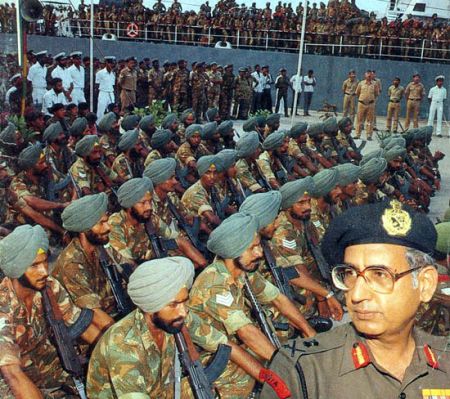
With the departure of the IPKF at the end of March 1990, the LTTE gradually took control of the North-East, which had been vacated under the terms of the Indo SL Agreement 1987 or occupied these lands illegally. They positioned their cadres in vital areas that enabled them to exert pressure on the Police who maintained law and order and on the Army who were very thinly deployed in the Northeast to counter them. In the Eastern province just one Infantry Battalion each was deployed in each of the districts of Ampara, Batticaloa and Trincomalee.

In Batticaloa district, five Army detachments were established at Wellawadi, Kiran, Kalawanchikudy, Kalmunai and Kallady. Of these detachments, Kalmunai [in the Ampara district] and Kalawanchikudy detachments belonged to 6th Battalion Sri Lanka Light Infantry (6 SLLI), which was raised in late May 1990.
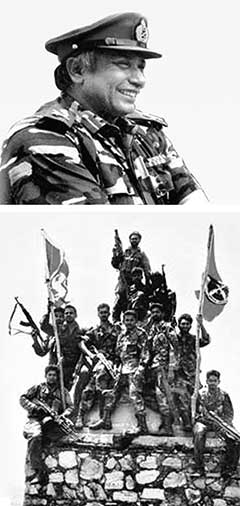
kobbakaduwa

Major General D. L. Kobbekaduwa and Troops celebrate the fall of Thoppigala

The Infantry Battalions were handicapped as they had to transfer one Rifle Company and composite platoons to the newly raised Infantry Battalions in late May 1990. The troops had to re-orientate themselves from a limited engagement environment in the South to an all out COIN [Counter Insurgency] Operations environment in the North and East.

However, 1 GW had already prepared themselves professionally and psychologically during their tenure of 10 months at Ampara. They saw the LTTE annihilate the TNA (Tamil National Army – ex-members of EPRLF/ENDLF) with the withdrawal of the IPKF. They had given refuge to about 20-30 TNA cadres who fled the LTTE attacks, into Ampara.

They were armed by the IPKF who wanted them to be their proxy, although not included in the infamous Indo – Lanka peace agreement. This is for the kind attention of the numerous Indian military experts and the more radical TNA politicians who speak about genocide.

1 GW was re-deployed in Batticaloa district on May 18, 1990. By then the situation was very tense in the Batticaloa district. The LTTE obstructed the movement of the security forces, provoked the Army and interfered with the Police in maintaining law and order. There were around 30-40 outposts with bunkers manned by 150-300 LTTE cadres in the BCO town and vicinity.

A large bunker covered the approach into the Batticaloa town under the clock tower across the lagoon facing the Police station. LTTE permission was required to visit most areas in town, where a concentration of more than 30 LTTE outposts had come up. They reserved the use of certain garages and service stations exclusively for themselves.

This situation was brought to the notice of the military higher command and the civilian bureaucracy negotiating peace with the LTTE at that time. But the Security Forces were explicitly told to co-operate with the LTTE to bring about a peaceful settlement to the conflict as the country couldn’t afford another battle with the LTTE.

The President and the civilian bureaucracy did not know the ground situation despite negotiating for peace with the LTTE, whilst the military higher command did not put across the difficulties faced by the security forces on the ground to the powers that be prior to the outbreak of hostilities, in order to continue in office.

On June 11, 1990, hostilities started in Batticaloa with the LTTE taking the Security Forces by complete surprise. The previous night a Sinhalese woman was caught by her husband when she was with a Muslim youth (an LTTE supporter) who was a tailor. The two males engaged in fisticuffs and both were brought to the BCO Police Station. The LTTE, who were looking for an opportunity to restart their campaign of violence, surrounded the Batticaloa Police Station and demanded the release of the Muslim youth.

When the Police informed them that the youth was admitted to the Batticaloa hospital, the LTTE insisted that the youth was not in the hospital and pressed their demand for his release. Later, the LTTE abducted this youth from the hospital. They then disarmed the policemen on guard, took over the Police Station with its armoury, communications, gold and money which had been kept for safe custody.

I was the Commanding Officer of 1 GW and the Coordinating Officer of the Batticaloa district, located at the Kallady Camp (approximately 2 kms away from the Batticaloa Police Station). I had been in Ampara immediately before taking up duties in Batticaloa. The Police did not inform me about the developing situation. The owner of “L H Bakery”, one of my school friends informed me by telephone at 0620 hrs, on June 11, 1990, that all the Sinhalese in the town were ordered by the LTTE to vacate within five minutes.

Since I was unaware of the prevailing situation prior to this message, I had already dispatched two of my platoons (two officers and sixty soldiers) to Ampara for their AWTC (Annual Weapon Training Classification) firing at 4.00 am that day.

At around 7.30 am, I was told a vehicle sent out from Kalawanchikudy Army camp (6 SLLI troops) had been ambushed at Kalmunai and all ten soldiers in the vehicle had been killed. Kalawanchikudy Army Camp, (to whom these soldiers belonged), had only 48 troops excluding the three officers. There was no way of moving out to Kalmunai to recover the dead of the patrol as the main road was blocked by the LTTE.

The LTTE had taken up a position by then around the Kalawanchikudy Camp and the Police Station opposite it. Having surrounded the camp and the Police Station they demanded their surrender, and also announced that they will not be harmed and will be handed over to the Sri Lankan Government at the Batticaloa airfield. Ten Sinhalese policemen escaped the deadly fate of the other policemen by jumping into to the adjoining Army Camp with their weapons and ammunition.

Captain Sarath Embowa of the 6 SLLI was the Officer Commanding the Kalawanchikudy Camp. He decided to fight the terrorists.

The LTTE who were in touch with the SLAF Batticaloa (Air Force) base informed them that if the Police surrendered without resistance, they would hand them over to the Government. The Police, who were not prepared mentally and physically, and had no confidence to fight a ruthless guerrilla organization without military (air and artillery) support, agreed to surrender to the LTTE. By this time the LTTE had surrounded most of the 13 Police Stations in Batticaloa and Ampara Districts and had captured the Policemen who surrendered with their weapons without a fight.

All of them were taken to selected locations close by, asked to dig their own graves and brutally murdered in cold blood. The tragic fate of 677 Sinhalese and Muslim policemen who surrendered should be a constant and unforgettable reminder to all concerned of the LTTE atrocities committed in this conflict. Why don’t the many local and international Human Rights activists care to investigate this cold blooded tragedy?

At 3.30 pm on June 11, Army Commander Lt. Gen. H. Wanasinghe, the Inspector General of Police, a senior officer from the Air Force and Director Operations of the Army, Brig. Vijaya Wimalaratne (late GW) arrived at Batticaloa Air Force base by air. The Senior Superintendent of Police, an ASP (living within Kallady camp) and I were heli-lifted from Kallady camp to join them for an urgent conference.

When I reached the SLAF base the policemen, their families and the Sinhala civilians had all gathered at the airport premises and were awaiting evacuation to Colombo. Getting through this crowd of emotionally devastated, highly charged, tensed and angry personnel was a trying task because the Tamil SSP was their target. He followed immediately behind me. Fortunately no untoward incident took place.

We had our meeting and returned to Kallady camp. The possibilities of reinforcing the Police stations were discussed. At that moment there was no way of reinforcing the police stations as the Army too were very thin on ground. The army camps too were in great danger due to them being under strength and, deployed far apart lacking mutual support. No artillery was available in Batticaloa district and the only available Bell 212 helicopter was not fitted with guns. (To fit the guns it would have taken between one to two hours).

An extremely dangerous situation existed. Our lack of preparation and abject appeasement of the LTTE could have led to the total loss of the East. On returning to camp from the Sri Lanka Air Force (SLAF) base at Batticaloa around 6.00 pm on June 11, 1990, the LTTE contacted me at Kallady and told me to inform Kiran (Kumburumulla) camp to surrender in five minutes and if it was disregarded, they were going to launch an all out attack on the camp. The LTTE had started their attack on Kiran and Wellawadi at 4.30 pm. In order to buy more time and avoid being found fault with for starting the war, I said that I would inform them of instructions after contacting the President.

I then contacted my Brigade Commander in Ampara, who responded evasively. I then contacted the 2 Division Commander Major General J. R. S. De Silva at Anuradhapura. He insisted that the Army should fight to the last man and the last round and that the entire country was depending on our performance in Batticaloa. I requested him for immediate assistance to evacuate the camps at Wellawadi and Kalmunai since they had only depleted platoons in each of them.

Meanwhile, all the four camps in the Batticaloa district and Kalmunai Camp in the Ampara district were under prolonged and severe attack. Wellawadi camp was established to provide protection to the Sinhala fishing community (about 200 fishermen, women and children) who had been living there for generations. 2/Lt RMCC Ranaweera GW (who left the Army the next year in 1991) and 22 men fought for more than 36 hours supported by two 81mm Mortars (from Kiran detachment) against more than 300-400 LTTE cadres throughout the night with 90 rounds of ammunition (first line scale).

The troops were able to protect the fisher families and evacuate them by sea with the assistance of the Sri Lanka Navy, in a gunboat commanded by Cdr Thisara Samarasinghe [Admiral and ex Navy Commander] on June 12, 1990. It must be mentioned that there was not a single civilian conflict related casualty in the entire evacuation at Wellawadi except for a mother and a child who drowned while boarding the naval craft.

The troops were provided ammunition from Kallady, which was delivered by helicopter, before they withdrew in a Navy gunboat. This took them to Trincomalee and safety. They suffered only one minor injury to a soldier due to LTTE fire, during the entire 36 hour crisis.

The situation at Kalmunai too was similar; the platoon under 2/Lt KASH Karunatillake SLLI was under tremendous pressure as intense fire was brought down on them by the LTTE. However on June 13, 1990 the Navy under the command of Cdr. Daya Dharmapriya [retired Rear Admiral] in his gunboat and support vessels, evacuated them after an agonizing battle whilst being supported by artillery fire from the Malwatte Army camp. However, the SLLI suffered several casualties as the evacuation was done whilst in contact with the LTTE.

The LTTE unleashed salvos of mortar, small arms and 84 mm rocket launcher fire at the Kiran Camp. The Officer Commanding the camp, Captain Sumith Perera GW and his second in command Lieutenant Chinthaka Munasinghe GW (both officers were killed in action in subsequent operations conducted against the LTTE in Jaffna in 1995 and Mannar in 1991, respectively) with their men valiantly held the camp against all odds. The only surviving officer was 2/Lt Suminda Jayasundera GW (now a retired Lt. Col. domiciled in Australia) who was a Young Officer (YO) with less than one year’s service with the Battalion at the time.

The LTTE even used chlorine gas against the troops in Kiran on June 13, 1990. It must also be mentioned that Pte Dharmasiri K.A., the radio operator of ‘A’ Company 1 GW maintained communication with Battalion Headquarters (HQ) at Kallady and rear HQ at Diyatalawa throughout the entire period during day and night.

When the antenna was damaged due to intense mortar fire, he fixed it at night by climbing a Palmyra tree. On the night of June 11, the Air Force helicopter fitted with machine guns became airborne to provide close air support. It should be noted here that the services provided by Flying Officer Thilana Kaluarachchi. (This officer was later killed when a missile hit the MI 24 he was flying in over Kokilai Lagoon in 1997).

He relentlessly and gallantly flew the entire night and continued every night until the detachment was relieved. He gave much needed air support, which kept the LTTE at bay and was a tremendous morale booster to the besieged troops. The ground to air communications was closely coordinated through Cpl. Gamini GW of 1 GW stationed at the SLAF base at BCO, during this period.

On June 16, 1990, during the battle, a cease-fire was requested by the LTTE through the Bishop of Batticaloa for both sides could attend to their respective casualties. However, the LTTE leaders refused to disarm and stay put in the SLAF base in Batticaloa, but wanted to accompany the Bishop to Kiran with me or my representative. I refused to their terms which were clearly to take us hostage and over-power the detachment by holding us at gunpoint.

The LTTE stooped to such cunning low levels and proved their perfidy, deceit and treachery throughout the conflict. They continued to bombard the troops psychologically by making announcements through a loud hailer asking the troops repeatedly to give up and surrender without fighting a losing battle. Troops returned fire and fought steadfastly and resolutely, to deny the LTTE any opportunity to break into the camp.

Troops in all camps lived on liquids, raw papaws, Palmyra fruits and the odd animal that strayed during the siege. They were collected during the night or when there was a lull in the fighting. Since the well, which supplied fresh water to the Kiran camp was exposed to LTTE fire, troops tunneled into it at night to get drinking water for their survival. Troops in Kiran survived for seven nights in trenches, clad only in one uniform throughout the regular attacks by the LTTE.

The alertness of the sentry at night enabled him to wipe out an entire group of nine LTTE guerrillas crawling into the camp by cutting the perimeter wire fence. Only one soldier was killed in action throughout the eight days of fighting. However, one officer and 60 soldiers of the 3×79 personnel in the camp suffered injuries and evacuated when reinforcements arrived.

The BBC correspondent refused to believe our casualties, as the surrounding area of the camp was littered with dead and decomposed LTTE bodies (over 100) due to the continuous fighting of almost seven days.

A rescue operation was finally launched under the command of GOC 1 Division Major General Denzil L. Kobbekaduwa. Before the rescue, he spoke to me over the radio on June 15, 1990. The voice of the GOC was a great morale-booster to me as we were all desperate about our survival. Until then the response from the military higher command was negative at best and very little encouragement was given to continue fighting.

The reinforcement operations were launched from the North of Batticaloa to relieve the Kiran Camp. 3 Brigade Group was commanded by Brigadier A. M. U. Seneviratne [retired Major General and Chief of Staff]. Fourth Battalion the Gemunu Watch and the Fifth Battalion the Vijayabahu Infantry Regiment had to fight their way and reached Batticaloa by June 19. Similarly, 1 Brigade Group commanded by Brigadier A. K. Jayawardhana [retired Major General and a one time Secretary of Defence] with First Sinha Regiment and First Special Forces Regiment fought their way from Ampara across country through Wellaveli to relieve Kalwanchikudy detachment in the South of Batticaloa. Both Brigade groups reached their objectives on June 18 despite heavy resistance from the LTTE.

The success of the 1 GW troops in the defence of their camps in the Batticaloa district was due to their courage, regimental espirit de corps, comradeship, belief in their leadership and their steely determination to survive amidst the death and wounding of their colleagues, along with the ensuing confusion and chaos of battle.

The effort taken to send the remains (cremated at night with the help of Palmyra branches amidst LTTE small arms fire) of the dead soldier [Sergeant Karunadasa E.A.D.] at Kiran to his next-of-kin was appreciated by his parents and was a great morale booster to the rest of the troops.

It must be reminded that soldiers fight for their survival first, then for their comrades, Regiment, the Army and the country, in that order of priority. Let the courageous stand taken by all those valiant and gallant men of Gemunu in BCO in June 1990 in general, and especially Kiran in particular, be a defining and bold moment and tradition for all those who have served, continue to serve and are to serve in the Gemunu Watch to follow. This tradition must be upheld with pride.

The Sri Lankan Armed Forces defeated the ruthless LTTE terrorists on May 19, 2009 and restored Sri Lanka’s territorial integrity and sovereignty after more than 27 years of bitter fighting. May we continue to maintain the hard won peace and democracy whilst remembering all those who sacrificed their today for our tomorrow.

POST SCRIPT

It is 25 years since the series of unfortunate events took place. As I pen these few lines as a tribute to all those gallant warriors of our country, I also pay my humble respects to all those fallen heroes in this terrible conflict.

However if we are to benefit from the experience, it is important that the lessons learnt are not forgotten or swept under the carpet. I request the President that action be initiated and a study made of our past, before embarking on the future national security policy which should be based on these and similar experiences.

Firstly, ensure we have a granite stone marker as a grim reminder, at the locations in Kiran, Wellawadi, Kallady, Kalwanchikudy and Kalmunai to honor those who sacrificed their lives for our motherland and for future generations so that their efforts would not be in vain.

We must make similar markers at all such locations so that history will not be erased by unpatriotic elements for their own convenience and hidden agendas.

When you analyze the reasons for this brutal conflict to take 30 years or more, we must note that a few individuals by lack of knowledge or arrogance of power or both, made serious mistakes that have gone unpunished. The late President Premadasa gave arms, ammunition, equipment and money to the LTTE in the name of peace and to counter the IPKF arming the TNA, and as a result, had to sacrifice his own life.

However, the more serious impact was on us and he is not here anymore to take the blame. He was not advised by his two top most military advisors, the Secretary Defence and the GOC Joint Operations Command who happened to be both 4 star Generals.

We also had similar Service Commanders who said we could never defeat the LTTE but who now spend their retirement as 4 star Generals. There were others who made big money from this conflict. Then there were those who sat in Colombo and earned promotions for their political affiliations. A few more who betrayed our forces by providing vital information to the LTTE for money and other lucrative perks continue to enjoy the freedom we and many other warriors fought for, by placing our lives on the line.

There were the two political Generals, one who professed that terror should be met with terror, resulting in a few officers and men who followed those illegal orders being put behind bars for their illegal deeds in Embilipitiya. Those who stood up to him were sent on compulsory retirement without their pensions. The other used soldiers for his personal security at the election campaign in Udathalawinna.

Unfortunately those soldiers who provided protection are still in prison for carrying out illegal orders without being visited by anybody other than their next-of-kin. We now have local and international human rights activists who talk about the Geneva Convention, the Law of War, Rules of Engagement, and Rules for Behaviour in Action.

The 677 policemen asked to surrender by the then government must be turning in their graves since it had taken 25 years now without an inquiry, not even a marker at their shallow graves they were forced to dig, before being killed in cold blood. Don’t they have human rights?

The casualty state is horrendous. From 1981 to the end of the conflict in May 2009, the Army lost 23,403 Killed in Action [KIA] and Missing in Action [MIA] which is 85% of the total 27,613 KIA/MIA in the conflict. The Navy lost 1,163 or 4.2% of the total KIA/MIA, the Air Force lost 426 which is 1.5% of the total KIA/MIA, and the Police lost 2,621 personnel which is 9.5% of the total KIA/MIA.

The Police lost 677 alone in BCO in 1990 after surrendering to the ruthless LTTE terrorists which is almost 26% of their total KIA/MIA. The Infantry comprising the Sri Lanka Light Infantry, Sinha Regiment, Gemunu Watch, Gajaba Regiment and the Vijayabahu Infantry Regiment had lost a total number of 18,461 KIA or MIA which is 79% of the total Army fatalities. When the total KIA/MIA of the Commandos, Special Forces and Sri Lanka National Guard is included, it rises by 10% to 89% of total Army KIA/MIA. This is the reality of the conflict and of those gallant troops who have suffered the most in this brutal conflict.

It is similar with the permanently disabled, the Wounded In Action [WIA], the many silent warriors suffering with PTSD [Post Trauma Stress Disorder], the many war widows, children without their fathers and mothers who were KIA and the pain of mind of the parents, family members and loved ones. The list is endless.

Therefore, it is important that we remember the gallant war heroes who sacrificed their lives for our tomorrow and respect with gratitude all those who have served, are serving and are to serve in the Armed Forces of our country. This is my humble tribute to all these honourable countrymen and women, for your silent but patriotic endeavours in the defence of our beloved motherland.

May you be blessed and protected by the gods and the devas to eternity. Words cannot replace or express your greatest sacrifice of protecting our motherland from the scourge of terrorism

I firstly pay tribute to the late General Denzil Kobbekaduwa, the most charismatic battle-field commander we had because he always understood the heartbeat of the soldier and put his life on the line to safeguard their interests before his own comfort at all times. The late Maj. Gen. Vijay Wimalaratne, my guru as an officer cadet and OC [Officer Commanding] Bravo company as a subaltern, who in my opinion was the most brilliant field commander we had because he knew the terrain we fought on, his adversary’s modus operandi, and above all knew and understood his men, always leading from the front.

His creation, the Gajaba Regiment will always bear testimony to his great qualities of inspired leadership and dedicated service to the Corps, Army and Country. We must also remember with eternal gratitude all those numerous war heroes who sacrificed their lives in the defence of our motherland during the past 67 years of our independence.

මෛත්‍රී-රනිල් දෙදෙනාටම ඕන වුණේ මාව පරදවන්න ඒත් දෙදෙනාට එකට රට කරන්න බැහැ – මහින්ද අකුරැස්‌සේ දී කියයි

December 28th, 2015

සමන් උපුල් පිනිදිය උපුටා ගැන්ම දිවයින

මෛත්‍රීපාල සිරිසේන රනිල් වික්‍රමසිංහ යන නායකයන් දෙදෙනාගේ අදහස්‌ හා සිතුම් පැතුම් පරස්‌පර බවත් ඔවුන් දෙදෙනාටම අවශ්‍ය වී තිබුණේ තමාව පරාජය කිරීමට බවත් හිටපු ජනාධිපති කුරුණෑගල දිස්‌ත්‍රික්‌ එක්‌සත් ජනතා නිදහස්‌ සන්ධාන පාර්ලිsමේන්තු මන්ත්‍රී මහින්ද රාජපක්‌ෂ මහතා පැවැසීය.

පසුගිය 27 වැනිදා අකුරැස්‌ස ප්‍රදේශයේ ඇඟලුම් කම්හලක්‌ විවෘත කිරීමේ

උත්සවයකදී මේ බව සඳහන් කළ රාජපක්‌ෂ මහතා තවදුරටත් මෙසේද කීය.

ශ්‍රී ලංකා නිදහස්‌ පක්‌ෂය කියන්නේ අපේ පක්‌ෂයක්‌. ඒක කාටවත් දෙන්න බෑ. මම හැමදාම කියනව වගේ නායකයන් දෙන්නෙකුට රට කරන්න බෑ. එක්‌කෝ මෛත්‍රීපාල සිරිසේන මහත්තයා රට කරන්න ඕනෑ. එක්‌කෝ රනිල් වික්‍රමසිංහ මහත්තයා රට කරන්න ඕනෑ.

දෙන්නෙක්‌ දෙපැත්තට අදින කොට ආණ්‌ඩුවක්‌ කරන්න රටක්‌ පාලනය කරන්න අමාරුයි. දෙන්නගෙ සිතුම් පැතුම් වෙනස්‌. මතවාද වෙනස්‌. එක මතයකට එන්න අමාරුයි. ඔවුන්ට ඕන වුණේ මාව පරාජය කරන්න විතරයි. අනිත් හැම එකම වෙනස්‌. මාව පරාජය කිරීම තමයි ඒ අය එකම සාධකය කරගෙන ඉන්නේ. මේ විදියට රටක්‌ කරන්න බැහැ.

නව දේශපාලන බලවේගයක් බිහිවෙනවා.. එය කිසිවෙකුට වළක්වන්න බෑ.. – මහින්ද

December 28th, 2015

BBC

එවැනි කණ්ඩායම් එකතු වී ශක්තිමත් විපක්ෂයක් බිහි කිරීම හැම දෙනාගේම වගකීමක් වී ඇති බව හිටපු ජනාධිපතිවරයා කියා සිටියි.

‘මේ යන රටාව අනුව අපට කියන්න බෑ අලුත් දේශපාලන පක්ෂ බිහි නොවේවි කියලා. පක්ෂවලින් මිනිස්සු එලෙව්වොත් ඒ මිනිස්සුන්ට යන්න තැනක් තියෙන්න ඕන. ශක්තිමත් විපක්ෂයක් හැදීමේ වගකීම හැමෝටම තියනවා’ මහින්ද රාජපක්ෂ හිටපු ජනාධිපතිවරයා අවධාරණය කරයි.

ඌරුබොක්ක, හොරගස්මණ්ඩිය ප්‍රදේශයෙහි ශ්‍රී ලංකා නිදහස් පක්ෂ කාර්යාලයක් විවෘත කිරීමෙන් පසු මාධ්‍යවේදීන් ඇසූ පැනයකට පිළිතුරු දෙමින් හිටපු ජනාධිපතිවරයා ඉහත කී ප්‍රකාශය කළේය.

පාර්ලිමේන්තුවේ විපක්ෂ මන්ත්‍රීවරු පිරිසක් ආණ්ඩුවට එකතු වී ඇමතිකම් ගැනීමට ඇති සුදානමක් ගැන තමන් නොදන්නා බව කී හිටපු ජනාධිපතිවරයා දෙමළ සංධානය රජයට සහාය දෙනවාදැයි විමසිය යුතු බව සඳහන් කළේය.

ශ්‍රී ලංකා නිදහස් පක්ෂය පාවා දුන් අය අද දේශපාලනයේ සිටියත් පක්ෂය පාවා නොදුන් එකම තැනැත්තා තමන් බව මහින්ද රාජපක්ෂ හිටපු ජනාධිපතිවරයා පවසයි.

https://youtu.be/pgQ3YRn_9q8

‘‘ශ්‍රී ලංකා නිදහස් පක්ෂය මගේ පක්ෂය. මම විතරයි ශ්‍රී ලංකා නිදහස් පක්ෂය දාලා ගියේ නැත්තේ. පක්ෂය එක්සත් ජාතික පක්ෂයට පාවා දුන්නේ නැත්තේ මම විතරයි. දැන් දේශපාලනේ ඉන්න බොහෝ දෙනා පක්ෂය පාවා දුන්නා. මම පාවා දුන්නෙත් නෑ. පාවා දෙන්නෙත් නෑ’ හිටපු ජනාධිපතිවරයා කියා සිටියි.

දැන් විපක්ෂයත් එක්ක ආණ්ඩුව ගෙන යන බව කී හිටපු ජනාධිපතිවරයා ශක්තිමත් විපක්ෂයක් නැති වූ විට ආණ්ඩු අයාලේ යන බව පවසයි.

‘මේ ආණ්ඩුවට හරි මග පෙන්වන්න ශක්තිමත් විපක්ෂයක් තියෙන්න ඕනෑ. ශක්තිමත් විපක්ෂයක් නැතුව රජයක් ගෙන ගියොත් ඒ රජය අයාලේ යනවා. ඒක තමයි මේ අයවැයෙන් පෙන්නුම් කෙරුණේ’ එබැවින් ශක්තිමත් විපක්ෂයක් හැදීමේ වගකීම හැමෝටම ඇති බව හිටපු ජනාධිපති වත්මන් කුරුණෑගල දිස්ත්‍රික් පාර්ලිමේන්තු මන්ත්‍රීවරයා අවධාරණයෙන් කියා සිටියේය.

පක්ෂ වලින් මන්ත්‍රීවරුන් පන්නා දැමුව හොත් ඔවුන් එකතු වී නව දේශපාලන පක්ෂයක් බිහි කිරීම කිසිවෙකුටත් වළක්වනු නොහැකි වනු ඇතැයි හිටපු ජනාධිපති මහින්ද රාජපක්ෂ පවසයි.

Poor Sirisena is only a gullible sucker caught by perpetrators of con tricks Ranil and Chandrika.

December 28th, 2015

By Charles.S.Perera

Ranil, Chandrika and the West  played a confidence trick on Sirisena.  Chandrtika knew Sirisena as  an easy bait  who could be made to dance to her tune.  She  gave him few lessons on back stabbing and Sirisena fell to the proposed plan like a gullible sucker. Ranil, Chndrika, Rajitha, Mangala knew that Sirisena was the ideal man who will swallow their bait to present himself as the President of Sri Lanka, when he was hardly able to speak up, as he said, for his rights under  the President Mahinda Rajapakse.

In addition the tricksters  were planning to remove the executive power of the president, and knew by doing that  they could relegate Maithripala to a corner while Ranil  and Chandrika with their Western masters would be able to do as they want without having to bother about a nominal President a  gullible sucker who will be happy smiling, shaking hands and making speeches.

Ranil is already experienced in that type of work, having been the Prime Miister under Chandrika. He did not care two hoots for President Chandrika, and Ranil the Prime Minister  took over Presidential powers, signing  the CFA with Prabhakaran dooming Sri Lanka to almost never ending terrorism, and going to the Whitehouse to meet George Bush.

Since he became the President Sirisena- the sucker  has done next to nothing other than assisting Prime Minister Ranil Wickramasinghe to take revenge on the former President Rajapakse to  fulfil Ranil’s desire to keep the field free from Rajapakse’s to assure his Presidential ambition in 2020.

What has this sucker President Sirsena done  so far.  He cannot do any thing on his own as he is strictly under the control of Ranil and Chandrika.  To begin with he appointed his guarding angel Ranil, the Prime Minister. Sirisena helped Ra     nil to  dismiss the Chief Justice  Mohan Pieris, re appoint Shirani Bandaranaike as the Chief Justice, and  make her resign from the Office, to appoint K.Sripavan a Tamil for the purpose of reconciliation with the LTTE Tamil diaspora, but not with the Tamils in Sri Lanka.

The realisation of USA and Western Agenda in Sri Lanka depends  on to the extent they please the Tamil Diaspora  Therefore, Ranil and Chandrika made Sirisena take all those actions completely in breach of the Constitution of Sri Lanka to please the USA and the West.  As much as Ranil and Chandrika are grateful to USA and the West in giving them a hand for the regime change in Sri Lana, the sucker Sirisena is grateful to Ranil and Chandrika for making a President out of him.

Ranil Wickramasinghe is a law unto himself and knows that the USA and the West is with him and treats Sirisena as a dumbo.  Sirisena  makes speeches and promises things and Ranil and his UNP cabinet turns their backs to him and do what they think is right.  What part did Sirisena play in the recent Budget of Ravi Karunanayake ?  Sirisena had no say in it ? Even if he had Ranil would not have listened to him.  Sirisena if he has any plan , he would like to implement, he has he has no one in the Parliament to give him a hand.

But it was Ranil who kept changing the Budget Presented by Ravi Karunanayake until it became unrecognisable even by the Finance Minister himself. Now Ranil and Chandrika are trying to find ways out to fix the balance of payment,  even if it were to  sell out  Sri Lanka to USA and the West.

By the way what was the mid term plan of Ranil Wickramasinghe ?

Sirisena had no hand in its preparation, and the report was one Ranil had prepared in 2002.  There is nothing new or innovative in it, other than make Sri Lanka dependent  to USA and the West.

After the Bond Scam Sirisena asked Ranil Wickramasinghe to remove the governor of the Bank- Arjuna Mahendran , and Ranil turned him a deaf ear and the Governor of the Central bank remains the same swindler that he was.  He- the Governor of the Central Bank now invites Saudi Arabia to set up an oil refinery, hope it is not another stunt of his to swindle additional bakshis from Saudi Arabia..

Sri Lanka has been turned topsy-turvy by Ranil and his UNP goons in Parliament.  Sirisena himself had no hand in it, as Ranil and Chandrika would not share their political secrets with Sirisena, because they too do not have confidence in Sirisena. The sucker he is, Sirisena, cannot imagine what has happened to him.

He is always packed out of the country to attend world conferences abroad, where he has not contributed any thing for the world to take notice.  He was not anywhere near the Western leaders at the Conferences who make their own group whether at the CHOGM in Malta or at the World Climate change Conference in France.  In the group photographs taken Sirisena is seen with the African leaders far away from the USA and Western leaders who take the Centre stage.

The representatives of USA and  the West just shake hands and make a passing word of flattery which keeps Sirisena happy and satisfied.  He comes backs to Sri Lanka after the conferences to find that Ravi Karunanayake  with the support of Ranil Wickramasinghe has taken steps to sell the country to the foreign investors.

UN Personnel and USA  Agents make themselves quite at home examining the Naval Camps and preparing the handing over of the North and East  for a Tamil administration.   Sirisena has already become a dummy. He is happy  because ignorance is bliss when he does not know what exactly is going on behind his back.

Latest information that Sirisena is perhaps unaware,  is what was discussed at a recent meeting Ranil is said to have had with Chandrika some where in London.  They are said to have discussed Sirisena the President without executive powers and what the devolution packet to the Tamils in the north is going to be.

President Sirisena when he left SLFP having back stabbed his leader, to make his  midnight flight to the bossom of Chandrika and Ranil to be their common Presidential Candidate,  to make his escape reasonable in the eyes of the public came out with the story that if he were to loose  the Presidential election he and his family would be six feet underground in a secret cemetery.  With  that he made the people understand the  criminal tendency of the Rajapakse regime. Some of the people may have believed , as Maithripala was for 47 years in the SLFP along with Mahinda Rajapakse

However a majority of the people would  not have believed that as Mahinda Rajapakse had no criminal  disposition.  On the other hand he stopped terrorism and underworld Criminality at least to a certain extent. There were no scandals and commission like those of Batalanda torture camps against Rajapakses’  The White Van culture was a hoax of the UNP to discredit the Armed Forces and the Defence Secretary of Sri Lanka.  If there was one it was not sponsored by the Rajapakse Regime but it was and is still being used by the UNP and anti Mahibda Rajapakse elements to project an Image of Rajapakse Government to please the west.  JVP who are well known for their Stalinist criminal beginning,  white wash themselves with such stories against the government of Mahinda Rajapakse. The people would not believe JVP as they were with Mahind Rajapakse at the beginning, and left thinking that they had gained enough popularity to get peoples’ votes to form a government of their own.

Sirisena is often packed off to make his speeches at international forums.  His first speech at the UNO was a very sad drill of trying to give the world an insight into Buddhist teachings as a means to achieve peace in a world in the throes of  human conflict. It had certainly  been written by a Christian.  It does not even speak of the  teachings of the Buddha, but about  Buddhist ethos:

As we learn from the Buddhist ethos prevalent in Sri Lanka, I recognize there are three kinds of human conflicts.The first is the conflict between the human being and nature. We are constantly engaged in this conflict in order to enjoy material comforts in life.  As a result, modern human beings seek to exploit natural resources extensively in the name of development. The second is the conflict between ‘human’ and ‘human’. Such conflicts occur among individuals, among communities and among nations. The Universal Declaration of Human Rights affirms that such conflicts occur when human rights are not protected by rule of law.

The third is the conflict within the human being The two kinds of conflict I mentioned earlier occur when we lose the battle within us as human beings. Therefore, this is the root cause of all conflicts ”

Sirisena may not have  listened to Dhamma as he should have, because he had a mind   scheming and planning for his own egoist political ambition of cutting the throat of  his  leader to take his place.  He once said that, when he is at home he is distressed  he does not know  what to do,  and stay thinking lying in his bed for hours .  His wife and children came to him and said, papa do not  worry what ever you do we will stand by you.”

However, his Christmas greetings sound hollow, Christmas symbolizes the birth of Jesus Christ who assumed a powerful voice, teaching us lessons of kindness and charity that have lasted for more than 2000 years. The Christian message of humanity, love to all beings and humility is seen in the birth of Christ taking place in a stable shared by animals and his first worshipers being humble shepherds.”

For Sirisena , The philosophy of the Prophet Muhammad is an example not only for the Islamic devotees, but also for the entire nation.”  How much of it does Sirisena really know ?  Apparently  from what he had done to completely upset a smoothly working development process in Sri Lanka , he seems to have not grasped the fundamentals of Buddhist philosophy

He makes speeches  and says what he wants to do but, it is not he who decides  it is Ranil and Chandrika who finally take decisions.  Sirisena said nothing directly on the very controversial budget presented by Ranil and Ravi Karunanayake.  But he grunted in places that, .. he would not allow foreign companies to enter into Gem Mining industry in Sri Lanka.”  Sirisena proposes but Ranil and Chandrika dispose.

President Sirisena, who helps Ranil and Chandrika to sell Sri Lanka to foreign interests has said ,  … without abusing the freedom of expression provided to talk in Parliament and through media today, they should use it to promote peace, harmony and reconciliation by shunning petty party politics. They should rally around to work towards progress and eradication of poverty and to ensure that there would not be another war in this country.”

Sirisena has probably not heard what the opposition to UNP and Yahapalanaya is  speaking out using at least the freedom to talk freely in parliament.

Sirisena speaking to the Scouts had said, …how discipline learned as a scout during his school days has helped him to carry out the responsibilities as Sri Lanka’s President.”

One can now understand how his discipline has still not risen above what it was when he was a scout. First when he joined the enemies of his political party,  and then acting in  breach of  the Constitution on Several occasions after he became the President, he broke the first duty of a scout, duty to God and country.  In  writing a  letter to Mahinda Rajapaksa to say that even if he were to win the election he would not be made the Prime Minister, he broke the second duty of a Scout – the duty to other people. Duty to self the third duty of a Scout is for him not to do what he professed others not to do, which Sirisena broke openly in taking his son to UN, allowing his daughter to represent him at state functions, and promoting nepotism.

Sirisena who played all tricks he could think of to  keep Mahinda Rajapakse away from politics, behaving in a very distasteful manner a President should not have behaved, now says in an interview to Sunday Lanka Deepa, I will not retire from politics. Politicians cannot retire from their social engagements. It is true that the Executive Presidency will be abolished. We will make strong and comprehensive measures in that direction. But that does not mean that I will retire from politics after abolition of Executive Presidency .”

This is probably some thing prompted to him by Ranil-Chandrika duo.  By doing that they can keep Mahinda Rajapakse from being a probable Prime Minister, or it may be Sirisena’s fear that he will be put six feet under ground in an unknown place.

What a hypocrite is Maithripala Sirisena ?  People should not give him even a vote at any future election.

Another one of his proposals is to stop concerts where Sri Lankan culture and morals are destroyed by foreign artistes..  In the mean time Maithripala Sirisena has managed to stop the Finance Minister Ravi Karunanayake of money laundering fame, from making another scandalous deal, A Cabinet Paper forwarded by Minister of Finance, Ravi Karunanayake, seeking Cabinet approval to compensate an individual, paying Rs 300 million from government coffers was put on hold by President Maithripala Sirisena during the Cabinet meeting on Wednesday (23), December, 2015.”

In the mean  time the Tamils  racist politicians in the North praise President Maithripala Sirisena, …. Recently, the Chairman of the Northern Provincial Council praised President Maithripala Sirisena and expressed his gratitude on behalf of the Northern Provincial Council, for lashing out at the racist views from the South and expressing his desire towards expediting the resettlement process in the Northern Province.”  He has switched the racial views, allowing the Tamil politicians of the North call the Sinhala south the racists.

Ranil and Chandrika have squeezed away from Maithripala Sirisena all the powers of  a real President, and soon he will be reduced to a decoration pushed into a corner, with Ranil  his UNP goons and Chandrika taking the centre stage. The slithery eel Nimal Sirispala de Silva is now making noises to attract the attention of Ranil and Chandrika.

It is the story of the Fox and the Crow: A fox was walking through the forest when he saw a crow sitting on a tree branch with a fine piece of cheese in her beak. The fox wanted the cheese and……..

Beat Cost of living during the Festive Season

December 28th, 2015

Sarath Wijesinghe- former Chairman Consumer Affairs Authority, former Ambassador to UAE and Israel-

Consumer

Festive season has emerged and the citizen is testing the buying power in purchasing the consumer items for festive season. Consumer is any actual or potential user of any goods or services made available for a consideration by any trader or manufacturer. (s75 of the consumer affairs Authority Act) This shows that every citizen is a consumer and need protection from the state to protect the consumer against unfair trade, hazardous to life and property of consumers, adequate access to gods, and seek redress against unfair trade practices. (s 7 of the Act no of 2003)

Is Consumer the King – and Powerful

In theory yes. But in practice it may not be so, especially in Sri Lanka where the consumer is not organized as in other parts of the world. Consumer day falls on 15th March and the world Consumer Federation has started the agitation throughout the world claiming the legitimate share for the consumer as Kennedy’s statement in 1983 that – the consumer includes us all – the largest economic group affecting and affected by almost all public and private economic decision yet they are the only important group whose views are often not heard”. In other parts of the world consumer is restricted from becoming unfair by the government as well as strong lobbing of the powerful organizations in maintaining the quality, standards, price and consumer rights of return goods, and maintain standards by the trade, manufacturer and the trader. Sri Lanka is full of adulterated and poisonous food and other consumer goods, unhealthy food chains and goods adulterated and downgraded with no restrictive conditions. Unhealthy food chains are thriving and there is no proper control of the quality and price of the consumer items expected to be monitored by the main regulate Consumer Affairs Authority.

Powers of the Consumer Affairs Authority as the Main Regulator

It is established in place of Fair Trading Consumer Act no 1 of 1987 and price control act 1 of 1987 for promotion of effective competition and protection of the consumer with a blend of UK, Australian and West modelled concepts creating a main regulator to regulate trade under s 9 of the act, which has power to undertake studies, issue directions, restrict selling above market price, determining standards, inquire complaints, enter into agreements, deal with offences such as refusal to sell, hoarding goods, investigations publication, prevent misleading , deceptive conduct and many more powers and expectations. Due to the abolition of the price control under the price control act, the new concept of price making was introduces where every trade is expected to exhibit the price mark and maintain standards of the items. (S29) It is left to the consumer to judge the effectiveness of the enforcement mechanism in maintaining the price and the standards of the consumer items. Is the CAA competent to beat the cost of living or it is teeth less organization is a matter the citizen will be deciding based on the performances of the organization.

Beat Cost of Living

Cost of living is a relative term depends on the conditions, environments, and jurisdictions. Rarely the prices of consumer articles are receded, but the salary and income increases from time to time. Price of rice or bread is not static, but consumer is ready to adopt the price fluctuations. In the west a major portion of the salary or income is utilized for accommodation when the food items are generally affordable, which is not the case in Sri Lanka. In the UK one could have a comfortable living with the minimum wages and in addition government subsidiary where necessary. In Sri Lanka though salary and income is less for many – traditional food items such as Jak, leaves, and village grown items (available in Polas” – street markets in towns too) assist consumer to make ends meet comfortably. If the consumer is sharp and careful it is easy to beat cost of living provided the cost of mobile phone, tuition and extravagance is restricted. In short one should know (a) when to buy (b) where to buy, (c) how to buy and (c) what to buy. In England the apple at Selfridges- the most expensive food chain could be purchased at the street market near the store for a lesser price. In Sri Lanka street markets are plenty and food can be carefully purchased and s stored to be used later. Consumers make the biggest blunder by eating out in food chains with unhealthy oily food and Colas inviting long term diseases. Consumer should be trained for healthy food at identified outlets. It is an exercise one should practice.

Complains to public bodies and to be organized is your civic duty

Ideally CAA is expected to entertain complaints on the phone, via net and all over the country. This extends to all consumer items and to services as well. In other parts of the world the consumer is so well organized that the Trader is under pressure and control of the consumer. Media plays a vital role in this matter. In the UK when Cola company used the water from Thames river it is the media that came forward as in the Bopal case in India to teach unfair trade practices of multinational companies. In Sri Lanka CAA is expected to organize a consumer federation to assist the consumer. it is the duty of the NGOs to take the mantel forward without wasting time for Human rights situations in Sri Lanka which maintains highest stander ands. It is time for the citizen to organize themselves to beat the cost of living and to organize the life leading a careful systemic planned organized life with other fellow citizens.

Careful during the festive season

It is illegal to perform bogus Sales and overprice the consumer items especially during festive season. Consumer have no right to demand price reductions. but they have the right to purchase quality and healthy goods. Citizen may complaint to 1919 service, CAA and the board of Standers for quality and price of consumer items. A joint exercise should be launched by the CAA organizing the trader, manufacturer, industrialist and the citizen to work together is a competitive but a friendly environment to beat the cost of living and for quality and health consumer items at a reasonable price.

Way Forward


It is the right of the citizen and duty of the state to ensure the consumer should be able purchase quality items at a reasonable price, and it is his/her duty to look for healthy food in the interest of the citizen. United Nations too have recognized the right to satisfaction and ensure on basic needs, safety, information, chance to be heard, redress, consumer education and healthy environment as a right and a requirement to be facilitated for the consumer/citizen by the state. It is the duty and a statutory requirement of the main regulator CAA to organize consumer organizations and to work on a joint project with the consumer, state, trader, manufacturer and the citizen for a fair and reasonable system of trade and business for a better life for the consumer. Consumer should be vigilant and smart, the trader should be fair and reasonable and the state should be efficient for a better day for the consumer/citizen.

Vida articles by Sarath Wijesinghe –(1) Sri Lanka Guardian on world consumer day on 19/01.2014, (2) Sunday Business times- Lead a simple life to beat cost of living 25/03/2012- (3) Rice price and cost of living on 20/04/2008 -Observer- (4) measure to bring does cost of living observer 15th July 2007

Sarath7@hotmail.co.uk

PROF.LAKSHMAN S. PERERA

December 28th, 2015

By Dr. Tilak S. Fernando

On 19 December2015, Professor Lakshman S. Perera’s second daughter, Kanthi Rupasinhge conveyed to me in an email with unfathomable emotions the sad news about the passing away of her father in London on 17th December. She simply wrote: As you had written about him in so much depth and warmth, I thought will convey this to you before the Death Notice is out. I learnt much about my father from you”.

Prof. Lakshman S. Perera

A few years ago I came to know Prof. Lakshman S. Perera in London. Subsequently, we remained close friends over the years. Prof. Perera took an immense interest in Sinhala culture and the language from the time he was an undergraduate at Peradeniya University. He identified the Sinhala language as being influenced by the original language of the pre-Aryan population of Ceylon (Veddas).

The teaching of Sinhala language in London dated back to the beginning of the 20th Century at SOAS (School of Oriental and African Studies) of the London University. When in 1986 university grants cut backs began to have an effect on teaching of Sinhala at the SOAS, Prof. Lakshman Perera, as a consultant, spearheaded a campaign against such a programme; set up an ad hoc committee and made representations to the Sri Lanka Government, through the University Grants Commission. That helped to convince the late President R. Premadasa to continue with the teaching of Sinhala by retaining a lecturer out of the Sri Lankan Government funds. This helped to continue with the teaching of Sinhala at the SOAS.

Lakshman S. Perera always had a dream from the time he obtained his honours degree (London External) in history, especially after he won the Hilda Obeysekera Fellowship to do research on Institutions of Ancient Ceylon from inscriptions.

Initially it proved to be hard when he had to learn the Brahmi script, in order to read inscriptions written in ancient Sinhala and Pali languages during the Colonial rule. When he became enthusiastic to arrange all published and unpublished inscriptions in chronological order to publish them in volumes, the response he received was negative. All profit-orientated publishers in Sri Lanka simply turned it down!

More and more refutation he faced, greater and greater he became tenacious to get his dream fulfilled. With each passing day his thesis was gathering dust at the Peradeniya University, while a generation of historians used it as reference material until many pages were reduced to shreds. Subsequently, it took him six years to get his thesis published, which ran into over a 1,000 pages.

During his retirement in London, Professor Perera approached the International Centre for Ethnic Studies in Kandy. Its Executive Director, Prof. K.M. de Silva and Prof. Srima Kiribamune, Senior Research Fellow, identified it as a first degree study on vitally important aspects of the history of Sri Lanka and took a decision to publish his works into volumes.

The laborious task of updating the references used in the text, after 50 years, and typing of 1,500 crumbling and discoloured pages, that could not be scanned, were successfully completed and Volume 1: The Institutions of Ancient Ceylon from Inscriptions, containing 322 pages from 3rd Century BC to 830 AD bound in hard cover, published by the International Centre for Ethnic Studies, Kandy, was released to the public in July 2001 at the Jayewardene Centre, Colombo.

It authenticated even in minute detail stories of the Mahavamsa, which had been condemned by some as myth and legend. Inscriptions identified outstanding rulers like Devanampiyatissa, Vattagamini and Dutthagami along with the latter warriors such as Senapati Nandimitta accurately.

One of the major controversial issues that popped up in recent the history of Ceylon was the Vallipuram Gold Plate in the Vadamarachchi Division of Jaffna Peninsula, beneath the foundation of an ancient structure on land that belonged to the Vishnu Temple, discovered in 1936.

Prof. Perera managed to exhibit the gradual process of centralisation of majestic power with the Maharaja at Anuradhapura, and the Rajas in the periphery, superseded by provincial administrators. The inscription recorded that in the region of Maharaja Vasaba (67-111 AD), Ameti Isigiriya was Governor of Nakadiva of Nagadipa, as Jaffna was then known. Prof. Perera concluded that sovereign power had extended to the Jaffna Peninsula, which made it a province under the Maharaja of Anuradhapura.

Volume II-Part I, described political institutions from 831 to 1016, that too was published by the International Centre for Ethnic Studies, Kandy in 2003 and, Volume II-Part II, Economic and Religious Institutions came out in 2005.

During his academic career, Prof. Lakshman S. Perera became the Administrative Head of four sub-departments in the Second Faculty of Arts in Colombo. In 1952,when the Faculty of Arts was shifted to the new campus in Peradeniya, he became the Professor of History of the Colombo Campus and later was elected to the office of the Dean of the Faculty of Social Sciences where he served as a member of the Editorial Board of the Revised University History of Ceylon and the Ceylon Journal of Historical and Social Studies.

In 1973, the Ministry of Foreign Affairs recommended him to the Department of Education at the Commonwealth Secretariat in London as a Senior Consultant on Universities and Higher Education where he continued in this position until 1983. Even after his retirement from the University, he has been serving as a member of the Executive Committee of the Council for Education in the Commonwealth. On 15 August 1998, Professor Lakshman Susantha Perera was decorated at the convocation held at the Bandaranaike Memorial International Conference Hall in Colombo,

Born with Bodhi Sathva qualities, Prof. Lakshman S. Perera’s yearning was always to help others, which meant that the problem of others became part of his own glitches. He always helped anyone who sought his advice seeking no rewards or publicity; neither did he pursue appreciation or praise and appeared always as a simple and an unassuming individual who always treated the other person as a human being.

May he attain the Supreme Bliss of Nibbana!

tilakfernando@gmail.com

ps: The funeral will take place on the 7th of January 2016 in London .It will be a cremation and the Ashes will  be later interred at the family grave at a later date. TSF

Enrique Iglesias: Sri Lanka’s president says gig organisers ‘should be whipped’

December 27th, 2015

Courtesy Independent (UK)

President Maithripala Sirisena said women running on stage to kiss the singer and throwing their underwear at him was ‘most uncivilised’

Sri Lanka’s president says the organisers of an Enrique Iglesias gig should be whipped, as punishment over the behaviour of some female fans.

President Maithripala Sirisena said local women running on stage to kiss the singer and throwing their underwear at him during a concert in Colombo on 20 December was “most uncivilised”.

“This is most uncivilised behaviour that goes against our culture,” President Sirisena told a public meeting.

“I don’t advocate that these uncivilised women who removed their brassieres should be beaten with toxic stingray tails, but those who organised such an event should be.”

Whipping with “toxic stingray tails” refers to an ancient punishment reserved for hardened criminals in medieval Sri Lanka.

Public displays of affection are frowned upon in conservative Sri Lankan society.

Police are known to have arrested couples for kissing in public parks.

The concert was part of the Latin pop star’s Love and Sex world tour.

Sri Lankan president: Organisers of Enrique Iglesias gig ‘should be whipped’

December 27th, 2015

By  Courtesy Telegraph

Women throwing their underwear at the Hero singer is “most uncivilised” behaviour, Maithripala Sirisena says

The Sri Lankan president has called for the organisers of an Enrique Iglesias concert to be whipped after the “most uncivilised” behaviour from female fans.

Maithripala Sirisena said the organisers should be punished after women threw their underwear at the singer in Colombo and he claimed some ran towards the stage to kiss the Hero singer.

The singer was performing at a rugby stadium in the capital on December 20 during his ‘Love and Sex’ world tour.

The president described how the punishment should be being “whipped with toxic stingray tails”, an ancient punishment, the BBC reported. The punishment apparently was used for criminals in medieval Sri Lanka.

“This is most uncivilised behaviour that goes against our culture,” Mr Sirisena said at a public meeting.

“I don’t advocate that these uncivilised women who removed their brassieres should be beaten with toxic stingray tails, but those who organised such an event should be.”

In conservative Sri Lankan society, public displays of affection are not culturally acceptable, even for those couples who are married.

As well as the behaviour of women at the concert, the president criticised the price of the tickets, believed to have been between 5,000 rupees (£23) and 50,000 rupees.

The gig’s organisers have yet to comment on the president’s remarks.

Rajapaksa Camp To Launch ‘Our Sri Lanka Freedom Front’ Ahead Of LG Elections

December 27th, 2015

Courtesy Asian Mirror

The ‘Joint Opposition’ which supports former President Mahinda Rajapaksa, has planned to launch a new political front to contest the upcoming Local Government Elections, political sources said.

Accordingly, the ‘Joint Opposition’ has planned to launch a front named “Ape Sri Lanka Peramuna” or Our Sri Lanka Front, to contest the election.

Several political parties including the National Freedom Front, Mahajana Eksath Peramuna, Pivithuru Hela Urumaya and Left Democratic Front are expected to join in forming this new alliance along with the Sri Lanka Freedom Party Rajapaksa camp.

The Rajapaksa camp had been in discussions on the possibility of launching a new front to contest the local elections. Udaya Gammanpila and Vasudva Nanayakkara were among those who had been publicly declaring the possibility of contesting separately from the UPFA.

Meanwhile, President Maithripala Sirisena decided to postpone the LG Elections by six months. Sources said that the President had taken this decision as the SLFP was yet to find a solution to its internal power struggle. Meanwhile, according to some SLFP Ministers in government, the ‘Joint Opposition is on the verge of a split. Minister S.B. Dissanayake recently claimed that 15 MPs were ready to join the government.

Is Hirunika following her father’s footsteps?”

December 27th, 2015

Courtesy The Daily Mirror

Nava Sama Samaja Party Leader Vickramabahu Karunaratne yesterday raised doubts whether MP Hirunika Premachandra followed the footsteps of her father who he identified as a hoodlum in Kolonnawa, as she attempted to resolve disputes among mobs.

He mentioned that late Bharatha Lakshman Premachandra was a reputed hoodlum who settled disputes among people in Kolonnawa.

It looks like the daughter has taken up the same task of solving people’s issues,” he said.

Commenting on the recent incident where a man was allegedly abducted by six supporters of Ms. Premachandra, he said no one could take the law into their own hands.

Prof. Karunaratne, a key activist of President Maithripala Sirisena’s election campaign, pointed out that it was solely the police who had the authority to take action against illegal activities. We wonder if this government is too practicing the previous government’s habit of abducting people. We have a police department to deal with crimes, and today the department is more independent than what it was in the past,” he told a news conference. – See more at: http://www.dailymirror.lk/100721/is-hirunika-following-her-father-s-footsteps#sthash.dycPNsuO.dpuf

කක්කුස්සිකාරයෝ

December 27th, 2015

වෛද්‍ය රුවන් එම් ජයතුංග

 කක්කුස්සිකාරයෝ හෙවත් අන්ටචබල්ස්ලාද මිනිසුන්‍ ය​. ලංකාවේ රෝහල් වල මා දුටු දෙයක් නම් කක්කුස්සිකාරයෝ හෙවත් වැසිකිලි සුද්ධ කරන්නවුන් සහ දොස්තරලා අතර මහා පරතරයක් තිබෙන බවයි. සමහර දොස්තරලා වැසිකිලි සුද්ධ කරන්නවුන් වාට්ටු හරහා ගියද ඔවුන්ව නොදකිති. හෙදියන් සහ ඇටෙන්ඩන්වරුන් නිතරම ඔවුනට බැණ වදිති. ඔවුන්ද හිස් පහත් කරගෙන වැසිකිලි ශුද්ද කොට නිහඞව යති. 
 කළුබෝවිල රෝහලේ වාට්ටු වැසිකිළි ශුද්ද කිරීම සඳහා කෙට්ටු පුද්ගලයෙක් විය​. ඔහු ගිණි වතුර කෑන් එකක් රැගෙන එයි. ඉන්පසු ඉදළකින් වැසිකිළි ශුද්ද කර දමයි. ඔහු  වැසිකිළි ශුද්ද කර ගිය මොහොතේ පටන් යළිත් රෝගිහු වැසිකිළි ජරා කරති. 
මාතලේ රෝහලේ මේ කහළ වැඩය කලේ පළනී නම් දෙමල මිනිසෙකි. ඔහු රෝහලේ ලේ සැරව ගෑවුනු රෙදි හෝදා  අමතර ආදායමක්ද ලැබුවේය​. ඔහු මේ රෙදි හේදුවේ ලොකු යකඩ බැරල් එකකය​. මෙම යකඩ බැරල් එකට දර හිස් සේලයින් බෝතල දමා  හවසට ගිණි ගහයි. එවිට පරිසරය දුමින් පිරී යයි. අපගේ වෛද්‍ය නේවාසිකාගාරය තිබුනේ  පළනීගේ වෙල්ලහැළිය ආසන්නයේය​.  පළනීගේ දුමේ ප්ලාස්ටික් විශ කාරකයන් තිබුනද ඉන් මදුරුවන් පළා ගිය හෙයින් කිසිවෙකු  පළනීගේ වෙල්ලහැළිය ගැන පැමිණිලි කලේ නැත​. 
වරක්  පළනී අසනීප වූ නිසාදෝ වැසිකිලි පවිත්‍ර කිරීමේ කාර්‍යය ඇණ හිටුනේය​. වාට්ටු නරකාදි මෙන් දිස් වූයේය​මේ හේතුවෙන්  පළනීගේ රැකියාවේ වැදගත්කම කාටත් අවබෝධ විය​.එම නිසා සෞඛ්‍ය අධ්‍යාපන පංතියකදී වරක් රෝහලේ වැගත්ම පුද්ගලයා කවරෙක්ද කියා විශේසඥ ප්‍රජා වෛද්‍යවරියක් මගෙන් ඇසුවාය​. ඇය මගෙන් අපේක්‍ෂා කලේ රෝහලේ වැගත්ම පුද්ගලයා රෝගියා යන පිළිතුරයි. නමුත් මම කීවේ රෝහලේ වැගත්ම පුද්ගලයා කක්කුස්සි හෝදන්නා බවයි. එයට හේතුවද මම කීවෙමි. වෛද්‍ය අධ්‍යක්‍ෂක නොමැති විට විශේසඥ වෛද්‍යවරයෙකුට අධ්‍යක්‍ෂක ගේ වැඩ ආවරණය කළ හැකිය​. විශේසඥ වෛද්‍යවරයා නොමැති විට ජ්‍යෙෂ්ඨ වෛද්‍ය නිලධාරීට වැඩ ආවරණය කළ හැකිය . වෛද්‍යවරයා නොමැති විට හෙදියට වාට්ටුව බලා ගත හැක​. නමුත් කක්කුස්සිකරු නොමැති විට ඔහුගේ වැඩ ආවරණය කිරීමට කෙනෙකු නැත​. එම නිසා රෝහල කඩා වැටෙයි. 
කොලොන්ගොඩ ග්‍රාමීය රෝහලේ වැසිකිලි පවිත්‍ර කලේ විජේකෝන් බණ්ඩා නම් පුද්ගලයෙකි. ඔහුගේ ගම අඹගහපැලැස්ස වූවද අඹගහපැලැස්ස රෝහලට හූවක දුරක ඔහුගේ නිවස තිබුනද ඔහු සැතපුම් හතලිහකටත් වඩා දුරින් පිහිටි කොලොන්ගොඩ ග්‍රාමීය රෝහලේ සේවය සඳහා පැමිණියේ ගමේ රෝහලේ වැඩ කිරීම නිසා පාසලේදී තමන් ගේ දරුවන් නින්දාවට ලක් වෙන නිසා කියමිනි. රෝහලේ සුද්ධ පවිත්‍ර කිරීම් කරන ඔහු රාත්‍රියට මදුරුවන් පිරි බාහිර රෝගී අංශයේ බංකුවක් මත නිදයි. 
ඒ කාලයේ මම කොලොන්ගොඩ ග්‍රාමීය රෝහලේ ස්ථාන  භාර වෛද්‍යවරයා විය​. දිනකට පැය හතරකට සීමාවූ අතිකාල දීමනා සහිතව මගේ වැටුව රුපියල් 20,000 ආසන්න විය​. නමුත් විජේකෝන් බණ්ඩාගේ වැටුප රුපියල් 1800 කි. මේ නිසා මට යම් වරදකාරී හැඟීමක් ද ඇති විය​. නව වාරයක් පටන් ගන්නා විට මම විජේකෝන් බණ්ඩාගේ දරුවන්ට පොත් පත් රැගෙන දුනිමි. නමුත් පසු කාලයක මට පෙනී ගියේ විජේකෝන් බණ්ඩාට ලොකු අහේනියක් නොමැති බවයි. අඹගහපැලැස්සේ ඔහුට තමන් ගේ ඉඩමක නිවසක් තිබුණි. එම ඉඩමේ පොල් එළවළු වගා කොට තිබුණි. කුඹුරෙන් හාල් ලැබුනේය​. රැකියාව ඔහුට අතිරේක ආදායම් මාර්ගයක් මෙන්ම විශ්‍රාම වැටුප මහළු කාලයේ ආරක්‍ෂණයක් විය​. 
මීගමුව රෝහලේ වාට්ටු වැසිකිළි ශුද්ද කිරීම සඳහා  කිහිප දෙනෙකු සිටි අතර ඔවුන් ප්‍රදේශයේ දේශපාලකයාගේ හෙන්චයියන් වූ හෙයින් ඔවුන් බීඩි බිබී රෝහලේ මුල්ලක වාඩිවී  වල්පල් කතා කරමින් සිටියහ​. මේ නිසා වැසිකිළි ශුද්ද කරන ලද්දේ අනියම් කම්කරුවන් දෙතුන් දෙනෙකි. මතු දින රැකියාව ස්ථිර කරනු ඇතැයි සිතාගෙන ඔවුන් වෙහෙසී වැසිකිලි ශුද්ද කලද රෝගීන් කොරිඩෝ‍රවලද ජරා කල නිසා ඔවුන් ගේ වෑයම සඑල වූයේ නැත​. 
යුද හමුදා රෝහලේදී  රාත්‍රී වැඩමුරය  කල දිනයක  මම අපගේ වාට්ටුවට පැමිනෙන කොල්ලෙකු අතට මුදල් දී යුද හමුදා කැන්ටිමෙන් මාළු පාන් හෝ රෝල්ස් දෙක තුනක් ගෙන එන ලෙස කීවෙමි. එහෙත් වාට්ටුවේ සිටි සාජන් මේජර් කොල්ලාගේ අතින් මුදල් ගෙන ඔහු කැන්ටිමට ගොස් මගේ උදෑසන ආහාරය ගෙන ආවේය​. පසුව  සාජන් මේජර්  මට පැවසුවේ කොල්ලා වාට්ටුවේ කක්කුස්සි සුද්ධ කරන්නා බවයි. එය ඇසූ පසු මගේ මුවට සිනහවක් ආවේය​. එහෙත් වාට්ටුවේ කක්කුස්සි සුද්ධ කරන කොල්ලාට සිනහවකින් සංග්‍රහ කිරීමට මම අමතක නොකලෙමි. 
 කැනඩාවේ යෝක් විශ්ව විද්‍යාලයේ වැසිකිලි ශුද්ද කරන්නා ශ්‍රී ලංකාවේ ද්‍රවිඩයෙකි. ඔහු මා දුටු මුල් දිනයේදී මම සිංහලයෙකු ලෙස හැඳිනගෙන මා දෙස නොබලාම ගියේය​.   වරක් ඔහු වැසිකිලිය ශුද්ද කිරීමෙන් පසු මම වැසිකිලියට ගියෙමි. ඒ යන අතරතුර වැසිකිලිය ශුද්ද කිරීම ගැන මම ඔහුට ස්තූති කලෙමි.  ඔහු හිස් සැලීමෙන් ඒ ස්තූතිය පිළිගත්තේය​. 
කක්කුස්සිකාරයෝත්  මිනිසුන්‍ ය​. ඔවුනටද බඩගින්න සංතාපය වේදනාව දැනේ. 
වෛද්‍ය රුවන් එම් ජයතුංග

Bipanchika, Anubhawar Shabdajyoti released at press club

December 27th, 2015

Nava Thakuria

Bipanchika, Anubhawar Shabdajyoti released at press club By Our Correspondent
Guwahati: The third annual issue of Bipanchika, published by Karmabir Nabin Chandra Bardoloi Puthibharal Paduoi Samaj, was released at Guwahati Press Club on Sunday. The same meeting also witnessed the release of Anubhawar Shabdajyoti, a collection of Assamese poems penned by Lambit Barua and published by Kohima Sahitya Sabha from Nagaland.
Inaugurating the annual magazine Bipanchika, director of Assam Library Services, Uttam Sharma appreciated the effort of the readers attached to Karmabir Nabin Chandra Bardoloi Puthibharal for their continuous effort to bring out an annual publication comprising articles from different sections of the society.

Uttam Sarma (4th R), Director of library service  and Naba Thakuria (2nd R), Secretary Guwahati Press Club releasing two books titled “Bipanchika” an annual magazine of Karmabir Nabin Chandra Bordoloi Puthibharal Padhuri Samaj and “Anubhawar Sabdajyoti” collection of a few Assamese poems written by Lambit Baruah respectively during a function organized by Karmabir Nabin Chandra Bordoloi Puthibharal Padhuri Samaj, at Guwahati Press Club on Sunday.

Uttam Sarma (4th R), Director of library service and Naba Thakuria (2nd R), Secretary Guwahati Press Club releasing two books titled “Bipanchika” an annual magazine of Karmabir Nabin Chandra Bordoloi Puthibharal Padhuri Samaj and “Anubhawar Sabdajyoti” collection of a few Assamese poems written by Lambit Baruah respectively during a function organized by Karmabir Nabin Chandra Bordoloi Puthibharal Padhuri Samaj, at Guwahati Press Club on Sunday.

On the other hand releasing Anubhawar Shabdajyoti, journalist Nava Thakuria expressed hope that the initiative of Kohima Sahitya Sabha will enrich the Assamese literary world in a different way.  He also pointed out that Assamese writers based in northeast India should also initiate to publicize their creations through digital medium as well.
Various speakers including senior librarian Rabindranath Pathak, Kohima Sahitya Sabha president Prahlad Sonowal, poet Lambit Barua, artist Debananda Ulup, Atul Bharali, Rabin Baruah, Hiramoni Pathak, Sewali Kalita, Nabajyoti Sikder, Runumi Bhattacharya, Runu Goswami, Meghali Das, Chandan Das, Radhika Sonowal, Amiya Sonowal, Jayanta Sarkar, Baishali Sharma etc also highlighted the need of regular interactions among various sections in Assamese society.


Massacre of the innocents: Isil are today’s King Herods say Archbishops

December 27th, 2015

By , Religious Affairs Editor Courtesy The Telegraph

Jihadists driven by vision of ‘apocalypse’ warns Welby in stark Christmas message

Britain’s two most senior clerics have drawn on the darker side of the nativity story in hard-hitting Christmas sermons warning of the possible elimination” of Christianity from the region of its birth.

The Archbishop of Canterbury, the Most Rev Justin Welby, and Cardinal Vincent Nichols, the leader of the Roman Catholic Church in England and Wales, both draw comparisons between the Biblical account of the mass murder of children around Bethlehem on the orders of King Herod and the 21st Century Jihadist threat.

In his Christmas morning sermon at Canterbury Cathedral, Archbishop Welby is expected to warn that that the so-called Islamic State group – also known as Isil, Isis or Daesh – wants to bring apocalypse” to the Middle East and beyond, driven by an obsessive belief that they are living in the last days”.

Meanwhile Cardinal Nichols, the Archbishop of Westminster, also used his Christmas address to speak of the surge in murder driven by faith, something he condemned as abhorrent”.

Islamic State fighter on the march in Raqqa

In a homily during Christmas midnight mass at Westminster Cathedral he also alluded to Herod’s massacre of the innocents and described Christians being murdered by Islamist extremists as martyrs.

“Today’s Herods, Isis and the like around the world in so many faiths, propose false apocalypses.”
Archbishop Justin Welby

He described the idea of violence in the name of God” as a corruption of true faith”.

The two impassioned messages come at the end of a year marked by slaughter and mass-displacement of religious minorities including Shia Muslims, Yazidis or Christians across Syria, Iraq, Libya and elsewhere in the Middle East.

Both clerics have publicly urged the Government to open the UK to significantly more refugees fleeing the region – pointedly likening the experience of those crossing the Mediterranean to Mary, Joseph and the Baby Jesus escaping into Egypt to avoid the wrath of Herod.

• Egyptian Christians wait for news of loved ones kidnapped by Isil

Speaking last week at an event hosted by Cardinal Nichols, the Prince of Wales also warned of the risk of Christianity being effectively wiped out in Iraq – once a centre of Christian scholarship – within five years.

Coptic Christian men whose relatives were abducted in Libya hold their photos in front of the foreign ministry in Cairo, Egypt  Photo: Hassan Ammar/AP

In his sermon Archbishop Welby is expected to describe Isil as a Herod of today”.

Using the word apocalypse” in the original Greek meaning – as an unveiling or revelation – he contrasts the message of hope summed up by the angels announcing the birth of Jesus with the deadly vision put forward by Jihadists and other religious extremists.

Today, across the Middle East, close to the area in which the angels announced God’s apocalypse, Isis and others claim that this is the time of an apocalypse – an unveiling created of their own terrible ideas, one which is igniting a trail of fear, violence, hatred and determined oppression.

Confident that these are the last days, using force and indescribable cruelty, they seem to welcome all opposition, certain that the warfare unleashed confirms that these are indeed the end times.

They hate difference, whether it is Muslims who think differently, Yazidis or Christians, and because of them the Christians face elimination in the very region in which Christian faith began.

This apocalypse is defined by themselves and heralded only by the angel of death.”

Isil video showing the aftermath of the murder of Coptic Christians  Photo: Universal News and Sport

Drawing a comparison with the Biblical account of the nativity, he continues: Herod too gets this apocalypse.

He senses that this tiny, helpless, vulnerable, utterly normal child is the ultimate threat to his power and authority.”

He will add: Force meets love, and love has to flee into Egypt and returns to ordinary life and eventually to a cross and an empty tomb, conquering the world.

At Christmas we are confronted with God’s form of power, which judges all our forms of power.

To all who have been or are being dehumanised by the tyranny and cruelty of a Herod or an Isis, a Herod of today, God’s judgement comes as good news, because it promises justice.”

“Violence in the name of God is abhorrent – it is always a corruption of true faith.”
Cardinal Vincent Nichols

Contrasting how, in the gospel accounts, the shepherds set out to worship the baby Jesus but Herod wanted to kill him, the Archbishop will add: Today’s Herods, Isis and the like around the world in so many faiths, propose false apocalypses.

But you and I are called to respond in worship and transforming, world-changing obedience, both as individuals, and together, to this revelation of the baby that defines God, for it is our response to Jesus that defines us.”

Speaking at midnight mass, Cardinal Nichols said the image of a baby was the antithesis of the violent message preached by religious extremists.

As this child is God in our flesh, then violence has no place at all in his presence,” he said.

Even more emphatically, it means that any claim to justify such violence in the name of God is abhorrent – it is always a corruption of true faith.”

Urging Catholics to pray for victims of religiously-motivated violence, he said: We pray especially for our Christian brothers and sisters who suffer grievously for their faith in Jesus as their Lord, losing life and belongings, suffering torture and unspeakable cruelty for his sake.

As we pray for their courage, we remember that Boxing Day is the Feast of St Stephen – the first Martyr – and that on 28th December we celebrate the Feast of the Holy Innocents, the children slaughtered out of hatred and fear of Jesus.”

Jaffna – an arid land without heroes -Part III

December 26th, 2015

H. L. D. Mahindapala

The first shot in the North-South war , a.k.a. Eelam War, rang out on July 27, (Friday), 1975. Its  vibrations shook the foundations of the sleepy villages and towns of Jaffna. It was never going to be the same again in Jaffna. The shock waves shook Jaffna not because the shot was fired at Ponnalai Varadraja Perumal Temple, Jaffna in a time  of peace. It was because of the political implications of killing   an unarmed pilgrim visiting  the temple. Fired at point blank range it killed Alfred Duraiyappah, the mild mannered Mayor of Jaffna,  who was alighting from his car for his usual Friday prayers. As the subsequent events confirmed, it signalled the end of an era and the beginning of uncertainty, fear and ominous times to come.

The sound of the first shot continues to echo even today because it was also the first shot fired by Velupillai Prabhakaran. He had just turned 21 then. His first shot removed any inhibitions he had about  killing human beings. From then onwards his career rose to dizzy heights not only because of  his own ability to kill but also because of  his ability to get others to kill on his behalf. As his confidence in killing grew he aspired to be his celluloid hero Clint Eastwood – the Hollywood idol who fixed everything with his gun. He turned his killing others and others dying for him into a cult. Jaffna took to the cult of death like duck to water and it was never the same again.

The killing  of Alfred Duraiyappah marks the beginning of the North-South war. It was the very the first shot in Prabhakaran’s war against the rest which he waged for 33 years. He emerged as the Thalaivar (the leader), leaving behind the other rival militants, purely on his ruthless capacity to kill. He had no qualms in  eliminating any other Tamil rival as long as it helped to make him  the sole representative of the Tamils”.  Eventually, he wiped out  the Tamil leadership that passed the Vadukoddai Resolution (May 14, 1976) that empowered him  with the gun. He also emerged at the propitious time when the Jaffna elite had legitimised violence and urged the youth to take up arms to wage a war which the ageing Tamil leadership could not undertake. He was the first born child of the Vadukoddai Resolution that legitimised violence to achieve Eelam. Armed with the licence given to him by the Vadukoddai Resolution he went on a spree of killing until it came to a stop at Nandikadal.

Not surprisingly, the last shots of the war also were fired by Prabhakaran when his bodyguards targeted the Tamil civilians fleeing from his Pol Potist gulag into the welcoming arms of the Security Forces. Those last shots were fired to kill the Tamils and protect Prabhakaran who needed the Tamils to shield him from the advancing Security Forces. Prabhakaran’s last shots targeting  his own people blasted the myth of the Tamils who believed that the people were behind their Surya Devan”. The Thalaivar who offered the cyanide pill as the sacrificial symbol of his new religion was now shooting the Tamils for not swallowing  the cyanide pills as a show of solidarity with his cause. Tamils fleeing from him was the  last blow to his ego. He and the Tamil Diaspora couldn’t accept that the Tamils preferred the Security forces of the enemy” to the liberations forces” of the Tamil killer squads. It was a desperate time when the Tamils had no hero to turn to. They ran into the arms of the demonised Sinhala forces who gave them food, shelter, medicine and, above all, peace which their hero could not deliver.

In between the very first shot and the last shots Prabhakaran never ceased killing unarmed Tamil civilians. S. C. Chandrahasan, the son of the father of Tamil separatism, S. J. V. Chelvanayakam, and V. Anandasangaree, head of the Tamil United Liberation Front (TULF), are on record saying that Prabhakaran killed more Tamils than all the other forces put together. He began his political career by killing Tamils and also ended it by not only killing his own people who shielded him but also humiliating them by misleading them into a war that ended in total defeat.

The Tamils who were pushed into an inescapable corner by the mono-ethnic extremism of  the Vadukoddai Resolution had no alternative but to go along with Prabhakaran. Political events cast upon him  the burden of carrying the Vadukoddai Resolution to a conclusion. The Tamils were stuck with him though the cruelties of Prabhakaran left the Tamils in a political and moral vacuum. But Prabhakaran was their last hope to achieve what was promised in the Vadukoddai Resolution. The politics and morality of the Tamils were tied to Prabhakaran. Whatever he did was right and whatever that was done against him was wrong. And when they lost him they found themselves in no-man’s land.

The dominant image of Prabhakaran in Tamil politics point directly to the tragedy, and also the obscenity, facing Tamils : they do not have in their history an inspiring or moral leader to hero-worship other than Prabhakaran. Oddly enough, he is a hero to the Tamils not because he won anything for them. They  gave everything they had to him and  he failed to deliver. But he is a hero because there isn’t a single other leader who had led the  Tamils into battle against a demonised enemy” on the scale launched by Prabhakaran and held on for so long. He was the lever with which the Tamils were hoping to manipulate the international community. He was the bargaining chip and when he went even the crafty NGO bluestocking, Radhika Coomaraswamy, was emotionally disturbed, fearing that everything she had fought for was lost. She  reacted aggressively castigating Dayan Jayatilleka for his speech at the UNHRC which overturned the anti-Sri Lankan resolution sponsored by the Europeans.

The Tamil elite was secretly glorying in Prabhakaran’s victories which they thought brought them some dignity at  home and recognition in the international community. But it was tinsel glory. He was fighting a war which he could not win, despite his initial successes. No one had spilt so much Tamil blood for so long and achieved nothing.  In the end, when he was on the run, he revealed his  true colours : he was not fighting for the Tamils, he was fighting for his own survival using the Tamils as a shield to protect him and  his family. His initial idealism had evaporated and the new realities told him that he  had to fight for his survival which he equated with the survival of the Tamils. But the Tamils have proved that they could achieve better things by running away from him in search of better worlds than staying with him.

His unrelenting commitment to kill was his strength and weakness. Killing was to him what a hit” was to a drug addict : he got a kick out  of it and he could not survive without it. Adulation and  hero-worship distorted  his power to think, if he  had any such powers at all. He expected the Tamils to fall at this feet, as their saviour, and follow him to the bitter end. It was when the Tamil refused to go along with him all the way that he fired his last shots at the Tamils deserting him. He was the kind of hero who demanded total obedience, particularly when it came to sacrificing their lives. His heroism depended  on other Tamils sacrificing  their lives for him. He expected to brain-wash other people’s children to die for him while keeping his own kids safely at home, or swimming in his pool in the heart of the dry zone. He dragged the Tamils along  with him, at gun point, to keep them as a human shield to protect him. And when the Tamils abandoned him, and voted with their feet to live in a better world, he shot the fleeing Tamils. How great is this Tamil hero who reached the  peak of his power by standing on a mountain of Tamil corpses?

However, the fact that he used the Tamils to glorify  his  own ends on the promise of delivering a goal which he could never achieve is not an issue that concerns his blind followers. Like the shaven-headed Neo-Nazis the cult followers are eager to overlook the failures of the most cruel and ruthless grave-digger, widow-maker and child-abuser produced by the Tamils to bury the Tamils in mass graves. In a perverse way the Tamils embrace his cult of death when they follow his bullet-brandishing flag, or commemorate his birthday. Unwittingly, they are thirsting for his cult of death. When they embrace Prabhakaran they deny life and all the goodness that life has to offer.

This signifies, firstly, the aridity and the hollowness of the history of Jaffna. They have yet to produce a man with dignity and humane values as their hero. Secondly, it points to the hidden layers of the pitiless fascist culture inherent in peninsular politics. Jaffna has been unhappy because it had no hero. It is also unhappy now because it’s hero is the biggest killer of Tamils. The Tamils who claim to have settled down in Sri Lanka even before the Sinhalese stepped in have nothing to show at the end of their journey other than Prabhakaran and his flag which, incidentally, was drawn by a street artist in Chennai. It was a cheap product both in costs and design. Prabhakaran  is said to have paid the S. Indian artist a pittance. And the over-all design of the flag had come from Prabhakaran who was impressed with the MGM lion snarling from a ring. He substituted the Chola tiger for the Hollywood lion and ringed the beast’s head with thirty-three bullets against a background of two crossed guns fixed with bayonets.

Since the flag is the highest symbol of a community/nation, representing its values and culture, the LTTE flag should be taken as a reflection of the Tamil culture and the values coming from  the depths of the Tamil mind contained in the cranium of of the greatest Tamil hero, Prabhakaran. In  contextualising the flag, it can be argued that Prabhakaran and his flag  reflect each other’s subhuman beastliness unerringly. It is a flag without a single redeeming feature. There isn’t a single symbol in it that represents humane values affirming its faith in peace, co-existence in a multi-cultural world and an inspiring / uplifting culture. No Tamil has  so far rejected this flag as being repugnant to the Tamil culture. They seem to be eager to go along with it, waving it from London to Melbourne, and from Toronto to Timbuctoo.

When a community embraces the symbols of its unrelenting and ruthless persecutor, torturer and killer what does it say of its culture? Doesn’t the symbiotic relationship between the Tamils’ greatest hero and the community means that they both share the same values? Isn’t one the reflection of the other? Consequently, isn’t it logical that the pathological killer of Tamils should chose the Chola Tiger ringed by thirty-three bullets and two bayoneted guns to represent the Tamils and their culture? It can be argued that the symbols in Prabhakaran’s flag represent the Chola warrior cult. Well, if Prabhakaran is the representative of that cult does it mean that the mission of the warrior cult of the Cholas is to eliminate Tamils from the earth? Or that the Tamils have been put on earth to shield Prabhakaran and his  family? Doesn’t the Tamil flag and the Tamil Thalaivar, when put together, expose the inherent evil characteristics of the bloody Tamil culture of Jaffna?

Prabhakaran’s rise, growth and death came out of the womb of Jaffna which was historically ruled by a fascist culture of varying  shades. In broad terms, Jaffna was ruled by three sets of local rulers in their brief history, leaving aside the colonial masters. They were (1) the Sankili type of tyrant who marched down to Mannar in 1544 and massacred Catholics for swearing allegiance to the Portuguese kings instead of him; (2) the Vellahla subalterns to colonial masters who ruled Jaffna with a caste”-iron fist and, (3) the worst of all, Prabhakaran, the ruthless killer of Tamil dissidents and his rivals, imitating Sankili’s political culture of killing all those who do not swear allegiance to him. All three aimed  to rule the territory as the sole representative of the Tamils” – a cult that resisted and  eliminated, by force if  necessary, all rivals. This cult had strong  fascist strands which held Jaffna in thrall. In the hands of Prabhakaran the cult of the sole representative of the Tamils” reached it ruthless extremity. He pursued it to the bitter end applying efficiently the  Chinese axiom that there can’t be two tigers hunting in the same mountain.

It was after President Mahinda Rajapakse liberated the Tamils from the fascist grip of Prabhakaran that the Tamils found the opportunity to taste democratic freedoms as never before. They were given the freedom to elect their own representatives without bending into two before fascists to get nomination. They were given the right to vote without fear of their hands beings cut for doing so.  Their fear of sending their children to school not knowing whether they would be abducted by Tamil Boko Harams was removed for good. They were able to receive food and other essentials from the Sinhala government” without substantial quantities being being siphoned off to fatten the fascist rulers and their cadres. They can crack jokes against Mahinda Rajapakse and Ranil Wickrermesinghe, or even criticise them without the fear of being hung on the lamp posts of Jaffna. They can owe allegiance to V. Rudrakumaran, the fake Prime Minister in New York, who can’t eve issue a visa to go the toilet, without fear of being massacred by a latter-day Sankili.

Above all, the right of Tamils to run their  region by elected Tamil representatives was realised for the first time in their history when President Mahinda Rajapakse held elections in the liberated Northern  Province. The Tamil representatives of Northern Province made history when they became the first elected rulers of their own territory. History will record that it  is the Sinhala forces that liberated Jaffna for democracy to flourish by dismantling the fascist rule that oppressed the Tamils from the time they established their settlement in the 12th century.  And  it must be emphasized that democracy is guaranteed in the NP Council only if the centre retains the power to maintain democratic institutions without the provinces being hijacked by future Prabhakarans.

Today a Sinhala government”, as they are never tired of saying,  has appointed a Tamil to lead the opposition. M. Sampanthan can hold his head high with dignity and be proud that a Tamil is officially leading the opposition to a Sinhala government”. Could he have, as a Tamil, led the opposition to the Thalaiavir of his Tamil government in the Vanni? Could he even have swim in Prabhakaran’s swimming pool? What is the dignity and honour he had when he had to go bending in two to get nomination and votes from a podian like Prabhakaran simply because  he wields a gun? Could V. Wigneswaran have given a judgment that went against his revered leader, if he was a judge in Prabhakaran’s kangaroo courts? So in what democratic space did the Tamils ever find their dignity, freedom, honour and respect?

President Maithripala Sirisena is in command of a force far greater than Prabhakaran ever had. But the Tamils have the freedom to oppose him without those guns being trained on them to make them obey his politics. The TULF leader Ananadasangaree once complained that when Mrs. Bandaranaike went to open the Jaffna University they exercised their right to protest, sitting in front of the University in Jaffna — and they did it without getting killed. But  under the Tamil Thalaivar they couldn’t even step into Jaffna. That’s the difference between the Sinhala governments” and the Tamil government” of Jaffna.

Then again consider  how much respect and  dignity did the Tamils, who were denied their basic right to worship their God in the Hindu temples, have under the Vellahla casteist fascism? I was there at Maviddipuram Temple when  the low-castes were waging their battle to gain entry into the temple run by a brahmin. I saw N. Shamugathasan, the leader of the Communist Party. But I never saw Sampanthan or any other Federal Party leader, including S. J. V. Chelvanayakam, standing up for the rights of the oppressed people of Jaffna. As stated by Bryan Pfaffenberger, who made a study of Jaffna caste system, the Federal Party tip-toed” out of the issue. They were pussy-footing around the issue fearing that they would lose the vote of the Vellahlas who were in the majority. Having denied the Tamil people their basic right to walk in day time, or to get a drop of water from the high caste wells, for centuries under their sacred Hindu system,  the Sampanthans and Wigneswarans have the gall to go round the world and proclaim, with feigned righteousness, that they have been denied their dignity, their respect, their culture by the Sinhala governments”.

The Tamils have  this tendency to live in a permanent state of catatonic denial. They bury their heads in the sand like the ostrich because the reality debunks their myths that feed their bogus fears whipped up by them to survive in peninsular politics. No  one  can survive in peninsular politics  without raising the fears of the Sinhala bogey-man. They thrive in the political culture of hate.  The Vadukoddai Resolution was filled with the politics of hate. It contained a caricature of history which demonised the Sinhala-Buddhists to lead Tamil politics to the extreme end of hate demanding a separate state. Filling their politics with hate was a necessity to demand a separate state.

Alfred Duriyappah was killed under the prevailing tense and  hate-filled political climate of Jaffna. He had been demonised by the TUF leaders for being a collaborator” with the Sinhalese.  Fledgling militants like Prabhakaran – he was shivering when he shot because it was his first killing, says eye-witnesses – were brain-washed to kill the enemy / traitors” of the Tamils. The Tamil political elite were  on platforms crying for the blood of Tamils like Duraiyappah. The Vadukoddai Resolution had legitimised violence as means  to  their end. The disillusioned Tamil youth too were responsive to this hate culture. Jaffna was tinder dry with the unbearable heat of hate.  It was ready to explode. Pin-pointing the responsibility for the death of Duraiyappah Prof. Rajan Hoole says: If anyone, it is the TUF and Amirthalingam (its leader)  who should bear the responsibility…”(p.18, The Arrogance of Power, Myths, Decadence and Murder, University Teachers for Human Rights (Jaffna), Rajan  Hoole).

Though he posed as a non-violent Gandhian, Amirthalingam did not mind the boys” killing someone here and robbing a bank there, said M. R. Nayana Swamy, Inside the Elusive Mind, Prabhakaran. Amirthalingam appears to have considered the TULF and Prabhakaran’s LTTE as two sides of the same coin, one political and ideological and the other armed and military. As later years proved, Amirthalingam was too naive to think thus.” (p. 45 – Ibid).

But the Tamil leadership never took responsibility for the Tamil violence they unleashed in pursuit of their elusive Eelam. They blamed it on the Sinhala-Buddhists. The Vadukoddai Resolution is the  ultimate  expression  of the hate politics of the Tamil leadership. They urged the Tamil youth to take up the guns. They did and the first move they made was to turn the guns on the Tamil leadership that passed the Resolution.

It was too late when the killer of Duraiyappah came back a decade or so later to get Amirthalingam. The karmic forces released by the TULF leader’s actions came chasing  after him, like his shadow, and got him in the end. Only the Sinhala police force, demonised and vilified by Amirthalingam and his mates, was there to defend the Tamil leaders under attack by Prabhakaran’s assassins. But even that could not save Amirthalingam.

More of this in the next article.

(To be continued)


PRESIDENT MAHINDA RAJAPAKSE- LOVER OF THE NATION!  WILL SRI LANKA BE NEXT BRAZIL?

December 26th, 2015

By M D P DISSANAYAKE

MAN WITH A MISSION:

The President Mahinda Rajapakse is continuing to command the respect and administration of the Sri Lankans.  His Report Card of nine years of performance showed the qualities of a rare politician who placed his love for the country above everything else.  He did not blink a moment during the nine year period, to allow the country to go backward.  Instead he gave leadership to begin new ventures, one after another, to enhance the gross domestic productivity and per capita income.

Adam Smith was the first to realize  “that the Wealth of a Nation was not in the accumulation of commodities nor in the resource reserves that a nation may happen to possess. But rather wealth exists in the productive knowledge of its people. The ability to efficiently transform resources (factor inputs) into desired goods and services represents the true source of a nation’s wealth.”

President Mahinda Rajapakse in his nine year business plan and plan implementation had identified the new avenues and major capital expenditure projects that are needed to increase the wealth of the nation.  In order to achieve this important factor, he has upgraded the education sector from  Primary, Secondary, High School and through to University Level.  He did not restrict the education to selected few Schools in Colombo, instead upgraded the teacher training, development, curriculum changes and equipped the schools throughout the country with modern technologies.

The capital formation is a long process and it involves a waiting period for the transformation of the economy.   The President Mahinda Rajapakse had a major problem to solve as the first priority.  That was winning the war against the Tamil Terrorists.  Many other leaders would have spent most of the time concentrating on winning the war first, before embarking on expansion of the economy.

WINNING TWO WARS SIMULTANEOUSLY:

But President Mahinda Rajapakse did operate a double barrel strategy.  In the first phase,  he put in place the best strategies and plans to win the War and entrusted the plan implementation to professional soldiers.  As the Chief Commanding Officer he did provide the leadership, but did not interfere.  He had a distinct plan when to complete the war and was confident of accomplishing his target, even though major western leaders, United Nations and Indian politicians attempted to derail his plans.

Having placed the War Plans in full gear, he simultaneously embarked on addressing the key issues of rebuilding country and its neglected infrastructure.  He was able to display his achievements to the world leaders through regular visits to Sri Lanka  and by holding major events such as Commonwealth Heads of Government meeting.  He build international confidence to attract major foreign investment conglomerates. International Insurers such as Lloyd had projected reduced risk factors in Sri Lanka and their premiums were drastically reduced by ranking Sri Lanka into a low risk country, thus enhancing the investment climate.

The management skills of this leader had shocked the world and some might have even  been irked. 

DISASTER AFTER JANUARY 8 CHANGE:

The change of President Mahinda Rajapakse regime nearly a year ago, had been a severe mistake and a drawback for the country. The economy and the entire country is now in total disarray.  Most of the projects that were nearing completion have been put on hold.  The new regime was unable to determine whether or not to go ahead with the Port Capital City Project.   Initially the new regime heavily attacked the project on the grounds of lack of proper feasibility study.  Then it turned into alleged corruption scandals.  After hibernating and lingering for nearly one year, this idiotic government had now finally decided to go ahead with the Port Capital City Project.

ECONOMIC CRISIS TO HIT SRI LANKA:

The International Monetary Fund had issued a warning on 17 December 2015 highlighting the deterioration of foreign currency reserves in Sri Lanka.  It said in the statement that “Deterioration in the overall balance of payments, the loss of central bank foreign exchange reserves, the weak state of public finances, and growing public debt are reasons for concern”.

In September and October this year, the Central Bank sold US800 million  to avoid a major financial crisis in the country. to defend the ailing Sri Lankan currency. This injection of funds were intended to finance oil imports and foreign outflows  from the government securities.

On December 19, the Prime Minister Mr Ranil Wickremasinghe made a candid comment that “Sri Lanka would seek an IMF stand-by arrangement to fend off risks from impacts of events affecting major economies next year”. Since making this statement, the Prime Minister and the President have made several changes to the budget, that will increase expenditure and decrease the revenue, further increasing the budget deficit.

Sri Lanka was on a strong footing till the end of last year.   The economy was moving at a speed, suddenly the new regime stalled economic activity.   This has decreased circulation of money, increased unemployment, decreased potential savings and investments.  The foreign investors are in two minds on the political stability of the country and delaying investing in Sri Lanka.

Unfortunately, there are no effective leaders in Sri Lanka to manage the economy.  Without  a War and reduced expenditure on defence, why the government is failing to meet its economic targets?

Sri Lankan rupee is expected to depreciate to Rs 160/USD by mid 2016. By end of November, the official foreign currency reserves were USD 7.3 billion. By November 2016, the Central Bank of Sri Lanka must repay foreign loans amounting to USD 4.75 billion.

With a fast depreciating local currency against the USDollar coupled with an  increase in budget deficit, rise in unemployment, fall in savings and investments, Sri Lanka is unfortunately is meeting the “BRAZIL CRISIS”  economic fundamentals.  For 2016, Brazil is brazing itself for a possible economic turnaround through Rio de Janerio International Olympics to be held in August.   What back-up is Sri Lanka  planning?

It is now evident that January 8 change should not have happened.    Those who provided leadership for the change are most likely to face public protests of massive scale.

Where will they hide?

Dhammapada Verse 67
Kassaka Vatthu

Na tam kammam katam sadhu
yam katva anutappati
yassa assumukho rodam
vipakam patisevati.

Verse 67: That deed is not well done, if one has to repent for having done it, and if, with a tearful face, one has to weep as a result of that deed.

Dhammapada Verse 69
Uppalavannattheri Vatthu

Madhumva mannati balo
yava papam na paccati
yada ca paccati papam
atha dukkham nigacchati.

Verse 69: As long as the evil deed does not bear fruit, the fool thinks it is sweet like honey; but when his evil deed does bear fruit, the fool suffers for it.


Dhammapada Verse 68
Sumanamalakara Vatthu

Tanca kammam katam sadhu
yam katva nanutappati
yassa patito sumano
vipikam patisevati.

Verse 68: That deed is well done if one has not to repent for having done it, and if one is delightful and happy with the result of that deed.

(Courtesy of  Nibbana.com. Translated by Daw Mya Tin, M.A.

THE PROPOSED AMENDMENT TO THE BUDDHIST TEMPORALITIES ACT AND THE COMING CONSITUTIONAL CHANGE:  IS THERE A SINISTER CONNECTION?

December 26th, 2015

DHARSHAN WEERASEKERA

A proposed Amendment to the Buddhist Temporalities Act was published in the Government Gazette on 4 December 2015.  On 21st December 2015, the Government submitted a motion to Parliament outlining its plan to convert Parliament to a Constituent Assembly to oversee the enactment of a New Constitution.

The said motion says that one of the reasons for the new Constitution is to provide a ‘Constitutional resolution of the national issue.’ It is reasonable to suppose that this will involve imposing some form or other of a federal system on this country.  The same motion says, however, that the draft of the Constitution will be submitted to the people for approval at a referendum.

If even a hint of federalism is in that draft, the Sinhala-Buddhists will reject it.  So, either the Government expects the new Constitution never to be enacted into law, or it has figured out a way to win at the referendum.  In my view, the latter is the case, and the proposed Amendment to the Buddhist Temporalities Act is the key to the plan.

At the risk of sounding like a ‘conspiracy theorist’ I shall discuss the above matter briefly, because, if I’m wrong in my conjecture, there’s no real harm, but if I’m correct, it is best for members of the public to be aware of the issue, and to start devising counter-measures, before its too late.

THE ARGUMENT

As I have indicated above, if there’s even a hint of federalism in the draft Constitution, the Sinhala-Buddhists will reject it.  Is it still possible to win at a referendum under those circumstances?

To win at a referendum, one needs an absolute majority of the valid votes cast at such referendum.  If the minorities vote in solid blocs, and the draft also gets the support of the UNP vote base (which I understand is roughly 30 percent of the national electorate) the Government can get close to the 50% mark.  If the Government can get even a small fraction of the Sinhala-Buddhists to approve the draft, victory is guaranteed?

But can the above be done, on an issue as visceral to the Sinhala-Buddhists as that of federalism?  In my view it is, under the following scenario:  if one splits the Sangha, i.e. gets a powerful faction of the Sangha to support the draft (not overtly but tacitly, enough for them not to be seen by the public as actively resisting it) I believe it would be possible to get a fraction of their respective congregations to tolerate the draft, and vote ‘yes’ on it.

The next question is, What would affect a split in the Sangha as aforesaid?”  Obviously, there would have to be a strong enough incentive, a quid pro quo involved.  In my view, this is where the proposed amendment to the Buddhist Temporalities Act becomes important.

Section 7 of the Buddhist Temporalities Act sets out the procedure for appointing the Diyawadane Nilame of the Dalada Maligawa.  As far as I understand it, at present that procedure is that when a vacancy occurs in the said office, the following parties:

  1. The Mahanayaka Theros of the Malwatte and Asgiriya Viharayas
  2. The Pradeshiya Lekams of holding office within the Kandyan Provinces
  3. The Basnayake Nilames of all Devales within the Kandyan Provinces, and
  4. The Trustees of all temples within the Kandyan Provinces of which the annual income during the preceding year is over one thousand rupees

Meet in Kandy and elect a successor.

Section 6 of the proposed Amendment makes a profound and drastic change to the above procedure, as follows.  In the event of a vacancy in the Office of the Diyawardene Nilame, only the following parties, to wit:

  1. Representatives of the Malwatta Viharaya
  2. Representatives of the Asgiriya Viharaya
  3. The Basnayake Nilames of only the four Devales connected to the Maligawa
  4. The District Secretary for Kandy

Will participate in electing the successor.

In short, the power of electing the Diyawardena Nilame, the custodian of the Daladawa, generally recognized as the most valuable religious treasure of Buddhists in this country, is effectively transferred to the Malwatta and Asgiriya temples, with the four Basnayaka Nilames of the Devales immediately connected to the Maligawa and the Kandy District Secretary thrown in.

If one looks at this in terms of the participation of representatives of the different Nikayas in the election of the Diyawadene Nilame, one sees that, under the present system (which I understand has persisted since the 1800’s with only minor changes) there is room for representatives of the Amarapura and Ramanya Nikayas to participate in said election (if they happen to be trustees of the temples mentioned in the Act).

Under the Amendment, the capacity of the Amarapura and Ramanya Nikayas to participate in the election of the Diyawadena Nilame, albeit to a limited extent, is entirely removed, and the power to elect the Diyawadena Nilame, or at any rate the monopoly on such power, is handed to the Malwatte and Asgiriya chapters of the Siam Nikaya, no doubt to the advantage, both spiritual as well as temporal, of the said two chapters.

I leave it to the reader to decide if the above change is a sufficient quid pro quo to get at least a fraction of the said two chapters to give the nod to a draft Constitution that might include federal elements (but sufficiently disguised, say, as proposals for devolution of power to facilitate reconciliation, or some such thing)?

CONCLUSION

As I indicated at the very start, I hope I’m wrong in my conjectures.  Nevertheless, in my view, it is best for members of the public to keep abreast of developments in regard to the matters discussed above, if they are not doing so already, and to devise counter-measures if any are needed.

To put it another way, if the Sinhala-Buddhists take it as a premise, or an article of faith, that a Constitution that compromises the territorial integrity of the country, or which has the potential to compromise such territorial integrity, if it is ever put to a referendum, will invariably fail, it may be necessary to question that premise.

At any rate, given what is at stake, it may be wise to formulate some contingency plans in case such a Constitution is put to a referendum, but with a plan in place to manipulate the referendum.  As the saying goes, Better to be safe than sorry.”

Dharshan Weerasekera is an Attorney-at-Law.  He is the author of two books:  The UN’s Relentless Pursuit of Sri Lanka (2013), and, The UN’s Subversion of International Law:  The Sri Lanka Story (2015)


LAST STAGES OF NANDIKADAL BATTLE

December 26th, 2015

By Tilak S. Fernando Courtesy The Ceylon Today

Pushpavalli Pradeepa in the photograph is missing up to now from April 1996, and her parents are not aware of what fate had become of her to date. She was just 18 years old when a LTTE squad, during their rule and monopoly in Mullaitivu, came and dragged her by force from her parents. His brother, Pudu Mathalan, had also been abducted in a similar fashion by the terrorists prior to this incident, but the boy managed to escape from the guerrilla grip, had taken to his heels and had been hiding in the jungle in fear of any reprisals from the LTTE terrorists until 14 April 2009, finally when the Sri Lankan Security Forces rescued him amidst 300,000 to 330,000 other innocent Tamil civilians who had been used by the LTTE as a strategic human buffer during their last struggle to survive.

Antecedents

Alagaratnam Subramaniam’s great grandmother was Bisomanike from Hingurakgoda. The family had lived there for a long time until his father, after suffering from a cancer in the stomach died. Subramaniam’s mother later decided to come and settle down at Milevahanpuram in Mullaitivu. Subsequently he got married to Pushpavathi in Milevahanapuram, and the couple produced five children, namely Prakesh, Pradeep, Pradeepa (Pushpavalli), Kajal and Kabifen. The Road Development Authority (RDA) has employed Subramaniam for the past 12 years.

Alagaratnam Subramanium

The writer was able to meet Alagaratnam Subramaniam, who continues to work at the RDA, presently as watcher/housekeeper of RDA circuit bungalows in Mullaitivu, at the end of October 2015. The true to life story related by Subramaniam to the writer about the last stages of the LTTE terrorist activities is certainly an eye opener to many a critic who have chosen to point a finger at the Sri Lanka Army.

Living Under Threat

According to Subramaniam there was a period where all Tamils in the area had to live under the LTTE rule and their lives were completely controlled according to the whims and fancies of the terrorist group. He, along with other Tamil civilians, had been compelled to work 10 (ten) days a month compulsorily for the LTTE, without any pay of course, in digging bunkers, ditches, as reinforcements etc. The RDA on the strict orders and commands from the LTTE deprived all those, including Foremen, who did not abide by such terrorist directives, of their dues.

IPushpavalli Prdeepa still missingPushpavalli Predeepa still missing

According to Subramaniam, the LTTE police did house to house visits and demanded to have two children from each family. He recollected how frightened they were on the day when the ‘ LTTE police’ suddenly appeared at his doorstep and demanded to have two children from his family as well. It had been a tense moment filled with horror and anxiety, yet his son Pudu Mathalan was dragged out by the terrorists by force right in front of his family members. However, the boy had managed to escape from the terrorist grip after five months of his captivity and had taken to his heels and ended up hiding in the jungles in fear of his recapture and reprisals by the brutal LTTE ‘soldiers’.

Final Operation

“The LTTE cadres surrounded all the neighbouring villages and scattered themselves around. They were in control, they dug bunkers amidst the civilian population but no one was allowed to escape! It was a blood curdling ordeal what the Tamil civilians had to undergo by reluctantly becoming captives of the LTTE at final stages of the war,” Subramaniam described

Such statements coincided with the 179 page Paranagama Commission Report which was tabled in Parliament by Prime Minister Ranil Wickremesinghe not so long ago concerning the current pet topic of Human Rights (HR) violations where it was revealed how ‘the LTTE had used the Tamil civilians as a strategic human buffer for their defence to suit their military aspirations’.

During the final and crucial stages of fierce fighting by both sides at the Nandikadal Lagoon (between Mullaitivu-Pudukudiyiruppu Road) the LTTE terrorists had been shooting at civilians who attempted to abandon them and run for their lives; to prevent such atrocities the Security Forces had been firing shells by air. Subramaniam said, in such a chaotic and confused state of a fierce war it was natural and acceptable that a few innocent people too may have become victims, which could not have been avoided, but he pointed an accusing finger at the Terrorist group for such an event.

Subramaniam is an eye witness to explain how the LTTE used civilian hostages to dig trenches and build fortifications, forced great number of children and innocent men into the front line which obviously led to a large number of civilian deaths when terrorists used such merciless methods of shielding themselves by using civilian hostages as a buffer while the innocent villagers attempted to escape from such an incarceration.

According to Subramaniam, on 13 April 2009 at 1500 hrs, the LTTE ‘police’ arrived and about 400,000 civilians in the area were asked to dig bunkers for the terrorist fighters to provide shelter, while on the ground they intermingled with the civilian population to take cover. No one knew who came and went as all the LTTE vehicles had tinted shutters in order to prevent any outsider observing who travelled inside their vehicles.

On the 21 April 2009 the real battle had commenced between the Sri Lankan Security Forces and the LTTE terrorists where both sides started firing RPG mortars at each other; especially the LTTE aimed their fire at the fleeing escapees while the Army had to fire shells at the LTTE terrorists to counteract such genocide caused by the terrorists to innocent civilians. It’s natural, he said, in such adverse conditions of cross fire innocent parties too may have had to pay a high price in their desperate attempt in running for their dear lives.

There were no roads to cross but the only way to escape, during such fierce crossfire, was to wade across the canal. The water level in the canal was up to chest level and many Tamils (the villagers as well as some of the LTTE cadres who wanted to save their lives) had no option but to leave the place with only the clothes they were wearing at the time and grabbing whatever important possessions they could carry, such as their ID papers and a few vital documents which they carried on their head.

It took four days for them to escape without being killed by the terrorists; when wading through the water across the canal Subramaniam had carried two of his children on his shoulders and guiding his son in front while wading across the water; their only precious documents such as IDs, birth certificates and so on, were safely kept wrapped between his turban and the head. The rescued people were safely removed from the ‘ war zone’ and taken to Ramanathan camp on Menik Farm, Vauniya where the welfare of hundreds of thousand refugees had been taken care of by the Sri Lankan forces, especially soldiers supplying them with food such as rice, flour, water, vegetables etc. and medicine.

Subramaniam said each refugee received Rs 25,000 initially before they were allowed to go to their homes, but once Subramaniam and his family returned to their village at Milevahanapuram, Piramandanar, there were no houses left to be seen except a pile of rubble and ashes as the LTTE had set fire to all the homes in their village at the final hour. Subramaniam further confirmed that the government later gave them Rs 500,000 to rebuild their house, where the family has settled down and he continues to work as a Caretaker attached to the UDA Mullative Office up to now.

From Alagaratnam Subramaniam’s own account it confirms the fact that the Sri Lankan Security Forces assisted thousands of marooned helpless Tamil civilians who were forced and kept as captives by the LTTE and finally managed to save their lives thanks especially to the Army’s sympathetic and humanitarian efforts.

He was personally happy that it was after so long that he found a way to express his gratitude to the Sri Lankan soldiers who saved him and his family and being able to give a graphic account of what took place during the last stages of the terrorist war which should bear witness as a true account of a victim who heard, saw and experienced the trauma and drama during the final rescue operations of innocent civilians from the LTTE terrorist grip.

tilakfernando@gmail.com

ඉන්දීය ‘රෝ’ ඔත්තු සේවය ජවිපෙ දපනේ දාගත් හැටි

December 26th, 2015

ධර්මන් වික්‍රමරත්න

ශ්‍රී ලංකාවේ විවිධාකාර රහස් ඔත්තු සේවාවන් වර්තමානයට වඩා අසූව දශකයේදී ක්‍රියාත්මක විය. ඒවා අතර මුල් තැනක්  ගත්තේ  ඉන්දියානු රෝ ආයතනය, ඇමරිකානු සී.අයි.ඒ, ඊශ්‍රාලයේ මොසාඩ් ඔත්තු සේවය, බ්‍රිතාන්‍යයේ එම්. අයි. 6 යන විදේශ රහස් ඔත්තු සේවාවන්ය. ශ්‍රී ලංකාවේ සිටින මෙම විදේශ ඔත්තු සේවාවන්හි නියෝජිතයෝ අනුයුක්තව සිටින්නේ මෙරට සිටින අදාල තානාපති කාර්යාල වල රාජ්‍ය තාන්ත්‍රික නිල නාමයන් යටතේය. ඔවුන්ගේ තානාපති නිලධාරි නිලය වූ කලී හුදු ආවරණයක් පමණි. මෙම චරපුරුෂ සේවාවන් ශ්‍රී ලංකාවේ වැදගත් තොරතුරු(මෙරට හමුදා කටයුතු, විශේෂ‍යෙන් පකිස්ථානය සහ චීනය සමඟ ජාත්‍යන්තර සබදතා, ඉරණවිල ඇමරිකානු හඬ, ත්‍රිකුණාමල වරාය තෙල් ටැංකි බදු ගිවිසුම්, දේශපාලන ක්ෂේත්‍රයේ චලනයන් වැනිදෑ) ලබාදීමට හැකි මෙරටෙහි ඉහළ පෙළේ පිරිස් යොදාගනු ලැබේ. රාජ්‍ය නායකයින්, ආරක්ෂක ප්‍රධානීන්, දේශපාලඥයින්, ප්‍රතිපත්ති සම්පාදකයින්, මාධ්‍යවේදීන් ඇතුළු විවිධ පිරිස් එයට අයත් වෙති. ඔවුන් සඳහා විදේශ ශිෂ්‍යත්ව, චාරිකා, මුදල්, ත්‍යාගයන් ඇතුළු විවිධ වරදාන ප්‍රදානය කරනු ලබයි.

Dharman Wickremaratne2ධර්මන් වික්‍රමරත්න විසිනි

ජවිපෙ මගින් 1971 සිදුකරනු ලැබූ කැරැල්ල මර්ධනය කිරීමට සිරිමා බණ්ඩාරනායක රජයට යුධ උපදෙස් සැපයූයේ බ්‍රිතාන්‍ය ඔත්තු සේවය බව වෙහෙසකර පර්යේෂණයකින් පසු බ්‍රිතාන්‍යයේ ෆීල් මිලර් වසර 40කට පසු සිය පර්යේෂණය මගින් 2015 මුල්භාගයේදී අනාවරණය කළේය. ජවිපෙ නැගිටීම මර්ධනය කිරීම සඳහා ශ්‍රී ලංකාවේ හමුදාව සහ පොලිසිය සන්නද්ධ කිරීමටද ඔවුන්ට උපදෙස් ලබාදීමද බ්‍රිතාන්‍ය මගින් ඉටුකල රහසිගත කාර්යභාරය එහිදී ඔහු හෙළි කළේය. ඉන්දියානු සාගරයේ වෙළෙඳ මුහුදු මාර්ග මැද ලංකාවේ භූ දේශපාලන පිහිටීම සහ ත්‍රිකුණාමලය වරායේ යුධමය වැදගත්කම නිසා බ්‍රිතාන්‍යයට ශ්‍රී ලංකාවේ මිත්‍රවය වැදගත් බව එහිදී අනාවරණය වී තිබේ.

DW261214රෝ සංවිධානයේ සැලසුමක් අනුව අබ්දුල්ලා වෙනුවෙන් මාලදිවයින් රාජ්‍යයේ බලය අත්පත් කර ගැනීමට ශ්‍රී ලංකාවේ ප්ලොට් සංවිධානය 1988 නොවැම්බර් 3 වැනිදා මාලදිවයිනට කල සංවිධානාත්මක ප්‍රහාරය පරාජය කල එහි පැමිණි ඉන්දීය හමුදාව ප්ලොට් කැරළිකරුවෙකු මාලදිවයිනේදී අත්අඩංගුවට ගත් අවස්ථාව.

ඊශ්‍රායලයේ ඔත්තු සේවය අසූව දශකය මුල් භා‍ගයේ ක්‍රියාත්මක වූයේ කොළඹ ඔබරෝයි හෝටලේ 9වැනි මහලේය. මොසාඩ් ඔත්තු සේවයේ නියෝජිතයෙකු වූ මටානි එම කාර්යාලයේදී ඝාතනය කිරීමට දෙමළ බෙදුම්වාදී කොටි සංවිධානය මගින් 1984 ජනවාරි 21 ඔබරෝයි හෝටලයේ බෝම්බයක් පිපිරුවද එය අසාර්ථක විය. එහෙත් හෝටල් සේවිකාවක් මරමුවට පත්විය. පසුව ඊශ්‍රායල් ඔත්තු සේවා කාර්යාලය කොල්ලුපිටියේ ලිබර්ට් ප්ලාසා වෙත ගෙන ගිය අතර එහි සම්බන්ධකාරකවරිය ලෙස සේවය කළේ මොනිකාය. වික්ටර් ඔස්ට්‍රොව්ස්කි විසින් ලියන ලද වේ ඔප් ඩිසෙප්ෂන් ග්‍රන්ථයේදී ඊශ්‍රායල් රජය කිනිමිනි ඔත්තු සේවාව ශ්‍රී ලංකා හමුදා භටයින්ට මෙන්ම දෙමළ බෙදුම්වාදී සංවිධාන වන ඊ.පී.ආර්.එල්.එෆ් සහ කොටි සංවිධානයේ සාමාජිකයින්ටද ඊශ්‍රාලයේදී අවි පුහුණුව ලබාදුන් බවට චෝදනා කළේය.

DW261202ජවිපෙ මගින් 1987 මුල්භාගයේදී රටපුරා අලවන ලද බිත්ති පෝස්ටර් කිහිපයක්

ඉන්දියානු රෝ සංවිධානය යනු රහසිගත මෙහෙයුම් වල නියැලුනු ඉන්දියානු බලගතුම ඔත්තු සේවාව ලෙස හදුන්වන පර්යේෂණ හා විමර්ෂන අංශය නම් වේ. රෝ යනු එහි කෙටි යෙදුමයි. ඉන්දියානු රෝ සංවිධානය යනු සෘජු ලෙසින්ම ඉන්දිය අගමැති කාර්යාල ලේකම්වරයා යටතේ ක්‍රියාත්මක වූවක් වන අතර අන් කිසිවෙකුට සහ කිසිවකට එහි බැදීමක් නැත. ශ්‍රී ලංකාවේ දේශපාලන ක්ෂේත්‍රයේ ගනු ලබන තීරණ වහාම දැන ගැනීමට සහ එම තීරණ ඉන්දියාවට හිතවාදී නොවන අවස්ථාවන්හි මැදිහත්ව ක්‍රියාකිරීම රෝ සංවිධානයේ අරමුණ වේ.

DW261203ඉන්දු ලංකා ගිවිසුම යටතේ ශ්‍රී ලංකාවේ නැගෙනහිර පළාතට 1987 ජුලි 29වැනිදා ගුවනින් පැමිණි ඉන්දීය හමුදාභට ප්‍රථම කණ්ඩායම රොයිටර් ඡායාරූප ශිල්පි ඇන්ඩෘ ටානෝස්කිගේ කැමරාවට හසුවූ අයුරු

ඉන්දු සෝවියට් මිත්‍රත්ව ගිවිසුම 1971 අත්සන් කිරීමෙන් පසු එක්සත් ජනපදයට ඉන්දියාවේ අසල්වැසි රටක සහාය අවශ්‍ය වූ අතර ශ්‍රී ලංකාව එයට බළල් අතක් සේ යොදා ගත්තේය. ශ්‍රී ලංකාවට සෘජුව අත පෙවීම ඇරඹුණේ ජේ.ආර්. ජයවර්ධනගේ එජාප ආණ්ඩුව 1977 බලයට පත්වීමෙන් පසුවය. එයට හේතු වූයේ එතෙක් ශ්‍රී ලංකාවේ පැවති නොබැදි විදේශ ප්‍රතිපත්තිය ඉන්දියාවද නොසලකා හරිමින් ඇමරිකාවට ගැති ප්‍රතිපත්තීන් ක්‍රියාවට නැංවීම නිසා එය ඉන්දිරා ගාන්ධි අගමැතිනිය නොඉවසීමය.

දෙමළ බෙදුම්වාදී සංවිධාන වන ටෙලෝ සමඟ මුලින්ද පසුව ඊ.පී.ආර්.එල්.එෆ්, ඊරෝස් සහ එල්.ටී.ටී.ඊ සමඟද ඉන්දිය ඔත්තු සේවය සබඳතා ඇතිකර ගත්තහ. එම බෙදුම්වාදී දෙමළ සංවිධාන රෝ සරණ පතා ගියා නොව රෝ ඔවුන් සොයා ගෙන පැමිණි බව යථාර්ථය විය. ශ්‍රී ලංකා ආණ්ඩුවට එරෙහිව තමිල්නාඩුවේ රාමනාදන්පුරම් දිස්‌ත්‍රික්‌කයේ කීප පොළකම ලංකා බෙදුම්වාදීන් පුහුණු කරනු ලැබුවේ රෝ සංවිධානය මගිනි. මෙවැනි පුහුණු කඳවුරු මාකිලිපට්‌නම්, මන්දපාති, කුම්බකෝනම් වැනි ඉන්දියාවේ දකුණු පෙදෙසට අයත් ස්‌ථානයන්හිද පවත්වාගෙන ගියහ. පසුව ඒවා රට මැද වෙනත් ස්‌ථානවලද පිහිටවනු ලැබීය. ඒ අනුව උත්තර ප්‍රදේශ්හි වක්‍රතා කඳවුරද මධ්‍යම ප්‍රදේශ්හි හමුදා ඇකඩමියක්‌ද මේ සඳහා රෝ සංවිධානය විසින් යොදා ගැණුනි.

DW261204.ඉන්දු ලංකා ගිවිසුමට පක්ෂව අටවාගත් ඉන්දීය කෙමනක්වූ එක්සත් සමාජවාදී පෙරමුණේ නිර්මාතෘ කෝවිලගේ ඇන්ටන් විජය කුමාරතුංග(වයස 16දී තැපැල් හැඳුනුම්පත් ඡායාරූපය), ඉන්දීය පූර්ණ අනුග්‍රහයෙන් පළාත් සභාවට තරඟ කිරීමට රුපියල් ලක්ෂ 400ක් ශ්‍රී ලංකා මහජන පක්ෂය වෙනුවෙන් ලබාගත් එහි ජේෂ්ඨ උප සභාපති ඔසී අබේගුණසේකර, රුපියල් ලක්ෂ 200 මුස්ලීම් කොංග්‍රසය වෙනුවෙන් ලබාගත් එහි නායක ඒ.එච්.එම් අෂ්රොෆ් සහ සියයට සීයක් ඉන්දියාවෙන්ම යැපුණු ඊ.පී.ආර්.එල්.එෆ් සංවිධානයේ නියෝජ්‍ය නායක සහ උතුරු නැගෙනහිර පළාත් සභාවේ මහ ඇමති තනතුරට තරඟ කල වර්ධරාජා පෙරුමාල් මෙහි වේ. ශ්‍රී ලංකා කොමියුනිස්ට් පක්ෂයට, ලංකා සමසමාජ පක්ෂයට සහ නව සම සමාජ පක්ෂයටද පළාත් සභාවට තරඟ කිරීමට වෙන් වෙන්ව රුපියල් ලක්ෂ 50 බැගින් අනුග්‍රාහක දායකත්වයක් ඉන්දියාවෙන් ලබාදී තිබිණි

බෙදුම්වාදීන්ට වෙඩි පුහුණුව ලබාදෙන ලද්දේ ඉන්දීය යුද හමුදාව මගිනි. ඒ දලායි හා අහමද්නගර් යන ප්‍රදේශ වලදීය. මධ්‍යම ප්‍රමාණයේ මැෂින් තුවක්‌කු, ස්‌වයංක්‍රීය රයිපල, පිස්‌තෝල හා ඒ.කේ. 47 රයිපල පරිහරණයද ඊට ඇතුළත් විය. තවද සිතියම් කියවීම, යුධෝපායයන්, යුද කටයුතු සැළසුම් කිරීම, කැලෑ සටන්, ගරිල්ලා උපක්‍රම යනාදී වශයෙන්වූ අංග සම්පූර්ණ පුහුණුවක්‌ එමගින් බෙදුවාදීන්ට ලැබිණ.ඉන්දීය රජයේ පූර්ණ අනුග්‍රහය යටතේ කලක් රහසිගතව කරගෙන ගිය කටයුතු පසුව විවෘත රහසක් බවට පත්විය. දෙමළ බෙදුම්වාදීන්  පුහුණුකල අය අතර ඉන්දීය බ්ලැක්‌ කැට්‌ කොමාන්ඩෝ ඒකකයේ ප්‍රධානියකු වන නග්රානි සහ ප්‍රති ඔත්තු සේවාවේ නියුතු ඉන්දීය පොලිස්‌ සේවයේ කටයුතු කරන ඒ. අර්ජුන්ද විය.

DW261205අසූව දශකයේ අවසාන භාගයේදී ඉන්දියානු රූකඩයන් බවට පත්වූ දෙමළ බෙදුම්වාදී සංවිධානවන ප්ලොට් සංවිධානයේ නායක උමා මහේෂ්වරන් සහ ඊ.පී.ආර්.එල්.එෆ් නායක කේ. පද්මනාභ

ශ්‍රී ලංකාවේ 1983 කළු ජූලියේ කලබල වන විට ශ්‍රී ලංකාවේ රෝ සංවිධානයේ ප්‍රධානියා වූයේ මැතිව් ඒබ්‍රහම්ය. ඔහුගෙන් පසුව ශ්‍රී ලංකාවට පැමිණි රෝ නියෝජිතයා වූයේ රොමේෂ් ෂන්මුගම්ය. ඉන්දු ලංකා ගිවිසුම 1987 ජුලි 29වැනිදා බලහත්කාරයෙන් ශ්‍රී ලංකාව සමඟ අත්සන්කර ගැනීමෙන් පසු ඉන්දීය ‘සාම’ සාධක හමුදා භටයින් 90,000ක් පමණ මෙරටට ගොඩ බැස්සේය. ඉන්දියාවේ කැබිනට් මණ්ඩල අනුමැතියකින් තොරව රජීව් ගාන්ධිගේ තනි තීරණයකට ශ්‍රී ලංකාවට හමුදාව යැවූ බව ඉන්දීය විදේශ ඇමති වරයෙකු වූ නට්වාර් සිං 2014 අගෝස්තු 1වැනිදා නිකුත්කල සිය චරිතාපදානයේ සඳහන් කර තිබේ. ඉන්දීය හමුදා සහායට ඊ.පී.ආර්.එල්.එෆ් සංවිධානය හරහා ද්‍රවිඩ විමුක්ති හමුදාව නමින් 10,000ක් පමණ වූ දෙමළ පිරිසක් පුහුණු කරන ලද්දේද රෝ සංවිධානය මගිනි. මෙම කණ්ඩායම යටතේ ත්‍රී ස්ටාර් නමින් කණ්ඩායමක් පිහිටවූ අතර දෙමළ බෙදුම්වාදී කොටි සංවිධානයේ තිප්පොලවල් සහ සාමාජිකයන් හඳුනා ගැනීමට එමගින් නායකත්වය දෙනු ලැබුවේද රෝ සංවිධානය මගිනි. මොරවැව සිංහල ගම්බිම්වලට පැන ඔවුන් සංහාරය කළේද මෙම ද්‍රවිඩ විමුක්ති හමුදාව මගිනි.

වඩමාරච්චි මෙහෙයුම අතරතුරදී තමිල්නාඩු රජය මගින් උතුරේ දෙමළ ජනයා සඳහා අතවශ්‍ය වියලි ආහාර ද්‍රව්‍ය සහ ඖෂධ රැගත් බෝට්ටු 19ක් සහනාධාර ලෙස 1987 ජුනි 2වැනිදා නීති විරෝධී ලෙස මුහුදෙන් එවීමට තැත් කරන ලදී. ශ්‍රී ලංකා නාවික හමුදාව එම බෝට්ටු ශ්‍රී ලංකා මුහුදු සීමාවට 1987 ජුනි 3 වැනිදා පස්වරු 6ට පැමිණියද ඇතුල්වීම නවතනු ලැබීය. පසුව ඉන්දියාව 1987  ජුනි 4වැනිදා පස්වරු 3.15ට අනවසරයෙන් ශ්‍රී ලංකාවට භාණ්ඩ ප්‍රවාහන යානා 5ක් ගුවන් මගින් පැමිණ උතුරට වියලි ආහාර සහ ඖෂධ ටොන් 25ක් හෙළුවේය. ජවිපෙ ආරම්භ කල 1965 මැයි 14වැනිදා සිටම ඉන්දීය ආක්‍රමණයක් පිළිබඳව අනතුරු ඇගවීමක් කර තිබිණි.  ජවිපෙ මගින් 1987 ජුනි 7වැනිදා කටුනායක ගුවන් හමුදා කඳවුරට සහ රත්මලා‍නේ ආරක්ෂක පීඨයට කඩාවැද නවීනතම අවි ආයුධ පැහැර ගැනීමෙන් පසු නිවේදනය කළේ ශ්‍රී ලංකාව ඉන්දියාවේ 26වැනි ප්‍රාන්තය බවට පත්කිරීමට එරෙහිව සටන් කිරීමට එම ආයුධ ලබාගත් බවය. ඉන්දු ලංකා ගිවිසුමට දෙරටේ රාජ්‍ය නායකයෝ 1987 ජුලි 29වැනිදා පස්වරු 3.37ට අත්සන් කළේ ඇදිරි නීතියද කඩ කරමින් ලක්ෂ ගණන් ජනයා රටපුරා විරෝධතා පලකර සිටියදීය.

DW261206ඉන්දීය ආක්‍රමණයට එරෙහිව ප්‍රථමයෙන් 1987 ජුලි 28වැනිදා දිවිපිදූ මොරටු සරසවියේ ඉංජිනේරු සිසු ක්ලිෆඩ් පෙරේරාගේ දේහය ජාඇල නිවසේ තැන්පත් කර තිබූ අයුරු. දේහය අසළ දකුණේ සිට පිළිවෙලින් සිටින්නේ පසුව ඝාතනයට ලක්වූ පේරාදෙණිය දන්ත වෛද්‍ය පීඨයේ සිසු ගිනිගත්හේනේ ධර්මප්‍රිය ජයනන්ද, කැළණියේ මානව සහ ශ්‍රාස්ත්‍ර පීඨයේ සිසු අනුරාධපුර බණ්ඩාගේ මච්චාගම සේනාරත්න, මොරටු ඉංජිනේරු පීඨයේ සිසු හෙට්ටිපොල නිමල් බාලසූරිය වේ. ඔහුට පසුව සිටින කොළඹ සරසවියේ නීති පීඨ සිසු ඩී.ජී.පී. කරුණාරත්න වර්තමානයේ කඩුවෙල උසාවියේ ප්‍රකට නීතිඥවරයෙකි

අවසානයේ ඉන්දීය හමුදාවට ශ්‍රී ලංකාවෙන් 1990 මාර්තු 24 වැනිදා මුළුමනින් පිටව යෑම සිදුවූ අතර රෝ සංවිධානයේ ශ්‍රී ලංකා මෙහෙයුම කොටි සංවිධානය හමුවේ අසාර්ථක විය. වර්තමාන ඉන්දීය යුධ හමාදා මාණ්ඩලික ප්‍රධානී ජෙනරාල් ඩල්බීර් සිංද ඉන්දීය හමුදාවේ පවන් මෙහෙයුම සඳහා 1987දී යාපනය ඇතුළු උතුරු නැගෙනහිර මෙහෙයුම්වලට එක්වූවෙකි. ඉන්දීය අගමැති රජිව් ගාන්ධි(46) මරාගෙන මැරෙන බෝම්බ ප්‍රහාරයකින් 1991 මැයි 21වැනිදා රාත්‍රියේ මදුරාසියේ පෙරුම්බුදුර්හි පැවති ඡන්ද රැස්වීමකදි ඝාතනය කිරීමටද කොටි සංවිධානයට හැකිවිය. ලෝකයේ හමුදා ශක්තිය අතින් සිව්වන ස්ථානය දරණ ඉන්දීය හමුදාවට පරාජය කිරීමට නොහැකිවූ කොටි සංවිධානය මුළිනුපුටා දැමීමට හැකිවූයේ 2009 මැයි 18වැනිදා ශ්‍රී ලංකා ආණ්ඩුවටය.

ඉකුත් ‍2015 ජනවාරි 8 වැනිදා පැවති ජනාධිපතිවරණයේදීද එවකට ජනාධිපති මහින්ද රාජපක්‍ෂට ඓරෙහිව මෛත්‍රීපාල සිරිසේනගේ නායකත්වයෙන් විපක්ෂය සංවිධානය කිරීමේහිලා ඉන්දියානු රෝ ආයතනය, ඇමරිකානු සී.අයි.ඒ. සහ බ්‍රිතාන්‍යයේ එම්. අයි.6 යන බටහිර රහස් ඔත්තු සේවාවන් කුමන්ත්‍රණය කල බවට චෝදනා ලැබිණි. එයට පෙර ඉන්දියානු රෝ කුමන්ත්‍රණයක් අනාවරණය වූ අතර ශ්‍රී ලංකාවේ නේවාසික රෝ ඔත්තු සේවා ප්‍රධානියාවූ කේ. ඉලගෝ ශ්‍රී ලංකාවෙන් ඉවත් කරන ලෙසට මහින්ද රාජපක්ෂ ආණ්ඩුව කල  ඉල්ලීමටද අවසානයේ ඉන්දීය තානාපති කාර්යාලයට එකඟ වීමට සිදුවිය.

DW261207.මව්බිමට පැමිණි අන්තිම ඉන්දිය හමුදා සෙබලා ශ්‍රී ලංකාවේ සිටින අන්තිම දේශදෝහියාගේ බඩවැලෙන් එල්ලා මරාදමන තුරු ඉන්දියන් ආක්‍රමණික වානර හමුදාවට එරෙහි සටන නතර නොකරන බවට රුහුණු සරසවියේ සිසුහු 1988 ජුනි 20වැනිදා අත් ඔසවා ප්‍රතිඥා දුන් අන්දම

අසූව දශකය අවසාන භාගයේදී ඉන්දීය තානාපති කාර්යාලය යටතේ රෝ සංවිධානය වෙනුවෙන් ජනතා විමුක්ති පෙරමුණ සමඟ ගනුදෙනු කල නිලධාරින් වූයේ ගුරුජිත් සිං සහ  හර්දීප් ජූරිය. කුමන මතභේද ඉන්දියාව සමඟ තිබුණද ජවිපෙ සමඟ ඇයි හොදැයියක් පවත්වාගෙන යෑමට ඉන්දීය රෝ සංවිධානය 1989 මුල් භාගයේදී සමත් විය.ජවිපෙ වෙනුවෙන් ඉන්දියාවේ ශ්‍රී ලංකා රෝ සංවිධාන නියෝජිතයින් සමඟ  සම්බන්ධකම් පැවැත්වූයේ දේශපාලන මණ්ඩල සභික ඩී.එම්. ආනන්ද, සෝමවංශ අමරසිංහ සහ මධ්‍යම කාරක සභික උපාලි ජයවීරද, ජවිපෙ වෘත්තීය සමිති වෙනුවෙන් ජවිපෙ මධ්‍යම කාරක සභිකයින් වන සමස්ථ ලංකා වෘත්තීය සමිති සම්මේලනයේ ප්‍රධාන ලේකම් ගාමිණී විජේගුණසේකර සහ සමස්ථ ලංකා සංස්ථා සේවක සංගමයේ ප්‍රධාන ලේකම් ගාමිණී ජයලත්ද, ශිෂ්‍ය ව්‍යාපාරයේ ක්‍රියාකාරකම් වෙනුවෙන් අන්තරේ කැඳවුම්කරු මොරටු සරසවියේ ඉංජිනේරු සිසු නිමල් බාලසූරිය, දේශප්‍රේමී පොදු එක්සත් පෙරමුණක් ගොඩනැගීමේ සාකච්ඡාවලට එක්වූ ශ්‍රී ජයවර්ධනපුර සරසවියේ ගාමිණී මාලසිංහ, මානව හිමිකම් සුරකීමේ ශිෂ්‍ය ව්‍යාපාරයේ සම්බන්ධීකාරක වූ කැළණි සරසවියේ විද්‍යා පීඨ සිසු ගැමුණු යසස් සෙනෙවිරත්න ඇතුළු කිහිප දෙනෙකි. ඩී.එම් ආනන්ද සහ ඉන්දීය රෝ නියෝජිතයින් අතර පැවති එක් සාකච්ඡාවකට ඉන්දීය හමුදාවේ මේජර් ජනරාල් හරිකිරාන් සිංගේ නායකත්වය යටතේ සේවය කල බ්‍රිගේඩියර් ජේ.එස්. ඩිලෝන්ද සහභාගිවී තිබිණි.

ඉන්දු ලංකා ගිවිසුමට පක්ෂව පළාත් සභාවට තරඟ කිරීමට ඉන්දියාව මගින් රුපියල් ලක්ෂ 400ක් ශ්‍රී ලංකා මහජන පක්ෂයට දෙවරකට ලබා දුන්නේය.  පක්ෂය වෙනුවෙන් එය ලබා ගැනීමේ සාකච්ඡාවන්ට එක්වූයේ එහි ජේෂ්ඨ උප සභාපති ඔසී අබේගුණසේකර, ප්‍රධාන ලේකම් යකුපිටි පියසේන ද සිල්වා, ප්‍රේමසිරි පෙරේරා ඇතුළු කිහිප දෙනෙකි. එමෙන්ම රුපියල් ලක්ෂ 200 මුස්ලීම් කොංග්‍රසයටද වෙන් වෙන්ව රුපියල් ලක්ෂ 50 බැගින් ශ්‍රී ලංකා කොමියුනිස්ට් පක්ෂයට, ලංකා සමසමාජ පක්ෂයට සහ නව සම සමාජ පක්ෂයටද පළාත් සභාවට තරඟ කිරීමට  අනුග්‍රාහක දායකත්වයක් ඉන්දියාවෙන් ලැබිණි. ඉන්දු ලංකා ගිවිසුමට පක්ෂ වීම සඳහා කොටි සංවිධානයට ඉන්දිය රුපියල් දශ ලක්ෂ 520ක්ද ලබාදී තිබිණි. මේ පිළිබදව 1987 සැප්තැම්බර් 28 වැනිදා රජීව් ගාන්ධි සහ ප්‍රභාකරන් අතර එකඟත්වයක් ඇතිවී තිබිණි.

DW261208.ජවිපෙ වෙනුවෙන් ඉන්දියාව සමඟ සෘජු සම්බන්ධකම් පැවැත්වූ දේශපාලන මණ්ඩල සභික ඩී.එම්. ආනන්ද, සෝමවංශ අමරසිංහ සහ මධ්‍යම කාරක සභික උපාලි ජයවීරද, ජවිපෙ වෘත්තීය සමිති වෙනුවෙන් ඉන්දියාව සමඟ ගණුදෙනු කල ජවිපෙ මධ්‍යම කාරක සභිකයින් වන සමස්ථ ලංකා වෘත්තීය සමිති සම්මේලනයේ ප්‍රධාන ලේකම් ගාමිණී විජේගුණසේකර සහ සමස්ථ ලංකා සංස්ථා සේවක සංගමයේ ප්‍රධාන ලේකම් ගාමිණී ජයලත්ද, ශිෂ්‍ය ව්‍යාපාරයේ ක්‍රියාකාරකම් වෙනුවෙන් ඉන්දියාව සමඟ සමීප සබදකම් පැවැත්වූ අන්තරේ කැඳවුම්කරු මොරටු සරසවියේ ඉංජිනේරු සිසු නිමල් බාලසූරිය, දේශප්‍රේමී පොදු එක්සත් පෙරමුණක් ගොඩනැගීමේ සාකච්ඡාවලටද එක්වූ ශ්‍රී ජයවර්ධනපුර සරසවියේ ගාමිණී මාලසිංහ, මානව හිමිකම් සුරකීමේ ශිෂ්‍ය ව්‍යාපාරයේ සම්බන්ධීකාරකවූ කැළණි සරසවියේ විද්‍යා පීඨ සිසු ගැමුණු යසස් සෙනෙවිරත්න.(ඉහළ වමේ සිට)

ඉන්දු ලංකා ගිවිසුමෙන් 1987 ජුලි මස ගිවිස ගත් පරිදි පාර්ලිමේන්තුව සම්මත කල 1987 අංක 42 දරණ පළාත් සභා පනතින් ලැබුණු බලතල ප්‍රකාර 1988 පෙබරවාරි 03 වැනිදා පළාත් සභා සංස්ථාපනය කරන ලදි. එජාප ආණ්ඩුව මගින් පළාත් සභා ඡන්දය පැවැත් වූයේ අවස්ථා 4කදීය. උතුරු මැද, ඌව, සබරගමුව සහ වයඹ පළාත් සභා ඡන්ද 1988 අප්‍රේල් 28වැනිදාද මධ්‍යම සහ බස්නාහිර පළාත් සභා ඡන්ද ජුනි 02වැනිදාද, දකුණු පළාතේ ඡන්දය ජුනි 09වැනිදාද, නැගෙනහිර පළාතේ ඡන්දය නොවැම්බර් 19වැනිදාද පැවැත්විණි. පළාත් සභා පනතට එරෙහිව වූ ජවිපෙ පළාත් සභා ඡන්දයට එරෙහිව දැවැන්ත විරෝධතා ව්‍යාපාර සංවිධානය කළේය. පිළිගත් දේශපාලන පක්ෂ වලින් ආණ්ඩු බලය හිමි එජාපය සමඟ තරඟ කළේ ඉන්දීය අනුග්‍රහය ලැබූ එක්සත් සමාජවාදී පෙරමුණ(කොප, සමසමාජ,නසසප සහ ශ්‍රී ලංකා මහජන පක්ෂය), ඊ. පී. ආර්. එල්. එෆ් සහ ශ්‍රී ලංකා මුස්ලිම් කොංග්‍රසය පමණි.

මේ අනුව ඉන්දු ලංකා ගිවිසුමට පක්ෂ සියළුදෙනා ජවිපෙ මගින් දේශදෝහීන් ලෙස හඳුන්වනු ලැබීය. ශ්‍රී ලංකාවට පැමිණි අන්තිම ඉන්දියන් සෙබලා ශ්‍රී ලාංකික අන්තිම දේශදෝහීයාගේ බඩවැලෙන් එල්ලා මරාදමන බවට ජවිපෙ සපථ කළේය. මේ යටතේ විප්ලවවාදී කොමියුනිස්ට් සංගමය නොහොත් කම්කරු මාවත කණ්ඩායමේ ක්‍රියාකාරිකයින් පවා ඝාතනයට ලක්විය. එක්සත් ඉන්දියානු සෝවියට් සමූහාණ්ඩුවක් තුළ ශ්‍රී ලංකාවක් ඇතැම් වාම කණ්ඩායම්වල දැක්ම විය. කම්කරු මාවතේ ක්‍රියාකාරිකයින්වූ වැලිමඩ පදිංචි පිටවලගේ, පේරාදෙණිය දුම්රිය ස්ථානයේ ගුණපාල, හලාවත ශ්‍රේෂන් ජවිපෙ මගින් ඝාතනයට පත්විය. 1971 කැරැල්ලේද කම්කරු මාවත ක්‍රියාකාරිකයින් දෙදෙනෙකුවූ පොරමඬුල්ලේ ගුණදාස සහ ලක්ෂ්මන්ද ඝාතනයට පත්වී තිබිණි.

DW261209.ඉන්දියානු හමුදාවට එරෙහිව දැවැන්ත ප්‍රහාරයක් එල්ලකලද ජවිපෙ ඉහළ පෙළේ නායකත්වයේ නියෝගය අනුව එය නතර කිරීමට සිදුවූ ත්‍රිකුණාමල දිස්ත්‍රික් සන්නද්ධ නායක ප්‍රේමකුමාර ගුණරත්නම් නොහොත් ගැමුණු, ජවිපෙ සහ ප්ලොට් අතර සම්බන්ධකම් මෙහෙයවූ ජවිපෙ ප්‍රධාන ලේකම් උපතිස්ස ගමනායක, ගමනායකගේ මවගේ සොහොයුරියකගේ ප්‍රත්‍රයාවූ ප්ලොට් සන්නද්ධ නායකයෙකුවූ එන්. මාණික්කතාසන්, ජවිපෙ සහ ඉන්දීය රෝ සංවිධානය අතර කපුකම කල ‘වරදට’ ජනපති ප්‍රේමදාස ආණ්ඩුව මගින් ඝාතනය කල කීර්තිධර මාධ්‍යවේදී රිචඩ් ද සොයිසා සහ ඝාතනයට පත්වූ රිචඩ්ගේ අයිතින් වෙනුවෙන් අවසානය දක්වා සටන්කල ඔහුගේ සහායකයෙකු වන ඊලටියවිතානගේ කරුණාදාස(වමේ සිට)

ජවිපෙ ඝාතනවලට එරෙහිව රජයේ ආරක්ෂාවට පරිබාහිරව ශ්‍රී ලංකා මහජන පක්ෂයේම ආරක්ෂක වලල්ලක් විජය කුමාරතුංග විසින් ගොඩනඟා ගැනීමට කටයුතු කළේය. ඒ අනුව විජය කුමාරතුංග විසින් 1987 ඔක්තෝබර් මසදී උමා මහේස්වරන්ගේ නායකත්වයෙන් යුත් ප්ලොට් සංවිධානයේ වව්නියාවේ අවි පුහුණු කඳවුරක පුහුණුවකට මහජන පක්ෂයේ කණ්ඩායමක් තෝරා යවන ලදී. විජය ඝාතනයවීමට පෙර අවස්ථා තුනකදී එසේ අවි පුහුණුව සඳහා කණ්ඩායම් තුනක් යවා තිබුණේද ඉන්දීය මැදිහත්වීමෙනි. උදෑසන හලාවතට ගොස් පැමිණ ආපසු නාරහේන්පිට පොල්හේන්ගොඩ පාරේ සිය නිවසින් පිටතට එමින් සිටියදී යතුරුපැදියකින් පැමිණි තුවක්කුකරුවන් දෙදෙනෙකු ටී 56 තුවක්කුවකින් විජයද 1988 පෙබරවාරි 16වැනිදා පස්වරු 12.20 ඝාතනය කළේය.

DW261210ඉන්දියානු ආක්‍රමණිකයාගෙන් මව්බිම බේරා ගනිමු සහ ඉන්දීය භාණ්ඩ වර්ජනය කරමු යන තේමාව ඔස්සේ ජවිපෙ අදිසි නායකත්වය යටතේ අන්තරේ මගින් 1989 ජුනි 6වැනිදා නුගේගොඩදී 70,000කට ආසන්න පිරිසකගේ සහභාගිත්වයෙන් දැවැන්ත රැළියේදී ජාතික කම්කරු සටන් මධ්‍යස්ථානයේ නියෝජිතයෙකු ජනතාව අමතන අයුරු(ඉහළ) සහභාගිවූ පිරිසෙන් කොටසක්(පහළ)

ස්වාධීන ශිෂ්‍ය සංගමයේ ක්‍රියාකාරිකයින් 05දෙනෙක් ප්ලොට් සංවිධානයෙන් නැගෙනහිරදී අවි පුහුණුව ලබාගෙන තිබිණි. ඊ.පී.ආර්.එල්.එෆ් සංවිධානය ඉන්දිය රෝ සංවිධානයෙන් මුළුමනින් නඩත්තුවූ අතර එහි දකුණු දිග ශාඛාව වශයෙන් ක්‍රියාත්මක වූ විකල්ප කණ්ඩායමටද, ද්‍රවිඩ ඊළාම් මිත්‍රත්ව කොංග්‍රසයේ මහජන විමුක්ති ව්‍යාපාරයටද(එයට උඩුවගේ හෙන්ඩි පෙරේරාගේ රතු භටයෝ කණ්ඩායම, ජවිපෙ නව ප්‍රවණතාවය, ජනතා සංගමයේ කණ්ඩායමක් සහ සමාජවාදී ජනතා ව්‍යාපාරය අයත් විය) ඉන්දිය රෝ අනුග්‍රහය ආරම්භයේදී ලැබුණද පසුව ඒවා හුදු නාම පුවරු පමණක් බැවින් නතර විය.

ඉන්දියානු ආක්‍රමණයට එරෙහිව ඉන්දිය භාණ්ඩ වර්ජනය කරන ලෙස ජනතාවගෙන් ඉල්ලා සිටි ජවිපෙ ශ්‍රී ලංකාවේ සිටින සියළුම ඉන්දීය ව්‍යාපාරිකයින්ට රටින් පිටවන ලෙස නියෝග කළේය. එය ප්‍රකාශයට පත්කළේ 1989 ජුනි 6 වැනිදා නුගේගොඩදී 70,000කින් පමණ සහභාගිවූ දැවැන්ත රැළියේදීය. එමෙන්ම ඉන්දියාවේ සිට ආනයනය කරන බොම්බයි ලුනු, මයිසූර් පරිප්පු වැනි පාරිභෝගික භාණ්ඩ වෙළෙඳ පොළේ අළෙවිය තහනම් කළේය. ඉන්පසු වෙළෙන්දෝ බොම්බයි ලූනු ලොකු ලුනූ ලෙසද, මයිසූර් පරිප්පු පොඩි පරිප්පු ලෙසද හැදින්වීය. ජංගම වෙළෙඳන්දෝ බොම්බයි මොටයි සීනුව ගසමින් අළෙවි කළේ නයිස් මොටයි කියාය. ජවිපෙ ඉන්දියන් විරෝධයෙන් ජනයා භීතියට පත්වී තිබුණේ එසේය. ඉන්දීය භාණ්ඩ ආනයන කරන ව්‍යාපාරිකයින් ඒවා නතර නොකල විට ඔවුන්වද ඝාතනයට ලක්විය.

DW261211
සෝමවංශ අමරසිංහ 1990 මාර්තු මස ශ්‍රී ලංකාවෙන් බෝට්ටුවකින් පලාගොස් කුලසේකරපට්නම් වෙරළ හරහා ඉන්දියාවේ රැකවරණය ලබාගත් අවස්ථාවේදී, සෝමවංශගේ බිරිද අයිරාංගනී මාලනී මුණසිංහ සිය දරුවා සමඟින් 1989 දෙසැම්බර් 25වැනිදා ඉන්දියාවේ තිවැන්ද්‍රම් නගරයේ රැකවරණය ලබාගත් අවස්ථාවේදී, සෝමවංශ සහ ඔහුගේ දරු පවුලට 1989 නොවැම්බර් මසදී ශ්‍රී ලංකාවේදී රැකවරණය ලබාදුන් දැනට කැනඩාවේ සිටින වික්‍රම නොහොත් ‘අම්පාරේ අයියා’, සෝමවංශ සහ දරු පවුලට ඉන්දියාවේ රැකවරණ කටයුතු සම්බන්ධීකරණය කල ජවිපෙ රියාද් කමිටුවේ ප්‍රධාන සංවිධායක කුරුණෑගල මැල්සිරිපුර ජයසිංහද වේ(වමේ සිට) ජයසිංහ ගමන් බලපත්‍රයක් සැදිමට 1990 මුල් භාගයේදී කටුනායකට යළි පැමි‍ණීමේදී උපැවිදිවූ අමරේගේ පවාදීමක් අනුව අත්අඩංගුවට පත්ව ඝාතනයට ලක්විය

ඒ අනුව ප්‍රකට ව්‍යාපාරිකයින් වන ෂන්මුගම් සහෝදරයෝහි ප්‍රධානියා 1989 පෙබරවාරි 6 වැනිදා කොටුවේදීද, පී.බී උම්බචි 1989 පෙබරවාරි 2වැනිදාද ඝාතනයට ලක්විය. කේ. ගුණරත්නම් 1989 අගෝස්තු 9 මරදානේදී, හෙප්තුල්ලාබොහී සමාගමේ අධ්‍යක්ෂ සබීර් හුසේන් 1989 අගෝස්තු 18 වැනිදා කොහුවලදීද ඝාතනය කරන ලදී. පැලවත්ත සීනි කම්හලේ සේවයකල ඉන්දීය ජාතික නිලධාරින් වූ බන්ෂෝල් අඹුසැමි යුවලද 1988 නොවැම්බර් 23වැනිදා සියඹලාආණ්ඩුවේදීද ඉන්දීය ව්‍යාපාරිකයින්වූ ඩී.කේ. සුන්දරම් සහ පී. නඩාර් වීරමුණි 1989 ජුනි 23 වැනිදා හලාවතදීද ඉන්දිය භාණ්ඩ තහනමට එරෙහිව ප්‍රසිද්ධියේ අදහස් පලකල කොරියානු ඉදිකිරීම් ව්‍යාපෘතියක ශ්‍රී ලංකාවේ සේවයේ නිරතවූ කොරියානු ඉංජිනේරු ආන් හෝචි 1989 නොවැම්බර් 23වැනිදා ගොකරැල්ලේදී  ඝාතනයට ලක්විය.

ජවිපෙ විසින් ජනාධිපතිවරණය සහ මහ මැතිවරණයට තරඟ කිරීම වෙනුවෙන් 1988 දී ආරම්භ කරන ලද පක්ෂ 8 සාකච්ඡාව පිළිබදව උපක්‍රමික ක්‍රියාමාර්ගයන් පිළිබදවද රෝ සංවිධානය උනන්දුවක් දැක්වූහ.අන්තර් විශ්ව විද්‍යාල ශිෂ්‍ය බල මණ්ඩලය මෙහෙයවීමෙන් පැවති එම පක්ෂ 8 සාකච්ඡාවලට සහභාගි වූයේ ශ්‍රිලනිප, ජවිපෙ, මහජන එක්සත් පෙරමුණ, අෂ්රොෆ්ගේ මුස්ලීම්‍ කොංග්‍රසය, පොන්නම්බලම්ගේ දෙමළ කොංග්‍රසය, ප්‍රජාත්‍රන්තවාදී වතු සංගමය, ලිබරල් පක්ෂය, එක්සත් ලංකා ජනතා පත්ෂය වේ. මව්බිම සුරකීමේ ව්‍යාපාරය ‍1986දී ගොඩනැගිමේදී අනුගමනය කරන ලද උපක්‍රමික ප්‍රවේශයේම දිගුවක් ලෙස ජාතික ගලවාගැනීමේ ආණ්ඩුවක් ‍ගොඩනැගීම මූලික කොටගත් සංවාදය අරමුණු කොටගෙන ජවිපෙ මගින් එය පවත්වන ලදී.

DW261212දෙමළ බෙදුම්වාදී කොටි සංවිධානයේ සරසවි ක්‍රියාකාරින්ව සිටියදී ඉන්දීය ඔත්තු සේවා ඉල්ලීම අනුව ඊ.පී.ආර්.එල්.එෆ් සංවිධානය මගින් 1988 දෙසැම්බර් 9වැනිදා රාසාමිනේතෝට්ටම්හි ඝාතනයකල පේරාදෙණිය සරසවියේ ඉංජිනේරු පීඨයේ දෙවන වසරේ සිසු එස්. පරාපරන් සහ මඩකලපුවේදී 1989 පෙබරවාරි 2වැනිදා ඝාතනය කරන ලද පේරාදෙණිය සරසවියේ දන්ත වෛද්‍ය පීඨයේ පළමු වසරේ සිසු ඒ. නිදිනාදන්(වමේ සිට). කොළඹ ඔබරෝයි හෝටලයේ 1984 ජනවාරි 21 ඊශ්‍රායල් නියෝජිතයෙකු ඝාතනය කිරීමට බෝම්බ පිපිරීම සම්බන්ධයෙන් පරාපරන් කලක් කොළඹ සහ බෝගම්බර බන්ධනාගාරයේ අත්අඩංගුවට ගෙන පසුව නිදහස් විය

ජනපතිවරණය සහ මහ මැතිවරණය ආණ්ඩුව විසුරුවා භාරකාර රජයක් යටතේ එකට පවත්වන ලෙස  ශ්‍රිලනිප ජවිපෙ ඇතුළු පිළිගත් දේශපාලන පක්ෂ පක්ෂ 8 විසින් 1988 ඔක්තෝබර් 18වැනිදා රජය වෙත ලිඛිත ඉල්ලීමක් ඉදිරිපත් කරන ලදී. පසුව එහිදී මුස්ලීම් කොංග්‍රසයේ නායක අෂ්රොෆ්, එක්සත් ලංකා ජනතා පක්ෂයේ ලේකම් වෛද්‍ය ගාමිණී විජේසේකර, ජවිපෙ උපාලි ජයවීර සහ අන්තරේ නියෝජිත ගාමිණී මාලසිංහ සමඟ ඉන්දීය රෝ නියෝජිතයෝ කොළඹදී සාකච්ඡාවන්ද පැවැත්වූහ. මුස්ලීම් කොංග්‍රසය මගින් නැගෙනහිර මුස්ලිම් කලාපීය පාලනයක් ඉල්ලමින් පක්ෂ 8 වෙත යෝජනාවක් ඉදිරිපත් කළේ ඉන් අනතුරුවය. සකච්ඡා බිඳවැටීමට එය ප්‍රබල එක් හේතුවක්වූ අතර ජනපතිවරණයට ශ්‍රිලනිපයෙන් සිරිමා බණ්ඩාරනායක තරඟ කිරීමත් සමඟම ශ්‍රිලනිපය දේශදෝහී අන්තයට උපක්‍රමික අවශ්‍යතාවයන් අනුව ජවිපෙට තල්ලු කිරීමට සිදුවූයේද එම ඉන්දීය සාකච්ඡාවෙන් පසුවය.

ජවිපෙ ප්‍රධාන ලේකම්වූ උපතිස්ස ගමනායකගේ මවගේ සොහොයුරියගේ පුතා ප්ලොට් සංවිධානයේ සන්නද්ධ නායකයෙකුවූ එන්. මාණික්කතාසන් වන අතර ඉන්දීය සබඳකම් ඔස්සේ ජවිපෙ සන්නද්ධ කැරළිකරුවන් පිරිසකට කණ්ඩායම් වශයෙන් නැගෙනහිර පළාතේ ප්ලොට් අවි පුහුණු කඳවුරුවලදී ඉන්දීය අනුග්‍රහයෙන් පුහුණුව ලබාදෙන ලදී. එමෙන් බිම්බෝම්බ තාක්ෂණය සහ සීමිත අවි ආයුධ කිහිපයක්ද ප්ලොට් සංවිධානය වෙතින් ලබාගත්තේ එම මැදිහත්වීමෙනි. ජවිපෙ මගින් ක්‍රියාත්මක කල රණහඬ ගුවන්විදුලිය සඳහා තාක්ෂණික දායකත්වය හිමිවූයේද ඒ යටතේය. රණහඬ ගුවන්විදුලි සේවය 1988 සහ 1989දී සෙනසුරාදා සහ ඉරිදා උදේ 7 සිට ක්‍රියාත්මකවූ අතර සඳුදා හැර අනෙක් සතියේ දින 4 රාත්‍රී 7 සිට මෙගා හර්ට්ස් 4.432 කෙටි තරංග 01 ඔස්සේ විකාශනය විය. අතිශයින් ජනප්‍රිය රණහඬ සේවය ඔස්සේ රෝහණ විජේවීරද ජනතාව අමතා කථා කළේය.

DW261213දෙමළ බෙදුම්වාදී කොටි සංවිධානයේ සාකච්ඡා වලින් දිරිමත්වූ ජනාධිපති රණසිංහ ප්‍රේමදාස 1989 ජුනි 1වැනිදා කල නියෝගය අනුව ඉන්දීය ආක්‍රමණික හමුදාවේ අවසාන සේනාංකයද 1990 මාර්තු 24වැනිදා ත්‍රිකුණාමලයෙන් ඉන්දියාව බලා පිටත්වූ අවස්ථාව

ජවිපෙ විසින් මුල් කාලයේදී මාන්කුලමේ සිට මන්නාරම් පාරේ යනවිට හමුවන කුංජිකුලම් එල්.ටී.ටී.ඊ කඳවුරේදීද පුහුණුව ලබාගන්නා ලදී. එහි යුධ පුහුණුව ලැබූ 16 දෙනාගේ ජවිපෙ කණ්ඩායමට ගොඩනැගිලි දෙපාර්තමේන්තුවේ ලිපිකරුවෙකුවූ ජැෆ්නා ජයා සහ අනුරාධපුර දිස්ත්‍රික් සන්නද්ධ නායකයෙකුවූ ෆොන්සේකාද ඇතුලත් විය. ඉන්දිය හමුදාවට එරෙහිව නැගෙනහිර ප්‍රහාරයන් නතර කිරීම සහ ඉන්දීය භාණ්ඩ වර්ජනය කිරීම කෙටි කලකින් නතර වූයේ එම ඉන්දීය අනුග්‍රාහකත්වය හේතුවෙනි. වසර 1989 මැදභාගය වනවිට ජවිපෙ පාලනය රෝහණ විජේවීර ගෙන් ගිලිහී තිබුණු අතර ඩී.එම් ආනන්ද ඉන්දියානු නිලධාරින් සමඟ ගනුදෙනු කළේ දේශපාලන මණ්ඩ‍ලයේ පූර්ණ අනුමැතියකින් තොරව බව කියති. මානව හිමිකම් සුරැකීමේ ශිෂ්‍ය සංවිධානයේ කටයුතුවලට ඉන්දියාව මගින් සරසවි ආචාර්යවරියක් හරහා මුදල් පරිත්‍යාගයක්ද සිදුකර තිබිණි. එය සම්බන්ධීකරණය කරන ලද්දේ කැළණි සරසවි සිසු ගැමුණු යයස් සෙනෙවිරත්නය.

පල්ලකැලේ හමුදා කඳවුරට 1987 අප්‍රේල් 15 ප්‍රහාරයක් එල්ල කිරීම සම්බන්ධයෙන් මැගසින් බන්ධනාගාරයේ සිටි පේරාදෙණිය ඉංජි‍නේරු සිසු ප්‍රේමකුමාර් ගුණරත්නම් ඇතුළු ජවිපෙ සාමාජිකයින් 221 දෙනෙකු ජවිපෙ මගින් 1988 දෙසැම්බර් 13 වැනිදා මැගසින් බන්ධනාගාරයට කඩාවැදි නිදහස්කර කරගනු ලැබීය. අනතුරුව 1989 පෙබරවාරි සිට ත්‍රිකුණාමලය දිස්ත්‍රික්කයේ ජවිපෙ සන්නද්ධ නායකයා ලෙස සිටියේ ප්‍රේමකුමාර්ය. ඉන්දීය හමුදාව සහ ඔවුන්ගේ ආයුධ පැහැර ගැනීම ඉලක්ක කරගෙන ප්‍රහාර කිහිපයක් ප්‍රේමකුමාර්ගේ මෙහෙයවීමෙන් සරත් කුලේගේ මැදිහත්වීමෙන් ක්‍රියාත්මක විය. නුවර ත්‍රිකුණාමලය මාර්ගයේ කන්තලේ 93වැනි සැතපුම්  කනුව අසළදී ඉන්දීය හමුදාව විනාශ කිරීම සඳහා බිම් බෝම්බයක් ඇටවීමටද ප්‍රේමකුමාර්‍ ඇතුළු පිරිස සමත්වූහ. ඒ ඉන්දු ලංකා ගිවිසුමේ දෙවන සැමරුම පැවැත්වෙන 1989 ජුලි මසදීය. ත්‍රිමලේ ජැටියේද තවත් බෝම්බයක් සවි කරන ලදී. වසර 1989 ජුලි 25 වැනිදා මුල්ලිපතානයිදී බිම් බෝම්බයක් මගින් ඉන්දීය හමුදා ටක් රථයක් පුපුරුවා හැරීමෙන් ඉන්දීය සෙබළු 14ක් මරමුවට පත්විය. සියලු ආයුධ පැහැර ගැනීමට ඔවුහු සමත් විය.

ඉන්දීය රෝ නිලධාරින් එම ප්‍රහාරය ජවිපෙ කල බව දැනගත් වහාම එය නතර කරන ලෙසට ජවිපෙ ඉහළ නායකත්වයෙන් ඉල්ලා සිටි අතර ජවි‍පෙ එම ආයාචනයට අනුගත වෙමින් ඉන්දීය හමුදාවට එරෙහි නැගෙනහිර සියළු ප්‍රහාරයන් නතර කළේය. ඉන් පසු කිසිදිනක ඉන්දීය හමුදාවට එරෙහිව ජවිපෙ මගින් ශ්‍රී ලංකාව තුළ මෙහෙයුමක් සිදු නොකරන ලදී. ප්‍රේමකුමාර් 1989 සැප්තැම්බර් 24වැනිදා ශ්‍රී ලංකික හමුදා අත්අඩංගුවට පත් වන්නේ පාලම් පොට්ටවුර් හිදීය. එයට පෙර 1987 ඔක්තෝබර් 25වැනිදා ජවිපෙ මගින් මහනුවර පිහිටි ඉන්දිය මහ කොමසාරිස් කාර්යාලයට බෝම්බ ප්‍රහාරයක් එල්ල කර තිබිණි.

ජවිපෙ සහ ඉන්දීය රෝ ඔත්තු සේවය අතර සම්බන්ධකම් ඇති කිරීමට කිහිප දෙනෙක්ම මුල්විය. අන්තරේ කටයුතු සම්බන්ධයෙන් නිමල් බාලසූරිය ආරක්ෂක රාජ්‍ය ඇමති ලලිත් ඇතුලත්මුදලි සමඟ නිල නොවන ඇයි හොදැයියක් ගෙන ගිය අතර ඒ මගින්ද ඉන්දීය සම්බන්ධකම් ගොඩනැගිණි. ඩී.එම් ආනන්ද සහ ඉන්දීය රෝ නියෝජිතයින් අතර ප්‍රධාන සම්බන්ධකම ගොඩනගන ලද්‍දේ කීර්තිධර මාධ්‍යවේදී රිචඩ් සොයිසාගේ මැදිහත්වීමෙනි. ජවිපෙ සන්නද්ධ නායක සමන් පියසිරි ප්‍රනාන්දු ආරක්ෂක හමුදා මගින් 1989 දෙසැම්බර් 27 රාත්‍රී නාවල කොස්වත්තේදී අත්අඩංගුවට ගනු ලැබුවේද රිචඩ් ද සොයිසා විසින් සොයාදුන් කුලී නිවසක සිටින විටය. සෝමවංශ අමරසිංහට සහ ඔහුගේ දරුපවුලට කැළණිය ප්‍රදේශයෙන් රහසිගතව ජීවත්වීමට 1989 අවසාන භාගයේදී නිවසක් සොයා දුන්නේද රිචඩ් ද සොයිසාය. ජවිපෙ-රෝ කපුකම කල වරදට අවසානයේදී 1990 පෙබරවාරි 18වැනිදා අලුයම 3.30ට නාවල වැලිකඩ වත්තේ නිවසින් රිචඩ් ද සොයියා රණසිංහ ප්‍රේමදාස ආණ්ඩුව මගින් පැහැරගත් අතර ඔහුගේ සිරුර 1990 පෙබරවාරි 19වැනිදා පස්වරු 4ට මොරටුව  කොරළවැල්ල දුම්රිය ස්ථානය අසළ මුහුදු වෙරළින් මතුවිය.

ජවිපෙ දේශපාලන සභික සෝමවංශ අමරසිංහට ඉන්දියාවට යාමට වීසාද ඉන්දීය තානාපති කාර්යාලය මගින් 1989 දෙසැම්බර් මස ලබා දෙන ලදී. සෝමවංශ ඉන්දිය තානාපති කාර්යාලයට ඒ සඳහා ගියේ ඊශ්වර් බ්‍රදර්ස්හි තොග කලමණාකරුවෙකු වශයෙන් කලක් සේවය කල කොටහේන අල්විස් ඇවනිව්හි පදිංචි මාතලේ වික්‍රමසිංහම් නොහොත් සෙල්වා සමඟය. සෝමවංශ අමරසිංහ විසින් කුරුණෑගල ලිපිනයක පදිංචි මුදියන්සේලාගේ නිමල් බණ්ඩාර දිසානායක නමින් 1989 නොවැම්බර් 23 වැනිදා මෙම ගුවන් බලපත්‍රය සියළු රටවල්වලට වලංගු පරිදි ලබාගත්තේ හැදුනුම්පත් 470721049V මගිනි. එහෙත් ඉන්පසු ආරක්ෂිත පියවරයක් ලෙස ඉන්දියාවට බෝට්ටුවක් මගින් පලායන සෝමවංශට සෞදි අරාබියේ සේවය කරන ඉන්දියානුවෙකුගේ නිවසේ රැකවරණය දෙනුයේද ඉන්දියානු සහායෙනි. සෝමවංශගේ බිරිඳ සහ දරුවාද කලින් එහි ගොස් තිබිණි. ජවිපෙ දෙවනි කැරැල්ලේ පරාජයෙන් පසු 1989 දෙසැම්බර් සිට 1990 මාර්තු දක්වා ඉන්දියාවට ගිය ජවිපෙ ක්‍රියාකාරිකයින් 400කට ආසන්න පිරිසකට තාවකාලික දේශපාලන රැකවරණය ලබාදීමට මැදිහත්වූයේද ඉන්දියානු රෝ සංවිධානය වේ. එම ජවිපෙ ක්‍රියාකාරීන් පසුව යුරෝපයේ රටවල් වලට විවිධ මාර්ග වලින් සංක්‍රමණය විය. සෝමවංශ අමරසිංහට ඉන්දියාවේ සිට පසුව බ්‍රිතාන්‍යයට ආරක්ෂිතව යාමට පහසුකාරකයා වන්නේද ඉන්දියාවය.

අබ්දුල්ලා වෙනුවෙන් මාලදිවයිනේ බලය අත්පත් කර ගැනීමට ශ්‍රී ලංකාවේ ප්ලොට් සංවිධානය 1988 නොවැම්බර් 3 වැනිදා මාලදිවයිනට කල සංවිධානාත්මක ප්‍රහාරය සිදු කළේද රෝ සංවිධානයේ සැලසුමක් අනුවය. ඒ සඳහා ප්ලොට් සංවිධානයට ගෙවන ලද මුදල ශ්‍රී ලංකා මුදලින් රුපියල් කෝටි හයහාමාරකි. එය පරාජය කිරීමට අවසානයේ හැකිවූයේ එයට පසුදින ඉන්දියානු ගුවන්යානා වලින් මාලදිවයිනට පැමිණි ඉන්දිය පැරෆුට් භටයින් 150ක‍ගේ කණ්ඩායමකටය. එම ප්ලොට් සාමාජිකයින් මාලදිවයින ආක්‍රමණය සඳහා පිටත්ව ගොස් තිබුණේ කල්පිටිය සහ මන්නාරම මුහුදු තීරය ඔස්සේ බහුදින යාත්‍රා මගිනි. එකල ප්ලොට් සංවිධානයේ කඳවුරක් පිහිටා තිබුණේ පුත්තලම මන්නාරම පරණ පාරේ මුසලි ප්‍රාදේශීය ලේකම් කොට්ටාශයේ මරිච්චිකට්ටියේය. එකල මාලදිවයිනේ සිටියේ 1,200ක පමණ වූ සිවිල් ආරක්ෂක බලකායේ පිරිසකි.  දකුණු ආසියානු කලාපය තුළ ඉන්දියානු ‘රෝ’ භූමිකාව ‍කොතරම් සංකීර්ණදැයි මින් පැහැදිලිය.

ජගත් දේශපාලනයේ ප්‍රතිවිරෝධයන්ට අනුරූපීව කලාපීය දේශපාලනය තුළ බලවේගයන්ගේ හැසිරීම සිදුවේ. කලාපීය බලවතා වශයෙන් ඉන්දියාවේ බලහත්කාරී දේශපාලන භූමිකාව තහවුරු කරන බොහෝ සාධක ශ්‍රී ලංකාවේ ජාතික ප්‍රශ්නය පිළිබද ඉන්දියාව සිදුකල මැදිහත්වීම් තුළ ඉතා පැහැදිලිව විද්‍යාමාන විය. ඒ පිළිබදව ජවිපෙ දේශපාලන දැක්ම මෙසේ 2වැනි කැරැල්ල අවසාන භාගයේදී සිදුවූයේ විෂයමූල අවශ්‍යතාවයක් වෙනුවෙන්දැයි හෝ ජවිපෙ පාලනය විජේවීර අතින් අවසාන භාගයේදී ගිලිහීම නිසාදැයි නිවැරදි තක්සේරුවකට පැමිණීමට නොහැකිවීම විවාදාත්මකය.(The writer is a senior journalist who could be reached at ejournalists@gmail.com OR 011-5234384)

ධර්මන් වික්‍රමරත්න

ejournalists@gmail.com

සටන අරඹමු. හමුදා රණවිරුවන් සුරකිමු.

December 26th, 2015

Chandrasena Pandithage

මාතෘ භූමියේ ඒකීය භාවය උදෙසා කටයුතු කල, හිටපු ජනාධිපති, ආරක්ෂක ලේකම්, හමුදා ප්රධාණීන් හා රණ විරුවන්ට එරෙහිව සිදුකරන සියලූම කටයුතු වහාම නවතා දමව්! අත් අඩංගුවට ගත් සියලූම හමුදා නිලධාරීන් නිදහස් කරව්!

මේ සටන ජනතාව ජයගතයුතුම සටනක් බවට පත්ව ඇත. ලැජ්ජාවට කරුණ වන්නේ හමුදාවභාර අයම හමුදාව විනාශ කිරීමයි සටන් උපක්කරමය වශයෙන් මෙරට 58 ලක්ෂයක්වූ ජනතාවගෙන් ඉල්ලා සිටිමු, ලබන ජනවාරි මස 8 වෙනිදා සි මාසයක කාලයක් අඛණ්ඩව, මෙරට විකිණීමට ඇති කිසිදු ලොතරැයි පතක් මිලදී නොගන්නා ලෙස.අප වෙනුවෙන් දිවිදුන්, අන්ධභාවයටපත්වූ අතපය අහිමිවූ හා සිරභාරයට පත්වූ රණ විරුවන් වෙනුවෙන් ඔබට මසක කාලයක විරෝධයක් පෑම සදහා ලොතරැයි පතක් මිලදී නොගෙන සිටීමට ශක්තියක් හාධෙෙර්යයක් ඇතැයි මෙරට දේශප්රේමීන් විශ්වාස කරයි.

” මාතෘ භූමියේ ඒකීය භාවය උදෙසා කටයුතු කල, හිටපු ජනාධිපති, ආරක්ෂක ලේකම්, හමුදා ප්රධාණීන් හා රණ විරුවන්ට එරෙහිව සිදුකරන සියලූම කටයුතු වහාම නවතා දමව්! අත් අඩංගුවට ගත් සියලූම හමුදා නිලධාරීන් නිද හස් කරව්!

December 26th, 2015

චන්ද්‍රසේන පණ්ඩිතගේ විසිනි

මේ රටේ බලය දරණ, කොටි ත්රස්තවාදී රජය, පලවා හැරීමේ සටන, ආරම්භ කරන්නේ, කවුද? කවදාද? කොහොමද?
මේ රටේ ඉතිහාසයේ කිසිදා කිසිවෙක් අපේක්ෂා නොකල දෙයක් සිදුව ඇත. ඒ වේලුපිල්ලේ පිරිබාහරන් රටෙන් 1/3ක් නොව මුලු රටම අල්ලා ගෙන පාලනය කරමින් සිටීමයි. ජීවත්වූ පිරිබාහරන්ට වඩා මියගිය ප්රභාකරන් බලවත්ව මුලු රටම පාලනයට නතු කරගෙන සිටින මේ මොහොතේ; නන්දිකඩාල්වල මරා දැමූ ප්රභාකරන් ගැන අභිමානවත්ව සිතමින් උදම් අනමින් කල් ගත කරන්නට අපට කාලයක් ඉතුරුව නැත. දැන් ජීවත්ව සිටින ප්රභාකරන්ව පලවා හැරීමේ මහා සංග්රාමය වහා වහා ඇරඹිය යුතු අවදියට සපැමිණ ඇත. ඒ අනුව මේ කටයුත්තට අත ගැසීමේ මහා පුණ්යකර්මය ජාතිය ඉදිරියේ ඇති බැවින්; කවුරු කවදා කොහොම මේ කටයුත්ත ආරම්භ කරනවාද? යන පැනය මතුව තිබේ. මේ මහා ජාතික සටන ආරම්භ කිරීමේ අවශ්යතාවය ඇත්තේ මෙරට 58 ලක්ෂයක් දේශප්රේමී ජනතාවට වන අතර, ඔවුනට එරෙහිව ලක්ෂ 62ක සතුරු බල ඇණියක් මේ දේශයේ විනාශය වෙනුනෙන් කටයුතු කිරීට පෙලගැසී සිටින බවද වටහා ගෙන සටනට අවතීර්ණ විය යුතුය.

සතුරා නිතිපතා ප්රකෝප කිරීම් සිදුකරමින් සිටින මේ මොහොතේ, ජන මනස විසින් මේ ප්රකෝප කිරීම් සදහා ක්ෂණික ප්රහාරයක් අපේක්ෂාවෙන් සිටී. තමන් අපේක්ෂා කරන මේ ක්ෂණිකවූත් බලවත් වූත්  ප්රහාරය පලමුව, දියත් කරන්නේ කවුදැයි බලා සිටින ජනතාව සම වන්නේ, කැද බීම සදහා උතුරණ වතුර මුට්ටියට පලමු සහල් මිට දමන තෙක් බලා සිටින ආඩින්ටය. එබැවින් අපේක්ෂා කරන කැද බීමට නම්, පලමු සහල් මිට උතුරණ වතුර මුට්ටියට දැමීමට 58 ලක්ෂයක් වූ ජනතාවම අදිටන් කර ගත යුතුය. මනාව දේශප්රේමී අරගලයක් සදහා මධ්යගත සම්බන්ධීකරණයකට භාජනය නොවුණ ජනතාවක්, ස්වයංව දේශප්රේමී අරගලයේ කොටස් කරුවෙකු වන්නේ කෙසේ ද? ඒ සදහා ගත යුතු ක්රියාමාර්ගය කුමක්‌ද? යන්න සම්බන්ධව, ජනතාව ඉදිරියේ ගැටළුවක් ඉස්මතුව ඇත. ඇත්තටම 58 ලක්ෂයක් වූ අප කවුද? අප සතු බලය කුමක්ද? ඒ බලය උපයෝගී කරගෙන සටන් වදින්නේ කහොමද? අපේ සතුරා කවුද? සතුරාගේ බලය කුමක්ද? යන්න සම්බන්ධව අපට මනා අවබෝධයක් තිබිය යුතුමය.

ගැමුණු කුමරුට සටන හා සටන් උපක්රමය කියාදුන් ඒ මාතාව පැවසූ ආකාරයට, අපද  සටන අනාගත යුතු නැත. අපේ දෙෙනික කාර්යයන් සිදුකරන ගමන්ම සටනද අපට ඉදිරියට දියත් කල හැක. ඒ සදහා අප දෙෙනික ජීවිතයේදී, කලයුතු කාර්යයත්, පූර්ණ සටන් බිමේ කලයුතු කාර්යයත් නිසි ලෙස කිරීමට අපට අවබෝධයක් තිබිය යුතුය.58 ලක්ෂයක් චන්ද දායකයින් වූ අප වටා චන්ද බලය උරුම නැති පරම්පරාවක්ද ගොනුව සිටින අතර, ඒ අයත් සමග ගත්කල ලක්ෂ 75කට ආසන්න ජනබලවේගයක දෙෙනික ගැටලු විසදීමට, අපට සිදුව තිබේ. අප කාලය සමග බද්ධව ගමන් කරන ජීවීන් පරපුරක් බැවින්, කුමන රජයක් තිබුණද අපට අපේ ගැටලු විසදා ගනිමින් ඉදිරියට ගමන් කිරීමට සිදුව තිබේ. මේ ලක්ෂ 75ක ජනබලකාය ජීවත් කරවීම සදහා විශාල මුදල් සම්බාරයක් ඇවැසිය. ඒ මුදල් සොයා ගන්නේ අපමය, එය අපගේ දෙෙනික අවශ්යතා උදෙසා වැය කරන්නේද අපමය. එය අප සතු බලයයි. වර්තමානයේදී, එය සුළුපටු බලයක් නොව මහා බලයකි.

මේ මාසිකව අප උපයන මුදල් වලින් හා විදේශයන්ගෙන් ගන්නා ණය මුදල් මත දුවන මේ ආණ්ඩුව, අපව මරණ බියෙන් මුදවා ගත් රණවිරුවන්ව එක එකා අත්අඩංගුවට ගෙන කොකා මාළු ගිලින්නාසේ විනාශ කරමින් සිටී. මේ පාදඩ ක්රියාව ඉදිරියේ මෙරට දේශප්රේමී ජනතාවට තවදුරටත් නිහඩව සිටිය නොහැක. එම නිසා මෙරට දේශප්රේමීංන් මෙරට   රජය පවත්වාගෙන යෑම සදහා තමන් ලබාදෙන ප්රතිපාදන ලබාදීම වහාම අත්හිටවීමට පියවර ගත යුතුව තිබේ. එය කරන්නේ කෙසේද? අප සියලු දෙනාම එකතුව සිතීම ආරම්භ කරමු. ලක්ෂ 58 චන්ද දායකයින්ගේ ලක්ෂ 58ක්වූ මනසයන්ට කල හැකි කාර්යයභාරය සුලු නොවේ. මේ රජය යුධ විරුවන් දඩයම් කිරීමට එරෙහිව අප සාමූහිකව ගත යුතු ක්රියා මාර්ගයන් සම්බන්ධව සිතමු. ලකෂ 58කට ලකෂ 58ක් දේවල් කල හැකි බව තේරුම් ගන්න. එහි එකතුව ජනතා බලය ඉදිරියේ දණගහන ලද පාදඩ රජයක් වන්නේ නම් එය අපේ ජයග්රහයයි ඔබ සැමට ජයවේවා!

චන්ද්‍රසේන පණ්ඩිතගේ විසිනි

Nepotism; Father Defence Minister, Son-In-Law PRO, Daughter Chief Guest

December 26th, 2015

Courtesy ColomboTelegraph

Public anger on social media has skyrocketed towards President Maithripala Sirisena – Prime Minister Ranil Wickremesinghe led yahapalanaya government as the Head of State’s daughter Chathurika Sirisena isscheduled to be the chief guest at a Ministry of Defense led Civil Security Departmental function to be held on the 28th of December 2015 at the BMICH.

ChathurikaA disgruntled voter of yahapalanaya said that this nepotism phenomenon is getting more sick and ugly by the day. The Minister of Defence is the President Sirisena himself. He then appoints his son-in-law Wewelpanawa Gamage Thilina Suranjith as the Public Relations Officer of the Defense Ministry and now brings his daughter to even be the chief guest in such a distinguished Ministry, where far more respected individuals could have been bestowed the honor instead” he posted on her Facebook page.

It is worthy to note that President Sirisena’s daughter Chathurika Sirisena who was an absolute non-entity till her father’s appointment in January 2015, started off as being the chief guest at lesser prominent functions such as the National Kite Festival, at school functions at Rathnavali Grls School Gampaha and Royal College Pollannaruwa and gradually moving on to be the chief guest at the recently held annual concert of the Naval Pre-schools of SLNS Gamunu, SLNS Tissa and SLNS Dakshina at the Navy Headquarters in Colombo on 06th December 2015.

Full Report;

https://www.colombotelegraph.com/index.php/nepotism-father-defence-minister-son-in-law-pro-daughter-chief-guest/

MOTHER NATURE SO UNKIND. Dedicated to the Victims of the Tsunami on 26th December 2004.

December 26th, 2015

Susantha Wijesinghe.


A lonesome lissome  lass, languish

In solemn silence, on the Sea Shore,

awaiting for Loved Ones in anguish,

refusing to believe, they are no more.


Twas 26th dreary doomsday December,

TSUNAMI rose high, frothing foaming fury,

Its verdict was for WORLD to remember,

How mercilessly, it can be Judge and Jury.


Had no qualms, in choosing lives,

Of rich and poor, young and old,

Brothers and Sisters, Husband and Wives,

Hear survivors trauma, story unfold.


It blew the roofs, edifices mowed down,

The MIGHTY FORCE, no match to withstand,

Devastating Countries, Village and Town,

and snatching babies from mothers hand.


People of the world, their hearts lit bright,

With speedy Aid to survivors forlorn,

Eternal Spring of help, now glows light,

BRIGHTENING HEARTS, OF CRUELTY BYGONE.


A poem presented in 2005 at Famous Poets Convention,

held at Reno Hilton, Nevada.


Susantha Wijesinghe

A Melvin Jones Fellow.


Malcolm Ranjith’s prohibition of Christmas Trees in Churches

December 26th, 2015

MISSAKA A

What is curious about Malcolm Ranjith’s notice prohibiting Christmas trees inside Churches is the clause that says certain customs are connected to Sinhala & Tamils. Let us remind Malcolm Ranjith that every Sinhalese and every Tamil including his own family are Christian/Catholic because Sinhala Buddhists and Tamil Hindus were FORCIBLY CONVERTED by the 3 colonial rulers that invaded and occupied Sri Lanka.

However if Malcolm Ranjith wishes to separate customs we have to immediately remind him to remove the name DAHAM PASAL from the Sunday Christian schools that have hijacked Sinhalese Buddhist words and customs in a crafty scheme to slowly penetrate into deep Sinhala Buddhist areas and give the impression that there is no difference in Buddhism or Christianity in a bigger global game to Evangelize Asia.

notice

The ignorant Tamil Hindus in both India and Sri Lanka have fallen lock stock and barrel for these Christian ploys and it appears the flow of Christian Missionary NGOs flooding the country after yahapalana nonsense took over are now laying the grounds for that steady take over.

If our people are not alert what these scoundrels could not do over 2600 years looks to be happening because of our own ignorance.

WAKE UP SINHALESE BUDDHISTS AND TAMIL HINDUS

MISSAKA A

Letter to the editor: Rs. 2 million worth books going waste

December 26th, 2015

Sent by: Dr. Mareena Thaha Reffai,

The news item that Rs. 2 million worth books are going waste just because the picture of the former Chairman’s picture has been printed on the front cover begs the question Are we all such fools?”

First of all who authorized such printing? If it is against the law then that person/s must be held responsible and must spend out of his own pocket to rectify the mistake. If he does not, then adequate punishment must be meted out to him, him being the former chairman being immaterial.

On the other hand just to keep the books without distributing while many a child finds it difficult to buy the books is atrocious. I is not clear whether they are text books or exercise books. There are many ways to overcome the problem. Simply pasting a sticker on the face of this picture will solve the problem. If the government cannot afford to spend on this I am sure many NGOO will come forward to do so for the sake of the poor.

Or without printing a new cover just of plain paper can be incorporated as the cover.

Or the picture just can be ignore and the books distributed.  After all most of the time the children put another cover on the books.

Whatever happens the books should not be allowed to collect dust and be dumped as garbage. Hope the authority will take some action.


Sent by:

Dr. Mareena Thaha Reffai,

White Vans and Black Vans

December 26th, 2015

N. A. de S.Amaratunga Courtesy Island

The government seems to have got into the habit of covering up its sins by saying that the previous government did worse things but nobody protested as they were afraid of the so-called white van. However, when Black Defenders are used for abductions it claims the law is enforced against the suspects. Perhaps similarly corruption, nepotism and other such social ills I suppose continue provided they are being done in a transparent manner and the people can talk about them and protest on the streets if they like.

The Chinese helped the previous government substantially and the country developed rapidly but according to the present rulers the policies of the previous government were not to the liking of the Western powers and that resulted in the UNHRC resolutions against Sri Lanka.

article_image

On the other hand, the Western powers are not doing anything to help us develop our economy though the government had high hopes. In fact the Western powers seem to be doing the opposite. They do everything they could to thwart our economic development so that they can continue to dominate us. All requests to the IMF for emergency aid have been turned down. Our currency has depreciated by about 8% since January 2015. The present rulers say the previous government had taken massive loans at high interest rates and that is the reason for our economic woes. But they themselves are desperately looking for loans.

Before the election the Colombo Port City Project was condemned, but now it has become acceptable. The original budget which was obviously designed to meet the conditions of the IMF has been drastically changed beyond recognition in the face of strong trade union pressure. The government says it listens to public opinion unlike the previous government which used the white van to suppress public protests. But the fact remains that they cannot take the risk of losing the forthcoming local government elections.

The IMF will move in for the kill before long. The government will be left with no alternative but to fall in line. The East Asian countries like Thailand, Indonesia are protesting against the IMF policies that have ruined their economies. In Sri Lanka too it is possible that the economy would be on the decline due to IMF intervention and the workers, farmers and the poor would be badly affected. One hopes black vans would not be deployed to suppress their voice.

The government is under heavy pressure to compromise security in the North and the East. Hence the story that the main grievance voiced by the Tamil people is that they should be allowed to go back to their lands which they occupied before the war and everything will be forgotten and that will be the end of the ethnic problem. There is no question that land should be provided to the landless but not at the expense of national security. The High Security Zones have to be maintained at any cost and alternative land must be given to people who have a claim for those lands in the High Security Zones. Further, Britain which did not raise a finger to help Sri Lanka defeat terrorism has now come forward to assist us in military reforms.

These issues are further complicated by the fact that the government is under pressure to bring in constitutional reforms to grant further devolution of political power on an ethnic basis.

Going by the number of the US state officials who have visited this country recently and the fact that no other country had received this dubious honour one could venture to say that the stakes must be very high in the geopolitical equation in the Indian Ocean region for the US to get involved in Sri Lanka so strongly. It is feared that Sri Lanka will soon lose its independence and sovereignty and come under the economic, political and military hegemony of the West. The West, particularly the US is losing slowly but surely its economic and military clout in the world. Our Government must realize the implications of this phenomenon and act in the best interest of the country.

N. A. de S.Amaratunga

“Unique relief from Kurunagala depicting the seven weeks after the enlightenment of the Buddha” by Dr. Osmund Bopearachchi

December 25th, 2015

Dr. Hema Goonatilake

Unique relief from Kurunagala depicting the seven weeks after the enlightenment of the Buddha”
by Dr. Osmund Bopearachchi, Emeritus Director of Research at the French National Centre for Scientific Research, Paris

will be held on Monday 28th December at 5,00 p.m. at the Royal Asiatic Society Auditorium.

The talk presents a a hitherto unpublished relief found in the premises of the Rankirimada Rajamaha Vihara, Doluwa, Kumbukwewa (Kurunagala District), most probably sculpted on the island by an Andhran artist by using Andhran limestone. This is the most ancient visual document, so far attested, depicting the seven weeks that follow immediately after the Enlightenment of the Buddha. Archaeological evidence along with epigraphic and literary sources attests the intense interactions between the Buddhists of Sri Lanka and those of the same faith in the Krishna valley in Andhra during the early centuries of the Common Era.


Copyright © 2026 LankaWeb.com. All Rights Reserved. Powered by Wordpress