Yahapalanaya Parliamentarian Hirunika Premachandra accused over an abduction of a man

December 23rd, 2015
The Police today arrested six suspects and took into custody a Defender vehicle belonging to Parliamentarian Hirunika Premachandra over an abduction of a man last afternoon.
The victim who was employed at a drapery store was abducted around 2.30pm on Monday (21). The employees of the store had informed the police who had initiated investigations into the matter.
The police further stated that the victim was a resident of Sewanagala and was temporarily boarded in Kolonnawa. The police who were able to identify the vehicle used to abduct the victim using CCTVs in the area has ascertained that the vehicle was registered under MP Hirunika Premachandra.
https://youtu.be/aWaBuBOO5IY

 පාර්ලිමේන්තු මන්ත‍්‍රීනී හිරුණිකා පේ‍්‍රමචන්ද්‍ර මහත්මියගේ ඩිෆෙන්ඩර් රියකින් ඇගේ ආධාරකරුවන් පිරිසක් විසින් තරුණයෙක් පැහැරගෙන යාම සම්බන්ධයෙන් වූ CCTV වීඩියෝ දර්ශණ නිකුත් වී තිබේ.

 FCID CID over to you
In a statement to the police a 26-year-old youth — who was abducted by some supporters of parliamentarian Hirunika Premachandra — said he was personally threatened by her, the Police Spokesman said today. The drapery store employee identified as U. Priyankara told the Dematagoda Police that he was forcibly taken away by six men in a Land Rover Defender on Monday afternoon.
 
The victim who turned up at the police station around 10.00 p.m. that evening with injuries on his face and body said the men had forcibly taken him in a Defender to an undisclosed location where he was confronted by Ms. Premachandra.

මඩ හෝදාගන්න ආ හිරුණිකා ගොමත් නාගනී… මාධ්‍ය හමුව නවතා නැගිට යයි…

තරුණියෙකු පැහැගෙන යාම සම්බන්දයෙන් චෝදනා එල්ල වී ඇති පාර්ලිමේන්තු මන්ත‍්‍රීනී හිරුණිකා පේ‍්‍රමචරන්ද්‍ර මහත්මිය ඊයේ පස්වරුවේ හදිසි මාධ්‍ය හමුවක් කැඳවූවාය.

එහිදී අදාල සිදුවීම සම්බන්ධයෙන් තමන්ගේ මැදිහත්වීමක් නැතැයි අවධාරණය කල ඇය හිරු රූපවාහිනියට දැඩි ලෙස දොස් පැවරීමද සිදු කලාය.

මාධ්‍යවේදීන් ඇසූ ප‍්‍රශ්ණවලට දෙන්නට හරිහමන් උත්තර ඇය හදාගෙන විත් තිබුනේද නැත.

Dismissing allegations that she had threatened and assaulted a 26-year-old man who had been abducted by her support staff in a “Defender” vehicle, UNP MP Hirunika Premachandra said today that all she wanted to do was to prevent a family from breaking up.

At a special media briefing yesterday evening, the MP, who is at the centre of the controversy, said that she wanted to help one of her staff members, as his family was about to be broken up by an outsider.

Admitting that it was wrong for her support staff to carry out the unlawful act of bringing a person forcibly to her office, Ms. Premachandra said that if the injustice that that was done to her staff member was referred to the police it would have taken days for the matter to be resolved.

She said the abducted man,, who was also married, had been having an extra marital relationship with the wife of one of her staff members who had two children.

She said the abducted man had forcible taken away the wife of the staff member and was keeping her.

When the staff member went with a group of people to talk to him at the drapery shop where he worked he had refused to come out. Then the group had dragged him out and had taken him from there, Ms. Premachandra admitted.

The group had brought the man to her office in Kolonnawa and reported to her. She said she had tried to sort out the matter and advised him to end the affair as it would break up another family.

When asked whether she did the right thing, as a responsible public representative, to interfere in a personal problem in such a manner, she said that all she wanted to do was to save a family.

She added that she had willingly brought her staff members who were involved in the abduction to the police station along with the vehicle to cooperate with the police inquiry. – See more at: http://www.dailymirror.lk/100551/i-wanted-to-prevent-a-family-from-breaking-up-hirunika#sthash.LEcbxRcX.dpuf

අයවැය හා වරාය නගරය

December 22nd, 2015

නලින් ද සිල්වා

 මේ ආණ්ඩුව විසිඑක්වැනි සියවසට ඔරොත්තු නොදෙන එකකි. එහි එ ජා ප නායකයෝ තවමත් රාජකීය විද්‍යාලය ආරම්භ කළ 1835 ජීවත් වෙති. මෛත්‍රිපාල සිරිසේන මහතා ජීවත්වන්නේ එයටත් වසර විස්සකට පමණ පෙර සුද්දන්ට ශ්‍රී වික්‍රම රාජසිංහ රජු පාවාදුන් වකවානුවෙහි ය. ඔහුට ඇත්තේ මහින්ද රාජපක්‍ෂ, බැසිල් රාජපක්‍ෂ ආදීන්ගෙන් පළිගැනීමේ චේතනාව පමණකි. ඔහුට අගමැති කම නොලැබුණු බැවින් ඔහු සියළු පාවාදීම් කරයි. ඔහු කිසි විටෙකත් බලය අත්නොහරිනු ඇත. ඔහු විධායක ජනාධිපති ධුරය අහෝසි කරනු ඇත්තේ අදාළ බලතල අගමැතිට පවරා ලබන මැතිවරණයේ දී අගමැති වීමේ බලාපොරොත්තු වෙනි. ඔහු නමින් පමණක් ශ්‍රී ල නි ප වෙයි. ඔහුට ඇති දේශපාලන පක්‍ෂයක් හෝ දර්ශනයක් හෝ නැත.
 
ආණ්ඩුවේ එ ජා ප නායකයෝ හතරදෙනෙක් වෙති. හතරදෙනාම සූරයන් නොවෙතත් රාජකීය විදුහලේ ඉගෙන ගත්තෝ ය. ඒ රනිල් වික්‍රමසිංහ, මලික් සමරවික්‍රම, ලක්‍ෂමන් කිරිඇල්ල  හා රවි කරුණානායක වෙති. මලික් සමරවික්‍රම හැරුණු විට අනෙක් තිදෙනා හමුදාවට සමච්චල් කළ අය වෙති. තෝප්පිගල කැලෑවක්, ඕනැම ගොනකුට යුද්ධ කළ හැකි ය, අලිමංකඩ යනුවෙන් පාමංකඩට කීම ආදිය ගැන සිංහලයන් කිසි දිනෙක සමාව නොදිය යුතු ය. ඔවුන්ට අවශ්‍ය දෙමළ ජාතිවාදයට රට පාවාදීම ය. පාර්ලිමේන්තුවේ නැති වුවත් ආණ්ඩුවේ අනෙක් රාජකීය නායකයා අවුරුදු කිහිපයකට පෙර මට මරණීය තර්ජන එල්ල කළ චරිත රත්වත්තේ ය. ඔහුගේ තර්ජනය ගැන එකල ශිෂ්‍ය නායකයකු වූ වත්මන් ජනමාධ්‍ය නියෝජ්‍ය  ඇමති පරණවිතාන මහතා දනියි. රත්වත්තේ ද අයවැයට වගකිව යුතු යැයි කියැවෙයි.  රාජකීය විදුහල හා ඒ පිටුපසින් ඇති මෙරට අනෙක් පාසල් තවමත් වර්ධිත බටහිර නූතනත්ව අවධියටවත් පැමිණ නැත. පරිගණක අන්තර් ජාල, වයිබර් තාක්‍ෂණ ආදිය  මෙරට හුදු සංකේත පමණ ය. එහි පසුපස ඇති චින්තනය මහල්ලන්ට පමණක් නොව තරුණයන්ට ද බොහෝ ඈත ය. තවමත් මෝටර් රථ පැදවීමටවත් මෙරට බොහෝ දෙනා නො දනිති. ඔවුන්ට අදාළ සංස්කෘතිය නො තේරෙයි. ඔවුන් වාහන පදවන්නේ පයින් යන්නේ ය යන සිතුවල්ල පෙරදැරි කරගෙන ය. ඊනියා මංතීරු නීතිය තදින් ක්‍රියාත්මක කරන බවට පොලීසිය මොරදුන්නේ එබැවිනි. එහෙත් මංතීරු එලෙස ම ඇත. මංතීරු ද සංකේත පමණ ය. වාහන ද සංකේත පමණ ය. අපි වාහන පදවමින්” සිතින් පයින් යමු. වාහන නීති නොතකා පයින් යන වාහන හේතුවෙන් මාර්ග අවහිර ඇතිවෙයි. අනතුරු සිදුවෙයි.
 
මගේ වෑයම සිංහලයන් ඊනියා නූතනත්වයට ගෙන යෑමට නො වේ. මම නූතනත්වයට විරුද්ධ වෙමි.  සමස්තයක් ලෙස ගත්කල ඊනියා නූතනත්වය මිනිසාට අහිතකර ය. ලෝකය මිනිසුන්ට ජීවත්වීමට නුසුදුසු තැනක් බවට පත්කෙළේ අදාළ යුදෙවු ක්‍රිස්තියානි චින්තනය ය. (මේ වාක්‍යය ඊනියා සංහිඳියාවක නමින් දණ්ඩ නීති සංග්‍රහයට එක් කිරීමට යන අලුත් වගන්තියට පටහැණි දැයි මම නො දනිමි. පටහැණි වුවත් ඒ බව කිව යුතු ය). පහළොස්වැනි සියවසේ අගභාගයේ ඉතාලියේ ඇති වූ යුදෙව් ක්‍රිස්තියානි පෞද්ගලික චින්තනය සියල්ල වෙන්කිරීමට උත්සාහ කරයි. එහෙත් යුදෙවු ක්‍රිස්තියානි චින්තනය ඒ නිසා ම එකක් ලෙස ක්‍රියාත්මක වෙයි. වත්මන් බටහිර කලාව පමණක් නොව බටහිර විද්‍යාව ද ධනවාදය ද ඇතිවූයේ මේ චින්තනයෙහි ය. කතෝලික සාමූහික චින්තනය වෙනුවට ඇති වූ යුදෙවු ක්‍රිස්තියානි චින්තනයෙන් මුල දී පෞද්ගලික ධනපතියෝ ඇතිකරනු ලැබූහ. දහනවවැනි සියවසේ මුල බටහිර චින්තනය එසේ වූ අතර පෞද්ගලික ධනපතියන්ට අනුබල දෙනු ලැබිණි. එහෙත් කල් යෑමේ දී යුදෙවු ක්‍රිස්තියානි සාමුහික චින්තනයක් ඇති වී ධනපති සමාගම්, බහුජාතික සමාගම් හා එංගලන්ත කම්කරු පක්‍ෂයේ මැදිහත්වීමෙන් රාජ්‍ය ධනවාදය ද ඇති විය. 
 
1917 රුසියන් විප්ලවය ගැන බොහෝ දෙනා කතාකර ඇත. එය මාක්ස් ට්‍රොට්ස්කිවාදයක ප්‍රතිඵලයක් නොව රුසියානු ජාතික චින්තනයෙහි (national thought) ප්‍රතිඵලයක් බව එක්තරා සමාජ විද්‍යාඥයකු කියා ඇතැයි ගුණදාස අමරසේකර මහතා පවසා ඇත. මෙරටට ඊනියා ජාතික චින්තනය පිළිබඳ අදහස පැමිණියේ ද රුසියන් විප්ලවය ඔසසේ ය! අද ඒ ජා පක්‍ෂය ද බටහිරයෝ ද ජනවාරි අටවැනිදා විප්ලවයක් ගැන කතාකරති! ඒ ප්‍රතිවිප්ලවයක් බව විප්ලවයට විරුද්ධ එ ජා ප නායකයන් දන්නේ කෙසේ ද? ඒ කෙසේ වෙතත් මාක්ස්ගේ හා ට්‍රොට්ස්කිගේ අදහස් උච්චාරණය කරමින් රුසියාවේ ලෙනින් හා ස්ටැලින් සිදුකෙළේ රාජ්‍ය ධනවාදයක් ඇති කිරීම ය. එය අලුත් අදහසක් නොවන බව මම දනිමි. එහෙත් එහි අලුත් යමක් නැතිවා ම නො වේ. ඒ මෙසේ ය. යුදෙවු ක්‍රිස්තියානි පෞද්ගලික චින්තනයෙන් යුදෙවු ක්‍රිස්තියානි සාමූහික චින්තනයකට මාරුවීමක් අවුරුදු සියයකට පමණ පෙර සිදු විය. ආර්ථිකයේ වර්ධනයට විශාල ධනපති සමාගම් අවශ්‍ය වූයේ ය. මුල දී පෞද්ගලික ධනපතියන්ගේ ප්‍රාග්ධනය ප්‍රමාණවත් වූ නමුත් පසුව අති විශාල ප්‍රාග්ධන අවශ්‍ය විය. මාක්ස් ප්‍රාග්ධනය එකතු වී ඒකාධිකාර පැන නැගීමක් ගැන කතාකරයි. එවැනි ඒකාධිකාර ඇතිවීමට එක්කෝ සාමාන්‍ය මට්ටමක ධනපතියන් ඇති වී ඔවුන්ගේ එකතුවීම්, අනෙකුත් ධනපතියන් ගිලගැනීමක් ආදිය සිදුවිය යුතු ය. නැත්නම් රජය මැදිහත් වී රාජ්‍ය ධනපතිවාදයක් බිහිකළ යුතු ය. මේ සමග බටහිර කලාවේ ද විද්‍යාවේ ද වෙනස්කම් ඇති වූ බව අමතක නොකළ යුතු ය. තනි තනි කලාකරවන්ට තනි තනි විද්‍යාඥයන්ට ලෝකයේ දැන් ඉඩක් නැත. විශේෂයෙන් ම 1930 දශකයෙන් පසුව ඒ හේතුවෙන් ම බටහිර ලෝකයේ අලුත් අදහස්වල හිඟකමක් ද දකින්නට ඇත. 
 
රුසියාව, චීනය වැනි රටවල මහා ධනපතියෝ නො සිටියහ. ධනවාදී සමාජවත් ඒ රටවල ඇතිවී නො තිබිණි. ඒ රටවල් ඊනියා නූතනත්වයට ගෙන යෑමට විශාල ප්‍රාග්ධනයක් අවශ්‍ය විය. එහි ඊනියා කොමියුනිස්ට් නායකයන් කෙළේ මේ ප්‍රාග්ධනය ඇති කිරීම ය. ඒ සඳහා ඔවුහු රාජ්‍ය ධනවාදයක් ඇති කළහ. එය ඊනියා සමාජවාදය නමින් හැඳින්වූයේ මාක්ස්ගේ නාමයෙනි. එහෙත් මාක්ස්ගේ අදහස් ලෙනින්ට, විශේෂයෙන් ම ස්ටැලින්ට බල නො පෑවේ ය. රාජ්‍ය ධනවාදය ඇතිවීමෙන් පසු දැන් අවශ්‍ය පරිදි විශාල ප්‍රාග්ධන හිමි ධනපතියන්ට ද බිහිවීමට අවස්ථාව සැලසී ඇත. 
 
එ ජා ප ලංගම කාබාසීනියා කර පෞද්ගලික බස් ඇතිකළ දිනවල  මා සමග පේරාදෙණියේ සිට කොළඹ බලා එමින් සිටි මාක්ස්වාදී ආර්ථික විද්‍යාඥයකු මා සමග පැවසුවේ වැඩිකල් නොගොස් බස් ඒකාධිකාර ඇතිවන බව ය. එකල මාක්ස්වාදියකු වූ මම ද එය අනුමත කෙළෙමි. එහෙත් එවැනි ඒකාධිකාර මෙරට ඇති නොවිණි. හිඟන ධනපතියන්ට එවැන්නක් පවා කරගත නොහැකි ය. අද බස් හිමියෝ උගසට බස් දුවති! අපට යුදෙවු ක්‍රිස්තියානි චින්තනය තව බොහෝ ඇත ය. 
 
මේ ආණ්ඩුවේ අයවැය දහනවවැනි සියවසේ මුල්කාලයේ වූ ධනවාදය හා එයට පදනම් වූ යුදෙවු ක්‍රිස්තියානි පෞද්ගලික චින්තනය මත සකස් වී ඇත. එංගලන්තය හා ඉන්දියාව ඇමරිකාවේ සහාය ද ඇතිව රාජපක්‍ෂ ආණ්ඩුව පෙරළා දමා රනිල් මෛත්‍රිපාල ආණ්ඩුවක් බිහි කළ ද ඒ රටවල් මෙරට ඊනියා සංවර්ධනයකට ආධාර නො කරයි. මේ ආණ්ඩුවට අද ඇති මූලික ම ප්‍රශ්නය ප්‍රාග්ධනය නොමැති වීම ය. රට ඊනියා සංවර්ධනයට යොමු කිරීම සඳහා අවශ්‍ය ප්‍රාග්ධනය මෙරට හිඟන ධනපති පංතියට නැත. මැතිවරණ දිනවල වොක්ස්වාගන් සමාගම මල්වානට පැමිණෙන්නේ යැයි බොරු ප්‍රචාරයක් කළ ද එය තවත් රනිල්ගේ චුවිංගම් ව්‍යාපෘතියක් විය. තරුණයන්ට චුවිංගම් හපමින් මෝටර් රථවල යෑමට දැන් අවස්ථාව උදා වී ඇත!
 
ආණ්ඩුවේ අයවැය කවුරුන් සම්පාදනය කළත් සම්පුර්ණයෙන් ම අසාර්ථක ය. විසඑක්වැනි සියවසට ඔබින ඊනියා ආර්ථික සංවර්ධනයක් ඇතිකිරීමට අවශ්‍ය ප්‍රාග්ධනය ලබාගැනීමට පමණක් නොව දෛනික වියදම් පියවාගැනීමට ද ආණ්ඩුව අපොහොසත් වී ඇත. එබැවින් මහජනයාට මෙතෙක් දී ඇති සහන කපාදමා ආණ්ඩුවේ වියදම් අඩුකිරීමට අයවැය සම්පාදකයන්ට සිදු වී ඇත. රාජ්‍ය සේවයට හිමි අයිතිවාසිකම් කපාදැමීම හැරෙන්නට ආණ්ඩුව කර ඇත්තේ ගොවියන්ට, ශිෂ්‍යයන්ට ආදී වශයෙන් දී ඇති සහනාධාර කපා දැමීම ය. ඒ පිළිබඳ විස්තර දැක්වීම මගේ ශෛලිය නො වේ. ඒ සඳහා දක්‍ෂයෝ මෙරට එමට සිටිති. ආණ්ඩුව වියදම් කපාදැමීමට ඉදිරියේ දී රාජ්‍ය සේවය කප්පාදු කරනු ඇත. 
 
විදේශිකයන්ට මෙරට ඉඩම් විකිණීමට ආණ්ඩුව තීරණය කර ඇත්තේ ද අවශ්‍ය ප්‍රාග්ධනය සපයා ගැනීමට ය. එහෙත් විදේශිකයෝ එලෙස ප්‍රාග්ධනය රැගෙන මෙරරට නො පැමිණෙති. ඔවුන් වෙරළේ ඉඩම් ගැනීමට නම් සමහර විට විසුරුණු දෙමළ ජනතාව සමග පැමිණීමට ඉඩ ඇත. රනිල් වික්‍රමසිංහ සාඩම්බර ප්‍රකාශයක් කරමින් කියා සිටියේ හුදෙක් බලයේ රැඳී සිටීම සඳහා ජනප්‍රිය ප්‍රතිපත්ති ක්‍රියාත්මක නොකරන බව ය. එහෙත් එසේ කියා දින දෙකක් ගතවන විට ඔහු අයවැය සංශෝධනය කෙළේ ය. ඒ මහජන විරෝධතා හමුවේ ජනප්‍රිය ප්‍රතිපත්ති අනුගමනය කරමින් බලයේ රැඳී සිටීමට නො වේ ද?
 
මේ ආණ්ඩුව බලයට පත්කිරීමට කටයුතු කළ දෙමළ ජාතිවාදීන් ඊනියා සිවිල් සමාජ, ආණ්ඩුවට හිතවත් වෘත්තීය සමිති, ජ වි පෙ වැනි පක්‍ෂ ද අද අර්බුදයට වගකිව කිවයුතු ය. මොවුහු රනිල් හා එ ජාප ගැන දැන නොසිටියෝ ද? රනිල් වික්‍රමසිංහ යනු පෙරේදා උපත ලෑබූ අයකු යැයි ඒ පක්‍ෂ හා සංවිධාන විසින් සලකනු ලැබිණි ද? 1994ට පෙර දාහත් අවුරුදු ශාපය ඔවුන්ට අමතක වී ද? ත්‍රස්තවාදය පැරදවූ රාජපක්‍ෂ ආණ්ඩුව පෙරළා දැමීම හැරෙන්නට ඔවුන්ට වෙනත් අරමුණු තිබූ බවක් නො පෙනෙයි. මේ අයට සුදනන් වීමට අවස්ථාව ලබා නොදිය යුතු ය. ඔවුන් සමහරකු පසුගිය 15 වැනි දා ඇතිකිරීමට ගිය වර්ජනය පුස්වෙඩිල්ලක් පමණක් විය. එය ආණ්ඩු විරෝධය ද තමන් අතම තබාගැනීමට ආණ්ඩුවට කඩේ ගිය හෙංචයියලා දැරූ අසාර්ථක උත්සාහයක් විය. ඒකාබද්ධ විපක්‍ෂය පාර්ලිමේන්තුව ඇතුළත මෙන් ම පිටත ද විරෝධතා ව්‍යාපාර දියත් කළ යුතු ය. 
 
ආණ්ඩුව අද වෙන කිසිවක් කරගත නොහැකි ව චීනය දෙසට හැරී ඇත. වරාය නගරය බිහිකිරීම නැවත ඇරඹීමට යන්නේ පරිසර දූෂණ අවම කිරීමෙන් ද? චීනය මේ දහනවවැනි සියවසේ දුර්දාන්ත ආණ්ඩුවට ප්‍රාග්ධනය ලබා දී ආණ්ඩුව රැකගනි ද? 
 
නලින් ද සිල්වා
 
2015 දෙසැම්බර් 17

සිරිසේන ගේ දෙමළ මෛත්‍රිය පිටිපස සිටින්නේ කවුරුද

December 22nd, 2015

මතුගම සෙනෙවිරුවන්

පසුගිය සතියේ ජනාධිපති සිරිසේන වතිකානුවට ගියේ පාප් ගේ නියෝගය මතයි. මහින්ද රාජපක්ෂ මහතා ගෙදර යන්නට කලියෙන් පාප්ගමනයට ගාලු මුවදොර අල්තාරයක් ඉඳි කළේය.ඒ අල්තාරය උඩ සිංහල බෞද්ධයා  බාවා හරාම් කළ පසු එහි ශාපය නිසාදේ මහින්ද චන්දයෙන් පැරදී ආපසු මැදමුලනටම ගිය බව කවුරුත් දනිති. සිරිසේන වතිකානුවට ගිය පසු කී දේ කොහොම වුවත් ලංකාවට පැමිණි සැණින් යාපනයට ගොස් දෙමල ජනතාව හමු වී නත්තල් සමරා කොටින් ගේ සුරතල් විඳිමින් දකුණේ සිංහළයාව විවේචනය කලේය. වසර විසිපහක් අවතැන් ව සිටින දෙමලා ගැන බලාපල්ලා යාපනයට විත් ඔවුන් විඳින දුක බලාපල්ලා කියා කීවේ හුදෙක් චන්දය පමණක් බලාගෙන නොවේ.එම ප්‍රකාශ පිටිපස සිටින්නේ පාප් ඇතුළු පල්ලි සංස්ථාවයි. වසර විසි පහක් නොව දහනව වන සියවසේ සිට යාපන අර්ධ ද්වීපයේ සිටි සිංහලයන් වන්නියට අනුරාධපුරයට මෙන්ම ගාල්ල මාතරට පන්නා දැමුවේ ඉංග්‍රීසීන්ය. යාපනයේ පල්ලි ටික හදා දෙමල ක්‍රිසතියානි රටක් හදා ගන්නට නම් සිංහල බෞද්ධයා යාපනයෙන් එළවිය යුතු බව සුද්දා දැන සිටියේය. දෙමල වහලුන් ගැන හැදූ තේසවලමෙයි නීතිය සුද්දා විසින් 1806 දී ගැසට් පත්‍රයේ පළකොට පණතකින් තහවුරු කලේ එබැවිනි. වසර සියයකට  පසු තවත් සිංහලයන් යාපනයේ බේකරි රස්සාවත් ගරාජ කර්මාන්තයත් කරනු දුටු ඉංග්‍රීසීන්  දෙමළ ජතිවාදය අවුස්සා පොහොර දමමින් ප්‍රභකරන් වැනි ත්‍රස්තවාදීන් බිහි කර සිංහලයාට ගසා ඝාතනය කොට පන්නා දැමීය. මේ අවතැන් වූ යාපන නිජභූමි උරුමක්කාරයන් ගැන සිරිසේනට වගේ වගක් නැත. මෙලෙස අවතැන් වූ සිංහලයන් ගණනින් විසදහසක් පමණ වූ බව සංගණන වාර්තා දක්වයි. යාපනය හ වන්නිය ගත් කළ එය හතලිස් පන්දහසකට අධිකය.

          මොවුන් උතුරේ මේ වන තෙක් දිවි ගෙවූවානම් ජනගහනය ලක්ෂය ඉක්මවා යන්නට හොඳටම ඉඩකඩ තිබුණි. නමුත් වාර්ගික පවිත්‍රකරණය යටතේ සුද්දන් ගේ සහ පල්ලියේ අවශ්‍යතාවය සපිරූ කොටි සංවිධානය ඇතුළු දෙමළ බෙදුම් වාදීන් උතුර සිංහළයන්ට තහනම් ප්‍රදේශ බවට පත් කලහ. මහින්ද රාජපක්ෂ රජය යුද්ධය නිමා කොට අනාථ කඳවුරු වල සිටි දෙමල ජනතාව පදිංචි කරලීමට ප්‍රමුඛත්වය ගෙන කටයුතු කළද සිංහලයන් පදිංචි කිරීමේ දී දැක්වූයේ මන්දගාමී පිළිවෙතකි.සිංහල රාවය සංවිධානය විසින් යාපන අර්ධද්වීපයේ නාවක්කුලිය ගම්මානය තුළ සිංහලයන් පදිචි කිරීමට අවශ්‍ය කටයුතු සහ පහසු කම් සලසන විට එවකට සිටි උතුරු ආණ්ඩුකාරවරයා සහ ආඥාධිපතිවරයා දිගින් දිගටම එයට බාධා කළේය. එවකට සිටි රජයේ අභිප්‍රාය වූයේ ප්‍රශ්ණ නොමැති වවුනියා කලාපයේ කැලෑ බෝගස් වැව ආසන්නයේ සිංහලයන් පදිංචි කොට ජනගහනය සම්පූර්ණ කිරීම පමණකි. එයින්අදහස් වන්නේ යාපන අර්ධ ද්වීපය තුළ සිංහල ජනපද පවත්වා ගෙන යෑම තහනම් බවයි. මෙම තහනම පිටිපස්සේ ඉන්දියාව සිටි බවට සහතිකය.දැන් සිරසේන ජනාධිපතිවරයා උතුරුට ගොස්  දෙමලා වෙනුවෙන් පමණක් කිඹුල් කඳුළු හෙලීම අපට වටහා ගත හැකිය. ඉන්දියාවේ රහස් ඔත්තු සේවා වල සරණනින් බලයට පත් වූ ඔහුට යම් කාර්ය නියමයක් ඇත. ඒ නම් යාපනය සහ නැගෙනහිර පළාත තුළ ස්වයංපාලනකට ඉඩකඩ සැලසීමයි.හමුදා කඳවුරු පිහිටා තිබූ ඉඩම් ආපසු ලබා දීම‚ කොටි සැකකරුවන් නිදහස් කිරීම‚දෙමල සංවිදින වලට තිබූ තහනමු ඉවත් කිරීම‚ ජනාධිපති කාර්ය සාධක බලකායක් පිහිටුවා දෙමල භාෂාව රටපුරා තහවුරු කරලීමට අවශ්‍ය පහසුකම් සැලසීම. ඒ තුළින් දෙමළ බසට බ්‍රාහ්මී මූලයක් ඇති බව පෙන්වීම වැනි දේ එකින් එක සිදු වෙමින් පවතී. ඒ අතර මහින්ද රාජපක්ෂ නම් සාධකය පෙරට දමා සිංහලයන් ඒ පිල්ලිය වෙතින් ඉවත් නොකර තබා ගැනීමටද වෑයමක් පවතී. එයට හේතුව සැබෑ සිංහල නායකයෙක් පෙරට පැමිණීම බෙදුම් වාදයට තර්ජනයක් බැවිනි. සිරිසේන ජනාධිපතිවරයාගේ යාපන කතාවෙන් ගම්‍ය වන්නේද එයයි. දැන් මෙරට සිංහල සංවිධාන විසින් කල යුත්තේ සිරිසේන ජනාධිපතිවරයාගේ ඉල්ලීම මත යාපනයට ගොස්  නාවක්කුලි ගම්මානයේ සිට මාධ්‍ය සාකච්ඡාවක් පැවැත්වීමයි. ඒ මගින් උතුරෙන් අවතැන් වූ සිංහලයන් ගැන රට අවදි කළ හැකිය.

මතුගම සෙනෙවිරුවන්

නැටුම් සර්ලාගේ විත්ති

December 22nd, 2015

වෛද් රුවන් එම් ජයතුංග 

නාලන්දේ නැටුම් සර්ලා දෙදෙනෙකු වූහ​. වෙළබඩගේ සර් සහ දයානන්ද සර් ය​. මේ සර්ලා දෙන්නාගෙන්ම ගුටි කෑමේ විරළ භාග්‍ය ලැබීමට මට හැකි විය​.

අප හයේ පන්තියේ සිටියදී දයානන්ද සර් පැමිණ නැටුම් ඉගැන්වීය​. හනුමා වන්නම අපට ඉගැන්වූ ඔහු අපටද වන්නම කියමින් නැටීමට නියම කලේය​. හනුමා වන්නම මට තාම මතකය​. එය පටන් ගන්නේ මෙසේය​.  …ගිරින් ගිරට පැන ලැගුම් සොයාගෙන ……. යනාදී වශයෙනි.

මේ වන්නම කියමින් දයානන්ද සර් ඉදිරියෙන් නටයි. අප පසු පසට වී දයානන්ද සර් නටන අයුරු බලමින් එසේ නැටීමට තැත් කලෙමු. මේ අතර සර් ගේ පසු පස සිටි දීපාල් අත් දෙක කොළපුවක් සේ සදාගෙන සර් ගේ පිටුපසට ගොම්පස් ඇල්ලීය​. මේ විකාරය දුටු මට සිනහව නවතා ගත නොහැකි විය​. වන්නම කිය කියා නටන විට සිනාසුනු කෙනා කවරෙක්දැයි කියා ඇසූ ගුරුතුමා මගේ කනෙන් ඇද්දේය​.

natum

නැටුම් සර් ගේ උදව්වට සංගීත සර් ද විය​. ඔහුගේ නම පතිරණ සර් විය​. පතිරණ සර් වයලීනය වැයුවේය​. වරක් ඔහු සුවඳ රෝස මල් නෙලා යන ගීතය ස සරි දාම පාද සා කියමින් වයන විට පසුපස සිටි මමත් ප්‍රසාද් රන්උළුත් ඒ සංගීතයට සාමගාමීව කටෙන් ගිටර් හඞක් වැයුවෙමු. පතිරණ සර්ට  අසු වූයේ එක ගිටාර්කාරයෙකි. අනෙක් ගිටාර් වාදක ප්‍රසාද් රන්උළු බේරුණි. වර්තමානයේ ප්‍රසාද් රන්උළු නාරි හා ප්‍රසව විශේසඥ වෛද්‍යවරයෙකි.

පසු කාලයක පතිරණ සර්ගේ සහයට තවත් සංගීත ගුරුවරයෙක් ආවේය​. ඔහු නමින් එඩ්වඩ් ජයකොඩි නම් විය​. පසු කාලයක මේ ගුරුවරයා ලංකාවම දන්නා ගායකයෙකු විය​. එහෙත් එඩ්වඩ් ජයකොඩි සර් ගෙන් මා ගුටිකා නැත​.

1976 වසරේ දී වෙළබඩගේ සර් බාලදක්‍ෂ කන්ඩායමට නැටුමක් පුරුදු කිරීමට ආවේය​. ඒකාලයේ පෝතක බාලදක්‍ෂයෙකු වූ මා ඇතුළු බොහෝ  බාලදක්‍ෂයන් වරද්දන වරද්දන නැටුම් පියවරක් පාසා වෙළබඩගේ සර් ගෙන් කෑවෙමු. වෙළබඩගේ සර් වේවැල වෙනුවට අත තබාගෙන සිටියේ ලී කෙළි පොල්ලකි.

1979 වසරේදී පාසලේ නව විද්‍යාගාරය ජනාධිපති ජේ . ආර් ජයවර්ධන මහතා අතින් විවෘත කෙරුණි. ජනාධිපති ජේ . ආර් ජයවර්ධන පිළිගැනීමේ ගීතය සහ නැටුම  සංවිධානය කරන ලද්දේ වෙළබඩගේ සර් විසිනි.  එම ගීතයේ කොටසක් මට තවමත් මතකය​. එය ආරම්භ වන්නේ මෙසේය. රාෂ්ඨ ප්‍රජාපතී… ජයවර්ධන ……..මෙම ගීතය ගායනා කලේ අලයා ( මේ සිසුවාගේ නම මතක නැත​) ප්‍රමුඛ ගීත ගායනාවට දක්‍ෂ ළමුන් පිරිසකි.

දොලහේ පන්තියේ සිටියදී අප නාට්‍යක් සංවිධානය කලෙමු. මේ නාටකය සඳහා යක් බෙරයක් අවශ්‍ය විය​. අප එය වෙළබඩගේ සර්ගෙන් ඉල්ලා ගත්තෙමු. නාට්‍ය රඟ දැක්වීමෙන් පසුත් මේ යක් බෙරය පන්තියේ තිබූ අතර සමහර සිසුන් දේයි දේයි ගාමින් යක් බෙරයට ගැසූහ​. තවත් සිසුවෙක් ලී කෙළි වලට ගන්නා ලී කොට දෙකකින් යක් බෙරයට ගසා යක් බෙරයේ එක් මුහුණතක් පැළුවේය​. මේ අතර වහාම යක් බෙරය නැටුම් කාමරය වෙත ගෙන එන ලෙස වෙළබඩගේ සර්ගෙන් විධානයක් ලැබුණි.

මේ නියෝගයෙන් ගත සීතලවූ අප බේරීම සඳහා එක්සත්ව ක්‍රියා කලෙමු. සුදු  කඩදාසියක් ගෙන යක් බෙරයේ  පැලී ගිය මුහුණත මත ඇලවූයෙමු. ඉන් පසු කළු කඩදාසියක් ගෙන එය රවුමට කපා සුදු  කඩදාසිය මධ්‍යයේ ඇලවූයෙමු. ඉන්පසු යක් බෙරය ප්‍රවේසමෙන් ගෙන නැටුම් කාමරයට ගියෙමු.

නැටුම් කාමරයේ වෙළබඩගේ සර් සිටියේය​. අපේ නඩයේ එක් කොල්ලෙක් සර් මෙන්න යක් බෙරය ගෙනාවා කියා බෙරයේ පැළුනු මුහුනත බිමට සිටිනසේ යක් බෙරය නැටුම් කාමරයේ බෙර තිබූ තැනින් තිබ්බේය . අප  වහ වහා පිටවී ගියෙමු. යක් බෙරය කොල්ලන් පලා තිබෙන බව නැටුම් සර් දැන ගත්තේ දොමි කිත කිත තා…. කියා යක් බෙරය ගැසීමට ගිය අවස්ථාවක බව අපට පසුව දැනගන්නට ලැබුණි. නමුත් යක් බෙරය පැලුවේ කව්දැයි සොයා ගැනීමට නැටුම් සර් අපොහොසත් වූයෙන් අපට හුස්ම වැටුණි.

පසු කාලයක මම උතුරු කොලඹ ශික්‍ෂණ රෝහලේ සේවය කරන විට ශල්‍යකර්මයක් කර ගැනීමට වෙළබඩගේ සර් පැමිණියේය​. මම සර්ව විශේසඥ ශල්‍ය වෛද්‍ය සරත් කොල්ලූරේ මහතා වෙත යොමු කිරීමට සහාය වූයෙමි.

වෛද් රුවන් එම් ජයතුංග 

මද්දෙගම- මීගහතැන්න ඩිමෙල් මාවත අබලන් යැයි ගම් වාසීන් මැසිවිලි නගති

December 22nd, 2015

පේශල පසන් කරුණාරත්න

 වලල්ලාවිට ප්‍රාදේශ්‍රීය ලේකම් කොට්ටාසයේ මීගහතැන්න, වලල්ලාවිට ප්‍රධාන මාර්ගයේ මද්දෙගම සිට මීගහතැන්න දක්වා ඇති අතුරු මාවතක් වන ඩිමෙල් මාවත 849D ග්‍රාම සේවා වසම හරහා ඇති එකම මාර්ගයයි.

ගම් වාසීන්ගේ එදිනෙදා කටයුතු කරගෙන සිදු කර ගැනීමට අති මෙම ඩිමෙල් මාවත මේ වන විට විශාල වශයෙන් හානී වී ඇත. කඳු බැවුම් සහිත ප්‍රදේශය හරහා වැටී ඇති මේ මාර්ගයද විශාල බෑවුම් සහිත මාර්ගයකි. මෙම ප්‍රදේශයට වසර පුරා පතිතවන දැඩි වර්ශා පතනය නිසාම මෙම මාර්ගය විශාල වශයෙන් ‍සෝදා පාළුවට ලක්ව ඇත. මෙයට හේතුවක් වශයෙන් දැකිය හැකි වන්නේ නිසි කානු පද්ධතියක් මෙම මාර්ගයට නොමැති වීමයි. ගම් වාසීන් එකතු වී සුළු සුළු සංස්කරන කටයුතු සිදු කලත් ඒවා තාවකාලික විසඳුමක් පමණක් වේ. මේ වන විට වහන ගමනා ගමනයට මෙන්ම පා ගමනින් යාමටවත් අසීරූ තත්වයක් ගම් වාසීන්ට උදා වී ඇත.

පසු ගිය රජය සමයේ මෙම මාර්ගය කාපට් අතුරා නිසි කානු පද්ධතියක් යොදා මාර්ගය සංවර්ධනය කිරීමට මුල් ගල් තැබුවද, එම මුල් ගල්ද අද වන විට සොයා ගැනීමටවත් නොහැක. මැතිවරණ කාලය තුලදී මැති ඇමති වරුන් පැමිණ ගම් වාසීන්ගේ බලාපොරොත්තු අළුත් කර ඔවුන්ගේ කාරිය කරගෙන ගිය පසු නැවත ඔවුන් පැමිනෙන්නේ තවත් මැතිවරණයක් පැමිණී විට පමණි.. නීසි බලදාරීන්ගේ අවධානය මේ සඳහා යොමු නොවන්නේ මන් දැයි ගම් වාසීන් මැසිවිලි නගති.

නීසි බලදාරීන්ගේ අවධානය යොමු වීමට ඔබ මාධ්‍ය ආයතනයේ සහය ඉල්ලා සිටිමු. 

අබලන් වී ඇති ඩිමෙල් මාවතේ වීඩ්යෝ දර්ශන පහත Link මගින් ලබා ගත හැක

https://www.youtube.com/watch?v=PKS7usjC7BQ

ස්තූතියි.

පේශල පසන් කරුණාරත්න

New year: War Crimes probe, labour disputes to the fore

December 22nd, 2015

By Shamindra Ferdinando Courtesy Island 


Foreign Minister Mangala Samaraweera announced last September at the Geneva-based UN Human Rights Council that he would consult all stakeholders on setting up of the accountability mechanism by end February, 2016. The resolution co-sponsored by Sri Lanka also called upon the Government of Sri Lanka to give the Council a verbal report on progress at the June, 2016 session.

The Maithripala Sirisena-Wickremesinghe government faces numerous challenges, next year, though it retains a commanding majority, in parliament, as reflected by the passage of budget 2016 last Saturday. The coalition will face the daunting task of managing the deteriorating national economy as well as a range of other issues, including the proposed war crimes probe, undoubtedly a sensitive political issue. Just five months after the last parliamentary polls, the Maithripala Sirisena-Wickremesinghe alliance is struggling to come to terms with ground realities with some sections of the alliance pulling in different directions. With post-war Sri Lanka at crossroads, one of the most politically sensitive years in Sri Lanka’s contemporary history draws to a close paving the way for 2016. The signs are that it’ll be a year of turmoil.

article_image

Had the then President Mahinda Rajapaksa taken heed of sound advice, given by General Secretary of the Communist Party, D.E.W. Gunasekera, not to call a early presidential election, he could have averted a disaster. Messrs Vasudeva Nanayakkara and Prof. Tissa Vitharana joined the CP leader in warning Rajapaksa of dire consequences unless he addressed contentious issues, immediately. The warning was given in the wake of the SLFP-led UPFA’s lackluster performance at the crucial Uva Provincial Council election on Sept. 20, 2014. As D.E.W. Gunasekera told the writer, after having met Rajapaksa, at Temple Trees, the Uva result should have prompted Rajapaksa to rethink strategy. Unfortunately, the former President hadn’t been interested in the left party leaders’ advice. Instead, the war-winning President went along with the then Economic Affairs Minister Basil Rajapaksa’s strategy.

The Rajapaksa project was meant to further consolidate their hold in the wake of the passage of the 18th Amendment, in early September, 2010, to the Constitution, as well as impeachment of the then Chief Justice, Mrs Shirani Bandaranayake, in January, 2013. The first woman to head the country’s judiciary, the 43rd CJ Bandaranayake was dismissed, disregarding rulings from the Supreme Court that the process was illegal and threatened judicial independence. The then National List MP Gunasekera had the guts to turn down Rajapaksa’s request to vote in favour of impeaching the CJ. Another National List MP Prof. Rajiva Wijesinha did the same.

Having thrown his full weight behind both, the 18th Amendment, which cleared the way for Rajapaksa to seek a third term, and the subsequent anti-Bandaranayake move, Maithripala Sirisena switched his allegiance to the UNP. In spite of a massive propaganda campaign, conducted by the previous government, Maithripala Sirisena convincingly defeated Rajapaksa at the January 8 presidential polls.

President Maithripala Sirisena thwarted Rajapaksa’s bid to return as the Prime Minister of an SLFP-led UPFA administration at the expense of proposed constitutional reforms. The President went to the extent of publicly stating why the electorate should reject Rajapaksa. Having thwarted Rajapaksa, Maithripala Sirisena entered into an unprecedented partnership with UNP leader Wickremesinghe to steer the country. The Rajapaksa Camp hadn’t been able to overwhelm the ruling coalition, though at the on set of the Maithripala Sirisena’s 100-day programme, the former President seemed to have the strength to stage a come back. The Opposition or the Abayarama parshavaya, as it is widely called, is struggling to sustain its campaign.

The coalition shamelessly abused the 19th Amendment to its advantage. Those in power today exploited the much touted law to freely appoint Ministers, Deputy Ministers, as well as State Ministers, contrary to the basic principles of the Yahapalana government. They, in fact, used the 19th Amendment to justify a large cabinet on the pretext of having a National Government. Under any circumstances, the present arrangement cannot be considered as a National Government. The government faces a plethora of contentious issues with the post-budget crisis and the proposed war crimes inquiry being the main issues. Failure to address them, sensibly, can cause political instability and uncertainty. Fallout can plunge the country into unprecedented turmoil and reverse the ongoing process meant to bring in a brand new Constitution as envisaged by the Maithripala Sirisena-Wickremesinghe administration.

Having defeated Rajapaksa, at the January polls, the Yahapalana rulers caused a debilitating setback to the longstanding China-Sri Lanka relationship by suspending the $ 1.4 bn Chinese-funded Colombo Port City project early this year. Some foolish politicians, and officials of the ruling coalition, made offensive statements. They simply forgot that the Chinese sustained Sri Lanka’s war effort. Following a series of deliberations, the government recently gave the Chinese the go ahead for their flagship project. Strangely, the war winning UPFA, too, last month, condemned the Jewish State, another country whose support paved the way for Sri Lanka’s ultimate triumph over the LTTE, in May, six years ago.

The year old government need to follow a sound foreign policy, without being branded as any particular country’s ally. Whatever the disputes the Rajapaksas had with the US, after the conclusion of the war, the superpower backed Sri Lanka’s war effort. The US made it possible for Sri Lanka to finish off the LTTE in less than three years. That is the truth. But, unfortunately, the previous government bungled in its approach towards the US.

Of the challenges faced by the one-year-old administration, nothing can be as difficult as implementing the Geneva resolution, adopted on Sept. 30, 2015. The government will have to soon announce its decision on the proposed mechanism to inquire into accountability issues during the war. Among those who had been closely involved with the Geneva process, leading to the Sept. 30 resolution, is UK-based Global Tamil Forum (GTF) spokesperson, Suren Surendiran, whom the writer first met in March, 2012, during UNHRC sessions in Geneva. Subsequently, the writer met Surendiran and GTF President, Rev. Father S.J. Emmanuel, in March, in London, where they stressed the importance of bringing the post-war national reconciliation process to a successful conclusion. The GTF delegation was in London to meet the Sri Lankan government delegation visiting the UK, on the invitation of Prime Minister David Cameron.

With high level deliberations taking place, regarding the proposed war crimes inquiry, Surendiran responded to several questions pertinent to the issue at hand. The GTF official reacted from Reykjavik in Iceland.

Q: Is there a deadline for setting up of a war crimes court?

A: Yes, there is as far as I know. Foreign Minister Mangala Samaraweera announced a last September at the Geneva-based UN Human Rights Council that he would consult all stakeholders on setting up of the accountability mechanism by end February, 2016. The resolution co-sponsored by Sri Lanka also called upon the Government of Sri Lanka to give the Council a verbal report on its progress at the June, 2016 session.

Q: Will you (GTF) appear before it?

The GTF will fully co-operate with the UNHRC resolution. However, it is the victims and their statements, along with the witnesses, including the various military, government and other civil service personnel, remaining LTTE members, photographic, video and other evidence that will be key to be examined by this special court. Remember over 290,000 people came out of the war zone at the end of the fight. Most are still living. All of them were direct witnesses.

Crimes committed post end of the war in May 2009, has even more victims and witnesses.

Q: Do you (GTF as well as other organisations which represent the interests of Tamil people living in SL and overseas) want 100 per cent implementation of the Geneva resolution approved on Sept. 30?

A: Beyond whether the GTF and other organizations want full implementation of the resolution, it is Government of Sri Lanka’s responsibility and by co-sponsoring the resolution, it’s her commitment to the UN and wider international community, to implement the resolution in full. It is the humanity’s obligation to the tens of thousands of victims to ensure justice is served, after all which is what the resolution is trying to achieve.

Remember there are victims of crime from all communities in Sri Lanka, including the military who had thousands disappeared during the war.

Q: What GTF’s relationship with the TNA?

A: We are two separate entities. GTF has a friendly, healthy and cordial working relationship with the TNA which includes the elected representatives of our people in Sri Lanka.

Q: TNA refused to field ex-LTTE cadres on its Aug. 17 parliamentary polls nomination lists. Did TNA consult GTF before the decision was made?

A: Of course, not! Like I said in my earlier answer, TNA and GTF are two separate entities. We have separate decision making bodies.

Q: The Paranagama Commission proposed international technical assistance and observer status for countries, thereby ruled out international judges, including Commonwealth judges. What is your position?

A: GTF fully supports the resolution, passed by the UNHRC, in September, 2015, which, incidentally, was also co-sponsored by the Government of Sri Lanka. The resolution calls for international judges, prosecutors, lawyers and other international specialists to be included in the accountability mechanism.

Q: Former President CBK recently declared that the proposed war crimes probe would focus on the top chain of command of the SL military. She asserted that those who ordered atrocities should be held accountable instead of targeting those who carried out orders. Please comment on CBK’s statement.

A: I believe that is a widely shared notion.

Q: Can you compare Sierra Leone war crimes probe and the proposed investigation in SL.

A: I am not a war crimes expert, however from what I know I realize that in Sri Lanka, during and after the war, many, and various crimes, were committed by both sides breaching numerous local and international laws.

Q: Finally, who backed GTF’s struggle which led to the Sept 30 Geneva resolution and the role played by foreign and local media.

A: GTF is an umbrella body representing various country organizations. To create awareness of the plight of Tamil people in Sri Lanka and to resolve their issues we proactively engage international and local media, other governments from countries where a large number of Tamil people live, international human rights and other organizations.

Q: Did you receive local (Sri Lanka) media coverage and backing to propagate your stand before Jan 8 revolution?

A: Yes, we did but it was strictly limited to a very few English print media including The Island. There was never a possibility of GTF being interviewed in the State media outlets like The Daily News or the Rupavahini. There were never any opportunity given to us by any Sinhala media outlets, be it print, voice and visual. Any coverage of GTF or any Tamil Diaspora news on these state media were either false propaganda or at best manipulated heavily to portray a negative image of GTF.

However, since 8 January 2015, the space for freedom of expression in Sri Lanka has changed dramatically. Even state media outlets, like the Rupavahini and Daily News, report on GTF and have given space and coverage for us to air our views. They also reflected accurately.

Q: And on the international scene, what GTF’s stand on the UK joining US, European bombing campaign targeting Syria?

A: GTF is a Sri Lankan Tamil Diaspora organization that only concerns itself with issues related to Tamils in Sri Lanka. GTF is absolutely committed to a non-violent agenda and it seeks a lasting peace in Sri Lanka, based on justice, reconciliation and a negotiated political settlement.

Obviously, the GTF as well as other Diaspora organizations, expect the full implementation of the Geneva resolution. The resolution called for Commonwealth and other international judges, prosecutors, lawyers and other international specialists to be included in the accountability mechanism.

Retired High Court judge, Maxwell Paranagama, on behalf of the Presidential Commission that investigated disappearances and accountability issues, proposed international observers as well as foreign technical assistance to the domestic war crimes probe. The proposal had the backing of a group of international experts which assisted Paranagama in accordance with the Second Mandate of the Commission.

Unfortunately, the government is yet to initiate discussions with the previous political leadership as regards war crimes investigation mechanism. Those now in power seem to be blind to the pivotal importance in consulting the previous leadership, both political and military. The previous government, too, cannot absolve itself of the responsibility in failing to properly respond to war crimes accusations. Had there been a proper examination of accusations, the anti-Sri Lanka project, during the previous government, wouldn’t have succeeded. The Rajapaksa Camp obviously still cannot comprehend mistakes made during the previous administration in the run-up to January 8 presidential poll. In spite of the contentious issue of the war crimes probe being high on the Maithripala-Wickremesinghe government’s priorities, the administration is likely to be distracted by trade union disputes. Although the government managed to avert a recent strike by giving in to a spate of workers demands, trouble is brewing in both state and private sectors with the powerful GMOA as well as the Ceylon Bank Employees Union (CBEU) preparing for a struggle in the new year. The reversal of a range of revenue proposals, due to pressure from the SLFP, will certainly place the national economy in a difficult situation hence the need to focus on the forthcoming crisis.

Prime Minister Ranil Wickremesinghe himself told parliament of the country having to face dire consequences of ISIS caused crisis in the Middle East as well as Europe. The Premier went to the extent of asserting the need for his government to seek IMF assistance to overcome the impending crisis.

To be continued on Dec 30

Conspiracies galore

December 22nd, 2015

Island Editorial

President Maithripala Sirisena, speaking in Jaffna on Sunday, vented his spleen on some unnamed extremists for blocking the path to reconciliation and conspiring to dislodge the government. He vowed to defeat those sinister plans. He seems to be troubled by a sense of being encircled with his erstwhile boss, Mahinda Rajapaksa, indicating his readiness to go on the offensive.

President Sirisena’s consternation is understandable. He finds himself in an unenviable position, struggling as he does to unify the SLFP; he will have to lead the SLFP-led coalition’s local government election campaign in a few months. He will have to ensure the UPFA’s victory if he is to consolidate his power in the SLFP. This is a tall order, especially for a person who has engineered the UPFA’s defeat at previous elections and weakened the SLFP in the process. The President’s task will be to win the LG polls without the backing of Rajapaksa. By leading the UPFA campaign he will place himself on a collision course with the UNP led by Prime Minister Ranil Wickremesinghe.

There is no guarantee that the political marriage of convenience between the UNP and the UPFA will last until 2020. Some SLFP heavyweights in the Cabinet are already promising to form an SLFP-led government before long while the government leaders are busy papering over the cracks. Holding a government together with a bunch of highly ambitious, strange bedfellows stepping on one another’s toes and pulling in different directions is no easy task.

There is said to be a presidential system in this country, but, in reality, Parliament is still stronger than the executive president. If the president and the prime minister happen to represent two rival parties and be at logger heads the latter becomes the more powerful to all intents and purposes. What we experienced from 2001 to 2004 with President Chandrika Kumaratunga and Prime Minister Ranil Wickremesinghe at each other’s jugular may serve as an example.

Now that there is no constitutional provision for the President to sack a government within one year of its formation, there is no way he or she can tame or get rid of a hostile prime minister from a rival party. The 19th Amendment has weakened the President’s position as never before; he will be reduced to a mere figurehead in the event of a power struggle between him and Parliament.

Is President Sirisena seeing crocodiles in a glass of water when he accuses his rivals of hatching a plot? Or, is he trying to gain public sympathy? We believe he has read the political situation accurately. Conspiracies are synonymous with Sri Lankan politics. The President himself was party to a plot, which dislodged the UPFA government last January. He broke bread (or hoppers?) with the then President Rajapaksa on the eve of his defection. His ambitious, revengeful rivals are biding their time. But, it is highly doubtful whether either of the two UPFA factions will be able to form a government though some SLFP ministers are bellowing rhetoric to that effect.

The UPFA is divided and, therefore, cannot hold itself together let alone win over 18 more MPs to gain a working majority in Parliament. The UNP can rest assured that it will have the backing of either the Sirisena faction of the SLFP or the UPFA dissidents. Even if the Sirisena loyalists’ honeymoon with the UNP were to come to an end, the UPFA dissidents are likely to enable the UNP to remain in power so as to undermine the President’s position. The UNP with 106 MPs is short of only seven seats to muster a working majority in Parliament. Enmity between Sirisena and Rajapaksa has stood the UNP in good stead and its political fortunes are not likely to be affected by the conspiracies the President is crying blue murder about.

Needed: A benevolent dictator

December 22nd, 2015

Dr. Sarath Obeysekera Courtesy Island

If one looks at history, many countries developed under autocratic rule. Sri Lanka, under Sinhala kings, prospered due to strict rules and control of the masses.

Even a private company develops in keeping with the vision of the CEO.

Russia, Iran, Iraq, Libya and especially Oman, developed under dictatorships.

As I have written before, what we need is a benevolent dictator. Under MR, we had autocratic rule, but alleged corruption brought an end to the regime which had discipline, and vision to develop infrastructure despite nepotism etc.

article_image

But, today we have no discipline or vision, but a lot of talk and frustration.

I see garbage on roads, encroachments along the roads developed by the previous regime, bribery and corruption, nepotism and greed. We talk about an orange revolution and some have even written books about it, but the country is at a standstill.

We read the newspapers with photographs of farmers in loincloth in Colombo, demanding solutions to their problems.

Time was when farmers did not have to protest. Leaders like Dudley and Premadasa met them in paddy fields. President Maithripala Sirisena is from a farming family. Maybe he does not want to get back to the paddy field!

Let the Prime Minister’s and the President’s Offices be shifted to a place like Muthurajawela so that everyone goes there to demonstrate and Colombo will be free from traffic blocks. Someone has to take over the reins of to lead the masses and trade unions and do something. Otherwise, there will be anarchy.

Dr. Sarath Obeysekera

WHAT CHANCE DOES AN INDIVIDUAL CITIZEN HAVE AGAINST THE UNITED NATIONS:  AN UPDATE ON DR. GUNADASA AMARASEKARA’S CASE

December 21st, 2015

By Kapila Gamage, Attorney-at-Law

On 23 September 2015, Dr. Gunadasa Amarasekara filed a case in the District Court of Colombo against the UN, citing the UN’s resident coordinator for Sri Lanka as defendant.  The case has been reported on in a number of newspapers, but many of those reports have contained inaccuracies.  As the instructing attorney in the case, I consider it in the public interest to clarify a few things about this case, since a number of inquiries have already been made about it both by Sri Lankans as well as foreigners.

Accordingly, I shall briefly explain Dr. Amarasekara’s argument in his plaint, the current status of the case, and finally, what in my view are some of the larger ramifications of the case to international law, as well as to Sri Lanka.

THE ARGUMENT IN THE PLAINT

Dr. Amarasekara’s argument in the plaint is as follows.  A close examination of the Human Rights Council resolution A/HRC/25/L.1 (March 2014) reveals that the international investigation against Sri Lanka authorized under paragraph 10 of that resolution is solely based on the recommendation for such an investigation made by the UN High Commissioner for Human Rights, in a series of related reports.

A close examination of the said High Commissioner’s reports reveals that the primary and principal basis for the High Commissioner’s recommendation for an international investigation is evidence contained in the Report of the UN Secretary General’s Panel of Experts on Accountability, released in 2011.

That report was produced for the personal use of the Secretary General, and never placed on the official record of the Human Rights Council, the General Assembly, or any other UN organ.  Furthermore, Sri Lanka never had an opportunity to respond officially and directly to the report before any UN forum.  As such (Dr. Amarasekara argued) the use of the report to authorize various actions against Sri Lanka at the Human Rights Council is ex facie illegal, which means the investigation ultimately authorized is also illegal.

The Human Rights Council is a creation of the UN General Assembly, so the UN is ultimately responsible for the actions of the Council.  Therefore, Dr. Amarasekara was asking the UN’s resident coordinator, on behalf of his principal, to admit in writing that the investigation is illegal, and to apologize for the disgrace and dishonor it has caused Dr. Amarasekara, along with all other citizens of this country.

According to the Constitution of Sri Lanka, the sovereignty of the country is in the people, and inalienable.  That means said sovereignty is shared equally by all citizens of this country, and any imposition on that sovereignty is an imposition on the part of it that resides in each citizen.

Dr. Amarasekara took as self evident that an international investigation against Sri Lanka, conducted against the wishes of a democratically elected government (and at the time the investigation was authorized the government opposed it) is by definition an imposition on the sovereignty of the country.  Therefore, he considered that he had suffered personal disgrace and dishonor, due to the reasons explained in the preceding paragraph.

CURRENT STATUS OF THE CASE

As I mentioned earlier, the case was filed on the 23rd of September.  In early October, the Ministry of External Affairs had filed a letter with court indicating that Mr. Nandy has diplomatic immunity under Act No. 9 of 1996, and no civil action can be pursued against him.

The plaintiff’s attorney had the case called by motion in early November, at which time Counsel Mr. Dharshan Weerasekera, appearing for Dr. Amarasekara, raised an objection.  He argued that Section 4(1) of Act No. 9 of 1996, which extends the protection of the Act to international organizations, says that when protection is so extended it has to be accompanied by a gazette notification.

The letter submitted by the Ministry did not mention the number or date of the gazette by which the protection of the Act No. 9 of 1996 was extended to the UN.  Therefore (Mr. Weerasekera argued) the letter as it stood was not in proper order for purposes of certifying Mr. Nandy’s immunity.  He requested court to seek a clarification from the Ministry with respect to the gazette in question, and, if no such clarification was provided, to allow an ex parte trial.  Court then set a date for the Order on that request.

That Order was delivered on 12th December:  Court upheld Mr. Nandy’s immunity, and said no further applications on the case will be allowed.  However, in the last sentence of the Order, court said that for purposes of regularizing” the process by which the fact of Mr. Nandy’s immunity had been conveyed, court was instructing the Secretary of the Ministry to forward the details about the relevant gazette.  So, that’s where the case rests.

LARGER RAMIFICATIONS OF THE CASE

To the best of my knowledge, Dr. Amarasekara’s case is the first time that a private citizen has sued the UN for harm purportedly done to his country.  I understand there is an occasion where a group of Haitians sued the UN, alleging that they had been infected with cholera as a result of some of the UN’s activities in their country.

There, clearly, the harm is not to all Haitians, just the ones allegedly affected.  Dr. Amarasekara’s argument, on the other hand, is that all Sri Lankans were harmed by the UN’s action, and any one of them has a right of action against the UN, an unprecedented position.

In my view, the importance of what Dr. Amarasekara has done is as follows.  One of the disturbing things one sees in international relations today is that the UN is increasingly being used as a tool by certain powerful nations, particularly the United States, to further their particular national and geopolitical goals.

The classic example of the above is the Iraq Invasion, which was launched under the pretext of carrying out a Security Council resolution.  One can add Libya to that list also.  The tactic, to repeat, is to get the UN or one of its subsidiary organs to provide legal cover or a legal imprimatur to an intervention of some sort or another.  The intervention, meanwhile, ends up destroying the country in question.

The point is that, to the citizens of the countries so destroyed, there is at present no way of gaining redress from the UN, since only governments of countries, or designated agencies, are heard at the UN.  Therefore, Dr. Amarasekara’s case focuses attention on a lacuna in international law, namely, there has to be an evolution of the law to allow citizens of countries harmed by the UN to seek redress for such harm, even if their governments are unable, or unwilling, to pursue such matters.

It is well known that law, where it advances, does so very slowly.  If, however, Dr. Amarasekara’s case can get people even thinking about ways of strengthening international law to allow private individuals to hold the UN accountable (where such accountability is warranted) as described above, the case will no doubt have done immense service to humankind.

I shall finally turn to the ramification of the case to Sri Lanka, and this matter can be briefly put as follows.  The Government of Sri Lanka has co-sponsored the resolution A/HRC/30/l.29 (September 2015) that accepts the conclusions of the investigation, and makes recommendations thereon.  So, as matters stand, there’s very little anyone can do to question the veracity of the conclusions of the investigation.

Recall, however that Dr. Amarasekara filed his case on the 23rd of September.  The aforesaid resolution co-sponsored by the government was adopted on the 30th of September.  The letter of demand plus other documents were mailed to the UN Secretary General along with the UN Human Rights High Commissioner.  That means, prior to the resolution, it can be established that there is at least one source through which they were made aware that there may be problems with the legality of the investigation.

The UN is the world’s premier international organization, dedicated among other things to ensuring peace and good relations among the various nations.  One must presume that even a hint that the UN may be responsible for an impropriety or injustice will be a matter of concern to the officers of that Organization.  And here was a citizen of a country claiming that the UN has been perpetrating an injustice against his country for upwards of three years.

Was there a minimal duty on the Secretary General, and/or the Human Rights High Commissioner, to take that citizen’s complaint seriously, even for a moment?  And if so, what did they do about it?

The point is this.  If, at some future date, Sri Lanka were to have a different Government, one that chose to question the conclusions of the investigation, it would be possible, in my view, for such a Government to argue that the UN was aware at the time the resolution endorsing the conclusions of the investigation was adopted that there may be problems with the legality of the investigation, and based on that, to agitate again the points raised by Dr. Amarasekara.

In such a situation it might be possible to precipitate (at that future time) an Advisory Opinion on the legality of the investigation.  In short, Dr. Amarasekara’s case may well have set the ground work for a future challenge against the investigation, a challenge designed to undo, if at all possible, at least some of its consequences.  It may be too late by then, but at least the possibility remains.  And that, under the circumstances, may be the most we can hope for at present.

Kapila Gamage can be reached at gamage_kapila@yahoo.com

Namal clicks rare shot of former President Mahinda Rajapaksa සමකාලීනයන් බොහෝ දෙනා ලෙඩ ඇඳේ.. දැයක ආයු ගෙන හිටපු ජනපති සැපෙන් සුවෙන්…

December 21st, 2015

lanka news

මහින්ද රාජපක්‍ෂ මහතා දක්‍ෂ අංගම්පොර ශිල්පියෙකු බවත් ඔහු එම ශිල්පය කාලයක් තිස්සේ ප‍්‍රගුණ කරන බවද කියැවෙයි.

හිටපු ජනාධිපතිවරයා මෙසේ ක‍්‍රීඩාශීලීව සිටින්නේ සිය සමකාලීන දේශපාලඥයින් මෙන්ය පසුකාලීනයන්ද බොහෝ දෙනෙකු විවිධ දුබලතාවන්ට පත්ව තිබියදීය.

ඔහු අදද තරුණයෙක් සේ සිය නෑ හිතවතුන්ගේ මළ ගෙවල්, මඟුල් ගෙවල්, බණ පිරිත් ගෙවල්වලට මෙන්ම රට පුරා වෙහෙර විහාරස්ථානවලටද ගොඩවන්නේ පෙර ලෙසින්මය. යනෙන සියළු තැන ඔහු වටා ජනයාද පිරෙයි. දරුවන් දණ ගසා වඳියි.

mahindadoingyoga6

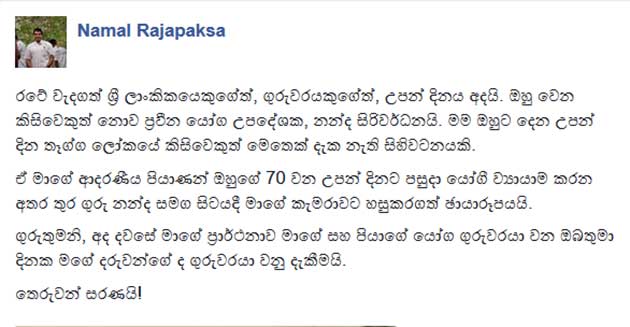
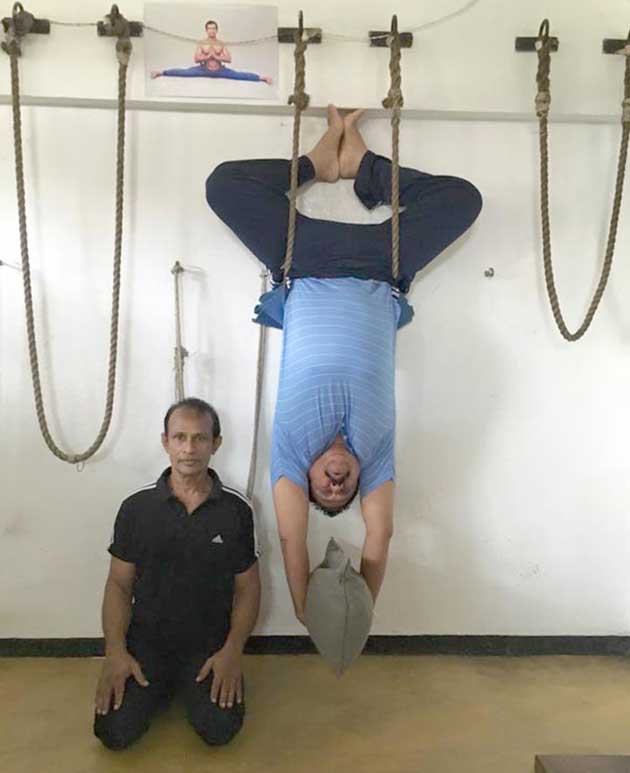
This photograph captured by MP Namal Rajapaksa and posted on his Facebook account shows former President Mahinda Rajapaksa in a rare Yoga position the day after he celebrated his 70th birthday, with Yoga instructor Nandana Siriwardena seated beside. MP Rajapaksa wished a very happy birthday to Yoga instructor Siriwardena whose birthday falls today (20) and also wished him long life enough to be the yoga instructor of the MP’s children as well.

mahindadoingyoga

හිටපු ජනාධිපතිවරයාගේ පෙර පින්තූර කිහිපයක්…

mahindadoingyoga2

හිටපු ජනාධිපති මහින්ද රාජපක්‍ෂ මහතා ඉතා හොඳින් ප‍්‍රගුණ කල අයෙකුට පමණක්  කල හැකි අසීරු යෝගා අභ්‍යාසයක යෙදී සිටින අයුරු දැක්වෙන පින්තූරයක් පාර්ලිමේන්තු මන්ත‍්‍රී නාමල් රාජපක්‍ෂ මහතා සිය ෆේස්බුක් ගිණුමට එක් කර තිබේ.

mahindadoingyoga4

mahindadoingyoga3mahindadoingyoga5
6,256 Viewers

This Is What Justice Looks Like in Saudi Arabia One Sri Lankan housemaid has been saved from a stoning death—for now. Others are still dying.

December 21st, 2015

BY JONAH COHEN AND RAMYA CHAMALIE JIRASINGHE Courtesy NEW REPUBLIC

December 21, 2015
A Sri Lankan woman sentenced to be stoned to death on charges of adultery has been granted a reprieve, but she is far from safe.

Signal

Beaten like slaves, treated like merchandise, these women are among the fortunate ones. Other young Sri Lankan housemaids, working for two dollars a day, never return home.

JONAH COHEN AND RAMYA CHAMALIE JIRASINGHE
A married housemaid, she received the death penalty while the man, also a Sri Lankan migrant worker, was given 100 lashes, the New Republic reported earlier this month. Since that article appeared, we received word that the Canadian embassy to Saudi Arabia would try to assist the woman.

The court has now agreed to reopen her case for appeal. But the public still doesn’t know her name, for whom she was working, what she testified in court, or who bore witness against her. Not her family, not even her betrayed” husband, knows that she stands to be executed.

Why won’t her name be released? Officials involved with the case claim she doesn’t want her family to know how far she’s fallen, that she’d feel humiliated. But it’s hard to believe that the same court that would stone a woman to death would also protect her from the sting of social scandal. It’s just as likely that the housemaid’s name is being concealed to stifle media attention, as well as to imply her shame and guilt over a sexual crime for which her male judges might kill her.
If she does somehow survive Saudi Arabia’s judicial system, and makes it out of the country, she will be among the countless migrant women who have returned home with horrific stories.

Now I have become a prostitute. I have come back home a prostitute,” says the woman in this video as she recounts the horror of her experience as a maid in Saudi Arabia. The house I was working in threw me out on to the road. When I got into a taxi on the road, the driver took me to a brothel. I had to work as a prostitute for two months.”

Another woman says that she was tasked with looking after 14 children. When I couldn’t manage, instead of taking me back to my agency, they sold me to another agency. And at that agency they hit me until I started bleeding from my skull.”

Beaten like slaves, treated like merchandise, these women are among the fortunate ones. Other young Sri Lankan housemaids, working for two dollars a day, never return home.

You might have heard about the young woman who was beheaded in Saudi Arabia in 2013. But you probably haven’t heard of the underage housemaid whose corpse was just returned earlier this month to her parents in Sri Lanka.

She hanged herself in the spring. Or so it is claimed by Saudi authorities. Her parents are skeptical. I have doubts that someone who was supposed to come home in May would kill herself like this,” her father says. She called us and said she was coming in May.”

Her parents had to fight tooth-and-nail to obtain her remains. All the agency wanted to do was bury her in Saudi Arabia,” her mom says. No one knows her there; this is our motherland, I wanted to bury her here.” The girl’s body was returned home many months later, rendering an autopsy all but useless.

Some might argue that these abused girls are outliers in an otherwise functional business relationship between the Middle East and Asia. There are, after all, about 2.1 million domestic workers in Middle Eastern countries. In Saudi Arabia, one of the largest employers, there are around 785,000 such workers, two-thirds of whom are women. Surely, the vast majority are fine.

But abuse isn’t an aberration. Namini Wijedasa, a Sri Lankan journalist, recently reported that the tales of misery are too numerous to ignore.”

Few, if any, of these migrant workers receive the protection of domestic employment laws. Visiting workers in Saudi Arabia must obtain permission from their employers to exit legally from the kingdom. If that is not slave labor, what is?

There’s also an utter lack of due process for these workers, and condemned prisoners are silenced, as is likely the case with the Sri Lankan housemaid charged with adultery.

Her future—whether she will live or die—remains uncertain. In the next month or so, pious men will once again stroll into a courtroom and pass judgment on her. Maybe they’ll have her stoned to death or thrown in prison, where there’s a good chance she’ll be raped by prison guards, like so many imprisoned workers before her.

But even if the court sets her free, justice won’t be served: Nobody will pay for the injustices done to her.

Jonah Cohen holds a PhD from the University of London, School of Oriental and African Studies.
Ramya Chamalie Jirasinghe is an award-winning poet and deputy director to the United States-Sri Lanka Fulbright Commission.

X-files and excuses

December 21st, 2015

Editorial Island

Many thought the Jan. 08 regime change would pave the way for thorough probes into attacks on journalists and media institutions during the past few decades. But, regrettably, investigations into those dastardly incidents are being conducted very selectively.

Media person, Pradeep Ekneligoda, disappeared and national rugby player, Wasim Thajudeen, died under mysterious circumstances which must, no doubt, be investigated. But, the government must not lose sight of other such incidents.

The abduction of The Nation Associate Editor Keith Noyahr in May 2008 has not yet been probed properly. Keith should be able to reveal vital information about his abductors who held, questioned and beat him for hours before releasing him. The government which was blamed for his abduction is now out of power and he is resident overseas.

Keith, as a responsible journalist who took up the cudgels for media freedom, is sure to cooperate with investigators. There is reason to believe his abductors were involved in attacks on other journalists as well. Therefore, his help needs to be sought to identify those elements.

It is mind-boggling why the police are still groping in the dark. Two months after Keith’s abduction, the then Chief Opposition Whip and UNP MP, Joseph Michael Perera, speaking in Parliament in July 2008 held the then Army Commander, Lt. Gen. Sarath Fonseka, responsible for attacks on journalists. BBC reported on July 28, 2008:

Sri Lanka’s main opposition party has accused the country’s most senior army officer of being behind violent attacks on reporters.

Opposition MP Joseph Michael Perera told parliament that the attacks were carried out by a ‘special team’ controlled by Lt. Gen. Sarath Fonseka.

Mr. Perera said the government should arrest the offenders and ‘immediately bring them to justice’.

The army has denied that it is any way involved in attacks on journalists.

“We are told by those in the army itself that journalists are abducted and subjected to grievous injury by none other than a special unit under the army commander,” Mr. Perera, a former parliamentary speaker, said.

The Sunday Leader editor Lasantha Wickrematunga was killed a few months later in Jan. 2009. The UNP which asked the Rajapaksa government to make arrests at that time is in power today. It is duty bound to get cracking and ensure that former Chief Opposition Whip Perera provides the police with all necessary information about the ‘special team’ he mentioned in Parliament. What prevents the government from doing so? Let no lame excuses be trotted out.

Perhaps, the yahapalana grandees do not want to open up a can of worms because those they accused of killing journalists at that time are today in the good governance camp!

Unfounded fears

Convener of the Mawbima Wenuwen Ranawiruwo (MWR) organisation, Major Ajith Prasanna, has told the media that a plot is being hatched to arrest former President Mahinda Rajapaksa and former Defence Secretary Gotabaya Rajapaksa over the disappearance of Prageeth Ekneligoda.

But, it is doubtful whether the present government will ever do anything of that nature on the basis of mere allegations. It is compassionate towards even terror suspects. Detained hardcore Tigers are being released on the grounds that there is no irrefutable evidence against them.

Before the presidential and parliamentary elections this year, the leaders of the present administration made solemn pledges to arrest the self-appointed leader of the LTTE, Kumaran Padmanathan alias KP, for his active involvement in terrorist activities in the past. They also said Karuna Amman had been responsible for many crimes in the Eastern Province such as the massacre of Buddhist monks at Arantalawa and the mass execution of 600 policemen. But, they have chosen not to take any action against the two former Tigers.

The champions of good governance, currently ensconced in power, condemned the ministers of the Rajapaksa government as a bunch of rogues responsible for mega corrupt deals, killings, abuse of power etc. The new government would deal with them severely, we were told. But, today, those ‘rogues’ have been forgiven and made ministers of the ‘yahapalana’ government!

Thus, we don’t think the present government will ever abuse its power to throw its political opponents behind bars on the basis of mere allegations even though former President Rajapaksa is threatening to stage street protests.

Moreover, no less a person than UNSG Ban Ki-moon has spoken very highly of the present government; he considers the Jan. 08 regime change one of the most significant world events during this year! President Maithripala Sirisena has said he had the rare honour of viewing Queen Elizabeth’s private jewellery collection as a special guest besides being given a gloveless handshake. Pope Francis has also showered praise on him, we are told. Prime Minister Ranil Wickremesinghe has always been in the good books of the international community.

So, the ‘yahapalana’ government led by President Sirisena and PM Wickremesinghe will not run the risk of blotting its copybook by arresting its opponents in the same manner as the Rajapaksa government.

Exposing Sarath Fonseka වෙලේ විදානගේ නිර්වත.. හඩ පටිය සහිතයි

December 21st, 2015

Sri AV Tv network

සරත් ෆොන්සේකා මහතා දැන් ඇවන්ට්ගාඩ් සමාගමට චෝදනා එල්ල කළද මීට පෙර ඔහුට රුපියල් මිලියන පනස් ගණනක් හා ජිප් දෙකක් ලබාදී ඇතැයි ඇවන්ට්ගාඩ් රැකියා අහිමි වූවන්ගේ සංගමයේ කැඳවුම්කරු කමල් ගමගේ මහතා පවසයි.

ඇවන්ට්ගාඩ් රැකියා අහිමි වූවන්ගේ සංගමයේ වාර්ෂික සුහදහමුව අද (04) විහාර මහදේවි එළිමහන් රංග පීඨයේදී පැවැත්විණ.

https://www.facebook.com/SriAvTvNetwork/videos/1016945108366473/

එහිදී එම සංගමයේ නියෝජිතයින් තමන්ගේ රැකියා අහිමිවීම සම්බන්ධයෙන් ජනාධිපතිවරයා හා අගමැතිවරයා මැදිහත් වී විසඳුමක් ලබාදිය යුතු බව ඉල්ලීමක් කළේය.

ඇවන්ට්ගාඩ් සමාගම සම්බන්ධයෙන් කරුණු හරි හැටි නොදැන කතා කරමින් බොහෝ දෙනෙකු චෝදනා එල්ල කළ බවත්, මෙම ව්‍යාපාරයෙන් දැනට 6754 දෙනෙකුට රැකියා අහිමිවී ඇති බවත්, එහි කැඳවුම්කරු කමල් ගමගේ මහතා පැවසීය.

එහිදී වැඩිදුරටත් අදහස් දක්වමින් ඔහු ඇවන්ට්ගාඩ් සමාගමෙන් ලාබ ප්‍රයෝජන ගත් පුද්ගලයින් සම්බන්ධයෙන් ද අදහස් පළ කළේය.

සරත් ෆොන්සේකා මහතාගේ පෞද්ගලික සහකාර විශ්‍රාමික කර්නල් කපිල රත්නායක මහතා ඇවන්ට්ගාඩ් සමාගමේ සභාපති නිශ්ශංක සේනාධිපති මහතා සමග දුරකථන සබඳතා පවත්වමින් ආධාර උපකාර ලබාගත් බව හෙතෙම පැවසීය.

ඔහුට ඇවන්ට්ගාඩ් සමාගමෙන් මාසයකට රුපියල් ලක්ෂ 15 බැගින් වැටුප් ගෙවා ඇති බවද එහිදී ඔහු අනාවරණය කළේය.

ෆොන්සේකා මහතාගේ කාර්යාලයේ කුලිය ගෙවීමට මුදල් ද, වාහනයක් ද ඉල්ලා ඔහුගේ පෞද්ගලික සහකාර විශ්‍රාමික කර්නල් කපිල රත්නායක විසින් එවන ලද බව කියන එස්.එම්.එස් පණිවිඩ ඇතුළත් කර මුද්‍රණය කළ පත්‍රිකාද, හඬ පට කිහිපයක්ද මෙහිදී මාධ්‍ය ආයතන වෙත ලබාදීමට එම සංගමය කටයුතු කරන ලදී.

එසේම ඇවන්ට්ගාඩ් සමාගමට චෝදනා කරන වත්මන් රාජිත සේනාරත්න අමාත්‍යවරයා ද ඔහුගේ පිරිසකට රැකියා ලබාදීමට කටයුතු කරන්නැයි ඉල්ලා එවන ලද ලිපිද සමාගම සතුව ඇතැයි හෙතෙම පැවසීය.

මාධ්‍ය හමුව ඇමතු ඇවන්ට්ගාඩ් සමාගමේ මෙහෙයුම් කළමනාකරු නිලුපුල් ද කොස්තා මහතා කියා සිටියේ ඇවන්ට්ගාඩ් සමාගම සම්බන්ධයෙන් අනුර කුමාර දිසානායක මහතා ද විවිධ ප්‍රකාශ කර ඇති බවයි.

එහි කරුණු හරි හැටි දැන කතා කිරීම සුදුසු බවත්, ඒ නිසා ඇවන්ට්ගාඩ් සමාගමෙන් සිදුවන්නේ කුමක්දැයි දැන ගැනීමට අනුර දිසානායක මහතාට හැකි නම් කාර්යාලයට පැමිණෙන ලෙසත්, ඒමට නොහැකි නම් නියෝජිතයෙකු හෝ එවන ලෙසත් ඒ මහතා ඉල්ලා සිටියේය.

මාධ්‍ය අමතා කතා කළ ඇවන්ට්ගාඩ් සමාගමේ වාණිජ කළමනාකරු නිලන්ත ජයවීර මහතා පැවසුවේ රණවිරුන්ගේ මාර්ගයෙන් ඉදිරියට පැමිණි කෙනෙක් ඇවන්ට්ගාඩ් හි සේවය කරන රණවිරුවන්ට අපහාස කර ඇති බවයි.

ඔහුගේම වචනවලින් කිවහොත් ඇවන්ට්ගාඩ් සමාගමේ වැඩ කරන්නේ සියයට 50ක් කලවැද්දෝ බවත්, එසේ වුවද අපි කලවැද්දන් නොව හමුදාවේ විශ්‍රාමිකයින් බවත්, හෙතෙම එහිදී කියා සිටියේය.

ඇවන්ට්ගාඩ් සමාගම මගින් විශ්‍රාමික හමුදා සෙබළුන්ට විශ්‍රාම ජීවිතය යහපත් ලෙස ගත කිරීමට අවශ්‍ය ශක්තිය ලබාදෙමින් වැටුපක් ලබා ගැනීමට හැකි වාතාවරණය සැකසූ බවද එසේ තිබියදී මෙම සමාගමෙන් වූ සේවය අගයනවාට වඩා එය විනාශ කරන තැනට පිරිසක් කටයුතු කළ බවද ඒ මහතා පෙන්වාදුන්නේය.

ඇවන්ට්ගාඩ් සමාගම සම්බන්ධයෙන් මාධ්‍යයවල පළවු වාර්තා සත්‍ය නැති බවත්, එම සමාගමේ කටයුතුවල ඇත්ත නැත්ත සොයා නොබලා කටයුතු කිරීමෙන් අසරණ වී ඇත්තේ රැකියා අහිමි වූ අප යැයි ද හෙතෙම පැවසීය.

එම සමාගම තුළ තවදුරටත් සේවකයින් හතලිස් ගණනක් හෝ රැකියා කරනු ඇතැයි විශ්වාස නොකරන බවත්, රැකියා අහිමි වූවන් සම්බන්ධයෙන් ජනපතිගේ හා අගමැතිගේ අවධානය යොමුවනු ඇතැයි අපේක්ෂා කරන බවත්, මෙහිදී ප්‍රකාශ විය.

වාර්ෂික සුහද හමුවට එක්වූ පිරිස අනතුරුව එහි දී නිහඬු විරෝධතාවයක ද නිරත විය.

එහිදී මාධ්‍ය වෙත ලබාදුන් එස්.එම්.එස් පණිවුඩ ඇතුළත් කර මුද්‍රණය කරන ලද පත්‍රිකාව පහත පරිදිය.

Concerned citizens address PM on Megapolis Plan

December 21st, 2015

Letter from Concerned Citizens Regarding the Proposed Western RegionMegapolis Development Plan (Courtesy Island)

Dear Prime Minister,

We welcome and laud the National Unity government’s efforts to initiate an integrated approach to the planned development of the Western Province including Colombo. We appreciate the potential for national economic and sustainable development that is inherent in well-planned urbanisation. We also note that underlying the plan to develop the western region as a megapolis is the objective, outlined in your recent economic policy statement, of ensuring a “high level of economic activity, powered by global and local businesses that will have the opportunity to provide employment and the facilities needed to build and sustain an advanced level of living.”

article_image

We appreciate the initiative to seek people’s views and concerns regarding the proposed megapolis. Events such as the forum convened in Colombo on 30 November by the Minister for Megapolis and Western Region Development are most welcome, being a clear and refreshing departure from the practices of the past.

However, given the history of past attempts at such development, especially the experience in Colombo of the last few years, as concerned citizens, we call on you to consider and commit to the following measures, which we believe are in line with the National Unity Government’s commitment to good governance:

Deepen public participation and transparency: We learn from the media and other sources that a draft of the plan for the western region megapolis is due to be completed as early as this week and taken to Parliament in January. While an expeditious approach is needed, there is significant concern that in view of the importance of this development planning exercise, there must be public consultation across the western region, and systematic engagement with various professional bodies on the proposed draft plan for the megapolis. In this context, we request you to kindly outline and clarify:

– The process and structure for public consultation that will be followed across the western region.

– The schedule and sequencing of various activities including planning, consultation, review, and the phases of implementation.

– Measures taken to ensure complete transparency and public access to all information regarding the planning, in all three languages.

– The sequencing and scheduling of major individual projects that make up the megapolis plan—it is especially important that the public have prior knowledge of proposed projects.

Ensure participation and strengthening of elected local government authorities: Local authorities in the western region currently appear marginalised from the process. This is not conducive to democracy and good governance, or for expansion of their capacities. We urge you to outline measures that will be taken to ensure their fullest participation and shared ownership, as well as build their capacities.

Ensure inter-agency balance, coordination and learning: It is crucial that the agency responsible for the planning of the megapolis does not become what the Urban Development Authority was under the previous regime: all-powerful and vertically rather than horizontally aligned with other agencies. There needs to be a more effective institutional balance, and synergies between various agencies mandated to deal with housing, transport, basic services, environment, etc., that must be involved, and we call on you to outline specific measures for inter-agency coordination and involvement so that expertise and experience is effectively transferred and deployed.

Consult before legislating special powers: From statements made by Minister Ranawaka, as well as media sources, it is clear that a new law is being proposed to grant special powers to plan and implement the megapolis project. We are concerned about the scale and extent of these special powers and the impact they may have on people and communities. We request you to ensure a draft is placed in the public domain for discussion before being tabled in Parliament.

Commit to strengthening and applying the National Involuntary Resettlement Policy: We welcome Minister Ranawaka’s assurance that no one will be forcibly relocated and that due process will be followed for any land acquisition in connection with the megapolis project. However, we call on you to commit that the National Involuntary Resettlement Policy, introduced by your government in 2001, will be: a) updated where needed to reflect the best international safeguards standards, and b) applied in all cases where relocation or land acquisition is found to be absolutely necessary.

Adopt community-driven location specific housing solutions: Sri Lanka has a history of pioneering community-centred participatory housing projects for the poor and the lower middle classes. We are concerned over reports that high maintenance and energy intensive high-rise buildings are being advocated as the primary approach to re-housing disadvantaged communities, despite its many drawbacks. We call on you to commit to adopting a community driven and participatory, location specific, in-situ housing, rather than one-size fits all high-rise projects.

Prioritise public transport and avoid supplier-driven capital-intensive solutions: We call on you to ensure that transport solutions are geared towards prioritising public transport, lowering fuel consumption, and enhancing sustainability. We urge you to commit to a phased implementation of the urban transport master plan for the Colombo metro region that was developed with support from the Japan International Cooperation Agency (JICA) and recently revised by the University of Moratuwa.

Prioritise environmental protection: Ensure environmental assessments, which are conducted independently and professionally, are placed in the public domain for review, underpin the overall plan for the megapolis, as well as every major project component.

Develop a comprehensive set of principles to guide the planning and implementation process: We urge you to draft a comprehensive set of principles and goals, drawing on and reflecting all of the above to steer the thinking of planners and other experts involved in the planning, design and implementation of the megapolis. Such principles must take into account the fact that the western region actually has a large concentration of relatively poor and economically marginalized population that is actively contributing to the region’s formal and informal economy. It is vital that any development plan centre on enhancing their full participation, well-being and quality of life. It is also equally important that such development is in line with equitable national resource allocations to meet development needs in other parts of the country, especially in regions with comparatively low standards of essential infrastructure and services. The forthcoming White Paper on the megapolis presents an opportunity to enunciate these principles and goals.

We appreciate the urgency to launch specific measures and projects related to the western region as demonstrable evidence of benefits. We also appreciate your intention to base such initiatives upon a comprehensive urban development plan. However, we ask that you would first outline a comprehensive set of principles with goals, to guide some initial projects that may be commenced expeditiously while allowing time for a more comprehensive and participatory development and review of the plan as a whole, in all its detail.

Honourable Prime Minister, in the light of government’s repeated assurances of a strong commitment to democracy and good governance, we are hopeful that you will consider citizen’s participation, and the concerns and issues we have raised. The Western Region Megapolis Plan is a unique opportunity to create a development scheme that is truly democratic in both its creation and application, and genuinely a ‘plan of the people’. We believe that addressing the issues we have raised will not only go a long way in ensuring wider ownership of the process, but also more positive outcomes for the western region and the country as a whole.

We look forward to hearing from you at the earliest.

Jayantha Dhanapala – Prof. Savitri Goonesekere – Susil Sirwardena

For and on behalf of:

Prof. Amal S. Kumarage, Chandraguptha Thenuwara, Gamini Viyangoda, Dr. Harini Amarasuriya, Prof. Kumar David, Dr. Jezima Ismail Chandra Jayaratne, Prof. Ranjini Obeyesekere, Tissa Jayatilaka, Shibly Aziz, Dr. T.L. Gunaruwan, Prof. Arjuna Aluwihare, Danesh Casie-Chetty, Priyantha Gamage, Dr. Vinya Ariyaratne, Prof. Sivaguru Ganesan, Ananda Galappatti, Ms. Visaka Dharmadasa, Dr. Selvy Thiruchandran, Rev. Dr. Jayasiri Peiris, Faiz-ur-Rahman, Dr. Devanesan Nesiah, Ms. Anita Nesiah, Mr. Ranjith Cabral, Prof. Camena Guneratne, Ms. Anushya Coomaraswamy, Mr. D. Wijayanandana, Mr. S.C.C. Elankovan, Ms. Shyamala Gomez, Dr. A.C. Visvalingam, Ms. Damaris Wickremesekera, Upatissa Pethiyagoda,


(The letter has been copied to ) Maithripala Sirisena, President of Sri Lanka Honourable Champika Ranawaka, Minister for Megapolis and Western Region Development,Honourable Lasantha Alagiyawanna, Deputy Minister for Megapolis and Western Region Development

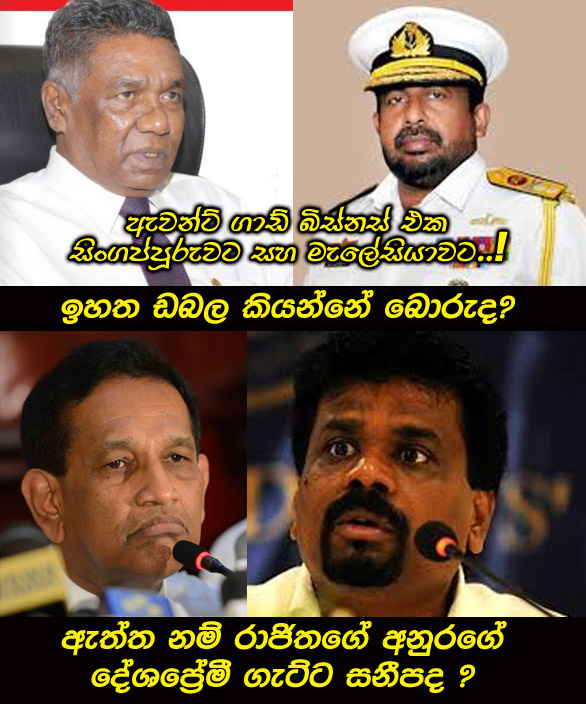
Navy hands over Avant Garde business to Singapore and Malaysia : Whither Rajitha and Anura’s stinking patriotism ? -Navy loses Rs. 90 million foreign exchange after taking over

December 21st, 2015

Courtesy lankaenews.com

(Lanka-e-News -18.Dec.2015, 9.50AM)  From the very outset Lanka e news had been exposing that the handing over of Avant Garde Co. to the Navy is a camouflage in order to cover the  evil design of Kili-Rajitha-Arjuna team to take over this most lucrative business of providing security to international commercial vessels . Recently , the statement made by defense secretary in this regard confirmed our report  ; and now the Navy Commander himself has let the cat out of the bag .

On 6 th December the defense secretary revealed to a daily Sinhala newspaper that this acquisition of Avant Garde by the Navy is a transitional phase before transferring the business to another Co.

The Navy Commander Vice Admiral Raveendra Wijeguneratne has told a daily newspaper day before yesterday (16) ,after the acquisition of Avant Garde by the Navy ,two Singaporean and Malaysian Companies have made a request to carry out the operations in the same way as Avant Garde Co. from the Galle Port, and the representatives of these companies are arriving in Sri Lanka (SL) in January 2016 to hold discussions in this regard.

The perplexing questions  is ,why is this  most lucratve business  going to be handed over  to foreign companies ?

Meanwhile the media reported quoting the Navy that after the Avant Garde Co. was acquired a monthly income of Rs. 220 million last month was generated by the Navy.While the Navy reveals its income of Rs. 220 million , it does not however reveal the earnings of Avant Grade Co. prior to that.When Lanka e news inquired into this , it wa discovered that every month Avant Garde Co. has earned an income of Rs. 310 million .These monies came into the country as foreign exchange. In other words the Navy has now  incurred a loss of Rs. 90 million ! meaning that the Navy has destroyed part of the foreign exchange that was coming into the country.

While this is the true picture , minister Rajitha Senaratne and Killi Maharaja duo ( mind you , it is Anura Dissanayake the blind ‘Batriot’ who is speaking on behalf of Maharaja) moving heaven and earth clandestinely to take over this business were  unendingly uttering lies  till their tongues ran dry and protruded out, that the acquisition of the Co. by the Navy is a most patriotic move as all the earnings are now being diverted to the country’s coffers.

Going by the same token , based on what Navy Commander revealed day before yesterday , won’t these earnings be diverted to the Singaporean and Malaysian Companies if the Avant Garde operations are given over to them ?

Following inquiries made by Lanka e news , it is now discovered  , since Lanka  e news was continuing to expose the murky and crafty plots of Kili-Rajitha-Arjuna to acquire the business , and because this atrocious  plan has become known widely , they are now trying to take over this business after registering companies in Singapore and Malaysia, while painting a false picture that these are foreign companies.

No matter what , the crucial question is , how did the Singaporean and Malaysian  companies suddenly become more trustworthy in terms of national security than the local Co?

When over 6000 workers were thrown out of employment ; the monies flowing into the country are going to be  diverted to foreign countries ; and much hyped national security concern is being cast into the garbage bin , the question that must be posed in this context to these so called cardboard patriots Rajitha and Anura Dissanayake is , whether their stinking festering ‘patriotic boil’ is now cured , or is it still boiling over with  all its uncontrollable stench?

If it is otherwise , it is the duty of these two vacuous bankrupt politicians to tell before the people whether the Navy Commander the ‘hero’ and the Defense secretary the ‘zero’ are lying.  The leaders of civil organizations and trade unions who were also blabbering without understanding the hidden self centered evil  aims and agendas of these scoundrels while also believing their  profusion of lies have one solution left -to defecate in their own pants all the lies they eagerly fed upon.

When the media that exposes the truth reveals the crooked and corrupt aims and activities of these rascals , the latter tried to gag the media by making counter accusations that those media personnel have taken  bribes from Avant Garde Co.

With evidence it has been proved that Rajitha has taken Rs. 5 million from Avant Garde Co.  In order to halt those exposures , he counter alleges that the media had taken bribes from the Avant Garde Co.(Media personnel are not appointed on the votes of the people is another matter ) and  threats are made that the list of bribe takers of the media will be exposed ,but  nothing has been  revealed so far  . However unlike them who make empty threats , this report on the other hand has revealed clearly and cogently the true murky activities and sordid  selfish self seeking traitorous aims of these crooked, corrupt ,bankrupt  politicos and bribe takers.

—————————
by     (2015-12-18 04:32:20)


The Real Cost of Christmas for the Turkeys

December 21st, 2015

Rantings From a Virtual Soapbox A blog in support of animal and human rights and the environment

Here in the UK an astonishing number of turkeys are killed each year.

It is estimated that around 10 to 20 million turkeys are slaughtered in the UK every year just for Christmas –  in addition millions of other animals suffer and die including pigs, chickens, geese and ducks during this so called season of peace and goodwill. Odd way to celebrate the birth of a man whom many believe to be a man of peace by the massacre of millions of sentient creatures who suffer as we do, animals whose lives are as important to them as yours is to you.

Here are the facts:

Male_north_american_turkey_supersaturated

Turkeys

90% are kept in windowless sheds with as many as 25,000 other birds. Wild turkeys live for around 10 years, but those destined to be eaten are slaughtered when they’re between 9 and 24 weeks old. It’s not just turkeys though – millions of pigs, geese and ducks also suffer in a time of supposed peace and goodwill. According to those organisations promoting turkey meat, Christmas just wouldn’t be Christmas without a traditional roast turkey! But how ‘traditional’ is it really?

Please continue reading:
https://www.vegsoc.org/truecost#.VI0z1jGsWUQ

Worldwide it is really not possible to even estimate how many turkeys are massacred at Christmas time. As already mentioned here in the the UK it is around 10 to 15  million, in the USA about 20 million with around 40 million on Thanks Giving, in  Australia between 3 to 5 million

In the USA 20 million are slaughtered for Christmas and 40 million for thanks giving.

Ben Franklin called turkeys true American originals.” He had tremendous respect for their resourcefulness, agility, and beauty. Turkeys are intelligent animals who enjoy having their feathers stroked and who like listening to music, with which they will often loudly sing along. In nature, turkeys can fly 55 miles an hour, run 18 miles an hour, and live up to 10 years.

But the story is very different for turkeys on factory farms: They will be killed when they are only 5 or 6 months old and, during their short lives, will be denied even the simplest pleasures, such as running, building nests, and raising their young.

Like chickens, the 300 million turkeys raised and killed for their flesh every year in the United States have no federal legal protection.More than 45 million turkeys are killed each year at Thanksgiving alone, and more than 22 million die at Christmas.

Read more:
http://www.peta.org/issues/animals-used-for-food/factory-farming/turkeys/#ixzz3LrmolLLv

Cruel Farming of Turkey’s

Here is how turkeys live their short wretched miserable lives

Stuffed! – Viva! investigation of UK turkey farms 

Warning distressing images

Undercover footage of the conditions in which turkeys are reared on six farms – including two of the UK’s biggest producers. The video shows overcrowded sheds, dead and dying birds, animals with gaping wounds, birds with one half of their beak removed and cannibalism. The companies involved are Bernard Matthews (the biggest turkey producer in Europe), Kerry Foods (owners of Home Pride, Mattessons Walls and Greens), and farms in Braintree, Sevenoaks, Chichester and Devon

Meat Your Meat: Turkeys

Warning very upsetting for people who care about animals.


Below is a longer version of the above video ( includes information about factory farming of other animals)


Every year in the United States, almost 300 million turkeys are killed for their flesh. Virtually all spend their entire lives on factory farms and have no federal legal protection.

Turkeys raised on factory farms are hatched in large incubators and never see their mothers or feel the warmth of a nest. When they are only a few weeks old, they are moved into filthy, windowless sheds with thousands of other turkeys, where they will spend the rest of their lives

Read more:
http://www.peta.org/issues/animals-used-for-food/factory-farming/turkeys/turkey-industry/#ixzz3Ls3Gqx66

Don’t take comfort by organic or free range turkeys

The reality of a free range farm

Something To Be Thankful For
A short film from Animal Place about the rescue of a single turkey from a free-range” farm, days before Thanksgiving. Though this film shows a positive outcome for one lucky Turkey it also shows the shocking conditions in which so called free range turkeys live.


If you think that an organic option is more humane, have a look at what happens to organic turkeys in this next video. In all cases slaughter always involves suffering, pain and fear and is never humane, there is nothing humane or ethical in bringing about the end of the life of a sentient being who like you and I  wants to live his days as nature intended. Roman Stoic philosopher and statesman Seneca once wrote:

But for the sake of some little mouthful of meat, we deprive a soul of the sun and light,
and of that proportion of life and time it had been born into the world to enjoy.

Warning distressing images of turkeys being slaugtered

Xmas Special the Short life of organic Turkys   

In Great Britain about 10 million of turkeys are killed for Christmas. This film shows breeding and slaughter of free range turkeys in one of organic farms in Britain.

Comparing to traditional and factory farming, organic way of breeding animals seems to be a healthier and more ethical solution.

But even in strict organic conditions these sensitive and majestic birds suffer from unnatural conditions, decrease of living space -what leads to diseases, stress and aggressive behaviour.  And after all, they have a short life on a farm, are raised only to be killed and later their meat is sold.

If you think that an organic option is more humane, have a look at turkey slaughter in this video. In all cases slaughter always involves suffering, pain and fear.

This year’s Christmas can be truly compassionate. Surprise yourself and your family with an amazing choice of vegan food and give turkey the gift of life.


No indeed your conscience can’t really be salved can it?  At the end of their time these sentient beings are cruelly slaughtered.

Question the ethics of killing millions of living beings to celebrate a festival about which few really understand. Most people do so from habit, tradition and thoughtlessness. I know I was once of this mindset.

Those of the Christian religion please question the incongruity of this festive blood bath to celebrate the birth of a person whom you consider to be a man of peace.

What can I do?

Go Vegan is the immediate answer though not the only one as things cannot be allowed to continue the way they are in cruel factory farms and inhumane slaughter houses and the end to such cruelty needs be made law now. Nonetheless going vegan or vegetarian , though vegetarians  need to consider the ethics of of consuming milk and eggs, is a good start in bringing an end to the vile cruelty of factory farming and slaughter

The best way to end the suffering of animals is to go vegan – or at least start in that direction. We can help you do just that. Please also share this page with your friends and family so that they know how animals suffer and how they can help end that suffering.

See more from VIVA about going vegan
http://www.viva.org.uk/resources/video-library/turkey-investigation-footage

Lots of advice to help you go vegan:
http://www.viva.org.uk/what-we-do/go-veggie-christmas

Go straight to the Christmas recipes:
http://veganrecipeclub.org.uk/christmas

Top Five Tips for a Vegan Christmas Feast
Read more: http://www.peta.org/living/food/top-five-tips-vegan-christmas-feast/#ixzz3LwrV5jkz

Vegan society all year round recipes
http://www.vegansociety.com/resources/recipes

Make this year a compassionate and cruelty free Christmas Surprise yourself and your family with an amazing choice of vegan food and give turkey the gift of life

How to Have a Vegan Christmas Feast With All the Trimmings
http://blog.peta.org.uk/2014/12/vegan-christmas-feast-trimmings/

OVERVIEW OF CHRISTMAS WITHOUT CRUELTY CAMPAIGN
http://www.animalaid.org.uk/h/n/CAMPAIGNS/living/ALL/563/

Quick and easy cook alternatives

If it all seems a bit of an effort think of the Turkeys, isn’t it worth it. There are though quick and easy ready prepared alternatives for those less inclined to cooking:

Here in the UK sold at Holland and Barrett and other health food stores

Celebration Roast and other prepackaged easy to cook and prepare meals
http://www.vbites.eu/food/products/111-celebration-roast-445g

In the USA

Tofurky® Holiday Products:
http://www.tofurky.com/tofurkyproducts/holiday_products.html

More from PETA:
PETA’s Favorite Vegan Substitutes
http://www.peta.org/living/food/favorite-products/

Here is a recipe for tofu turkey, though this does require more preparation and cooking:
http://allrecipes.com/recipe/tofu-turkey-i/

If you don’t live in the UK or USA most countries now are likely to have stores that stock alternatives just enter a search such as:
Vegan and Vegetarian Turkey Alternatives or vegan substitutes

More information

End Factory farming:
http://factoryfarming.org.uk/whatis.html

Never doubt that Turkeys are sentient beings:

Sentience in Farm Animals: Turkeys

A turkey is not just for Christmas, a turkey is a thinking, feeling being with a life of his or her own. Below you will read compelling facts and anecdotes that demonstrate that a turkey is not an automaton driven by instinct, but like all animals he is a conscious being aware of and able to interact with his surroundings: sentient.

Read More:
http://www.think-differently-about-sheep.com/sentience%20in%20farm%20animals%20poultry%20turkeys.htm

Turkey Facts:

A random selection of interesting or unusual facts about Turkeys
http://www.think-differently-about-sheep.com/Turkey_Facts.htm

Big-Birds-Big-Cruelty-Turkeys-in-Australia
https://www.facebook.com/pages/Big-Birds-Big-Cruelty-Turkeys-in-Australia/153541898049663

Credit Photo

File:Male north american turkey supersaturated.jpg
http://commons.wikimedia.org/wiki/File:Male_north_american_turkey_supersaturated.jpg

Sri Lanka inflation accelerates to 4.8-pct in November

December 21st, 2015

Courtesy LBO

Dec 21, 2015 (LBO) – Sri Lanka’s consumer prices rose 4.8 percent in the 12-months to November from a year earlier, from the 3.0 percent a month earlier, data from the state statistics office showed.

Year on year inflation of Food Group has increased from 2.3 percent in October 2015 to 4.6 percent in November while Non-food Group also increased by 3.5 percent to 4.9 percent during this period.

The Department of Census and Statistics commenced releasing this new price index called ‘National Consumer Price Index’ from last month.

The national consumer basket includes 407 items which represent the consumption expenditure of all households in Sri Lanka and the base year is 2013.

However, the Department has been releasing Colombo Consumer Price Index from June 2011, covering only the urban areas of Colombo district.

National-consumer-index-november


IMF bailout unavoidable next year: Prof. Sally

December 21st, 2015

Courtesy The Daily Mirror

Given the tight liquidity in capital markets due to the rise in global interest rates, a bail-out package from the International Monetary Fund (IMF) is unavoidable for Sri Lanka next year, according to Professor Razeen Sally, an economist with international repute.

However, Professor Sally noted that the IMF lacks confidence over the Lankan government and in particularly with its ministry handling the country’s finances, as the maiden budget of the national unity government has ignored fiscal consolidation— one of the top conditions imposed by the lender when  extending support.

In 2009, Sri Lanka was bailed-out by the IMF from a balance of payment (BOP) crisis—which was triggered by excessive money printing to support subsidies—through a US $ 2.6 billion Stand-By-Arrangement (SBA).

Two weeks ago, Sri Lanka’s Prime Minister, Ranil Wickremesinghe told parliament that the government was looking to start discussions with the IMF for another SBA as the global growth is projected to slowdown.

He noted that ISIS rebels creating greater instability in the Middle East could also hurt Sri Lanka’s economy.  However, the message sent out by the recent Budget 2016 could make the dialogue with the IMF for a potential SBA facility problematic as it seriously lacked  fiscal consolidation.

The new government had also not made progress in the macro-economic front too, Professor Sally, the Visiting Associate Professor at the Lee Kuan Yew, School of Public Policy, National University of Singapore, pointed out.

According to him, Sri Lanka has a culture of acting irresponsibly over its finances and then expects to be bailed out by the IMF. He stressed that continuing this vicious cycle of resorting to the IMF is very damaging.

It prevents a sinner from repenting and it’s another excuse to continue sinning,” said Professor Sally. He noted that the last SBA facility was clearly political and was given under very easy conditions.

The last government pretended it was reforming and the IMF pretended the government was reforming but it kicked the can down the road,” he remarked.  He said Sri Lanka could not expect the IMF to come and sort out all its problems as much of the reforms must be carried out internally.

– See more at: http://www.dailymirror.lk/100241/imf-bailout-unavoidable-next-year-prof-sally?#sthash.ex754t6Y.dpuf

Onward Tamil Soldiers! Pirapāharan’s Inspiration remains Potent

December 21st, 2015

Michael Roberts, courtesy of Colombo Telegraph, 19 December 2015, where it appears under a different title.  

Note that the images deployed here are not found in the CT version, where the  Bibliography is also less expansive. Do also attend to the reasons why I have expanded the Bibliography: viz., a desire to elaborate the concept of sacrificial devotion” ……. ……. =http://sacrificialdevotionnetwork.wordpress.com/ a tool used extensively in my studies of Tamil Tiger devotion to cause and suicide attacks plus defensive suicide on capture as one facet of this commitment.

Way back in the 1960s the scholar Sinnappah Arasaratnam noted that in Sri Lanka two (communal) extremisms were feeding off each other and thereby sharpening conflict (1967, 1974 & 1979). This was, of course, just one factor contributing to a developing crisis that requires a careful analysis that identifies the multiple factors aggravating division. The tragic tale remains true today: Sinhalese and Tamil extremists continue to stir the pot and gain vigour by attacking each other (and others too).

The vehemence is all the greater because the vanguard of such fervour resides among migrants in Western lands who are encouraged by the freedom of the internet to ride the waves of communication with slander and sarcasm as their principal weapons. Among the Sri Lankan Tamils of the diaspora, of course, this venom has been grounded in the bitter experiences that induced so many to leave Sri Lanka in the last three decades of the 20th century.

Via familial stories as well as the vast propaganda machinery built up by the LTTE over the last 25 years this fervour has been transmitted to some of the second/third generation migrants brought up in these lands. As with so many Tamils living in Sri Lanka in the 1990s and 2000s Velupillai Pirapāharan, thetalaivar of Thamilīlam, was more or less a deity among these migrant peoples. In fact, he was likened to a Sun God (Jeyaraj 2009).
PRABHA + Tiger Figs 1 & 2 raghavan_prabhakaran3 Pirapāharan in his early days as freedom fighter … Fig 3 image019
VP 22 Fig 3Pirapāharan pays homage to Black Tigers on 5th July 2005, with garlanded image of Miller, the first Black Tiger suicide bomber, as principal symbol — Pic from TamilNet. Note that Miller’s target on 5 July 1987was a SL Army compound at Nelliyadi and cannot in any way be considered an act of terrorism”
pongal_pots_320 Fig 5 = Fifty pongal for the talaivar on his 50th birthday — 26 November 2004

kopay_m_cemet_27_11_2004_2  Fig 6= Kopay tuyilam illam readied for Māvīrar Nāl, 2004

mnal_germany_13_20267_435 Fig 7 = A Māvīrar Nālgathering in Germany, 2004 with displays of the heroes on the walls of a hall mnal_germany_11 Fig 8
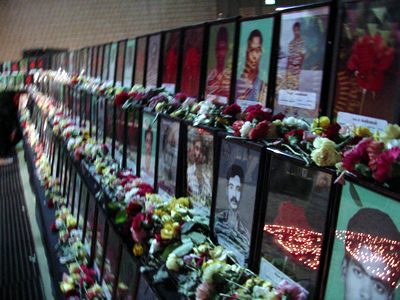
mnal_2004_23Fig 9 & 10= Māvīrar Nāl pageantry & gathering, 2004mnal_2004_26 Fig 10
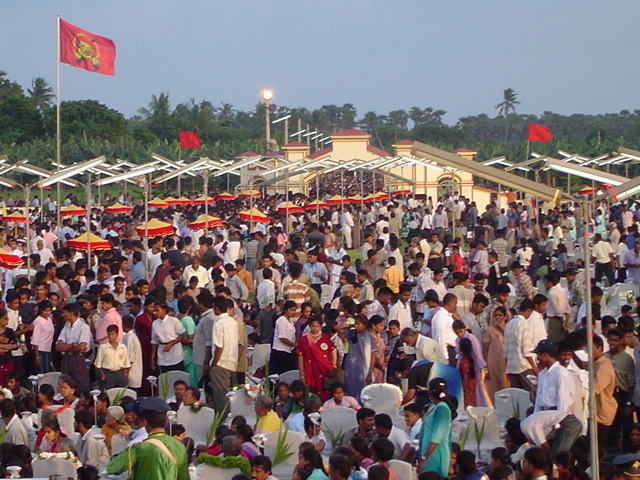
During the halcyon days of the LTTE this worship was expressed on his birthday 26th November[1] – a day that happened to precede an even more important moment of Tamil Tiger bonding, Māvīrar Nāl celebrated every 27th November to pay homage to the Tiger dead and re-affirm the peoples’ commitment to the goal of Eelam (Schalk 2003; Roberts 2009; Natali 2008… and Figs. 6-10).

The demise of Pirapāharan on 18th May 2009 has not dented this worship of the Sun God or the commitment to the liberation struggle among many Tamils in the island and abroad. The 18th May has now been added to the ritual calendar of Thamilīlam as Genocide Day,” with protest events being organized by the faithful in many cities in the West.

L 160--FB-Heroes Day Offerings 2012 Fig 11 = Offerings to Pirapāharan on 26th November 2012 – Pic from a Tamil pal, with no further details [see Roberts, Tamil Person and State. Pictorial, p. 207 for elaboration]

Likewise, conventional Saivite ceremonies of goodwill and sustenance for Pirapāharan are still conducted in some places in Sri Lanka and abroad to bestow blessings on his life’s journey on 26th November every year (see Fig. 11). A large Tamil gathering at Wembley in London to mark Pirapāharan’s greatness by commemorating his birthday (captured on camera by a Sinhalese migrant: Fig. 12) recently raised a minor storm among Sinhalese of an internet communication chain, adding to the fuel planted by the success of the Sri Lankan Tamil networks in persuading USA, the West and the UN bureaucracy to press war crimes charges against the government of Sri Lanka.
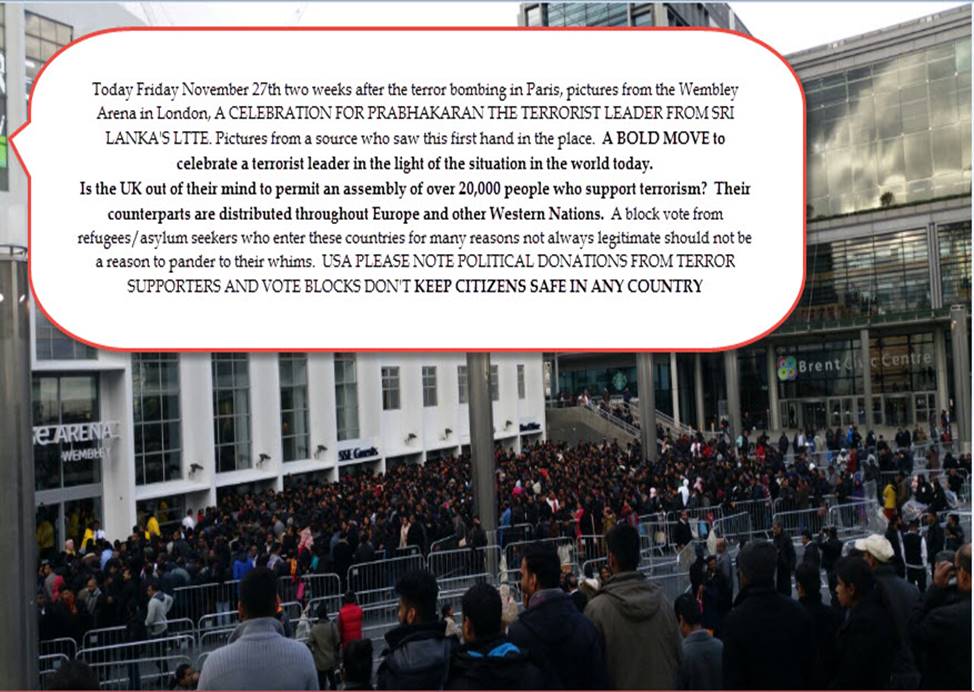
aa-WEMBLEY Meet Fig 12 = SL Tamils gatherat Wembley … arouse Sinhala agitation

However, it is the commemoration of Heroes’ Day on the 27h November every year in many cities and towns in the West that marks the commitment of Sri Lankan Tamils (and other supporters) to the cause of an independent Tamil state of Thamililam. These gatherings in 2015 were not confined to London and Toronto, but seem to have been mounted in numerous cities – for instance from Fribourg in Switzerland to Oslo in Norway. Such moments of coordinated activity must surely sustain the fervour displayed on the streets of so many cities in the West in March-April-May 2009 as the LTTE slid to comprehensive military defeat (Figs 13, 14 & 15).

OSLO Gethering 2015 Fig 13= SL Tamils assemble for Māvīrar Nāl in Oslo, 2015 ….and (Figs 14 & 15)  FRIBOURG gathering on Heroes day Heroes day-Fribourg  in Fribourg, Switzerland, with typical Tamil drama performances rooted in past time, albeit with an LTTE flavour, to inspire the audience Maaveera drama fribourg Fig 16
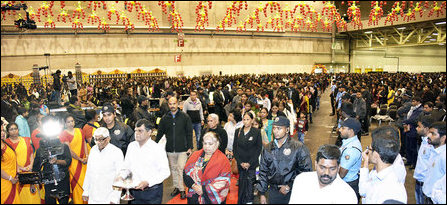
In the course of researches into the last stages of the war through studies of the Wikileaks exposure of the US ambassador’s dispatches to Washington, I perceived a chance process which may have contributed to the success of Tamil agitation in penetrating official US thinking in 2009. In my surmise, logically, similar processes could be occurring now as we speak. My write-up was placed in the Colombo Telegraph on the 9th December 2015. As expected, it drew the ire of the many piranhas (in this instance SL Tamil) who inhabit the air waves.

However, one of these sniper attacks by one Thanga” on the 11th December 2015 was, as Neville Jayaweera intimated, carefully crafted and quite clever. Thanga challenges my characterization of the LTTE as fascist” and insists that the LTTE was a party of freedom fighters and therefore remains popular among Tamils unlike Hitler and Mussolini in their countries. The LTTE was immensely popular with the masses. …. the armed struggle was a direct result of state violence inflicted on Thamils ever since independence. Chandrika Kumaratunga put it succinctly when she said Prabhakaran is the product of Sinhala racism. One cannot create a fighting force from thin air. Concrete socio-political-economic conditions must exist.”

Thanga’s neat sound-bites and part-truths do not a comprehensive argument make. He is guilty of gross oversimplification. It is entirely feasible for a freedom fighter movement to be fascist in structure and organizational form. The dead bodies of so many Tamil parliamentariansgunned down by the Tigers and the heaps of TELO and EPRLF dead are grotesque testimony to Pirapāharan’s killer mentality (Hoole 2001).[2] As a reporter for the Economist indicated, Pirapāharan was a textbook fascist who went on to murder his Tamil rivals, inspire love and terror among his followers and monopolise the Tamil nationalist cause.”[3]

Alas, this did not dim his popularity both within Thamilīlam and in some drawing rooms in Colombo and in many drawing rooms of the diaspora. On this count I do not question Thanga. Pirapāharan remains venerated today.

But Thanga also requires a little history lesson. With Hitler and Mussolini after 1944/45, the German and Italian peoples had no choice: occupying armies sat astride their countries for decades; while the Allies, quite intelligently, deployed the Marshall Plan to rebuild Germany and Europe in ways which have enabled Germany today to become the headmistress of the European Union. The US Army had contingents at strategic sites in West Germany, including Heidelberg when I resided there for spells in 1976 and 1987.

But it is with reference to Sri Lankan history in the period 1948 to 1983 that Thanga requires a history caning. Part-truths do not a story make, the more so when — as I indicated at the outset – a complex configuration of forces sharpened the pre-existing ethnic divide to a point of bitter conflict.

The ethnic (also called communal”) differentiation between Sinhalese and SL Tamils in Sri Lanka has been long-standing and grounded in cultural practices as much as political history. What sharpened the divisions in the independence era was the process of democratic politics from 1948-1970 within (A) a particular political structure and (B) the island’s peculiar demographic configuration (Roberts 1978; Wilson 1975).

Point A refers to the Westminster system of parliamentary elections based on first-past-the post electoral constituencies set up (in good faith but with disastrous results) by the Soulbury Constitution. Given the specific distribution of ethnic groups in the island, the political parties discovered over the decade 1956-1960s that a small swing in votes led to a landslide victory for either the SLFP or the UNP. Robert Kearney’s studies reveal this aspect quite clearly (1967 & 1973).[4] There was a structural disincentive for anyone to promote compromise politics across the ethnic divide (Roberts 1978). That is why the main Leftist parties abandoned their principled support for parity of status for both languages” and joined Mrs. Bandaranaike’s alliance in 1964. In blaming the demagogy of her father and mother (plus the UNP) Chandrika Bandaranaike is oversimplifying. The failures were system induced.

Yes, Sinhala prejudices, the political demagogues and the work of prejudiced bureaucrats after the Sinhala Only Act was in place also contributed to the polarization. However, Sinhala politicians were not the only demagogues (as Neville Jayaweera has clarified in his biography — 2014). The Tamil politicians were not without their prejudices and also indulged in demagogic activity. The Tamil intelligentsia also practiced considerable dissimulation by proposing that the whole of the Eastern Province was part of their traditional homelands.” As early as the 19th December 1949 this specific dishonesty was embedded in the manifesto of the Federal Freedom Party of the Tamil-speaking People of Ceylon” (ITAK 1949). This particular Tamil argument can be interpreted as a maximization claim of the sort seen in the history of Japanese and German fascism too – a form of lebensraum” that forcibly embraced the Sri Lankan Muslims as Tamil.

I do not expect Thanga to take kindly to this brief history lesson. My schoolmaster tones will him repel. Besides, he is hardcore Tiger and venerates Pirapāharan. In brief, he is probably incorrigible. That fact is a pointer to the vast network of support and tutelage to the memory of Pirapāharan and his Tigers that exists among the Sri Lankan Tamil peoples all over the world today. This is the most significant contention that I leave for readers to ponder. In such a milieu, the positions of moderate Tamils like David Jeyaraj and Rajan Hoole will, as Thanga affirms, carry little weight among the Tamil masses. Democratic politics trumps sensibility and produces, well, Trumps – Donald Trumps of the Sri Lankan Tamil variety.

***   ***

APPENDIX  https://www.tamilnet.com/art.html?catid=13&artid=38027

Occupied Tamil Eelam marks Heroes Day amidst ‘Sri Lankan’ harassment

[TamilNet, Friday, 27 November 2015, 13:54 GMT] Tamil Eelam Heroes Day was observed in the occupied country of Eezham Tamils amidst intensified monitoring by the occupying military intelligence operatives of genocidal Sri Lanka on Friday. The university community in Jaffna, comprising the student union, teachers association and the union of non-academic staff gathered at Parameasvarar temple, which is located inside the campus of the University of Jaffna, to mark the largest event after 2009 to be organized braving the intimidating presence of the SL military intelligence operatives. Earlier in the day, former TNA parliamentarian and Northern Provincial Councillor M.K. Shivajilingam lit the flame of sacrifice at the historic Nalloor temple. A special prayer was held at St. Patricks Church in Jaffna.
FLAME OF SACRIFICE -JP Flame of Sacrifice at Nallur Temple

Pirapāharan pays homage to maaveerar on an earlier occasion02-Pirapaharan at flame
EXTENDED BIBLIOGRAPHY … where I take the liberty of including a wide range of references to inform readers of the type of material one has to take into account. Believe you me, this list is only a tithe of the books and articles I have had to read over years of teaching and research — especially with reference to the topic of sacrificial devotion”, the concept I deploy to embrace the commitment to cause reveled by the Tamil Tigers, the kamikaze and modern-day jihadists…in implicit challenge to the oversimplified use of the term terrorism.”

Those interested in the manner in which practices of what one can call enchantment” occurred together with hard-headed practical skills in the military and assassination operations of the LTTE, I recommend a dip into the works by Bastin, Kailsapathy, Mines, Mosse, Nagarajan, Nabokov, Siemen-Netto and Tanaka. There are many other pertinent readings, but these will do for a start.

Aiyappan, A. 1977. Deified Men and Humanized Gods: Some Folk Bases of Hindu Theology.” in The New Wind: Changing Identities in South Asia, ed. Kenneth David. Hague: Mouton Publishers, pp. 95–104

Arasaratnam, Sinnappah 1967 Nationalism, Communalism and National Unity in Ceylon,” in Philip Mason (ed.) India and Ceylon. Unity and Diversity, OUP, pp. 260-78.

Arasaratnam, Sinnappah 1974 History, Nationalism and Nation Building: The Asian Dilemma, Inaugural Lecture at the University of New England, Armidale.

Arasaratnam, Sinnappah 1979 Nationalism in Sri Lanka and the Tamils,” in M. Roberts (ed.) Collective Identities, Nationalisms and Protest in Modern Sri Lanka, Colombo: Marga, pp. 500-19.

Bastin, Rohan. 2002a. The Domain of Constant Excess: Plural Worship at the Munnesvaram Temples in Sri Lanka. New York: Berghahn Books.

Bastin, Rohan 2002b. Sorcerous Technologies and Religious Innovation in Sri Lanka.” Social Analysis 46, no. 3: 154–174.

Chalk, Peter 1999. The Liberation Tigers of Tamil Eelam’s (LTTE) International Organization and Operations: A Preliminary Analysis.”Commentary 77 (Winter). http://www. cis-scrs.gc.ca/en/publications/commentary/com77.asp.

Chandrakanthan, A. J. V. 2000. Eelam Tamil Nationalism: An Inside View.” Pp. 157–175 inSri Lankan Tamil Nationalism: Its Origins and Development in the Nineteenth and TwentiethCenturies, ed. A. Jeyaratnam Wilson. London: Hurst and Company.

Daniel, E Valentine 1989 ‘Three dispositions towards the past: one Sinhala, two Tamil’, Social Analysis 25: 22-41.

Dharmadasa, K N O 1992 Language, religion, and ethnic assertiveness in Sri Lanka, Ann Arbor: University of Michigan Press.

De Silva, K M 1981 A history of Sri Lanka, Delhi: Oxford University Press.

De Silva, K M 1986 Managing ethnic tensions in multi-ethnic societies. Sri Lanka, 1880-1895, Lanham, New York: University Press of America.

Economist 2010 Victory for the Tiger Slayer,” 28 January 2010,http://www.economist.com/node/15393468

Farmer, B H 1964 ‘The social basis of nationalism in Ceylon’, Journal of Asian Studies 24: 431-39.

Harman, William 2011. Embracing the Martyred Dead: The Tuyilam Illam as SacredShrines for the Sri Lankan Tamil Tigers.” Paper presented at the conference of the American Academy of Religion at San Francisco, November.

Hellmann-Rajanayagam, Dagmar 1994 The Tamil Tigers: Armed Struggle for Identity. Stuttgart:Franz Steiner Verlag.

Hellmann-Rajanayagam, Dagmar 2005. ‘And Heroes Die’: Poetry of the Tamil Liberation Movement in Northern Sri Lanka.” South Asia 28, no. 1: 112–153.

Hoole, Rajan 2001 The Arrogance of Power. Myths, Decadence, Murder,Nugegoda: Wasala Publications for the UTHR

ITAK 1949 Inaugural Meeting of the Ilankai Tamil Arasu Kadchi, Colombo, 18December 1949… with Presidential Address by SJV Chelvanayakam,” in M. Roberts, Tamil Person and State. Pictorial, Colombo: Vijitha Yapa Publications, pp. 273-92.

Jayaweera, Neville 2014 Jaffna: Exorcising the Past and Holding the Vision

Jeyaraj, DBS 2009 Prabhakaran: Powerful symbol of Tamil armed struggle,”http://dbsjeyaraj.com/dbsj/archives/650

Kailasapathy, K. 1968. Tamil Heroic Poetry. Oxford: Clarendon Press.

Kearney, Robert N. 1967 Communalism and language in the politics of Ceylon, Durham, N C: Duke University Press.

Kearney, Robert N. 1973 The Politics of Ceylon (Sri Lanka), Ithaca.

Kemper, Steven 1991 The presence of the past. Chronicles, politics, and culture in Sinhala life, Ithaca: Cornell University Press.

Manikkalingam, Ram 1995 Tigerism, Colombo: a pamphlet.

Manogaran C and Bryan Pfaffenberger 1994 The Sri Lankan Tamils. Ethnicity and identity, Boulder: Westview Press.

Mines, Diane P. 2005. Fierce Gods: Inequality, Ritual, and the Politics of Dignity in aSouth Indian Village. Bloomington: Indiana University Press.

Mosse, David. 1994. Catholic Saints and the Hindu Village Pantheon in Rural TamilNadu, India.” Man (n.s.) 29, no. 2: 301–332.

Narayan Swamy, M R 1994 Tigers of Lanka. From boys to guerillas, Delhi: Konark Publishers Pvt.

Nabokov, Isabelle 2000. Religion against the Self: An Ethnography of Tamil Rituals. Oxford: Oxford University Press.

Nagarajan, Vijaya R. 2007. Threshold Designs, Forehead Dots, and Menstruation Rituals: Exploring Time and Space in Tamil Kolams.” Pp. 85–105 in Women’s Lives, Women’s Rituals in the Hindu Tradition, ed. Tracy Pintchman. Oxford: Oxford University Press.

Natali, Cristiana 2008 Building Cemeteries, Constructing Identities: Funerary Practices and Nationalist Discourse among the Tamil Tigers of Sri Lanka.” Contemporary South Asia 16, no. 3: 287–301.

O’Duffy, Brendan 2007 LTTE: Majoritarianism, Self-Determination, and Military-to-Political Transition in Sri Lanka.” Pp. 257–287 in Terror, Insurgency, and the State:Ending Protracted Conflicts, ed. Marianne Heiberg, Brendan O’Leary, and John Tirman.Philadelphia: University of Pennsylvania Press.

O’Duffy, Brendan 2003 Self Determination and Conflict Regulation in Sri Lanka, Northern Ireland and beyond,” 8 May 2003,http://tamilnation.co/selfdetermination/tamileelam/0305duffy.htm

Peiris, Gerald H. 2013 An Appraisal of the Concept of a Traditional Tamil Homeland in Sri Lanka,”  26 April 21013,  https://thuppahi.wordpress.com/2013/04/26/an-appraisal-of-the-concept-of-a-traditional-tamil-homeland-n-sri-lanka/

 Pfaffenberger, Bryan 1979. The Kataragama Pilgrimage: Hindu-Buddhist Interaction and Its Significance in Sri Lanka’s Polyethnic Social System.” Journal of Asian Studies 38, no. 2: 253–270.

Pratap, Anita 2001. Island of Blood: Frontline Reports from Sri Lanka, Afghanistan and

Other South Asian Flashpoints. New Delhi: Viking.

Roberts, Michael 1978 Ethnic Conflict in Sri Lanka and Sinhalese Perspectives: Barriers to Accommodation”, Modern Asian Studies, 12:353-76.

Roberts, Michael 2001a Ethnicity after Said: post-Orientalist failures in comprehending the Kandyan period of Sri Lankan history,” Ethnic Studies Report 19: 69-98.

Roberts, Michael 2001b Sinhala-ness and Sinhala nationalism,” Colombo: Marga Monograph Series on A History of Ethnic Conflict in Sri Lanka:Recollection, Reinterpretation and Reconciliation, Colombo: Marga Monograph Series, No 4.

Roberts, Michael 2002a Primordialist strands in contemporary Sinhala nationalism in Sri Lanka: urumaya as Ur,” Colombo: Marga Monograph Series on A History of Ethnic Conflict in Sri Lanka Recollection, Reinterpretation and Reconciliation, Colombo: Marga Monograph Series, No 20.

Roberts, Michael 2002b Modernist theory. The printed word. The instance of pre-modern Sinhala

     society, Colombo: ICES Monograph Series.

Roberts, Michael 2003a The Agony and Ecstasy of a Pogrom: Southern Lanka, July 1983,” Nethra

special issue, 6: 199-213.

Roberts, Michael 2003b Language and National Identity: The Sinhalese and Others over the Centuries,” Nationalism and Ethnic Politics 9: 75-102.Roberts, Michael 2005 Saivite Symbolism, Sacrifice and Tamil Tiger Rites”, Social Analysis 49: 67-93.

Roberts, Michael 2006 Pragmatic Action & Enchanted Worlds: A Black Tiger Rite Of Commemoration,” Social Analysis 50: 73-102.Roberts, Michael 2007 Suicide Missions as Witnessing: Expansions, Contrasts,” Studies in Conflict & Terrorism 30, no. 10: 857–887.

Roberts, Michael 2008 Tamil Tigers: Sacrificial Symbolism and ‘Dead Body Politics.’”Anthropology Today 24, no. 3: 22–23.

Roberts, Michael 2010 Killing Rajiv Gandhi: Dhanu’s Sacrificial Metamorphosis in Death?” South Asian History and Culture 1, no. 1: 25–41.

Roberts, Michael 2010 Ethnic Identity in Sri Lanka’s Pre-Capitalist Past: Shanie, Darshanie and Roberts,” 15 August 2010,https://thuppahi.wordpress.com/2010/08/15/ethnic-identity-in-sri-lanka%E2%80%99s-pre-capitalist-past-shanie-darshanie-and-roberts/

Roberts, Michael 2011 Death and Eternal Life: Contrasting Sensibilities in the Face of Corpses,” 29 June 2011,https://thuppahi.wordpress.com/2011/06/29/death-and-eternal-life-contrasting-sensibilities-in-the-face-of-corpses/

Roberts, Michael 2012 Velupillai Pirapaharan: VEERA MARANAM.” Thuppahi’s Blog,26 November.https://thuppahi.wordpress.com/2012/11/26/velupillai-pirapaharan-veera-maranam.

Rogers, John D. 1994 Post-Orientalism and the interpretation of pre-modern and modern political identities: the case of Sri Lanka,” Journal of Asian Studies53: 10-23.

Rogers, John D. 2004 Early British rule and social classification in Lanka,”Modern Asian Studies 38: 625-47.

Schalk, Peter. 1997. Resistance and Martyrdom in the Process of State Formation ofTamililam.” Pp. 61–84 in Martyrdom and Political Resistance: Essays from Asia andEurope, ed. Joyce Pettigrew. Amsterdam: VU University Press.

Schalk, Peter. 2003. Beyond Hindu Festivals: The Celebration of Great Heroes’ Day by the Liberation Tigers of Tamil Eelam (LTTE) in Europe.” Pp. 391–411 in Tempel und Tamilien in zweiter Heimat, ed. Martin Baumann, Brigitte Luchesi, and Annette Wilke. Wurzburg: Ergon Verlag.

Siemon-Netto, Uwe 2002. A Goddess and Lucky Numbers Are Allies in Sri Lanka War: TheTamil Tigers’ Elusive Leader Is a Devotee of the Hindu Goddess Kali, but Not the Figure 8.” United Press, 12 August.

Taraki [D. P. Sivaram] 2004a. LTTE Develops Asymmetric Deterrence to Stall Foreign Intervention.” Daily Mirror, 22 May.

Taraki 2004b. Strategic Positioning Vital for Military Advantage.” Daily Mirror, 21 July.

Taraki 2005a. What Is the Larger Picture in Pirapakaran’s Mind?” Daily Mirror, 9 March.

Taraki 2005b. Are Tigers Militarily Weak?” Daily Mirror, 23 March.

Spencer, Jonathan (ed.) 1990a Sri Lanka. History and the roots of conflict, London: Routledge.

Spencer, Jonathan 1990b A Sinhala village in a time of trouble, Delhi: Oxford University Press.

Wickremeratne, Ananda 2006 Historiography in conflict and violence,” in M. Deegalle (ed.) Buddhism, conflict and violence in modern Sri Lanka, London: Routldge, pp.114-33.

Wilson, AJ 1975 Electoral Politics in an Emergent State: The Ceylon General Elections of May 1970, CUP.

***   ***

 FOOTNOTES & CITATIONS

[1] I have seen photographs of ceremonies involving pandals or a circle of pots in his honour held in places in Thamililam and the north of Sri Lanka during the 1990s and 2000s but will need to search for them.Figure 5 is one illustration.

[2] Also see the following sources:

[3] See ‘Victory for the Tiger Slayer,” 28 January 2010,http://www.economist.com/node/15393468

[4] I benefited from personal interaction with Kearney during his visits to Sri Lanka where on one or two occasions he presented a paper before the Ceylon Studies Seminar at Peradeniya. This seminar series and personal interaction with such personnel as AJ Wilson. KM de Silva, Shelton Kodikara, Gerald Peiris and other colleagues at Peradeniya helped me sharpen my analytical skills… and provided the grounding for my arguments in Ethnic Conflict in Sri Lanka & Sinhalese Perspectives: Barriers to Accommodation,” Modern Asian Studies, 1978 – an article drafted in Germany in 1976 where I forecast the sharpening of Sri Lanka’s ethnic conflict to a situation similar to Cyprus and Lebanon [partially wrong—it has been more severe].

ප්‍රෝටීන හා ෆෝටෝන

December 21st, 2015

නලින් ද සිල්වා

 ඩී එස් සී උපාධිධාරී සේවාර්ජිත (සම්මානිත) මහාචාර්ය අශෝක අමරතුංග මහතා තමා වෙනත් අයකුගෙන් ගත් මත, අදහස් ආදිය විස්තරාත්මක පිටු අංක සහිත ව කීමට මැළිවෙයි. ඔහු පිටු අංක තබා මූලාශ්‍රයවත් පැහැදිලිව නො කියයි. ඔහු දැනට ඉදිරිපත් කරන ඊනියා ජීවිතයේ අරුත ගැන අදහස් මා කලින් ද සඳහන් කර ඇති පරිිදි බටහිර ලෝකයෙහි සාකච්ඡා කෙරී ඇත. විකිපීඩියා කියවීමෙන් වුවත් යමකුට ඒ බව දැනගත හැකි ය. එවැනි අදහසක් ගත් තැන නොව ඉතා සුළු කරුණක් ගත් තැන පවා පාඨකයාගෙන් හැකිතාක් වසං කිරීමට අමරතුංග මහතා උත්සාහ දරයි. 
පසුගිය දෙසැම්බර් 09 වැනි දින පළවූ ඒ මහතාගේ ලිපියෙහි මෙසේ සඳහන් වෙයි. ජීවිතයේ අරුත (meaning) සහ අරමුණු (purpose) යනුවෙන් දෙකක්‌ ඇති බව පෙනේ. ජීවිතයේ අරුත කුමක්‌ වුවත් අපට අරමුණක්‌ කරා යා හැකි ද? අරමුණ අප සඳහා යෑයි සිතිය හැක. අරුත අප සඳහා නො වන්නට පුළුවන. අරමුණ සාක්‌ෂාත් කරගත්තත් නො ගත්තත් එය අප සඳහා අප ගේ හැකියාවන් මගින් සකසාගන්නා දෙයකි. ජීවිතයේ අරුත අප සඳහා යෑයි සිතා ගැනීමට හේතුවක්‌ නැත. ජීවිතයේ අරුත විශ්වය/ස්‌වභාවධර්මය සඳහා විය හැකි ය.” මෙහි මුලින් ම කියැවෙන වාක්‍යය අමරතුංග මහතා ලබාගෙන ඇත්තේ එක්තරා වෙබ් අඩවියක පළ වූ ලිපියකිනි. අමරතුංග මහතාට අරමුණ හා අරුත යනුවෙන් දෙකක් ඇති බව පෙනේ යැයි නොකියා අහවල් වෙබ් අඩවියෙහි පළ වූ අහවල් ලිපියෙහි එසේ සඳහන් කර ඇති බව කීමට තිබිණි. 
අරුත හා අරමුණ ගැන අමරතුංග මහතා පවසන අදහස් ගැන අපි එකඟ නො වෙමු. අරුත යන්න ඉංගිරිසි මීනිං (meaning) යන්නෙහිත් අරමුණ යන්න ඉංගිරිසි පර්පස් (purpose) යන්නෙහිත් පරිවර්තන වෙයි. එහෙත් මලලසේකර ශබ්දකෝශයෙහි පර්පස් යන්නට අරමුණ මෙන් ම අර්ථය යන්න ද සඳහන් වෙයි. කෙසේ වෙතත් අමරතුංග මහතාට දැන් අවශ්‍ය වන්නේ අරුත හා අරමුණ යන දෙකෙන් තමන් කතාකරන්නේ ජීවිතයේ අරුත ගැන බව පැවසීමට ය. ජීවිතයේ අරුත විශ්වය/ස්වභාව ධර්මය සඳහා විය හැකි යැයි අමරතුංග මහතා පවසයි. මෙහි හැකි යැයි කීව ද අමරතුංග මහතා ඇතුළු යුදෙවු ක්‍රිස්තියානි සංස්කෘතියෙහි අය ද අනුකාරකයෝ ද අපේ ජීවිතවල අරුත/අරමුණ විශ්වය/ස්වභාව ධර්මය සඳහා යැයි නිශ්චිත ව කියති. ද සයන්ස් ඩිල්‍යූෂන් පොත හා තවත් පොත් ලියා ඇති රූපට් ෂෙල්ඩේ‍රික් මහතා ද ඉන් වෙනස් නො වේ. 
අමරතුංග මහතාට කිසිවක් පැහැදිලිව ලිවීමට නොහැකි වීම මේ සංවාදයෙහි ඇති ප්‍රධාන ම ගැටළුවකි. ඒ මහතාට නිරවුල් අදහස් ද නැත. අමරතුංග මහතාගේ ඒ ලිපියෙහි ම සඳහන් පහත සඳහන් වාක්‍ය සලකා බලන්න. ජීවිතයේ අරුත සහ අරමුණු වශයෙන් වෙන් කොට දැක්‌වුව ද එසේ සම්පූර්ණයෙන් වෙන් කරන්නට නොහැකි ය. ජීවිතයේ අරුත විශ්වය විසින් නිගමනය කෙරෙනවා නම් අරමුණ ද ඒ සඳහා ම සැකසී ඇති ක්රි යාදාමයක්‌ විය යුතු ය. කෙනකු ගේ ජීවිතයේ අරමුණ මිනිසාට සේවය කිරීම යෑයි සිතමු. ඔහු එම අරමුණ සාක්‌ෂාත් කරගන්නා විට ඔහු ගේ ජානවල යම්කිසි ඉතා කුඩා වූ වෙනසක්‌ ඇති වන්නට පිළිවන. එම වෙනස ජීවිතයේ අරුත හා සම්බන්ධ වී ඇත. කෙනකු ගේ ජීවිතයේ අරමුණ විද්යාවව හදාරා අලුත් සොයාගැනීමක්‌ සිදු කරන්නට නම් එය සිදු කරන විට ද ඔහු සිදු කරන්නේ ඔහු ගේ ජානවල වෙනස්‌ වීම් මගින් ජීවිතයේ අරුතට අනුකූලව ක්රි යා කිරීම ය. අප මෙතැන දී ඉදිරිපත් කරන අදහස ද අප ගේ මූලික මතවාදය වන ජීවිතයේ අරුත වනාහි DNA, RNA, ප්රොටීන් නිෂ්පාදනය වන්නේ ය යන්නට අනුකූල බව පෙනී යා යුතු ය. එම නිසා කිව හැක්‌කේ යමකු තම ජීවිතයේ අරමුණු සාක්‌ෂාත් කරගැනීමට වෙහෙසන විට ඇත්තෙන් ම ඔහු සිදු කරන්නේ ජීවිතයේ අරුත වූ විශ්වයට/ස්‌වභාවධර්මයට සේවය කිරීම ය. සමහර අය ජීවිතයේ අරුත සහ අරමුණ පටලවාගෙන ඇති බව බෝධි ධනපාල මහතා පවසා ඇත. එසේ සිදු විය යුතු නැත. ඒ දෙකේ සම්බන්ධතාව මා පැහැදිලි කොට දී ඇත. එම පැහැදිලි කිරීමෙන් පෙන්නුම් වන්නේ ජීවිතයේ අරමුණ වනාහි ජීවිතයේ අරුත සඳහා ලැබෙන වේතනය බව ය.”
අමරතුංග මහතා අරුත හා අරමුණ අතර වෙනස පිළිබඳ මූලාශ්‍රය ගැන අපට ඉඟියක් ලබා දෙයි. ඔවුන්ගේ වාදයකට අවතීර්ණ වීමට මා කිසිසේත් ම සූදානම් නැත. අමරතුංග මහතාට අනුව එක් එක් අයගේ ජීවිතවල අරමුණු වෙනස්විය හැකි ය. යමකුට ඒ අරමුණ මිනිසාට සේවය කිරීම විය හැකි ය. තවත් අයකුගේ අරමුණ (බටහිර) විද්‍යාව හදාරා අලුත් යමක් සොයාගැනීම විය හැකි ය. (මේ කතාකරන්නේ සිංහල බෞද්ධයන් ගැන නම් විය නො හැකි ය. සිංහල බෞද්ධයකු අලුත් සොයාගැනීමක් කර නැත. එහෙත් ඇතැම් සිංහල බෞද්ධයෝ මහත් ආඩම්බරයෙන් බටහිර විද්‍යාව හා ථෙරවාද බුදුදහම අතර සම්බන්ධයක් දකිති. එවැනි සම්බන්ධයක් ඇත්නම් බටහිර විද්‍යාවේ නොබෙල් තෑගි යම් ප්‍රමාණයක් සිංහල බෞද්ධයන්ට හිමිවිය යුතු ය) ඒ අරමුණ කුමක් වුවත් ඒ ඒ අයගේ ජානවල වෙනස්වීම මගින් කෙරෙන්නේ ජීවිතයේ අරුත යැයි අමරතුංග මහතා හා ෂෙල්ඩ්‍රේක් මහතා ඇතුළු යුදෙවු ක්‍රිස්තියානි චින්තනයට අයත් අය හෝ අනුකරණය කරන අය හෝ කියන ආකාරයට විශ්වයට/ස්වභාව ධර්මයට සේවය කිරීම ය. මෙය කෙතරම් දුරට ඊනියා පරිණාමවාදය සමග එකඟ වන්නේ දැයි අමරතුංග මහතා අපට කියා දෙන්නේ ද? අපට අපේ ගතිගුණ අනුව ජාන වෙනස් කළ හැකි ද? එසේ වෙනස් කළත් ඒවා ඊළඟ පරම්පරාවට යන්නේ ද? විකෘතීන් හා ස්වාභාවික වරණය සමග මේ සියල්ල එකඟ වන්නේ ද? මෙය ලැමාර්ක්ගේ (Lamarck – මේ මා දන්නා උච්චාරණය ය) අදහස් සමග වඩාත් ගැලපෙන්නේ ද?  අමරතුංග මහතා මේ සියල්ල අපට පහදා දෙන්නේ ද? 
අමරතුංග මහතාට අනුව මුළු මහත් සත්ත්ව සන්තතියට ම පොදු වූ ජීවිත අරුතක් ඇත. එහෙත් ඒ ඒ මිනිසාට විශේෂිත වූ ජීවිත අරමුණු තිබිය හැකි ය. ජිවිතයේ අරුත යන පද අමරතුංග මහතාගේ අදහසක් නොවන බව විකිපීඩියා ලිපි කියවීමෙන් වුවත් දැනගත හැකි ය. ඒ පද මීනින් ඔෆ් ලයිෆ් (meaning of life) යන ඉංගිරිසි ප්‍රකාශයෙහි සිංහල පරිවර්තනය ය. මෙය යුදෙවු ක්‍රිස්තියානි සංස්කෘතික යෙදුමකි. එම සංස්කෘතියෙහි දෙවියන් වහන්සේට සේවය කිරීම විශ්වයට/ස්වභාව ධර්මයට සේවය කිරීම ලෙස පමණක් වෙනස් කෙරී ඇත. දෙවියන් වහන්සේගේ තැනට විශ්වය පත්වී ඇත. දෙවියන් වහන්සේ ලෝකය මැවූ (නිර්මාණය කළ) සේක යන්න වෙනුවට විශ්වය ඊනියා මහා පිපරුම සමග නිර්මාණය වී ඇත යන්න  ආදේශ වී ඇත. බටහිර ගණිතයෙහි ඊනියා ස්වසිද්ධි හා අර්ථ නොදක්වන ලද ගණිතමය භූතාර්ථ (මඅටහඑමඅටඉචඅල එනටඉටඉඑස) දෙවියන් වහන්සේගේ තැනට පත් වී ඇත. බටහිර විද්‍යාවත් බටහිර ගණිතයත් නිර්මාණය කෙරෙන්නේ යුදෙවු ක්‍රිස්තියානි චින්තනයෙහි ය. එය රේඛීය චින්තනයකි. 
අමරතුංග මහතාගේ ලිපි ගැන අපි නොවැම්බර් 11 වැනි දා මෙසේ කීවෙමු. අමරතුංග මහතා අවුල් සහගත ව කීව ද අවුල නිරවුල් කරගත් පසු ඔහු ප්‍රධාන මාතෘකා හතරක් ඔස්සේ කරුණු දක්වන බව පෙනෙයි. පළමුවෙන් ම ඔහු කියන්නේ ලෝකයේ කවදත් කොතැනත් තිබුණේ එකම විද්‍යාව බව ය. දෙවනුව ඔහු යථාර්ථයක්  ගැන සඳහන් කරයි. තුන්වනුව නියතිවාදයක් ගැන කතාකරයි. හතරවැනුව ඊනියා ජීවිතයේ අරුත ගැන ඔහු කියන පරිදි තමාගේ ම මතයක් ඉදිරිපත් කරයි. අපි අමරතුංග මහතාගේ එදිනෙදා ලිපිවලට පිළිතුරු දීමේ දී මේ මාතෘකා හතර සිහියේ තබා ගනිමු.”  මෙහි කරුණු දැක්වීම් කෙරෙණුයේ හතරවැනි මාතෘකාව ඔස්සේ ය. 
ජීවිතයේ අරුත ගැන කතාකළ ද අරමුණ ගැන කතාකළ ද බටහිර විද්‍යාව හැදෑරීමෙන් බෞද්ධකම නැතිකර නොගත් සිංහල බෞද්ධයනට ඒ ප්‍රශ්නයක් නො වේ. සිංහල බෞද්ධයනට ඇත්තේ ජීවිතයේ අරුත සෙවීමවත් අරමුණ දැනගැනීමවත් නොව දුක නැති කිරීම ය. එහි දී අප ජාන වෙනස් කරන්නේ ද නැද්ද ආදී ප්‍රශ්න කිසිසේත් ම අදාළ නො වේ. බටහිර විද්‍යාව හා බුදුදහම මිශ්‍ර කර මැලේ අච්චාරු දැමීමට උත්සාහ කරන අමරතුංග මහතා වැන්නවුන්ට නම් තණ්හාව ජාන වෙනස්කිරීම (පරිණාමවාදය සමග එකඟ නොවුණ ද) ආදිය ගැන අතාර්කික කතා කියමින් පුවත්පත්වල පිටු පිරවිය හැකි ය. 
මේ පිළිබඳ ව අපි පසුව තවදුරටත් කතාකරමු. ඒ අමරතුංග මහතාගේ අවුල පාඨකයාට දැනගැනීමට සැලැස්වීමට ය. ඔහු අවුලක සිටීම ගැන අපට ප්‍රශ්නයක් නැත. එහෙත් ඔහු පාඨකයන් අවුල් කරන විට අපට මැදිහත්වීමට සිදුවෙයි. මෙහි දී රූපට් ෂෙල්ඩ්‍රේක් මහතාගේ ද සයන්ස් ඩිල්‍යූෂන් පෙතෙහි එක් පරිච්ඡෙදයක් ගැන සඳහන් නොකර බැරි ය. ඒ පොතෙහි පස්වැනි පරිච්ඡෙදය (2013 කඩදාසි කවර සහිත ප්‍රථම මුද්‍රණයෙහි 130 –- 156 පිටු) නම් කර ඇත්තේ ඉස් නේචර් පර්පස්ලස් (ස්වභාව ධර්මය අරමුණු රහිත ද?) යනුවෙනි. මෙහි ප්‍රෝටීන සම්මිඤජනය (නැමුම) ගැන ද සඳහන් වෙයි. 
ෂෙල්ඩ්‍රේක් මහතාගේ ඉහත සඳහන් පොතෙහි අදාළ පරිච්ඡෙදය කරුණු කිහිපයක්  නිසා වැදගත් වෙයි. ඒ කරුණු සමහරක් සාකච්ඡා කිරීමට පෙර ක්වොන්ටම්  යාන්ත්‍රිකය ගැන යමක් සඳහන් කළ යුත්තේ අමරතුංග මහතා ඒ සම්බන්ධයෙන් අදහස් දක්වන ප්‍රාඥයකු වන බැවිනි. ඔහු තම දෙසැම්බර් 09 ලිපියෙහි පහත සඳහන් කරුණු ප්‍රකාශ කරයි. එය තරමක් දීර්ඝ වුවත්, පාඨකයාගේ දැනගැනීම සඳහා අපි ඒ උපුටා දක්වමු.  
මෑත දී (2011 වර්ෂයේ) චීනයේ මොන්ගෝලියානු විශ්වවිද්යාරලවල සිදු කරන ලද පරීක්‌ෂණවලින් පෙනී යන්නේ ඇමයිනෝ අම්ල දම්වැල් සරලව තිබී අතරමැදි ව්යයුහවලට නො යා කෙළින් ම ක්රි යාකාරී සංකිර්ණ ව්යනුහයට ක්‌ෂණයකින් ළඟා වන්නේ ක්‌වොන්ටම් පිනුම (දඋඅනටඋම ජඋමප) උපයෝගි කරගැනීමෙන් යෑයි එම විද්යා්ඥයන් පවසන බව ය. ළඉඅඔටඋ ළඋඔ සහ ඣඋන ළඋ නමැති විද්යා ඥයන් දෙදෙන ගණිතමය මොඩල නිර්මාණය කිරීමෙන් මේ බව පෙන්වා දී ඇත. එම ගණිතමය මොඩල සම්මිඤ්ජන වේගය සහ උෂ්ණත්වය සටහන් ප්රමස්‌තාර සමග පෑහෙන බව ඔවුන් පෙන්වා දී ඇත. ඇමයිනෝ අම්ල දම්වැල අතරමැදි ව්යබුහයන් රාශියක්‌ මඟ හැර ඉතා ම සංකීර්ණ වූ ව්යදුහයකට ක්ෂිණයකින් ළඟා වන්නේ ක්‌වොන්ටම් යාන්ත්රයණය උපයෝගි කරගනිමින් යෑයි මේ විද්යා්ඥයෝ පෙන්වා දෙති. මෙහි සත්යපයක්‌ නැතැයි කියන විද්යා ඥයන් ද සිටින බව පෙනේ.
ක්‌වොන්ටම් පිනුම යනුවෙන් හැඳින්වෙන්නේ අණුවක්‌ තුළ ඉලෙක්‌ට්රොවනයක්‌ එක්‌ ශක්‌ති මට්‌ටමකින් වෙනත් ශක්‌ති මට්‌ටමකට සංක්රකමණය වීම ය. ඒවා එක්‌ ශක්‌ති මට්‌ටමකින් වෙනත් ශක්‌ති මට්‌ටමකට ක්‌ෂණයකින් සංක්ර මණය වන්නේ ය. එසේ සිදු වන විට විද්යුත් චුම්බක විකිරණ පිට වීමක්‌ හෝ උරාගැනීමක්‌ හෝ සිදු වේ. එම විකිරණ ක්‌වොන්ටිකරණය වී ෆෝටෝන් ලෙස පිට වීම හෝ උරාගැනීම හෝ සිදු වේ. මෙය නැනෝ තත්පර කිහිපයකින් සිදු වේ.
ප්රොිටීන් සම්මිඤජනය වන විට මෙවැනි දෙයක්‌ සිදු වනවා ද? එක්‌ සරල ව්යමුහයකින් අතරමැදි ව්ය ුහයන් මඟහැර සංකීර්ණ ක්රි යාකාරී ව්යදුහයට ප්රො ටීන සම්මිඤජනය වීම ක්‌වොන්ටම් යාන්ත්රමණයට අනුව සිදු වන දෙයක්‌ ද? ප්රො ටීන් සම්මිඤජනය සිදු වීමේ දී ඉලෙක්‌ට්රෝන එක්‌ ශක්‌ති මට්‌ටමක සිට තවත් ශක්‌ති මට්‌ටමකට සංක්රමමණය වීමක්‌ සිදු වනවා ද?”
ඇමයිනෝ අම්ල සරල ව තිබී සංකීර්ණ ව්‍යුහයක් ගන්නේ කෙසේ දැයි අමරතුංග මහතා අසයි. එය ඒ මහතා අසන ප්‍රශ්නයක් නොවන බව පළමුවෙන් කිව යුතු ය. එහෙත් ඒ ප්‍රශ්නය වැරදි ප්‍රශ්නයක් විය හැකි ය. ප්‍රෝටීන අණුවක් දඟර ගැසුණු, නැමුණු ඇමයිනෝ අම්ලවලින් සමන් වී ඇත. ඇමයිනෝ අම්ල සරල ව තිබී පසුව ප්‍රොටීන අණු බවට පත්වන්නේ කෙසේ ද යන්න අපි පළමුවෙන් මෙතනින් පටන් ගනිමු යන යුදෙවු ක්‍රිස්තියානි රේඛීය චින්තනයෙන් ගලා එන්නකි. පටිච්චසමුප්පදායෙහි චක්‍රීයබව (චක්‍රිය චින්තනය මත පදනම් වීම) ගැන කෙතරම් කතාකළ ද සිංහල බෞද්ධ විද්‍යාඥයන් යැයි කියාගන්නා අයට තමන්ට සංස්කෘතියෙන් උරුම නොවුණු එහෙත් බටහිර අධ්‍යාපනයෙන් අනුකරණය කිරීමට පුරුදු කෙරී ඇති යුදෙවු ක්‍රිස්තියානි රේඛීය චින්තනයෙන් කැඩීමට නො හැකි ය. 
ඒ කුමක් වුවත් එම චින්තනයෙහි හැදී වැඩී ඇති ෂෙල්ඩ්‍රේක් මහතා ඔවුන්ට ආවේණික වූ ආකාරයට සංකිර්ණ ව්‍යුහ සහිත ප්‍රෝටීන අණු සෑදෙන්නේ කෙසේ ද යන ප්‍රශ්නය අසයි. ක්වොන්ටම් යාන්ත්‍රිකය අනුව ප්‍රෝටීන අණු යනු විභව ලිඳක අවම ශක්ති ව්‍යුහයක් සහිත ස්ථායී අවසන් අවස්ථා ය. (ඉහත සඳහන් අදාළ පරිච්ඡෙදයෙහි 144 වැනි පිටුව). පටන් ගැනීම අවසානය ආදිය යුදෙවු ක්‍රිස්තියානි චින්තනයට අදාළ කරුණු මිස සිංහල බෞද්ධයනට අවශ්‍ය දේ නො වේ. ප්‍රශ්නය වන්නේ ඇමයිනෝ අම්ල මේ අවසන් අවස්ථාව දැනගන්නේ කෙසේ ද යන්න ය. එහෙත් මෙය ද වැරදි ප්‍රශ්නයක් යැයි සිතමි. 
කෙසේ වෙතත් මෙයට ඊනියා ක්වොන්ටම් පිනුම සමග  ඇති සම්බන්ධය කුමක් ද? අමරතුංග මහතා අර මොංගෝලියානු පරීක්‍ෂණ හා සම්බන්ධ විද්‍යාඥයන් දෙදෙනා ඊනියා ක්වොන්ටම් පිනුම යන්නෙන් අදහස් කරන්නේ කුමක් දැයි පැහැදිලිව නොකියන බැවින් ඒ ගැන යමක් ප්‍රකාශ නොකර සිටීම වැදගත් ය. එයින් කියැවෙන්නේ ඇමයිනෝ අම්ලවල පරමාණුවල (අණුවල යැයි කීම නිවැරදි නො වේ) ඇති ඉලෙක්ට්‍රෝන එක් ශක්ති මට්ටමක සිට තවත් ශකති මට්ටමකට මාරුවීමෙන් ප්‍රෝටීන අණු සෑදෙන බව ද? සියළු ප්‍රෝටීන සැකසීමේ දී මේ පිනුම් ඇති වන්නේ ද?  ඇමයිනෝ අම්ල ඊනියා අතරමැදි අවස්ථා මගහරින්නේ ය යන්නෙහි තේරුම කුමක් ද? ඇමයිනෝ අම්ලවලට ඒ අතරමැදී අවස්ථා ගැන දැනුමක් වේ ද?
අමරතුංග මහතා එවැනි සංකීර්ණ ප්‍රශ්න ගැන නොව සරල ප්‍රශ්න කිහිපයකට පිළිතුරු දෙන්නේ ද? ඊනියා කවොන්ටම් පිනුමක දී ඉලෙක්ට්‍රෝනය චලනය වන්නේ ද? එසේ චලනය වන්නේ අවකාශ කාලයෙහි ද? අමරතුංග මහතා නැනෝ තත්පර ගැන කියන බැවින් ඒ ප්‍රශ්නය අදාළ ය. කෙසේ වෙතත් ඉලෙක්ට්‍රෝනය එක් කක්‍ෂයකින් චුත වී වෙනත් කක්‍ෂයක ප්‍රතිසන්ධිය ලබා ගන්නේ ද? එසේ කරන්නේ එකම ඉලෙක්ට්‍රෝනය ද? වෙනත් ඉලෙකට්‍රෝන ද? ඉලෙක්ට්‍රෝනය නොනැසී පවතින්නේ ද? අර විමෝචනය කරන හෝ අවශෝෂණය කරන හෝ විකිරණයට (ෆොාටෝන) ශක්තියක් වේ ද? ෆෝටෝනවලට ගම්‍යතාවක් වේ ද?   
නලින් ද සිල්වා
2015 දෙසැම්බර් 14


WHY NOT INVESTIGATE THE MOST WANTED 50 TAMILTIGER WAR CRIMINALS NOW LIVING IN 9 WESTERN COUNTRIES?

December 20th, 2015

By Keerthi Waranakulasuriya – Defence Columnist, Sunday Divaina (translated  by Ranjith Soysa)

Within a few days the year 2015 will come to end. For the first time in the history, Sri Lankan defence forces will have to make amends for defeating the LTTE, the Tamil Terrorists. The war crimes charges are levelled against Sri Lankan defence forces by the Head of United Nation’s Human Rights Commission. Neither the High Commissioner, nor the countries such as the USA or the UK can intervene in Sri Lanka’s domestic issues as per the UN Conventions.

Therefore, the UN Human Rights Commissions does not have any powers to dictate that the SL defence personnel have to be punished for war crimes, the Sri Lanka government should do away with the PTA and should release the land used for the national security. But, what has happened is the recommendations of the Commissioner has been accepted by the Sri Lanka Government including the appointment of a hybrid investigation team to look into the alleged war crimes!

To plan the proposed investigation method a team of 10 persons will be traveling to Edinburgh in Scotland in the near future. The team will include members of the TNA and the Muslim Congress.

Who is behind the proposed trip to Scotland? It is  a NGO which did all possible to stop the Wanni military operations and is funded by the foreign sources. Even though the NGOs have no role in interfering into the defence force’s activities, they have become active partners in the investigating the alleged war crimes of in SL.

The UK is in the process of providing UK pounds 6.6 million to reorganize the SL Defence forces. In between the allegations of war crimes and the reconciliation concept promoted by the UK the Sri Lankan defence forces have been placed in an unenviable situation. Further, the UK is planning to be involved in the reorganization of the SL Police and starting a program to train the SL journalists on investigative journalism.

But the Western countries including the UK have refused to mention that the LTTE war criminals now living in the West should also be investigated. These war criminals now live in the UK, the USA, Canada, Switzerland, Norway,, Sweden and Australia. The Inter-Pol has released a red notice on the most of these Tamil Tiger war criminals saying that they are required to be investigated.

One such wanted criminal is Kanthalingam Premragi alias Raggie who collected funds for the LTTE thro TRO, Before he was apprehended he ran away to the UK and has received political asylum in that country and still active in fund raising etc.

Similarly. The Norwegian Embassy in Sri Lanka helped a few LTTE activists to escape to Norway but, to date Norway has not revealed the names of these activists.

The following are the Tiger Terrorists who are wanted by the inter Pol.

Sivaganam, Ramacahandarn Abhiram, Wasantha Kumar Muthurasa. Jeagnathan, Jiaseelen, Navaneesan, Rasanyagam, Sri Ganesh Kandiah, Kanthalingam. Premargi, Marakandu, Sivarupna, Anthony Kalistan, Sinniah Gunasekeran, Raja Vadivel, Thamothrampilai Sudahrshan, Velupillai Revathan, Satakunarajah, Shabish, Sellaiah Raamchandran, Vinayagimoorty Sekaerapillai, Ravishanker Kanagarajah, Annalingam,Kandeepan. Thankikasalam, Sri Sankar. Wimalthan Ponnukone, Jeganathan, , Ponnukone, Vivekanathan, Subraminaum. Navarasa. Sabeshwarn, Sebestian Pillai, Kanthipan, Nadarajah Satahyseelan. Vivekanathan Navaneelan, Tony Jihas Murugapillai, Mannkavsagr Karathipan. Sanmugasundaram, Doraiaswamy Selvakumar, Kamalanthan, Sathiskumar, Jeyavinothan Rajamurthy, Karunakularathnam,  Navaneethna Rasanayagam, Vasantha Kumar Muthurasa, Jeyarathnam Rudrakumar, Jeyanthan Dharmalingam, Coomaraswmy Dharmakumar, Anthony Rajgas, Thambirajah Yougarajh, Jegan Mahalingam, Sivasankar Kandamanam, Sivasubramanium Hariram, Amaladas Jesurasa,  Chelliah Kapalan, Arulprakasam Bernard, Cruz, Navrathnam Jetamanoharan, Sivaparan Perimbanayagama, Nikapilai Emilkanthan and Acchudan.

From these terrorists, Jeaganathan, Dharmalingam was arrested by the French Police when he tried to get a police report for himself, But, the French Police did not hand him over to the Inter Pol.

Velupillai Revethan was a VP of a Sinhala NGO when he was planted by the LTTE to monitor the movements of former Defence Secretary and to explode a bomb near the Apollo hospital. The plot misfired and Revathan escaped to India.

Further, it can be revealed that a number of wanted LTTE terrorists had been given the political asylum by the Canadian Government and are still active in the LTTE movement. Kangarajah Ravisanker is presently one of the LTTE leaders in Canada and he has taken action to supply explosives to the LTTE in their war effort. He also worked under the no 2 of the LTTE ‘s arms supply group which operated from Bangkok under Ponnaih Anandarajah. Kanakrajah who was in the arms transportation wing of the LTTE organized two ship loads of asylum seekers to Canada and is now living in Canada. In one of these ships Manicavasagar Karathipan too travelled to Canada. It was revealed in a subsequent investigation that he was functioning under Pottu Amman in the LTTE’s intelligence wing. One of the leading members in Canada’s Tamil Congress, David Poopalaplliai did all that was possible to tell the Canadian Government that Karthipan was not an LTTE activist and should not be handed back to SL Govt. Kanagrajah Ravisanker too have received the Canadian citizenship with the help of Canadian Tamil Congress. It has be revealed that Ravisanker was working with Soosia, the LTTE’s Sea Tiger wing.

While providing facilities to hard core LTTE criminals Canada is insisting that Sri Lankan defence forces should be investigated and punished. Canadian Tamil Congress which worked in hand and glove with the LTTE and the LTTE members who sought asylum in Canada had been deleted from the list of Terrorists organizations by the present Sri Lankan Government!

It is indeed ironical to find nine Western countries have provided facilities to the hard core LTTE criminals to live as citizens while insisting that a war crimes probe of the UN should be launched against the defence forces of Sri Lanka.

Meantime, Norway which is one of the countries that had actively helped the LTTE criminals is to help draft the new constitution of Sri Lanka while engaged in a number of land surveys in the North of Sri Lanka to restrict the land used by the defence services to protect the national security.


(translated  by Ranjith Soysa)

Wimal Weerawansa’s London Lecture

December 20th, 2015

Excellent & enlightening.

Exposes Champika & JVP.

 A must listen for all patriots about  treachery & impending danger.

https://youtu.be/_PJPusBYacE

Sithijaya Sirasa TV 16th December 2015

December 20th, 2015

End of a Unitary Sri Lanka ? Thanks to Yahapalanaya – Watch “Sithijaya Sirasa TV 16th December 2015” on YouTube


Hermann Hesse’s Siddhartha – II

December 20th, 2015

By Rohana R. Wasala Courtesy The Island

I heard about the novel Siddhartha and its author Hermann Hesse for the first time when it appeared in film version in 1972. Watching the film prompted me to read the book. It is claimed that the book enjoyed the highest global popularity it ever achieved during the period 1960 to 1975. The simplicity and the lyricism that characterize  Hesse’s original German (adequately preserved in Rosner’s English translation) have delighted generations of readers despite the arcane quality of its thematic preoccupation. Though Siddhartha had such a long history in its making (Part One was published in 1922, and Part Two in 1951) it came to such prominence in the world of books only in the 1960’s.

Hesse meant his novel for a Western readership. However, it is doubtful whether  they had any familiarity with common religious beliefs and philosophical concepts of ancient Indians to understand the story with adequate empathy with the characters that populate the specific fictional world conjured up by the author. The usual uninformed Western reaction to Indian ascetics (‘Samanas’ in the novel) is to insultingly call them hippies. Of course, part of the appeal of the novel is its very esotericism. For us it is different. Given our general acquaintance with Buddhist and other Indian religious traditions, we are equipped to do a better job of deconstructing Hesse’s literary masterpiece.  While watching the film again on the You Tube, at least forty years after I first saw it, as preparation for this essay,  I realized that, strangely, the scene that had been indelibly etched in my memory was that of the ten or eleven year old wayward son of Siddhartha pushing his way through the jungle trying to run away from his  father, whereas the more alluring scene of Siddhartha kneeling before a naked Kamala  had almost totally been forgotten. This may be because the boy’s action had impressed me as more central to the meaning of the novel than the erotic scene.

The title of the novel ‘Siddhartha’ is of special interest, for that was the name of the Buddha before his attainment of Buddhahood or Enlightenment: Prince Siddhartha Gautama of the kshastriya (warrior) caste. (Incidentally, the second name here is spelt ‘Gotama’ in the novel.) Hardly any new reader of the novel among them would imagine that the Siddhartha of the story is anyone other than the Buddha-to-be Siddhartha Gautama. But he is not; it is a different person, a Brahmin’s son.  In fact, the Buddha Gautama appears only once in the story. That is when Siddhartha and his friend Govinda call on him at the Jetavana grove monastery in the town of Savathi, built by the Buddha’s great benefactor Anathapindika. It is then that Siddhartha has a short conversation with the Illustrious One. However, the Buddha is invoked in many pages of the book as a shining beacon of spiritual enlightenment. It is also true that the essential stages of Siddhartha’s  progress towards enlightenment or wisdom  are roughly similar to those of the Buddha’s. Thus,  Hesse seems to imply a close identity between the two.

The common Sanskrit name ‘Siddhartha’ is composed of two parts, Siddha and artha. The word ‘siddha’ has the meaning of ‘achieved or fulfilled’; the word ‘artha’ may be explained as ‘meaning or purpose’. So, Siddhartha means ‘the one who has achieved the purpose of his life’. In fact, we were taught this at school long ago in our Buddhism lessons. In the context of the novel, the name is appropriate for the protagonist Siddhartha, the Brahmin’s son, for he is shown to have achieved his goal of Buddha-like enlightenment at the very end of the novel, though without overtly having followed the way that the Buddha demonstrated to his disciples. The novel embodies the story of the Brahmin Siddhartha’s meandering but ultimately successful spiritual journey of self-discovery unaided by any teacher or teaching.

It also reflects Hermann Hesse’s own long struggle to achieve what he seemed to think was his personal spiritual health, for, as he once complained, he had been ‘sick with life’. Like all his other novels, Siddhartha bears the imprint of his religious (or rather, psychological/spiritual) crisis that characterized his personality.  In this respect, Siddhartha is particularly interesting, for it may be interpreted as an allegorical rendering of the author’s own relentless pursuit of spirituality. The fact that the completion of this short novel in two parts took so long can be cited in support of this biographical argument.

Hesse was born in the town of Calw (pronounced ‘kalf ) in Germany in 1877. His father and mother  were Protestant Christian missionaries who had served in India. Even at a very young age,  Hesse was willful and difficult to control as his mother once wrote to his father (who had been serving away from home at the time). Though  his parents expected him to  study for the ministry, he inwardly rebelled against the idea. The young Hesse suffered from a severe personal crisis that led him to flee from the Maulbroom seminary in 1892. He was entrusted to a famous theologian and faith healer for help.  The attempted cure by the faith healer failed, and the 15 year old Hesse tried to take his own life, as the disillusioned Siddhartha does in the novel.

After being expelled from school, he worked in bookshops, as was usual with fledgling German authors at that time. His first novel Peter Camenzind  (1904), which Austrian psychologist and physician Sigmund Freud himself praised as one of his favourite readings,  narrates the story of a young writer who leaves his native village in the Swiss mountains in order to be initiated into the wider world. The wider world was the late 19th and early 20th century Europe where the intelligentsia had been roused by two fairly contemporaneous, but disparate  developments : the advent of psychoanalysis pioneered by Sigmund Freud and the devastating World War I. All the great economic powers of the contemporary world were enmeshed in the latter Euro-centred military conflagration.  Investigations into the hidden sources of human behaviour under Freudian psychology (involving such notions as id, ego, and superego as parts of the human mind) threw into crisis people’s hitherto-held  self-conceptions; the psychologists’ findings undermined the implicit trust of ordinary men and women in the power of human reason alone in matters of the intellect and morality. The id and instinct emerged as even more important. Political conflicts between powerful nations led to World War I (1914-1918). It turned out to be the most destructive war in human history up to that time. The estimated number of casualties was 38 million (over 17 million dead, and 20 million wounded). The unprecedented scale of the destructiveness of that war was due to the lethal efficiency of the modern weaponry used, whose invention was a monument to the scientific and technological sophistication of the human race, which, in its turn, was thanks to the triumph of human reason. The perceptive awareness of this paradox led intellectuals of the time including Hesse to pay more attention to the importance of understanding the wellsprings of the psychological and moral behavior  of individuals for the betterment of society.

Since scholars with a psychological or spiritual bent failed to find anything satisfactory in this regard in the traditional theistic religious heritage of Europe, they turned to the East. The Dharmic religions of the East (such as Hinduism, Jainism, and Buddhism) set great store by the power of the human mind. Students of English literature of this period, for example, are familiar with the works of authors (poets, novelists, dramatists, etc) who drew upon the philosophical and religious traditions of the East for the exploration of themes connected with this new trend of ‘inner search’ involving self-discovery  and self-improvement: Joseph Conrad, T.S. Eliot, W.B. Yeats, Edwin Arnold, etc., among many others can be mentioned as some casual examples. The pacifism of Dharmic religions had a special appeal for European thinkers who had begun to question the validity of such concepts as righteous anger” that crusaders of all kinds used to wage war on peaceful nations who held different political views or professed different religions. Hesse was an author who subscribed to pacifist ideals. This is the reason why he dedicated the first part of the book to French dramatist, novelist, and essayist  Romain Rolland (1866-1944), who himself had been awarded the Nobel Prize in literature in 1915 “as a tribute to the lofty idealism of his literary production and to the sympathy and love of truth with which he has described different types of human beings”.

Rolland wrote: “The true Vedantic spirit does not start out with a system of preconceived ideas. It possesses absolute liberty and unrivalled courage among religions with regard to the facts to be observed and the diverse hypotheses it has laid down for their coordination. Never having been hampered by a priestly order, each man has been entirely free to search wherever he pleased for the spiritual explanation of the spectacle of the universe.” Here,  Rolland remarks on the freedom of inquiry that Dharmic religions (led by Hinduism) allow the individual searcher in their lonesome struggle for the spiritual explanation of the spectacle of the universe.” In my opinion, this freedom of individual questioning and investigation is what Hesse demonstrates through Siddhartha in the novel.

Siddhartha is not a treatise on Buddhism. It is a work of fiction. The omniscient narrator is also a creation of the author. But what the individual reader may infer from the story could be identical with or at least similar to the author’s own interpretation of the state of enlightenment that is the ultimate spiritual achievement that one can attain in Buddhism.  Characters as well as their ideas and motives are the products of a creative writer’s imagination. The novel presents Siddhartha’s final state of transcendent peace as the same as that achieved by any successful disciple of the Buddha. But we know that Siddhartha says he does not accept the teachings of the Buddha while not denying that he is the Perfect One. Having praised the Buddha for proving the unity of the world through his doctrine of cause and effect, Siddhartha tells him that he thinks that nobody finds salvation through teachings”. Knowledge can be taught, but not wisdom, says Siddhartha.

I venture to propose here my personal thesis that, in the final analysis,  what Hesse depicts as a realized goal in this story of Siddhartha the Brahmin’s son is not a pure Buddhist ideal, but an amalgam of Buddhist, Hindu, and Christian ideals (which, at a deep level, seem to be conceived as identical with each other). Though he owed much to the influences of Hindu and Buddhist philosophies, Hesse stated: Christianity, one not preached, but lived, was the strongest  of the powers that shaped and moulded me”.  His must have been a thoroughly ‘Indianized’ Christianity.  In a conversation with Miguel Serrano, Hesse said about belief in God: “You should let yourself be carried away, like the clouds in the sky. You shouldn’t resist. God exists in your destiny just as much as he does in these mountains and in that lake. It is very difficult to understand this, because man is moving further and further away from Nature, and also from himself.” Although, apparently, Hesse is here talking about his Christian religious belief, his words also evoke Hindu pantheistic ideas. This imputation of an element of mysticism to Buddhism, I feel, is due to Hesse’s own religious heterogeneity.

Earlier in this essay I described the thematic preoccupation of the novel as arcane. It may sound arcane to most of us who feel tempted to associate spirituality with mysticism. But today the subject of spirituality is neither arcane nor archaic, for our interest in human spirituality remains as strong as ever, and spirituality is a subject that has begun to be studied scientifically as an aspect of psychology (something similar to the Buddhist attitude which is entirely free from mysticism) . Celebrated Brazilian novelist Paulo Coelho’s phenomenally popular O Alquimista or The Alchemist (1988), which propelled him to world fame has remarkable affinity with Hesse’s Siddhartha in terms of its subject.  (The Alchemist has been translated into 80 languages and had sold 210 million copies worldwide by June 2015 according to the Wikipedia.) Reminiscent of Siddhartha’s wanderings, Santiago the young shepherd, the protagonist in The Alchemist finds the treasure he seeks, not where he was led to look for it by dreams, far from home braving daunting obstacles, but right where he started.

Concluded

U.S. to persuade ‘Sinhala Hardliner’ Ranawaka for federalism in Sri Lanka

December 20th, 2015

By Daya Gamage – Asian Tribune Political Note from U.S. Washington, D.C. 19 December (Asiantribune.com):

A hard-line advocate for the retention of the unitary system in Sri Lanka whose advocacy resonates well with the majority Sinhalese sentiments and a strong advocate for a federal system for Sri Lanka in the U.S. Department of State met December 18 at a time the Sirisena-Wickremasinghe administration announced the formation of a constitutional assembly to discuss a new constitution for Sri Lanka.U.S. Ambassador Atul Keshap meets Minister of Megapolis and Western Development Champika Ranawaka.

Minister Patali Champika Ranawaka, the leader of the nationalist Jathika Hela Urumaya and a leading minister who could influence the Sinhalese opinion in favor of the current administration on the issue of federalism met with Atul Keshap, the U.S. ambassador in Colombo, who has gone on record tilting in favor of the Tamil political agitation for a federal structure for the north-east region of Sri Lanka.

The U.S. Embassy Web Portal carried this very interesting caption announcing the dialogue between the two: U.S. Ambassador Atul Keshap met today with Minister of Megapolis and Western Development Champika Ranawaka. During the meeting, Ambassador Keshap and Minister Ranawaka discussed future infrastructure projects essential to Sri Lanka’s prosperity, energy production and environmental protection, and progress on the development of a new constitution. Ambassador Keshap stressed the United States supports the Sri Lankan voters’ vision of a unified, peaceful, prosperous, and reconciled Sri Lanka with equal opportunity and human rights for all, regardless of ethnicity or religion.”

The last time the American embassy officials discussed infrastructure projects with high officials in the Government of Sri Lanka was way back in 1988 when the then Housing and Construction Minister (prime minister) R. Premadasa was planning his Marine Drive that would have cost a portion of the sea-front land in which the American Embassy was located – at that time in Galle Face. The protest made the abandonment of the idea for Mr. Premadasa to start the Marine Drive from the Kollupitiya Junction close to the sea.

Anyone who monitors Sri Lanka affairs are knowledgeable that the least the American government is interested in are infrastructure, energy production and environmental protection.

U.S. Ambassador Atul Keshap meets Minister of Megapolis and Western Development Champika Ranawaka.This obviously cannot be a serious exchange of views about infrastructure, energy production (Sri Lanka buys its requirements from the Middle East) or environmental protection. The dialogue starts there (anyone who has been in serious diplomacy work knows) when the serious talks are directed to what the American government is mostly interested in: Constitution making.

The U.S. Embassy Web Portal caption has given less prominence to the “progress on the development of a new constitution”.

The significance of Ambassador Keshap having ‘an audience’ with Minister Ranawaka, who has nothing to do with constitution-making, is his strong pro-Sinhala voice within the current administration that can de-rail what the U.S. Department of State envisages: a constitution with federal features.

Not so long ago Patali Champika Ranawaka had gone on record expressing his opposition to a federal structure.
Quoting from a Sri Lankan newspaper – 4 August 2015 – “The Jathika Hela Urumaya (JHU) says it will not allow the Tamil National Alliance (TNA) to have its way and implement a Federal system in Sri Lanka. The TNA has been calling for a Federal solution since 1949. It is just one of their dreams”.

The newspaper further said “last week Mr Ranawaka vowed that “federalism will never be given to the North” and stated we will never support a federal solution”.

Having a US-friendly administration, American foreign service officers assigned to Colombo are aware that they could persuade leading personalities to produce a constitution with federal features but could have a serious setback if strong pro-sinhala personalities such as Minister Ranawaka who resonates with the sentiments of majority Sinhalese could derail the Washington strategy.

A savvy diplomat, Ambassador Atul Keshap knew who and what the obstacles were and what strategy needed to be adopted to fulfill the objective of Washington. Hence the dialogue with the Jathika Hela Urumaya leader Minister Patali Champika Ranawaka.

It is interesting to ascertain the recent track record of the United States regarding the establishment of a federal structure for Sri Lanka.

The U.S. despite its condemnation and rejection of terror tactics by the Tamil Tigers which led to the outfit being declared a Foreign Terrorist Organization (FTO) under U.S. Federal laws was conscious that Tamil grievances were the underlying causes led to the birth of the LTTE; that those causes needed to be recognized by the Sri Lankan authorities to build a secular society awarding the ethnic Tamil minority a greater participation in the affairs of the nation.

Assistant Secretary for South Asia Richard Boucher in one of his official visits to Sri Lanka at a press conference in Colombo on June 1, 2006 expressed the United States policy in this manner:

I think we all understand that the Tamil community in Sri Lanka has certain rights and certain needs and certain grievances that need to be addressed. I met this morning with a number of representatives of the Tamil community and just talked to them about how things are here and what they felt and what they faced. Although we reject the methods that the Tamil Tigers have used, there are legitimate issues that are raised by the Tamil community and they have a very legitimate desire, as anybody would, to be able to control their own lives, to rule their own destinies and govern themselves in their homeland; in the areas they’ve traditionally inhabited. So I don’t want to confuse the issue of talking to Tamils and understanding legitimate grievances and legitimate aspirations of the Tamil community with not talking to the LTTE. Whether to talk to the Tigers or not is based upon their behavior and if they continue terrorism we won’t. If they abandon terrorism and one’s able to say they are no longer a terrorist organization, then we would find opportunities to consider dealing with them.”

When Richard Boucher recognized the ‘homeland concept’ and ‘traditionally inhabited’ areas, the right to ‘govern themselves in their homeland’, and inalienable right to ‘control their own lives’, he was giving legitimacy to the claims of an organization designated by his own administration as a ‘Foreign Terrorist Organization’.

With the annihilation of that secessionist movement, the ‘Voice of the Tamils’ was taken over by the professional elements of the Tamil Diaspora with whom the State Department continues its dialogue to date.

Ambassador Atul Keshap, has gone on record that the United States supports a federal structure as a catalyst for national reconciliation among the Sinhalese majority and Tamil minority.

Mr. Keshap made the authoritative declaration that Sri Lanka needs a federal structure to redress minority Tamil grievances when he was Deputy Assistant Secretary in the State Department’s South Asian Bureau. Previously, he was working very closely on Sri Lankan issues with Robert Blake when the latter was the assistant secretary of the South Asian Bureau.

Atul Keshap, before he was posted to Colombo as ambassador, has been to Sri Lanka on two occasions, one in June 2014 and the other in February 2015.

Ignoring the Sinhalese sentiments that establishing a federal structure in the Island is a stepping stone for separatism, Atul Keshap made the pronouncement when he accompanied assistant secretary for South and Central Asian Affairs Nisha Biswal on an official tour in June 2014 at a media interview in Colombo.

Officials in the United States Department do not make policy statements to the effect what other nations should undertake unless they are recognized as policy planks at some high level of the American government.

When Mr. Atul Keshap, not once but several occasions in the same interview with a Sri Lankan newspaper – Daily Mirror – about the vitality of establishing a federal structure in Sri Lanka, he was obviously pronouncing a policy plank of the United States Government already consolidated at some high level.

At this June 20, 2014 interview Mr. Keshap told what the United States believed in saying: The U.S. believes in a very bright future for this country and it believes that Sri Lanka has the potential in terms of human capital, in terms of resources, in terms of geographic location, in terms of having secured peace after a very brutal civil war – a country connected to the entire world. A country that is not the subject of UN Human Rights Council Resolutions because it has perfected its democracy and perfected its respect for human rights. A country that has created a meaningful formula for devolution of power and federalism, to ensure coherence among the various regions. A country that is reconciled, peaceful, and prosperous”.

Lamenting about the long delay in bringing changes Mr. Keshap said: It’s been five years since the war ended and I haven’t seen any meaningful discussion or movement along the lines of a meaningful negotiation of the very tricky political issues related to federalism.

He reiterated in another place in this interview: “We care about meaningful devolution of powers to ensure that a true federal compact can be forged to really cement the peace and put the country on a good track”.

ThisDaily Mirror interview was carried in full in the American Embassy web site giving tacit approval to every sentiment Mr. Keshap expressed including the importance of a federal structure for Sri Lanka.

The U.S. Permanent Representative for the United Nations Samantha Power, Obama administration’s top foreign policy advocate visited Sri Lanka November 21-23. This was her second visit, the previous one being June 2010 during the Rajapaksa administration.

The visit was significant as she, since 2012, have been direct participant of UN-Department of Political Affairs- initiated ‘promotion of federalism’ in Third World nations on ethnic lines.

Samantha Power’s visit was even further interesting when Colombo has an American diplomatic envoy – Atul Keshap – who is a strong believer in a federal structure in Sri Lanka.

And more interesting because the Sirisena-Wickremasinghe administration on 17 November 2015 made an official announcement – with cabinet approval – that the Executive Presidential system will end with Sirisena’s completion of his term and that in 2016 the Sri Lanka legislature will be transformed into a ‘Constitutional Assembly’ to draft a new constitution for the country.

The professional operatives of the Tamil Diaspora in their dialogues with the officials of the state department and Obama White House have been advocating that the best solution to redress Tamil grievances was a constitutional arrangement devolving administrative and development powers to the ‘Tamil Homeland’.

Dr. Power, since 2012, was instrumental in getting the UN Department of Political Affairs (DPA) to come out with a plan to re-structure several developing Third World nations’ constitutional arrangements to impose federalism as an answer to ethnic minority grievances. The U.S. and UN started it in Nepal as a test case.

The DPA for decades has been under the effective control of the State Department. The Under- Secretary-General (Political), the second most senior office holder next to the Secretary-General, has always been a former state department official. Currently, it is headed by Jeffrey Feltman, the former assistant secretary who had served the state department for more than two decades. Mr. Feltman too visited Sri Lanka since the advent of the Sirisena administration.

It is in this context that the visit of Power in late November 2015 to Sri Lanka was so crucial to the existence of Sri Lanka as a united nation. Ambassador Keshap’s dialogue with Minister Ranawaka on 18 December was a follow-up sequence.

The UN, since 2012, has been holding a number of closed-door meetings and seminars at which the partition of UN member states has been discussed. Most of the meetings have been held under the direction of the UN Inter-agency Framework for Coordination on Preventive Action (the Framework Team or FT). The FT is directly under the control of Under- Secretary-General (Political Affairs). retary-General (Political) B. Lynn Pascoe, another retiree from the U.S. State Department. The holder of this position as the head of the Department of Political Affairs (DPA) advises the UN Secretary-General on peace and security issues globally, while overseeing “good offices” initiatives and field-based political missions carrying out peacekeeping, preventive diplomacy and peace-building activities. The incumbent also oversees the UN electoral assistance provided to dozens of its member states each year.

The dialogue between Ranawaka and Keshap is the continuation of these developments, most importantly Keshap having ‘an audience’ with a nationally-known Sinhalese nationalist is undoubtedly aimed at neutralizing him to pave the way for a conducive atmosphere at the forthcoming Constitutional Assembly to start a discourse on bringing in federal features to a new Sri Lanka constitution. Starting a discourse on bringing federal features is a diplomatic breakthrough for the U.S. State Department. If that happens, the classified diplomatic cable to Washington will note Ambassador Atul Keshap’s ‘Evidence of Effectiveness’.

– Asian Tribune –

– U.S. Ambassador Atul Keshap meets Minister of Megapolis and Western Development Champika Ranawaka.


Move to arrest Mahinda, Gotabaya over Eknaligoda case:Mawbima Wenuwen Ranawiruwo organization

December 20th, 2015

Courtesy Adaderana

There is a move to arrest former President Mahinda Rajapaksha and former Defence Secretary Gotabaya Rajapaksha over the disappearance case of missing journalist Prageeth Eknaligoda, Convener of the Mawbima Wenuwen Ranawiruwo organization Major Ajith Prasanna says.

He made the observation at a press conference held in Colombo this afternoon (20). The police have so far arrested five suspects who have been identified as intelligence officers in connection with the case.

Prasanna also accused the Criminal Investigation Department (CID) of urging these arrested officials to sign some papers in a bid to make the former President and the former Defense Secretary responsible for the case.

There is no different between the controversial Millennium City incident and this. Both are betrayals, said Prasanna.

The court had earlier included the names of Army Commander and Army Intelligence Chief as respondents in connection with the disappearance case as well.

That came after the approval was granted for the detention and questioning of five army personnel including an Army Corporal, a Sergeant, and two Lieutenants.

The suspects were arrested following interrogation at the Police HQ for over five hours with respect to the case. At present, a Habeas Corpus case also  continues at the Homagama Magistrate’s Court over the incident.

Joint Rally On January 8

December 20th, 2015

by Dilhan Wimalka Courtesy The Sunday Leader

The JVP and civil society organisations are planning to stage a combined rally on January 8 in a bid to remind the government of all the promises they had made to the people one year ago.

The Propaganda Secretary of the JVP, Vijitha Herath said that President Sirisena and Prime Minister Wickremesinghe had made many promises to the people prior to the elections, including the abolishing of the executive presidency, investigating large scale fraud and corruption, limiting of the number of Cabinet Ministers, implementing the right to information laws, etc. However, it’s nearly over a year since the establishment of the good governance regime, but so far the government has failed to adhere to their pledges convincingly, said Herath.

Therefore, the JVP and the university lecturers, lawyers, artists and civil societies will join in this rally at the Ananda Samarakone open air theatre in Nugegoda at 3 pm on January 8, in order to remind the government of their promises to the people.

MAHELA AND KUMAR’S RETIREMENT DELAY HAMPERED YOUNGESTERS!

December 20th, 2015

By M D P DISSANAYAKE

Historical analysis of batting performances of Mahela and Kumar showed a dramatic downturn in batting trends during 4 years prior to their retirement.  Except on occasions playing against England, they did not perform well.  Perhaps the intent had been to be in the record books at the Lords and other premier Clubs in England, instead of playing for Sri Lanka.

Apart from gaining glory through  England factor, the local politics also played a significant role in the delay of announcement.    It is no secret that both of them eyed for major political role with the opposition at that time,   still not absolutely certain of victory for opposition victory, hence continued playing cricket instead.

This has delayed the introduction of youngsters to the national team by three to four years.  Its impact will be felt at the next years T20 world cup as well as the next ODI world cup to be held in England in 2019.

We are fortunate to gradually build the team around Angelow Mathews, with Dimuth, Chandimal, Kusal, Udara, Chameera etc., with determination to bring victory for Sri Lanka than for their personal glory.

The lack of all rounders is still seen as a major set back for Sri Lanka.  The batting performances of the last 4 tailenders require significant improvement.  This group of 4 tailers  have not been able to accumulate an average of 35 runs  in most of our innings, when other major team tailenders have been able to play with superior batting skills.   We draw the attention of the selectors to this major area, where improvement is essential.

SLFP and joint Opp. will not keep quiet-MR

December 20th, 2015

Courtesy The Daily Mirror

The SLFP and the Joint Opposition will not keep quiet about the changes that were taking place in the country today, former President and Kurunegala UPFA MP Mahinda Rajapaksa said.

Speaking at the 80th celebration of the Lanka Sama Samaja Party (LSSP) the former President said the citizens were now witnessing an age where they were waiting for ships to bring in supplies.

It is an age where school children have been given coupons instead of uniforms; parents spend more on getting the coupons than the material taken from coupons. The system was brought on, to stop giving out uniforms,” he said.

The former President went on to say the country would again be divided on racial and ethnic lines and development has come to a complete stop. They said we pocketed 90 per cent and made the roads with the remaining 10 per cent.

They asked us if we made the roads in gold and then they said they would make the Colombo – Kandy expressway, a plan that we brought in, with just 10 per cent of the original Rs. 2 billion that was proposed.

Now they are saying the cost of the expressway is Rs. 4 billion,” he said. The former President also said the LSSP with other leftist parties should lead the protest against the current government and even though the party was not represented in parliament it could not be taken away from the people.(Muditha Dayananda) –

See more at: http://www.dailymirror.lk/100209/slfp-and-joint-opp-will-not-keep-quiet-mr#sthash.1cX3LaJz.dpuf

Wigneswaran forms new organization: first step towards splitting TNA?

December 20th, 2015

Courtesy Adaderana

The Chief Minister of Sri Lanka’s Tamil-majority Northern Province has formed a new non-political” organization which observers see as the first step towards splitting the Tamil National Alliance (TNA) which he represents in the Northern Provincial Council (NPC).
The outfit, christened Tamil Makkal Peravai or Tamil Peoples’ Assembly (TPA), was formed after a four-hour meeting at the Jaffna Public Library.
Estimates of the number of people who attended vary from 15 to 30. But the significant thing is that only one TNA member of the NPC, and not a single TNA MP attended.
It was a closed door meeting into which the media were not allowed. After the meeting, Wigneswaran refused to brief the media, but individual attendees spoke to the press.
Prominent among those who attended were Gajendrakumar Ponnambalam, leader of the pro-LTTE Tamil National Peoples’ Front (TNPF), and Suresh Premachandran of the Eelam Peoples’ Revolutionary Liberation Front (EPRLF), who is opposed to the TNA’s leaders. To give it a non-political color, the religious leader Srila Sri, Somasundara Desigar Paramacharya of the Nallai Adeenam was included along with some civil society activists. (NIE)

-Agencies


Copyright © 2026 LankaWeb.com. All Rights Reserved. Powered by Wordpress