Mahāpajāpatī  Ordained at  Very First Asking

April 30th, 2023

  Ven. Bhikkhu Mihita, PhD (writing from Canada) 

The issue of the ordination of Mahapajapati Gotami, step-mother nursing mom of Prince Siddhartha,

later Buddha, continues to be controversial. The general understanding, as encouraged in the Pali version,  is that she was denied  ordination, not only once but twice, and was finally given    at Encounter 5, Buddha’s hands pushed by Ananda. The Chinese Madhyama agama  and Sanskrit, however,  include  a specific line  that speaks to her ordination at the first request.    

So to introduce the context first, the Buddha visits father King Suddhodana in 1PE (year 1, Post-Enlightenment). At this Encounter 1, listening to the Dhamma, she becomes a stream-entrant (sotapanna) while the King becomes a nonreturner (anagami). In 5PE,  he makes a second visit, father on death-bed.   After the King passes away,  the  Buddha stays behind at hometown Kapilavatthu, spending the rains season (vassana). With both   son Nanda, and grandson Rahula, already in robes, Mahapajapati understandably has her mind on it, too.

At the end of Vassana,    she approaches the Buddha, and in this Encounter 3,   makes her first  Entreaty – a polite request,  regarding women leaving home to homelessness, to train in the Path.   But to be noted is that she is not specifically  requesting   personal ordination for herself.

A year or two later, Buddha successfully averts  a  fight  over the waters of river Rohini.    Inspired by a Dhamma talk, 250 soldiers from each side – Koliyans on mother’s side, Sakyans on father’s,  seek  and are given ordination.  Pajapati, on behalf of the wives,  making  the same request again, it  comes to be   turned down.                       

But a careful look at the wordings of the very first Entreaty  (Encounter 3)   seems to tell a different story.  Here then is the text, as per the Madhyama agama:

MAHAPAJAPATIBUDDHA
Can women attain the fourth fruit of recluseship?”   [Noble silence]
For that reason [can] women … leave   home to  homelessnessNow, Gotami, do not have this   thought… [to] leave home  to homelessness ….
 … to train in the path?”Gotami, you [a] shave off your hair like this, [b] put on ochre robes and [c] for your whole life [d] practice the pure holy life.   

The response  she  gets  for the first part of  the question  is a ‘noble silence’.   It may be noted that when invited for alms, Buddha’s acceptance was through silence. So  his silence to the question then means that he indeed gives the hint that,  yes, women can attain the fourth fruit”,  meaning Arahanthood,  meaning Nibbana while alive.                                                       His  answer to the second part of the question, Now, Gotami, do not have this thought..”,   true enough, may have a negative ring to it. But, it  can be seen as a mere cautioning about   leaving home  into  homelessness.  But, as if in relation to her last words,  … to train in the path?”,      the Buddha seems to take  her  to the  personal level  –  [a] shave off your hair like this, [b] put on ochre  robes” and [c] for your whole life [d] practice the pure holy life” (as in the Madhyama-Agama wording).

Now doesn’t   putting on robes, and shaving off  hair    mean   giving up lay life, as was also done by Siddhartha upon leaving the Palace? Having no hair and being in a robe are what mark a Bhikkhu and Bhikkhuni from the laity, then as it is today.   So, what would  the Buddha have meant with his  words  other than ordination?  Isn’t it further confirmed when the shaving and donning is to be  for your whole life”?

But Pajapati seems to have taken the words to mean that she was denied ordination,  seemingly again for a very good reason. Today, ‘ordination’ entails leaving home into homelessness,  hair     shaven , and   wearing  the robes.  Required also is a begging bowl. Ordination directed by two Sangha Elders, Higher Ordination Upasampada call for 10 monks, to be held in  an authorized seema ‘boundary’.

               So today, ordination basically  EQUALS formalities and rituals. No ritual, no ordination! Period. And by the time when Mahapajapatī makes the first entreaty, such formalities had certainly come to be in place, too,   in relation to male ordination.  

However, and this is the critical point, in the earliest stages of  male ordination there were no  such formalities. Visiting the Group of Five, with whom Samana Gotama future Buddha had spent time in the bush exploring liberation, he  was to   teach them  the Dhamma,     addressing  them simply as ‘O Bhikkhus’,  when  they reply Lord”.  Ordained!   And many a wanderer of the time being Brahmins, they most likely had long hair, and beards,  too, and were bare-bodied waist-up.  But no call to shave off the hair or wear robes. 

 But to take the case of the first lay male Yasa, there was no call to leave the household either to be given ordination,  even though he  came from luxury. As  for his  higher  ordination, the Buddha’s  words were, Come, oh Bhikkhu. Well taught is the Dhamma. Lead the holy life to make a complete end of suffering”.                                                                             

Re  other male seekers, too,  ordination comes to be when the Buddha addresses them: Oh,  Bhikkhu”,  or  ‘Come Bhikkhu’ (ehi bhikkhu),  or if more than one, etha bhikkhave. There is no mention of shaving off hair,  getting into robes, getting a begging bowl  or leaving the household.                      For all the absence of formality and ritual,  when it comes to male ordination, the tradition has  clearly  had  no hesitancy in recognizing the first five and the others as being  ordained.    And nobody even today would deny  that the one-  or  two-word call from the Buddha did not constitute an ordination.                                                                                             

To continue with  the caution as in all three versions – Pali, Chinese and Sanskrit,  about leaving home into homelessness, in real pragmatic terms, could  a royal lady, by this time of about  the  age of 55  (or possiblyolder by another tradition), have   lived in the bush? Never mind the animals, but what about the human predators? Could  she have survived  the onslaughts of weather – sun, rain and wind?   What about begging for food?  Could she make the rounds for hours? Would  there be no harassments by the males in a society where women were mere chattels?  If  food collected, would  there be animals going after it? So would  allowing Pajapati to leavethe household not be an invitation to suffering? To be remembered is that Buddha himself was to abandon    extreme self-suffering, arriving at the Middle Path.  Additionally, would  such materialistic impediments in the bush not stand in the way  of qualities supportive of liberation such as meditation (sati; samaadhi),   happiness (peeti) and relaxation (passaddhi)?                                 On the other hand, would  remaining in the Palace, by herself,  not be supportive of a   lifetime commitment and practice?   Would  it be  an impediment to her spiritual  life?  Husband passed away, and   son   and grandson in robes,   who would be in her way, physically or   psychologically?  The only ones interacting with her    would be  her women attending on her . Would  they be in her way?  Would their  attending on her be an attraction back to lay life to one with hair cut off   and in  robes, specially for one    already a sotapanna?            

So, in essence, then,   the palace by herself would  have been the perfect fit – a peaceful environment, guaranteeing  food,  safety and security. Indeed this may well have been the context that prompts  the Buddha allowing an ‘empty house’ (sunnagara) as the third option for Sangha living,   in addition to the bush and under a tree.                                                                            If this be the case then, that would show  that Mahapajapati was by no means denied ordination.  What she was denied was ‘leaving home to homelessness’ (agarasma anagariyan).     What we see is the Buddha, in his pragmatic creativity, finding  a way ofordaining her.   So while the physical going forth had been cautioned against,   she  is clearly being guided along into  a   psychological going forth, this    for a  full lifetime.  

While Buddha instructing  that she shave off her hair and put on robes for her whole life, as in the last line, is only  in the Chinese and Sanskrit versions,  a definitive piece of evidence    that  she   was given ordination  comes from the Pali version itself. In relation to the final  encounter, Mahapajapati making her way to  the Buddha in Vesali, with a number of other ladies, and  asks the same question  – as to whether women could  come by the fourth recluseship, leaving home into homelessness. But at this Encounter, laying down a  set of Vinaya Rules, called Garudhamma ‘Principles of Respect’, the Buddha specifically says that accepting them would constitute  the higher ordination (upasampada) for Mahapajapati.   Now, does one not have to   have   an initial ordination, pabbajja,  to  qualify for the higher ordination?  

So when  was it    given?  As seen above, it was certainly not when the request was made the second time on behalf of the soldier wives. The obvious context when she receives the initial ordination would be none other than the initial Entreaty.

The Buddha spending Vassana  at Kapilavatthu  when the King passes away is another piece of evidence,   this being the only time. It may have been   for grief counseling to Pajapati.  But it may indeed have been to provide an opportunity for her to come to him.  

To be noted is that both levels of Pajapati ordination were given by the Buddha by way of an instruction.   If we need a  precedent in relation to male ordination,   we  have the case of Mahakassapa. It was    a distinct   form of ordination by accepting an instruction”. While this method is not shown in the Vinaya,    has the Elder  responsible for the First Council  ever been considered to be not ordained?  So it is then the same method that is used by the Buddha in relation to Mahapajapati Gotami.

But still, if the case has still not been made,     there is the case   of the Buddha  making   exceptions”,   Subhadda, the last to get ordained under him, being  an example.   The  rule by now was that   a disciple of   another teacher looking for discipleship under  the Buddha was to mark time  for four months before being admitted. And, of course,    upasampadā was to be given after several years following   pabbajja. But says the Buddha, I make individual exceptions”,  and then he asks Ananda to ordain him in his very presence, at both levels.   So asking Pajapati to shave off and put on robes may  be seen  as an exception made by the Buddha.      

To be noted is that Mahapajapati comes to be ordainedat the first Entreatyeven when  she had not specifically asked for it!   In doing so, the Buddha can be said to achieve two goals. One is to create  conditions for the personal  liberation of his nursing mom, in an expression of gratitude, katannuta, a rare value as pointed out by him. And the second is that by     admitting   this single female to the monastic life,    the Buddha was also  opening the door for women’s ordination in general, though in time.    

What the  Buddhian  pragmatism  shows then  is his  clear interest to build a Bhikkhuni sangha, and no  reluctance, as is  in the general thinking. Buddha charactering himself   ‘forward looking’ in this context should also dispel the myth that his hands were pushed by Ananda.        If male ordination  was now a grown up plant, it began with  a single seed, namely,  Kondañña, the first to gain insight to the Buddha’s teachings. Likewise can the Buddha’s proactive offer to Mahpajapati Gotami  be seen    as the  first single seed towards    female ordination.         Disallowing   a collective  ordination up until the right time would, of course,      have no bearing  on Mahapajapati Gotami  herself, already  on the Path.  There could have been no better conditions than asking her to wear  ochre  robes with hair shaven, but implicitly suggesting that  a room in the palace be her  Empty House, in a self-isolation.                                                                     

A parallel  apple to  apple comparison then would be   early female initiation to early  male initiation, while apples to oranges would be early female initiation to   late male initiation.  In conclusion, we can say that just as in relation to male ordination in the earliest stages, entailing no ritual,  Mahapajapati was indeed ordained at the very first Entreaty. The Buddha can also be said to be confirming in   his noble silence that  women in general can attain to the fourth recluseship, keeping the door ajar for a wider Bhikkuni ordination.

While the last line as in the dialogue does not occur in the Pali version, nor is there mention of the Buddha spending the vassana,  showing it to occur the very first time the Buddha visits father Suddhodana following his Enlightenment. So while the Pali version is clearly the earliest written version, on this issue, there seems to be some confusion. But our analysis should show that there  is no question as to the authenticity of the Chinese and Sanskrit versions, later as they are.

Ven. Bhikkhu Mihita  is the former Prof. Suwanda H. J. Sugunasiri, who introduced Theravada Buddhism  to Cuba, also getting ordained in Havana by way of inspiring Cubans.  Pioneer activist and spokesperson in Canadian Buddhism  beginning in the 1980’s, he is Founder of Nalanda College of Buddhist Studies, Toronto,  and Founder, Canadian Journal of Buddhist Studies, Toronto,  his latest initiative being  the Buddhist Literary Festival Canada.  
WHY GOVERNMENT SHOULD SELL EVEN PROFIT-MAKING STATE-OWNED ENTERPRISES

April 30th, 2023

By Sanjeewa Jayaweera Courtesy The Island

The recent pronouncement by President Ranil Wickremesinghe (RW), that The government has no business to be in business.” was music to the ears of those who believe in a free market economy. However, it also drew the ire of the loony left, the trade unions, a few die-hard academics who still cling to ideals of socialism as well as a few journalists.

In all probability, if a straw poll is conducted, most voters would say that the Government of Sri Lanka (GOSL) should continue to own and operate state-owned enterprises (SOEs). It is indeed a paradox that despite it being well-known that SOEs are inefficient, corrupt and a drain on taxpayer funds due to significant losses, many in our country still believe privatization is undesirable. One can only assume this is due to the entitlement mentality ingrained in us over several decades and the belief that the government should be our provider.

What ails the SOEs

Citizens ultimately own SOEs but have no voice and lack the interest or wherewithal to monitor them. Therefore, efficiency is entirely dependent on the existing system of governance. Political patronage is the criterion for selecting the top management of SOEs allowing government politicians to choose their relatives and close friends despite their having no prior experience in holding such positions. That such appointments have resulted in adverse consequences to the enterprise and the country is a well known fact.

Employment in state institutions has been on a ‘Jobs for the Boys’ philosophy to which many, including university graduates, subscribe. All SOEs are overstaffed primarily due to elected politicians using their power and influence to overload them despite no existing vacancies. The problem has been compounded by the fact that most of those appointed are poorly skilled. Once employed, they join trade unions and demand above-average wages and bonuses even when losses are being incurred. They want their personal income tax paid by the SOE and light work norms. So it is not surprising that despite the economic Armageddon we have hit, many still hang on to the belief that the government should be running businesses.

The need to educate the public

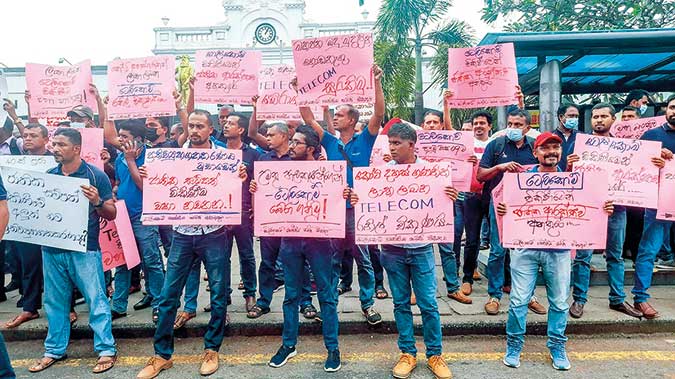
The recent announcement by the government that it intends to divest its investments in Sri Lanka Telecom (SLT), Lanka Hospitals (LH), and the Sri Lanka Insurance Corporation (SLIC) has resulted in many, including the leader of the opposition, the JVP, trade unions, a few journalists and other media personnel together with some academics to say We are against the privatization of profit-making SOEs.” Their opposition to the sale resonates with the public and supports the theory of selling the family silver.

When a young journalist posed this question to RW at a media conference, he told her in his typically offhand and condescending tone, We have debts to settle as well.” I believe it was an opportunity lost by RW to explain through the media to the people why it makes perfect sense to dispose of the shares held in SLT, SLIC and LH.

In my opinion, when it comes to the economy and finance, most people in our country are ignorant. Many highly educated people and experts in their own field I know say, I don’t know or understand finance.” In the last couple of years, we have seen greater discussion and information sharing on the economy and finance due to the economic crisis. However, there is still a lack of understanding and proper appreciation of the issues. The government must disseminate the policy through its media with greater focus and transparency. I have often been dismayed when RW and other government officials say, The IMF has told us to do this and that”. Instead of passing the buck to the IMF, GOSL needs to say commonsense and financial prudence demands what we’re doing.

Why it’s sensible for GOSL

to sell its SLT stake

For me, the logic in selling the shares of profitable enterprises is evident on both financial and ideological grounds. In the case of SLT, the GOSL, through the Treasury and the Employees Trust Fund (ETF), currently own a controlling 50.9% of the company. A share of SLT trades presently at around Rs. 94 on the Colombo Stock Exchange. This means the company’s value is around Rs. 168 billion. Therefore the GOSL stake is worth around Rs. 86 billion.

However, the current market price of an SLT share is significantly overvalued due to the anticipated sale of the government stake. According to the company’s latest Annual Report, in the last 10 years up to the end of 2021, the highest price the share commanded was Rs. 57.30 in 2014. However, in 2022 the highest traded price was Rs. 78.90, whilst the lowest was Rs. 28.70. Obviously, an independent valuation would need to be carried out considering that a controlling stake is being sold. Several well-established methodologies are used in the valuation of companies.

To illustrate my point that it is beneficial for GOSL to sell out, I will assume Rs. 65 per share is the price the government will get on the deal. The GOSL would therefore be able to receive Rs. 59.7 billion by selling its SLT stake.

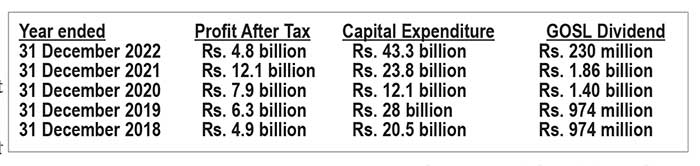
I have set out below the last five-year financial performance, capital expenditure and dividends paid to GOSL by the SLT Group.As can be observed, despite posting healthy profits, the dividends declared have been constrained by the high capital expenditure incurred. Given the rapid technological development and the ever-expanding use of mobile communication and the Internet, all telecommunication companies need to incur continuous capital expenditure to keep abreast.

The table shows the GOSL has only received total dividends of Rs 5.4 billion over five years, an annual average of Rs 1.1 billion a year.

So the question is whether retaining its SLT shares and earning Rs. 1 billion a year against receiving Rs. 59.7 billion as sales proceeds, is beneficial to the country or not. As stated by RW , the GOSL by selling could then utilize the Rs. 59.7 billion proceeds to retire some of its current debt and also not raise new loans as is currently done at interest rates above 20% plus. The interest saving for a year on the new debt at 20% would be Rs. 12 billion.

Opportunity cost is the criterion for making prudent financial decisions. The definition of opportunity costs is the value or benefit of what you lose or miss when you choose one alternative over another. In this instance, in case the GOSL does not sell its SLT stake at my assumed price of Rs. 65 per share, the opportunity cost foregone is Rs. 11 billion for a year.

The sale of SLT shares will not impact on our national security as the largest telecommunications operator in the country is a foreign-owned entity.

In 1997, the government, through a competitive bidding process, sold 35% of its shareholding in SLT to Nippon Telegraph and Telephone (NTT) of Japan for US$ 225 million. This was then the largest ever privatization transaction of GOSL.

The transformation of SLT under a Japanese CEO after partial privatization was immense and is often cited as an example of why SOEs should be privatized. The days when we had to wait nearly five years to get a new fixed-line connection were ended as SLT was transformed into a service-centric business enterprise. However, even after two decades, the Chairman of SLT, in his message to the shareholders in the 2021 Annual Report, laments, In January 2020, we saw a company with immense potential, but its progress was obstructed in several areas. Staff unrest was at the top of the list with regular strikes and work stoppages leading to poor messaging (signalling) to the customers, especially the corporate sector.”

Staff remuneration cost at SLT versus its competitor

According to the latest Annual Report (AR), SLT employed 8,058 staff. In 2021 costing Rs. 20.7bn. wages. In contrast, Dialog Axiata Plc, its main competitor, with a significant market share (17.7 mn subscribers vs SLT’s 9.3 million) and revenue (Rs 142 Bn vs Rs. 102Bn) over SLT, employed only 3,631 staff with a total wage bill of Rs. 10 bn. The bottom line is that SLT incurs Rs. 10.7 bn staff costs over its competitor to service a subscriber base significantly lower than its rival. These figures reflect the cost inefficiencies at SLT and other SOEs and is the primary reason the trade unions vehemently oppose the sale of the GOSL stake.

Furthermore, Dialog Axiata Plc has stated in its Annual Report that they have invested US $ 3 Bn since inception. In 2021, they paid Rs 8.4 billion as direct taxes and collected Rs. 14.8 Billion as consumption taxes. Another benefit of privatization for the GOSL is that it stands to collect higher direct taxes from companies operating efficiently with a cost focus.

The logic I have applied to the sale of the SLT stake is equally applicable to the sale of the GOSL stakes in Lanka Hospitals and Sri Lanka Insurance Corporation.

We need to set aside, at least now, this long-held view that the government should be involved in controlling and operating businesses. The process of privatization is lengthy and, as can be seen, will meet various hurdles. However, the GOSL must be steadfast in its determination to go ahead with the planned privatization/restructuring process of SOEs and actively engage the public and educate them of the benefits.

Transparency and competitive bidding when Privatising SOEs

A mandatory requirement for privatization is that the process must be totally transparent and be based on competitive bidding. Furthermore, the base price/valuation for sale should be arrived at by an independent party so that they are no doubts that the GOSL and the people received the best possible deal.

The success of India

Sri Lanka should look across the ocean at India, which since 1991 has been following a strategy of Liberalization, Privatization and Globalization that has led to consistent economic growth; India is now considered a global economic powerhouse. A few years back, Prime Minister Narendra Modi said the government has no business to be in business, and his administration is committed to privatizing all PSUs barring the bare minimum, in four strategic sectors.

It is the government’s duty to support enterprises and businesses. But it is not essential that it should own and run enterprises,” he said. Modi also said the Centre’s policy is to either monetize or modernize public sector enterprises on the basis that the government has no business to be in business”.

(The views and opinions expressed in this article are of the author and are not of any institution or organization that he may be associated with.)

On sweeping close to one’s feet

April 30th, 2023

Jayanath Bodahandi (Bodhi), the eldest in his family, would have been just out of school when his father, an illustrator at an advertising agency, passed away. Bodhi could draw and the kind people at the agency offered him a job.

There was a problem. Bodhi lived in Balapitiya and the salary would hardly cover expenses such as rent, food and bus fare. There was a solution. The hamuduruwo of the village temple arranged for him to stay in a temple in Colombo.

Bodhi returned to the temple late after his first day at work to find there was no food for him. The loku hamuduruwo had explained that it wasn’t a rich temple frequented by wealthy and generous laity; it was not possible to provide meals.  

Bodhi went to sleep hungry. He was up early the following morning. He decided that this arrangement wasn’t working. He had just enough money for the bus to Balapitiya. So he went to work. No, not to the advertising agency. The temple.

He picked up an idala (ekel broom) and started sweeping the temple premises. As he was finishing, he noticed the loku hamuduruwo watching him. When he was done, he kept the idala aside, went up to the loku hamuduruwo, worshipped him, thanked him for allowing him to stay and told him that he had decided to give up on his job and return home.

The loku hamuduruwo understood Bodhi’s predicament. He dissuaded the young man: ‘thiyena vidihakata kaala imu; yanna ona naha (you don’t have to go; let’s manage with what we have).’

Years later Bodhi said that in retrospect the exercise of sweeping the temple compound was like an advertising campaign.

It was a simple act. An act of gratitude for something simple that he received — a roof over his head for one night. It led to a career in advertising that saw him become a creative director at a top agency and then starting off on his own.  

Two things reminded me of Bodhi’s story, a poem and a photograph. First, the poem.

පා අවට විතරයි
පිරිසිදු කළේ ඉදල
අවසානයේ
අතුගෑවිලා මිදුල

Essentially: the ekel broom sweeps around or close to the feet, but it is an entire compound that has got swept.

The poet throws soft light on the simple and commonplace and makes visible profound truths, as is evidenced in most of the poems in the collection, Suminda Kithsiri Gunaratne’s sixth, Prisma (Prisms).

And the photo: that of a hamuduruwoidala in hand, sweeping the compound of the Buddhangala Monastery in Ampara, apparently belonging to the Digamadulla Kingdom, 4th Century BC. Buddhangala, although located deep in the jungles around Ampara, was brought back to life, so to speak, by a brave young hamuduruwo in 1964, Rev Kalutara Dhammananda Thero. I am not sure if it is this hamuduruwo who is captured in the photograph, but most certainly the complex developing to what it is now owes much to the fact that the Thero had focused on sweeping close to his feet.

On a tree close to where the hamuduruwo is sweeping there’s a board with the following line from the Dhammapada: ‘Appamado amatha padang — nopamaava nivanata hethu ve,’ which can be loosely translated as ‘timely action, i.e. without delay, paves the way to nirvana.’

That which needs to be done right now, then, needs to be done with absolute integrity of the faculties, with composure, dedication and unwavering resolve. Large and complex extents, physical and otherwise, get cleared thereby.

Bodhi was sweeping the area close to his feet; the entire compound got swept . Rev Kalutara Dhammananda Thero was sweeping the area close to his feet; and now people know there’s a place called Buddhangala in Ampara. The hamuduruwo in the photograph is sweeping the area closest to his feet; it’s an example, a study in concentration that throws a lot of light on right conduct.

Tharindu, in his photographic endeavours, is essentially covering or rather clearing nearby-ground; he ends up clearing vast areas of the mind, his and (at least) mine.  Suminda uses pen as an idala. He removes clutter, keeps things tidy. He is in fact casting a thin ray of light on the mind’s prisms which duly disperses and shows things in their true colours.

All sweepers. Focusing on that which needs to be sorted in the here and now. The rest follows. 

ඇමරිකානු තානාපතිනිය ප‍්‍රසිද්ද විවාදයකට කැදවයි…

April 30th, 2023

උපුටා ගැන්ම ලංකා සී නිව්ස්

ඇමරිකා එක්සත් ජනපද රාජ්‍ය දෙපාර්තමේන්තුවේ දේශපාලන කටයුතු පිළිබඳ නියෝජ්‍ය ලේකම් වික්ටෝරියා නූලන්ඩ්ගේ තිර පිටපතකට අනුව මෙරට ඇමරිකා එක්සත් ජනපද තනාපතිනිය වන ජුලී චන්ග්ගේ අධ්‍යක්ෂණයෙන් දියත් වූ ශ්‍රී ලංකාවට ද ලිබියාවට, හයිටියට හෝ ඉරාකයට අත්කර දුන් ඉරණමම අත් කර දීමේ කුමන්ත්‍රණය පිළිගත හැකි සාක්ෂි සහිතව අනාවරණය කිරීමට විමල් වීරවංශ මහතා විසින් රචිත නවය; සැඟවුණු කතාව” පර්යේෂණාත්මක කෘතිය මැනවින් සමත්ව ඇති බවත් එය මෙරට පමණක් නොව ජාත්‍යන්තර දේශපාලන කරලිය ද උණුසුම් කිරීමට සමත්ව ඇති බවත් ඉහත කී කුමන්ත්‍රණයේ දේශීය භූමිකාවන් ඉටු කළ සරත් ෆොන්සේකා, පාඨලී චම්පික රණවක, ජනතා විමුක්ති පෙරමුණ, පෙරටුගාමී සමාජවාදී පක්ෂය, රාජ්‍ය නොවන සංවිධාන නඩය ඇතුළු ඇමරිකානු පිල්ලි ඉන් දැඩි ලෙස කැළඹී, පරල වී, නන් දොඩවමින් සිටින බවත් ජාතික නිදහස් පෙරමුණේ ජාතික සංවිධායක, පාර්ලිමේන්තු මන්ත්‍රී ජයන්ත සමරවීර මහතා පෙන්වා දෙයි.

පරල වී, මඩ ගසමින්, නන් දෙඩවීම පසෙක තබා, කෘතිය පිළිබඳව හරවත් දේශපාලන සංවාදයකට සූදානම් ඕනෑම අයකුට ඒ සඳහා අවස්ථාව විවරව ඇති බව ද ජානිපෙ ජාතික සංවිධායකවරයා පවසයි.

අද(30) පිටකෝට්ටේ පිහිටි ජාතික නිදහස් පෙරමුණේ ප්‍රධාන කාර්යාලයේදී පැවැති මාධ්‍ය හමුවකට එක්වෙමින් ඒ මහතා මෙම අදහස් පළ කළේය.

එහිදී වැඩිදුරටත් අදහස් දැක්වූ ජයන්ත සමරවීර මහතා මෙසේද සඳහන් කළේය.

එළිබහින ඇමරිකානු පිල්ලි ටික

අප පක්ෂයේ නායක, උත්තර ලංකා සභාගයේ සභාපති විමල් වීරවංශ සහෝදරයා ඊනියා ගාලුමුවදොර අරගලයේ ඇතුළාන්තය පිළිබඳව රචිත පර්යේෂණාත්මක කෘතිය පිළිබඳව මේ වන විට ශ්‍රී ලංකාව තුළ පමණක් නොවෙයි ජාත්‍යන්තර දේශපාලන කරලිය තුළ ද උණුසුම් කතාබහක් ඇතිව තිබෙනවා. පොත ඉංග්‍රීසියට පරිවර්තනය වීමටත් ප්‍රථමයෙන් එය ඉංග්‍රීසියට පරිවර්තනය කර ගෙන, කියවා තිබූ ශ්‍රී ලංකාවේ ඇමරිකානු එක්සත් ජනපද තානාපතිනිය පැවසුවේ ‘මෙහි සඳහන් කරුණු පිළිබඳව මා කම්පාවට පත් වෙනවා. එය ප්‍රබන්ධයක්’ කියලයි. ඒ වගේම ෆීල්ඩ් මාර්ෂල් සරත් ෆොන්සේකා මහත්තයා මේ කෘතිය පිළිබඳව පාර්ලිමේන්තුවේදී අදහස් දැක්වූයේ ආවේගශීලීව, පරල වෙමින් විමල් වීරවංශ සහෝදරයාට මඩ හා අවලාද ගසමින්. ඒ වගේම පාඨලී චම්පික රණවක මන්ත්‍රීවරයා ද මාධ්‍ය හමුවක් පවත්වා නන් දොඩවා තිබුණා ‘අරගලයේ නීතිඥයෝ’ යැයි කියා ගත් පිරිසක් විලාප දෙනවා දැක්කා, ‘අරගලය පැත්තෙ නාපු විමල් වීරවංශ ඒ ගැන පොත් ලියන්නේ කොහොමද?’ කියා. විමල් වීරවංශ සහෝදරයා ලිව්වේ අරගල භූමියේ කූඩාරම් ඇතුළේ, යාබද හෝටල් කාමර ඇතුළේ හෝ වෙනත් තැන්වල සිදු වූ දේවල් නොවෙයිනේ. ඒ වගේම ජනතා විමුක්ති පෙරමුණේ ප්‍රධාන ලේකම් ටිල්වින් සිල්වා මහත්තයා, ‘විමල් වීරවංශ අරගලය පැත්තේ ආවෙත් නැහැ. එයා හැමදාම ලියන්නේ එයාගේ ඔළුවේ තියෙන දෙයක්’ කියමින් නන් දොඩවා තිබුණා. ඊට අමතරව මේ වන විට චන්ද්‍රිකා කුමාරතුංග මහත්මිය පස්සේ වැටිලා ඉන්න ධනීෂ් අලී නැමැත්තා ද මේ ගැන නන් දොඩවා තිබුණා. අරගලය” පිටුපස තිබූ ඇත්ත කතාව මෙසේ අනාවරණය වීමත් සමගම ඇමරිකානු පිල්ලි ටික එකා පරයා එකා එළියට බහිමින් තිබෙනවා.

ෆොන්සේකාගේ ‘කැරැට්ටුව’

ඇමරිකාව මුලින්ම ‘රෙජීම් චේන්ජ්’ කරගන්න හැදුවේ ෆීල්ඩ් මාර්ෂල් සරත් ෆොන්සේකා හරහායි. ඒ 2010දී යි. අපි දන්නවා ජාත්‍යන්තර මානව හිමිකම් කවුන්සිලය ‘සත්‍ය හා යුක්තිය සඳහා වන ව්‍යාපෘතියක්’ හැදුවා .එහි ප්‍රධානියා වූයේ යස්මින් සූකා මහත්මියයි. යුද ජයග්‍රහණ සමයේ මේජර් ජෙනරාල්වරයකු ලෙස කටයුතු කළ වත්මන් ආරක්ෂක ලේකම් කමල් ගුණරත්නට පිටු 100ක යුද අපරාධ හා බැඳුණු චෝදනා පත්‍රයක් ද යුද ජයග්‍රහණ සමයේ බ්‍රිගේඩියර්වරයකු ලෙස කටයුතු කළ වත්මන් ආරක්ෂක හමුදා මාණ්ඩලික ප්‍රධානී ශවේන්ද්‍ර සිල්වාට පිටු134ක චෝදනා පත්‍රයක් ද මෙම ව්‍යාපෘතිය මගින් සකසා තිබෙනවා. නමුත් දැන් බලන්න, යුද ජයග්‍රහණ සමයේ හමුදාපතිවරයා වූ සරත් ෆොන්සේකාට විරුද්ධව කිසිදු චෝදනා පත්‍රයක් මෙමගින් ඉදිරිපත් කර නැහැ. යස්මින් සූකාලා සරත් ෆොන්සේකාට විරුද්ධව එක වචනයක්වත් කියන්නේ නැහැ. එහෙම වෙන්නේ සරත් ෆොන්සේකා වික්ටෝරියා නූලන්ඩ්ලාගේ, ජුලී චන්ග්ලාගේ, යස්මින් සූකාලාගේ සුවච කීකරු ගෝලයකු නිසයි. බලන්න, ඊනියා ගාලු මුවදොර අරගලය භූමියේ කතාවක් ලැබුණු එකම දේශපාලනඥයා සරත් ෆොන්සේකා. එහෙම වෙන්නේ ඔහු ඇමෙරිකා එක්සත් ජනපදයේ සුවච කීකරු ගෝලයකු නිසයි. මේ කෘතියෙන් තමන්ගේ රෙදි ගැලවෙන කොට සරත් ෆොන්සේකා කලබල වීම අපට තේරුම් ගත හැකියි.

43 වන සේනාංකයේ පාඨලී”

පාඨලී චම්පික රණවකගේ කලබල වීමත් අපට වටහාගත හැකියි. ඔහු තවමත් ඇමරිකාව සහ ශ්‍රී ලංකාව අතර අත්සන් කිරීමට යෝජිත එම්සීසී ගිවිසුම සම්බන්ධයෙන් පෙනී සිටිනවා. ජුලී චන්ග්ලාගේ ‘ප්ලෑන් ඒ’ අනුව කතානායකතුමාගේ ප්‍රධානත්වයෙන් එදා අන්තර්කාලීන පාලනයක් හැදුවානම් ’43 වන සේනාංකයේ පාඨලී චම්පික රණවකටත්’ ඇමරිකාව එහි ඉඩක් දෙනවා. දැන් බලන්න, ‘අරගල ඩිජිටල් නායක’ පැතුම් කර්නර් අද ඉන්නේ ජනාධිපති රනිල් වික්‍රමසිංහ සමග. අරගල නායිකාවක වූ දමිතා අබේරත්න අද ඉන්නේ විපක්ෂ නායක සජිත් ප්‍රේමදාස සමඟයි. මේ අයත් හෙට දිනයේ දී යමක් කියාවි.

ශ්‍රී ලංකාව තමන්ගේ දඩබිමක්, තිප්පොළක් බවට පත්කර ගැනීමට, අමෙරිකානු රාජ්‍ය දෙපාර්තමේන්තුවේ දේශපාලන කටයුතු පිළිබඳ නියෝජ්‍ය රාජ්‍ය ලේකම් වික්ටෝරියා නූලන්ඩ්ගේ තිර පිටපතට අනුව, මේ රටේ ඇමරිකානු තානාපතිනිය ජුලී චන්ග්ගේ අධ්‍යක්ෂණයෙන් දියත් වූ ඊනියා ගාලුමුවදොර අරගලයේ ඇත්ත කතාව හෙළිදරව් වීමත් සමඟ පරල වී ඇති බැටෑලියන් එකට අපි කියන්නේ, ‘මේ පොතේ තිබෙන කරුණු, සාක්ෂි, දේශපාලන හරයන් සමග වාද කරන්න එන්න’ කියලයි. එහෙම ආවොත් අපි පෙන්වන්නම් ශ්‍රී ලංකාව තවත් ලිබියාවක්, හයිටියක්, ඉරාකයක් බවට පත්කිරීමට නුඹලා කුමන්ත්‍රණය කළේ කෙසේද? කියා.

‘ටිල්වින් – ලාල් පරස්පරය’

දැන් ජනතා විමුක්ති පෙරමුණේ ප්‍රධාන ලේකම් ටිල්වින් සිල්වා මහත්තයා ජුලී චන්ග්ටත් එහා ගිහිල්ලා කියනවා, ‘මේක විමල්ගේ ප්‍රබන්ධයක්’ කියලා. නමුත් ජනතා විමුක්ති පෙරමුණේ දේශපාලන මණ්ඩල සභික, වෘත්තීය අංශයේ නායක කේ. ඩී. ලාල්කාන්ත මහත්තයා මේ ගැන මොකද කියන්නේ? ‘මේ අරගලය මෙහෙයවන ලද්දේ ඇමරිකානු තානාපතිනිය විසින්’ කියන එක ඇත්ත කියලයි ඔහු කියන්නේ. ලාල්කාන්ත මහත්තයා තව අපූරු හෙළිදරව්වක් ද කරනවා. ‘දැනුවත්ව මේ අරගලයට ගියානම් ඒක ජොබ් එක. පැතුම් කර්නර් කරන්නේ ජොබ් එකක්.’ කියලයි ඔහු පෙන්වා දෙන්නේ. ඒ වගේම ඔහු කියනවා, ‘නොදැනුවත්ව අරගලයට ගියානම් ඒක මෝඩකම’ කියලා. එයාට අනුව පැතුම් කර්නර් කරන්නේ ජොබ් එකක්; රැට්ටා මෝඩයෙක්. ඒ කියන්නේ මෝඩකමට වගේම ජොබ් එකක් ලෙස අරගලයට ගියපු අය ඉන්නා බවයි

‘අනුර – ලාල් පරස්පරය’

ඊනියා ගාලුමුවදොර අරගල සමයේදී ජනතා විමුක්ති පෙරමුණේ නායක අනුර දිසානායක මහත්තයා පිළිගන්නවා, ‘අපි අරගලයේ ප්‍රධාන කොටස්කරුවෙක්’ කියා. ‘අපේ කලා සංගමය, තරුණ සංගමය, කාන්තා සංගමය මෙහි ප්‍රධාන කොටස්කරුවෝ. අපේ සටන් පාඨ එතැන ක්‍රියාත්මක වුණා. අපි එතැන් සජීවී විකාශ ක්‍රියාත්මක කළා.’ කියා ඔහු පවසනවා. මම දැන් ඉතාම ආදරයෙන් ලාල්කාන්ත මහත්තයාගෙන් අහනවා, ‘ජනතා විමුක්ති පෙරමුණ ගාලුමුවදොර අරගලයේ කොටස්කරුවකු වූයේ නොදැනුවත්ව ‘රැට්ටා’ වගේ මෝඩකමට ද? නැත්නම් ජනතා විමුක්ති පෙරමුණත් එතැන කළේ පැතුම් කර්නර් වගේ ජොබ් එකක් ද?’ කියා. දැන් ඒක ජනතා විමුක්ති පෙරමුණ රටට කිව යුතුයි.

‘රටට කළ අපරාධය’

ඊනියා ගෝල්ෆේස් අරගලය, මේ රටට කරපු හානිය සුළුපටු නැහැ. එමඟින් දහස් ගණනක් මියයාමට නියමිතව තිබුණා. රටම අමු සොහොනක් වීමට ඉඩ තිබුණා. දැන් බලන්න, මහ බැංකුව ජාත්‍යන්තර මූල්‍ය අරමුදලට යට කරන්න නව මහ බැංකු පනතක් එනවා. මහජනතාව තම අයිතීන් දිනාගන්න පෙරට එන විට මර්දනයට අවශ්‍ය නීති ඇතුළත් නව ත්‍රස්ත විරෝධී පනතක් එනවා. දහතුන්වැනි සංශෝධනය පූර්ණ ලෙස බලාත්මක කිරීමට සැරසෙනවා. පසුගිය දිනවල ඇමරිකාව ‘Top Secret Mission’ එකක් දියත් කළා. සීඅයිඒ ප්‍රධානියා පවා ශ්‍රී ලංකාව තුළට ආවා. ඒ අනුව හෙට දිනයේ ශ්‍රී ලංකාව තුළ ඇමෙරිකානු යුද කඳවුරකට පාර කැපෙන සෝෆා ගිවිසුමට රනිල් වික්‍රමසිංහ ජනාධිපතිවරයා අත්සන් තබාවි. ඒ වගේම පාඨලී චම්පික රණවක ඇමතිකම් ලබා ගෙන ඇමරිකාව සමග එම්සීසී ගිවිසුමට පාර කපා ගනීවි. එදා ‘Top Secret Mission’ එකක්, කවර හෝ රටට හානිකර මෙහෙයුමක් සිදු වුවහොත් එය රටට අනාවරණය කළේ, ඊට එරෙහිව ජනතා බලවේග සංවිධානය කළේ ජනතා විමුක්ති පෙරමුණයි. ඉහත කී ඇමෙරිකානු Top Secret Mission එක පිළිබඳව ජවිපෙ නායකයන් කට ඇරියේ නැහැ. ‘මේ සියලු අපරාධයන්ට සරත් ෆොන්සේකා, පාඨලී චම්පික රණවක, ජනතා විමුක්ති පෙරමුණ, පෙරටුගාමීන්, රාජ්‍ය නොවන සංවිධාන නඩය වගකිව යුතුයි’ කියන එක ජනතාවට අපි අවධාරණය කරනවා”

මෙම මාධ්‍ය හමුවට ජාතික නිදහස් පෙරමුණේ භාණ්ඩාගාරික, හිටපු පාර්ලිමේන්තු මන්ත්‍රී දීපාල් ගුණසේකර මහතා ද එක්ව සිටියේය.

අනුරුද්ධ බණ්ඩාර රණවාරණ
මාධ්‍ය ලේකම්,
ජාතික නිදහස් පෙරමුණ

කරන්නාගොඩගේ තහනම පිටුපස හිටපු හමුදාපතිවරයකු සිටින බවට අනාවරණයක්

April 30th, 2023

Lanka Lead News

හිටපු නාවික හමුදාපති වසන්ත කරන්නාගොඩ ඇමෙරිකාවට පැමිණීම එරට රාජ්‍ය දෙපාර්තමේන්තුව තහනම් කරනු ලැබ ඇත්තේ හිටපු නායක හමුදාපතිවරයකු සහ රහස් පොලිසියේ පරීක්ෂකවරයකු ලබාදුන් සාක්ෂි මත බව කරුණු අනාවරණය වී තිබේ.

එම සාක්ෂිකරුවන් කරන්නාගොඩට එරෙහිව රහස් පොලිසියට ද කටඋත්තර දී ඇති බව පැවසේ.

මේ අතර වසන්ත කරන්නාගොඩට එරෙහිව රහස් පොලිසියට කටඋත්තර දුන් තවත් නාවික නිලධාරියකුට ඔස්ට්‍රේලියානු රජය එරට දේශපාලන රැකවරණ ද ලබා දී ඇති බව වාර්තා වේ.

අරගලයේ සැඟවුනු කතාව එළියට දැමීමෙන් අමෙරිකානු පිල්ලි ටික කලබල වෙලා – විමල්ගේ සැඟවුණු කතාවට චෝදනා කළ අයට ජයන්ත සමරවීරගෙන් පිළිතුරු (වීඩියෝ)

April 30th, 2023

 Lanka Lead News

විමල් වීරවංශ මහතා විසින් රචිත අරගලයේ සැඟවුණු කතාව කෘතිය එළිදැක් වූ පසු මෙරට සිටින අමෙරිකානු පිල්ලි ටික කලබලයට පත්වී ඇති බවත් මෙරට අමෙරිකානු තානාපතිනිය ද කෘතිය එළිදැක්වූ විගසම එය ඉංග්‍රීසියට පරිවර්තනය කරගනිමින් කියවා ඇති බවත් ජාතික නිදහස් පෙරමුණේ ජාතික සංවිධායක, පාර්ලිමේන්තු මන්ත්‍රී ජයන්ත සමරවීර මහතා පවසයි.

විමල් වීරවංශ මහතා විසින් රචිත අරගලයේ සැඟවුණු කතාව කෘතිය සම්බන්ධයෙන් එල්ල වී ඇති විවේචන පිළිබඳව මාධ්‍ය හමුවක් පවත්වා ඒම චෝදනා සදහා පිළිතුරු ලබාදීමට ජයන්ත සමරවීර මහතා අද(30) කටයුතු කළේය.

එහිදී අදහස් දැක්වූ ජයන්ත සමරවීර මහතා,

විමල් වීරවංශ මහතාගේ මේ කෘතිය සම්බන්ධයෙන් අද ජාතික වශයෙන් විතරක් ජාත්‍යන්තර වශයෙන් දේශපාලන ලෝකය විශාල ලෙස කැලඹීමයකට ලක්වෙලා තියෙනවා. මේ කෘතිය පිළිබද කලබලයට පත්වුණු ඇමෙරිකානු තානාපතිනිය ජුලී වැන්ග් මෙක ඉතාම වේගයෙන් ඉංග්‍රීසියට පරිවර්තනය කරගෙන මෙය ප්‍රබන්ධයක් කියලා කියනවා. ඊට පස්සේ ෆිල්ඩ් මාර්ෂල් සරත් ෆෙන්සේකා මහත්තයා පාර්ලිමේන්තුවේදි පරල වෙලා මඩ ගහන්න පටන් ගන්නවා. ඒ් වගේම අපි දැක්කා පාඨලී චම්පික රණවක මහත්තයාත් මේ ගැන කතා කරනවා. තව අපි ඊයේ දැක්කා අරගලයේ නීතිඥයෝ ද මොකක්ද කියන කට්ටයක් කියනවා, අරගලයට ආවේවත් නැති විමල් වීරවංශ මොනවද අරගලය ගැන දන්නේ කියලා. අපි කයනවා විමල් වීරවංශ අරගලයේ හිටියේ නෑ තමයි ඒ්ක හරි අපි මේ පොතේ ලියලා තියෙන්නේ අරගලය ඇතුලේ කුඩාරම්වල වෙච්ච දේවල් හරි ඒකේ ඇතැම් නායකයින් හෝටල්වල කාමරවල කරපු දේවල් දේවල් හරි රෑට රෑට තැන්තැන්වල සිද්ධවෙච්ච දේවල් හරි නෙවෙයි”

සවිස්තරාත්මක වීඩියෝව නරඹන්න…

Fuel prices reduced from tonight

April 30th, 2023

Courtesy The Daily Mirror

The Power and Energy Minister has decided to reduce the retail prices of Lanka Petrol 92 Octane, Lanka Petrol 95 Octane Euro 4, Lanka Auto Diesel and Lanka Super Diesel 4 Star Euro 4 from tonight.

The announcement was made by Minister Kanchana Wijesekera this evening.

Consequently, a litre of Lanka Petrol 92 Octane (Rs. 340) will be reduced by Rs. 7, and the new retail price will be Rs. 333. A litre of Lanka Petrol 95 Octane Euro 4 (Rs. 375) will be reduced by Rs. 10 and the new retail price will be Rs. 365.

The price of a litre of Lanka Auto Diesel (Rs. 325)  will be reduced by Rs. 15 and the new retail price will be Rs. 310. The retail price of a litre of Lanka Super Diesel 4 Star Euro 4 (Rs. 455) will be reduced by Rs. 135 and the new retail price will be Rs. 330.

However, there is no price revisions of Lanka Kerosene (Rs. 295) and Lanka Industrial Kerosene (Rs. 330). (Chaturanga Pradeep Samarawickrama)

Public opinions to be sought regarding new Anti-Terrorism Bill

April 30th, 2023

Courtesy Adaderana

The Ministry of Justice has decided to obtain public opinions and suggestions with regard to the new proposed Anti-Terrorism Bill.

Accordingly, any individual including the political parties and civil society organizations will receive the opportunity for this purpose, Minister of Justice Wijeyadasa Rajapakshe said.

Thereby, the general public can hand over their suggestions and opinions regarding the matter to the Justice Ministry until May 30, 2023.

It has reportedly been decided to hold several rounds of discussions with regard to this, after obtaining the public opinions and to decide the future actions related to the new proposed Anti-Terrorism Bill in consideration of all those suggestions by the public.

Furthermore, Minister Rajapakshe also emphasized that measures will be taken to table the relevant bill in the parliament in a manner that is acceptable by all.

The new Anti-Terrorism Bill was published by the government in the gazette recently and certain parties raised objections regarding the matter.

Accordingly, Justice Minister Rajapakshe took steps to temporarily halt the tabling of the relevant bill in the Parliament.

Sri Lanka’s inflation dips as IMF bailout kicks in

April 29th, 2023

Courtesy Mizzima

Cash-strapped Sri Lanka’s inflation eased to 35.3 percent, the lowest in a year, the statistics office said Friday as the country pressed ahead with austerity measures under an IMF bailout.

Fuel and food prices coming off their record highs helped inflation moderate in April, the Department of Census and Statistics said.

April is the first full month since the International Monetary Fund released the first instalment of a $3 billion loan spread over four years.

The rate of price increases peaked at 69.8 percent in September as Sri Lanka struggled to finance imports of essential goods after declaring a sovereign default on its $46 billion foreign debt in April last year.

April’s inflation of 35.3 percent is the lowest since the 29.8 percent recorded a year earlier.

President Ranil Wickremesinghe warned his 22 million people soon after the IMF bailout in late March that they may have to endure more hardships due to austerity measures.

The South Asian nation went through months of food and fuel shortages, along with runaway inflation and prolonged blackouts, due to an unprecedented foreign exchange shortage.

The economic crisis led to months of protests that eventually forced then-president Gotabaya Rajapaksa to flee the country and step down in July.

Wickremesinghe has doubled income taxes, increased electricity tariffs and removed fuel subsidies as part of moves to shore up state revenue since replacing Rajapaksa.

He has also cracked down on trade unions protesting against high taxes and the government has warned it will confiscate the property of anyone staging work stoppages.

In its latest annual report, released on Thursday, the Central Bank of Sri Lanka expected an economic revival next year after a record 7.8 percent GDP contraction in 2022.

The bank forecast the economy to shrink by 2.0 percent this year but said it could grow at 3.3 percent in 2024.

US Sanctions Former Sri Lankan Navy Chief – Analysis

April 29th, 2023

By  Courtesy Eurasia Review

Although human rights violations are cited as the reason for sanctioning, the West has been using sanctions mainly to attain geopolitical objectives.  

The US this week sanctioned the former Sri Lankan navy chief, Adm. Wasantha Karannagoda. Earlier, Canada had sanctioned former Presidents Mahinda Rajapaksa and Gotabaya Rajapaksa. These listings have been portrayed as measures to enforce human rights. But, in fact, human rights have been a veneer, a fig leaf so to speak, to cover hard-nosed geopolitical objectives. 

The history of sanctions clearly demonstrates that the West, particularly the US, uses sanctions as an instrument of geopolitics to browbeat weak and dependent nations and cripple leaders who would not bend to the American ill.  

Sanctions are not applied against strong countries or strong leaders who are pro-US. For example, the US will not sanction Indian Prime Minister Narendra Modi for human rights violations because he is now a powerful, pro-US leader. Earlier, when he was a provincial leader (Chief Minister of Gujarat), the US had no problem about barring his entry into the US for alleged complicity in the 2002 Gujarat killings.

Holier Than Thou 

The sanctioning power would not punish its own citizens who had committed war crimes abroad. 

The UK had tried to bring legislation to prevent its troops from being dragged to courts in vexatious” litigations. Eventually, under pressure from rights groups, that move was abandoned. 

The US, had been a major violator of human rights in Afghanistan. But it had threatened to arrest and sanction judges and other officials of the International Criminal Court (ICCC) if they moved to charge any American who served in Afghanistan with war crimes. White House National Security Advisor John Bolton had called the ICC unaccountable” and outright dangerous” to the United States, Israel and other allies. He said that the US was prepared to slap financial sanctions and criminal charges on officials of the court if they proceeded against any Americans.

We will ban its judges and prosecutors from entering the United States. We will sanction their funds in the US financial system, and we will prosecute them in the US criminal system,” he fumed. We will do the same for any company or state that assists an ICC investigation of Americans.”   

Actually, Canada sanctioned the Rajapaksa brothers and the US blacklisted Adm.Karannagoda not for the reasons stated (war crimes) but for not letting the separatist Tamil Tigers off the hook in the crucial final phase of the war in Sri Lanka as per the West’s wish. And after the war, they had brazenly invited China to take the lead in infrastructural development worth billions of dollars.

Bangladesh

Likewise, the US sanctioned top officers of the Bangladesh anti-terrorist outfit, the Rapid Action Battalion (RAB), not for extrajudicial killings and disappearances, as claimed, but because Prime Minister Sheikh Hasina was accommodative toward China. She had refused to be bullied into joining the Indo-Pacific anti-China line-up Quad”. 

Both the Rajapaksas and the RAB were assessed only from the US foreign policy angle in total disregard of their role in ridding their countries of terrorism and separatism (and drug running and Islamic radicalism in the case of Bangladesh).   

The Rajapaksas took the Canadian sanctions in their stride, perhaps given Sri Lanka’s dependence on the West for the IMF bailout. But the Bangladesh Foreign Secretary Masud Bin Momen summoned the US Ambassador Earl Miller and delivered a protest about the sanctioning of RAB.

The sanction against Bangladesh came in for adverse comment in the US itself. Derek Grossman, national security and Indo-Pacific analyst at RAND Corporation and Michael Kugelman, South Asia Senior Associate at the Wilson Center, viewed the US action in the context of strategic competition against China,” and noted that the Biden administration had not been happy about Dhaka’s growing ties with China.

Russia

In an unprecedented step against geopolitical rival Russia, which had invaded Western ally Ukraine, the US and its allies imposed wide-ranging sanctions, cutting off economic and trade links; seizing Russian assets, and blocking Russians from global payment systems like SWIFT, PayPal, Visa, and Mastercard. Sanctions made Russia’s Central Bank struggle to support the rouble. 

The long term goal of sanctioning Russia is to overthrow the recalcitrant Vladimir Putin and to prevent Russia from being a global challenger to the hegemony of the US and its allies.

ICC

The International Criminal Court (ICC) at The Hague has also become an instrument of Western hegemonic politics. Since the inception of the ICC, Africans have been brought to trial, predominantly. None from the West. In protest against such anti-African bias, Burundi left the ICC and the Kenayan parliament voted to leave it in 2013. South Africa threatened to quit.

The fundamental problem is that the court is operating in a world that is unequal politically and economically,” James Goldston, a former attorney in the ICC prosecutor’s office, was quoted as saying.

Futility of Sanctions 

Do sanctions deliver the goods? Mostly not, says Daniel W.Drezner in a piece entitled: The United States of Sanctions: The Use and Abuse of Economic Coercion in Foreign Affairs (Sept-Oct 2021). 

Sri Lanka’s ideas or policies on human rights have not changed as a consequence of sanctions because the existing policies have the approval of the majority Sinhala-Buddhist community, and because these policies are considered necessary for the survival of Sri Lanka as a single entity. 

In the case of Bangladesh too, the sanctions did not lead to any change in policy because Sheikh Hasina’s political clout has been based on her merciless action against drug peddlers, drug smugglers and Islamic terrorists, actions which are necessary for law and order and economic development.

Globally too, sanctions have not worked, though they have been the most oft used tool of US foreign policy. Daniel Drezner points out that during President Barack Obama’s first term, the US designated an average of 500 entities for sanctions per year, for reasons ranging from human rights abuses to nuclear proliferation to violations of territorial sovereignty. That nearly doubled during Donald Trump’s presidency. President Biden imposed new sanctions against Myanmar, Nicaragua and Russia.    

Drezner says that economic sanctions have hurt the targeted countries but have not broken them. But this is not grasped by the US leadership. A 2019 Government Accountability Office study concluded that not even the federal government knew if sanctions were working.

The truth is that Washington’s fixation with sanctions has little to do with their efficacy and everything to do with something else: American decline. No longer an unchallenged superpower, the United States can’t throw its weight around the way it used to. In relative terms, its military power and diplomatic influence have declined.”

Two decades of war, recession, polarization, and now a pandemic, have dented American power. Frustrated US presidents are left with fewer arrows in their quiver, and they are quick to reach for the easy, available tool of sanctions,” Drezner says.

Sanctions have hurt the US too, but the US is oblivious to this. 

Sanctions strain relations with allies, antagonize adversaries, and impose economic hardship on innocent civilians. Thus, sanctions not only reveal American decline but accelerate it too.”

To make matters worse, the tool is growing duller by the year. Future sanctions are likely to be even less effective,” Drezner predicts. 

Sanctioned countries attract sympathy and material help. China and India came to sanctioned Russia’s rescue. China will help Sri Lanka and India will not give up its policy of wooing Sri Lanka, irrespective of US sanctions. Geopolitics is the determining factor.  

P. K. Balachandran

P. K. Balachandran is a senior Indian journalist working in Sri Lanka for local and international media and has been writing on South Asian issues for the past 21 years.

POLITICS IN SRI LANKA Part 3 Me

April 29th, 2023

KAMALIKA PIERIS

The middle class, fed up of the shortages of the Sirimavo government, hailed the arrival of JR. They welcomed his appointment as head of state. They became disillusioned later, but his core group of admirers did not desert him.

JR handled the transition from a controlled economy to a more open one with great political skill said KM de Silva. JR was one of the few intelligent and educated politicians of Asia, said Daya de Silva. He was a visionary who transformed this country into a modern market economy. It was all good and smooth running since JR took over. JR was a benevolent dictator. He had a strong team and took firm decisions. The open economy was good. Tourists and foreign investors came in concluded Daya. 

One of the spectacular achievements of JR was the Accelerated Mahaweli Development Scheme said Sarath Amunugama.,  A project which was to have taken 30 years was successfully completed in 10 years. It was a gigantic engineering, financial, land settlement, agricultural and management undertaking which changed rural agriculture irrevocably.  

This was the largest river valley development which could be undertaken in the country. Many dams were needed.  Sarath noted that the early work of the damming of Mahaweli Ganga was done by CP de Silva during 1965-1970. When JR and Gamini Dissanayake got onto it, most of the preliminary planning work was already complete.

The Mahaweli project ignored the creation of a Trincomalee development corridor, it concentrated on dams, reservoirs and power stations. So human settlements and its spatial networks suffered, said Willie Mendis.  The Mahaweli programme carried out mostly through aid programmes did bring many benefits but the liberalization policy undermined local agricultural and industrial programmes, said IPC Mendis.

Sarath Amunugama noted that the Tourism sector was started by JR. He set up the Tourist Board. Hotels such as Lanka Oberoi, Intercontinental, Hilton, Taj and other International hotels built in Colombo as well as many resort hotels in scenic parts of the island were built in JR’s time. Trincomalee became an important tourist destination. A busy hotel industry was in operation in the area led by Nilaweli Beach hotel, Blue Lagoon and so on, said Jayatissa Bandaragoda.     

The first southern resort was at Bentota, at the Bentota Rest house. Sarath found much land fragmentation when he went to the south to see about the development of tourism there. In Balapitiya there were more than 200 pangu holders for each small block of land. Once the big hotels were built and tourists started coming, an amazing development took place said Sarath. Around our main destination a large number of middle and small level hotels restaurants, batik shops and grocery stores sprang up he noted.

Sarath Amunugama noted that the Cultural triangle” was another achievement of JR, though many tend to overlook this.

 I was told long ago, had Japan had offered to introduce television to Sri Lanka free, during the time of Sirimavo Bandaranaike. Her government had turned it down. In 1965 JR too had suggested the introduction of television, but the idea was shot down.

 In 1977 JR was in a position to introduce television to the island. He wanted it to be a state venture supervised by the media ministry. He turned to Japan. The enthusiastic Japanese ambassador got us the whole project free of charge as an outright grant said Sarath Amunugama who   was in charge of the project.

The Grant could be given according to Japanese law only for education, so we said this was for education and the original agreement carried this.  One of the studios in Rupavahini was specially designed to facilitate the making of education programmes and we did start broadcasting lessons in English and mathematics which won awards at international competitions, concluded Sarath.

JR started the National lottery to supplement the national budget.  Other ministers also saw the advantage of this, specially the printing contract it carried and started their own lotteries. Prime Minister Premadasa started Sevana fund, then came Mahapola. Eventually JR stopped any more lotteries.

President JR Jayewardene decided that a new parliament building was needed to accommodate the increased number of Parliamentarians. He requested the Embassies to help with the necessary expertise. The only Embassy that responded was the French and following consultation a team from Ecole Française d’Extrême-Orient for new towns led by Dr. François Daniel and Architect Planner Deloche arrived in Sri Lanka.  Architect Ashley de Vos was asked to join the team. JR had read something that Ashley de Vos had written, visited him and requested him to join.

Ashley recalls that the team toured the country for about a week to understand the history of the island. The historical monuments and the use of water as a feature in the landscape was impressive and taken note of. The team looked to see whether it was possible to create a connection of the new with the past and a location in Anuradhapura for the new Parliament was suggested.

Meanwhile, AnandaTissa De Alwis the MP for Kotte had suggested Kotte where there was   marsh land with very little habitation. The island in the middle of the Diyawanna Oya was thought to be appropriate for the Parliament project, especially with the marsh and the potential for the use of water in the design.  This island belonged to the E.W.Perera’s.

The Dutch hydrology expert brought over by the French reported that the marshes had to be preserved inviolate with the rain water flowing over the maximum area and finding its natural outlet to sea. If the marsh was intruded into or filled, and the free flow of water obstructed, the site and anything on it will get flooded.

Accordingly, the cleaning up and freeing of the natural lakes of the accumulated reed beds and other accretion was  done The Diyawanna Oya now had a free flow into the lakes behind the old Christian College, Kotte and into the sea.

However, having got wind of the proposal, large areas of the marsh were hurriedly sold by the owners to private developers and many areas were subjected to arbitrary filling. Two large tracks of land was bought up and resold for development.  This affected the landscape and interfered with the proposed location of the Ministerial offices and the housing for the officers who were going to work there.

 This was totally against the views of the Dutch Hydrology expert. He wanted the marsh kept inviolate. He concluded that arbitrary filling and blocking of the free flow of excess water of the Diyawanna Oya into the natural lakes behind the old Christian College Kotte, and the canals leading to the Wellawatta canal and to the sea should not be restricted or closed off. If not flooding would occur.

If you interfere with the free flow of rain water in the marshes and along the Diyawanna Oya into the natural lakes, into the canals and into the sea, the heavy rain will inundate the little marsh that is left and the unfortunate outcome will be that the Parliament building will get flooded he said. The parliament went under water on two occasions, noted Ashley de Vos. (Continued)

De-Dollarization Kicks Into High Gear

April 29th, 2023

  Courtesy The Unz Review


It is now established that the US dollar’s status as a global reserve currency is eroding. When corporate western media begins to attack the multipolar world’s de-dollarization narrative in earnest, you know the panic in Washington has fully set in.

The numbers: the dollar share of global reserves was 73 percent in 2001, 55 percent in 2021, and 47 percent in 2022. The key takeaway is that last year, the dollar share slid 10 times faster than the average in the past two decades.

Now it is no longer far-fetched to project a global dollar share of only 30 percent by the end of 2024, coinciding with the next US presidential election.

The defining moment – the actual trigger leading to the Fall of the Hegemon – was in February 2022, when over $300 billion in Russian foreign reserves were frozen” by the collective west, and every other country on the planet began fearing for their own dollar stores abroad. There was some comic relief in this absurd move, though: the EU can’t find” most of it.

Now cue to some current essential developments on the trading front.

Over 70 percent of trade deals between Russia and China now use either the ruble or the yuan, according to Russian Finance Minister Anton Siluanov.

Russia and India are trading oil in rupees. Less than four weeks ago, Banco Bocom BBM became the first Latin American bank to sign up as a direct participant of the Cross-Border Interbank Payment System (CIPS), which is the Chinese alternative to the western-led financial messaging system, SWIFT.

China’s CNOOC and France’s Total signed their first LNG trade in yuan via the Shanghai Petroleum and Natural Gas Exchange.

The deal between Russia and Bangladesh for the construction of the Rooppur nuclear plant will also bypass the US dollar. The first $300 million payment will be in yuan, but Russia will try to switch the next ones to rubles.

Russia and Bolivia’s bilateral trade now accepts settlements in Boliviano. That’s extremely pertinent, considering Rosatom’s drive to be a crucial part of the development of lithium deposits in Bolivia.

Notably, many of those trades involve BRICS countries – and beyond. At least 19 nations have already requested to join BRICS+, the extended version of the 21st century’s major multipolar institution, whose founding members are Brazil, Russia, India, and China, then South Africa. The foreign ministers of the original five will start discussing the modalities of accession for new members in an upcoming June summit in Capetown.

BRICS, as it stands, is already more relevant to the global economy than the G7. The latest IMF figures reveal that the existing five BRICS nations will contribute 32.1 percent to global growth, compared to the G7’s 29.9 percent.

With Iran, Saudi Arabia, UAE, Turkey, Indonesia, and Mexico as possible new members, it is clear that key Global South players are starting to focus on the quintessential multilateral institution capable of smashing Western hegemony.

Russian President Vladimir Putin and Saudi Crown Prince Mohammad bin Salman (MbS) are working in total sync as Moscow’s partnership with Riyadh in OPEC+ metastasizes into BRICS+, in parallel to the deepening Russia-Iran strategic partnership.

MbS has willfully steered Saudi Arabia toward Eurasia’s new power trio Russia-Iran-China (RIC), away from the US. The new game in West Asia is the incoming BRIICSS – featuring, remarkably, both Iran and Saudi Arabia, whose historic reconciliation was brokered by yet another BRICS heavyweight, China.

Importantly, the evolving Iran-Saudi rapprochement also implies a much closer relationship between the Gulf Cooperation Council (GCC) as a whole and the Russia-China strategic partnership.

This will translate into complementary roles – in terms of trade connectivity and payment systems – for the International North-South Transportation Corridor (INSTC), linking Russia-Iran-India, and the China-Central-Asia-West Asia Economic Corridor, a key plank of Beijing’s ambitious, multi-trillion-dollar Belt and Road Initiative (BRI).

Today, only Brazil, with its President Luiz Inácio Lula Da Silva caged by the Americans and an erratic foreign policy, runs the risk of being relegated by the BRICS to the status of a secondary player.

Beyond BRIICSS

The de-dollarization train has been propelled to high-speed status by the accumulated effects of Covid-linked supply chain chaos and collective western sanctions on Russia.

The essential point is this: The BRICS have the commodities, and the G7 controls finance. The latter can’t grow commodities, but the former can create currencies – especially when their value is linked to tangibles like gold, oil, minerals, and other natural resources.

Arguably the key swing factor is that pricing for oil and gold is already shifting to Russia, China, and West Asia.

In consequence, demand for dollar-denominated bonds is slowly but surely collapsing. Trillions of US dollars will inevitably start to go back home – shattering the dollar’s purchasing power and its exchange rate.

The fall of a weaponized currency will end up smashing the whole logic behind the US’ global network of 800+ military bases and their operating budgets.

Since mid-March, in Moscow, during the Economic Forum of the Commonwealth of Independent States (CSI) – one of the key inter-government organizations in Eurasia formed after the fall of the USSR – further integration is being actively discussed between the CSI, the Eurasia Economic Union (EAEU), the Shanghai Cooperation Organization (SCO) and the BRICS.

Eurasian organizations coordinating the counterpunch to the current western-led system, which tramples on international law, was not by accident one of the key themes of Russian Foreign Minister Sergey Lavrov’s speech at the UN earlier this week. It is also no accident that four member-states of the CIS – Russia and three Central Asian stans” – founded the SCO along with China in June 2001.

The Davos/Great Reset globalist combo, for all practical purposes, declared war on oil immediately after the start of Russia’s Special Military Operation (SMO) in Ukraine. They threatened OPEC+ to isolate Russia – or else, but failed humiliatingly. OPEC+, effectively run by Moscow-Riyadh, now rules the global oil market.

Western elites are in a panic. Especially after Lula’s bombshell on Chinese soil during his visit with Xi Jinping, when he called on the whole Global South to replace the US dollar with their own currencies in international trade.

Christine Lagarde, president of the European Central Bank (ECB), recently told the New York-based Council of Foreign Relations – the heart of the US establishment matrix – that geopolitical tensions between the US and China could raise inflation by 5 percent and threaten the dominance of the dollar and euro.”

The monolithic spin across western mainstream media is that BRICS economies trading normally with Russia creates new problems for the rest of the world.” That’s utter nonsense: it only creates problems for the dollar and the euro.

The collective west is reaching Desperation Row – now timed with the astonishing announcement of a Biden-Harris US presidential ticket running again in 2024. This means that the US administration’s neo-con handlers will double down on their plan to unleash an industrial war against both Russia and China by 2025.

The petroyuan cometh

And that brings us back to de-dollarization and what will replace the hegemonic reserve currency of the world. Today, the GCC represents more than 25 percent of global oil exports (Saudi Arabia stands at 17 percent). More than 25 percent of China’s oil imports come from Riyadh. And China, predictably, is the GCC’s top trading partner.

The Shanghai Petroleum and Natural Gas Exchange went into business in March 2018. Any oil producer, from anywhere, can sell in Shanghai in yuan today. This means that the balance of power in the oil markets is already shifting from the US dollar to the yuan.

The catch is that most oil producers prefer not to keep large stashes of yuan; after all, everyone is still used to the petrodollar. Cue to Beijing linking crude futures in Shanghai to converting yuan into gold. And all that without touching China’s massive gold reserves.

This simple process happens via gold exchanges set up in Shanghai and Hong Kong. And not by accident, it lies at the heart of a new currency to bypass the dollar being discussed by the EAEU.

Dumping the dollar already has a mechanism: making full use of the Shanghai Energy Exchange’s future oil contracts in yuan. That’s the preferred path for the end of the petrodollar.

US global power projection is fundamentally based on controlling the global currency. Economic control underlies the Pentagon’s ‘Full Spectrum Dominance’ doctrine. Yet now, even military projection is in shambles, with Russia maintaining an unreachable advance on hypersonic missiles and Russia-China-Iran able to deploy an array of carrier-killers.

The Hegemon – clinging to a toxic cocktail of neoliberalism, sanction dementia, and widespread threats – is bleeding from within. De-dollarization is an inevitable response to system collapse. In a Sun Tzu 2.0 environment, it is no wonder the Russia-China strategic partnership exhibits no intention of interrupting the enemy when he is so busy defeating himself.

POLITICS IN SRI LANKA Part 3 Md

April 29th, 2023

KAMALIKA PIERIS

JR’s role in creating an all powerful President,  bringing in a highly defective Constitution in 1978, his introduction of Proportional Representation, the Manape,   the National list and Bonus seats, which  allowed defeated candidate to sit in Parliament ,  the Open Economy, the Indo Lanka accord which gave the Trincomalee tank farm to India,  made Tamil a national language and created the hated Provincial Councils,  have all  been  discussed heavily  in newspapers, in the social media and elsewhere. They are still under angry discussion, but the country has not succeeded in eliminating any of them. They are still in existence.

A post of Ombudsman was created in 1978. Vittachi pounced on this. The Ombudsman   could not entertain complaints from the public on his own, observed Vittachi. He could only look at cases referred to him by a parliamentary committee and these could be approached by a member of the public only through an MP. Further the Ombudsman could not inquire into anything done by the President, Minister, deputy ministers, MPs, members of the Public Service Commission or Judicial Services Commission. Also exempt were members of the President’s staff.

MPs received many benefits during JR’s time. MPs received a lifelong pension after   five years in Parliament. Public servants have to work for ten years to get a pension, critics observed.  

 In 1986 media noted that brand new fleets of luxury Mercedes Benz limousines were acquired by government for use of MP and visiting VIPs. This is in Vittachi’s book.  The   year before, government had ordered 16 Mercedes Benz cars, one was a fully bullet proof one which has been sent to UK for special modifications. One politician, who had got a luxury Benz complained that the cassette player did not work and a new one was sent via DHL within three days as replacement at the cost of Rs. 40,000, recorded Vittachi.

 In March 1986 there was a Special Presidential commission to probe complaints of bribery and corruption against MPs. Once the commission had disposed of allegations against two or three minor officials, JR wound it up. It had received 1973 complaints, of which 634 were under investigation at the time. His ministers were safe. No one had seriously expected JR to permit his Mps activities to be probed by the Commission, said Vittachi.

JR wanted to give punitive powers to Parliament.  In 1987 Parliament powers and privileges Amendment bill was passed. Parliament was both complainant and judge, observed Vittachi.

JR’s administration had many unsavory aspects and these are remembered even today, specially the way he crushed the 1980 trade union strike. The July 1980 strike was on cost of living and reinstatement of some interdicted workers and a wage increase of Rs 300 per month. Government used emergency regulations and declared all service as essential services and that all strikers be considered to have vacated post. Strike was crushed. 40,000 workers had lost their jobs. Thousand remained sacked. Many committed suicide.

 A simple demand of a wage increase to meet the hardships of cost of living was allowed to escalate, without government trying to talk to them at all. Was it a showdown deliberately engineered by government to crush the Trade union movement, asked Vittachi. Many unionists lost their jobs   in the 1980 strike. Many committed suicide, others lived for the rest of their lives in utter poverty, said Sarath Amunugama. When he became Minster of Finance, Sarath   gave them compensation  but many of them were dead by then.

In 1981, JR’s government introduced a  highly controversial white paper on education. After introducing pro-market policies in the late 1970s, the UNP sought to liquidate free education, said angry  critics. In 1981, it published a White Paper on Education” that proposed school management committees, with parents responsible for seeking funds to run schools. Mass opposition forced the withdrawal of the plan.

The United Front government of Sirimavo Bandaranaike put Rohana  Wijeweera in prison. But Wijeweera  did not stay there for long. When  JR came to power in 1977, he ordered Wijeweera’s release.   JR negotiated with JVP and offered them three portfolios. They asked for defense. Then the UNP chairman and Secretary were assassinated by JVP within few weeks of each other, observed Sarath Amunugama.

During JR’s time there were two foreign ministries, said Sarath.  One was the formal Ministry. The other was  an informal one created around Minster  ACS Hameed.  This second ‘Ministry’ was staffed by his favorites and relatives. It  ran a parallel service making appointment, soliciting funds and scholarships, privately contacting NCOs and entering into all sorts of negotiations  where the donors were held to believe that they were negotiating with the formal Foreign Service and not the Minister’s private bureau. 10 Cuban medical scholarship holders were  handpicked by Hameed.  Ambassadors fell over each other to carry the minister’s suitcase. ( Amunugama p  179)

Lionel Fernando as GA Jaffna was very popular. At the time, the best of Sinhala teachers were attached to Oriental faculty of university of Jaffna, Sucharitha Gamlath, Dharmasena Pathiraja, Sunil Ariyaratne,  observed Sarath. JR suddenly transferred Lionel  to accommodate Doraiswamy, who angered Jaffna by his haughty ways.  ( Continued)

The Democrats Plan to Steal Another Election

April 29th, 2023

Paul Craig Roberts Courtesy The Unz Review

Joe Biden with a dismal approval rating of 37% has announced that he is running for a second term.  How can he possibly win?  By again stealing the election.

Democrats control the large cities in swing states.  In the past two elections, they have proven that they can easily steal the election.  It is now impermissible to even report evidence of election theft.  Experts who provided evidence were threatened with prosecution, and Fox News management rushed to pay more than three-quarters of a billion dollars of shareholders’ money in order to create the precedent that reporting evidence of stolen elections constitutes defamation.  As Democrats control election procedures and vote counting in large cities, they, and not the voters, determine election outcomes.  The last two American national elections prove the truth of Stalin’s dictum:  It matters not how people vote; it matters who counts the votes.

The All-America Economic Survey found that 70% of Americans disfavor a Biden second term. This indicates that a large percentage of Democrats themselves do not want Biden.  In America today, elections are nothing more than a veil behind which the elite rule.

The Democrats have a good candidate, Robert F. Kennedy, Jr.  But RFK opposes Big Pharma’s control of US medicine and the agencies–FDA, NIH, CDC–that serve as Big Pharma’s protectors and marketing agents, and he opposes other aspects of the oligarchic system protected by official narratives upheld by the media.  RFK will not be permitted to be president.

Republican Trump has by far the largest number of voters, but the Democrats have weaponized law in an effort to stop him from running.  Other possible and strong Republican candidates–Ron DeSantis and Tucker Carlson–are unacceptable to the ruling elite and to the Republican establishment.  If DeSantis makes himself acceptable to the establishment, he will lose his luster with voters.

The long-term ongoing collapse of US education has produced a population many of whom are comfortable with censoring and suppressing information that they are programmed to regard as offensive” or misinformation.”  These two categories of unwelcome information refer to truths that are inconvenient for the elite and their official narratives.  The regard of truth as hurtful has gained a foothold and exercises peer pressure on parts of the population, which makes it difficult for the people to act in their own interest.

Essentially, democracy has ceased to exist in the US.  Increasingly, elected” representatives are appointees of the ruling elite, who control the selection of candidates by their allocations of campaign funds.  Trump was the last elected  President (twice).  It is unlikely the ruling elite will allow Trump to again enter the White House.

When facts can’t matter, there is no science.  Remember how easy it was for a crank to destroy Soviet genetics.  Already in the US we have reached the point where mathematics is said to be a tool of white supremacy.  Americans might think this is laughable, but the Soviet geneticists who were executed and imprisoned didn’t find it laughable.

In America today there is no remaining foundation for democracy.  The media has been captured and turned into a propaganda ministry for the ruling elites.  Truth is discredited as hurtful, offensive, and a danger to national security–remember Julian Assange has been in effect incarcerated for a decade without due process of law simply because he reported leaked facts inconvenient for the US government.  Tucker Carlson has just been fired from Fox News for telling truths inconvenient for the ruling elite.

Formerly, the Democrats represented the working class, and Republicans represented the business class.  Today both parties represent the ruling oligarchy.  No party represents the people.

POLITICS IN SRI LANKA Part 3 Mc

April 29th, 2023

KAMALIKA PIERIS

 JR made a huge change to Sri Lanka‘s economy by ‘liberalizing’ the economy. That was in 1977, but JR’s economic policy is remembered   today as well, with deep feeling. His policy is   blamed for the current economic collapse and JR is criticized all over again.

Sri Lanka had liberalized too soon, said critics. Sri Lanka had opened its economy in 1977, while all other South Asian countries commenced opening their economies only after 1990, said economist Srimal Abeyratne.  Sri Lanka was the first in south Asia to openly embrace neoliberalism, added others.  India started implementing neo liberal reforms only in the 1990 and at a much slower pace.   

JR is remembered with deep feeling as the person who brought in the ‘Open Economy’. Critics observed that the ‘Open economy’ did not help to improve Sri Lanka’s economy. It made it worse.  Welfare gains were reversed. Food subsidies were trimmed and transport subsidies eliminated.  The protections that had been in place for small scale businesses were removed. The existing small businesses were closed down but   no new industries were started. This meant that   existing jobs were destroyed without creating new jobs.  

The emphasis was on imports. The private sector was encouraged to import and market almost anything from a pin to a Rolls Royce said critics.  Smuggled goods   flooded the consumer market with low priced imported goods. Local goods could not compete with these goods, their cost of production was too high. Out went the handlooms and the power looms and instead fabric was imported. CWE shops were disbanded, commented  Garvin Karunaratne.

Perfectly acceptable local products such as the Wadsco clock and Menik spaghetti disappeared. Satisfactory local products were replaced by inferior foreign products. To give two homely examples, the imported plastic curtain tape was far inferior to the locally produced cotton item I had used for years. For decades we had used a locally produced file tag for our files. This was replaced by a complicated imported plastic tag with three separate components. These continue to be used in offices today.  The local tag has disappeared.

Food and agriculture were affected by JR’s policy. The Paddy Marketing Board was abolished. The government scrapped the Guaranteed Price Scheme for rice and the farmers had to sell their goods to traders at low prices. Rice mills and paddy stores became neglected to pave the way to import rice.  I could not believe the way the Ambalantota Rice mill had been vandalized. It had been my home for one full year, lamented Garvin Karunaratne.

 A vegetable and fruit purchasing scheme   and a canning factory were set up in the Marketing Department and were functioning well.   Under JR the Marketing Dept was abolished because it interfered with the private traders. The canning factory was privatized.  Instead of buying fruit from local producers they now imports fruits and produce jam, continued Karunaratne.

 The CWE and  the Marketing Department  which purchased vegetable, fruits at fair prices from producer and sold the goods at cheap rate to city consumer, the canning factory which enabled us to be sufficient in jam and fruit juice, and  the rice mills were enterprises which Sri Lanka  had built up over three decades. They were all blown to bits by the JR Jayawardena government at the behest of the IMF, said Garvin Karunaratne.

This policy of importing food stuff continued long after JR. In 2019, a newspaper editorial  said that even kurakkan is imported today.  Cheap imports have taken their toll on the local food production. There have been instances where rice was imported shortly before the commencement of the harvesting season, here, so as to bring down the prices of rice and, thereby, enable big-time millers to purchase paddy at extremely low prices and hoard it. This kind of exploitation has caused many farmers to give up paddy cultivation, unable to recover even the cost of production, concluded the editorial.

Privatization was introduced by JR. The first to be privatized was United Motors. They were selling Mitsubishi vehicles and the Japanese were prepared to pay a big price and buy the firm, but JR said no.  They were finally given 5% of the shares. This trend to privatize continued thereafter. Bogala mines, when it was in private hands it was doing so well .Then the government took it and after that it was sold to the Germans, said Karunasena Kodituwakku.  Assets like Insurance Corporation and Distilleries Corporation that brought in money to the government were singled out and privatized for a song.

Petroleum Corporation’s Sapugaskanda refinery worked well throughout the 1970-77 period, despite difficulties. A new urea plant was built next door by the State Fertilizer Manufacturing Corporation, to produce urea for fertilizer for domestic agriculture, using naphtha, a byproduct from the refinery. After JR took over in 1977, the government decided to export the naphtha.    It shut down the new fertilizer factory and handed it over to a private business for producing nails.

The Foreign Direct Investment (FDI) brought in by JR did not benefit Sri Lanka. The benefits went to the  foreign company. The best example of this is Prima, the first recorded FDI signed by the JR  government.  JR gave Prima a lucrative deal in Sri Lanka.

 Prima had started as flour mill in Singapore in 1961 and rose to be a world flour milling company. Prima wanted to expand and had decided on Sri Lanka,   with Maharajas as the local negotiating partner.  The preliminary discussions were in Singapore between Cheng Tsang Man, founder of Prima and a representative of Maharajas.

 Sri Lanka was purchasing 400,000 tonnes of wheat mainly from France. Cheng proposed setting up a state of the art flour mill in Sri Lanka, with foreign investment of more than USD 50 million. For every 100 metric tonnes of wheat the government supplied, Prime would give 76 metric tonnes of wheat flour, keeping the 24 metric tonnes of bran. There would be no payment from Sri Lanka. In 20 years the mill would be handed over to Sri Lanka.   It sounded good but actually, Prima was benefitting, Sri Lanka was losing. Prima was getting the valuable part of the wheat, the bran. Sri Lanka was  getting the left over flour.

Negotiations began with JR’s government .Prima were hardnosed business men, who knew to strike a deal. After an interminable amount of time, there was agreement on both sides. Prima got unprecedented tax concessionsand government allocated land for the project in Trincomalee.

Prima was quick off the ground. Prima had earlier identified the perfect location to build the Prima facility, at China bay, Trincomalee through an aerial survey of the Trincomalee harbor. Mitsui Japan was nominated for the construction of the flour mill. This was Mitsui’s maiden foray into Sri Lanka. Prima brought in the  best expertise and world’s best equipment from Germany for the mill.

Construction was completed in 1980, and flour milling by Prima Ceylon started in China Bay. The collaboration was so close between government and Prima Company that the foundation laying ceremony was held at the Government Agent’s residence, recalled Jayatissa Bandaragoda, then GA Trincomalee .

 The Prima project was   presented to the public, as though it was a public   investment project, which it was not. JR used this mill as a trump card in his election campaign. He would craftily say on the election platform’ I am giving you eight kilograms of grain’, but never said that the  public was paying for it, observed Sumi Moonesinghe.

When  the time came for the plant to revert to Sri Lanka,   20 years  later, President  Chandrika  Kumaratunga sold the mill back to Prima. If it had been placed on the open market it would have sold for much more, said Sumi Moonesighe.  

In 2019 Prima  happily  celebrated 40 years’ uninterrupted operations  in Sri Lanka. Prima said it is getting on splendidly. It was operating one of the largest integrated flour-milling complexes in the world . The  silos store 350,000 MT of flour with the harbor having the capacity to berth vessels with a 100,000 MT capacity. Prima exports 45 different flour varieties. Wheat is imported from the US, Canada, and Australia.   Exports are mainly to South East Asia, India, the Middle East, and other Asian destinations which include Malaysia, Hong Kong, China, Indonesia and Sri Lanka. ( Continued)

Differences Between Euromaidan and Aragalaya

April 29th, 2023

Dilrook Kannangara

A recent book by a parliamentarian equates the events of Aragalaya (2022) in Sri Lanka to Euromaidan uprising (2013) of Ukraine. However, the two are vastly different; in fact, opposed to each other. Most of these claims are unsubstantiated and only based on either hearsay or guesses. Understanding key differences between Euromaidan and Aragalaya is important.

On the surface both were aimed at removing their respective elected presidents and both relied heavily on social media. As with every trouble spot around the world, Americans were seen around both. However, similarities end there.

One major difference between Euromaidan and Aragalaya is that the former was driven by Urkainian ethno-nationalism while the latter (Aragalaya) shunned nationalism. Euromaidan was not supported by Ukraine’s minorities and in fact hurt their businesses, connections and even security. Ethnic Russians in Ukraine were severely affected by the Euromaidan Uprising. On the contrary, Aragalaya had the support of all minorities including Christians. Instead of alienating minorities, Aragalaya created unity with minorities. Following Euromaidan, all minorities in Ukraine felt unsafe and a civil war started targeting them which escalated into a full-scale war in 2022. However, Aragalaya on the other hand strengthened reconciliation between ethnic groups both during its activities and even after its conclusion. The deposed Ukrainian president won his mandate from Ukrainians of all ethnicities but the deposed Sri Lankan president only won his mandate from the majority community. Over 90% of Ukraine’s minorities voted for Yanukovych but over 90% of minorities rejected the deposed Sri Lankan president. Events after each uprising were significantly shaped by this difference.

Although Euromaidan changed the policies of Ukraine’s government, Aragalaya didn’t. Even after Aragalaya, the same policies are carried out by the Sri Lankan regime. Real power still remains with the same people in Sri Lanka.

Euromaidan Uprising had political leadership from the formal opposition of the nation despite being jailed. However, Sri Lanka’s Aragalaya had no such political leadership. Individuals with no political party membership at that time led it collectively. Some of them have since been lured into various political parties but they were not party members at the time of Aragalaya.

After Euromaidan, the then Ukrainian president fled to Russia where he lives. However, the Sri Lankan president returned to Sri Lanka where he and his wife live.

The then Ukrainian president ordered its military to attack civilians who participated in Euromaidan but the Sri Lankan president did not. In fact, the Sri Lankan president himself designated Galle Face as a protest site, provided sanitation facilities to participants, police assistance to ensure the safe passage of vehicles and the general safety of participants, water facilities and even allowed them to occupy high security zones for months. The then Ukrainian president had Russia in mind for his retirement whereas the Sri Lankan president had USA in his mind for his retirement. Aragalaya replaced Sri Lanka’s US citizen First Lady and US citizen economic affairs minister with local citizens.

The Ukrainian president was accused of major corruption during his term as president but the Sri Lankan president did not have serious accusations of corruption against him during his term as president.

Another key difference is the fate of participants. All participants of Euromaidan were released from court cases and criminal liability but hundreds of participants of Aragalaya face court action, are remanded and some are convicted.

Ukraine had a thriving economy when Euromaidan was launched, however, Sri Lanka had a shrinking economy for the third consecutive year when Aragalaya was launched. In fact, Sri Lanka declared loan creditors’ bankruptcy with a week of the official commencement of Aragalaya in April 2022. Ukraine then had adequate supply of electricity, gas, fuel and fertilizer when Euromaidan was launched. In fact, Ukraine was a net exporter of all these then! On the other hand, Sri Lanka suffered severe fuel, gas, electricity and fertilizer shortages when Aragalaya was launched. Fuel queues stretched up to 10 kilometres, gas queues lasted for five days and electricity was supplied for only 14 hours a day. Farmers had to forgo fertilizer for over a year.

Ukraine maintained a single-digit inflation rate when Euromaidan was launched. Sri Lanka had double-digit inflation which was the fourth worst in the world when Aragalaya was launched.

Euromaidan was opposed by Russia but Aragalaya was not. In fact, Russia extended trade with Sri Lanka even more after Aragalaya in terms of fertilizer, tourism and tea and also extended a very generous fuel offer which Sri Lanka rejected. Sri Lankan authorities detained a Russian passenger plane before Aragalaya but following the change, none of it was even contemplated.

Ukraine’s relations with China suffered heavily following Euromaidan but Sri Lanka’s relations with China improved following the change brought by Aragalaya.

President reveals plans to establish an Institute of History

April 29th, 2023

Courtesy Adaderana

During a discussion on the 178th Anniversary of the Royal Asiatic Society of Sri Lanka (RASSL) at the Mahaweli Centre on Thursday (April 27), President Ranil Wickremesinghe shared his intentions to establish the Institute of History, with the aim of bringing together the museum, archives, archaeology, cultural triangle, and universities with the RASSL as the focal point.

The President emphasized that this institute should not be in competition with RASSL or any other institute. Rather, it should work collaboratively with these institutions to enrich the process.

Once the final draft of the Institute of History is ready, it will be discussed with the relevant parties such as the universities, Archaeology, and RASSL.

Additionally, President Wickremesinghe stressed the importance of protecting libraries and the need to collect various collections from museums, archives, and universities, including unpublished theses. He also highlighted the importance of funding projects and urged officials to prioritize them.

Regarding historical programs, the President emphasized the need to resolve funding issues related to the Postgraduate Institute of Archaeology, seeking assistance from the legal draftsman to finalize a copy, followed by the establishment of a committee to carry out the functions and appoint members.

He is hopeful that these efforts will give a better impetus to the study of history in the country, as many people do not study history.

The Head of State further assured monetary assistance to establish air conditioning units to preserve library books and urged the organization of conferences that were postponed due to COVID.

During his visit to the RASSL Library, the President inspected the facility and took an official photograph with council members, as well as signed the Visitors Book.

During a discussion held at the Royal Asiatic Society of Sri Lanka (RASSL), the President of the RASSL, Dr. Malini Dias presented the 175th anniversary medal, two scholarly books, and a letter to President Ranil Wickremesinghe.

Additionally, Dr. Bohingamuwa and Ms. Hasula Wickramasinghe presented RASSL journals, while Dr. Chandana Jayawardhena handed over Science and Technological volumes to the President. Past President of the RASSL, Archt. Ashley De Vos and other RASSL Council members were also in attendance.

Notorious criminal ‘Ratmalane Kudu Anju’ arrested in France

April 29th, 2023

Courtesy Adaderana

The notorious criminal figure, Sinharage Saminda Silva alias ‘Ratmalane Kudu Anju’ has been arrested in France, Sri Lanka Police confirmed today.

‘Kudu Anju’ had been wanted for his involvement in multiple crimes including the murder of Dehiwala-Mount Lavinia Municipal Council member Ranjan de Silva, as well as large-scale drug trafficking. The suspect had operated his drug syndicate while in hiding abroad.

The Interpol too had issued a Red Notice for the arrest of ‘Kudu Anju’.

The INTERPOL informed the arrest of ‘Kudu Anju’ of the Sri Lankan authorities, police spokesperson SSP Nihal Thalduwa said.

He was taken into custody by the French law enforcement authorities following a complaint filed by his wife over a personal dispute between the duo.

Sri Lanka, UNDP join hands to better align taxation policies for achieving Sustainable Development Goals(SDGs)

April 29th, 2023

Courtesy Adaderana

The Sri Lanka Country Engagement Plan was launched on Friday (April 28) as a joint initiative of the Inland Revenue Department, the Fiscal Policy Department, the Finance Ministry and the United Nations Development Program (UNDP) in Sri Lanka.

The engagement plan aims to better align taxation policies with the achievement of the Sustainable Development Goals (SDGs) in the country.

The SDGs are a universal call to action to end poverty, protect the planet and ensure that all people enjoy peace and prosperity by 2030. But it requires fundamental changes to the way the economy and fiscal policies are organized.

In order to offset challenging market conditions faced by developing countries and accelerate progress towards the SDGs, the recently launched SDG Stimulus Plan of the UN Secretary-General had called for a fit-for-purpose sustainable financing approach.

Therefore, stable and reliable state revenues are crucial for financing the SDGs. 

Hence, the Inland Revenue Department, the Fiscal Policy Department, the Finance Ministry and the UNDP in Sri Lanka came together to better align taxation policies with the achievement of the SDGs in the country.

Joining 25 countries globally – notably the Maldives and Bhutan in the Asia Pacific region – the Sri Lanka Country Engagement Plan will provide the roadmap for the demand-driven activities envisaged for the country.

Funded by the governments of Finland and Norway, this initiative will be implemented for two years and anchored at the Inland Revenue Department and the Fiscal Policy Department. 

Gracing the occasion, State Minister of Finance Shehan Semasinghe stated, The Government of Sri Lanka recognizes that revenue generation stands at the core of financing public development and is integral to achieving the SDGs. Tax systems play a major role in mobilizing domestic resources which form the bedrock of both development and climate finance.

This initiative does not implement new taxes to achieve the SDGs, but rather propose how existing public finance policies and principles can be better aligned and efficiently managed to make progress towards the SDGs.”

Commenting on the importance of aligning fiscal policies towards the achievement of SDGs, R.M.P. Rathnayake, Deputy Secretary to the Treasury stated, the Government of Sri Lanka – through this initiative – hopes to enhance domestic resource mobilization and foster a stronger connection between development financing and revenue generation by designing a sustainable progressive tax system for the realization of the SDGs. Notably, this initiative will explore better alignment of fiscal policies and frameworks with the SDGs, develop capacities to improve tax administration, and help incorporate Sri Lanka’s perspective and needs in global and regional discussions on reforms”. 

Forging wide-ranging partnerships, the Initiative will roll out an SDG Taxation Framework, raise awareness on alignment of public finance to achieve the SDGs and implement an OECD-UNDP Tax Inspectors without Borders Programme (TIWB) which will provide hands-on ‘learning by doing assistance’.

Further, the Initiative aims to explore digitalization solutions to improve tax filing, processing and collection efficiency, support Sri Lanka’s climate and gender considerations in fiscal policies, and support treaty negotiations in partnership with the South Centre, Switzerland. 

Articulating the need to address the gap between public finance and the SDGs, UNDP Resident Representative in Sri Lanka, Azusa Kubota stated, At the time of polycrisis characterized by the COVID pandemic, the war in Ukraine, the energy shortage and the rising cost of living, the global community is confronted with a fast-growing fiscal gap. At the same time, we are seeing regression in the SDGs – none of the countries in the region are likely to reach SDGs by 2030. This situation calls for a more efficient generation of income and targeted and responsible use of resources for investments in areas that directly contribute to the SDG attainment. UNDP is committed to working with the Government of Sri Lanka and a wide range of stakeholders in the roll out of this Initiative to help the country mobilize its resources at scale and achieve the SDGs”.

Major Threat to Life on Earth

April 28th, 2023

Dr. Priyanka (Pri) Bandara Medical Researcher/Educator 

Asking the question, Do we really want to live in a society where everything about us is tracked and traced?,” Dr. Pri poses real, relevant concerns. Dr. Pri, Dr. Carpenter and Jennifer Manzier are today’s three ‘Good Morning CHD’ guests, divulging the science and personal impacts of the an invisible smog” we are bathed in.” Watch to find out what implications this form of pollution poses on our health.

Full Report

Major Threat to Life on Earth | Childrens Health Defense

Debts that cannot be repaid in full

April 28th, 2023

Malinda Seneviratne

A friend joked recently that there was a time when friends and relatives would ask ‘aren’t you thinking about being married?’ but now they ask ‘haven’t you thought about migrating?’  Clearly times have changed from relatively bearable to hard and worse. Understandable too.

If things are unbearable, there are two options. One, do your best to make things bearable. If this cannot be done alone, then seek like-minded people, network, build a community, turn idea into ideology. Fight. That’s if ‘this place,’ however you define it, is considered to be of value.

That’s not easy when one’s mind has been and is constantly bombarded with negativity about the country, the culture and history even as it is injected with all kinds of fairy stories about some other place.  

So there’s the second option: leaving. Decide to leave and you can support the decision with countless arguments. In other words, once you’ve convinced yourself about a decision or a course of action, it’s easy to convince the world, especially because even if the world objects, you’ve justified things to yourself.

Nothing wrong with this.

Recently I met a school friend, Esala Hettiwatte. He spoke about these matters.

‘I have told my children, go wherever you want to go, but remember that there’s no land like this.’

Now someone could argue that it’s a place-bias born of long years of residence. ‘There’s no place like home,’ after all it is not a country-specific assertion.

I get him though. When people ask me why I returned to Sri Lanka (and many have, over the years),  I’ve told them, ‘there are two reasons: first, I am a beneficiary of free education and that’s a debt I cannot every hope to repay in full, and secondly I can’t think of a country more beautiful or a people more enchanting than this.’

It’s not just free education though. Just think. The vast majority of Sri Lankans benefit from free education and free health services including complicated surgeries which would cost a fortune if done in a private hospital. They benefit from all kinds of subsidies. Much of it can be calculated but we don’t add it up to overall income. Someone paid for someone’s education. That beneficiary is not asked to repay that someone. Indeed most beneficiaries aren’t even conscious that these can be seen as debts and that the civilised thing to do is to repay in one form or another.

So, being ignorant or feigning ignorance allows us to absolve ourselves from any guilt. Indeed, no one will say ‘hey dude, pay your debts before you leave!’ I am not saying that either, don’t worry.  One doesn’t have to be resident in a village, a community, a household or country to serve the relevant place or people. And there’s no deadline either. If you do feel obliged to repay, you can do it as you wish, when you wish.

Esala was not talking of any of these things. He feels blessed to have been born here. He feels blessed to live here, despite all the deprivations. I feel the same way.

The beauty needs no description. All you need to have done to love this country is to have traveled. It’s a small island. Easy to cover, so to speak. Easy to discover and rediscover. It’s more than that.

There was a sitcom that was very popular in the USA a few decades ago titled ‘Cheers’. The theme song had a line that was almost an ad: ‘where everybody knows your name.’  Familiarity. That’s what was special and was being marketed.

In Sri Lanka, any conversation of any length has the potential of producing life-long friendships. Talk to a stranger for a few minutes and you’ll probably find that the person is related or knows someone you know or there are places both have been to or things both are fascinated by.  

Maybe it is the size of the country. Maybe it is the culture. Maybe it is just Esala. Maybe just Esala and myself. But maybe there’s some truth in the Victor Ratnayake song, ‘Okkoma rajavaru (all kings)’ where he claims, ‘we are all fathers, we are all mothers, we of the Thun Sinhale are all related.’

Yes, people have issues with ‘Sinhale’ thanks to those extremists who have misread the name and are convinced that it confers exclusive ownership to a particular group identifying itself with a particular language and thanks to those who have different fixations about self and community. Sinhale, though, is a composite of the Yaksha, Naga, Deva and Raksha, the four hela communities. And ‘Thun Sinhale’ refers to the island’s geography separated into the three provinces Ruhunu, Maya and Pihiti.

That’s an aside.

We are all related. A nation of relatives. We will be there for each other, even those we dislike or consider to be enemies, in moments of triumph and moments of tragedy: we are present at the magula (celebration) and the maranaya (death).

We can never leave. We can never completely pay off the debts we owe. True for me. True for Esala too, probably. But more than that, this country is way too beautiful to leave. Some loves are like that. 

[‘The Morning Inspection’ is the title of a column I wrote for the Daily News from 2009 to 2011, one article a day, Monday through Saturday. This is a new series. Links to previous articles in this new series are given below]

‘ප්‍රොජෙක්ට් රන්’ සම්මානලාභී පාසල් සඳහා සම්මාන පිරිනැමේ

April 28th, 2023

අග්‍රාමාත්‍ය මාධ්‍ය අංශය

‘අපෙන් රටට – රට නැගුමට’ යන තේමාව ඔස්සේ මදර් ශ්‍රී ලංකා භාරය මඟින් ක්‍රියාත්මක කළ ප්‍රොජෙක්ට් රන් වැඩසටහනේ ත්‍යාග ප්‍රධානෝත්සවය අද (2023.04.28) අග්‍රාමාත්‍ය දිනේෂ් ගුණවර්ධන මහතාගේ ප්‍රධානත්වයෙන් අරලියගහ මන්දිරයේදී පැවැත්විණි.

පාසලේ හෝ පාසල අවට ප්‍රජාවේ ගැටළුවක් හඳුනාගනිමින්, එම ගැටළුවට විසඳුම් ඉදිරිපත් කිරීමේ ව්‍යාපෘතියක් පාසල් දරුවන් හරහා ක්‍රියාත්මක කිරීම ප්‍රොජෙක්ට් රන් වැඩසටහන මගින් සිදුකෙරිණි.

සිසුන්ගේ දේශාභිමානය වර්ධනය කිරීම, නිර්මාණශීලිත්වය – ස්වාධීනත්වය – නායකත්ව හැකියාව – ව්‍යාපෘති කළමනාකරණ හැකියාව හා ව්‍යවසායකත්ව හැකියාව වැඩිදියුණු කිරීම , වගකීමෙන් යුතු පුරවැසියන් ලෙස ගොඩනැගීමට සිසු පරපුරට අවබෝධය ලබා දීම යන කරුණු මෙම වැඩසටහනේ ප්‍රධාන අරමුණු විය.

එහිදී ප්‍රථම ස්ථානය දිනාගත් යාපනය මයිලනි සිව මහා විද්‍යාලය,  දෙවන ස්ථානය දිනාගත් අම්/අල් – මස්හර් උසස් බාලිකා විද්‍යාලය, තෙවන ස්ථානය දිනාගත් නිකවැරටිය කු/ මහසෙන් ජාතික පාසල  ඇතුළු ජයග්‍රහකයින් සඳහා අග්‍රාමාත්‍යවරයා අතින් සම්මාන හා ත්‍යාග ප්‍රධානය සිදුකෙරිණි.  

දිවයිනේ දිස්ත්‍රික්ක 25ම ආවරණය වන පරිදි  ක්‍රියාත්මක කෙරුණු මෙම වැඩසටහන මඟින්  2021/22 වර්ෂයන් සඳහා  පාසල් 150ක් පමණ ව්‍යාපෘති ක්‍රියාත්මක කළ අතර ඉන් පාසල් 75ක් අවසාන වටයට තේරිණි. ඉන් පාසල් 2ක් විශේෂ සම්මාන හිමිකර ගත් අතර තවත් පාසල් 03ක් ජාතික මට්ටමින්ද, පාසල් 11 ක් පළාත් මට්ටමින්ද,  ජයග්‍රහණ හිමිකර ගත්හ.

ශ්‍රී ලාංකික සිසු ප්‍රජාව තමාගෙන් රටට ඉටුවිය යුතු මෙහෙවර පිළිබඳව ගැඹුරින් සිතා ක්‍රියා කරන වගකීමෙන් යුතු පුරවැසියන් ලෙස ගොඩනැගෙන්නට අත්දැකීම් ලබනු පිණිස R – Responsible Citizenship (වගකීම් සහිත පුරවැසිභාවය), U – Unity (එකමුතුකම), N – National Pride (ජාතිකාභිමානය) යන තේමා 3 ක් යටතේ මෙම වැඩසටහනක් ලෙස ක්‍රියාත්මක වේ.

මාතෘ භුමිය පිළිබඳව සුබවාදී සිතුවිලි ශ්‍රී ලාංකිකයන් තුල ජනිත කරවීමත්, මවුබිමට ආදරය කරන පුරවැසියන් ලෙස ගොඩ නැගෙන්නට පුළුල් ධනාත්මක ආකල්ප වර්තමාන දරු පරපුර තුල ජනිත කරලීමත්, සංවර්ධන ක්‍රියාදාමයේ සෘජු දායකත්වය සපයන්නට දේශීය මෙන්ම විදේශීය ශ්‍රී ලාංකිකයන් පෙළඹවීමත් ශ්‍රී ලාංකික අනන්‍යතාව මත සමස්ත ශ්‍රී ලාංකිකයන්ගේ එකමුතුකම, සහජීවනය ගොඩනැගීමත් පරමාර්ථ කර ගනිමින් දිගු කාලින ව්‍යාපෘතියක් ලෙස 2008 වර්ෂයේදී මදර් ශ්‍රී ලංකා භාරය ආරම්භ කරනු ලැබීය.

මෙම අවස්ථාවට අධ්‍යපන අමැති සුසිල් ප්‍රේමජයන්ත මහතා සහ අධ්‍යාපන අමාත්‍යංශයේ නිලධාරීන්, මදර් ශ්‍රී ලංකා භාරයේ නිර්මාතෘ ආචාර්ය ජානකී කුරුප්පු මහත්මිය ඇතුළු පිරිසක් සහභාගි වූහ.

අග්‍රාමාත්‍ය මාධ්‍ය අංශය

Strong Currency, High Rates Help Slow Sri Lanka’s Inflation

April 28th, 2023

Courtesy BNN Bloomberg

(Bloomberg) — Sri Lanka’s inflation eased in April amid a higher borrowing rate and a stronger local currency that helped reduce import costs. 

Consumer price index in Colombo rose 35.3% from a year ago, the Statistics Department said in a statement Friday. That compares with a 50.3% rise in March based on a revised index, and Bloomberg’s survey estimate of a 37.8% gain. 

The latest reading suggests the Central Bank of Sri Lanka’s efforts to reach single-digit inflation by the end of this year is bearing some fruit. The monetary authority earlier this month held its benchmark rate at a two-decade high to keep Asia’s fastest inflation in check and support economic recovery after the nation secured a $3 billion International Monetary Fund bailout.

Read More: ADB Eyes Cheaper Funds for Sri Lanka, Green Bond Support 

The IMF loan is unlocking more funding for the South Asian nation which faced its worst economic crisis since independence with a default in sovereign bonds as well as shortages in dollars and essential items. Improving investor sentiment after the funding has supported the local currency, helping the nation boost imports of food and fuel.

Food prices rose 30.6% in April from a year ago, slower than 47.6% in March, while transport inflation was up 32.3%, significantly lower than 72.7% in the previous month, reflecting impact of cut in fuel prices. 

The Sri Lankan rupee has strengthened from its record low in May to emerge as the world’s best-performing currency this year, according to data compiled by Bloomberg. Tourism is also helping fuel the recovery.

There are some roadblocks though, particularly with Sri Lanka’s push to expedite a debt restructuring plan that would be crucial to unlock funds under the IMF program.

In the latest setback, the government has pushed back the release of its debt overhaul plan to the middle of May. It is seeking to avoid talks that include pre-conditions amid demands from its foreign bondholders and reluctance from some local banks to participate in the restructuring, President Ranil Wickremesinghe said on Wednesday.

–With assistance from Tomoko Sato and Ronojoy Mazumdar.

ඇමරිකානු තානාපතිනිය අරගලය මෙහෙයවූවා යැයි විමල් වීරවංශ කියපු කතාව ඇත්ත- ලාල් කාන්ත කියයි

April 28th, 2023

අන්තර්ජාල වැඩසටහනකට එක්වෙමින් ජවිපෙ හිටපු පාර්ලීමේන්තු මන්ත්‍රී ලාල් කාන්ත මහතා, විමල් වීරවංශ මහතා විසින් ලියන ලද නවය : සැඟවුණු කතාව” නම් ග්‍රන්ථයෙහි අඩංගු කරුණු සම්බන්ධයෙන් අදහස් දක්වමින් පවසා සිටියේ එම ග්‍රන්ථයේ හෙළිදරව් කරන අමෙරිකානු තානාපතිනි ජූලියා චූන්ග් මැතිණිය අරගලය මෙහෙය වූවාය කියන කරුණ සත්‍යක් බවයි.

කෙසේ වුවද ජවිපෙ ලේකම් ටිල්වින් සිල්වා මහතා මාධ්‍ය සාකච්ඡාවකට එක් වෙමින් පවසා සිටියේ විමල් වීරවංශ මහතා ජීවත් වන ලෝකය තුල ඔහුට හිතෙන දේවල් ලියන බවයි. මේ සම්බන්ධයෙන් පාර්ලිමේන්තුවේදී අදහස් දැක්වූ විමල් වීරවංශ මහතා ජූලි චූන්ග් මැතිණිය මේ රට ලිබියාවක් බවට පත් කිරීමට අරගලය නැමැති මැච් එක ගහපු ආකාරය හෙළිදරව් කිරීමට තමා එම ග්‍රන්ථය ලියූ බවත් දිනක් ඇතුලත එම පොත ඉංග්‍රීසියට පරිවර්තනය කර කියවා ජූලි චූන්ග් මැතිණිය එහි ඇති කරුණු සාවද්‍ය යැයි පැවසීමට තරම් උනන්දු විම සතුටට කරුණක් බව පැවසුවේය.

US blacklists Karannagoda on the basis of findings of NGOs, ‘independent investigations

April 28th, 2023

By Shamindra Ferdinando Courtesy The Island

‘I haven’t sought US visa for more than 15 years’

Admiral of the Fleet Wasantha Karannagoda yesterday (27) said that he had not applied for a visa to visit the US and was not planning to do so. He said so when The Island sought his response to him being designated by the US State Department.

The action is the first since the US designation of the then Commander of the Army General Shavendra Silva in Feb 2020.

Sri Lanka’s most successful Navy Commander said that his designation over 12 years after the eradication of the LTTE had come as a shock because the US provided the much-required intelligence to hunt down some of the LTTE’s floating arsenals.

In fact, I haven’t visited the US since 2007,” Karannagoda said. The US owed an explanation as one time US Ambassador in Colombo Robert O Blake, who was instrumental in providing US intelligence in 2015––six years after the conclusion of the war––didn’t have any hesitation in solidly standing by the Navy.

Blake, who served as US Ambassador in Jakarta in 2015, is on record as having said that he facilitated help for two reasons, namely the Navy hadn’t been responsible for gross human rights violations and it was their interest to thwart weapons transfers to any terrorist group.

Referring to the US State Department announcement on the latest designation, the former Navy Chief said that it was difficult to believe a senior retired officer or any person for that matter could be designated simply on the basis of ‘a gross human rights violation documented by NGOs and independent investigations is absurd’.

The Admiral of the Fleet responded to the US statement as the Foreign Ministry declared that such unilateral action by the US without following due process is counter-productive to the holistic approach that Sri Lanka has taken on addressing national unity and reconciliation.

In January, this year, Canada imposed sanctions on former presidents Mahinda Rajapaksa, Gotabaya Rajapaksa, Staff Sergeant Sunil Ratnayake and Lieutenant Commander Chandana Prasad Hettiarachchi over gross and systematic violations of human rights” during armed conflict. In all these instances Sri Lanka hasn’t done anything other than regretting such actions.

Regretting the US decision to target Karannagida, the Foreign Ministry said that Foreign Minister Ali Sabry, PC, expressed grave concerns to US Ambassador Julie Chung.

The FM stated: As a longstanding bilateral partner of Sri Lanka, such unilateral action by the U.S. without following due process is counter-productive to the holistic approach that Sri Lanka has taken on addressing national unity and reconciliation. It is also unfortunate that the announcement emanates against the backdrop of tangible progress made by the Government in strengthening the country’s democratic governance and reconciliation structures.

Despite these challenges, Sri Lanka will continue in its ongoing efforts to achieve reconciliation, economic recovery and socio-economic development.”

The US State Department has announced Karannagoda has been designated in terms of Section 7031(c) of the Department of State, Foreign Operations, and Related Programs Appropriations Act, 2023, due to his involvement in a gross violation of human rights during his tenure as a Naval Commander. As a result of today’s action, Karannagoda and his wife, Srimathi Ashoka Karannagoda, are ineligible for entry into the United States,” the State Department declared on April 26.

The allegation that Wasantha Karannagoda committed a gross human rights violation, documented by NGOs and independent investigations, is serious and credible. By designating Wasantha Karannagoda, the United States reaffirms its commitment to upholding human rights, ending impunity for human rights violators, acknowledging the suffering of victims and survivors, and promoting accountability for perpetrators in Sri Lanka.

The bilateral relationship between the United States and the Government of Sri Lanka is based on 75 years of shared history, values, and a commitment to a free and open Indo-Pacific. As we continue to build our bilateral relationship, we are committed to working with the Sri Lankan government on advancing justice, accountability, and reconciliation, including promoting security reform that maintains human rights at the forefront while ensuring Sri Lanka has the resources and training to properly address emerging security concerns”, the State Department said.

Arson attack on President’s private residence: J. Sri Ranga named as a suspect

April 28th, 2023

Courtesy The Daily Mirror

The Criminal Investigations Department (CID) today named former Parliamentarian J. Sri Ranga as a suspect regarding the investigations over the incident of setting fire to President Ranil Wickremesinghe’s private residence in Colombo.

Accordingly, Colombo Fort Magistrate Thilina Gamage issued an order directing the Prison Authorities to produce J. Sri Ranga before Court on May 3. 

Former MP J. Sri Ranga is currently in remand custody for allegedly influencing the witnesses of a fatal traffic accident in Vavuniya in 2011.

A group of protesters had torched President Ranil Wickremesinghe’s private residence on July 9, last year causing extensive damages to the property.(Lakmal Sooriyagoda)

Karannagoda says former military official, US ambassador behind his ban

April 28th, 2023

Courtesy The Daily Mirror

While expressing surprise on the US decision to blacklist him and his family from entering US, North Western Province Governor Wasantha Karannagoda yesterday said that there is ‘something else’ behind the move.

I have some doubts about the move and believed that there is something else behind this,” the former Navy Commander Karannagoda said adding that, It was a surprise to me that 14 years after the war, suddenly the US has taken a decision to blacklist me.”

He also said he believed that a former military official and the US ambassador are behind the move.

The former Commander also accused the State Department for refereeing information that were documented by NGOs and other investigations to impose the ban on him. It is a shame for the State Department to refer some NGOs reports to designate me,” he said.

Sri Lanka parliament passes resolution on IMF agreement by majority votes

April 28th, 2023

Courtesy Adaderana

The Resolution for the Implementation of the Arrangement under the Extended Fund Facility (EFF) of the International Monetary Fund (IMF) for Sri Lanka was passed in the parliament today (April 28) with majority votes.

Members of Parliament voted for the resolution on the implementation of the IMF-supported program following a three-day debate from April 26 – 28.

A total of 120 MPs voted in favour of the Resolution while 25 voted against it. Thereby, the resolution was passed by 95 majority votes.

The main opposition Samagi Jana Balawegaya (SJB), the Tamil National Alliance (TNA), Sri Lanka Freedom Party did not back the resolution.

President Wickremesinghe had previously noted that the key points of the IMF agreement would be enacted into law, once the resolution on the implementation of the EFF program is passed in the parliament.

On March 20, 2023, the Executive Board of the IMF green-lighted a 48-month extended arrangement under the EFF program of SDR 2.286 billion (approximately USD 3 billion) for Sri Lanka.

The EFF program opens doors for Sri Lanka to access financing up to USD 7 billion from the IMF, international financial institutions and multilateral organizations.

The program is expected to provide much-needed policy space to drive the economy out of the unprecedented challenges and instill confidence amongst all the stakeholders.

Soon after receiving the IMF’s board approval, Sri Lanka received an initial disbursement of USD 333 million (amounting to SDR 254 million) from the EFF arrangement, which is expected to catalyze new external financing including from the ADB and the World Bank.

Sri Lanka reached a Staff-Level Agreement with the IMF on a four-year program supported by the Extended Fund Facility on September 01, 2022.

The government is currently negotiating debt restructuring with bondholders and creditors before the IMF reviews the agreement in September.

Earlier this month, Japan, India and France launched a common platform for talks among bilateral creditors to coordinate restructuring of Sri Lanka’s debt.

The three creditor countries have been working closely for a coordinated debt restructuring process for the island nation.

China, Sri Lanka’s largest bilateral creditor, did not join the initiative at the outset, however, on several occasions, reiterated support for Sri Lanka’s debt restructuring process. The Asian economic giant says it has been in close communication with the island nation and supports Chinese financial institutions in actively discussing debt treatment arrangements with Sri Lanka.

Buddha statue found in Egypt points to ancient India links

April 28th, 2023

Courtesy Adaderana

A statue of Buddha has been discovered in Egypt’s ancient seaport of Berenice on the Red Sea, shedding light on trade ties with India under the Roman empire.

A Polish-US mission discovered the statue dating back to the Roman era while digging at the ancient temple in Berenice”, an antiquities ministry statement said on Wednesday.

The find has important indications over the presence of trade ties between Egypt and India during the Roman era”, the head of Egypt’s supreme antiquities council Mostafa al-Waziri said.

The statue, with part of its right side and its right leg missing, measures 71 centimetres (28 inches) in height and portrays Buddha with a halo around his head and a lotus flower by his side.

Waziri said Berenice was one of the largest seaports in Roman-era Egypt, and was often the destination for ships from India laden with spices, semi-precious stones, textiles and ivory.

Egypt has unveiled many major archaeological discoveries in recent years, amid attempts to revive its vital tourism industry after years of political unrest and the Covid pandemic.

However, critics say the flurry of excavations has prioritised finds that grab media attention over hard academic research.

The crown jewel in the government’s plans is the long-delayed inauguration of the Grand Egyptian Museum at the foot of the pyramids in Giza.

The government plans to attract 30 million tourists a year by 2028, up from 13 million before the pandemic.

Source – AFP

– Agencies 

The immovable feast cooked in Easter fires

April 27th, 2023

Malinda Seneviratne

Over the last 24 years, Easter Sunday has been celebrated on various days, from the 23rd of March to the 5th of May. It is then a movable holiday or, if one wants to be overly technical about it, a movable holy-day given that the word derives from the Old English hāligdæg (hālig ‘holy’ + dæg ‘day’).  Not all holidays have anything to do with divinity or religious purpose, but Easter certainly is. In Sri Lanka, however, while the ‘true’ Easter, if you will, is movable, there’s also a political Easter that is not only static but has in fact taken on greater significance. That’s the Easter Sunday of the attacks on several churches executed by…hold you breath…a since hardly-mentioned organisation led by a since-hardly-mentioned man.

April 21, 2019. The audacity of the attacks, the magnitude of the damage caused and the enormity of the tragedy certainly makes casual passover impossible, even though the politics that followed is as unholy as it can get.

So, first of all, a moment of silence.

A moment of silent in memory of those who lost their lives, were injured or who lost loved ones. A moment of silence for members of the clergy (let’s leave the relevant faith and denomination out) who called out for justice quite out of character to the ‘turn the other cheek’ recommendation.

A moment of silence for the perpetrators, the architects of the attack and those who executed them, their backers, apologists and others who through various means ensured that the name of a particular organisation and the names of particular perpetrators of a particular religious persuasion were systematically removed from the discourse on terrorism, truth, justice and retribution.

A moment of silence for whoever first touted the idea of a ‘mahamolakaru’ and all those who turned it into a refrain when talking about the tragedy, tossing around insinuations, tossed out the dictum ‘innocent until proven guilty,’ and proceeded to judge, condemn and execute…no, not the perpetrators, but some who were at worst enables on account of incompetence and negligence.

A moment of silence for the over 700 persons arrested in relation to these crimes, the over 300 enlarged on bail and the over 40 persons on whom 11 indictments have been served.

A moment of silence for those who believe justice was done the day stiff fines were imposed on some people whose ‘crime’ was, as mentioned, of the omission kind; the ‘some people,’ coincidentally or otherwise, belonging to a particular community which has been considered ‘The Enemy’ by spokespersons for both the accusing religious community and the religious community which the perpetrators belong to, now and in the long centuries that have passed.

A moment of silence for those whose fixations, ideological and political persuasions and shameless designs to use the Easter Sunday attacks to exact revenge on people they hated for reasons that had nothing to do with the tragedy pushed them to make a mockery of justice, truth and due process.

A moment of silence for selective amnesia. A moment of silence for selective and pernicious targeting. A moment of silence for ignoring the truth and in the process affecting a lovely pass for the religious fundamentalism that was the bedrock on which the attacks were planned and executed.

Those who carried out the attack were of a particular faith. Let’s not name it because that would be unholy. They prayed to an entity they considered divine before embarking on their murderous mission. Indeed they may have uttered the name of this entity at detonation-point by way of consoling themselves that the appreciative omnipotent would arrange a heavenly afterlife for them.

But no, terrorists have no religion. At least that’s the weak and laughable dismissal offered by those who were trigger-happy to attribute to an entire community numbering over ten million the crimes of a handful who happened to belong to that community because of given name, yes, not even close to, say, religious affiliation reverentially obtained and affirmed as was the case of the Easter Sunday terrorists.

Let’s forget all of the above, ladies and gentlemen. Let’s join hands with the vile, revengeful, pernicious, lying and myopic. Let’s form a human chain from Peduru Thuduwa through Colombo, Devundara Thuduwa, Madakalapuwa and back to Peduru Thuduwa.

Let us, in this hand-holding way, express unity in calling upon leaders to render justice to victims and remain conspicuously silent about the names and convictions of those who caused so much grief on that immovable and immutable Easter Sunday in the year 2019 and made us forget THAT resurrection and embraced the resurrection and re-resurrection of deceit and crass politicking in the name of justice and truth.

And let us celebrate the fact that thanks to these devious machinations, we’ve unshackled ourselves from the tyrannies of the Gregorian and Julian calendars. Let us retire prayer. Let us feast to our hearts’ content. Tongue-in-cheek of course.

 malindadocs@gmail.com.


Copyright © 2026 LankaWeb.com. All Rights Reserved. Powered by Wordpress