Aragalaya Pushing State Towards Anarchy

July 27th, 2022

By Gagani Weerakoon Courtesy Ceylon Today

Independent MP Wimal Weerawansa yesterday (27) said in Parliament that there is a conspiracy to take the State towards anarchy in the guise of ‘Aragalaya’ and that attempt should be defeated.

Weerawansa made this remark during the debate on Emergency Regulations.

The country has reached to a critical junction at this moment. Everyone knows we voted for MP Dullas Alahapperuma in the poll to elect a President with the other opposition parties in Parliament. However, that election was won by Ranil Wickremesinghe. If Alahapperuma won, we could have established an All-Party Government. We proposed an All-Party Government for the first time to former President Gotabaya Rajapaksa on 8 April. But, he did not accept it,” he said.

To solve the current crisis situation, the administration should be recognised by the people. It should have validity. The current administration does not have the approval of the people. However, this administration is legal. It is established according to the Constitutional frame work, he noted.

Owing to the hardships caused mainly by the economic crisis, hundreds of thousands of people gathered in Colombo to send the former President home. Following that mass scale protest, the former President stepped down peacefully. This Aragalaya was started under the banner of Gota Go Home. The society accepted it because of the hardships they have to go through. But what has happened now? Even when Gota has gone home, this Aragalaya still continues. What is the point of this?” he queried.

Now these so called protesters demand Ranil Wickremesinghe to go home. What are they doing? Are they going to demand everyone who is appointed as the President to go home? When will it stop? The easiest way for them is to make it clear about who they want as the President, Then we can make that person the President, Weerawansa stressed.

Why are they doing this? Don’t they want to see the country is breathing freely? Don’t they want to find solutions for the economic crisis? We too have problems with the current administration. It is true that we do not agree with some of its conduct. We can deal with them in a different way. But this ‘Aragalaya’ is trying to portray the country as another Libya by giving interviews for the international media every day.”

I am not condemning the genuine grievances of the people. I am not condemning the efforts of youth of this country who want a system change. But this is an attempt to destroy the State. It should not be allowed to happen. It does not matter whether I am in the government or the Opposition. I would not allow that to happen. I do not want Minister Posts from Ranil Wickremesinghe. Such posts are not valuable for me. But the State is valuable for me. I need my State, he said.

They occupied Presidential Secretariat, the President’s House and the Temple Trees. Are these attempts peaceful? How can anyone say these are peaceful? Even after that some group wanted to occupy Parliament. The security forces prevented that sinister attempt. What will happen if they occupied Parliament on that day? Those people mercilessly beat soldiers. Our Army is one of the best armies in the world. You can check it with UN Peacekeeping Mission. Even after the attack against them near Parliament, the Army behaved professionally. The so called strugglers should not take that patience as cowardice.”

I will tell you what is happening now. First they burned down houses of 73 MPs and emotionally blackmailed and mentally intimidated them. They did the same for clergy, artists and the Police as well. If a suspect is arrested and produced before the court, hundreds of lawyers go to the Court. This is an indirect intimidation on the Judges. They might think If they do not give a favourable verdict, the next arson attack will be on their houses.

If these so-called strugglers occupied Parliament on that day, will there be a State? After that they only have to occupy the Supreme Court building, SLRC and ITN. They will then say everyone should dance according to their tune. Is this what we really need? I though we need to overcome the economic crisis, not these unnecessary dramas. Even if we are in the Opposition we have a responsibility to do our part for the country to solve the current crisis,

Following our discussion, top level officials at a Russian oil company visited Sri Lanka. They had discussions with Energy Minister Kanchana Wijesekara and the CBSL Governor. They left the country on 9 July. After seeing some videos filmed inside President’s House such as the people having baths in swimming pool, they told us that they understood the attitude of Sri Lankans. I did not reply to that comment. What can I say? This is the image that the international community have about us now.

That Russian Company has sent a MoU. Now we have to say whether we agree with the MoU. If we agree, then they would send us an Operational Agreement. We can obtain fuel for a lower price that the global market from them. But, an official of the Legal Division of the CPC has informed in written that it is dangerous to agree with the MoU without screening the legality of this oil company. This is a loan from the Russian Government. Why are we checking the pedigree of the company that comes in our aid in a crucial time like this? This is not the suitable time for that.

If we try to carry out our personal agendas, we will not allow such a deal to happen, as if we sign this agreement with Russian company the fuel shortage might come to end and the government will be stable after that. That is how many think. But we are not like that. We do not want to destabilise the country. We do not want to ruin the State. I told this to the current President as well. However, it seems that some people are trying to block that attempt.”

It is very clear that some external force is trying to use Sri Lankan economic crisis for destabilise the State. Everyone should understand that. They use the genuine agitations of the people as a cat’s paw to carry out their own sinister agendas.

National State has both pros and cons. The State gives us free education and free healthcare. There are cons too. But the State should be stable before doing anything. It is a crime to attempt to destabilise the State. Countries like Sierra Leone and Haiti did that mistake and now the people in those countries are suffering. I saw some people in ‘Aragalaya’ have gone to the UN and request for international intervention. TNA MP Sritharan has asked for a foreign army to be occupied in North and East. If this continues, Siritharan will come in front of army camps in the North and demand the troops to abandon the camps. Then they will go to the religious places like Kuragala. The whole country will be fallen into anarchy if this situation continues.”

MP Amarakeerthi Athukorala was killed in broad daylight. He did not do any wrong. We can understand the suffering of the people, so we can bear such incidents. But we cannot simply stay and watch the attempts to destabilise the State.

There was a movement called ‘Yellow Shirts’ in Thailand. It was an endless struggle just like the one in Sri Lanka. If you search, you can find that a Bar association was behind that movement too. The U.S. provided funds to the struggle through that Bar association. I would like to present a document. Ths document states about an organisation called NED attached to the CIA.  It was initiated in 1983. This organisation is working in bout 100 countries. This organisation has given colossal amounts of grants to several Sri Lankan organisations.  Some of those grants have been used through the Bar Association of Sri Lanka.  Now you can understand. They are emotionally blackmailing us. They even can attack us after this revelation. But we cannot surrender to such attempts.

Also, some persons are trying to intimidate the military. I saw a video that a young person screams at a soldier that Prabhakaran was better than the Sri Lankan military. How can they say such things? The Sri Lanka Army serves the people in every difficult situation. Why these people try to mentally intimidate the military like this?

I listened to the speech of Field Marshal Sarah Fonseka. He ordered the army not to attack the protesters.  He ordered the army not to do anything. Is he saying that if the so called strugglers occupy Parliament, military should simply watch such attempts? They are not strugglers, but anarchists. We have to face these anarchists strongly.”

However, if the government use the Emergency Regulations to suppress the rights of the civilians, we will vote against it next month. I know that our votes are not crucial to pass the Emergency Regulations. But we have to stop this crime of destabilising the State. We will not be a part of that crime. That U.S. organisation I told you about before has provided money to many organisations in Sri Lanka. Some Youtubers have been also funded by them.”

The representatives of the Russian oil company had passed by Galle Face. They told that the same thing happened in the Ukraine too. Thousands of people gathered at a park to chase away the President who had friendly ties with Russia. They said the U.S. Embassy in Ukraine funded those protesters. They said the U.S. Ambassador is above the President of Sri Lanka. I think that is correct because former President Gotabaya Rajapaksa used to meet the U.S. Ambassador at least thrice a week.  The Amabssador emotionally blackmailed the former President. He did not take correct dicisions at the correct time. At the end, he did not receive any support from foreign countries.”

Majority of people does not want to chase away everyone who becomes the President after Gotabaya Rajapaksa. It is a need of certain persons who are funded by foreign forces. Therefore, I think the current President should work to gain the trust of the people. For that, an All-Party Government must be established.

We have already presented our proposals for an All-Part Government. Everyone needs to act with a responsibility at this critical juncture. We should not let Sri Lanka to become another Libya. The youth who genuinely want a system change should not allow the anarchists to win. I saw on social media that the method used to arrest the person who forcibly entered into SLRC is wrong. That person stopped Poya Day programme broadcasted on Rupavahini. Is that correct? I do not have anything against the youth who are honest and took the streets because of the genuine agitations. But the persons like the one who stormed into SLRC are not in that category. The honest strugglers should not be deceived by such persons.”

Also, a leader of a political party had told a rule beyond the current constitution should be established. This is their plan. What will happen if this becomes a reality? The State will be collapsed. The anarchists will rule the country. There will be no law and order. I would like to make a request to the Police and Armed Forces. You (the Police and Armed Forces) should protect the State. You do not have to protect us. Do not let the anarchists to destabilise the country. We are with you in that mission.”

BY Gagani Weerakoon and Methmalie Dissanayake
Strugglers conspiring to destroy the State with vested interest: Wimal

July 27th, 2022

Courtesy The Daily Mirror

Claiming that the protesters who are engaged in the struggle are attempting to destroy the State tactfully with the backing of external forces, Parliamentarian Wimal Weerawansa today said such moves should be defeated.

Speaking at the emergency debate, he told Parliament that they would vote in favour of the proclamation of emergency regulations, because they wanted to prevent the state being destroyed.

Weerawansa said the people protested to evict former President Gotabaya Rajapaksa and that they could not approve of the moves to evict all the rulers who come to power.

“If the activists continue to protest to evict everyone who is in power, we cannot do anything. We have to accept that this is a legitimate government, whether we like it or not. We cannot allow the country to become another Libya. These protesters are trying to destroy the State with vested interests,” he said.

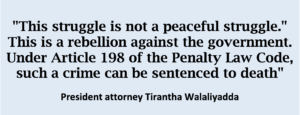
He said the protesters with a massive crowd behind them and supporting them, took over President’s House, Presidential Secretariat and Temple Trees, and said the protest cannot be called as a peaceful struggle. (Ajith Siriwardana and Yohan Perera)

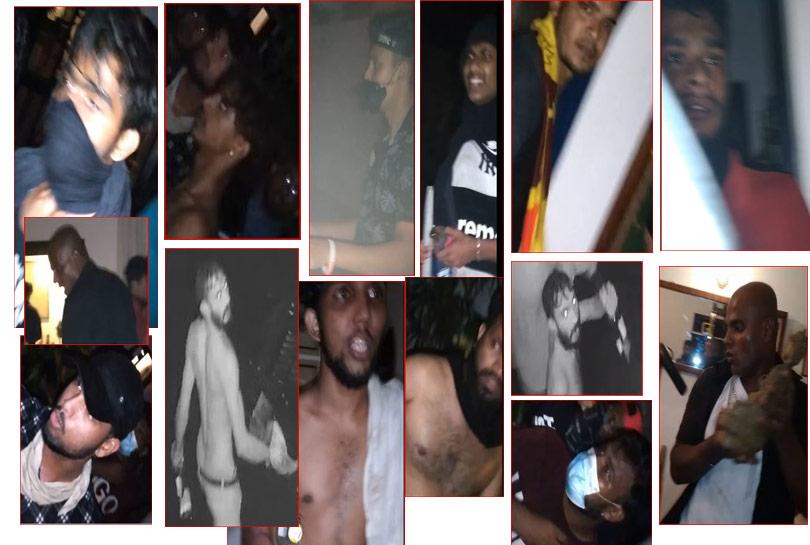
Police release photographs of main suspects wanted over setting fire to Ranil’s private residence

July 27th, 2022

Courtesy The Daily Mirror

he Police released a set of photographs of a group of suspects wanted over the incident of setting fire to President Ranil Wickremesinghe’s private residence in Colombo on July 9.

Police said the investigations into the arson attack on the President’s private residence was being carried out by the Criminal Investigations Department.

They said the investigators were looking to identify a group of persons identified as the main suspects involved in causing damage and setting fire to the house based on the CCTV footage and the video footage.

Accordingly, the police released 14 photographs of suspects in order to identify them and take the necessary legal action.

The police requested the public to inform the CID to the following phone numbers 071-8594950, 071-8594929 or 011-2422176 through WhatsApp or calls if they have any information about the people in those photographs.  

Earlier, the police arrested four suspects arrested over the incident and were remanded till August 10 by Colombo Fort Magistrate’s Court.

President Wickremesinghe’s private residence on 5th Lane in Colombo has been set on fire by the protestors after a tense situation erupted between the protestors and security forces on July 9.(DSB)

Police arrest IUSF activist Veranga Pushpika

July 27th, 2022

Courtesy The Daily Mirror

An activist of the Inter-University Students Union and the ‘GotaGoGama’, Anthony Veranga Pushpika has been arrested by the Colombo South Divisional Crime Detective Bureau (DCDB) today in connection with causing damages to public property during a recent protest near the Police Headquarters.

It was reported on social media that the activist who was returning on a bus after taking part in a demonstration in Colombo had been forcibly taken away by an unidentified group in a blue coloured jeep in Fort.

However, the OIC of the Colombo South Division said there was no truth in him being abducted. He said the police had taken him into custody and he will be produced in court by the Fort Police.

Veranga Pushpika was also the former President of Ruhunu Maha Shishya Sangamaya.(Darshana Sanjeewa Balasuriya)

IMF says Sri Lanka needs to talk with China about debt restructuring

July 27th, 2022

Courtesy Adaderana

Reuters) – The International Monetary Fund (IMF) said Sri Lanka should kick off debt restructuring talks with its bilateral lender China, while the island state’s government seeks a financing loan from the Washington-based fund.

China is a big creditor, and Sri Lanka has to engage proactively with it on a debt restructuring,” Krishna Srinivasan, director of the IMF’s Asia and Pacific Department, told Reuters in an interview on Tuesday.

The island of 22 million is currently engulfed by its most severe economic and political crisis in recent history.

Six-time prime minister Ranil Wickremesinghe was recently appointed as president after a popular uprising ousted his predecessor following months of severe shortages of fuel, food and medicines. 

The government recently decided to restrict fuel imports for 12 months. 

The country owes Beijing some $6.5 billion in financing including development bank loans and a central bank swap, according to data from the Institute of International Finance (IFF).

The world’s second-largest economy has invested in projects such as highways, a port, an airport and a coal power plant. Japan and India are also bilateral creditors to Sri Lanka.

Sri Lanka has to engage with its creditors, both private and official bilateral, on a debt workout to ensure debt sustainability is restored,” Srinivasan said, as he pointed out that technical talks on a new IMF program are ongoing with both officials from the finance ministry and the central bank.

Sri Lanka’s foreign ministry and central bank did not immediately respond to a request for comment. China’s embassy in Sri Lanka did not immediately respond.

The South Asian nation has requested an IMF rescue plan to overcome its worst economic crisis since independence in 1948. The country defaulted on a bond payment debt earlier this year on its $12 billion overseas debt with private creditors, as it struggles to pay for imports of basic goods.

There are some areas where we need to make further progress,” Srinivasan added, but declined to specify the top reforms Sri Lanka should address in other to reach an agreement.

An Extended Fund Facility (EFF) programme from the IMF, which would be the fund’s 17th plan for the nation, requires countries to make structural economic reforms.

Maldives and Laos are other examples of countries in the region that are facing onerous debt situations.

Srinivasan said the fund is advising countries to spend more in alleviating the impact on the poor and vulnerable but keeping budget neutral by reducing expenditures elsewhere or raising revenues where feasible.”

It’s not just public debt, but also corporate debt and household debt – and that has implications for policymaking,” he said. The debt issue is very significant.”

Source: Reuters

–Agencies

Bail rejected for suspects arrested over torching of President’s residence

July 27th, 2022

Courtesy Adaderana

Colombo Fort Magistrate Thilina Gamage has ordered to further remand the 04 suspects who had been arrested on suspicion over the incident of setting fire to President Ranil Wickremesinghe’s private residence, until the August 10.

When the case was called before the Court today (27), the magistrate has also granted permission to name Ivon Andrew Perera, on whom a foreign travel ban has been imposed, as the fifth suspect in the incident after considering a request made by the Crime Investigation Department.

The CID officials informed the court the suspects are being investigated under the Public Property Act and opposed the granting of bail to the suspects at this time, as the investigations regarding the incident are yet at an initial stage.

The CID further said that they are working to obtain assessment reports regarding the damages caused to the official vehicle provided to then Prime Minister Ranil Wickremesinghe and 03 vehicles belonging to the police including a fire engine, during the incident.

The magistrate who considered a request made by the Criminal Investigation Department, granted permission to obtain a report from the Government Valuation Department on the harm caused to the relevant vehicles.

The attorneys representing the suspects, presenting facts before the court, pointed out that the Criminal Investigation Department has not submitted any evidence to the court to prove that the suspects caused damage to the vehicles and property in this incident.

They questioned as to how charges can be leveled for offences under the Public Property Act in such a situation and requested the court to release them under suitable bail conditions. 

However, rejecting the bail applications, the magistrate stated that although no information has been submitted proving that the suspects had definitely caused harm to government property and vehicles, they have failed to show cause as to why they had entered President Ranil Wickremesinghe’s private residence without an invitation. 

Dhaniz Ali arrested for forcibly entering state media institute remanded

July 27th, 2022

Courtesy Adaderana

Dhaniz Ali, the man who was arrested last night while trying to leave for Dubai on a flight from the Bandaranaike International Airport (BIA) has been remanded until the 05th of August.

He was produced before the Colombo Fort Magistrate’s Court earlier today.

The 31-year-old, a resident of Webada in Kurunegala, was taken into custody in connection with the forcible entry to Sri Lanka Rupavahini Corporation and attempt to disrupt telecasts on July 13.

On July 13, a group of protesters including Dhaniz Alia forced their way into the state-owned media institute, demanding that only anti-government protests-related news be broadcast thereafter.

Two of the protesters then appeared on a live interview, after which the channel suspended its live and recorded telecasts for brief period of time.

The police later initiated investigations into the incident to identify the protesters in question.

According to a statement issued by the police, the Colombo Fort Magistrate’s Court had previously issued a warrant on Ali for failing to appear before the court over a case filed against a protest staged in front of the Finance Ministry on June 20, when a delegation of the International Monetary Fund (IMF) met with a group of ministerial officials.

Further, he had been released on bail by the court over a case against alleged damaged caused to public property during a demonstration staged opposite the Police Headquarters on June 09.

Sri Lanka Parliament approves state of emergency

July 27th, 2022

Courtesy Adaderana

Proclamation on the state of emergency declared by the then Acting President under the Public Security Ordinance approved in Parliament of Sri Lanka by majority vote.

The Proclamation on the state of emergency declared by then Acting President under the Public Security Ordinance was approved in Parliament today (27) by a majority of 57 votes with 120 voting in favour and 63 voting against it.

Parliament convened today at 10.00 am and the debate started after the Leader of the House, Minister Susil Premajayantha, presented to the Parliament the resolution regarding the declaration of state of emergency announced by the Acting President under the Public Security Ordinance. 

At the end of the debate, which continued until 5.20 pm, Chief Opposition Whip Lakshman Kiriella asked for a division and accordingly the voting was held.

Then Acting President Ranil Wickramasinghe had declared that the provisions of Part 2 of the Public Security Ordinance shall come into operation throughout Sri Lanka from July 18, 2022 through the Proclamation dated 17.07.2022 under Section 2 of the aforesaid Ordinance.

It further states that Parliament is duly informed in terms of Article 155(4) of the constitution that the purpose of the above Proclamation is to the protection of public order and the maintenance of supplies and services essential to the life of the community.

According to the Public Security Ordinance, this Proclamation will be valid for a period of one month if approved by the Parliament within 14 days. If the approval of the Parliament is not obtained within 14 days, it will be cancelled. 

Also, the state of emergency can be extended once every 30 days with the approval of the Parliament.

It is stated in the gazette that this proclamation has been issued in accordance with the powers vested in the President in terms of the Public Security Ordinance to ensure public security and the protection of the public order and the maintenance supplies and services essential to the life of community. 

Have Central Bank officials given Governor & Govt wrong advice?

July 26th, 2022

Shenali D Waduge

Are we barking up the wrong tree? We often target the politicians little realizing that most often they act on advice given to them. In such a scenario, have we omitted to look into the role of senior offilicials & questioned if they could have misled the governors & the govt? Did they suggest to take $12b ISBs? If they didn’t, have they made any notes of their objections? Did they negotiate debt repayment before opting to default? What are the options they looked at before declaring Sri Lanka would default repayment? The role of Finance Minister Sabry is also to be questioned.

Questions for Indrajit Coomaraswamy (IC)

The primary cause that made debt repayment unsustainable was the $12billion international sovereign bond loans taken by Central Bank Governor Indrajit Coomaraswamy (2016-2019) – did he do so on his own initiative or was he advised? If he did so on his own will, what was his intention?

Questions for Central Bank Top Management (CBTM)

  • Did CBTM advise IC to take $12b ISBs
  • Was CBTM getting any external advice to promote taking of $12b ISBs or even defaulting repayment?
  • Was there a particular reason for CBTB to advise the Governor to take $12b ISB loan especially when they were aware of the roll-over maturing debt status
  • What was done with this $12b ISB loan
  • Was CBTM aware that taking $12b ISB loan would make Sri Lanka economically vulnerable on account of roll-over maturing debt repayment?
  • Did CBTM initiate discussions to delay repayment – if they did, do they have evidence of this? If they did not, why did they chose not to or did anyone ask them not to?
  • Why didn’t CBSL officials think of repaying debt using the inflows from 25% export conversions of $750m & roll-over maturing SLDBs of $363m (total $1133m)
  • Why didn’t CBTM consider utilizing the $1b plus trade loan of $1.5b from China that was to be received end of May 2022?
  • Why didn’t CBTM consider the Indian line of credit of $1b plus another $500m from postponement from Asian Clearing Union settlements?
  • Why did CBTM along with Finance Minister Sabry decide to declare Sri Lanka defaulting on loan repayment when there was 4 options available to them (renegotiate loan repayment / Chinese loan / Indian Credit line & export conversions/roll-over SLDBs)
  • With all the above options at hand, why did Finance Minister Sabry, present CBSL Governor & Mahinda Siriwardena opt to declare Sri Lanka would default on 12 April 2022 supported by the cream of Sri Lanka’s business circles and so-called politician econimists and financial gurus.
  • The above team are to be personally held responsible for reversing 74 years of debt-honoring by Sri Lanka – embarrassing the country beyond measure.

Questions for present Governor Nandala & then Finance Minister Sabry

  • Did you both take consent of CBSL Monetary Board & Sri Lanka’s Cabinet or even the Parliament before deciding to declare default on 12th April 2022? If not, who gave you both the green light to make such a public announcement that would impact the entire country?

Did the CBTM & Governor & former Finance Minister lead  Govt & Sri Lanka astray?

What the then Finance Minister Sabry & Central Bank Top Management were aware of 

  • In 2022 Sri Lanka had to repay a debt of $7100m
  • $1166m had been repaid in March 2022 (balance $5934m to be paid)
  • $244m debt servicing to be paid in April 2022
  • $789m debt servicing to be paid for May-June 2022
  • $1033m debt servicing total for April-May-June 2022
  • Sabry-Nandalal-Siriwardena’s decision to declare default on 12thApril 2022 was without approvals of Parliament, Cabinet or Monetary Board & fully aware that China was to extend $2.5b and India was to assist with $1.5b by end May 2022

What top businessmen/women were ignorant of in pushing to default repayment

  • A bevy of top businessmen/women issued statements appealing to default repayment in January 2022 arguing that the money should be used to buy essentials. They made public presentations to this effect.
  • In April 2022, Sabry-Nandalal-Siriwardena declared default, as a result not only did Sri Lanka become a country globally declared untrustworthy to deal with, there was no forex to buy essentials which was far more than what was required to pay off loan repayments. Rating agencies placed Sri Lanka under D” default status.
  • Suppliers refused to give on credit & demanded up-front payment & inability to do so left people in queues.
  • Sabry & CBSL cannot claim they were unaware of the outcome of Sri Lanka being declared defaulting & should have known what would happen.

Why did they decide to take such a risky decision impacting entire country & its people & embarrassing the credibility of Sri Lanka too?

  • If they took a decision without consulting others – they should have had a backup plan as well – did they have one? what happened to that?
  • Is their only back-up plan to go running to the IMF? If so was it on their advice that no negotiations to defer payment of loans took place & instead they decided to float the rupee (IMF requirement) and thereafter declared default?
  • Why aren’t this group being held responsible for the default status of Sri Lanka unilaterally decided by them?

Either way it is not the Govt but CBSL Top Management and the CBSL Governor who are answerable along with the professional economists who also pushed for defaulting on loan repayment. Why are public not demanding accountability from them?

Shenali D Waduge

INTERNATIONAL BIAS: World reaction to US Capitol Hill riot & Protestors rioting in Sri Lanka

July 26th, 2022

Shenali D Waduge

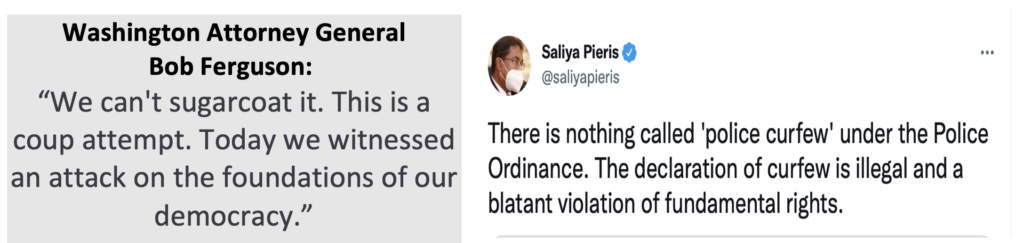
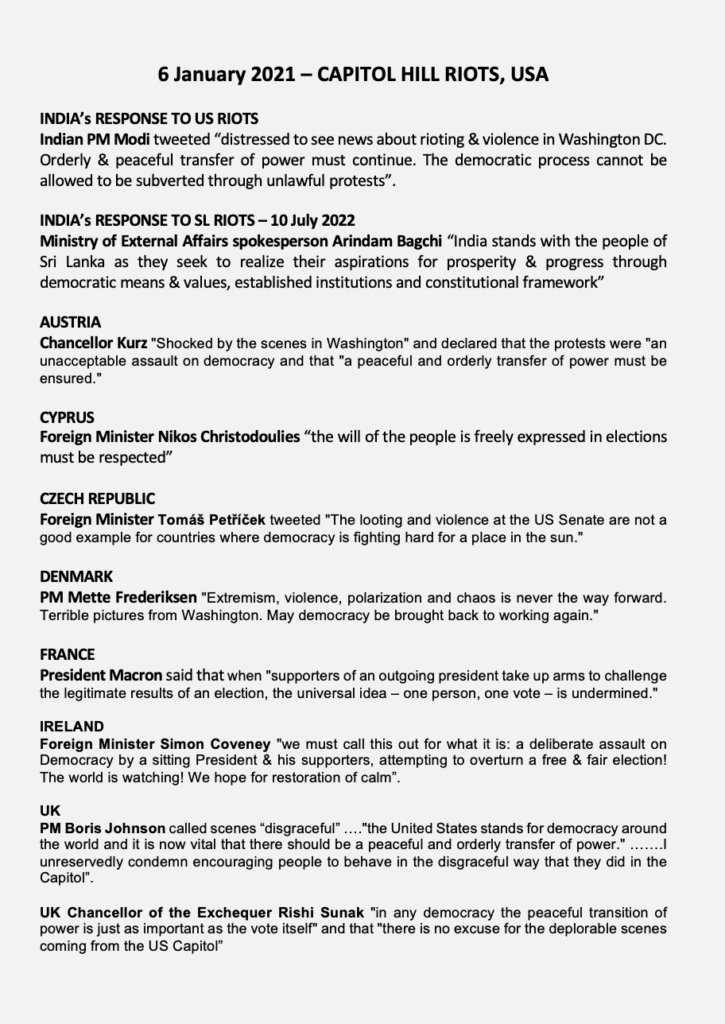
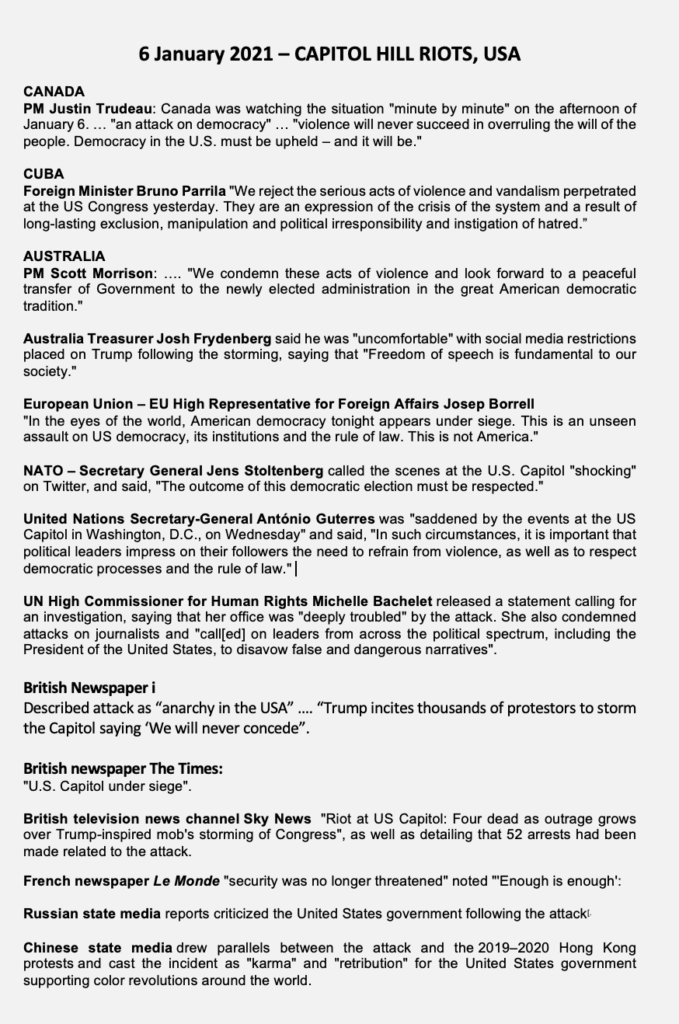
Let us compare how the international community reacted to 2 incidents of riots targeting State buildings in US & Sri Lanka & the hypocrisy of those issuing statements in response to both incidents. Let us also compare how the world reacted to law enforcements clear the rioters in US and the manner they reacted to how law enforcements attempted to clear rioters in Sri Lanka after almost 2 weeks of illegal occupation. The hypocrisy is prevalent resulting in the sitting President Ranil Wickremasinghe pointing out to the US envoy why she or no other envoy uttered a word when his personal residence was burnt to the ground!

On 6th January 2021 groups of pro-Trump protestors forcibly entered Capitol Hill while Senators were inside refusing the accept election results. US troops had to be called in. 5 protestors died as a result and scores injured including US police.

https://www.voanews.com/a/congressional-panel-lays-out-findings-on-2021-riot-at-us-capitol-/6611610.html

On 9th July 2022 groups of people who had created an autonomous area inside the Capitol began forcibly scaling the walls, breaking gates and illegally occupying Sri Lanka’s Presidential Secretariat, Prime Ministers Office, President’s House and Prime Ministers official residence & burning down the private home of PM Ranil while also taking over 2 state television networks. Colossal damage, destruction and plundering antiques and valuables took place.

This was how the world reacted to US rioters entering Capitol Hill.

From the above statements what can be deduced is:

  • Democratic process in US cannot be allowed to be subverted through unlawful protests (which is what took place in Sri Lanka)
  • Peoples’ aspirations must be realized through constitutional framework (not riots that took place in both Sri Lanka & US)
  • Protests in US were seen as unacceptable assault on democracy” – if that was so in US, it could not be any different in Sri Lanka.
  • The will of the people is expressed in elections & results must be respected (this is not what happened in Sri Lanka)
  • Looting & violence were abhorred in US (if so it should be same in Sri Lanka)
  • Extremism and violence is not the way forward (was this said to the protestors in Sri Lanka)
  • UK PM described the manner of violence as disgraceful” – did he do the same for Sri Lanka?
  • If riots in Capitol Hill was an attack on democracy – why is it not considered the same in Sri Lanka?
  • If violence will not succeed in overruling will of the people – what makes Sri Lanka’s riot different?
  • If acts of violence & vandalism is rejected in US – why is it not done in Sri Lanka?

Pro-Trump rioters stormed Capitol Hill on 6th January 2021 at around 1p.m.  smashing windows, breaching barricades but Capitol Hill was cleared shortly before 6p.m. Curfew was imposed in Washington DC. Besides the Capitol Police the National Guard was also brought in as well as police from other states. Police officers were also injured as rioters clashed with the police.

What ensued on 6th January 2021 in US Capitol Hill comes nowhere near the devastation that took place on not just one state building but numerous – The President’s House, the Presidents Secretariat, The Prime Ministers official residence, the Prime Minister’s Office, 2 State TV stations were attacked, gates broken, barricades breached, scaling over walls, illegally occupying, destroying, damaging and stealing state belongings. The present President’s & former PM’s personal residence was burnt to the ground along with all of his personal belongings.

All those that lined up to condemn what is certainly minimal damage in US should have condoned the attacks of 9 July 2022 in Sri Lanka – but did they do so? If not, why are their responses different?

Here’s where the discrepancies in reporting by international & local media & reactions by international community prevails

  • Heavily armed police used to secure US Capitol is acceptable – but not in Sri Lanka
  • US police using tear gas to push mobs away is acceptable – but not in Sri Lanka
  • Pushing past barricades & forcing themselves inside US Capitol is unacceptable – but in Sri Lanka it is ‘people’s right’.
  • US police shooting killed 5 persons including a woman is acceptable – but using batons by Sri Lanka police is not.
  • Scaling walls of the US Capitol is declared violent protests but scaling the walls of public buildings in Sri Lanka was never condemned.
  • US mobs carrying arms and related dangerous objects were condemned but rioters forcibly taking guns of Sri Lankan police became just a passing statement.
  • Police officers were using pepper spray on the crowds – if Sri Lanka police had done so UNHRC would have slapped resolutions

In July 2021 – 4 police officers related how they were beaten, taunted with racial insults, threatened kill him with his own gun” and even thought they would die when they tried to defend Capitol Hill. This was no different than the brats of youth touch the uniforms of the soldiers & berate them. Was this part of the NGO training given to youth across Sri Lanka under the guise of ‘democratic inclusiveness”?

The US police officers called the rioters terrorists” for attempting coup” but what would have happened if Sri Lanka Police & Armed Forces did the same?

More than a 100 US Police officers and armed guards were injured and their stories are proudly relayed but what about Sri Lanka’s police & armed forces, some of whom still lie in hospital bruised after being attacked by mobs. One of the US policemen had even pleaded for mercy yelling he had kids – didn’t some of the police in Sri Lanka do the same? Were there anyone to relate their stories? Are they not human too?

However one thing was common – there were some people in both US & Sri Lanka trying to whitewash the mobs referring to the hooligans as martyrs.

https://www.cbc.ca/news/world/capitol-riot-hearings-prime-time-1.6483847 this footage shows rioters beating police in US – while these are condemned by all and quite rightly so, those that condemned attacks on US police have preferred to be numb on rioters attacking Sri Lanka Police & Armed Forces. We are baffled and wonder why?

https://fb.watch/eu8M5du9nr/

When compared to the damage 4 state buildings were subject to in Sri Lanka while the personal residence of the PM was burnt to the ground, the attacks on Capitol Hill looked like nothing yet the US Capitol Police officer Caroline Edwards herself injured called the riot carnage & chaos”.

https://www.voanews.com/a/usa_four-us-police-officers-grippingly-describe-january-6-attack-us-capitol/6208799.html

On 6th January 2021 itself Capitol Hill was freed from rioters within 6 hours and everything returned to normal. Curfew was imposed and no one opposed. In Sri Lanka it is prominent political lawyers who openly opposed encouraging people to even defy the curfew.

The same did not happen in Sri Lanka when 4 state buildings became illegally occupied on 9th July 2022 and 2 state tv stations were also taken over.

Sri Lanka: US Backed Colour Revolution in Colombo

Actions by police was always pre-empted by diplomatic statements or arm-twisting threats and human rights charlatans appearing with their ‘freedom’ songs while the premier legal fraternity who was seen appearing free of charge for the rioters and clapping when they were given bail, while others joined a human change in Galle Face Green, were openly presenting the notion that rioters had every right to riot. This gave the rioters the freedom to do as they liked and a carte blanche to believe that whatever they did the lawyers would be at hand to provide legal services.

https://economynext.com/sri-lanka-bar-association-opposition-eu-slam-assault-on-protestors-uk-us-concerned-97783/ It was therefore no surprise that the Bar Association would join US, UK & EU to slam the GoSL and vilify the forces. It looked more like taking the opportunity to chastise the army & police under whatever excuse they could conjure up.

When images of the carnage slowly began emerging primarily from boasting selfies of the rioters themselves, the legal fraternity feeling embarrassed as their role was getting exposed, tried to denounce the acts of carnage  however the posts that covered their initial jubilation of the actions of the rioters are now being filtered as evidence of their aiding and abetting in the carnage. Given their profession, they are likely to get off scott free and the ignorant youth will no doubt end up the scape goats while the business community, revenge seekers, sports stars, artists and others aspiring to enter the political game would also slyly disassociate themselves in the days to come. These entities are the shields that the external lobbyists use to cover what took place in Sri Lanka on 9 July 2022.

While 5 were shot by US police not a single rioters died since 9 July 2022 however when Sri Lanka’s police & armed forces attempted to take back what was illegally being held tweets and calls from embassies flooded to prevent it. Doesn’t this seem strange that the very mouthpieces that denounced rioters in US would be encouraging rioters in Sri Lanka? The very mouthpieces that supported the US police & armed guards would be chastising the Sri Lankan police & armed forces. Would you know why they are reacting like this?

Sri Lanka has been too familiar with the manner that a drama is concocted to justify or vilify by the usual culprits – the narrative always has groups of journalists claiming ‘we are media, don’t hit us’ but they hardly cover the correct picture or do a very one-sided version or angle the story in such a way the truth is kept undisclosed and left for people to make their own warped versions.

While people storming the buildings, climbing over gates and walls, breaking gates and barricades is never denounced, security forces arriving to clear areas that have been blocking entry to Presidents Secretariat are given negative media coverage presenting the notion that the rioters were in the right & the armed forces were doing wrong to them. This was a complete misrepresentation of the facts.

Even the OHCHR statement claims property belonging to the protestors, including tents, IT equipment & kitchen items were destroyed or confiscated”. What the OHCHR statement conveniently left out is that these were illegal structures on a public place not meant for only protestors – water, electricity used by them throughout the 100 days were not paid for nor have they got permission from the municipality to be located on the venue. Where have you heard of protestors taking over a public area by force and keeping it for 100 days? If such is allowed any group of people can claim to be protesting and put up tents and refuse to move from any public site. Can such be allowed? Protests should be allowed – but these cannot be 24x7x365 days and beyond and entail temporary fixtures becoming permanent ones. Surely, UN must be aware of this? Would protestors be allowed to do the same in UN or any other country’s public venue. It took just 6 hours to disburse the rioters in US who had also created an autonomous area. When this site was broken down did OHCHR also write a statement similar to the one issued against Sri Lanka? If not, why this hypocrisy? https://www.ohchr.org/en/statements/2022/07/comment-un-human-rights-office-spokesperson-jeremy-laurence-raid-sri-lanka?fbclid=IwAR0R48H5GZQ1PekthJvokPZt9ey0Oy50BzLqQXXCAGOLnHPbhX0rEEubh9E Read the hypocrisy behind the statement issued to Sri Lanka but not to US!

Shenali D Waduge

POHOTTU AS USA’ S PROXY Part 7F2

July 26th, 2022

KAMALIKA PIERIS

1987–89 JVP INSURRECTION

JVP staged a second uprising which lasted from 1987 to 1989. This was not an open revolt, but a low intensity conflict with the JVP resorting to assassinations, raids and attacks on military and civilian targets. With these practices of fear and intimidation, the JVP was able to bring the country to a standstill. This campaign virtually brought the country to a standstill confirmed Indradasa. It was known as period of terror.

The situation in 1987 was different 1971 said Air vice Marshal Sosa. The strategy this time was to avoid direct confrontation with the nation’s defence mechanism but harass the public to a state of despair.

The day the insurgency broke the JVP assassinated Member of Parliament of Tangalle Jinadasa Weerasinghe and burnt to the ground the residence of MP for Ambalantota Dr P M B Cyril. Bus depots were set ablaze along with the buses. All light poles (wooden) were cut down, trunk roads were blocked by felling trees, shops had been ordered to close and Public Servants to keep away from work.

JVP had some support initially among the public, especially in the southern and central districts, after JVP challenged the Indo-Sri Lankan Accord.  JVP seemed to enjoy public support in Matara, Hambantota, Moneragala, Badulla, Kurunegala and in the Uva Province as well and successfully carried out various strikes, work-stoppages, protests and boycotts, in 1987 

JVP resorted to sheer terrorism to bring about work stoppages, disruption to transport services    and trade . JVP burned down post offices, robbed the collections from bus conductors, and destroyed their ticket machines, damaged industrial and domestic electricity and water meters. JVP forcibly collecting vehicle revenue licenses. JVP destroyed records held in kachcheries including files on local taxes and land registers.

 Almost two thirds of the country did not have an electricity supply for more than six weeks, because the power pylons in Matale were destroyed by the JVP.  JVP repeatedly went for electric transformers. There were other acts of sabotage with the destruction of Government property.    There was also a campaign to boycott Indian goods.

JVP crippled the country with violently enforced general strikes for two years. Many individuals or organizations were warned or intimidated with messages dropped in the night in front of homes and with posters or graffiti on walls. Those that did not cooperate were brutally killed, with the repercussions extended to their family members. Grama Sevaka were directed to hand over their resignations under threat of death.

JVP issued death threats to professionals, to lawyers and doctors so they could not work.  JVP called for hartals and work stoppages. JVPs repeated warning to State-owned media personnel to stay away from work and increasing threats led to resignations. As a result, trains were not functioning properly, schools and college did not hold exams for almost two years.

 For four years no one had graduated from any of the state universities. Medical College was not functioning for almost five years. Factories and work place were forced to close down for long periods resulting in the workers undergoing severe hardship and production suffered.  Strikes paralyzed key government departments. Tourists were walking past immigration and customs   counters freely as the officers were not there.

JVP called upon the public to engage in a civil disobedience campaign by refraining from paying taxes and other dues such a bus fares. Posting letters’ without stamps. JVP said people must observe curfew and not leave homes, work places should shut down, transport must cease to operate, blackout must be observed from 6 pm. People should refrain from listening to radio or watching TV.  The public  were ordered not to go out of their homes. “Lights off” and “switch-off Radio and Television” orders were given.

Schools were targeted. In 1988  Several Colombo schools shut down   and  students of several small schools in Kandy boycotted classes. School Principals were ordered to confine themselves to their offices whilst the students were encouraged to stone all passing Police or Military vehicles. Principal of Polonnaruwa Rajarata Vidyalaya was threatened when he took down a black flag on Independence Day hoisted by pupils.

JVP regularly  organized demonstrations in schools.  There were widespread protests by school children in  1987-1988. These were well organized  within the JVP district and division structure.

Demonstrations spread to Colombo and Kandy as well with Isipatana Vidyalaya in Colombo and Vidyartha in Kandy joining in.  Demonstrations erupted in Anuradhapura at St. Josephs College and Anuradhapura Central.  In Anuradhapura school children had stoned a police patrol and injured six policemen. In Matale, students of St. Thomas, Wijeya College and Science College had also joined in the street demonstrations.

In remote areas of south and Uva striking school kids were heard calling out ‘Colombata kiri apita kekiri’. These  demonstrations centered on the  elite schools of the provinces. But none of the English speaking schools such as Royal , St Thomas , Ladies College in Colombo were involved, only the schools of the ‘Sinhala elite’ were in the demonstrations.

Ellawala Medhananda recalled that when he was principal of Anura Maha Vidyalaya, Getahatta, his pupils informed him that they were ordered not to attend school and to congregate outside. Or they will be killed. They had to go on strike in school. Pupils were told they would be killed if they did not strike for at least   three days. The pupils obeyed, after informing Medhananda.

Medhananda also received a letter, from Kirti Vijayabahu”, threatening to kill him.  His temple received a letter telling  both monks to leave the temple .The two monks did so. Medhananda went back to the school and hid there.  In the night the JVP came to the school and searched it, watched by  Medhananda  who had hidden in a loft in the school.

The main feature of the October 1988 agitation was the large scale involvement of school children. On October 3 about two thousand children for the elite schools of Galle, St Aloysius, Mahinda, Richmond, Southlands Balika, Sanghamitta Balika and Ripon Balika demonstrated in Galle. Schools in Hambantota, Tangalle, Ambalantota, Tissamaharama, and Debarawewa were            closed following agitation fRorm children. In Matara students of Rahula College and Sujatha Balika were tear gassed.In Ambalantota an army detachment was attacked with stones by demonstrating school children.  In Kalutara the demonstrating school children had been tear gassed and chased away.

Soon afterward all schools were closed indefinitely. Later it was announced that 115 schools would remain closed while others would re-open. The schools to stay closed were the privileged schools in each district.  In Colombo it was Ananda, Nalanda, Thurstan, DSS Senanayake, Isipatana, Mahanama, as well as Ananda Sastralaya Kotte, Dharmapala Pannipitiya and Prince of Wales Moratuwa. In Galle it was Richmond, Mahinda, St Aloysius, and Ripon Balika. In Ambalangoda it was Dharmasoka, In Matara it was Rahula, Sujatha, St Thomas and St Thomas Balika.

Later when school reopened, demonstrations erupted again. Schools that were not previously affected now came out on strike. In Colombo district, Carey College, Lumbini, Mahabodhi, St Thomas ,Veluwana Maha Vidyalaya (Dematagoda), Janadhipathi (Kotte), Samudradevi ( Nugegoda). 

In June  1989, a group of students at the Peradeniya University seized a jeep, killed the three inside, and burnt their bodies within university premises. A similar incident took place at Sri Jayewardenepura University. In July 1989 all universities were closed down indefinitely.

Initially the public did not take JVP orders seriously. But JVP started killing and the public realized that they dare not disobey these orders. Teachers who resisted interference of JVP activities were assassinated. JVP selectively conducted attacks on shopkeepers, drivers of public and private vehicles,   trade unionists, management staff of government and private institutions and burning buses of both private and public companies. These acts of terror served to create fear among the public.JVP made it a point to track down those who resisted  opposed or betrayed them and punished them. Principal of Mahakumbura College who opposed JVP shot and killed two daughters.

From 1987 to 1989, the JVP  was  able to dominate in the affairs of the country. The  UNP government tried to appease it. 1988 JVP Imposed ban on Sinahla New Year, shops in south ordered to close before that. University exams not held due to threats .Spectacular jail breaks in  Welikada, Bogambara, Badulla. Welikada escape was  done with inside help. JVP had support from the air force personnel guarding the prison. In 1988 at Pelawatte rehabilitation camp most JVP escaped through a tunnel they had cut. In Nov 1988 ,there were  prison riots at Colombo, Kandy, Mahara, Anuradhapura , Negombo and Pelawatte.

At the height of the JVP’s attempted destabilization, police officers in and around Colombo given the task of fighting the JVP had to live by their wits. They found that they could not hold conferences in police stations as the JVP had informants inside. They found themselves having conferences at odd hours in places like Galle Face Green and the Parliament Esplanade.

JVP reacted violently to exposure of their activities by newspapers, TV and radio. Newspaper agents were killed, vehicles transporting newspapers were burned, and employees of TV stations, Rupavahini, ITN and SLBC were threatened and ordered to give up employment. When these were ignored JVP killed important media personnel, including  DG of Rupavahini and SLBC,  a director of SLBC,  a radio and TV announcer. Gladys Jayawardene, Chairman of the State Pharmaceutical Corporation was also assassinated for not stopping the import of Indian pharmaceuticals.

Deshapremi Janatha Viyaparaya (DJV)   the military wing of the JVP  was the division responsible for the violence of the 1987 period. DJV trained it members, in the  jungles in the southern and western quarters, in central highland and a few in India. The training tactics were a closely guarded secret. JVP   first said that DJV, was a separate  organization which was being supported but not directed by the JVP. Later, they abandoned this position.DJV openly  received instructions from JVP said Attanayake.

The head of the DJV was Keerthi Wijebahu”. Keerthi Wijebahu was the pseudonym of Saman Piyasiri Fernando, leader of the military wing. There was also another military wing, Deshapremi Sannadha Balakaya also under Keerthi Wijayabahu.

DJV  consisted of full time member. They had a cell structure. Communicating between one cell and another was  tightly controlled, so that even if one was caught he could not give info on more than ten members. Many gave  useless information  and stayed silent under extreme pressure when caught.

DJV   used the army. Soldiers who went on leave were used to attack security force installations.  Some were asked to desert and bring a weapon with them. DJV also roped in  those who were  suspended from the army.  The three who started the JVP  military campaign in south  were three deserters from the army in the north. DJV also used common criminals  and contract killers.

The DJV carried out a large number of murders. It killed more than 70 Members of Parliament between July 1989 and November 1989. The DJV murdered probably thousands of people, said analysts. Killings took place in both urban and rural areas . DJV targeted opponents.  On December 15, 1986, the DJV abducted and murdered Daya Pathirana, the leader of the Independent Students’ Union (ISU) of the Colombo University, which was a rival students’ union.. Analysts see this as the significant starting point of  political assassinations.

Executions were mostly carried out at night with armed groups entering homes of victims and carrying them away to be tortured and executed. Occasional bombings also took place. There was a bomb in Gampaha in 1989.

Funerals of these victims were not allowed to be held.  Traditional final rights were not allowed and the caskets had to be carried below the knee level as a mark of disrespect.

There was also   a JVP Bhikkhu death squad called Kudahapola Balakaya, operating in the JVP insurrection in 1980s. These were Buddhist monks who were also terrorists.  At night they would done civilian clothes and go out and commit murders and as monks would do the last rights later on, said Chandraprema.

It is estimated that over 100 monks had disappeared  or were killed in1989 . Ven. Kotuhene Premawansa, chief prelate of  Nawalawatte temple in Tudella and Pohoddaramulle  Premaloka were killed in temple premises. Ven.Upali of Dickwella was killed in temple. Others were abducted. The abducted monks  included  Ven. Balangoda Dhammissara, Gonadeniya Sirinanda, Medirigiriye Sumana, Godakande Mahinda,  Wattala Piyadassi, Kakuranpala Dhammananda. Parts of  four bodies           of Bhikkhus who had been abducted   while visiting a temple in Galle were found on Hikkaduwa beach .

In 1988 there were  more than fifty monks in custody.  They included Ven. Nakkala Kusalnyana of Kumbukwella temple Galle. Kottegala Gantana of Ruhuna University  and  Ratanesa Upali.

When the security forces and the vigilante groups launched an offensive against the JVP, younger monks were very vulnerable as they had been identified for having spearheaded public agitations. Many monks gave up robes, some died or disappeared.  By early 1990, there were 45 Buddhist monks, mostly university students, in detention camps. Some had surrendered. They criticized the JVP for misleading them and started supporting the government. Their statements were given wide publicity in the media.

POHOTTU AS USA’ S PROXY Part 7F3

July 26th, 2022

KAMALIKA PIERIS

From 1987 to 1989, the JVP was able to dominate the country. A wave of violence swept in after 1987. There were suddenly large number of people who were willing kill. And a larger number who were willing to accept this. There was a general increase in murder, rape, abduction and holdups, said Chandraprema.

1988 started a phase of open confrontation.  Trees were cut and placed across roads, power pylons and transformers damaged and telephone exchanges were sabotaged,   and hospitals were not functioning. JVP ordered the closure of Gampaha hospital in 1988. The letter had come to Gampaha hospital.

Forces personnel were regularly killed, defense installations attacked.  The family of senior Police officer Udugampola were shot and burnt in their ancestral home.  His mother, brother, brother’s wife, and their children died. Prominent persons and intellectuals died every day, many left the country. 

From September 1988 JVP imposed unofficial curfew at least once a week. Sometime for over a week in a town or village, district or province. Those who defied were killed. JVP wanted to keep the urban areas of the country constantly on the boil.

On Sept 12 1988 in most part of country, not a single shop or pharmacy opened, no buses, few people on the road, streets of villages deserted, no sounds of radio, TV.  Banks were closed, buses did not run, harbor was dead, postal service were crippled, no supply of water no electricity and not even food.

From mid 1988 JVP made officials, government servants, families of MPs and Provincial Councillors, prominent business men and their families who supported the government   paste JVP posters, stitch and hang flags, distribute leaflets and even collect money.

On the orders of JVP trade unions, professionals, student bodies, religious Association s and even old boy Associations of certain schools marched in the funeral procession of Thrimavithane in 1988,   with prominently displayed banners. Intelligence videoed the entire procession and this was used later to identify JVP.

The situation in October to November 1988 was unlike anything before, said Chandraprema. Wave of terror continued and many families were gunned down. Robberies and arsons were 100 per day and average of 20 people killed each day in 1988. Death rate was 100 per day in Dec 198.8

JVP ordered a strike on Oct 1988.  It was a total success. Workers all over the country were told not to go to work on October 26. Trains were stopped by threatening letters. Tulhiriya textiles mills closed down. Government establishments in Anuradhapura, Polonnaruwa, Panadura, Matale, Kandy, and Nuwara Eliya were closed. A threatening letter brought out demonstrators in Eppawela. At Mattakkuliya CTB depot 150 workers stopped work.

On November 3. 1988, JVP ordered all shops, offices, hotels, business establishments, state institutions to close. Also banks, state and private transport,   petrol stations. No one should watch government TV or listen to government radio, ordered JVP. Switch off lights till midnight. All houses and institutions to hoist red and black flags. The order was signed Keerthi Vijayabahu. This protest was a great success. All obeyed orders to the letter, reported Chandraprema. 

In November 1988 JVP ran the country, said Rohan Gunaratne.  It was in a state of near anarchy. People were threatened and they kept away from work. Bank, postal and telecommunications came to a halt. There was a shortage of petrol. Public transport forbidden. Bus drivers who defied orders were   killed.  Shops closed for weeks. There were queues for kerosene. There was a food shortage.

On December 12, 1988, 170 JVP detainees escaped after breaching the prison walls in two simultaneous operations launched outside and within the prison. It stunned the UNP Government.

In June 1988 JVP said the first to go to vote for Southern Provincial Council election would be shot. In Hambantota an early voter was shot dead. At the 1988 Presidential election despite JVP there was a turnout of 65%. On day of election four killed near polling booth at Tissamaharama, but still people voted and were relieved to have had elections, said Chandraprema.

JVP had a good spy network which they used to extort money. In 1989 JVP came to home of garments exporter Ramya Weerakoon and demanded money. Come out you and your daughters, api deshapremi jatika sahodarayo, they said.  They mentioned a bank account to which Ramya had received a remittance for a shipment sent out earlier. 

 She said the payment was for raw material for the new shipment. We don’t care the sahodarayo said. Our leaders have ordered us to take Rs 50,000 from you. We will come here tomorrow. Have the money ready. The next day they came at 9.30 pm and took the money away. 

1989 was the last year of the JVP terror. It was also the year in which government started to get on top of the JVP.

In May 1989 there was a spate of strikes in all sectors. 1989 SLTB strike was the crucial tug of war between government and JVP. at the start SLTB could not say why they were on strike. Two leading JVP in CTB were killed. This shook the JVP and gave confidence to the public. Strike was a defeat for JVP.  It was the beginning of the end. 

June 1989 saw much JVP activity. Gam Udawa celebration in Mahiyangana  were attacked . There was a spate of violence in south  in June 1989. In august 1989, JVP forced  government hospitals ,private hospital and dispensaries to stop work. There was also a partial hartal of government Departments, transport, banks after JVP issued threatening letters. This was JVP ‘s last hartal .

Killings continued in 1989. There was arson, robbery, death squads murdered in large  numbers  Mahaweli had an average of 70 bodies floating every day. In April 1989 there was a  landmine war  in south which showed signs of spreading . At the end of the June JVP had killed an estimated 130 SLTB employees, and destroyed about 200 buses, in order  to keep the terror level ‘ high’. 

in 1989  there were huge, well attended rallies  organized by JVP.  public  were brought in forcibly.  In June 1989 JVP held a massive rally at Nugegoda. This was its last public show.

POHOTTU AS USA’ S PROXY Part 7F4

July 26th, 2022

KAMALIKA PIERIS

B.J.C. Perera was Consultant Pediatrician in Kurunegala in 1988.  In Kurunegala there was a lot of public support for JVP and people in the area were openly sympathetic to the cause said BJC. JVP   were in almost total control.  Hospital had JVP sympathizers on the staff. Two of his House officers were also JVP.  They tried to disrupt the working of the hospital. ‘’But I did not allow them to disrupt ward activities,’ Said BJC.  

The hospital was not closed for even one day. Kurunegala was one of the few hospitals which functioned normally, he said. Kurunegala child Immunization clinic was over loaded, with about 300 children brought from outstation in lorries and cars, since the other clinics were not working. ‘We managed to immunize them all,’ said BJC.  This  service was provided for several weeks.

JVP was watching him and liked his concern for his patients. They sent him a message that since he had a baby at home, he could use the electric lights in the house. JVP   had ordered the public not to put on electric lights. BJC refused, saying he would be labeled a JVP sympathizer, so they told him to use thick curtains and only a couple of lights.

 Towards the end of the insurgency, both army and JVP were active in Kurunegala. An army officer came to the hospital, said BJC. He spoke separately to doctors, and asked them to continue the good work, told nurses, separately that any saboteurs would be treated like insurgents, told laborers that he knewexactly who JVP were. He will kill the two of them and hang them for all to see at the entrance to the hospital. He will personally shoot them through the heads, said the army officer.

In 1988 JVP made final error in Kurunegala, said BJC. They had dragged out a supporter of the government His children had come running and hugged the father. JVP killed the children as well. This disgusted the public who went to the police and army and told them details of JVP activity in the entire Kurunegala region. The force and police came out at night, rounded up the JVP.  Nothing was heard of them after that. They were    apparently eliminated and burnt in the jungles and forest areas of Kurunegala. The insurgency collapsed virtually overnight in 1989 in Kurunegala, concluded BJC Perera.

GOVERNMENT RESPONSE.

Government of Sri Lanka eventually defeated the JVP. Intelligence cells set up in police stations  had good penetration and advance information was received on JVP activities. The government set up the Operation Combine, the Joint Operations of the armed forces (“Ops Combine”) . In  July 1989 Ops Combine underwent certain changes. The Rapid Deployment Force (RDF) was given specific tasks and a new intelligence service unit was formed. One of the concepts of the “Ops Combine” was the capture of special targets secretly. 

In 1988 a large section of the elite was willing to bend over backwards to accommodate the JVP, but in 1989 JVP’s excesses had upset them. The Government was therefore able to obtain help from a wide spectrum of society including the opposition parties and particularly the Left in crushing the JVP. The Government was thus able to deploy methods from the crudest to the highly sophisticated.  They used persons who knew to handle different groups of people accordingly, said Rajan Hoole.

In December 1987 the army  had started to break through JVP , and gain control of  Embilipitiya area. Embilipitiya area was  cleared  in 1988. This was not easy,  there were  vast jungle tracts. They found an underground armory there, 9 feet long. A JVP   member had led army to a hideout at Kakkangodella on Embilipitiya Middeniya road. Ruhuna ranahanda” had been issued from there.  JVPers also led the authorities to  another hideout at Bando Kokkayaya near Panamure. Sophisticated radio equipment was discovered in a concrete bunker near a  latrine.

By 1989 JVP Colombo had been successfully infiltrated  Intelligence  knew  a least some JVP  centers, such as one in Ratmalana. Intelligence  had even worked their way into   the Ratmalana outfit.  State Intelligence  had videoed the entire procession  at the Thrimavithane funeral. Informants with inside knowledge of the JVP were  brought in, given lists of names, shown the video and told to identify the people as faces appeared on the screen.

The government  attitude changed in 1989. The government decided not to give in. during the General strike in June 1989. Army   drove the buses and ensured there was public transport. And navy took charge of unloading food ships in port.

Around June 1989, media personnel resigned or kept away from work. Security forces took over the work and the media functioned. Newscasters were navy men.   When Thevis Guruge, head of SLBC was assassinated in 1989  for ignoring the threats of the JVP,  security forces took charge of the radio and television Stations . The news was read by armed service personnel.  

The  government under President Premadasa responded militarily in 1989. The army and police started shooting suspected JVPers and their families and burning their houses. In Kandy road barriers were put up at night time,   in places like Lewella  in Kandy. 

At mid-year,  1989 the Government began a massive crackdown on the JVP. It detained several thousand JVP suspects. By the end of the year, security forces had captured or killed much of the JVP’s top leadership. Anti JVP operations of government   after July 1989 were effective and sophisticated. Impact felt only after August 1989.  Most cadres  were caught   through information given by JVP activists in custody.

Intially there were five intelligence agencies working on JVP .They were National Intelligence Bureau, Counter Subversive Unit, Colombo Detective Bureau,  Military Intelligence,  and Operations Combine . They had not been able to function effectively because there were political barriers,   bureaucratic intervention, and operation  difficulties, said Gunaratna.

Secretary Defence, Joint Operations Command and the army  could give orders for Ops Combine. Army now asked for and obtained full  control of Ops Combine .   Ops combines was restructured. It was put under a single authority,  troops better deployed , a new intelligence unit set up and Rapid Deployment Force was given specialist tasks.  Ops combine was to capture special targets covertly. Ops combine  in Colombo was given a lot of security forces.

The operations were  carried out by platoon commanders and corporal s,  specially trained to work in small numbers Army detachments were sent into jungles and villages throughout Sri Lanka . Troops moved light, often out of tents in mini groups. Most of the time they were out on operations moved by foot, keeping enemy under pressure. They divided into three, guard group to guard camp,  reinforcement group, and deep penetrating group. JVP  was now deterred from using small number attacking patrols,  forces also operated in small  numbers

Troops checked vehicles day and night. There were cordon and search operations as well. Sudden road blocks were  set up,  every time at  a different  place . Troops  were positioned there and also undercover . Troops in civil  were also at bus stand, tea boutiques and eating houses. Trailing suspicious persons, keeping watch on houses.  They also engaged in ambushes, these were done mostly at night after 10 pm and would last till early hours of dawn.  Persons were picked up late in night or early morning. A lot of work was also done by police.

Operations teams isolated themselves from the rest and kept mum about their work. Army used code words and were vigilant about infiltration.   Army watched soldiers when they went on leave.

 The teams were also asked to obtain public support. To encourage information from public, ask them identify infiltrators  and to indicate land mines. The teams were told that  they should go out and patrol impressively with canopy removed from the truck. They should give the  public confidence.

From August 1989 reprisal killings against JVP became common. Bodies began to appear on road daily. 16 decapitated heads were placed around the pond in University of Peradeniya . JVP had killed three army families in Anuradhapura . In relation, decapitated heads appeared on stakes, all over Anuradhapura district. The  public now realized that state was getting the upper hand.

War against the JVP was a hit-job war. It was not superior weapons or training or numerical strength, it was accurate information and element of surprise. It was not difficult to kill off the JVP , observed Chandraprema.

A new element had   also come in. There was a new urban guerilla movement against the JVP  Private armed groups emerged to counter JVP terrorism. JVP were killed by private vigilante groups,  such as  Black Panthers, Yellow Scorpions and the Peoples Revolutionary Red Army, PRRA.

These persons  arrived at the most unexpected  times, and killed with cold blooded ruthlessness. They had accurate inside information, and had probably heavy infiltrated the   JVP. There was a  spate of killings of JVP .

When JVP issued death  threats,   these vigilante groups issued counter threats. Posters appeared which said ape ekata thope dolahak.”

The ‘Deshapremi Sinhala tharuna Peramuna’ circulated a letter to JVP.  This letter said  Dear father/ mother/ sister, your son, / brother/ husband has taken the lives of mothers like you, also sisters and innocent children.  They have killed the family members of heroic Sinhala soldiers who fought the Tamil tigers to protect the motherland.  Is it not justified  to put you also to death? Be  ready to die. May you attain Nirvana. Sgd Patriotic Youth Front. ( abridged )

Estates  employed private defence groups known as Green Tigers.  JVP had killed 17 estate superintendants. Lawyers who took up the causes of JVPers were also killed by these vigilantes. It was not possible for the security forces to  protect all threatened persons, so they encouraged the creation of these vigilance groups and provided them with shot guns.

By October, 1989  it became clear that although the JVP was still in a position to organize strikes and hit out at key state installations, its capacity to seize  state power had weakened considerably. It was running out of weapons and manpower. The fact that the JVP had been unable to kill more than 20 people from the ceasefire on 27th to the end of September, was an indication of their limited  strength. Most of the JVP cadres were liquidated in  October 1989.  The moment  an arrest was made the  victim was blindfolded  . Police did not give the bodies back.   

Death squads and Joint Operations did not hesitate to take away any youths from their homes and no complaint was accepted by the police or army posts regarding those youths. The authorities kept quiet about the abductions and investigations were closed after the abductions took place.  Strict censorship of the mass-media prevented any coverage of events. On the whole, the result was terror and near-anarchy in the country. 

From August 1989 onwards, reprisal killings against the JVP became a regular feature. Bodies began to appear on road sides. Bullet riddled and burnt bodies were a common sight in rivers, wells, pits and by the road sides. That was the only evidence about how many youths were abducted per night.

 Analysts had had much to say about the state operation against the JVP.  Certain analysts were more upset about the state killings than the JVP killings. This period, according to observers was as bad as the JVP offensive. Death squads were dominant and the government allowed them to function.

There seemed to be no difference between State armed forces and secret death squads. Both had only two objectives: eliminating subversives and injecting as much fear in the public mind as possible. As a result of this double violence the highest number of killings in Sri Lanka took place in August 1989.   The target list of the JVP had also expanded at this time.

There was the issue of the  abduction and disappearance of 31 students of Embilipitiya.  In 1994 Ravaya was told where the grave was, at Suriyakanda, Rakwana.  Information as a student of Moratuwa University employed as a technical officer in a private engineering company. They were going to build a road and this was going to cover the grave forever. The grave was in Sinharaja forest, there had been an artillery camp there and the abducted from neighboring areas were brought there and killed. And buried there. He gave a detailed map of the graves. They dug there and found remains of the bodies.

A section of the JVP cadres made use of the ceasefire declared by the government over a period of three weeks and surrendered to the armed forces. The government announced that over 7,200 were under detention for involvement with the JVP.

In October 1989, Raja Mahattaya, the Colombo district division number two leader, was arrested. From information the army received from Raja Mahattaya and from others, they were able to trace D M Ananda to the Ratnapura area. His arrest was a major breakthrough for the government.

D.M.Ananda was the functionary number 1 in the JVP . He was also the political cum military leader of the Colombo/Sabaragamuwa area, the leader of the bhikkhu, women’s and workers’ fronts and the leader of the Jathika Kmart Satan Madyathanaya. These  made him the single most powerful person in the organization.”

Ananda was held in the Mattegoda army camp, where he divulged that Araliya Estate in Galaha was the group’s headquarters in the region. A special operations team of the army arrested Piyadasa Ranasinghe and H B Herat in Galaha. They were JVP leaders who met Rohana Wijeweera frequently.

Under interrogation, they told army investigators the whereabouts of Wijeweera and a few hours later Wijeweera was arrested at Ulapane, Kandy, at the estate bungalow where he lived, masquerading as a planter under the name of Attanayake. The next day, Upatissa Gamananayake, who was the General Secretary of the JVP, was also captured. He was captured in Panadura, where he was running a small shop under the pseudonym of Dias.

By November  1989 Rohana Wijeweera  and  12 of  the 13 JVP Politbureau members  were arrested.  The only  Politbureau member to survive was Somawansa Amarasinghe who had fled the country as soon as the first arrest took place.

STRINGENT MEASURES TO FIGHT BRIBERY AND CORRUPTION

July 26th, 2022

By Dr. Tilak S. Fernando

People waiting in a queue to purchase cooking gas. Picture by Sulochana Gamage

The current economic crisis is exacerbating day after day. People line up in extended queues, although the Government advises not to line up in long rows. The general public does that because they may lose their place in the queue once they leave. Therefore, desperate folk stand in queues day and night and sleep wherever possible because of this problem. The Sri Lankan people have never seen such a predicament in the last 74 years since ‘Ceylon’ gained Independence.

Ex-President Gotabaya Rajapaksa has left Sri Lanka and is in hiding, initially in the Maldives. The latest news is that he has travelled to Singapore, but his permanent residence is still unknown. Also, that US immigration rejected his visa to enter the U.S.! Meanwhile, Basil Rajapaksa, who attempted to flee the country was blocked at the Katunayake airport and had to return.

According to the Minister of Transport, the current problem is due to the wrong fiscal policies followed by the respective Governments since Ceylon gained Independence. The fundamental problem is that Sri Lanka’s budgetary policies were mistaken; as a result, expenditure was more than the income. That is why Sri Lanka’s budget showed a deficit every time. Sri Lanka’s loan payments have increased tremendously due to the dollar fluctuation and the lack of foreign exchange.

Sri Lanka has defaulted on its foreign loans. As a result, one of the creditors filed a Court action against Sri Lanka. It was caused because the officials in high-ranking positions had used Sri Lanka’s Foreign Reserves in a boundless fashion. It is crystal clear that the majority of the Sri Lankan administrators were unenlightened or naïve on such issues.

Insensitive attitude of all

What is needed now is to increase the Government’s income by exporting goods to overseas countries. It shows a complete lack of enthusiasm by the Government officials who make such decisions on innovations. Every innovation seems to be limited to television exposure only. There was an interesting interview on the YouTube channel: ‘Truth with Chamuditha’ on the fate of the first man who introduced electric cars to Sri Lanka, Anuruddha Lihinikaduwa.

Anuruddha Lihinikaduwa said: Including the Minister of Finance at that time, during Yahapalana regime, and officials of the Customs wanted commissions to release his 37 cars from the port.” He was a person who did not believe in bribery and corruption. So, he closed down his plants, including ‘charging stations’, which were imported from Sweden at expensive amounts and he became a cultivator! He said that ‘the age of the battery life of the electric cars is only five years. The Yahapalanaya regime did not allow him to import batteries and officially but increased the import tax’.

Instead, the opportunity was afforded to the ‘black-market dealers!” So, the cars imported over five years ago do not have batteries for replacement, forcing the owners to abandon the vehicles after paying expensive sums. Fortunately, another ingenious attempt by a Sri Lankan to convert electric cars to hybrid models is in the market, but at an additional cost to the owners. This is the fate of Sri Lanka.

United Kingdom

The U.K. Government encourages the public to go for electric cars in the future. As an incentive, the U.K. Government authorises electric vehicles to be exempt from Road Tax. There are ample charging stations spread across the country. However, for any person who intends to drive his electric car on a long destination where there are no charging stations available, the agents are supposed to give the owner an alternative vehicle, which runs on petrol. The Westminster Council allows electric cars to enter the Central London area free of the congestion charge, which is expensive.

In Sri Lanka, people are faced with a fuel problem. Had the previous Governments inclusive of the Yahapalana regime, not concentrate on bribery and corruption, it would have been an excellent choice for electric car owners to travel up to 300 km before it needs charging again. It would have served in the present fuel crisis to transport , at least schoolchildren to school and back. Anuruddha Lihinikaduwa intended to promote the electric car as a second family car in Sri Lankan society. He was so fed up with the officials then that he hadn’t approached the Gotabaya Rajapaksa regime either!

Corruption and bribery are the biggest problems in Sri Lanka. Corruption exists from top to bottom! Various innovators and latest novelties are introduced often, but such inventions are confined to television displays only. The Sri Lanka Government does not seem to stretch any helping hand to any new originalities!

In the writer’s article on June 10, 2022, the Daily News highlighted how to increase the Dollar income in Sri Lanka. The writer went into detail on a company that manufactures Silicon semi-conductors out of Tiruwana power. In this regard, the writer mentioned a company in Castle Street, Colombo 8 (using journalistic ethics) that earns dollars by exporting ‘Tiruwana’ power to Japan, Korea, Israel, Malaysia and the USA to the tune of US$ 15,000 dollars a year.The writer went into detail about this particular organisation currently producing 2,000 tonnes, and they can increase the capacity to 5,000 tonnes by expanding their output by 33%. That would have augmented the Government’s income, automatically by doubling the revenue. The firm states there are numerous Government-owned lands full of Tiruwana stones. Still, administrators who control these lands have become a hindrance rather than extending a helping hand to the company and the country to bring more dollars, especially in the present economic crisis. The Chairman of this organisation wished to meet with the Prime Minister or the President (who now fled the country) to explain in detail the company’s current predicament. There was no response from the Government or even to the writer to find out about the company!

Current economic crisis

There is no political solution to the present economic crisis. The Government needs to find more avenues to earn foreign exchange. Just printing alone creates more money in a haphazard manner. Printing money will not help, but it increases the Cost of Living. The Central Bank of Sri Lanka projects the Cost of Living may go up to 70% in the future. Multiple causes aggravate the current economic crisis. The primary roots are corruption and tax reductions by the ‘chased’ out Government at the initial stages when they came to power.

Regarding the textile trade, all garment exporters need to import most of the raw material from abroad, which reduces the net amount of dollars they earn from their exports. They are compelled to purchase and import quality textiles and accessories such as thread, labels, which reduce the dollar earnings.

There are two aspects to the current crisis – domestic and foreign. Apart from it, Sri Lanka managed to earn apprx. US$ 600 million per month from expatriate workers. Still, with the COVID-19 pandemic, such incomes have gone down to US$ 250 million. During the current economic crisis, a few Opposition members of particular political parties urge foreign workers not to send money to Sri Lanka! Little do they realise by punishing the Government it is their kith and kin in this country who are made to suffer more and more. The ‘Aragalaya’ means a peaceful demonstration against the rulers, but such statements contradict the thuggery and looting. Such information will not help any foreign nations to help.

It would be advisable for the new ‘Citizen-friendly Government’ to introduce new regulations to ban all ‘petrol-guzzling’ cars. These luxury SUVs consume 3-4 litres per kilometre! Another area would be to restrain the qualification of the MP’s pensions after five years.

The Chairman of the Committee on Public Enterprises (COPE) constantly requests to give more ‘teeth’ to COPE to bring those who are found and proven guilty to entrap them into the legal framework. The COPE Chairman pointed out that the whole country is in a huge crisis today due to the decisions of a few officers who led the economy in a haphazard way; it should be considered a crime and investigated immediately.’

What is the purpose of appointing the COPE Committee without facilities to bring those guilty and responsible for fraud and corruption before the law? A new ‘people friendly Cabinet’ should consist of young brains and not the same ‘old senile pensioners’!

tilakfernando@gmail.com

Sri Lanka Has Hit the Bottom! – Strategic Geographical Location of Sri Lanka Ignored.

July 26th, 2022

Prof. Hudson McLean

Sri Lanka Has Hit the Bottom! – 

Strategic Geographical Location of Sri Lanka Ignored.

Why Sri Lanka Needs New Blood. New Young Leadership!

Why are two Island States under British Rule in the Indian Ocean, Ceylon (an Island paradise) & Singapore (a muddy fishing village), emerging during the 1960s, slumped into a Third World, whilst the other climbed into a First World?

Whilst Lee Kwan Yew as the founding Prime Minister, had Vision, Leadership, Control, and Honesty, the Senanayake, and Bandaranaike wasted Time on Nationalism, Religion and did nothing to develop the basic exports created by the British. 

The following governments with No Leadership suffered, partly due to LTTE-Tamil Terrorism and endemic Corruption.

The staple exports such as Tea, Garments, and a few Domestic labour human exports, and Tourists kept the economy on a drip feed.

Borrowing and increasing the Government Debt steadily climbed upwards, with a question, how much did the leaders benefit from the backsheesh & kickbacks.

The day of reckoning arrived with COVID-19 and the rising price of oil.

Even then, there were no Ministers of State with any Leadership, Imagination, or Innovation to offer any Life Support to the drowning economy of Sri Lanka.

Only just as President Gotabaya Rajapakse was taking an Air Force jet escape flight to the Maldives, one Sri Lanka businessman Dhammika Perera came up with a potential positive solution, a Seven Point Plan.

This goes to show that there are potential or business leaders with Strategic Thinking capabilities and Sri Lanka desperately needs New Clean Honest Patriotic Talent.

Sri Lanka cannot survive on the basic revenue earners and must develop business-oriented Export Revenue generating industries. 

Develop and Market the three Ports, Colombo, Hambantota, and Trincomalee.

As stated by Dhammika Perera, Ratmalana Airport could be developed into Cheap Regional Charter flights.

Nationalistic ideas of Sinhala should give way to English as a vital conduit to foreign revenue.  Both IT and Healthcare are revenue-generating exports, to create employment to the 20-25-year-old.

The Foreign Ministry may upgrade its missions in the EU, UK, USA, and Canada with properly trained professional Marketing & Sales Oriented staff.

The operative word is Results-oriented Selling Sri Lanka to targetted markets!

Express Your Opinion – Read What Others Say!
The Independent Interactive Voice of Sri Lanka on the Internet.

Please visit -: http://www.lankaweb.com/

අමෙරිකානු තානාපතිනිය රාජ්‍යය තාන්ත්‍රික සීමාවෙන් ඔබ්බට යමින් සිටින බව වෘත්තිකයන් ඇයට ලිඛිතව දන්වයි 

July 26th, 2022

Lanka Lead News

ගරු ජුලී ජේ. චුන්ග්,
තානාපතිනි,
එක්සත් ජනපද තානාපති කාර්යාලය කොළඹ,
210 ගාලු පාර,
කොළඹ 03,
ශ්‍රී ලංකාව.

ගරු තානාපතිතුමියනි,

ශ්‍රී ලංකාවේ වෘත්තිකයන් වශයෙන් අපි ඔබගේ තනතුරෙහි ක්‍රියාකාරකම් පුරාවටම නිරීක්ෂණය කරමින් සිටිමු. ශ්‍රී ලංකාවේ ඔබගේ කටයුතු රාජ්‍ය තාන්ත්‍රික මට්ටමින් ඔබ්බට ගිය දේශපාලන මට්ටමට ලඟා වී ඇති බව අපගේ අවධානයට ලක්විය.

ශ්‍රී ලංකාවේ වත්මන් තත්ත්වයත් සම්බන්ධව අවංක උනන්දුවක් ඇති පුද්ගලයෙකු ද රාජ්‍ය තාන්ත්‍රික සීමාවෙන් ඔබ්බට ක්‍රියා කිරීමට නැඹුරු වනු ඇති බව තේරුම් ගත හැකි නමුත් එක්සත් ජනපදය කෙරෙහි ශ්‍රී ලංකා ජාතිකයන් තුළ සෘණාත්මක ආකල්පයක් ගොඩනැගීම වළක්වා ගැනීම සඳහා සීමාවන් තුළ ක්‍රියා කිරීම සැමවිටම අවශ්‍ය වේ. එය වඩාත් වැදගත් වන්නේ, ඉදිරියේ අපේක්ෂා කළ හැකි ගෝලීය ගැටලු සලකන විට මේ ජාතීන් ඔවුන් අතර සබඳතා ශක්තිමත් කර ගත යුතු කාලයයි.

එහෙයින් රාජ්‍ය තාන්ත්‍රික සබඳතා පිළිබඳ වියානා සම්මුතිය 1961” උල්ලංඝනය කරන ඕනෑම හැසිරීමකින් ස්වයං සංයමයකින් සිටීම අපි අගය කරමු.

අද අප මුහුණ දී සිටින දේශපාලන තත්ත්වයට සෘජුව සම්බන්ධ වනවාට වඩා, අපට සහාය ලබා දීමට වඩා පිරිසිදු හා දීප්තිමත් මාර්ග තිබේ. ඔබ දන්නා පරිදි, වත්මන් අරගලය ප්‍රධාන වශයෙන් බිහිවී ඇත්තේ මේ මොහොතේ අප මුහුණ දී සිටින ආර්ථික අර්බුදය හේතුවෙනි. මෙම ආර්ථික අර්බුදයේ ප්‍රතිඵලයක් ලෙස ශ්‍රී ලංකා මහ බැංකු අධිපතිවරයා ප්‍රකාශ කර ඇත්තේ රට පූර්ව-භංගාත්මක සාකච්ඡාවට නියමිත ණය ගෙවීම් පැහැර හැරීමකට අවතීර්ණ වන බවයි. 2022 ජූලි 25 දිනට නියමිත ශ්‍රී ලංකාවේ 5.875% ජාත්‍යන්තර ස්වෛරීත්ව බැඳුම්කරවලින් ඩොලර් මිලියන 250කට වඩා වැඩි ප්‍රමාණයක් හිමි Hamilton Reserve Bank Ltd සමාගම නිව්යෝර්ක් ෆෙඩරල් අධිකරණයක නඩුවක් ගොනු කරමින් [නඩුව Hamilton Reserve v. Sri Lanka, 22-cv-5199, එක්සත් ජනපද දිස්ත්‍රික් උසාවිය, නිව් යෝර්ක් දකුණු දිස්ත්‍රික්කය (මෑන්හැටන්)] ප්‍රාග්ධන හා පොලී සම්පූර්ණයෙන් අයකර ගැනීමට අපේක්ෂා කරයි. තවද මතු වූ එක් ප්‍රධාන කරුණක් නම්, මෙම බැඳුම්කර ප්‍රාධාන වශයෙන් එක්සත් ජනපද විශ්‍රාම පද්ධති විසින් රඳවාගෙන ඇති අතර එමඟින් මෙය ඇමරිකානු විශ්‍රාමිකයන්ට දැඩි ලෙස බලපානු ඇත.

ගරු තානාපතිතුමියනි, ඔබගේ අභිප්‍රාය සත්‍ය බවට විශ්වාසයෙන් සහ ගෞරවයෙන් යුතුව අපි ඔබෙන් ඉල්ලා සිටින්නේ අපට සහනයක් ගෙන දීමට ඉහත ප්‍රශ්නයට සම්බන්ධ වන ලෙසයි. අප මුහුණ දී සිටින වත්මන් අර්බුදය හේතුවෙන් පමණක් නොව, සැතපුම් 9000 ක් ඈත රටක ඇති වූ අර්බුදයක් හේතුවෙන් ඇමරිකානු විශ්‍රාමිකයන් ද පීඩාවට පත් වනු ඇති බැවින්, මෙය සමථයකට පත් කිරීමට ඔබේ රජයට ප්‍රමාණවත් වුවමනාවක් ඇති බව අපි විශ්වාස කරමු.

කරුණාකර මෙය අධිකරණ ක්‍රියාවලියට ඇඟිලි ගැසීමට කරන ඉල්ලීමක් ලෙස වරදවා වටහා නොගන්න. මෙම ඉල්ලීම අපට සහනයක් වන නීතිමය රාමුව තුළ හැකි පහසුකමක් සඳහා ය.

ස්තූතියි.

අවංකව,
ඉංජිනේරු කපිල ආර් පෙරේරා
සභාපති – වෘත්තිකයන්ගේ ජාතික පෙරමුණ

Chinese PM says Beijing will help Sri Lanka “within its capacity”

July 26th, 2022

Courtesy NewsIn.Asia

Beijng, July 26 (Chinese official media): The Chinese Premier Li Keqiang on Tuesday sent a message to Sri Lankan Prime Minister Dinesh Gunawardena congratulating him on taking office as Sri Lankan Prime Minister.

In his message, Li said that China and Sri Lanka enjoy a profound traditional friendship, and are friendly neighbors and strategic cooperative partners.

Since the establishment of their diplomatic ties 65 years ago, the two sides have always treated each other with respect and as equals, continuously strengthened mutual political trust and promoted mutually beneficial cooperation, and joined hands to deal with difficulties and challenges, said Li, adding that bilateral relations have maintained sound and steady development.

The Chinese side firmly supports the friendly cooperation between China and Sri Lanka, empathizes with the Sri Lankan people regarding the current difficulties facing them, and stands ready to continue to provide them support and assistance within its capacity, Li said.

The Chinese premier said he would like to work with Prime Minister Gunawardena to strengthen solidarity and mutual support among developing countries, and deepen practical cooperation in various fields, so as to bring more benefits to the two countries and their peoples.

Bangladesh seeks $4.5b IMF loan as reserves shrink

July 26th, 2022

Courtesy Khaleej Times

Bangladesh has sought the funds for its balance of payment and budgetary needs, as well as for efforts to deal with climate change

Bangladesh has sought a $4.5 billion loan from the International Monetary Fund, the Daily Star newspaper reported on Tuesday, joining South Asian neighbours Pakistan and Sri Lanka in seeking help to cope with mounting pressure on their economies.

Known for its big garment-exporting industry, Bangladesh has sought the funds for its balance of payment and budgetary needs, as well as for efforts to deal with climate change, the Daily Star reported, citing documents it had seen.

It said Finance Minister AHM Mustafa Kamal wrote to IMF managing director Kristalina Georgieva on Sunday.

Officials at the finance ministry and the office of the IMF in Bangladesh did not immediately respond to requests for comment.

The Bangladesh Bank recently announced a policy to preserve dollars by discouraging imports of luxury goods, fruit, non-cereal foods, and canned and processed foods.

The bank’s foreign-exchange reserves fell to $39.67 billion as of July 20 — sufficient for imports for about 5.3 months — from $45.5 billion a year earlier.

Remittances from overseas Bangladeshis fell five per cent in June to $1.84 billion, the central bank said, as many migrant workers lost their jobs because of the Covid-19 pandemic and many of them could not get home because of the travel disruption is caused.

Elsewhere in South Asia, Sri Lanka is facing its worst economic crisis in seven decades while Pakistan’s foreign exchange reserves are depleting rapidly.

The region’s economies have been hit particularly hard by the Ukraine war, which has raised the cost of fuel and other essential imports.

Bangladesh’s July to May current account deficit was $17.2 billion, compared with a deficit of $2.78 billion in the year-earlier period, according to central bank data.

In the first 11 months of the fiscal year that ended on June 30, imports jumped 39 per cent but exports grew 34 per cent. — Reuters

ECO-EXTREMISM HAS BROUGHT SRI LANKA TO ITS KNEES

July 26th, 2022

Matt Ridley Courtesy  https://www.rationaloptimist.com/blog/

An obsession with organic farming ‘in sync with nature’ triggered an unsustainable but predictable economic crisis

Five years ago, the World Bank was extolling how Sri Lanka intends to transition to a more competitive and inclusive upper-middle income country”. Right up to the middle of last year, despite the impact of the pandemic, the country’s misery index (inflation plus unemployment) was low and falling. Then the misery index took off like a rocket, quintupling in a year.

What happened? There is a simple explanation, one that the BBC seems determined to downplay. In April 2021, president Gotabaya Rajapaksa announced that Sri Lanka was banning most pesticides and all synthetic fertiliser to go fully organic. Within months, the volume of tea exports had halved, cutting foreign exchange earnings. Rice yields plummeted leading to an unprecedented requirement to import rice. With the government unable to service its debt, the currency collapsed.

Speciality crop yields like cinnamon and cardamom tanked. Staple foods became infested with pests leading to widespread hunger. As Ted Nordhaus of the Breakthrough Institute put it in March: The farrago of magical thinking, technocratic hubris, ideological delusion, self-dealing and sheer shortsightedness that produced the crisis in Sri Lanka implicates both the country’s political leadership and advocates of so-called sustainable agriculture.”

The government promised more manure, but it would take at least five times as much manure as the country produces to replace the synthetic” nitrogen fixed from the air, and there’s not enough livestock or land to produce that much. In Glasgow for the climate summit last year, Sri Lanka’s president was still boasting that his agricultural policy was in sync with nature”.

At the time, his organic decision was widely praised by environmentalists. Sri Lanka scored 98 out of 100 on the ESG” – environmental, social and governance – criteria for investment.

Vandana Shiva, a feted environmentalist, said: This decision will definitely help farmers become more prosperous.” She has been silent recently. Dr Shiva has led relentless criticism of the Green Revolution of the 1960s, which brought fertiliser and new crop varieties to south Asia, banishing famine for the first time in history even as population increased. Her (and others’) claims that traditional, organic farming could feed the world more healthily remain wildly popular among environmentalists. Sri Lanka has tested that proposition and found it wanting.

As the agricultural scientist Prof Channa Prakash of Tuskegee University in Alabama once told me: Sure, organic agriculture is sustainable: it sustains poverty and malnutrition.” Farming was organic when millions died in famines every decade and the US prairies turned into dustbowls for lack of fertiliser to hold the soil during droughts.

But if you watch or listen to the BBC, you will hear little of this. On its website, under the headline Sri Lanka: Why is the country in an economic crisis?”, you have to read right to the end to find a grudging admission that When Sri Lanka’s foreign currency shortages became a serious problem in early 2021, the government tried to limit them by banning imports of chemical fertiliser. It told farmers to use locally sourced organic fertilisers instead. This led to widespread crop failure.” The Indian commentator Shakhar Gupta calls Sri Lanka’s organic conversion an episode of mega stupidity” on a par with Mao Tse-tung’s order to persecute sparrows.

In the Netherlands, too, farmer protests are mainly about a policy of reducing the use of nitrogen fertiliser. In this country, organic farming gets publicity far out of proportion to its actual contribution: about 3 per cent of Britain’s farmland is organic.

If the world abandoned nitrogen fertiliser that was fixed in factories, the impact on human living standards would be catastrophic, but so would the impact on nature. Given that about half the nitrogen atoms in the average person’s body were fixed in an ammonia factory rather than a plant, to feed eight billion people with organic methods we would need to put more than twice as much land under the plough and the cow. That would consign most of the world’s wetlands, nature reserves and forests to oblivion.

International Democrat Union congratulates president Ranil Wickremesinghe & call partners to support SL

July 26th, 2022

Courtesy Hiru News

The International Democrat Union (IDU) congratulates Ranil Wickremesinghe on his election as the 8th President of Sri Lanka. President Wickremesinghe takes office in the most challenging political and economic situation the country has ever faced. The mismanagement under the previous President Gotabaya Rajapaksa and the corruption of the Rajapaksa family have led the country into a state of collapse.

President Wickremesinghe is the most experienced politician Sri Lanka can entrust with the leadership of the country in this situation. As a six-time prime minister, he has proven that he can resolve political crises for the benefit of the people while gaining the trust and support of the international community for his good governance.

We therefore call on all international friends and partners to support Sri Lanka, President Wickremesinghe, and the United National Party (UNP) in their efforts to lead the country out of the crisis and get the necessary financial assistance from the International Monetary Fund (IMF) and the World Bank.

Some SJB MPs in favour of all party govt with RW

July 26th, 2022

Courtesy The Daily Mirror

Whilst Samagi Jana Balawegaya (SJB) parliamentary group has unanimously decided to vote against the Emergency Bill tomorrow, there seemed to be different opinions about an all party government as some MPs representing the party opine that the party should play a role in an all party government without accepting ministerial portfolios.

SJB Gampaha District MP Harshana Rajakauna who spoke to media after the party’s working committee and parliamentary group meeting, said his party would support a multi-party government without accepting ministerial portfolios. 
We are of the opinion that SJB should play a role in the government without accepting any ministerial portfolios. We have also requested the government to appoint MP Harsha de Silva as the Chairman of Public Finance Committee. Also we believe that SJB should play a role in committees,” Mr. Rajakaruna said.

MP Rajitha Senaratne said SJB will not play a role in an all party government which the ruling party envisages. What the ruling party and President Ranil Wickremesinghe intend doing is to woo MPs to their camp by offering ministries and money. Therefore we don’t intend to be a party of such a government,” he said.

He alleged that monetary rewards have been given to MPs to get them to vote for Mr.  Wickremesinghe when electing a new President.

However MPs Thursha Indunil Amarasena, Mujibur Rahman, Harshana Rajakaruna and Tissa Attanayake confirmed that SJB will vote against Emergency today.

We will see whether any SJB MPs would vote in favour of Emergency and confirmed the claim made by Minister Harin Fernando that some SJBer have voted against the decision of their party on July 20.,” MP Amarasena said. (Yohan Perera)

Leading GotaGoGama activist Dhaniz Ali arrested

July 26th, 2022

Courtesy The Daily Mirror

A leading Galle Face protest site activist Dhaniz Ali has been arrested by the CID while trying to leave for Dubai on a flight from the BIA this evening, Police said.

He was accused of entering the Sri Lanka  Rupavahini Corporation and attempted to disrupt telecasts on July 13.

The Police media unit said that there was an arrest warrant against the suspect. 
Meanwhile, a video circulating on social media shows CID officers attempting to arrest the suspect while inside the plane despite the passengers onboard protesting against the move.

Man who forcibly entered Rupavahini and disrupted telecast arrested at BIA

July 26th, 2022

Courtesy Adaderana

Dhaniz Ali, the person who forcibly entered Sri Lanka Rupavahini Corporation and attempted to disrupt telecasts on July 13, has been arrested.

He was taken into custody while trying to leave for Dubai on a flight from the Bandaranaike International Airport in Katunayake.

On July 13, a group of protesters including Dhaniz Alia forced their way into the state-owned media institute, demanding that only anti-government protests-related news be broadcast thereafter.

Two of the protesters then appeared on a live interview, after which the channel suspended its live and recorded telecasts.

The police later initiated investigations into the incident to identify the protesters in question.

Long-term investments in Sri Lanka are India’s plan to fix economic crisis: Envoy

July 26th, 2022

Courtesy Adaderana

After helping Sri Lanka with an unprecedented assistance of around $4 billion since January as the country plunged into a deep economic crisis, India is now planning to invest heavily in newer sectors through both private and public firms there, Gopal Baglay, high commissioner of India to Sri Lanka, told ThePrint in an interview.

The sectors India will focus on include renewable energy, hydrocarbons, ports and infrastructure, and IT among others. Both countries are also looking at signing the long pending Economic and Technology Co-operation Agreement.

The top Indian diplomat in Colombo said New Delhi will now work with the new government there, both at the functional as well as political levels, to facilitate talks for a bailout package by the International Monetary Fund (IMF) for Sri Lanka, which got stuck earlier as the situation there worsened.

The island nation has been reeling under a massive crisis following over 100 days of protests by its people, witnessing a change of regime with the ousting of former president Gotabaya Rajapaksa, who eventually fled the country. Subsequently, Ranil Wickremesinghe was elected as president and Dinesh Gunawardena as prime minister.

Sri Lanka is an economy having three main sources of revenue — exports, tourism and remittances. Due to Covid, some of these sources dried up completely. Sri Lanka is now trying to come back to normal levels of functioning and the economy will benefit from more investments. As a result, we are now looking at bringing in more investments in this country,” Baglay told ThePrint.

We will engage with the new Sri Lankan government on this for promoting greater trade, greater investment and more cooperation between the two economies,” he added.

Since January this year, India has offered aid and humanitarian assistance to the tune of around $4 billion to Sri Lanka, the largest ever given to any country, to help the island nation meet its shortage of food, fuel, medicines and other essential items.


Investment in newer sectors

According to Baglay, discussions with the new government there have already begun regarding which sectors the investments will be coming in.

He said Indian investors, from the public as well as private sectors, will explore opportunities in certain key sectors of ports and infrastructure, renewable energy, electricity, hydrocarbons, agriculture and dairy, education and information technology, among others.

Basically those areas where India has its own strength…And we being in the neighbourhood are in a better position to create wider ties in these areas. It is already happening as we speak,” he said, adding that a team from NTPC Ltd (National Thermal Power Corporation Limited) had visited Sri Lanka earlier this month. 

The NTPC is looking at establishing a solar power plant in Sampur in eastern Sri Lanka near Trincomalee, under a joint collaboration with the Ceylon Electricity Board (CEB).

Even in this situation, which obviously has its own difficulties, we continue to work with the Sri Lankan government to push forward, as best as one can, joint ventures and joint projects. At the same time, we are also in discussion with the new government to create more avenues for newer investments from India,” Baglay highlighted.

He said that apart from renewable energy and IT, the focus now will also be on the manufacturing of pharmaceutical products.

Sri Lanka presently imports pharmaceuticals, 70 per cent of which actually comes from India. So, the idea is if Sri Lanka can not only start producing pharmaceutical products for its own requirements but eventually also export them to earn forex,” added Baglay.

Similarly, the high commissioner said, Sri Lanka has huge potential in solar and wind energy, thus that can also be exported to India after meeting its own requirements.

So it will create another source of revenue…Sri Lanka sees benefits in this issue. In the current situation, Sri Lanka has seen the benefits of a closer economic partnership with India. They have also benefitted from a large economy like ours and a large and diversified market,” he added. 


India to assist Sri Lanka on IMF package

As Sri Lanka anxiously awaits for the IMF to design and offer a bailout package to help stabilise its teetering economy, the multilateral lending institution is acting tough as the country continues to remain chaotic while lack of clarity on Chinese debt data continues to pose a challenge.

India takes care of Sri Lanka’s interests in the IMF as both are members…We’ve come forward in the talks whenever we have been asked to help. But their negotiations with the IMF are their negotiations as a sovereign government. But we have facilitated the process and facilitated the sentiment in the international community in supporting Sri Lanka at this juncture,” Baglay underlined.

He said India has made a strong case” for Sri Lanka in bilateral talks also with the US, Japan and Australia for coming forward to help the country.

Earlier this month, IMF Managing Director Kristalina Georgieva had called the crisis in Sri Lanka a warning sign” for countries which have high levels of debt but constrained policy space.

A high-level IMF delegation had undertaken a visit to Sri Lanka end-June, but the talks for a comprehensive package remained inconclusive.


Conclusion of ETCA ‘beyond’ FTA

Apart from investments, Baglay said both sides are now also working towards expediting the conclusion of the pending Economic and Technology Co-operation Agreement (ETCA), which will go beyond” the existing India-Sri Lanka free trade agreement that came into force in March 2000.

ETCA is something which goes beyond the FTA because it also brings in several other aspects. Technology is the key driver here,” he added.

The ETCA was initially slated to be signed in 2016 when President Wickremesignhe was the prime minister of Sri Lanka. It is expected to address larger issues of market access and asymmetry in two-way trade.

Sri Lanka is also carrying out a unique ID project for its citizens under a grant assistance from India. This is based on India’s Aadhar model.


Source: The Print
-Agencies

Sri Lanka confirms 119 new Covid-19 cases and five more deaths.

July 26th, 2022

Courtesy Adaderana

The Director-General of Health Services has confirmed 5 deaths and 119 infections of Covid-19 reported yesterday (July 25).

https://youtu.be/ZcP8VLew62s

The new development brings the total number of Covid-19 related cases confirmed in the country to 665,094 and the death toll to 16,544.

According to the Department of Government Information, the victims include three males and two females, above the age of 60.

Overseas legal moves targeting ex-Prez: Manohara wants govt. to ensure his safe return

July 26th, 2022

By Shamindra Ferdinando Courtesy Island

President’s Counsel Manohara de Silva yesterday reminded the new government that it couldn’t absolve itself of the responsibility for the protection of ex-President Gotabaya Rajapaksa now being hounded by interested parties over unsubstantiated war crimes allegations entirely based on hearsay evidence.

The leading lawyer said so in response to The Island query regarding South Africa-based International Truth and Justice Project (ITJP) requesting Singaporean Attorney General to arrest the ex-Sri Lankan President over war crimes. Sri Lanka brought the war to a successful conclusion in May 2009 against LTTE terrorists responsible for many heinous crimes, including assassinations of ex Indian Premier Rajiv Gandhi and President Ranasinghe Premadasa, while the double talking West tried to throw it a last minute lifeline by sending a ship to ferry away its leadership from Northeast Sri Lanka as they were cornered by security forces.

The ITJP made a similar move in the US in 2019. Foreign Ministry spokesperson yesterday confirmed that the Sri Lankan mission in Singapore has brought the development to the notice of the Ministry.

Reiterating his earlier accusation that the US may have declined to issue a visa to the then President Gotabaya Rajapaksa to pave the way for interested parties to take action against the former Defence Secretary, De Silva said that the government and the Parliament should make their stand unequivocally clear on the issue.

President Gotabaya Rajapaksa accompanied by his wife, Iyoma and two bodyguards arrived in Singapore on July 14 from the Maldives. The group landed in Male on the previous day after having left Sri Lanka in the wake of violent protests.

The constitutional expert declared: The state has a duty to protect its citizens. The yahapalana government co-sponsored the UNHRC resolution which accepted the findings and recommendations of the UNHRC report. This report recognized the right to prosecute under universal jurisdiction (that is to prosecute in any country even offenses committed in one’s own country) or to establish in Sri Lanka courts with foreign judges, investigators and prosecutors. This disgraceful plan of the yahapalana administration was reversed by the present PM Dinesh Gunawardena when he was the foreign minister in the Gotabaya Rajapaksa government.

Since this treacherous move to accept UNHRC recommendations was made during Wickremesinghe- Sirisena government, the incumbent government should clarify whether they still support those findings, including the right to prosecute under universal jurisdiction. The present government should immediately provide for the ex-president’s safe return and ensure that adequate security is provided for him to live in Sri Lanka, including accommodation under protection of the state.”

Manohara de Silva said that a thorough inquiry into the events leading to Gotabaya Rajapaksa’s resignation would reveal how external and local elements manipulated the population to create a situation conducive for targeting the wartime leadership.

Lawyer de Silva said that the ITJP inadvertently contradicted the report of the three-member Darusman panel as regards a key issue pertaining to the removal of aid workers from the war zone in Sept 2008 whereas the UN report acknowledged the presence of UN and ICRC personnel till early 2009.

Darusman panel member Yasmin Sooka is ITJP’s Executive Director who has been engaged in a major campaign against Sri Lanka’s wartime political and military leadership.

Sri Lanka’s former Ambassador in Myanmar Prof. Nalin de Silva said that the ITJP move against the former President should be examined against the backdrop of the rebel SLPP group’s strategy that strengthened the Western efforts to get rid of the Rajapaksas.

The rebel group comprising Vasu-Wimal-Udaya deliberately or inadvertently facilitated the Western and Indian project meant to humiliate those responsible the eradication of the LTTE. Prof. de Silva asked whether those who spearheaded the protest movement were happy about ex-President Rajapaksa’s predicament. The academic declared that those who couldn’t stomach the LTTE’s defeat backed the campaign that forced both Mahinda Rajapaksa and President Gotabaya Rajapaksa to step down.

Re: $50 – $80 million dollar investigation:

July 25th, 2022

Mr Ranjith Naranpanawa Rowville Victoria

The Hon Senator Penny Wong
Suite 4
19 Gouger Street
Adelaide
South Australia

CC: Prime Minister Albanese.
       Secretary General UNHRC.

Re: $50 – $80 million dollar investigation:

Dear Senator Wong,
Firstly please allow us to congratulate you on your outstanding efforts towards peace and International trade.

Secondly this letter was authorised by the Executive Committee of;
THE GLOBAL PEACE CONGRESS OF AUSTRALIA INCORPORATED on 21/07/2022.

Our NGO promotes Peace wherever it’s needed, much more  in Sri Lanka at the moment.
A mother threw herself and her two children off a bridge into the river,  committing suicide because she could no longer bare to see her children suffering hunger.

Also people are dying from the oppressive heat whilst lining up to try to get a minuscule amount of fuel to cook their rice with.

Corruption on all levels is rampant.

The country is in crisis with citizens rioting in the streets and burning down houses and invading the Presidential Palace, ransacking it.

The most valuable farmers are in need of urgent agriculture assistance.

We have a good ear to the ground in Sri Lanka and we have been told that not one citizen has received any food assistance or fuel from the gifted Australian money.

As taxpayers we are keen to communique with you to attempt to locate the journey of that money.
* to whom was it paid?
* has a transparent audit been sent
  back to you or your department?
* do you have something positive
  that we can show the people of Sri
   Lanka to prove that the aid was
   sent and can be accounted for.

We are a most generous country, we are always the first to help when other countries are in crisis.
This is exactly how taxpayers expect their hard earned dollars to be spent.

Thanking you in anticipation of your reply and please do not hesitate to contact us if you think we can help in any way.

Yours Earnestly
President
Mr Ranjith Naranpanawa
5 Landsbrough Avenue
Rowville
Victoria

Public Officer/ Secretary
Diannah Paramour
7010 Huon Highway
Dover
Tasmania

පුස්තකාල මිලියන 22

July 25th, 2022

ජයන්ත හේරත්

’60 සිරිමාවෝ ආවාය

පත්තරකාරයෝ

පහර පිට පහර

දිගට හරහට

දුන්නෝය.

පස්සර අමරානන්දගේත්

හුළං ගියේය.

ආණ්ඩුව

පැරදුනේය 

පලා ගියේය.

’65 ආවේ ඩඩ්ලිය

53 එපාවී

60 ඕනවී

60 එපාවූ ඩඩ්ලිය.

’70 දි

පත්තර කාරයෝ

සිරිමා-දිශානතිය ට

භ්රමණය විය

දින්නේ සිරිමා ය.

’77 ජේ ආර් දින්නේය

පත්තරකාරයන්ගේ වැඩය.

පත්තර කාරයෝ

හොඳ වැඩ කාරයෝය

හොඳට නරකට දෙකට

කට නෙවේය පත්තරමය!

ලංකාවේ ආණ්ඩු

එන්නේය

ජනතාව

ෆේල් කරන්නේය.

ආණ්ඩුව යන්නේය

අලුත් පරණ ආණ්ඩුව

නව වෙස් මුහුණුවරකින් 

එන්නේය.

අවුරුදු කීපෙකින්

පරණ ආණ්ඩුව

නැවත  එන්නේය

ෆේල් වෙන්නේය

ආපහු යන්නේය.

පාස් වෙන්නේය

හොඳට ආපහු

හැරී බලන සඳ..

මේ කිසිම ආණ්ඩුවක්

අසාර්ථකමත් නැත.

ජනතාව නට්ටටම

ෆේල් කරලත් නැත.

Cumulative effect එක

සමුච්චිත බලපෑම

ධනාත්මක ය.

Positive ය.

’58

පටන් ගත්

C P de Silva ගේ

මහවැලි යෝජනා ක්රමය

තවමත්

නොනැවතී

ගලා බසින්නේය.

අතරමැදදී

ජාල විදුලියත්

දෙන්නේය.

කුඹුරුවලට

ගොවීන්ට

වතුරත් දෙන්නේය.

ලංකාවේ 100% ක්ම

විදුලිය සංධි කර තිබෙය.

මිලියන 22 ටම

මදි නොකියා ඇත්තේ

ස්මාර්ට් ෆෝන් ය.

Galaxy 22ය.

Google Pixel 6ය.

iPhone 13 ය.

ස්මාර්ට් ෆෝන් එක

අලුත් දෙයියන්නාන්සේ ය. 

පුස්තකාල ය.

මිලියන 22 ය.

jvp npp කුරුටුගාමී

ස්මාර්ට් ෆෝ න් 

පාවිච්චි කරන්නේ

හනුමන්තගේ

වැඩටය

ගිනි තියන්නය.

ලංකා ගිනි-අවුලුවන්නන්ගේ සංගම්

නැති කලේ

පුස්තකාල 2ක් ය.

එකක් තිබුනේ යාපනේය. 

අනෙක කුරුඳු වත්තේය, රනිල් ගේය.

ගිනි වැලකීම

හා

ගිනි නිවීම හොඳය,

ගිනි තැබීම වැරදිය

රටටම පාඩුය.

ගොවියා දිනවපු,

වී මෝල්කරුවන් පාලනය කෙරුණු

වී අලෙවි මණ්ඩලය,

ඩීල්කාරයන් හා එකතුව

ජේ ආර්

’77 දි 

වසා දැම්මේය.

66

ඩඩ්ලි ගේ

ගොවි හමුදාව

උපන් ගෙයිම මළේය.

ගොවියා

පොහොර සහනාධාර

ආණ්ඩුවෙන් ගෙන,

පුද්ගලික මෝල්කාරයාට

වැඩි මිලට

වී ටික දෙන්නේ

ආණ්ඩුවට දීමෙන්

ලැබෙන ගාන අඩු නිසාය.

මාරම ඩීල් ය!

ගොවියා පරාදය

මෝල් මාපියාව දිනුම්ය.

ආපහු හැරී බලන සඳ..

නැවත

වී අලෙවි මණ්ඩලයක්

ගොවි හමුදාවක්‌ 

ස්ථාපිත කලොත්

හොඳය.

POHOTTU AS USA’ S PROXY Part 7F1

July 25th, 2022

KAMALIKA PIERIS

The JVP did not fade away after April 1971 as it would have done, had it been a purely local affair. Instead, JVP met secretly and reorganized.    JVP first retreated into their hideouts in the jungles of the North Central Province. They moved the camps from place to place.  They did not stay in one place for long. The leader at Namal oya camp was in a separate chena known only to couple of trustworthy members.

There were jail breaks. In November 1971 JVPers escaped from Vidyalankara, Vidyodaya and Weerawila camps. At Vidyalankara, they   escaped through a tunnel which they had dug.  Prison authorities had earlier reported that there was no tunnel  leading to the conclusion that JVP has accomplices in the prison. At Anuradhapura prison as they escaped, JVPers had freed the other prisoners as well.

The plan was to get back the original cadres rather than recruit new ones. JVP prisoners received visits by   persons pretending to be relatives. They carried JVP messages in and out of these camps and prisons.  JVP cadres   met them as they were released. One of the places used for this was the Peradeniya University.  It was done discreetly without arousing suspicions of undergrads, said Indradasa.

howver, some of the 1971 lot did not  join. most, if not all, of the surviving Wellawaya JVPers  did not join in the 1988-9 JVP  terrorism, said Lalin Fernando. instead there were new recruits such as Richard de Soyza.

Somawansa Amarasinghe, fleeing the country, had hidden in a house provided by Richard de  Soyza. Richard was translating a book by Wijeweera into English the night he was abducted. Richard had tried to get the radio and TV stations paralyzed  during the 1987  insurgenecy. Richard  was not the hero that the media had projected him to be.  Ben Bavinck  recroded in October 1989 that a  Sinahla pastor from Kurunegala  had told him that several JVP members were Christian, the pastor knew them personally.

Cells were established throughout the country except North and East. Cells were set up in Colombo, Galle, Tangalle, Embilipitiya, Ratnapura, Polonnaruwa, Chilaw Kegalle and Moneragala.  There were cells of 25 in each police area  Cells were all linked with each other.  Cells were used for recruitment, indoctrination, and weapons training. Cells were organized in schools as well. JVP also later had   cells at Walkers and Central Finance Co in Kandy

The five lectures had originated in 1968 and were developed in 1969. In 1977 the five lectures were revised. They now focused on the need to capture power by force.  They were given by specially trained members.

After 1971, JVP made changes in its structure. All key points in the organization were held by those loyal to Rohana Wijeweera. A secret Central Committee was established, which gave the main directions.  The identities of this secret committee were known only to the district organizers. The leading JVPers had code names.

The JVP was wary of those who wanted to join them and they were first screened. There was tight control of information. Those who came for lectures were given places to meet at, from where they would be taken to a secret venue. The organization structure of JVP was secretive. It was almost beyond destruction said Rohan Gunaratna. 

By 1977, Wijeweera had set-up an organization with thirteen Politbureau members and twenty-nine Central Committee members. The Politbureau Members were Rohana Wijeweera, Upatissa Gamanayake, Piyadasa Ranasinghe, Saman Piyasiri Fernando, P.B. Wimalaratne, Gunaratna Wanasinghe, Sumith Athukorale, Somawansa Amerasinghe, H.B. Herath, D.M. Ananda, Shantha Bandara, Nandatillake Galapatthi and Lalith Wijeratne. Names of the Central Committee members are given in the footnote below. [1]

The JVP Politburo never met in full session. They got together only in ones, twos or threes. It was D M Ananda the functionary number 1 in the JVP’ who conveyed decisions from one group to another.

The organization was divided into three Departments. The departments were directly placed under the Politbureau. Department No1” consisted of Zonal Committees. The island was divided into five zones, (i) Western/Sabaragamuwa; (ii) Central; (iii) Rajarata; (iv) Uva/Eastern, and (v) Southern.   Analysts noted that the North and North West were excluded. The names of the Zonal leader are given in the footnote below.[2] 

The Zonal Committees were in turn divided into District Committees which were placed under the leadership of members of the Central Committee. The District Committees were headed By Central Committee members. Names of District committee members are given in footnote below. [3]   .

Each district was divided into a number of Divisions. A district could have two or more Divisions, depending on the size and requirements. Each Division had a Divisional Secretary, and a Secretary each for education, finance, military organization, propaganda, youth, students, workers, bhikkhu and women. Rank wise, the Secretaries of the Divisions were just below the Central Committee. But often, a single person   held various ranks simultaneously. The military wing had   an operation leader, trainer, intelligence specialist,  planner and strategist

Divisions were classified and numbered .  Kandy district was divided into four divisions D1 to D4. D1 contained K 33, K 66 and K 99. K 33 was Mahanuwara, Senkadagala ,K 66 was Udunuwara, Yatinuwara   and K 99 was Galaha, Marassana and Talatuoya. D2 was Gampola and Nawalapitiya, D3 was Galagedera and Harispattuwa, D4 was Teldeniya, Ududumbara, Kundasala and Wattegama.  With the exception of Wattegama, l these are  the polling divisions of the Kandy electorate.

Department No. 2” consisted of National Committees. There were national committees for Education, Finance, Propaganda, and Military Organization. Gunaratne Wanasinghe headed the committee for education; Finance was Somawansa Amerasinghe, Propaganda, Upatissa Gamanayake and Military, Saman Piyasiri Fernando

Department No. 3” consisted of eight Front Organizations. They were Youth, Students, Bhikkhus, Women, Trade unions, Rural,  Cultural and Propaganda. Through these JVP   expanded its support among school children, university students, unemployed youth, Buddhist monks, the nationalist intelligentsia and intermediate layers of rural Sinhala society” said analysts. The women’s wing was started in  1983 and schools girls joined.

There was  the Patriotic Students Movement for secondary schools. This was entirely controlled by the JVP though they avoided getting identified directly with it.  Branches of this organization were set up in several schools in Colombo and outstations.  The intention was to build up a membership, especially in the ‘A’ level classes, from which these students would enter university. This would ensure a readymade membership from among freshers.  JVP had put up posters near smaller schools so that an awareness of JVP would be in their minds when they reached A levels. This was one of their most valued sources of recruitment.

In the universities JVP started with action committees. From these developed a powerful apex organization, the Inter-University Student Federation (IUSF). The IUSF co-ordinated student activities in a national level. The IUSF  became the most powerful organization formed by JVP in the universities.   By 1985, the JVP came to dominate student politicsin school and University.

Analysts noted that the Arts students, who had traditionally given the lead, were now the followers. At the Peradeniya University, it was the Engineering students who took the lead, at the Colombo University it was the  Science undergrads and  at  Ruhuna , it was the medical students. 

Two powerful  bhikkhu fronts, Deshapremi Taruna Bhikshu Sanvidanaya and Manava Hitavadi Bhikkhu Sanvidanaya were set up by the JVP  in the 1980s  Young bhikkhus, some from University  joined these fronts  and were  very active. The possibility of some bhikkhus giving up their robes and joining the JVP/DJV cannot be ruled out, said Attanayake.  It is also  possible that members of the JVP, posing as priests, went to various temples to propagate their ideology. The robe  could be used to great advantage, observed Indradasa. The robe offered cover, and had impact on a Buddhist population. 

However, this was not the first JVP bhikkhu  organization . Young bhikkhus had participated in the 1971 insurgency. The decision to  start the 1971 attack was  taken in  the  Bhikkhu hostel of a university. In Kotmale insurgent activity had  centered around the Buddhist temple, where they coordinated the plan to attack the police station.   Fifty     six bhikkhus had been arrested by 1976. The correct figure could he much higher, said analysts.

These bhikkhus had gone to great lengths to provide all kinds of incidental help, said Attanayake. These bhikkhus had  assisted in raising funds for the organization. They  had provided shelter in abandoned temples to JVP members on the run. These temples were also used for storing weapons.

For the trade union front, JVP created their own trade unions and also infiltrated the trade unions of other political parties. JVP-led trade union, the Samastha Lanka Sevaka Sangamaya which only had about 500 to start  with, benefited by the July 1980 strike where the government dismissed over 40,000 workers. They also  benefited from the Nurses strike of 1986.   JVP tried to take over the GMOA but failed.

There were 17 JVP dominated or controlled trade unions in 1986. A trade union combine, called Janata Satan Peramuna, comprising all JVP trade unions was formed thereafter. When JVP trade unions were proscribed, JVP infiltrated the service itself.

JVP also set up  the Jatika Sisya Madyastanaya and the Jatika Kamkaru Satan Madyastanaya. Jatika Sisiya Madhastanaya handled all JVP action in schools and technical colleges . It formed committees of teachers, parents, and staff.  In 1986 JVP had support in over 2000 schools in island except in north and east.

 there were also ‘sympathetic  organisations’ such as   ‘Citizens Committee of Colombo’, ‘HR  organization of University teachers’ and  ‘international University bhikkhu Federation.

JVP conducted  its  propaganda at village, district and town level. JVP had monthly, bi weekly and weekly publications.  Publications had militant sounding titles,  such as Vedihanda”,” Ripalaya” (rifle)” Aragalaya”.  Some publications were targeted  towards specific groups, such as fishermen, school teachers, or  security forces By 1987 these publications were popular at village level. there were also the  JVP  radio transmissions. Postersgave time and frequency.

To attract mass support at village level JVP  organized several attractive campaigns in late 1970s and 1980s where  Wijeweera said that JVP was the leading left movement in the country. The JVP are the only saviors  of the workers ,unemployed, students and the masses.

Speakers at public meetings of JVP were articulate, they were carefully handpicked, progress monitored. Many listened to speeches  even if they did not agree with all of it,  to hear the criticisms against those in power in the country. Hundreds joined JVP  from 1983-1987 and were indoctrinated.

JVP was  a major underground force from1983-1987. JVP had   grass roots contacts and  knew exactly where to go and whom to meet  it was not possible to catch the JVP in a particular area, because there was absolute secrecy. they used five to ten aliases.  

 leaders and cadres never operated in an area native to them. Nobody knew them.  . there was a rapid transfer of activists from one unit to another or from one zone to another.  if  the leader was caught, he would be rapidly replaced       Even if all are taken from one district those in the other district will oversee, said Rohan Gunaratna.  

By 1984, the JVP had decided on a second armed struggle. JVP’s plans for the next insurgency was known to the authorities from July 1983, said  Rohan Gunaratne.

 in 1984 JVP  started camps for    military training in jungles between Ampara and Siyambalanduwa, there were camps at Hiniduma, Hambegamuva. Hambegamuwa camp was a major JVP training center.

Batches of 30 to 40 were trained for five to seven days. these temporary training camps familiarized member with various types of weapons such as T56, AK 47, said Indradasa. This was done mainly by hand drawn sketches, and pictures of rifles. A rudimentary military training was given.  There were also classes in physical training. At the camp trainees were forbidden to divulge real name, and  place of residence,  only the leader knew the names.

A separate military wing  was set up in 1986  and JVP started to collect weapons. Weapons were discovered in Ruhuna, Colombo  and Peradeniya  universities..in 1987 intelligence services had received reports of university students undergoing weaponry training in camps of the Deshapremi Janatha Vyapaaraya  DJV. The biggest such training camp was held in the Erathna area, near Sri Pada in January 1987. Maheepala Kodippili, following his arrest, admitted to the CID on June 19, 1987, that he had attended the training camp along with a group of university students under the direction of Sarath of the Colombo University. 

 JVP leader Padmasiri was asked to form an armed student battalion. there were at least 100 combat trained JVPers in University of Ruhuna. Undergraduates  had played a key role in the raid on Pallekelle army camp.


[1] Central Committee Members were  Gamini Wijegunasekera, Kandewatte, Amarasiri, Lionel Fernando, Ragama Some, Upali Jayaweera, Norman Manawadu, Ananda Idagama, Ruwan, Jayatilaka. Palitha, Jude Anthnny, Mirigama Chandare, P. Thangarajah, Gamini Jayalath, Beligalla Siriwardene, Aruna Wijesuriya, Gunapala Satharasinghe, Ariyasena, Piyasena Ramanayake, Dharmawardhana Munasinghe, Indraratne, Samaranayake, Algiriye Munasinghe, Y.M. Aheyratne, K.G. Jinadasa, Sirimal, Ranjitham Gunaratnam and  Kitulagoda. 

[2] The Zonal Leaders were 1.Western/Saharagamuwa Zone Political Secretary: D.M. Ananda Military Secretary: Saman Piyasiri Fernando 2. Central Zone Political Secretary: Piyadas:1 Ranasinghe Military Secretary: H.B. Herath 3. Rajarata Zone Political Secretary: Lalith Wijeratne Military Secretary: Lalith Wijeratne 4. Southern Zone Political Secretary: Upatissa Gamanayake Military Secretary: Upatissa Gamanayake 5. Uva/Eastern Zone Political Secretary: Shantha Bandara Military Secretary: H.B. Herath( godahewa probably)

[3] Distdct Secretaries D.M. Ananda (Colombo), Dharmawardana Munasinghe (Gampaha), P.K.B.A. Indraratne (Kegalle), Mahinda (Puttalam), Upali Jayaweera (Kandy), Dhammika ldamegama (Matale), Ranjitham Gunaratnam (Kurunegale), Wimalaratne (Kalutara), S.K. Jayatilaka (Galle), Gamini Wijegunesekera (Matara), Ariyasena (Hambantota), Sumeda (Polonnaruwa), Tissa (AnUradhapura), Premakumar (Trincomalee), Shantha Bandara (Nuwara-Eiiya), Amarasiri (Badulla) and Kandewatte (Monaragale

.

මේ රටේ කවුරු බලයට ආවත් මෙම ජාහික ප්‍රතිපත්තිය පිළිගැනීම සහක්‍රියාත්මකකිරීම අනිවාර්යයයි.

July 25th, 2022

ආචාර්‍ය සුදත් ගුණසේකර

1ජනතාවගේ එදිනෙදා ජීවිතයට අත්යාවස්‍ය සහල් පිටි, අල, පරිප්පු, ලොකු ළුුණු, කරවල සහ සීනි  වැනි ආහාර ද්‍රව්ය සහ, ඉන්ධන, ඖෂධ වැනි දේවල්, පෝලිම්වල පැය ගණන් නොසිට  හිගයකින් තොරව සාධාරණ මිලකට ලබාගැනීමට මෙන්ම ජලය, විදුලිය සහ ප්‍රවාහන සේවා අඛණ්ඩව ලබාගතහැකි  පරිසරයක් ඇතිකිරීම

2 අත්යාවස්‍ය භාණ්ඩ සඳහා දැඩි පාලනමිල ක්‍රමයක් ක්‍රියාත්මක කිරීම සහ එය උල්ලන්ඝනය කරණ සහ භාණ්ඩ සඟවන පුද්ගලයින්ට එරෙහිව දැඩි දඩුවම් දීම

3 වී වගාව ප්‍රධානකොට ඇති කෘශිකර්මාන්තයට, මෙන්ම අපනයන වැවිළි කර්මාන්තයට අවවස්‍ය රසායනික පොහොර සහ පළිභෝධ නාසක වැනි යෙදවුම් සාධාරන මිලකට හිගයකින් තොරව ලබාදීම.

4 ගෙවතු මුල්කොට ගෙන  දීපව්යාප්ත දැවන්ත ආහාර නිශ්පාදන වැඩ පිළිවෙලක් ගම් මට්ටමින් වහාම ඇරඹීම සහ  නිස්පාදිත භාණ්ඩ, ප්‍රවාහනය,අළෙවිකිරීම ගබඩාකොට තැබීමට සීතගබඩා  පහසුකම්, අලෙවි සන්වර්ධන දෙපාර්තමේන්තුවෙන් සැපයීම

5 පසුසම්පත් හා ධීවර කර්මාන්ත වලටද අවවස්‍ය සියලුම පහසුකම් ලබාදී විශේසයෙන්ම ධීවර කර්මාන්තය idhiriyeidhii දැවැන්ත අපනයන කර්මාන්තයක් බවට පත්කළහැකි අන්දමින් සන්වර්ධනය කිරීම.

6 බහුතර ජානතාවගේ එදිනෙදා ජීවිතයට අනවස්‍ය, ඇපල්, මිදි චීස් සහ රට බීම වර්ග වැනි සුඛෝපභෝගී භාණ්ඩ ආනයනය කිරීම වහාම නතර කිරීම

7 අතීතයේදී පැවති අන්දමට අඩු ආදායම් ලාභීන්ට සලාක ක්‍රමයට සහල්,පිටි සීනි වැනි අතයාවස්‍ය ද්‍රව්ය ලබාදීම සහ වැඩි ආදායම් ලබන පුද්ගලයින් සහ ආයතන වලින් වැඩි බදු අයකර ගැනීම

8 රජයේ අනවස්‍ය වියදම් වහාම නතර කිරිම

9 පාසැල් යන ළමයින්ට ඇඳුම් සහ පොත් ලබාදීම වැනි අනවස්‍ය දේවලට විරාමයක් තැබීම.

10. 13 වන විවස්ථා සන්සෝධනය සහ පලාත් සභා අහෝසිකිරීම.

11මැති අමතිවරුන්ගේ වැටුප් වසරකට නතර කිරීම සහ ඔවුන්ට ලබාදෙන සියළුම අමතර දීමනා, වරප්‍රසාද  අහෝසි කිරීම සහ දැනට දී ඇති නිල වාහහන සියල්ල ආපසු ලබාගෙන වෙන්දේසියේ විකුනා එම මුදල් ඹාණ්ඩාගාරයට බැරකිරිම සහ ඔවුන් සියලුදෙනාටම විදෙස් ගමන් තහනම් කිරීම.මැතිසභා රැස්වීම වලට පොදු වාහනවලින් එන මෙන් දැන්වීම.ඒ සම්ඟම ඔවුන්ට දී ඇති පුද්ගලික සේවක මන්ඩල (ඇමති 25 රාජ්ය ඇමති?—) සහ ආරක්ශක නිලධාරින් ආදී සියල්ලද වහාම ඉවත් කළයුතුය

12 ශ්‍රී ලන්කා පරිපාලන සේවයට අයත් නැති සියලුම අමාත්යාන්ශ ලේකම් වරුන් සහ ශ්‍රි ළන්කා විදේශ සේවයට අයත් නැති සියළුම විදේශ සේවා පත්වීම් අවළන්ගු කල යුතුය

13) රජයේ සේවයට බඳවාගැන්නීමේ පටිපාටියට සහ ක්‍රම්වේදයන්ට පටහැණිව සහ භණ්ඩාගාරයේ සේවා හා සන්ක්‍යා අද්යක්ෂකගේ නියමයන්ට පටහැනිව කිසිම රජයේ ආයතන්යකට කිසිම සේවකයෙකු අලුතෙන් බඳවා නොගත යුතුය.

මෙම ක්‍රියාත්මක වැඩපිළිවෙල නිසියාකාරව සිදුවේදැයි සොයාබැලීමට විෂේෂ ඒකකයක් බැගින් සෑම අමාත්යන්ශයකම පිහිටුවීම

14 රජයේ මෙම වැඩ පිළිවෙල ක්‍රියාත්මක කිරීමේ වගකීම ජාතික මට්ටමේ අමාත්යන්ශ හා දෙපාර්තමේන්තු වලට අමතරව දිසා, උපදිසා සහ ගම් මට්ටමේ පූර්ණ වගකීම දිසාපති, ප්‍රාදේශීය උපදිසාපති සහ ග්‍රාමසේවා නිලධාරීන්ට පැවරීම.

(මෙම වැඩ පිළිවෙල ක්‍රියාත්මක කිරීම දේශපාලන ඇඟිලිගැසීම්වලින් තොරව සිදුකළ යුතුය.)

අඛණ්ඩ ප්‍රගති සමාලෝචනය

පළමුව සතිපතාද  දෙවනුව දෙසති පතාද ඉන්පසුව මාස්පතාද අඛණ්ඩව ප්‍රගති සමාලෝචනය කළයුතුය. සෑම මසක අවසානයේම කාර්ය සාධනය සමාලෝචන වැඩපිළිවෙලක් මගින් නිලධාරින් මෙන්ම ඇමැතිවරුන්ද ඇගයීමේ වැඩපිළිවෙලක්ද ක්‍රියාත්මක කළයුතුය

3 තෙවනුව වහාම ගතයුතු තවත් කරුණු කීපයක්

1රජයේ අනවශ්ය වියදම් වහාම නතර කිරීම සහ ආදායම් වැඩි කිරීම

උදා: 1 අමාත්ය මණ්ඩලය මෙම ලිපියේ සඳහන් පරිදි වහාම 17 ට සීමා කිරීම

2 ප්‍රජාතන්ත්‍රවාදය විහිලුවක් බවට පත්කොට කැබිනට් ඇමතිවරුන් හුදු පඹයන් බවට පත්කොට ඇති විවස්ථා විරෝධී රජයේ ශබ්ද විකාශන යන්ත්‍ර සහ පාර්ලිමේන්තුවේ කොඩිගස් පමණක්වූ රාජ්ය ඇමතිවරුන් වහාම ඉවත් කිරීම එසේ කළ විට අමාත්යාන්ශ 24 ක් වැසීයාම නිසා ඊට අදාල කාර්යාල,නිලධාරින්න් ,යාන වාහන සහ වෙනත් වියදම කෝටි ගණනින් අඩුවෙනුඇත

3 කිසිම වැඩකට නැති පින්පඩිකාරයින් රැළක්වන පලාත් සභා ආණ්ඩුකාරයින් වහාම ඉවත් කොට දිස්ත්‍රික් පාලනය විනාශකල ජාතියට සුදු අලියෙක් සහ හූනියමක් වූ පලාත් සභා අහෝසිකොට දිසාපතිවරුන්ට තම දිසාවේ රාජකාරිය කිරීමට යලිත් නිදහස දීම

4 මැති ඇමතිවරුන්ගේ සියලු දීමනා සහ වැටුප් නතරකොට මෙතෙක් රටට හා ජාතියට කර ඇති පව් ගෙවීම සඳහා, රට යථා තත්වයට පත්වන තුරු,නොමිලේ සේවය කරන මෙන් දැන්වීම,

5 පාඩු ලබන රාජ්ය ආයතනවල ප්‍රධානීන් වහාම ඉවත්කොට ඒවා යථාතත්වයට පත්කළ හැකි අය පත්කිරීම

6 සියලුම අතිරික්ත අමාත්යාන්ශ සහ රාජ්ය ආයතන වසා දැමීම

7 සියලුම මැති ඇමහිවරුන්ගේ සහ හිටපු ජනාධිපතිවරුන්ගේ විශ්‍රාම වැටුප් සහ සියලුම වරප්‍රසාද වහාම අහෝසිකිරීම කිරීම

8 අඩුම ගානේ 1977 සිට හෝ සියලුම දේශපාලකයින්ගේ වත්කම් පරීක්ශාකොට වැරැදිකරුවන්වන් සියලුම දෙනාට දණ්න්ඩුවම් කිරීම සහ යුතු අන්දමින් උපයාගෙන මේ රටේ හෝ විදේශවල තිබෙන සියළුම වත්කම් ශ්‍රි ලන්කා  භාණ්ඩාගාරයට ලබාගැනීම

8 අධිකරණය ,රාජ්ය සේවය සහ සියලුම විස්ව විද්යාල ස්වාධීන කිරීම

9 සියළුම රාජ්ය අයතනවල අතිරික්ත රාජ්ය සේවක්යින් වන්දි

ගෙවා ඉවත්කොට ස්වයන් රැකියාවලට යොමුකිරීම

10 ජාතිකරාජ්ය වැටුප් ක්‍රමයක් හා අර්ථවත් අයබදු ක්‍රමයක් ඇති කිරීම.

ආදී වශයෙන් (මේ ටිකෙන් පමණක් ප්‍රකෝටි කීයක් රටට ඉතිරිවේදැයි බලනමෙන් මම ජනාධිපහිවරයාට කියමි.

4 සිව්වනුව ඩොලර් යුද්ධය ජයගන්නා හැටි

ණය ගෙවීම සහ හාණ්ඩ ආනයනයට අවස්‍ය ඩොලර් සොයා ගැනීම

1)      මහබැන්කුව මගින් දැනට කෙරීගෙන යන වැඩපිළිවෙලට අමතරව ලෝකය පුරා විසිරීසිටින ශ්‍රී ලාන්කිකයින්ට මාස්පතා රට ගොඩගැනීමේ අරමුදල නමින් මහ බැන්කුවේ විශේෂ ගිණුමක් ආරම්භකොට එයට තමන්ට හැකි මුදලක් එවනමෙන් නව ජනාධිපති වරයා ඔවුන්ට ආයාචනයක් කිරීම. ඒ සඳහා ඔවුන් උනන්දුකිරීම සඳහා විසේෂ ප්‍රතිලාභ ක්‍රමයක්ද ඇතිකළ යුතුය

ළොව පුරා විසිරී සිටින 30 ලක්ෂයකට අධික පිරිසකගෙන් මසකට එක් අයෙකු ඩොලර් 10 ක් එව්වත් එක් මසකට $ මිලියන 30 ක් ලැබේවි නේද.එක් අයෙක් $ 100 ක් එව්වොත් එය එක් මසකට  $ මියනයක් (මි300) නොවේද?මෙම අරමුදලේ උතුම් අරමුණ දැනගත් විට $ 100 ට වඩා වුවද  එවන දේශප්‍රේමීන්ද සිටින නිඅසා, මාස කීපයක් ඇතුලත රටේ සියළුම ණය ගෙවා අව්සන් කිරීමට හැකි බවද කිව  හැක.

2)  හෑම ශේස්ත්‍රයකම අපනයනය ඉහල දැමීමේ වැඩපිලිවෙලක් ක්‍රියාත්මක් කිරීම. අපනයන කරුවන්ට අව්ස්ය සෑම පහසුකමක්ම ලබාදිය යුතු අතර, ඒ සඳහා ඔවුන් උනන්දුකිරීමේ විසේෂ වැඩ සටහනක් ඇතිකල යුතුය.

3) අත්යවස්‍ය දේට පමණක් ආනයන භාණ්ඩ සීමාකිරීම

4) රට, අහරින් ස්වයන්පෝෂනය කිරීම. ඒ අතර වී වගාවට ආර්ථිකයේ ප්‍රමුඛස්ථානය දියයුතු අතර ඊට අවශ්ය ජලය,රසායනික පොහොර, පළිභෝධනාසක ආදිය සාධාරණ මිලකට ලබාදීම. මීට සමගාමීව අලි, ඌරන්, මුවන් ,ඉට්තෑවන්,වඳුරන්, රිළවුන්, දණ්ඩු ලේණන්, මොණරුන් සහ වෙනත් පක්ශීන් වැනි වනසතුන්ගෙන්  වගාවන්ට සිදුවන හානි (දැනට 35 %) අවම කිරීමේ දීපව්යාප්ත වැඩපිළිවෙලක් ක්‍රියාත්මක්   කිරිම. ආහාරවලින් රට ස්වයන්පෝෂිත කිරීමෙන් ආහාර ද්‍රව්ය ආනයනය සඳහා දැනට වැය වන අතිවිශාල මුදලක් ඉතිරිකරගත හෑක ආහාරවලින් රට ස්වයන්පෝෂිත කිරීමෙන් ආහාර ද්‍රව්ය ආනයනය සඳහා දැනට වැය වන අතිවිශාල මුදලක් ඉතිරිකරගත හෑක

5.ඊට සම්ගාමිව රටතුල  දැවැන්ත කෘශිකාර්මික, කාර්මික සහ සේවා ආදි සියළු අන්ශවලම අපනයනය කඩිනමින් වර්ධනය කිරීම මඟින් විදේශ විනිමය ලබාගැනීම වැඩි කරගැනීම සහ ඊට් අවගස්‍ය ව්‍යාප්ති උජාතික ප්‍රතිපත්ති  රටතුල පවතින අර්බුධකාරී තත්වයෙන් ජනතාව සහ රට මුදාගැනීමට යෝජිත ජාතික ප්‍රතිපත්ති.

එක්සත්, සව්භාග්යමත් ප්‍රබල ශ්‍රී ලාන්කික ජාතියක් ගොඩ නැගීම සඳහා සියළු දෙනාම ඒකමතිකව පිළිගත යුතු

5.පස්වනුව  ජාතික  ප්‍රතිපත්ති මාලාවක්

1 කි පු 307 සිට 1815 දක්වා නිලවශයෙනුත් එදා සිට අද දක්වාම නිලනොවන ලෙසිනුත් අඛන්ඪව වසර 2329 පැවති පරිදි මේ රට සින්හල බෞද්ධයින්ගේ පරම මාතෲ භූමියමිය බව මෙරටවාසී සෑමදෙනාම මෙන්ම සමස්ථ ලෝකවාසීන්ම අවිවාදයෙන් පිළිගතයුතුය

තවද කිසිම අවස්ථාවකදි කිසිවෙකුට ඒ තුල වෙනම වාර්ගික ප්‍රදේශයක් හෝ වෙනම පාලන ප්‍රදේශයක් හෝ වෙනම රාජ්යයක් ඉල්ලීම හෝ ප්‍රකාශකිරීම රාජද්‍රෝහී හී ප්‍රකාශයකි.

මේ අතර රටේ පුරවැසියන් වශයෙන් ජීවත්වන දෙමළ, මුස්ලිම් සහ වෙනත් සුළුජනකොටස් මේ බිමෙහි වසර 2500 කට වැඩි කලක් පුරා රටේ පරම උරුමකරුවන් වන සින්හලයින් සමඟසුහදව ජීවත් වී ඇත. ජාතියේ උරුමයට තර්ජනයක් නොවන තුරු ඔවුන්ද සින්හල අපගේම සොහොයුරන් වශයෙන් අපි සලකමු. කෙසේ වුවද අපගේ එම පරම උරුමයට ඔවුන් කිසිදිනක වචනයෙන් හෝ ක්‍රියාවෙන් තර්ජනයක් නොවිය යුතුය. එමනිසාම ඔවුන් කිසිවෙකුට මේ රටතුල අයිතිහාසික නිජබිම් හෝ වෙනමරාජ්යයන් ඉල්ලිමට කිසිදු අයිතියක්ද  නැත.එසේම මේ රටේ ආණ්ඩුක්‍රම විවස්ථාවේ ඒ බව විව්ස්ථා ගත කළ යුතුය.  එසේම සැමදෙනාම  ඒ බව පැහැදිළිව වටහා ගතයුතුය.

2රටේ නම සින්හලේ/ශ්‍රී ළන්කාව විය යුතුය ඒ හැර ඉලන්කයි ආදි වෙනත් වචනවලින් යකින් එය හැඳින්වීම රාජද්‍රෝහී අපරාධයක් වශයෙන් සැළකිය යුතුය. ක්ස්ෆෝර්ඩ් සරසවියේ මහාචාර්ය සී සී

 ඩේවිස් ගේ දකුණු ආසියාතික සිතියම්වල ද සඳහන් වනුයේ ක්‍රි.පූ. 5 වනසියවසේ සිට 17 වනසියවස දක්වාම මේ රට සින්හලේ වශයෙන් හැඳින්වූ බවය.

3 මේ රටේ ජාතිය. ක්‍රි පූ.543 සිට පැවති පරිදි සින්හල වියයුතුය. දෙමළ සහ මුස්ලිම් ජනකොටස් යනු මේ සින්හලයින්ගේ රටට විටින් විට පැමිණි සින්හලේ රජ්වරුන්ගේ සහ පසුව මේ රටේ පාලකයින්ගේ අනුග්‍රහය ඇතිව මෙහි පදින්චි පුරවැසිකම ලබාගත් සන්ක්‍රමනික ජනවර්ග පමණි. ඔවුන් අතීතයේදී කිසිම අවස්ථාවක මේ රට තුල වෙනම ජාතීන් වශයෙන් ප්‍රකාශ කොට නැත.එබැවින් වර්තමානයේද අදදනොකළ යුතුය. එසේම එවැනි ප්‍රකාශ කිරිම හෝ කටයුතුවල යෙදීම රාජ්ද්‍රෝහී  අපරාධ්යක් වශයෙන් නීතිගත කළයුතුය

4 ක්‍රි ව පෙ 307 සිට අඛ්හණ්ඩව පැවති පරිදි අදද බුද්ධාගම මේ රටේ රාජ්ය. ආගම විය යුතුය කෙසේ වුවත් සියළුම ආගම්

ම් ඇදහීමේ පූර්ණ අයිතියට සහතික කෙරේ.

5කි.පූ. 307 සිට පැවති පරිදි බුද්ධාගම මෙ රටේ රාජ්ය ආගම විය යුත්හුය

6 රටේ රාජය භාශාව සින්හල විය යුතුය

7 බුද්ධාගම රටේ රාජ්ය ආගම වියයුතුය.

8 මේ රටේ,ජනාධිපති,අගමැති, අග්‍රවිනිස්චයකාරතැන,ත්‍රිවිධ හමුදාපතිවරුන්, පොලිස්පති සහ නීතිපති      සින්හල යින්ම වියයුතුය

9 සියලුම ජනවර්ග,ආගම්,ආදිය මුල්කරගෙන පිහිටුවා ඇති සියළුම දේශපාලනපක්ශ තහනම් කළ යුතුය.

10 ඒකීය රටක් එක  නීතියක්     

11     මධ්යම කඳුකරයේ මු ම අඩි 5000 ඉහල අධිරක්ශිතයක්

11 එක් ජාතික කොඩියක්

12 එක් ජාතික ගීය

ජාතික ආර්ථිඅකයේ ගොවිතැනට මුල්තැන

12 නව මැතිවරණ  ක්‍රමයක්

13 දැනට පවතින  ජනතා පරමාධිපත්තිය ආරක්ශාවන මුල්තැන දෙන ආණ්ඩුක්‍රම විවස්ථාඅවක් වක්      

14     දරුණු අපාරධවලට මරණ දඬුවම

15 දේශීය සහ විදේශීය රාජ්ය සේවය වුර්තිකයින්ට පමණි නි

16 වෙනස්නොවන නොබැඳි විදේශ ප්‍රතිපත්තියක්

17 සෑමපුර වැසියෙකුටම රටේ ඔනෑම තැනක පදින්චියට, දේපල මිලදි ගැනීමට රැකියා කිරීමට අව්ස්ථාව    

18     මේ රට ෆෙඩෙරල් රාජ්යක් කොට දෙමල බලය නන්ග්වා සින්හල බ්ලය බිඳ දමා සින්හල ජාතිය විනාශ කිරිමට       ඉන්දියාව විසින් බලහත්කාරයෙන් අප හිස මත පැටවූ1987 ජූලි 29  ඉන්දු-ලන්කා ගිවිසුම සහ ඒ තුළින් උපන් 13 වන විවස්ථා සන්සෝධනය අහෝසිකොට මේ රටට හා ජාතියට  හූනිමක් වි ඇතිති පලාත් සභා වහාම අහෝසි කිරීම.

19 මේ රටේ ආර්ථිකය බිඳවැටීමට ප්‍රධාන හේතුවක් වන  දැනට පවතින අධිකක රජයේ නිවාඩු දින ගණන ජාත්යන්තාර්ජත්යන්ට්‍ර සාමාන්න්යන්ය ගණන වන 12 හෝ ඊට ආසන්න සන්ක්යාවකට අඩුකොට  වසරකට අපතේ යන මිනිස්නඉස් දින ගණන රටේ සන්වර්ධනයට යොදාගතයුතුය


Copyright © 2026 LankaWeb.com. All Rights Reserved. Powered by Wordpress