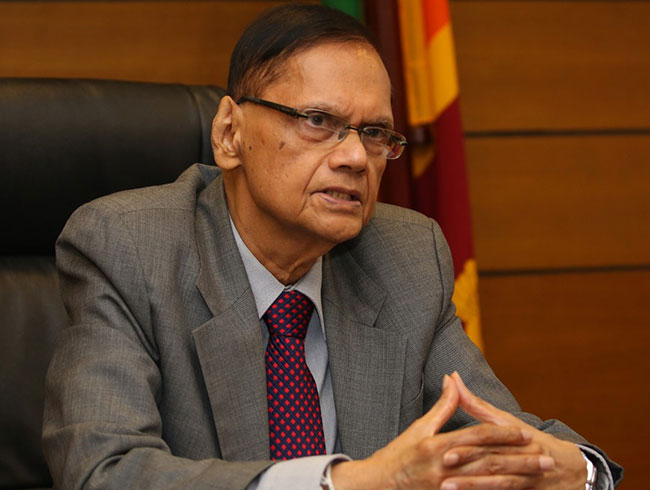
Foreign Minister of Sri Lanka Hon. Prof. G.L. Peiris concluded a successful two- day official visit to India from 06-08 February 2022. The Foreign Minister undertook his maiden visit to New Delhi after assuming office as the Foreign Minister in August last year, on an invitation extended by the External Affairs Minister of India Hon. Dr. Subrahmanyam Jaishankar.
During the visit, Foreign Minister Peiris met with his counterpart Dr. Jaishankar and the National Security Advisor of India Shri Ajit Doval. Indian Foreign Secretary Shri Harsh Vardhan Shringla also called on the Foreign Minister.
The meeting between the two Ministers, followed by delegation level talks was held on 07 February at the Ministry of External Affairs in New Delhi. During the meeting, Minister Peiris thanked the External Affairs Minister of India for the invitation and the warm hospitality extended to him and his delegation.
Observing that the relationship between India and Sri Lanka has evolved from a transactional relationship into a strategic partnership, Foreign Minister Peiris stated that it is increasingly recognized by the people of Sri Lanka that India is a true friend whom Sri Lanka can rely on at all times. In this context, Minister Peiris appreciated the financial assistance that the Government of India has extended to Sri Lanka to the tune of 2.4 billion USD at this critical juncture. Minister Jaishankar assured that the long-standing friendship between the two countries will always be a source of support to Sri Lanka.
The bilateral talks focussed on a wide range of matters of mutual interest, which included economic cooperation, power and energy cooperation, connectivity, people to people contact etc. Particular attention was drawn to the energy security of Sri Lanka, and referring to the recently inked Trincomalee Oil Tank Farm agreements, Foreign Minister Peiris stated that it signals a closer integration between two countries, resulting in substantial benefits; a win-win situation for both. The prospects for renewable energy cooperation, particularly in wind and solar power sectors were also discussed at the talks.
Focussing on the economic development in Sri Lanka, the discussion centred on the potential for Indian investments in priority sectors such as pharmaceuticals, food processing and manufacturing for which Minister Peiris invited Indian investments. The ways and means to harness the growing Indian outward tourism to revive tourism industry in Sri Lanka were also discussed.
With a view to maintaining the momentum of the trajectory of the Indo-Lanka relationship, the Ministers agreed on the early finalization of several agreements and MoUs in the areas of defence, culture and education, that are pending between the two countries.
During the talks, Foreign Minister Peiris also raised the fisheries issue with the Indian External Affairs Minister. Terming it as a ‘flashpoint’, the Foreign Minister pointed out that it has become a recurring issue, assuming a different complexion. The two sides agreed on the urgent need to convene all bilateral mechanisms in this regard.
Minister Peiris extended an invitation to Minister Jaishankar to undertake an official visit to Sri Lanka in March this year. He also stated that Sri Lanka is very much looking forward for Hon. Prime Minister of India to visit Sri Lanka for the forthcoming BIMSTEC Summit in March 2022.
The meeting between Minister Peiris and National Security Advisor of India Shri Ajit Doval was held on 08 February. The National Security Advisor of India and the Foreign Minister of Sri Lanka discussed a range of issues pertaining to the mutual strategic interests of the two countries. The status of the bilateral relationship was reviewed and priority areas for future cooperation were discussed.
The Foreign Minister, during his visit to New Delhi had a number of interactions with prominent Indian print and electronic media as well.
Foreign Minister Prof. G.L. Peiris was accompanied to these meetings by Sri Lanka’s High Commissioner to India Milinda Moragoda and senior officials of the High Commission of Sri Lanka in New Delhi and the Foreign Ministry.
Bangladesh and Pakistan together make up 5 percent of the world’s population. The Possibilities of market value in the case of export and import between these two states are inevitably huge. But the trade between the two countries of 39 crore people is now only 6-7 hundred million dollars. This is a very small share in the exports of both countries. In 2019-20, only 50 million worth of goods went from Bangladesh to Pakistan. It has the potential to grow exponentially. The industrial sector of both countries has expanded tremendously in the last 50 years. The industrialists of the previous generation knew the details of each other’s people and markets. The next generation of industrialists is unable to make use of that historical experience due to a lack of political action.
India and China have been in the midst of a war frenzy for the past year. But in the meantime, it has done business worth about 109 billion dollars. The example of Pakistan-India may be more relevant in this regard. The two countries exchange gunfire every week. There have been three large-scale battles between them. But in the meantime, they are selling products. In the 2019-20 fiscal year, goods worth 300 million US dollars went from India to Pakistan. Last year it was almost four times more. They may go back to the previous state in the future. If Pakistan-India can continue to trade despite the fragility of political relations, Bangladesh can do the same with both countries. You need to be able to. Building a market in South Asia is becoming more urgent for Bangladesh to escape the European-American political caution.
Pakistan has put Bangladeshis on the priority list for visas since 2019. Both countries can make it easier to boost export trade. This will increase the market of jute, tea and tobacco in Bangladesh, Pakistan will also increase the export of yarn, sugar, etc. However, in order to make the current trade balance more favorable for Bangladesh, policy support from Pakistan is needed. After a long hiatus, Pakistan has already shown diplomatic interest in developing relations by sending an ambassador to Bangladesh. They have to go further. Islamabad has a lot of responsibility to heal the historical wounds of Bangladesh. Many Pakistani policymakers want Bangladesh to forget the 1971 Independence war and move forward. But it is not easy on the part of Bangladesh; Not even possible. Rather, it would be convenient in practical terms to solve the problems arising from the seventy-first chapter quickly. It is high time for Pakistan to realize the situation. Those are not to be avoided. Pakistan wants to increase trade relations with Bangladesh. The Canada-based International Forum for Rights and Security, a think tank, recently published a report on Bangladesh and Pakistan. It has been shown there that Bangladesh is ahead in all areas of the index. Many Western economists have called on all countries to follow the Bangladesh model in the development of South Asia.
According to Bangladeshi Media, Bangladesh Commerce Minister Tipu Munshi has said that Pakistan is keen to boost trade and economic ties by maintaining good relations with Bangladesh on January 26, 2021. He said there were problems in some areas in trade with Pakistan. If they are removed, the trade will increase further. Both countries have huge potential to increase trade and commerce. This opportunity can be used. He made the remarks during an exchange of views with Pakistan’s High Commissioner to Dhaka Imran Ahmed Siddiqui at his office in Dhaka on Wednesday (January 26th, 2021).
The Commerce Minister of Bangladesh said Bangladesh’s trade with Pakistan is ongoing. Tea, pharmaceutical products, readymade garments, ceramic products, shoes, leather and jute products are exported from Bangladesh to Pakistan.
There is an opportunity to further increase these exports. Under the leadership of Prime Minister Sheikh Hasina, Bangladesh is advancing rapidly in all fields including economic and social. The development of Bangladesh is now visible. Bangladesh’s capacity in international trade has increased.
He said Pakistan had recently imposed anti-dumping on hydrogen peroxide exports. Such measures hinder the development of trade. Any existing problem can be solved through discussion. The problems can be identified and resolved at a meeting of the Joint Economic Commission (JEC) between the two countries. Traders have an important role to play in increasing trade. Traders can increase trade by visiting each other’s countries. Necessary cooperation can be given in this case.
Pakistan’s High Commissioner Imran Ahmed Siddiqui said the Pakistani government wants to move forward by developing trade relations with Bangladesh. There is ample opportunity to enhance trade and economic relations between the two countries. Pakistan is keen to enhance trade and economic ties while maintaining good relations between the two countries. Ceramic products made in Bangladesh are being widely used in various government departments of Pakistan.
Envoy Imran requested that visas for visits to Bangladesh be made easier for Pakistanis for personal and business purposes and that Dhaka-Karachi direct communication is introduced for the transportation of goods. He also called for a single country fair for Bangladeshi products in Pakistan and stressed holding the 9th meeting of the Joint Economic Commission (JEC).
In the last fiscal year 2019-2020, Bangladesh exported goods worth. 50.54 million to Pakistan. During the same period, it imported goods worth 543.90 million US dollars. If trade complexities are removed in some cases, the export of Bangladeshi products to the Pakistani market will increase further. Bilateral trade between Pakistan and Bangladesh for the year 2020-21 was $721.67 million. Of which Pakistan’s exports to Bangladesh in that time were $650.21 million while imports stood at $71.45 million. Bangladesh is one of the top 10 export destinations for Pakistani products. (Data are collected from reports of various media outlets).
According to recent media reports ( based on the data of the ‘State Bank Of Pakistan ) Pakistan’s goods and services trade with Bangladesh witnessed surplus of 46.65 percent during first six months of financial year (2021-22) as compared to the corresponding period of last year. The overall exports to Bangladesh were recorded at $399.408 million during July-December (2021-22) against exports of $ 274.246 million during July-December (2020-21), showing growth of 45.63 percent, SBP data revealed. Meanwhile, on year-to-year basis, exports to Bangladesh during December 2021 also increased by 52.01 percent, from US $ 54.433 million to US $82.746 million. Similarly on month-on-month basis, exports of Bangladesh were rose by 14.38 percent during December 2021 in comparison with exports of US $ 72.339 million in November 2021, SBP data said.
It is true that Bangladesh and Pakistan cam profit by growing business relations. Pakistan can export cotton, yarn, fabric, leather, inorganic chemicals, vegetables and electronics (fan), halal foods to Bangladesh. There is a high demand for these products in Bangladesh. On the other hand, Bangladesh can export its world-class medicines, apparel, agro-products, halal foods, ceramics, etc. Bangladesh can benefit from using Pakistan’s Gwadar port and China-run CPEC. Bangladeshi products can be exported to Central Asia and imported from the region easily. As a result, Pak-BD ties would boost up more. Both sides can also work in promoting cooperation in the areas of science and technology, information technology, health care, digital cooperation, SME [Small and medium-sized enterprises] development, tourism, etc. Bangladesh has vast experience in dealing with refugees, tackling climate change approach, countering terrorism, human resource development. Pakistan has experience in the sector of religious tourism. Both countries can exchange these advantages.
According to some reports of the media outlets and data of Pakistan’s central bank, in the first three months of the current financial year, the trade volume between Bangladesh and Pakistan is growing day by day. Bangladesh is now at the top of Pakistan’s foreign trade list. Although having some political problems between Pakistan and Bangladesh but the bilateral relationship between the two South Asian countries is growing. According to those reports, Bangladesh-Pakistan trade in the goods and services sector increased by about 37 percent (36.90 percent) in the first three months of the 2021-22 fiscal year compared to last year. The import of Pakistan from Bangladesh has increased by about 44 percent (43.96 percent) this year. From July to September of the 2020-21 fiscal year, Pakistan imported goods worth just over 12 million. Which stood at 17 million at that time in the 2021-22 fiscal year. It is true that bilateral trade is increasing between Bangladesh and Pakistan. Pakistan and Bangladesh should reap the benefits from growing their trade ties.
However, there are many potentials in economic relations between Bangladesh and Pakistan. But this should be realized by the government of Pakistan for its own interest. Because they need Bangladesh’s help and support in reviving their fragile economy and raising various regional issues at all international forums. The sooner the Pakistani government realizes this, the better for them. Pakistan and Bangladesh can gain by growing trade ties.
Bangladesh has always been a shining example of religious unity and peace. “Secularism” is not only a phrase engraved in Bangladesh’s constitution as one of the four essential principles of the state, but it is also an automatism that molds Bangladeshi people’s social sustenance.
However, there has been an increase in the number of tremors in the non-perpetual tranquillity in the name of terrorism and religious fanaticism. Although Islamist groups were always active in politics, Islamist factions first arose in 1989 in Bangladesh and ran wild in the years that followed with the sole goal of establishing a Caliphate in the area. The attacks on Udichi, the bombing of Ramna Batamul, the countrywide series of bombings, the targeting of bloggers, the rise of Bangla Bhai and Shayokh Abdur Rahman all lowered public morale and drove the government to establish a fast force (RAB) to put a stop to them.
On July 1, 2016, the terrorist assault on the Holy Artisan, a ritzy bistro only a stone’s throw away from the American Embassy, tarnished all efforts and predominance against terrorism. The Dhaka bombing, along with a series of subsequent incidents, marked the beginning of a new era of terror in Bangladesh. Terrorists were attempting to engage the state with modern weaponry via an encrypted communication channel. Following that incident, Bangladesh initiated a full-fledged war on terrorism, which was generally successful. An early interview with Tamim Ahmed Chawdhury, the architect of the Holy Artisan assault, in ‘Dabiq’ (the online journal of the Islamic States of Iraq and the Levant) discloses that the grounds for using Bangladesh for terror strikes are the geopolitical advantage and near proximity to India. Bangladesh has frequently been used as a launch pad for assaults against India, not just from outside, but also from within, by Islamist terror groups.
Bangladesh, the subconscious guardian of its nearest neighbor, had frequently served as a coadjutor in combating insurgencies in India’s North East area. Aravinda Rajkhowa, the Chairman of the United Liberation Front of Asom (Ulfa), was arrested and handed over to India in 2009; Anup Chetia, a ULFA stalwart, was arrested in 1997 and deported in 2015 after 18 years in prison in Bangladesh; and ULFA leader Ranju Chowdhury alias Rattan Sarker was arrested in 2010. Bangladesh handed up the entire ULFA leadership as well as the leaders of the Bodo insurgents to India. Bangladesh’s zero tolerance attitude toward terrorism had greatly benefited India, as North-East insurgencies were a major headache for the country.
India may have returned the favor by secretly assisting Bangladesh in apprehending the fugitive assassin of ‘Bangabandhu’ Sheikh Mujibur Rahman. It is well known that India and Bangladesh have extraordinary real-time cooperation and collaboration amongst their intelligence organizations.
India has consistently praised Bangladesh’s zero-tolerance approach against terrorism, with Indian Prime Minister Narendra Modi, Indian President Ramnath Kovind, Foreign Minister, Home Minister, and Chief Ministers of surrounding states expressing their gratitude and gramercy.
For the time being, the insurgency is at its lowest in India’s north-eastern region, which has prompted Chief Minister, Hemant Bishwa Sharma, to express thanks to Bangladesh and his desire to improve business and connection between Bangladesh and North-East India, as now they can concentrate on something other than insurgencies. It will happen eventually, benefiting both nations and boosting connections. Just as Bangladesh extended its hand to provide peace to the area, India requires Bangladesh’s aid to ensure the region’s growth. India wishes to access and link to the difficult-to-reach region via transit from Bangladesh, to which Bangladesh answers with a counter-proposal of transshipment. Last year, a trial run was conducted, therefore opening a new door of economic possibilities.
Regional commerce in South Asia remains below potential, but leaders in India and Bangladesh are forging strong bilateral relations to spur economic growth and prosperity. The Maitri Setu, or Friendship Bridge, erected across the Feni River is a critical corridor that will allow this to happen. Several connection channels have been resurrected, and while only a few projects are now active, many more are in the works. If a seamless connection is built, time and costs will be minimized, and both sides of the border would benefit immensely. This hard-earned ephemeral tranquility in the Northeast can only be eroded if livelihood and trade are harmed. Prosperity in the Northeast, like peace, may come to take Bangladesh’s hand.
Though insurgency is at its lowest; internal turmoil in seven sisters bubbled again last year. It is past time for India to focus on improving the livelihoods of the people in the Northeast. Connectivity and infrastructural development with Bangladesh are essential for this. This will also open up new routes through Bangladesh to the northeast, Bhutan, and Nepal.
There is an age-old belief that the interconnectedness of economy, survival, stability, development, and security lessens the likelihood of wars between states, particularly neighbors. Because of their shared interests, future, and destiny, India and Bangladesh’s stability, peace, growth, and security are inextricably intertwined and interdependent.
A peaceful neighborhood benefits business and the economy. The people of Bangladesh and India desire peace and prosperity.
Author profile: Benedict B. George is a Ph.D. fellow at the University of Texas, having a master’s degree in Strategic Studies. His area of interest is Asian Foreign Politics
President Ibrahim Mohamed Solih, in his Presidential address during the inaugural sitting of the People’s Majlis (Parliament), on February 3 announced that the government is set to launch a “National Moderation Campaign” in a bid to eradicate religious extremism in the Maldives. Raajje, January 29, 2022.–SOUTH ASIAN INTELLIGENCE REVIEW
Campaign for Free and Fair Elections (CaFFE) will soon commence regional workshops of the Janani Project, an initiative to build digital literacy and empowerment among grassroots female politicians. CaFFE Executive Director, Manas Makeen and the research team have already met with Assistant Elections Commissioners of the areas in which the workshops will be held to discuss the digital issues that grassroots female politicians face in the areas. CaFFE Executive Director and the research team have also met with representatives from the civil society, trade unions and CaFFE’s long term collaborators to further understand the unique challenges in each area as well as to lobby for their support for the successful implementation of the project.
CaFFE has officially requested the assistance of the Elections Commission and Assistant Elections Commissioners as well, and had received positive responses. The workshops will be held in three rounds, targeting the same group of women.
The first round of workshops will be an introduction to social media and digital safety and it will also act as a brainstorming session. CaFFE has conducted a research on the issues faced by grassroots female politicians in December last year and these sessions will complement that research. The second round of the workshops will focus on the legal aspects of digital media use and using existing laws to counter harassment, while the third round of workshops will focus on building the technical capacity of participants.
The workshops will be conducted by experts in the area with the support of the Elections Commission, Assistant Elections Commissioners, civil society organizations and a number of senior female political and social leaders. CaFFE has also established an Advisory Council including Former Minister Ferial Ashroff (UPFA), Former State Minister Vijayakala Maheswaran (UNP), MP Rohini Kavirathne (SJB), MP Thalatha Atukorale (SJB), Former MP Hirunika Premachandra (SJB), Urban Councillor Samanmali Gunasinghe (JVP), Senior Research Fellow at LIRNEasia, Dr. Sujata Gamage and CaFFE Director Surangi Ariyawansha.
For further information or if you are a grassroots female politician interested in taking part in the workshops, please contact us at caffesrilanka.lk@gmail.com
(More Details : Manas Makeen Executive Director – 0776539793 )
To safeguard the world’s largest mammal, scientists and conservation organizations advocate for one of the world’s busiest shipping channels to be redirected. Researchers have been piecing together information about a little-known, vulnerable group of blue whales that lives off the southern coast of Sri Lanka since 2008.
What they’ve found so far points to a specific group of cetaceans, if not a subspecies. Rather than traveling immense distances, as other blue whales do, the Sri Lankan species should stay in the area all year, feeding on microscopic shrimp and communicating through different vocalizations.
The magnitude of the peril they confront has also become apparent. The whales’ habitat crosses a major shipping route that connects East Asia to the Suez Canal, putting them at risk of ship collisions and noise pollution.
On a typical day, the whales are bombarded by roughly 200 ships, many of which are cargo ships or oil tankers with lengths of up to 300 meters.
“The issue for these whales is that they live in a gigantic obstacle course that people have constructed,” said Asha de Vos, a marine scientist who spearheaded the region’s first long-term whale research in 2008.
It’s a global conflict that’s becoming increasingly heated. Shipping traffic increased by 300 percent between 1992 and 2013, with marine transport accounting for about 90% of international trade.ADVERTISING
After a study revealed that a modest alteration in the shipping route may significantly impact the whales, a drive is currently underway in Sri Lanka to address what De Vos characterizes as a “uniquely resolvable issue.”
A trio of international conservation groups has publicly called on the Sri Lankan government to submit the route modification to the International Maritime Organization, supported by her long-standing drive to shift the shipping channel.
“Studies show that establishing a shipping lane 15 nautical miles south of the existing lane would reduce the danger of accidents with blue whales by 95%,” the letter from the International Fund for Animal Welfare (IFAW), Great Whale Conservancy, and OceanCare stated.
The 15-nautical-mile movement was “insignificant” for ships traveling across the world, according to IFAW’s Sharon Livermore. This minor alteration in the shipping lane’s location would have a big impact on the conservation status of these whales.
While there are no exact figures on how many whales dwell in the region or how many have been killed by ships, numerous bodies have been discovered in recent years that show the collision.
Rerouting
(Photo : Wikimedia Commons)
The rerouting would also aid the country’s burgeoning whale-watching sector and small-scale fishing villages, whose boats have been seen bobbing dangerously near to massive ships in the shipping lane.
Her organization addressed the Sri Lankan government in 2015 about shifting the shipping path, describing it as a once-in-a-lifetime chance to conserve blue whales, 90 percent of whom were murdered by whalers throughout the twentieth century.
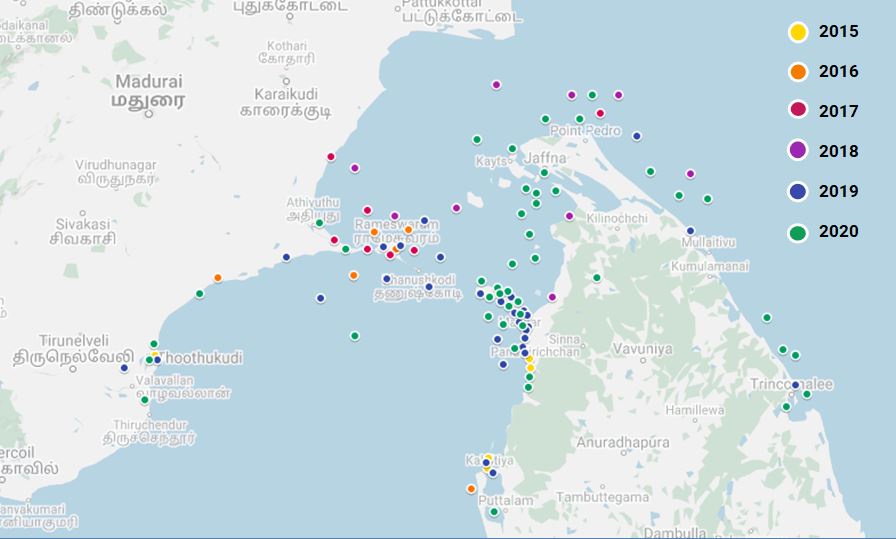
From 2015 to 2020, authorities in Sri Lanka and India seized nearly 65 metric tons of sea cucumbers worth more than $2.8 million and arrested 502 people in connection with the attempted trafficking.
The sea cucumber fishery is banned in India and restricted under a licensing system in Sri Lanka, but growing demand for the animals in East Asia has turned the waters between these South Asian countries into a hotspot for the illegal trade.
The presence of the legal trade in Sri Lanka means Indian fishers can smuggle their catches into the country and launder them into the legal market for export.
The overharvesting of sea cucumbers has severely depleted their populations; from 21 species of sea cucumber deemed commercially viable for fishing in 2008, there were only nine by 2015, according to surveys.
COLOMBO/MANDAPAM — It was a calm October night over Sri Lanka’s northern seas, the silence broken only by the sound of a rapidly approaching motorboat from India. In Kalpitiya, a town further down the island’s western coast, it rendezvoused with a truck waiting on the beach.
Also waiting there was a Navy patrol team, which seized the illegal consignment of 1,196 kilograms (2,637 pounds) of dried sea cucumbers worth more than 16 million Sri Lankan rupees (nearly $80,000); authorities also arrested two trafficking suspects.
The previous month, on Sept. 19, the Indian Coast Guard made a similar arrest in the waters off Mandapam in Tamil Nadu state. The individuals arrested in that incident were carrying 2 metric tons of sea cucumbers meant to be smuggled by sea into Sri Lanka.
Seizures of illegally harvested sea cucumbers have become increasingly common in the waters between India and Sri Lanka. Between 2015 and 2020, the Sri Lankan Navy and the Indian Coast Guard made 502 arrests and seized nearly 65 metric tons of sea cucumbers worth a combined $2.84 million.
A group of men sorting sea cucumbers for processing. Image courtesy of Ganeshan Nishanthan.
Increase in smuggling
According to data analysis of sea cucumber-related seizures and arrests reported in the media, 2019 and 2020 saw a sharp increase in cases, making the Gulf of Mannar/Palk Bay region between the two countries a global hotspot for sea cucumber smuggling.
Despite their name, sea cucumbers aren’t vegetables; they’re echinoderms, from the same phylum of marine animals that includes starfish and sea urchins, and live on the sandy bottoms of oceans, where they perform the important ecological function of nutrient cycling.
Sea cucumbers aren’t typically eaten in South Asia. Instead, their harvest here is for demand from East Asia, where they go by many names, most often bêche-de-mer, and are considered a delicacy, eaten both fresh or dried, and used in traditional Chinese medicine.
Exports of bêche-de-mer from this region have historically been low, but the trade has grown significantly in recent years as the demand for sea cucumbers has increased. Some species, like the sandfish (Holothuria scabra), sell for around $1,800/kg ($816/lb) while the white teatfish (H. fuscogilva) fetches about $401/kg ($182/lb) due to the high demand, making sea cucumber harvesting a lucrative business.
For the harvesters, the slow-moving sea cucumbers are easy pickings. But this has led to sea cucumber populations becoming overexploited across much of their historical ranges.
In light of this, India banned the sea cucumber fishery in 2001, while Sri Lanka tried to restrict the trade through a system of permits issued for collection, processing, transporting and exporting.
Sea cucumbers are slow-moving echinoderms, similar to starfish and sea urchins, and make for easy pickings for divers. Image courtesy of OceansAsia.
Risking legal loopholes
Given the current market trends, this disparity has allowed Indian fishers to exploit Sri Lanka’s legalized sea cucumber trade. They do this by smuggling their harvest to Sri Lanka to launder” the Indian sea cucumbers with the legally permitted supplies for export. Sri Lankan fishers also often violate permit conditions by gathering more sea cucumbers than allowed, as a bigger catch means more profit.
There’s also the problem of bottom trawling, which is banned in bothcountries. While 20% of the sea cucumber catch in India is deliberately targeted by fishers, the rest is incidental catch, mainly from bottom trawling. Even then, the incidental catch is hardly ever released back into the sea, said Deepak Bilgi, conservator of forests in Madurai, India.
This stock of sea cucumbers was confiscated by the Indian Coast Guard in September 2020, in which authorities foiled an attempt to smuggle the animals to Sri Lanka. Image courtesy of the Indian Coast Guard.
Indian link
Satish Sundaram, a forest range officer from India’s Mandapam and Ramnathapuram wildlife ranges in the Gulf of Mannar Marine National Park, said that during his five-year tenure until November 2020, he had arrested more than 100 persons in connection with 70 cases of sea cucumber trafficking.
In Sri Lanka, records show that the Navy seized 16,576 kg (36,544 lb) of dried sea cucumbers and 11,840 kg (26,103 lb) of wet sea cucumbers from 2015 to 2021. While the dried consignments are mostly the smuggled lot, there are also instances that consignments are confiscated because they had sea cucumbers in their possession without a valid permit or in violation of permit conditions,” said Indika de Silva, a spokesman for the Navy.
The biodiversity-rich Gulf of Mannar and Palk Bay areas, the main stretches of water between India and Sri Lanka, are the current hotspot for sea cucumber poaching. But over on the southwestern side of the Indian subcontinent, the Lakshadweep archipelago saw a significant spike in the number of reported smuggling and poaching incidents last year, showing that sea cucumber-related offenses are expanding and spreading to this remote island chain, said Teale Phelps Bondaroff, director of research at OceansAsia, an organization that investigates and marine environmental crimes.
Bondaroff, who analyzed data compiled by the authorities and the media, said there was a sharp increase in cases in 2019 and 2020. The increase could mean two things: an increase of illegal activity and also the increase of patrolling,” he told Mongabay.
In Sri Lanka, the Navy continues its regular sea patrols and has also strengthened its surveillance along coastal areas where seizures generally occur, according to a Navy spokesman.
Most fishers and the fishing community along the northwestern coastal belt live below the poverty line, and the COVID-19 pandemic only worsened the problem, driving people to look for alternative sources of income.
But fishers in and around the Gulf of Mannar and the Indian side of Palk Bay are used to collecting and trading sea cucumbers. This requires more study to understand whether the pandemic was a driver of illegal trade of sea cucumber,” said Sajan John, head of the marine unit at the Wildlife Trust of India.
Sea cucumbers were common in shallow coastal waters decades ago, but divers say they now have to go deeper in search of high-value species. Image courtesy of Chamari Dissanayake.
Fishermen’s woes
S. Chinnathambi, coordinator of Sri Lanka’s National Traditional Fishermen Federation, said fishers are constantly being exploited by unscrupulous traders into harvesting high-value threatened species.
Because sea cucumbers can be sold at a good price, fisherfolk try to harvest more. They will exploit any opportunity,” said Anthony Rajah, a diver from Mannar in the island’s north.
Rajah, who has been harvesting sea cucumbers for decades, told Mongabay that fishers used to be able to collect the animals closer to shore, but now they have to dive deeper and wade into unexplored areas to find them.
It is not that easy, and we need to put more effort now to collect them compared to then, but still this gives us a better income and I continue to engage in sea cucumber fishery,” Rajah said.
The license system in Sri Lanka has failed to effectively control the ongoing overexploitation of the country’s sea cucumber stocks, with reduced catch sizes reflecting the levels of depletion.
Sea cucumbers being dried in preparation for export. Image courtesy of Ganeshan Nishanthan.
A 2008 study listed 21 commercially viable species for fishing, but by 2015, this had dwindled to just nine. The latter survey also warned of the possible loss of more species, potentially leaving just five as feasible for fishing, according to Ganeshan Nishanthan of the University of Sri Jayewardenepura.
A scientific base for issuing licenses should be adopted based on species and available stocks, said Chamari Dissanayake, also from the University of Sri Jayewardenepura. During her tenure at the National Aquatic Resources Research and Development Agency (NARA), Dissanayake conducted a sea cucumber stock assessment in 2008. That didn’t include the northern seas, given that this part of the country was under rebel control during Sri Lanka’s civil war, which only ended only in 2009.
So, it is time to have a countrywide stock assessment, before it becomes too late for the species,” Dissanayake told Mongabay.
This map shows the locations where arrests and seizures relating to the sea cucumber trade were carried out from 2015-2020. Image courtesy of OceansAsia.
The government is now promoting sea cucumber farming, which is expected to ease the pressure on wild stocks. While experts have welcomed the move, they caution it must be accompanied by measures to prevent it from becoming yet another way to conceal the illegal trade and export of wild-caught sea cucumbers.
While regulations pertaining to sea cucumber fishery should be reinforced, addressing the smuggling of stocks should be addressed as a bilateral issue with serious repercussions on the conservation of the species in both India and Sri Lanka, Bondaroff said.
This is a high-value trade, so penalties should not be normalized, and immediate action should be taken to protect the region’s sea cucumber populations from overexploitation, he added.
Banner image of processed sea cucumbers, known as bêche de mer, are a popular delicacy in East Asia and an ingredient used in traditional Chinese medicine, making them an expensive commodity. Image courtesy of OceansAsia.
COLOMBO (XINHUA) – Sri Lanka’s Ministry of Trade said yesterday it decided to import 100,000 tonnes of white rice from Myanmar to control the rising price of rice in local markets.
The ministry said in a statement it planned to import the rice at USD445 per tonne through the Sri Lanka State Trading (General) Corporation.
It plans to import 20,000 tonnes of rice at a time and release it to the market gradually.
The Ministry of Trade said it requested the Central Bank to issue the required foreign exchange for the import of the rice.
Imports of rice in Sri Lanka are usually limited to small quantities, especially rice such as Basmati, officials said.
The United States, Britain, Canada and few other Western so-called champions of human rights will press their unreasonable demand at the United Nations Human Rights Council (UNHRC) next month to initiate an international probe into alleged human rights violations in the last phase of the separatist war against Tiger terrorists 13 years ago. The UNHRC claim evidence has been produced, but refU.S.es to share it with Sri Lanka or their law enforcement authorities to verify its authenticity.
Last Thursday, the U.S. attacked and killed Islamic State leader Abu Ibrahim al-Hashimi al-Qurayshi, a dreaded terrorist, in Syria amid concerns about a potential resurgence from the terrorist group. It reflects the ongoing nature of U.S. involvement in military operations overseas, even after President Biden pulled American forces out of Afghanistan last year. In this drone attack at least 13 civilians including six children and four women were also killed.
This kind of unavoidable civilian deaths could occur when the armed forces try to kill terrorists who caU.S.e scores of deaths of innocent civilians by their actions. Hence, it is unreasonable to call on President Biden to punish the soldiers who carried out the attack to kill the ISIS leader.
What is highly objectionable is the UNHRC and others who refrain from taking up such issues against the U.S. or the UK, who blame Sri Lanka for alleged civilian deaths during the last days of the separatist war against Prabhakaran, the most ruthless terrorist leader in the world who is accountable for the lives of thoU.S.ands of men, women and children including a President of Sri Lanka and a former Prime Minister of India.
UNHRC picks on weak nations
The UNHRC wants to hold international investigations on the purported 2009 civilian deaths in Sri Lanka, but even after 50 years the UNHRC is not in the least concerned about the British soldiers who killed thoU.S.ands of innocent Irish civilians.
The UNHRC maintains a deafening silence on the killings of innocent Irish civilians killed by the British armed forces in Londonderry 50 years ago, despite the fact that clear evidence has been recorded that as many as 3,700 people died over the course of the four-decade conflict in Northern Ireland.
The most horrendoU.S. incident was on 30 January 1972, the Blood Sunday brutal killing of unarmed civilians holding a peaceful protest in the city of Londonderry in Northern Ireland. The people in several towns held events to mark the 50th anniversary of the brutal killing of 14 unarmed civilians by the British soldiers, who fired upon a crowd of protesters. Last Sunday the family members of those killed held roses as they participated in a walk of remembrance.
Today we remember all those who died or were injured as a result of the atrocity on #BloodySunday50, one of the darkest days for this island,” Irish Prime Minister Micheál Martin said in a tweet. We also pay tribute to the families of the victims, whose dignity and persistence in the search for truth and j U.S.tice has never wavered.”
The Voice of America said the families of the victims are despondent over whether the soldiers involved will ever face trial. Charlie Nash saw his 19-year-old coU.S.in William Nash killed as members of the British Parachute Regiment fired more than 100 high-velocity rounds on 30 January 1972, at the demonstrators in Londonderry. We thought there might be rioting, but nothing, nothing like what happened. We thought at first they were rubber bullets,” Nash, now 73, told AFP. But then we saw Hugh Gilmour -one of six 17-year-old victims- lying dead. We couldn’t take it in. Everyone was running,” he said.
A public investigation later concluded that British soldiers fired on the unarmed protesters even though none of those killed posed a threat to the soldiers.
Prosecutors announced they were pursuing criminal charges against two British soldiers who took part in the Bloody Sunday shootings, but the cases were dropped last year.
UK off the hook
What followed was most surprising. It was the introduction of the Overseas Operations Bill to protect UK soldiers from prosecution for crimes committed abroad after five years. This means that victims could be denied jU.S.tice and offenders escape the law. The UK would also be violating numeroU.S. human rights treaties by not ensuring abU.S.es are properly dealt with.
Ministers defending the Bill said, the goal of the Overseas Operations (Service Personnel and Veterans) Bill”, is to establish the supremacy of the law of armed conflict.” The bill, according to the Government, will put an end to the seemingly endless acts of lawfare” against British personnel. However, the Human Rights watch said, the new legislation has jeopardize the United Kingdom’s commitment to the rule of law. It was designed to make it close to impossible to prosecute almost all cases five years after the offence happened. This includes war crimes, torture or other appalling abU.S.es. It places members of the Armed Forces above the ordinary criminal law – in a way that is completely unprecedented.
By the new Bill, the British Government effectively decriminalised torture. The critics point out that it is extremely dangeroU.S. for members of the Armed Forces to be given a free pass over alleged war crimes. Yet the Government was determined to protect those accU.S.ed of torture and war crimes, instead of stopping them in the first place. The HR Watch expressed fear that this Bill was one of several laws that the Government is trying to pass in the UK that is incompatible with our human rights obligations and added that such statute of limitations on war crimes committed by soldiers is a blatant breach of international law.
The above is the human rights position of the United Kingdom and its double standards. The other major accU.S.er, United States, has a worse record than that. The U.S. human rights violations in in Asia runs into volumes from Hiroshima and Nagasaki atomic bombs, killing over 300,000 civilians instantly to Mai Lai napalm chemical attacks on Vietnamese women and children and horrendoU.S. killings of Afghan civilians.
While the UK and U.S. openly cover up and protect their soldiers found guilty on human right violation abroad, they want to probe some alleged violation in Sri Lanka, with connivance of UNHRC, a bias organisation according to former U.S. President Donald Trump.
While, everybody agrees that nobody should oppose charges being brought against nations and States who have allegedly committed War Crimes and Crimes against Humanity, it should not be a policy of pick and choose. Furthermore, one has to understand certain hard core military actions are necessary when a State armed force fights a ruthless terrorist organisation like the LTTE, a terrorist group proscribed by many countries including UK and U.S. There is conclU.S.ive proof that some foreign forces including some of the very accU.S.ers and their proxies were involved in training LTTE terrorists and providing them arms in the past.
It is apparent that the accU.S.ers as well as the UNHRC only pick on weak nations in Asia, Africa and South America to highlight alleged human rights abU.S.e and leave the affluent nations alone.
The recently announced multi-faceted US$ 200 million plan to develop Galle Harbour both as an enhanced commercial port and as a water sports and leisure hub hosting cruise ships, is an attractive proposition. Indeed, the Public-Private sector project, envisaging domestic and foreign investment, promises to breathe life into a port which has been in the doldrums from the last decade of the 19th Century onwards, after having been the primary port for 500 years until 1873.
The details of the development plan outlined by the Minister of Ports Rohitha Abeygunawardena, are not yet available, but from the broad contours of the plan revealed to the Media, it appears that very drastic changes are envisaged – changes that could have an adverse impact on the port’s tangible heritage, warn marine and cultural archeologists.
They say that Galle Harbour has to be seen as being part of the Galle UNESCO Heritage Site” comprising Galle Fort and the old town. Any damage done to the port’s heritage could lead to UNESCO’s heritage appellation being withdrawn.
The massive ramparts, bastions, buildings, lighthouse, clock tower and magazine are the most visible features of Galle Harbour’s maritime landscape, that also includes underwater maritime archaeological sites and Sinhalese and Buddhist sites of significance. It is well known that Galle Bay is the resting place of a number of wrecked vessels of the Portuguese, Dutch, and the British era, and perhaps even of ships of the earlier Arab era. The rocks and reefs at the entrance of the Harbour had been playing havoc with shipping for centuries. But the wreckage is invaluable for marine archeologists to whom it is part of Sri Lanka’s heritage, and therefore, worth preserving.
Marine archeologist Lt.Com (Rtd) Somasiri Devendra recalled that earlier, there was another plan to develop Galle port, along with a Marina. But there was opposition, first from UNESCO which said that the project would impact on the Galle World Heritage site and lead to its de-listing. An expert from Italy came and submitted a similar report to the Department of Archeology.
As maritime archaeologists, we also objected. And the Department of Archeology insisted that, in terms of the Antiquities Act, an Archaeological Impact Assessment should be carried out by experts chosen by the Department. Any decision on the port should therefore be based on such studies and legal considerations,” Com.Devendra said.
2007 Survey
In 2007, following discussions between the Sri Lankan Department of Archaeology and the Department of Maritime Archaeology, Western Australian Museum (WAM), WAM was engaged as a consultant to undertake a maritime archaeological survey of Galle Harbour as part of an Archaeological Impact Assessment (AIA) process.
The scope of the consultancy was to outline the impact of the then proposed Galle port development on the underwater cultural heritage of Galle. The survey took place between 14 November and 2 December 2007. WAM staff were supported in Sri Lanka by the Department of Archaeology, the Sri Lankan Maritime Archaeological Unit (MAU), and the Central Cultural Fund.
It is noteworthy that WAM had been involved in maritime archaeological investigations in Galle Harbour since 1992.Remote sensing and diving search projects, undertaken in 1992, 1993 and 1996, had resulted in the location of a range of significant maritime heritage sites in the Harbour including Arab-Indian stone anchors.
A number of VOC (Dutch East Indian Company) vessels are known to have been wrecked in or around Galle. The sunken Dutch ship Hercules (1661) is of particular interest. Then there are the wreck sites of Dolfijn (sunk in 1663); Barbestien (1735); Geinwens (1776). These sites are an integral part of the values for which Galle Harbour is perceived as significant i.e. as physical and archaeological evidence of Dutch colonial activity, port development and maritime trade in Galle, Sri Lanka and Southeast Asia generally,” the WAM report said.
Further: The European colonial fort and port infrastructure on the western shore is in juxtaposition to the virtually untouched eastern shore, with the Buddhist architecture of the Peace Dagoba and other Buddhist sites of significance, Jungle Beach and Watering Point. Other evidence of Galle Fort’s operations and construction is present in the quarries and likely archaeological remains of Dutch infrastructure at Watering Point.”
Gibbet Island is likely to have human remains and possibly graves relating to executions and burials carried out during the Dutch occupation period. The name given to Gibbet Island in early Dutch records is ‘Hercules Kirkhof (trans graveyard)’.”
The WAM team had located 11 iron steamship wrecks (excluding the two modern wrecks). The following vessels are known to be wrecked in the vicinity of Galle Harbour: SS Phatti Allum; SS Rangoon (south-west of Galle Harbour). The WAM study says that two recent wrecks demonstrate possible impacts to the Galle fort and maritime archaeological sites.
The modern wreck of a Singapore-owned dredger Scorpio lies in three parts. The main hull and machinery of the dredger lie on the western end of the Gibbet Island breakwater where it was carried by currents after running aground near the Hercules site in June 2007. A part of the dredger’s pontoon hull subsequently broke away and was carried by currents to a position just outside of the naval base entrance (this wreckage appears to lie directly on top of a wreck marked on Admiralty charts).”
While it is fortunate that neither of these wrecks have directly impacted the highly significant VOC Hercules or Avondster sites, or damaged the fort walls, they do demonstrate the natural dangers of Galle Harbour, the potential for large modern wrecks to end up in the same places as historic shipwrecks, and the real potential for modern shipping accidents in Galle Harbour even with its current status as a minor port,” the WAM report warned.
If the port is expanded to take larger ships and increased shipping traffic, then the impact to the heritage landscape values and amenity of Galle Fort UNESCO heritage site caused by major port infrastructure, increased shipping movements and attendant increased risk of shipping-related incidents such as wrecks, marine oil spills, and dust and pollution from heavy road traffic must be taken into consideration, the report suggested.
Recommendations
To preserve the heritage values of the Harbour, as described above, our recommendation is to relocate shipping facilities to a less culturally sensitive region. The establishment of a port in Galle will have implications for the Harbour’s proposed listing as a world heritage site. If Galle Harbour is selected for redevelopment, all attempts should be made to minimize the impact of any built structure on the cultural and natural aesthetics of the Harbour,” the WAM report recommended.
Consideration for the heritage values of Galle UNESCO site should be extended to the wider maritime landscape of Galle Harbour, that under current plans will be significantly impacted by placing major modern port infrastructure between the ancient fort and eastern bay area, along with attendant risks from increased shipping movements,” the report said.
Better focus on Hambantota and Colombo
Finally, the WAM said that the Sri Lankan Ports Authority had better focus on Hambantota and Colombo as the sites for major port and infrastructure developments, and limit development in Galle to upgrading and improving existing facilities in accordance with its current status as a minor port.”
But now having given China, control over the commercial Hambantota port for 99 years, it would not be practical to think of developing it as a leisure hub.
However, environmentalists and marine archeologists say that Galle bay could be developed as a yachting and water sports hub with enhanced facilities, while avoiding its development as a commercial port to attract big vessels.
By Hiruni De Silva Courtesy Ceylon Today-Hiruni De Silva is a Sri Lankan Counter-Terrorism Analyst.
The teardrop island of Asia in the Indian Ocean is used as a pawn on the geopolitical chess board. After the misery of its 30-year bloodthirsty war, exhausted since 2009, Sri Lanka now suffers its aftermath. At present Sri Lanka is being pulverised by the hands of power abusive world politics. In the power hunger game, the Western Bloc reigns supreme. The recent flickering spark of this is the construction of the Mullivaikal Memorial in the premises of the University of Jaffna.
Since year 2019, the LTTE international network made several attempts to build a monument to commemorate LTTE leaders and members. The Mullivaikal Memorial commemorates members of the LTTE killed in the final battle in 2009. The terrorist supporters and sympathisers wish to rebuild the memorial within the premises of the University of Jaffna. This construction has a negative impact. It is not only on the people, also on social harmony and co-existence among the communities that live in the Jaffna Peninsula. A Twitter video was recently posted by the former leader of the Opposition MPP and Mayor of Brampton, Patrick Brown. With that video promoting separatism, one could clearly comprehend the level of intense lobbying by the LTTE fronts in Canada. The LTTE funding and votes have trapped number of Canadian politicians to support brutal terrorists seeking to revive and strike back. The outrage on the demolition of the Mullivaikal Monument is clearly, not an act of harmony or justice. Is Canada interfering with the sovereignty of Sri Lanka by permitting the LTTE to conduct activities against Sri Lanka’s interest?
Globally proscribed
As the LTTE is a globally designated terrorist entity, it is operating largely in the Western World through political, youth and community organisations. The LTTE fronts are Transnational Government of Eelam (TGTE), the Tamil Youth Organisation (TYO) in France, French Tamils Co-ordination Committee (CCTF), Australian Tamil Congress (ATC), British Tamils Forum (BTF), Irish Tamil Forum (ITC), Solidarity Group for Peace and Justice in Sri Lanka (SGPJ), and the United States Tamil Action Group (USTAG). Brampton Mayor, Patrick Brown became a muppet in the hands of the LTTE. This incident exposed the hidden manipulations of LTTE international network too. Some Western politicians vulnerable to LTTE funds and votes in Canada, France, Australia, USA, Great Britain and Germany started to accuse the tear drop island. They pointed the finger to Sri Lanka’s democracy and the State sovereignty of Sri Lanka.
The Sri Lankan conflict is one of the best documented conflicts in the world. The allegations that there were war crimes and genocides are false. These false allegations are made by the LTTE and separatist fronts such as USTAG who have no credibility. The true reasons behind these false allegations against Sri Lankan security forces should be unveiled. The separatist war led by the LTTE’s vicious terrorist Prabhakaran began in 1983 when they attacked 13 Government security force personnel in the Jaffna Peninsula. This war has been exploited by some Western powers. They have been using this platform to intervene in State matters of Sri Lanka. The geopolitical rivalry has impeded Sri Lanka’s progress and economic prosperity. The international interferences in state matters have become a significant barrier to Sri Lanka’s development, which suffers due to the West’s vassalage to the LTTE.
Throughout the period of brutal war Sri Lanka suffered from under development and a huge loss of lives. The LTTE separatists introduced themselves as freedom fighters killing innocent and brave, young and old, alike. According to the UN country report the total number of civilians killed from January to May 2009 is 8186, this includes both civilians and security force personnel. Since the recapture of the Mavil Aru reservoir in 2006, 6261 tri-force personnel were killed and 29,551 were injured. During the three decades of war 24,962 Army personnel, 1160 Navy personnel, 443 Airforce personnel, 456 Special Task Force personnel and 2568 Police personnel were mercilessly killed by LTTE terrorists. Like in Afghanistan, Iraq, Syria, Libya and Yemen, the Sri Lankan conflict too produced fatalities and casualties. However, the number of civilians killed was very low and most of those killed were LTTE terrorists and the civilians deliberately targeted by the LTTE militants. Although there were isolated atrocities by Sri Lankan security forces similar to atrocities in Afghanistan and Iraq by US Forces, there was never deliberate targeting of civilians. Throughout the conflict 52 per cent of the Tamil population lived in the South of Sri Lanka.
The Sri Lankan war was not a ‘civil war’ between Sinhala and Tamil citizens of the country. This was a battle between the Sri Lankan security forces and the LTTE terrorists. Therefore, this conflict is better identified as a Non International Armed Conflict (NIAC). The motive of the LTTE was an independent homeland for Tamils in the North and East. It is a merciless action disturbing national sovereignty. This separatist ideology is the foundation stone of LTTE terrorism with which they tricked the international community. This made the seepage of domestic problems to the international platform. The LTTE successfully tricked the international community about Tamil Eelam and instigated them against Sri Lanka and its humanitarian actions.
The neighbour’s mistakes
Before approaching the Western bloc, the Tamil Tigers approached neighbouring India. Since India consisted of a huge Tamil population in the Tamil Nadu region. India’s geopolitical agenda on Sri Lanka had a different view from the Western Bloc. Sri Lanka was infected with the separatist ideology of Tamil Eelam. This was a germ spread by Tamil Nadu. The underline cause of Tamil Nadu politicians to spread the ideology of separate homeland for Tamils was their obsession to establish power in Sri Lanka. The Tamil Homeland included regions such as the Northern and Eastern Provinces. This mechanism of approaching the international community paved the way for the LTTE to be stabilised. As a result, the LTTE was recognised as the most organised terrorist group with a huge international funding network.
Prabhakaran was guileful enough to persuade political leaders and parties of the Western bloc. The influence of the international community on behalf of the LTTE was their significant need of Tamil votes. The powerful western nations helped the LTTE since Tamils were a widespread community in the world. Each Tamil individual was seen as a vote. Prabhakaran’s method of approaching the international community was different. He was opportunistically emphasising the number of Tamil votes that can be gained in the elections. The funding provided by the LTTE too contributed to the West intervening with the State matters. That obviously persuades their minds about the need for a Tamil Homeland. The greediness for power in the leaders of the international community, especially Western Nations dragged Sri Lanka into this dungeon. Eventually, the LTTE became the extensive, foreign funded terrorist network in the world. The Western bloc always had an eye towards Sri Lanka as the gateway to the Indian Ocean. Therefore, maximum advantage was obtained from the sudden fortune.
The State that safeguards
The Western Governments have used the human rights agenda to pressurise Sri Lanka, in order to develop a Western centric foreign policy. The USA, United Kingdom, New Zealand, Canada, France, Germany and Switzerland were the main nations to be harsh about the Sri Lankan humanitarian actions. The recent challenge on Sri Lankan national sovereignty was made by Canada. It was initiated with the statement of Patrick Brown on the Mullivaikal Memorial incident. Canada introduces them as a State that safeguards the human rights and as a State known for better uplifting of the fundamental rights of citizens. In the incident of military sexual misconduct, victims were not given their due concern. It is pathetic to hear that nearly two years after the incident only the Defence Minister, Anita Anand apologised. It seems a bit ironic that Patrick Brown, the Brampton Mayor is the one to deny that allegation at its first instance. Where is the justice for those victims of military sexual misconduct? Such double standards are a paradox and make it difficult to understand the nature of the Canadian Government towards Sri Lanka.
Similarly any war has its own collateral damages and acts done to obtain military advantage. The Sri Lankan security forces have not committed any sort of extra judicial killings or genocides. There is neither genocide nor military sexual misconduct committed by Sri Lanka. The Sri Lankan security forces have followed all required IHL standards. The Canadian move about the Mullivaikal Memorial incident doesn’t make any sense. It is because there are human rights violations in their own country within the authoritative bodies. No State that stood against Sri Lanka for its false allegations of Human Rights neither who passed resolutions against Sri Lanka for war crimes raised their voices against Canada. The national sovereignty of Canada was not disturbed by any means. This is what geopolitical double standards mean. These actions unveil the avaricious needs of the Western Block and the true nature of the politicians of international community who strive in power hunger. Canada and every Canadian should never forget that LTTE’s single biggest support base was Canada. Canada should not once again de-stabilise Sri Lanka by permitting its politicians to be recruited by LTTE supporters living on Canadian soil.
India’s support has made a world of difference” to Sri Lanka’s economic situation, said Sri Lankan Foreign Minister G.L. Peiris, on his first visit to India since he was appointed last year, making it clear that the flurry of agreements announced in recent weeks have allowed the neighbours to move on from the problems of the immediate past”.
In an interview to The Hindu, he cautioned, however that the unresolved conflict over fishing rights is a constant irritant” in bilateral relations, and the recent clashes between Indian and Sri Lankan fishermen that led to the death of two Sri Lankans, was a flashpoint” in ties that he hopes to resolve through talks.
There’s no doubt whatsoever that Indian support at this critical juncture has made a world of difference. It has helped us to tide over the immediate difficulties which were obviously acute,” Mr. Peiris told The Hindu, referring to a series of announcements, including one billion dollars in various lines of credit, a currency swap arrangement of $400 million and a debt deferral of $515 million for two months from India.
In addition, India and Sri Lanka concluded a long pending agreement to jointly develop oil tank facilities in Trincomalee, and have planned a number of infrastructure projects involving the private sector, which will be further discussed when Finance Minister Basil Rajapaksa visits Delhi in the next few weeks. Sri Lanka has also invited Prime Minister Narendra Modi to attend the BIMSTEC summit in Colombo on March 30, and hold substantive” bilateral talks.
All of this has engendered a degree of confidence which we didn’t see in the immediate past. And it has brought into being very special relation… there is a feeling that India has always stepped in when Sri Lanka needed it,” Mr. Peiris added.
Ties between India and Sri Lanka plummeted in February 2021 over the Rajapaksa government’s decision to cancel an MoU with India and Japan for Colombo’s East Coast Terminal project, which it later cleared for a Chinese company. Several other projects involving India had also been delayed for what Mr. Peiris called logistical issues and bureaucratic reasons”. Subsequently, Sri Lanka awarded the West Coast Terminal project to the Adani group, and after a number of rounds of talks, including calls between PM and President Gotabaya, as well as three meetings between the foreign ministers on the sidelines of events in New York, Dhaka and Abu Dhabi, relations have seen a new enthusiasm and a fresh energy”, he said.
Mr. Peiris met with External Affairs Minister S. Jaishankar and Foreign Secretary Harsh Shringla on Monday, as a part of his three-day visit. In a tweet, Mr. Jaishankar said they held productive talks,” which included discussions on economic cooperation, energy security, pending agreements on infrastructural projects, and agreed to schedule bilateral mechanism talks on the fishing rights issue at an early” date.
Mr. Peiris said in the interview that he also hoped to consult India and other BIMSTEC members including Bangladesh, Bhutan, Nepal and Thailand about the best way to tackle the problem” of whether to invite Myanmar to the summit, or to follow the ASEAN grouping decision to exclude the military regime that took power in a coup last year.
Mr. Peiris also said apprehensions in India over Sri Lanka’s close ties with China were not logical”, and the relationship with China was not at the expense of India”.
We are part of the Belt and Road Initiative. China has played a significant role with regard to the development of our ports and harbours and infrastructure of which we are appreciative,” he said, adding that Colombo hoped that China will soon restructure Sri Lanka’s debt, given its economic problems, a request made to Chinese Foreign Minister Wang Yi during his visit to the island last month.
When asked about the issue of Tamil reconciliation and devolution of power to the North and East, that India has consistently pushed for, Mr. Peiris said a committee of experts would submit a draft on the issue within two months to the President’s Council, but added that no decision can be implemented unless there is sufficient consensus” from the Sri Lanka’s Sinhala majority. In January, several legislators from the North and East wrote a letter directly to Prime Minister Modi, seeking India’s intervention in ensuring the Sri Lanka government keeps its commitment to the process.
Excerpts
When it comes to confidence, the question of China often becomes an issue between India and Sri Lanka, particularly when projects are cancelled in China’s favour, and we saw a visit by FM Wang Yi to Sri Lanka last month….
That’s not a new problem. There’s no exclusivity in Sri Lanka’s foreign policy. We have cordial relations with all our friends. But the relationship with India is in every respect a very special relationship. That is partly due to circumstances relating to history, geography, economy, it’s the destiny of the two countries is inextricably interwoven, but it’s also a matter of conscious choice is not that destiny has put us together.
There has a realisation in both countries that further integration represents a win win situation. In every sector People to People contact outtake tourism that is low hanging fruit, the Ramayana trail, developing 52 sites, tourism sites. At the time COVID-19 hit us about 1/3 of the tourists coming into Sri Lanka were from India. India is our largest is our second largest trading partner, the third largest source of investment into Sri Lanka.
We do have a relationship with China. We are part of the Belt and Road Initiative. China has played a significant role with regard to the development of our ports and harbours our instruction infrastructure of which we are appreciative but that is not at the expense of India. And we have repeatedly assured that under no circumstances would we allow any part of Sri Lanka’s territory territorial waters are aspirants to be utilised in any manner that is detrimental to India or to any other other friends. So there really is no need for apprehensions to be entertained. It is it is just a kind of fear, which has no logical basis.
Just recently, two Sri Lankan fishermen were killed in clashes between a fisherman on both sides. Is there some kind of a new package or some kind of a new way forward, that you are discussing with India?
There have been discussions about retraining Indian fishermen with regard to methods of deep sea fishing discussions among fishermen’s cooperative societies on the two sides and other long term solutions. We do need something of a more immediate nature. I would say this is a real flashpoint in the relationship between the two countries it is a constant irritant. And we really do need to find a solution to these. There’s goodwill on both sides, and there is the realisation and the result. To address this matter in earnest and find a solution, I hope my visitwill play a constructive role in that regard.
To turn to the Tamil issue, legislators from the North and Eastern Provinces wrote to PM Modi asking for his intervention in ensuring an implementation of promises on devolution and the 13th amendment. Do you see this as another flashpoint? Should India have a role?
No, I won’t say that…India has taken interest [in the past]. But the principal responsibility, obviously is of Sri Lanka, and Sri Lankan political parties must engage primarily with the Sri Lankan government. There is at the moment, a comprehensive constitutional reform exercise that is underway. There is a committee of experts who is preparing a draft that is expected to be ready and to be submitted within the next two months. And this [devolution] is one of the issues that will no doubt be addressed in that draft. But whatever is done must be backed up by a sufficient consensus in the country. You know, if there is a great deal of resistance experienced, then it will be difficult to implement on the ground. So, we will we will try to talk to all stakeholders and arrive at understanding with regard to arrangements which will really stand the test of time.
But it has been eight months since talks were supposed to be held between the Tamil leaders and President Gotabaya, and have not been held yet?
We many things, principally Covid-19 has intervened. But it is something that we are committed to and we will have those discussions quite soon.
HC Navaratne responds to Ontario’s politico’s allegation 140,000 killed in Vanni war
Sri Lanka has pointed out flaws in the process adopted by the Geneva-based United Nations Human Rights Council (UNHRC) to pursue unsubstantiated war crimes accusations, which paved the way for the 2015 accountability resolution. In spite of serious concerns expressed by the then Opposition and the armed forces, the yahapalana government co-sponsored the controversial resolution against Sri Lanka.
Sri Lanka’s High Commissioner in Ottawa Harsha Kumara Navaratne has pointed out glaring inadequacies in the Geneva process exploited by interested parties, including those in Canada, to accuse Sri Lanka of causing genocide in the final phase of the conflict.
There hasn’t been a previous instance of Sri Lanka directly disputing the Geneva process since the adoption of the 2015 accountability resolution. The much-anticipated position has been taken ahead of the next Geneva sessions scheduled to begin later this month.
The following is the text of the statement titled ‘Refuting the allegation of ‘Tamil Genocide’ in the final phase of the conflict in Sri Lanka issued by the Sri Lankan mission in Ottawa requesting those interested in genuine post-war national reconciliation to initiate a dialogue with HC Navaratne: The term genocide is used to describe one of the gravest crimes against humanity, comprising of specific acts committed with intent to destroy, in whole or in part, a national, ethnical, racial or religious group. Therefore, the Sri Lanka High Commission in Canada notes with serious concern attempts by certain parties in Canada trying to portray the final phase of the conflict in Sri Lanka which ended in 2009 as ‘genocide’ against the Tamil people of Sri Lanka. The Sri Lanka community in Canada is multi-ethnic and multi-religious. In this context, the Private Member Bill 104 on ‘Tamil Genocide Education Week’ passed in Canadian province of Ontario has caused strain in intercommunity relations among the Sri Lankan community by the depiction of a false narrative against one community.
In addition, while appreciating the various Canadian Government focused programs for Sri Lankan Tamil Canadians, we are disappointed to note that on January 31, 2022, at an event announcing funding for Tamil students with targeted mental health and wellness programs and resources, Mr. Stephen Lecce, Ontario’s Minister of Education made comments including we are very deliberate in our choice of words that we recognize a genocide that transpired against the innocent Tamil people” and in a genocide that has left over 140,000 innocents perished at the hands of the regime in Colombo”. Mr. Vijay Thanigasalam, MPP Scarborough – Rouge Park, who was also present, referred to Tamil genocide’ in his remarks.
We are appreciative that the Department of Foreign Affairs, Trade and Development in a
Diplomatic Note dated 7 th April 2021 responding to a clarification stated that the Department of Foreign Affairs, Trade and Development clarify Canada’s official position with regard to allegations of genocide in Sri Lanka, the department can officially confirm that the Government of Canada has not made a finding that there was genocide in Sri Lanka”. Further, the Government of Canada has proscribed the Liberation Tamil Tigers Eelam Organisation (LTTE) as a Terrorist organization.
In this background, the repeated use of the word Tamil Genocide” only generates dissention and prejudice amongst the children and community of Sri Lankan Canadians living in Ontario. Therefore, such allegations need to be refuted in the interest of social harmony and to prevent the spread of fallacies about Sri Lanka in the international community.
During the final phase of the conflict in Sri Lanka, the government forces confronted the internationally proscribed terrorist group Liberation Tigers of Tamil Eelam (LTTE), one of the most brutal terror groups the world has witnessed. The aim of the LTTE was to divide Sri Lanka on ethnic lines and carve out a separate State. With this objective, they conducted a three decades long terrorist campaign which brought much suffering and destruction on all communities.
During the last stages of the military conflict in 2009, when the LTTE was facing inevitable defeat, it resorted to holding Tamil civilians hostage as a human shield and refused all efforts to move civilians away from conflict areas. The allegation of civilian casualties and the exaggeration of the numbers was the means by which the LTTE sought to force foreign intervention to halt the government advance.
Nevertheless, the government forces managed to rescue approximately 290,000 Tamil civilians from the clutches of the LTTE, cared for them and resettled them. In addition, over 12,000 armed LTTE cadres were rehabilitated and released, proving thereby that the Sri Lankan government had avoided causing unnecessary deaths even among enemy combatants, not to speak of noncombatant civilians.
Therefore, there is absolutely no evidence to suggest any act and/or intent of the spurious allegations of genocide” during the military engagement with the LTTE. Neither was there a pattern of events even to suggest genocide”. Military experts have noted that the tactical options were justifiable and proportionate given the situation in the last phase of the military conflict.
Some parties, including LTTE remnant groups and sympathizers, have seized on hypothetical figures of civilian casualties contained in certain seriously flawed Reports commissioned by the UN, to push a claim of genocide of Tamil people in Sri Lanka during the final stage of the military conflict. However, not even the much-disputed UN Secretary General’s Panel of Experts report (PoE) carry the accusation of genocide” against the Government of Sri Lanka. The principal findings of the OHCHR Investigation on Sri Lanka (OISL), in 2015 in to the alleged war crimes” of Sri Lanka do not even suggest genocide”.
Groups espousing the claim of genocide have seized the claim, made without any proof, in the PoE report that there could have been as many as 40,000 civilian deaths” during the final months of the conflict. The PoE report came up with the hypothetical figure of 40,000 civilian deaths by setting off the actual number of people finally rescued by the Sri Lanka Army which was approximately 290,000 against the hypothetical figure of 330,000 which they deemed to be the number of civilians who had been in the area (Vanni) before military operations commenced in that region. This hypothetical number of 330,000 civilians used by the PoE is a purely arbitrary construct. Nobody, in Sri Lanka or outside, really knew exactly how many civilians the LTTE was holding in captivity during those months in 2009.
In addition, the PoE report mentions a lower figure of 7,721 deaths (up until 13 May 2009) reported by the United Nations Country Team in Sri Lanka. However, this figure is later disputed by the PoE report without explaining how it is that over 30,000 people could have been killed in the final days up until 18 May 2009 when the conflict ended, if the figure of 40,000 is ever to be correct and accurate.
It may be noted that in July 2011, the data collected by Department of Census and Statistics of Sri Lanka in the Northern Province, found that in 2008 and 2009 when the final battles raged in the Northern Province, the total number of persons who died of causes other than natural causes, was 9,283. The field data collection required for the project, the first enumeration of its kind in that part of the country since the census of 1981, was carried out by the predominantly ethnic Tamil government employees serving in the Northern Province. The number of fatalities suffered by the Sri Lanka Army during the final war against the LTTE between July 2006 and May 2009 was 5,876. It would only be logical to assume that the LTTE would have suffered a greater number of fatalities than the armed forces of Sri Lanka, and that of those reported (9,283) to have died in the Northern Province due to other than natural causes in 2008 and 2009, the vast majority would have been LTTE cadres or those directly involved in hostilities.
Legal experts have identified that the use of the disputed figure, which is the central weakness in the PoE report, is exacerbated by the standard of proof that it professed to adopt. A non-legal analysis (‘I felt sure’, I felt reasonably confident’, I was absolutely convinced’, ‘I had my suspicions’ etc.) is used in a document dealing with alleged criminality on a major scale – that name those who may be responsible and who merit further judicial and other process. They note that international courts and tribunals have not placed reliance on reports of this nature as being probative evidence to prove allegations in trials for war crimes and crimes against humanity.
Since the end of the conflict in 2009, Sri Lanka has pursued a policy of restoration, reparation, re –integration, rehabilitation and reconciliation within the overall concept of restorative justice. At a time when Sri Lanka is moving ahead with these processes, certain groups, including remnants of LTTE international network, have been trying to discredit and destabilize the efforts undertaken by Sri Lanka by pushing agendas such as ‘Tamil genocide’.
As seen in the comments made by Mr. Stephen Lecce, who cited a figure of 140,000 deaths, the contents of unverified reports have succeeded in misleading the international community and influencing opinion-formers and decision makers. If, with the passage of time, the dubious nature of the evidence on which the UN reports are based is forgotten, their accusations, which are in fact unproven, may become potent over repeated use.
The allegations of genocide impact on Sri Lanka’s relations with the international community, at a time when it is engaged in a long-standing cooperation with the UN human rights mechanisms and the UN Human Rights Council and is delivering on its commitment to address accountability and reconciliation through domestic processes and institutions.
Therefore, the High Commissioner of Sri Lanka extends an open invite to all those who are committed to the peace and reconciliation process of Sri Lanka to visit, meet and have a dialogue with him on this subject.”
The Director-General of Health Services has confirmed 26 new coronavirus-related fatalities for February 06, increasing the death toll in the country due to the virus to 15,621.
This includes 17 males and 09 females, according to the Department of Government Information.
Six of the deceased were in the age group of 30-59 years. Two others were aged below 30 years and the remaining 18 victims were aged 60 years and above.
The first question I ask the Minister in charge of the Electricity Board is as to why he skipped the CPC and go to the IOC for such a large volume of fuel from a foreign Agency that will drain millions of Foreign Exchange? I know he will say the CPC refused.
Now that already the Government has been compelled to sign an agreement with the IOC on the Trinco Oil Farm and the Harbour, I wonder whether this is the next step in handing over Trinco Oil Tank Farm A Marvel in the East’ (as one writer has described it) and the Trico Harbour, including 85 acres of land adjoining the second best natural harbour in the world and the best in the East, to India, the much-awaited Dream by India for more than the past75 years. Dravida Munnetra Kasagam also once agitated to annex it, to India as their future Port of EELAM. In that backdrop now I suspect this deal as a part of a subversive agenda on the part of India to get a tighter grip of this Island nations security and the economy defeating all attempts by India’s arch-rival China and the USA currently in tow with India on Indo-Pacific Quadrilateral Program, that could disappear at any moment the USA finds a better ally in the region than India or the Indian interests overtake those of the USA. A tighter legal hold on Trinco will be a geopolitical asset to India to control not only Sri Lanka but also the entire Indo Pacific region from a strategic angle. India’s strength there might definitely paralyze the territorial integrity, sovereignty, and political independence of this Island nation, in view of its focal importance on the great East-West naval route. It is in this backdrop and long-term security concerns one has to look at both these deals and not from the point of view of short-term implied benefits.
To me, both these agreements by the Sri Lankan government are extremely short-sighted political bungles that lack political and strategic wisdom and maturity or far-sightedness. It reminds me of the story about chopping the goat’s neck to save the pot that we have learned in grade 11 in the village school. I can understand the stands of the two respective Ministers, each driven by the urge to overdo the other arguing for his case. But surely what the others including the Defense and Trade Minister were doing. Well even if the whole Cabinet gave its nod why the Prime Minister, the senior elder statesman or the President the Head of the Cabinet brought their attentions to these imminent serious long- term economic, security, and geopolitical implications and asked the two Ministers to settle it among them as an internal issue by asking the Electricity Minister to first, settle the 97 million bills with the CPC. That would have settled the problem and the CPC would have then supplied the fuel required.
However, now that the government has got caught in the trap let us wait and see as to how they will come out of it. It is said that there are hundreds of Advisers to the Ministries, the Prime Minister and the President, led by a Chief Advisor. What the hell they had been doing when the government is getting trapped like this. Were they sleeping or just planting the stake to save their positions? In this scenario, I think not only the Cabinet but also all these Royal Advisors are responsible to the nation for all the future repercussions that will befall the nation on account of these two idiotic Agreements.
As I see it as a layman, both these agreements are clever manipulations of the Indian Kautilyan bureaucracy. They first signed the Trinco Oil Farm Agreement and put the first noose. Then they agreed to give a US $ 500 Million swaps as an aid to help Sri Lanka to meet its Dollar crisis. But they were very careful to tie up that 500 m with the purchase of fuel from India. Third, the IOC agreed to provide fuel to CEB, which they refused at first and set off the bills against that 50 million swaps. The money is Indian, fuel to is Indian, IOC Indian and finally, the profit with interest for the loan as well as the fuel is back to the Indian coffers. See how nicely and cleverly they have manipulated it and how our entire Cabinet and the bureaucracy have been caught up in the Indian trap?
Why did the energy Ministry surpass the CPC to purchase fuel from the IOC
Isn’t this surprising and shocking and extremely dangerous that the Energy Ministry has decided to bypass the CPC and has decided to purchase its fuel requirements from the IOC an Indian agency. I can’t understand why the Cabinet has given its nod without studying the pros and cons including economic losses to the country and its serious long-term implications down the Kautilyan line. Why can’t the Ministry of Energy buy this from CPC? So that the profit will accrue to this country, instead of it going to India and draining the total 500 m US$ credit facility given by India back to India with interest? Is there a deal behind this as well? Worth looking in to, by those interested and competent.
The Energy Minister in my view should have,
1 First Settle the outstanding bills with the CPC Rs. 90 billion due to fuel already purchased
and
2 Thereafter buy the diesel and Petrol from the CPC. So that the profit from this deal will not go to India but CPC will get it. The CEB will also function with CPC fuel and CPC a Sri Lankan business concern will also prosper and contribute to economic development at home instead of funding the econ development of India, with the loan money taken from them going back to India. CEB purchasing fuel from CPC means it leads to development at home and profit for the country.
Does the Cabinet too want to close down the CPC and hand over the entire fuel distribution business to the IOC?
Does the Cabinet too want to close down the CPC and hand over the entire fuel distribution business to the IOC? The first mistake in this game was done by Ranil’s government in2002. Firstly, by handing over the distribution of fuel to IOC and Secondly, handing over the Trinco Oil Farm of 101 Tanks each with a capacity of 20,000 Metric Tons totaling 1.2 Million MT. Mount Batton constructed these tanks in 1927 -32 to store all the needs to meet the requirements of the whole of southeast Asia. We never made use of these tanks after 1948. What an asset and an economic marvel for Sri Lanka.
Doesn’t this show that our Cabinet is more concerned about the IOC than the CPC and the well-being of Indians rather than Sri Lankans at Home? One should not get surprised if we hear next that they have decided to hand over the CPC as well, with all its assets to India. The next step in their march to vistas of prosperity will be handing over all 101 Tanks, the harbour, and the 85 acres around it to India.?
Now that Trinco oil Farm and the Harbour and port of Hambantota, Colombo West Terminal and Kankasanture Airport and Declaration of the North and East as Traditional Homeland of South Indian Tamils, Tamil is made an Official Language all over Sri Lanka with Tamil only in the North and East, while even in India it is not, though they have 70 million Tamils in Tamilnadu alone and all illicit Tamils in Sri Lanka are given citizenship by JR/ Rajiv Accord it is only left for Tamils to declare unilaterally EELAM on this soil.
The relevant News item on the Cabinet decision is given below.
ECONOMYNEXT 2.2 2022.
ECONOMYNEXT – Sri Lanka will buy 40,000 metric tonnes of diesel and 40,000 metric tonnes of petrol from the Indian Oil Corporation following discussions, a government’s statement said.
The Ministry of Energy has discussed with the Indian Oil Company to procure” the fuel, the statement said.
Indian Oil Corp has agreed to supply the fuel.
The cabinet of ministers had given the go-ahead to purchase the fuel.
The statement did not say whether a 500 million dollar credit line given by India to Sri Lanka to buy fuel will be used. (Colombo/Feb01/2022)”
Sri Lanka to purchase 40,000 Metric Tons of diesel from IOC
Tuesday, February 1, 2022 – 11:02
Local
The Cabinet of Ministers has approved to procure 40,000 metric tons of diesel and 40,000 metric tons of petrol from the Indian Oil Company.
Bangladesh and Pakistan together make up 5 percent of the world’s population. The Possibilities of market value in the case of export and import between these two states are inevitably huge. But the trade between the two countries of 39 crore people is now only 6-7 hundred million dollars. This is a very small share in the exports of both countries. In 2019-20, only 50 million worth of goods went from Bangladesh to Pakistan. It has the potential to grow exponentially. The industrial sector of both countries has expanded tremendously in the last 50 years. The industrialists of the previous generation knew the details of each other’s people and markets. The next generation of industrialists is unable to make use of that historical experience due to a lack of political action.
India and China have been in the midst of a war frenzy for the past year. But in the meantime, it has done business worth about 109 billion dollars. The example of Pakistan-India may be more relevant in this regard. The two countries exchange gunfire every week. There have been three large-scale battles between them. But in the meantime, they are selling products. In the 2019-20 fiscal year, goods worth 300 million US dollars went from India to Pakistan. Last year it was almost four times more. They may go back to the previous state in the future. If Pakistan-India can continue to trade despite the fragility of political relations, Bangladesh can do the same with both countries. You need to be able to. Building a market in South Asia is becoming more urgent for Bangladesh to escape the European-American political caution.
Pakistan has put Bangladeshis on the priority list for visas since 2019. Both countries can make it easier to boost export trade. This will increase the market of jute, tea and tobacco in Bangladesh, Pakistan will also increase the export of yarn, sugar, etc. However, in order to make the current trade balance more favorable for Bangladesh, policy support from Pakistan is needed. After a long hiatus, Pakistan has already shown diplomatic interest in developing relations by sending an ambassador to Bangladesh. They have to go further. Islamabad has a lot of responsibility to heal the historical wounds of Bangladesh. Many Pakistani policymakers want Bangladesh to forget the 1971 Independence war and move forward. But it is not easy on the part of Bangladesh; Not even possible. Rather, it would be convenient in practical terms to solve the problems arising from the seventy-first chapter quickly. It is high time for Pakistan to realize the situation. Those are not to be avoided. Pakistan wants to increase trade relations with Bangladesh. The Canada-based International Forum for Rights and Security, a think tank, recently published a report on Bangladesh and Pakistan. It has been shown there that Bangladesh is ahead in all areas of the index. Many Western economists have called on all countries to follow the Bangladesh model in the development of South Asia.
According to Bangladeshi Media, Bangladesh Commerce Minister Tipu Munshi has said that Pakistan is keen to boost trade and economic ties by maintaining good relations with Bangladesh on January 26, 2021. He said there were problems in some areas in trade with Pakistan. If they are removed, the trade will increase further. Both countries have huge potential to increase trade and commerce. This opportunity can be used. He made the remarks during an exchange of views with Pakistan’s High Commissioner to Dhaka Imran Ahmed Siddiqui at his office in Dhaka on Wednesday (January 26th, 2021).
The Commerce Minister of Bangladesh said Bangladesh’s trade with Pakistan is ongoing. Tea, pharmaceutical products, readymade garments, ceramic products, shoes, leather and jute products are exported from Bangladesh to Pakistan.
There is an opportunity to further increase these exports. Under the leadership of Prime Minister Sheikh Hasina, Bangladesh is advancing rapidly in all fields including economic and social. The development of Bangladesh is now visible. Bangladesh’s capacity in international trade has increased.
He said Pakistan had recently imposed anti-dumping on hydrogen peroxide exports. Such measures hinder the development of trade. Any existing problem can be solved through discussion. The problems can be identified and resolved at a meeting of the Joint Economic Commission (JEC) between the two countries. Traders have an important role to play in increasing trade. Traders can increase trade by visiting each other’s countries. Necessary cooperation can be given in this case.
Pakistan’s High Commissioner Imran Ahmed Siddiqui said the Pakistani government wants to move forward by developing trade relations with Bangladesh. There is ample opportunity to enhance trade and economic relations between the two countries. Pakistan is keen to enhance trade and economic ties while maintaining good relations between the two countries. Ceramic products made in Bangladesh are being widely used in various government departments of Pakistan.
Envoy Imran requested that visas for visits to Bangladesh be made easier for Pakistanis for personal and business purposes and that Dhaka-Karachi direct communication is introduced for the transportation of goods. He also called for a single country fair for Bangladeshi products in Pakistan and stressed holding the 9th meeting of the Joint Economic Commission (JEC).
In the last fiscal year 2019-2020, Bangladesh exported goods worth. 50.54 million to Pakistan. During the same period, it imported goods worth 543.90 million US dollars. If trade complexities are removed in some cases, the export of Bangladeshi products to the Pakistani market will increase further. Bilateral trade between Pakistan and Bangladesh for the year 2020-21 was $721.67 million. Of which Pakistan’s exports to Bangladesh in that time were $650.21 million while imports stood at $71.45 million. Bangladesh is one of the top 10 export destinations for Pakistani products. (Data are collected from reports of various media outlets).
According to recent media reports ( based on the data of the ‘State Bank Of Pakistan ) Pakistan’s goods and services trade with Bangladesh witnessed surplus of 46.65 percent during first six months of financial year (2021-22) as compared to the corresponding period of last year. The overall exports to Bangladesh were recorded at $399.408 million during July-December (2021-22) against exports of $ 274.246 million during July-December (2020-21), showing growth of 45.63 percent, SBP data revealed. Meanwhile, on year-to-year basis, exports to Bangladesh during December 2021 also increased by 52.01 percent, from US $ 54.433 million to US $82.746 million. Similarly on month-on-month basis, exports of Bangladesh were rose by 14.38 percent during December 2021 in comparison with exports of US $ 72.339 million in November 2021, SBP data said.
It is true that Bangladesh and Pakistan cam profit by growing business relations. Pakistan can export cotton, yarn, fabric, leather, inorganic chemicals, vegetables and electronics (fan), halal foods to Bangladesh. There is a high demand for these products in Bangladesh. On the other hand, Bangladesh can export its world-class medicines, apparel, agro-products, halal foods, ceramics, etc. Bangladesh can benefit from using Pakistan’s Gwadar port and China-run CPEC. Bangladeshi products can be exported to Central Asia and imported from the region easily. As a result, Pak-BD ties would boost up more. Both sides can also work in promoting cooperation in the areas of science and technology, information technology, health care, digital cooperation, SME [Small and medium-sized enterprises] development, tourism, etc. Bangladesh has vast experience in dealing with refugees, tackling climate change approach, countering terrorism, human resource development. Pakistan has experience in the sector of religious tourism. Both countries can exchange these advantages.
According to some reports of the media outlets and data of Pakistan’s central bank, in the first three months of the current financial year, the trade volume between Bangladesh and Pakistan is growing day by day. Bangladesh is now at the top of Pakistan’s foreign trade list. Although having some political problems between Pakistan and Bangladesh but the bilateral relationship between the two South Asian countries is growing. According to those reports, Bangladesh-Pakistan trade in the goods and services sector increased by about 37 percent (36.90 percent) in the first three months of the 2021-22 fiscal year compared to last year. The import of Pakistan from Bangladesh has increased by about 44 percent (43.96 percent) this year. From July to September of the 2020-21 fiscal year, Pakistan imported goods worth just over 12 million. Which stood at 17 million at that time in the 2021-22 fiscal year. It is true that bilateral trade is increasing between Bangladesh and Pakistan. Pakistan and Bangladesh should reap the benefits from growing their trade ties.
However, there are many potentials in economic relations between Bangladesh and Pakistan. But this should be realized by the government of Pakistan for its own interest. Because they need Bangladesh’s help and support in reviving their fragile economy and raising various regional issues at all international forums. The sooner the Pakistani government realizes this, the better for them. Pakistan and Bangladesh can gain by growing trade ties.
A drafter of the Animal Welfare Bill blamed the non-enactment of the law on politicians from mainstream political parties and both sides of the aisle, whom he claimed feared losing votes, and thereby their political survival.
Attorney-at-Law (AAL) Senaka Weeraratna who is a Member of the Bar Association of Sri Lanka (BASL) while serving as a Legal Consultant on animal welfare legislation to the Law Commission of Sri Lanka from 2000 to 2006 played a pivotal role in steering the drafting of the said Bill, claimed that politicians, for opportunistic and political reasons did not want to have anything to do with the Bill.
The Bill which was given the nod by Cabinet in January 2016 seeks to repeal and replace the Prevention of Cruelty to Animals Ordinance, No. 13 of 1907 as Amended, which is the existing law in this regard.
He alleged that these politicians don’t want to touch the Bill even with a barge-pole and are not prepared for a discussion on the matter for fear of losing votes and the voting bloc of powerful groups of communities who have no sympathy for animal life.
They believe that this is not immoral but is legitimate. They are not sensitive and they don’t care. This is the reality. This is a national shame for a country with a practice of an animal-friendly cultural heritage. All pleas made to the politicians have fallen on deaf ears and they have turned their backs on the cries and grievances of the poor animals. The sanctity of life is not solely for human beings who are but only one species out of approximately eight million,” he explained.
Elsewhere, the President of the BASL, Udaya Rohan De Silva PC noted that this Bill was essential.
This Bill came up earlier but has been abandoned since. We talk of humanitarian grounds and the rights of normal people but we don’t talk about animals rights. This has to be looked at and animals have to be safeguarded. We will urge the Minister of Justice, AAL Thalatha Atukorale to get the matter on track and proceed further. We will push the authorities to do the needful in this regard,” he elaborated.
COVID-19 has resulted in the worst health, social and economic crisis of our time. From the loss of life and its impact on communities, to the widespread economic instability and job loss, the devastating impacts of the pandemic are being felt across borders, sectors, and age groups. For the youngest members of our society, the pandemic has resulted in considerable upheaval. The prolonged closure of pre-schools and childcare centers, the shift to online education, the limited access to routine medical services, and the isolation from friends and family has increased vulnerability and stifled opportunities for child growth and development. Given the importance of the early years in human development, it is likely that the impact of these losses will be felt for generations to come. As we make our way through the seemingly endless list of COVID-19 variants, we are left with little choice but to accept and adapt to a new normal. In doing so, we must now focus on mustering the support to rebuild and recover.
In Sri Lanka, the World Bank has collaborated with the State Ministry of Women and Child Development Pre-Schools & Primary Education, School Infrastructure & Education Services (SMWCD) and the MARGA Institute to obtain a more holistic understanding of how the pandemic has affected child development outcomes and the provision of Early Childhood Development (ECD) services in the country. A telephone survey carried out in August 2021 across all nine provinces of the country captured the views and experiences of primary caregivers, ECD teachers, and ECD officers. It covered different aspects of child development ranging from health and nutrition deficits to behavioral changes and losses in cognitive and non-cognitive skill development.
Health safety and hygiene practices inculcated with use of face masks, sanitizers and handwash basins at the ECD centers.
The survey showed that in many parts of the country the pandemic has disrupted routine healthcare services, leading to delays in child vaccinations, check-ups, and nutrition support programs. Overall, 22 percent of caregivers indicated that their children have missed clinic appointments due to the pandemic. Many children also missed out on nutritional supplements and support provided by the government. The data suggests that children may have experienced food security challenges during the pandemic. Approximately 10.7 percent of surveyed families received the emergency support dry ration pack given by the government and 19.7 percent of families took loans for consumption purposes. For a country that was already grappling with childhood stunting and malnutrition, the consequences of these disruptions will be significant and are likely to be amplified by broader socio-economic issues including the rising cost of living.
Teachers also noticed behavioral changes in children, which in some cases could be a red flag. In general, teachers observed decreased activity and skill use, and also noticed increased impatience, anger, and less camaraderie among children. Following extended periods of isolation and limited social interaction, teachers felt that some children have become quieter and more reserved. Many of these concerns were shared by caregivers who felt that their children have missed out on valuable time in school. My child misses preschool so much. She makes me dress up like a teacher, and she dresses up in her school clothes, and we pretend that we are in preschool. She insists on this. Otherwise, she refuses to do her schoolwork,” said one parent from the Monaragala District.
On a more positive note, the findings indicate that most children have accessed learning material through various channels: 94 percent of caregivers said they maintained communication with teachers or community volunteers, and 80 percent of ECD teachers had taken steps to provide material and instructions to caregivers. Around 47 percent of teachers had visited children’s homes to provide support, and 63 percent of urban sector teachers, 33 percent of rural sector teachers, and 11 percent of estate sector teachers had used online platforms or mobile apps while ECD centers were closed.
Though not representative of the country’s overall situation, these findings do provide some indication of the pandemic related developmental losses in children from the rural, urban and plantation regions. They reveal gaps in service provision, particularly related to the challenges and lack of infrastructure and facilities for online education. They also highlight the difficulties faced by ECD professionals and the financial challenges and job losses within the sector which could affect the service provision capacity in the country.
This information can serve as a starting point for remedial action and provide a basis for the prioritization of interventions. In the short term it is necessary to ensure that all children continue to have access to early education. In addition, the implications on child nutrition suggest the need for urgent remedial action to prevent further damage and to reverse the negative impacts on child health and nutrition status. In the long-term, further action may be necessary to revive the ECD sector by providing necessary support to vulnerable centers and ECD professionals. Exploring alternative approaches for the provision of early years services may be needed to recover from the massive development losses, and to remediate, catch up and build back better.
Given that the early childhood years form the foundation of human capital development, ECD and the ECD service sector must be given due priority in the post pandemic recovery process. Targeted attention is needed to improve and strengthen children’s health and nutrition status, care and well-being, and cognitive and non-cognitive skill development. Let’s commit to action to develop robust and resilient systems to support Sri Lanka’s littlest citizens.
Sri Lanakan Foreign Minister’s visit ahead of Finance Minister trip
Sri Lankan Foreign Minister G.L. Peiris will meet External Affairs Minister S. Jaishankar on Monday, in his first visit to India since being appointed last August. Both sides are expected to discuss India’s economic support to Sri Lanka, plans for new infrastructure projects and pending issues over fishermen’s rights.
Announcing Mr. Peiris’ arrival in Delhi on Sunday, the Ministry of External Affairs (MEA) said Foreign Secretary Harsh Shringla would call on him on Monday morning, and he would meet Mr. Jaishankar later in the day, and fly out on Tuesday.
BIMSTEC summit
Officials are also expected to discuss Sri Lanka’s plans to hold the BIMSTEC (Bay of Bengal Initiative for Multi-Sectoral Technical and Economic Cooperation) summit on March 30 as the current Chair of the regional grouping that includes Bangladesh, Bhutan, India, Myanmar, Nepal, Sri Lanka, Thailand, which Prime Minister Narendra Modi has also been invited to attend.
The Foreign Minister arrived just days after the Export Import Bank (EXIM) of India and the Government of Sri Lanka signed a $500- million Line of Credit agreement which would help Sri Lanka cope with its current fuel shortages. Last month India announced it would defer Sri Lankan debt repayment of $500 million by two months, and extended a $400 million currency swap arrangement, to give its neighbour some breathing space on a currency reserve crunch.
India and Sri Lanka have signed an MoU for the development of oil facilities in Trincomalee, after detailed talks with Sri Lankan Finance Minister Basil Rajapaksa during his visit to Delhi in November. Both governments are in talks for another $1 billion in assistance from India, which will be reviewed during Mr. Peiris’s visit, and also during another visit later this month by Mr. Basil Rajapaksa.
Tensions over fishing
However, long-drawn differences over fishermen’s rights are expected to be on the agenda for talks, as Sri Lanka demands that Indian fishermen stop bottom trawling” and overfishing of the Palk Straits. Tensions escalated last month after mid-sea clashes between Indian and Sri Lankan fishermen that led to the death of two Jaffna fishermen. Meanwhile, on January 25, Sri Lanka released more than 50 Indian fishermen who had been detained by the Sri Lankan navy in December. The foreign ministers are expected to discuss ways to defuse tensions over the issue.
Mr. Peris has met Mr. Jaishankar on two previous occasions in the past few months, including on the side-lines of the UN General Assembly in New York, and an Indian Ocean Region conference in Abu Dhabi in December. He was Foreign Minister of Sri Lanka from 2010-2015 under then-President Mahinda Rajapaksa who is now Prime Minister.
Illustration: Liu Rui/GTEconomic cooperation between China and Sri Lanka has made headlines lately, after Sri Lanka asked for China’s help on its debt restructuring. A spokesperson for China’s Ministry of Foreign Affairs said earlier this week that China will continue to provide assistance to Sri Lanka’s economic and social development to the best of its capacity, when commenting on the issue of “Sri Lanka’s debt restructuring.”
However, it seems that mutually beneficial economic cooperation between China and Sri Lanka has made some people in Sri Lanka’s neighboring country India anxious and fearful. They feel growing cooperation between China and Sri Lanka is a loss for India, which traditionally treats Sri Lanka as part of its sphere of influence.
In a Foreign Policy magazine article, India journalist C. Raja Mohan warned that “China’s two-ocean strategy puts India in a pincer.” Another article on the Indian news site theprint.in said that “New Delhi will be watching with an eagle eye,” as the Chinese Foreign Minister visits “a bunch of Indian Ocean states.” It suggested that an India-led QUAD rescue Sri Lanka from its “Made in China” crisis.
India indeed is watching closely, but unfortunately, with the wrong lens that makes many in the country so shortsighted that they cannot see the benefits of cooperation between China and its neighbors. That also makes them over-confident over where the country is.
For example, since when India is leading the QUAD? How can the QUAD – a US-led geopolitical tool in the Indo-Pacific on security issues – provide real economic support for Sri Lanka to endure current temporary difficulties?
It’s China that has been providing concrete assistance to Sri Lanka’s economic development, and China has made the same commitment amid the South Asia country’s current economic test. On the contrary, India has always viewed China-Sri Lanka economic cooperation from the perspective of a geopolitical game. New Delhi insistently views normal economic cooperation between China and Sri Lanka as a strategic loss, which is completely wrong.
In fact, China’s assistance to Sri Lanka could also benefit India’s economy in many ways. Sri Lanka is a close neighbor of India and is very close to India economically. Therefore, Sri Lanka’s economic development is beneficial to India. Conversely, an economic crisis in Sri Lanka will also hurt India’s economy.
Putting aside political differences, there still remain many opportunities for cooperation among China, India and Sri Lanka. China and India can jointly help Sri Lanka develop its economy, which will also help enhance cooperation and trust between China and India.
That’s also true for India’s other neighbors. For instance, Nepal, which had long relied on importing electricity from India, last November for the first time sold hydropower to India, amid a reported acute power shortage following the impact of COVID-19. And it was Chinese investments in Nepal’s hydropower sector help it realize this important milestone. The country needs both Chinese investment and the Indian market to tap the full potential of its hydropower sector.
India is a major power in South Asia and is still one of the fastest growing economies in the world. No one is denying that; however, how many in India think and behave is not befitting the status of a major power. They need to take a long view of where India’s national interest really lies in the long term and act accordingly. Blindly following the US geopolitical games and relentless pursuing a confrontational approach toward China are definitely not in its interests.
By Huang Lanlan in Shanghai and Chen Runze in Colombo Courtesy Global Times
Chinese and Sri Lankan national flags are seen at Colombo’s Port City during the visit of Chinese State Councilor and Foreign Minister Wang Yi in Colombo, Sri Lanka, on January 9, 2022. Photo: VCG After Sri Lanka declared an economic emergency and asked China for help at the beginning of the year, some Western and Indian conspiracists once again went on a bashing spree against China and its Belt and Road Initiative (BRI).
By maliciously tying Sri Lanka’s recent financial distress to the Chinese investment in the country, they got busy hyping the so-called “Chinese debt trap” in an attempt to mislead the public and attack the China-Sri Lanka cooperation.
Some users created and spread rumors on social media in January that “China’s central bank issued bank notes with a face value of 10,000 rupees in Sri Lanka,” which was later refuted. This misinformation insinuates China’s violation of Sri Lanka’s currency sovereignty, smearing the mutually beneficial economic cooperation between the two sides as an “unequal plunder” by China, observers told the Global Times.
With either rumors about currency sovereignty or the so-called “China debt trap,” some Western countries, led by the US, and India have been attacking China’s overseas construction projects. However, their clichés have rarely been echoed in BRI countries, Chinese and Sri Lankan scholars said.
China is a good friend “with consistent economic policies, good trade practices and a win-win attitude,” Samitha Hettige, advisor of the National Education Commission of Sri Lanka, mentioned in his article published in December on Sri Lanka’s English-language newspaper, Ceylon Today. “Sri Lanka-China relations are quite strong, only based on friendship and nothing to do with [business or politics],” Hettige told the Global Times.
Disinformation campaign
The rumor about currency sovereignty went rife earlier in January, coinciding with Wang’s visit to Sri Lanka. One of the earliest rumormongers was a Twitter user under the name “bandhini fernando” who frequently posts anti-China misinformation, the Global Times found. On January 9, “bandhini fernando” posted two fake pictures of “Sri Lanka’s new 10,000 rupees note” saying it was issued by the People’s Bank of China.
“Wang Yi officially handed over new currency to Sri Lanka during his meeting with [Sri Lankan] President,” bandhini fernando wrote. The user claimed that the “new bank note” can be used in Sri Lanka and wickedly described the Chinese-invested projects of Colombo Port City and Hambantota Port as “Chinese territory.”
The rumor was refuted the following day by Sri Lankan fact-checking agency Factcrescendo, which quoted a response by the Deputy Governor of the Central Bank of Sri Lanka, CJP Siriwardana, as saying that the bank currently has no plans to issue a 10,000 rupees bank note and the highest currency value in Sri Lanka remains 5,000 rupees.
The “China debt trap,” an old accusation though, is another defamation campaign by the West and India against China-Sri Lanka’s economic cooperation.The Chinese Ministry of Foreign Affairs responded by saying that the accusations are not true. “China-Sri Lanka cooperation is mutually beneficial and has been warmly welcomed by all sectors in Sri Lanka,” said the ministry spokesperson Wang Wenbin on January 10.
There is no such thing as a “China debt trap,” noted Hettige. “The total Chinese loans only account for a little more than 10 percent of our total loan property portfolio, and China is actually the fourth largest [creditor], behind international capital markets, multilateral development banks and Japan,” he told the Global Times, highlighting that “the media did not show the fact.”
US and India’s role
The US and India play a major role in the slandering campaign against China-Sri Lanka cooperation and China-funded projects in the country, observers found.
“Sri Lanka has not fallen into a debt trap,” President of Sri Lanka, Gotabaya Rajapaksa, once stressed in the presence of then US Secretary of State Mike Pompeo, as Sri Lanka’s news site Ada Derana reported in October 2020. Readers often see mainstream American newspapers and magazines, including The New York Times, the Wall Street Journal, Foreign Policy and The Atlantic, publish articles blathering about the alleged “China debt trap.” Responding to the smears and attacks, Rajapaksa said in an official statement in October 2020 that “constructing a port in Hambantota is an idea of Sri Lanka and not China’s.” He also added that the project has a vast potential for generating income and employment opportunities for his country.
“The US frequently defames China-invested projects in Sri Lanka, partly to hope that Sri Lanka will abandon [the BRI] and opt for the [aid plans] the US offers,” said Qian Feng, Director of the Research Department of the National Strategy Institute at Tsinghua University.
“Some Indian government officials and reporters always regard South Asia as India’s ‘sphere of influence,’ wary of the so-called ‘outside forces’ developing relations with other countries in the region,” Qian said while highlighting that “with hostility toward China, they see China’s cooperation with countries like Sri Lanka a weakening of India’s power of influence there.”
Make your trip to Sri Lanka even more special with a sleepover in one of these unique hotels, although don’t blame us if you can’t bear to leave…
This sleek bed and breakfast feels like a stylish home from home – guests are invited to help themselves to snacks and (non-alcoholic) drinks from the bar, or explore the countryside on the property’s bicycles.
Accommodation takes the form of a villa or one of three one-bedroom bungalows, named after the three sons of Don Hendrick Wickramarathne, a local judge who built the house in the early 20th century.
After stumbling across the property in 2010, current owners Raf and Harold subsequently transformed it into a boutique hotel, and it’s now one of Tangalle’s most charismatic stays.
Numerous positive claims are often cited for organic farming such as being environmentally friendly, superior food quality free from pesticides and other toxins, efficient energy use and sustainable food production. Much of these are highly contestable, and the most critical issue, why it is expanding only at a snail pace, is hardly discussed.
As shown in Fig.1, organic farming, despite it commencing in the 1960s, yet comprises only a very small fraction, 1.5%, of the global farmlands of which 66% is pasture; and it is expanding at only 2% annually. Only 16 countries have over 10% of their agricultural land organic, the highest extent of 46% being in Liechtenstein, a very small country (principality) in Europe, of 160.5 square kilometers with a population of 38,137 people.
Nearly all these 16 countries (with over 10% organic farmland) have pastures and animal production as the principle agricultural pursuit, and the main fertilizer for pasture is farmyard manure. The elite in rich countries love organic beef steaks though costly!
Nitrogenous fertilizer scarcity the biggest constraint to organic farming
Of the four main nutrients components in fertilizers, nitrogen (N), phosphorus (P), potassium
Why is organic farming expanding only at snail’s pace globally?
(K) and magnesium (Mg), the last three have natural sources approved for use in organic farming. Rock phosphate (P), muriate of potash or potassium chloride( K) and Epsom salt or magnesium sulphate(Mg) are natural deposits. Magnesium and calcium can also be supplied via dolomite, another natural mineral deposit.
Whereas muriate of potash and Epsom salt are readily soluble and hence can be taken up by roots; rock phosphate is insoluble and is made available to plants in the soil very slowly via solubilization with acids in the soil and microbes. Rock phosphate, therefore, usually cannot meet the P demand of seasonal crops. The answer has been super-phosphate manufactured by adding sulphuric acid to rock phosphate which makes its use prohibitive in organic farming. On the other hand, copper sulphate manufactured using sulphuric acid and copper metal or copper oxide is widely used as a fungicide in organic agriculture.
However, according to the founding concepts of organic farming based on philosophical views about nature, not biological science, even synthetic mineral fertilizer use is prohibitive. Natural means and methods were assumed to be superior. However, this argument is not consistent with science.
Nitrogenous fertilizer scarcity is the biggest constraint to expansion of organic farming as synthesized ammonium compounds such as ammonium sulphate and urea are prohibitive. Mineral deposits of sodium nitrate or Chile saltpetre from Chile and Peru are used as a nitrogenous fertilizer sources in organic farming in some European and other countries, but not permitted in others because the use of soluble fertilizers is considered to be contrary to organic farming principles. Then how can the use of copper sulphate be condoned? The International Federation for Organic Agriculture Movements (IFOAM) should review some these conditions that should vastly enable expansion of organic farming.
One of the ‘environmentalists’ objection to production of ammonia and urea is the very high energy consumption amounting to 1% of the global energy or 173 KWh and the related greenhouse gas emissions. The reaction of the synthesis of ammonia using atmospheric nitrogen and hydrogen from methane, via the Haber- Bosch process is carried out at very high temperatures of 400-450 degrees C and a high pressure of 210 atmospheres.
Urea manufacture also accounts for a large water consumption of 12.8 cubic metres/ton of which 95% is clean water. On the other hand, global conventional agriculture is heavily dependent on it and the reputed geographer and economist Prof. Vaclav Smil, of the University of Manitoba some years ago calculated that 40% the global population is alive on account of availability of urea for crop production.
There is much research in progress for synthesis of ammonia and urea with far less energy use. For example a Chinese research team led by Shuangyin Wang reports (Nature Communications Vol.12 Article number 4080; 2021) an electrochemical method, still at research stage, of urea synthesis from nitrogen and carbon dioxide at room temperature using some metal catalysts (MBenes). Concurrently, several projects are under way on urea production from the same raw materials using solar and wind energy. If these technologies become feasible for industrial urea manufacture, would IFOAM approve use of such urea in organic agriculture, now that an exception has been made by way of copper sulphate use as a fungicide in organic farms?
One of the complaints of our farmers who have switched to organic farming is the very slow decomposition of organic vegetative material, especially grass and straw in the preparation of compost. This is because of their very high carbon-nitrogen ratio. Microbes require soluble nitrogenous compounds, amino acids etc, for their growth and multiplication, a pre-requisite for decomposition of the organic matter, which provides them the nutrients and energy needed. Much labour is needed for collecting, heaping and churning the organic matter from time to time for accelerating the decomposition; and many organic fertilizer producers surreptitiously mix a little urea to increase the nitrogen content in the organic mass, which helps rapid decomposition, although it is against the organic principles.
Much of the organic material such as compost used in organic farming usually contains only about 2% nitrogen implying that to provide 100kg/ha of nitrogen at least 5 tons/ha of such material has to be applied as against 217 kg of urea ,for example, which contains 46% nitrogen. A high nitrogen demanding crop such as tea or leafy vegetables would require 10 to 20 tons per hectare per year or season to meet the crop nitrogen demand supply of which should be impractical for large scale use.
Crop rotation with leguminous crops is a common way of providing at least a part of the nitrogen. However, such crops should be worked into the soil for optimum benefit which means that the cropping intensity is reduced leading to less crop yield per unit time in such organic farming approaches.
On the whole organic crop yields are lower than conventional ones. For example, Holger Kirchman, Professor of Soil fertility and Plant Nutrition of the Swedish University of Agricultural Sciences (Outlook on Agriculture 2019, Vol. 48(1) 22–27) estimates that on average yields of organically cropped legumes were 20% and non-legumes 40% lower than those of conventionally grown crops.
Overall the yield was 35% lower for organic crops than conventional. Since yields are lower under organic, more land is required to produce the same amount of crop. A 35% yield gap means that 50% more arable land is required to produce the same yield. A demand for 50% more farmland imposes huge land use changes implying wide-ranging environmental consequences that follow when converting to organic farming.
By 2050 the global population is to reach 10 billion, and according to the UN, about two-thirds of the predicted growth in population between 2020 and 2050 will take place in Africa implying the huge demand for land for food production. Organic farming then is not the answer but conventional farming, with modern technologies involving genetic engineering and other technologies for optimizing land productivity.
Pesticides
A serious limitation to the expansion of organic farming is the inadequacy of effective organic pesticides. Consequently sulphur and copper sulphate as mentioned above are widely used in organic farming as fungicides. Both their use especially in organic farming has reports of ill-health among workers.
Several toxic plant extracts are used in organic farming for insect control such as rotenone and pyrethrums.
They cause environmental and health risks. Rotenone is moderately toxic to birds and highly toxic to fish, and kills bees when used in combination with pyrethrum. According to the Occupational Safety and Health Administration of the U.S , it can also cause damage to the human liver and kidney. Research has established a connection between rotenone and Parkinson’s disease. Pyrethrum has also been shown to be toxic to many animals. Apart from being a human carcinogen, it has been shown to be toxic to some fish and even kill lizards.
Unavailability of effective weed killers (herbicides) for organic agriculture is a further serious constraint to its expansion. This was dramatically shown here in the last Maha season, when with the virtual 100% overnight shift to organic farming, and application of nanourea (‘Nanoraja’) and other fertilizer concoctions to paddy crops, the accelerated growth of weeds relative to the rice, competitively suppressing the rice yields.
Health risks with organic fertilizers
Organic fertilizers although an essential source of plant nutrients and soil conditioners, may carry infectious agents and toxic materials such as antibiotics. They are reported to be mostly introduced into the food chain via animal and human excreta. The recent highly controversial shipload of organic matter from China that was identified by the local Quarantine authority to contain a pathogen is a case in point.
Numerous pathogens, bacteria, viruses and parasitic organisms have been reported as the cause of food –borne epidemics. Antibiotics and other medications used for treating animals from organic fertilizer sources can enhance the occurrence of resistant strains of microbes that can harm human health via consumption of organic foods. Sub-lethal concentrations of antibiotics in organic food products can induce antibiotic resistance. In fact the WHO has directives on the reuse of organic matter sources, especially excreta.
Heavy metals such as cadmium, zinc, arsenic and lead can accumulate far more in organic fertilizer applied soils than from chemical fertilizers because huge quantities of it are applied (usually 10 tons/ha) than chemical fertilizer; and although similar concentrations (quantities as parts per million) are present in both sources, the amounts entering the soil and crops are far greater with organic fertilization. This is evident from substantially higher concentrations reported both in organically fertilized soils and organic vegetables and fruits.
In conclusion, that organic farming is natural is no argument for its expansion because growing populations and the consequent demand for food would, under organic farming, mean clearing more forest and other lands for agriculture because of its inherently lower yields. The way forward as pointed out by the FAO and other international organizations and scientists is via generation of new technologies (genetic engineering) to produce more crops per unit of land and water, apart from population control.
Sri Lankan Foreign Minister G. L. Peiris arrived in Delhi on Sunday for a three-day visit to India to strengthen bilateral ties including in areas of trade and connectivity.
He was received in Delhi by the High Commissioner of Sri Lanka in India, Mr Milinda Moragoda.
Foreign Minister of Sri Lanka Prof. G. L. Peiris arrives in Delhi on an official visit,” tweeted Indian External Affairs Ministry Spokesperson Arindam Bagchi.
He will meet India’s External Affairs Minister S Jaishankar and National Security Advisor Ajit Doval.
According to the Ministry of External Affairs (MEA) of India, Foreign Secretary Harsh Vardhan Shringla will also call on the visiting dignitary on Monday.
In their talks, the two foreign ministers are expected to delve into ways to further expand bilateral cooperation in diverse areas including trade and investment.
The contentious fishermen issue is also likely to figure in the talks, according to Indian media.
Jaishankar met Peiris in September last year in New York and held a comprehensive discussion on the close partnership between the two countries.
Sri Lanka’s Finance Minister Basil Rajapaksa had travelled to India in December last year. His trip focused on measures concerning the economic crisis faced by the island nation.
Jaishankar had a virtual meeting with Sri Lankan Finance Minister on January 15 and conveyed that India has always stood with Sri Lanka and will continue to extend support.
The USD 400 million SAARC currency swap facility has been extended to Sri Lanka and the ACS settlement of $ 515.2 million has been deferred by two months. Another USD 500 million LOC for the purchase of fuel from India has also been extended.
India delivered 100,000 Rapid Antigen Self Test Kits to Sri Lanka on Friday to assist it in the fight against COVID-19.

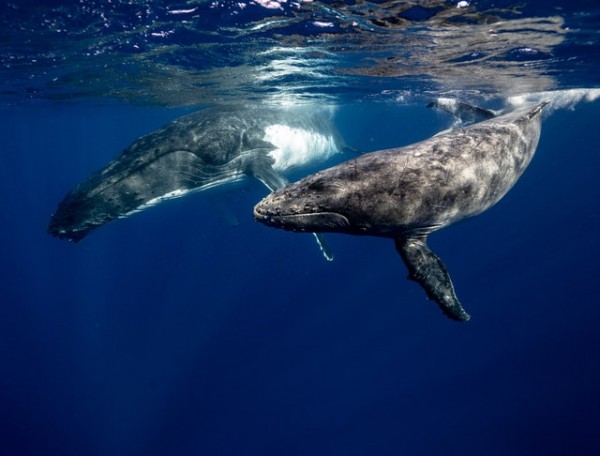 (Photo : Elianne Dipp)
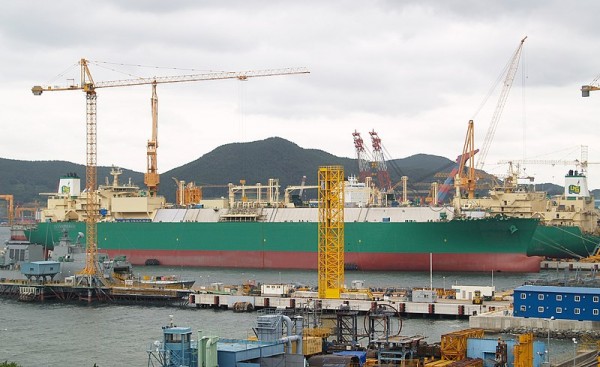 (Photo : Wikimedia Commons)