By Chandre Dharmawardana. National Research Council of Canada, Ottawa and Department of Physics and Astronomy Université de Montreal.
The largest drain on Sri Lanka’s foreign exchange earnings is in purchasing fossil fuels for power and transport, and in feeding the 22 million people who depend on a mere million hectares of arable land, as compared to 44 million hectares in Canada with a population of just 37 million. Much of agricultural land in the dry zone” depends on irrigation water. This is provided by a network of reservoirs that tap the heavy rains of the hill country to deliver the water to the agricultural regions via rivers and irrigation canals.
Here I point out the possibility
of boosting power production EVEN FURTHER by optimal partitioning of
water between agriculture and hydro-power production, by shielding the
water in the IRRIGATION tanks from EVAPORATION, and in NOT USING WATER to
control weeds in paddy fields.
Figure 1. Schematic of the main Mahaweli hydro-power and agricultural irrigation network.
In ancient times, small manually built tanks (weva”) supplied water to small hamlets (gama”) where people lived at a precarious subsistence level (see Prof. Siriweera’ study of ancient food security). The temple or Kovil was the only spiritual, cultural and educational resource. That ancient hydraulic system held pride of place in the ancient world. But it did not tap the heavy rainfall of the hill country. The total population sustained by the whole Land even at its best times was probably less than today’s population in Colombo.
In contrast, today’s hydraulic system not only provides irrigation water, but also electric power that drives modern technologies, hospitals, electrified transport, and every aspect of daily life at levels of culture and leisure that were not available even to elites of the ancient world.
The attached figure (Figure 1, credits: Thushara de Silva et al., 2019, Vandebilt University, USA) shows how hydro-power stations (red squares) of the Mahaweli system are also associated with the various irrigation schemes (green hexagons) denoted by A, B, C, … H, MH etc. The head water of the Mahaweli is diverted at Pollgolla towards the north” via Bowatenna mainly for agriculture, while another branch supplies the Minipe agricultural regions via Randenigala and Rantambe power stations.
However, if more water is sent to
irrigated agriculture, there is less available for power production.
Agriculture needs water in large amounts at specific times, while power
production uses water far more steadily. The water that is used for hydro can
be used in agriculture when stored downstream and released at the required
time.
Figure 2. Agricultural water
requirements in various Mahaweli Systems in millions of metric tons per
hectare. [Credits: Thushara de Silva et al.,
Vanderbilt University, USA, 2019]
Figure 2 shows the monthly water
use in the two planting seasons. The upstream reservoirs have to provide
enough water to the irrigation reservoirs at a time to be ready to supply
the irrigation water as soon as needed. I find that it quite sufficient
to model the water-requirement by a sum of just two Gaussians. Similar simplifications
can be done, when analytic calculations can be carried out as the differential
equations become quite tractable. Such analytic models enable one to establish
more reliable asymptotic behaviour of these systems, and determine upper and
lower bounds to the critical indices and carry out critical path anlayses and
other evaluations far more conveniently than with purely numerical
“brute-force” computer simulations popular with Engineers and those
who write glossy “proposals”.
More importantly, exploring such
analytic models mathematically enables one to obtain an intuitive
physical familiarity with the system. We find that water requirement can
be cut down by beyond a FATOR OF TWO implementing two simple provisions:
(A) the irrigation tanks are covered by floats to prevent evaporation. This also prevents algae and water weeds, and improves the aquatic environment. The floats may also carry solar cells and connected to the central grid using smart switching technologies that are now standard, even in small islands like Hawaii. So if the CEB claims that Sri Lanka’s power grid is “too small” to handle power fluctuations easily or introduce smart grid approaches, such a claim is simply not valid.
(B) WATER IS NOT USED for weed control in paddy planting.
Instead, weeds should be controlled
using safe herbicides like glyphosate. There is of course socio-political
resistance to “chemicals” entrenched in occult beliefs in
revelations by God Natha”, or due to baseless propaganda against agro-chemicals”.
To meet that challenge, the so-called System Rice Intensification” (SRI)
methods may be used.
SRI has been tested out in India and
Madagascar. It is said to increase yields by over 30%, i,e.,
4-5 tonnes per hectare instead of at most three tonnes per hectare
obtained with reduced use of chemical” fertilizers, while also using 40% LESS
water than conventional methods. If chemical fertilizers and humus are used
together, the yields become 8-10 tonnes per hectare, with even less soil erosion.
However, a pilot project to test a new idea is needed before extensive
adoption.
The steps (A) and (B) or similar ideas are not included in the usual studies on optimizing water management in multipurpose reservoir systems even though quite complex models like RIBASIM, WEAP (e.g., see, Louckes and van Beek 2017) etc., have been used by engineering researchers. Such models, though complex, are only as good as the ideas incorporated into them. Ideas can be tested more transparently using simpler analytic models of the sort used in theoretical physics. There are also losses in seepage that are not included in standard engineering models, or in my calculations, as no simple engineering approach is currently available to reduce seepage from the bottom of the reservoirs.
All this suggests that if
reservoir capacity permits, the water available for hydroelectricity can be
easily doubled while providing more than adequate irrigation water to the
agricultural schemes of Lanka and providing ALL THE NEED POWER using only
hydro power, for at least the next decade. If so much water can be saved,
it makes good sense to expand reservoir capacity or bring into service the
abandoned small tanks that are found in many parts of the dry zone – but they
too will need evaporation shields. Furthermore, the possibility of raising the
Kothmale dam to increase capacity by 20% has been proposed by Engineer
Kenderagama (5-Nov-2020, Island newspaper). If this is in fact feasible,
the hydro-power output will also increase by almost 20%. Thus we see that
lack of a power research Institute” similar to, say, the TRI for the eta
sector, hampers in the evaluation and analysis of new ideas in such a vital
national endevour like power production, as the CEB alone is not equipped to
deal with such matters.
Kendaragama has also drawn attention
to the question of the long-term safety of the hydro-power dams.
The projections of power needed by Sri Lanka given by the CEB are INCORRECT and are a gross under-estimate as the CEB does not seem to have considered that most motor vehicles will use electric power within a decade.
In any case, the proposed steps are
a means of establishing a solid shield against global warming and persistent
drought that will be part of the future weather patterns. Then the mechanisms
put in to prevent evaporation or deal with sudden excess water will
become God Sent” provisions.
The technology that is needed for
the main proposal made here to save water, i.e., by introducing floating
evaporation shields on reservoirs, does not need modern technology or
“foreign exchange”. Adding solar cells on to the floats, and using
smart grid switching technology of course will bring us to the 21st century
techniques, but at very little cost.
By Chandre Dharmawardana. National Research Council of Canada, Ottawa and Department of Physics and Astronomy Université de Montreal.
Microfinance
for various small businesses (including agriculture) has been a vital support
for the economic development and the growth of Sri Lanka since the beginning of
the economic activities of the country. Microfinance helped non-economic
purposes such as giving dowry, spending for weddings, funerals, and many other
purposes helped in the management of human affairs. In history, how microfinance
had been operated cannot clearly state, however, it was a private business and
the government regulation did not apply. It is difficult to identify a fixed
beginning of credit support for the variety of small businesses and services,
however, microfinance is informally operated in the country in various names or
formats, and the publication of Robert Knox carries a picture and little
details of microfinance (Knox, Robert (1681), A Historical Relation of the
Island of Ceylon, translated by David Karunaratne in 1959, Page 260-262), that
reflects the truth about microfinance in history. The Mahavamsa describes that
the 13th King of Sri Lanka spent three hundred thousand (pieces of
money) to free Buddhist bhikkus (Monks) from indebtedness so microfinance had
been in the country and no doubt that since before Christ (The translation of
Mahavamsa by Wilhelm Geiger 1912, PP 258-259) microfinance had been operated in
Sri Lanka.
Historical
experience in the management of microfinance invites the attention of the
government to develop policies and regulations for the operation of
microfinance. It was an indispensable role of the government. The Central Bank
of Sri Lanka is the regulatory authority for the financial system, which
includes microfinance, too. However, the Central Bank has not done a complete
job. Why the authority has neglected, the role is known by Gods, not any
others.
Commercial
credits were known by people through the operation of trading banks and other
financial institutions, however, the operation of Gramin Bank in Bangladesh,
was known to the world about microfinance operation, and when Noble Price was
awarded to the leader of the Gramin Bank in Bangladesh, it was developed world.
Now people of the world know what is microfinance and how it is important for
lower-income earners to get rid of poverty.
The
explanation of Knox shows the management of microfinance in history was cruel
when customers defaulted the repayment the modern management and if it can go
back to history, it might seem that the open market system would not work
supporting small businesses. The example of Mahavamsa shows that the release of
borrowers from indebtedness was done by the government. The regulation and laws
in the history of the applied that are effective today, it could be seen people
are carrying heavy stones on the back everywhere. This means many defaulters of
repayment today are in the country and will be subject to punishments.
Therefore, today needs regulation and when the Central Bank cannot do so, it
needs political leadership to consider while educating the public about the
repercussion of the operating of microfinance.
Microfinance
operates in a broader area that involves many lenders and borrowers for many
purposes and is essential to small business operations, as business needs
working capital frequently. Dr.N. M. Perera, when he was the Minister of
Finance, explained in a budget speech the major reason for the failure of
microfinance in the country and identified two reasons, when people borrow money
for a business purpose, they would use such money for consumption if they have
not income to spend for consumption, and when borrowed money used for
consumption expected cash inflow would be weakened and repayment of the loan
would be a failure.
When
logically thinks 80% of the population associates with the microfinance field
and identifying all coliseum of borrowing relate to microfinance and regulating
and policymaking may be a complicated task. Usually, microfinance is related to
production activities in history, but in the modern era, it is applied for
various purposes such as wedding spending, giving dowry, and many others. In
developed countries, microfinance is called personal loans that operate in a
broader area.
I
do not know how many researches have been conducted on the matter and making
regulation covering all aspects of micro-financing may not be successful or
possible either, and when deeply analyse the effort of the state minister it
might be a reason to lose votes to the government and when submitting the bill
to the parliament, many slogans and rallies outside the parliament would be
incurred as a protest against the bill.
Mr.
Shehan Semasinghe has not disclosed so far what contents they include in the
proposed bill. Most probably, the bill has been drafted by persons who have no
practical experience of micro-financing. The borrowing small quantum of money
incurs in Sri Lanka in the way of mortgaging pieces of jewelry to informal
lenders at a higher rate of interest. Sometimes, these informal lenders charge
15% monthly interest, which means the annual rate of interest could be 180%.
Later, Peoples’ bank began micro-financing scheme called Athamaru” how far it
was successful or was a failure is unknown to people.
Micro-credits
contain a broader area and feel like bacillus in Sri Lanka because it operates
many areas and regulating entire micro-credit is a complex task. Many credits
relate to informal borrowers and lenders. Sometimes, microfinance may deal with
the illicit drug business. How to identify these informal businesses. The
identification of their issues for regulating purposes may difficult.
Multi-purpose
cooperatives and rural banks had been operating in Sri Lanka to provide
microfinance for members, the establishment of Peoples’ Bank as an initiative
of Mr. Philip Gunawardane and Mr. Ronnie de Mel took over many microfinance
businesses to the Peoples’ Bank. Later, after the JVP insurrection in 1971, the
government introduced two major acts, which were land reforms and supports for
reforms in the agricultural sector. The authority in acts permitted
establishing Agricultural Service Centres. These two laws supported the Bank of
Ceylon to embark the market operating branches in Agricultural Service Centres.
However, they were closed down when Mr. Felix R.D Bandaranaike was the minister
of finance. Microfinance in the Bank of Ceylon was called cultivation loan and
later I found that the total volume default of agricultural credits in the
country was less than the default of a single corporate customer in Colombo.
When
regulating microfinance operations the government should take some
responsibilities as in the way King Siri Naga or Voharika Tissa played, when
Dr. N. M. Perera was the minister of Finance there was a Credit Guarantee and
Re-finance schemes, later the credit guarantee scheme was abandoned by the
Central Bank.
The
major areas of regulating microfinance should be included. Before regulating
the operation process of microfinance, it requires identifying the lender and
the business format of lenders that may be a sole proprietorship, partnership
or a private company, or public company. Many micro-financing businesses are
not identified as business owners due to tax reasons. Therefore, regulating
them to register in a recognised format of business ownership is essential. In
Colombo, there may be more than a hundred lenders, and in each regional town,
over five lenders are operating. The regulating process would generate
additional revenue for the government.
Purpose of lending
Amount of lending
Collateral of lending
Supervision of lending
Repayment of Lending
Restructuring and
monitoring of finance
Remedial management
Management of past due
and legal actions
Considering for borrowers
who were past due
PURPOSE
OF LENDING
The
central bank authority may know that the total lending of Sri Lanka is
formidable to identify and the disaggregated data with the purposes cannot
reconcile with the total portfolio, because many lenders are reluctant to
disclose the volume of lending, and many dislike identifying as lenders. It is
not a problem getting data from organized financial institutions, such as
banks, finance companies, and others. Informal lenders are averse to the
disclosure and the central bank needs to explain and give an ultimatum for
registration. Under the proposed regulation, the name of the lender, the amount
lent and other information should be compulsory to provide. Finally, the
central bank should be able to calculate disaggregated figures according to the
purposes and reconcile them with total lending volume.
AMOUNT
OF LENDING
Microfinance
should be limited to an amount that is small size and if any person or
organisation lends more than a limited amount, it should be considered as
either retail or medium market or corporate lending. Microfinance could be
granted against collateral or the expected cash flow of the business project
that microfinance is expected to be used. This is called cash flow lending, and
microfinance should be subject to cash flow lending. The amount of loan that
could be granted to a customer needs to decide by the lender and regulation
regarding this area should be focused on various factors, such as the borrower’s
ability to pay back or creditworthiness, current obligations to other lenders,
and other factors. Banks and financial institutions have credit policy and
operation manuals are there and the regulation relating to the amount of loan
should be subject to the borrowing purpose and the injection for the purpose.
When borrowers didn’t get sufficient funds, it would be a cause to
default.
COLLATERAL
OF LENDING
The
term collateral is used in the USA and it says in Sri Lanka security. Clean
loans could be granted, signing a promissory note. Late Dr. Wickrema
Weerasooria expensively did researches on this subject and published several
books. Obtaining securities for microfinance is a grey area to talk about
because there is a conflict between the aspect of commercial lending and
micro-credits. Granting clean loans is a highly risky task and helps to default
as recorded in history.
Getting
a land mortgage is an arduous task as it needs to ensure the ownership of the
land. The floating charge is not relevant for fixed securities.
Inter-se-guarantees, indemnity bonds, and personal guarantees, Paripasu bonds,
and parate execution are complicated legal concepts, and regulating
microfinance needs to consider all these concepts and it cannot be done ad hoc
ways. Many customers in the SME sector have no assets to keep as security.
MONITORING
OF CREDITS
The
major reason to default micro-credit is a weak monitoring process. Monitoring
of granted credit is a broader and complex process and many lenders (formal and
informal) do not successfully monitor how credit is used and how credit affects
borrower’s life. The monitoring process should be associated with related
organizations and should be more organized to classify the credit until they
payback. The classification of granted credit is not done by lenders, and this
has been the major reason for defaulting credit.
Management
of microfinance is a costly exercise and when grant credits monitoring should
be explained to customers and lender needs arranging such activities.
REMEDIAL
MANAGEMENT
Remedial
management should be organized while monitoring granted credit, and there are
many strategies for the remedial process. Sometimes, customers may need
additional credit facilities or advice, or any other supports. Monitoring and
remedial management should be regulated, and lenders and borrowers should be
educated on this matter.
As
I mentioned before, regulating microfinance is not a simple task the way
politicians think. The bill needs broadly discuss and different concerned
people may propose changes and the political authority needs listening to all
aspects.
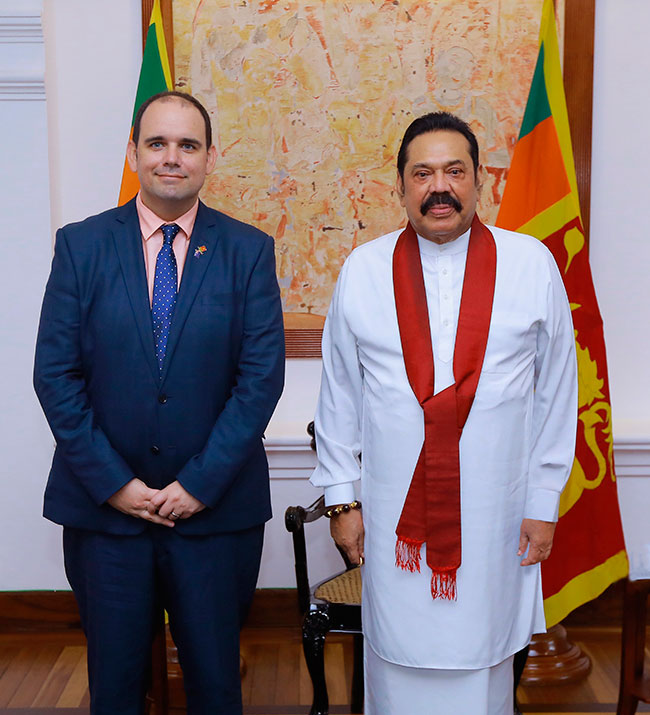
New Zealand first resident High Commissioner
to Sri Lanka – Mr Michael Edward
Appleton – together with Mr. Andrew
Traveller the Deputy High Commissioner
called on Hon. Prime Minister Mahinda Rajapaksa at Temple Trees this
morning (11th August 2021).
The Ambassador conveyed his pleasure to be the
New Zealand first resident High Commissioner to Sri Lanka and expressed his
keen interest in growing collaboration between the both nations. As one of the
world’s largest milk producers, The Ambassador mentioned that New Zealand is
pleased to share dairy industry technology and know-how with Sri Lanka.
Referring to his previous discussions with
Mr. Namal Rajapaksa, Sports Minister in Sri Lanka , the Ambassador is optimistic
on bridging the two nations through sports and games.
Thanking for opportunity the Ambassador said
he is looking forward to working together with the Government to enhance
bilateral relations with Sri Lanka.
Thanking the Ambassador for the visit the
Prime Minister stated that he is also looking forward to working together with
the Government of New Zealand to enhance the friendship between both nations
and wished the Ambassador a very successful tenure in Sri Lanka.
Prof. G. L. Peiris, Minister of Education,
Hon. Ajith Nivard Cabraal, State Minister of Finance, Capital Markets and State
Enterprise Reforms and Mr. Yoshitha Rajapaksa, Chief of Staff of the Hon. Prime
Minister and Mr Senaka Silva, former New Zealand Honorary Consulate in Sri
Lanka were also present at the meeting.
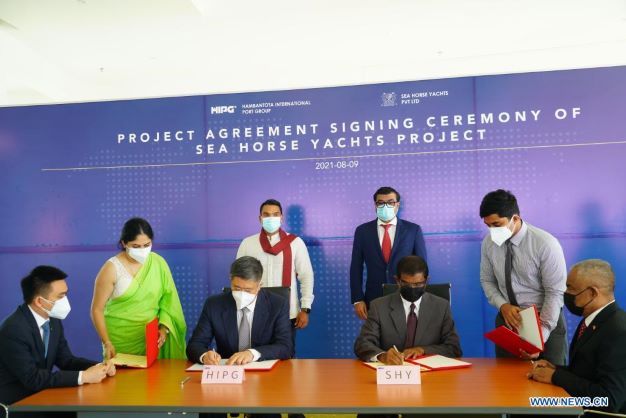
Hambantota, August 10 (Xinhua/HIP): Sri Lanka’s Hambantota International Port (HIP) signed a 58-million-U.S. dollar deal with Maldivian company Sea Horse Yachts on Monday to assemble and export yachts from HIP’s industrial park.
Namal Rajapaksa, minister of youth and sports and state minister of digital technology and enterprise development, told Xinhua that the project would be a stepping stone for bigger investments in the local maritime industry, and for establishing Sri Lanka as a yacht-building nation.
He later tweeted that the project is expected to generate 500 jobs.
Rajapaksa said that the Hambantota Port was fully equipped with all the infrastructure needed to attract investment, and that the government was working on improving the ease of doing business and expanding technical and vocational training for the maritime sector.
The objective of our government is to promote Sri Lanka as a maritime and aviation hub in South Asia focusing on transshipment and manufacturing. This project is a landmark for the Yacht industry and for Yacht manufacturers as Sri Lanka has a rich history in boat building dating back to the times of our kings. Island nations such as Sri Lanka and the Maldives have always built their economies around trade and our proximity to ancient maritime routes which are still used to this day. We look forward to strengthening these and developing them to cater to the needs of a modern world. Ventures such as this will pave the way for the next generation of youth, providing them with the knowledge and the tools to build an entirely new industry and a new era of boat building! I hope it will serve as a catalyst to spark in our youth the entrepreneurial drive to take Sri Lanka to the next level,” Namal Rajapaksa said.
Signing ceremony at the Hambantota port
High Commissioner of Maldives to Sri Lanka Omar Abdul Razzak who was at the ceremony said it was noteworthy to mention that according to history, the first connection between Sri Lanka and Maldives made hundreds of years ago was through maritime relations.
I understand this new collaboration to build state of the art, modern, luxury, high-speed passenger boats & yachts would have the highest standards, and would use advanced composite materials and innovative technologies in boat building,” he said, adding that this initiative further cements strong trade bonds between the two countries,” Razzak said.
Johnson Liu, CEO of HIPG, speaking at the ceremony, said the Hambantota Port Industrial Park is an international trade zone. We are rapidly moving to diversify HIP’s industrial zone portfolio and at the same time we are widely promoting the location internationally. We have signed with more than 30 investors from across the globe i.e. UK, Singapore, Japan, Sri Lanka, China and now the Maldives. We provide on ground logistical and operational support for these new ventures so that they will be up and running within a short space of time. This is done under our new operational blueprint ‘HIPG Speed’. Our port industrial park team has assisted Sea Horse Yachts to obtain the necessary approvals from BOI, CEA, MEPA & CCD, and we will continue to provide further support, with land levelling, construction and operations etc.”
Foreign investment is a key driver of economic growth, as is the revenue generated via tourism. As one of its primary exports, tourism remains Sri Lanka’s calling card to the world. Over the last fifteen months (March 2020-June 2021) the government has attracted over $950 million in investments, dedicated to revitalising the island’s burgeoning tourism sector.
64 project proposals have currently been received and 38 projects, to the value of $102.38 Million, have received approval. These ventures will be executed under the auspices of SLTDA. The level of interest shown by global investors is a positive sign for things to come and indicative of the immense potential inherent to the local tourism sector.
To ensure a faster and more convenient process for all investors, numerous measures have been put in place. Sri Lanka Tourism Chairperson Kimarli Fernando speaking about these initiatives highlighted some of the key policies designed to encourage international investment and expedite the process.
This new era of strategic investment is like nothing the country has seen before and is set to launch Sri Lanka’s tourism sector into a brave new future. We have taken great care to streamline the investment process, so it is more in line with what international investors expect. This includes a master document which merges the requirements of all government agencies into a single easy to use application for investors.” She shared.
By removing previous hurdles, streamlining the entire process for greater efficiency, and ensuring absolute transparency, the government has given investors a clear route. This provides interested parties with the guarantee they need when considering the long-term viability of their investment. SLTDA has also established an Investment Relations Unit (IRU) to expedite the approval of all tourism investments. This provides greater clarity on regulatory issues and allows investors to form a direct partnership with the administrative body.
As Sri Lanka positions itself as the ideal destination for post covid travel, these investments, and the subsequent revenue they generate will empower communities and benefit local economies all across the island.
Nearly 150,000 persons have not received their COVID-19 vaccine in the Colombo district, Colombo District Secretary Pradeep Yasaratne said today.
He said a total of 99,373 persons between the age 30 to 59 have forgone their vaccine while about 46,600 elderly above 60 have not taken their vaccine in the Colombo district.
“It has been observed that the majority of peope above 60, who have not got themselves vaccinated are residents of Colombo and Kolonnawa areas,” he underlined.
The District Secretary said the Police have already launched an operation to identify the unvaccinated people and take them to vaccination centres with their consent.
The Health officials have set up a special vaccination center at the Shalika ground to administer vaccine for all unvaccinated people.
According to health authorities, there have been several misconceptions, which discourage people to get vaccinated.
Providing home-based care for COVID-infected children aged above 02 years has commenced, says Dr. Channa De Silva, Consultant Paediatric Chest Physician at Lady Ridgeway Hospital, Colombo.
Accordingly, symptomatic or mildly symptomatic children can also be referred to medical supervision, he added.
Dr. De Silva noted that children who undergo home-based care should not have uncontrolled comorbidities, chronic heart diseases or other medical conditions.
A home-based treatment program was initiated after taking into account the rapid increase in the number of children infected with COVID-19 and it is now being implemented island-wide, he stated further.
According to Dr. De Silva, the children requiring home-based care should have an adult at home for providing caregiver support, as well as proper communication facilities.
Children eligible for this procedure can be given treatment at home in coordination with the Medical Officer of Health (MOH) of the area.
For inquiries in this regard can be obtained from the call centre through the hotline 1390.
Speaking further, Dr. de Silva stated that COVID-19 is a common viral condition in most children and that they recover from the infection the due to natural immunity, adding less than 1% of children with novel coronavirus end up having complications.
He also urged parents to hospitalize children with any COVID-related complication, without delay.
Further. Dr. De Silva cautioned that giving medicines to children without the prescription from a doctor can be harmful.
Sri Lanka’s Health Minister Pavithra Wanniarachchi says that around 95 percent of the country’s population above the age of 30 have received at least a single dose of one of the Covid-19 vaccines.
The government had recently decided to extend the current Covid vaccination programme to include those below 30 years of age.
Around 3.5 million of the total 21 million population of the country are below 30 and given the current surge of the deadly viral infection, the importance of vaccinating people in the 18-29 age group had been highlighted.
The government had expressed confidence that it can start vaccinating below 30 years of age population by the end of August.
The Director General of Health Services has confirmed another 124 coronavirus related deaths for August 10, pushing the country official death toll due to the virus pandemic to 5,464.
This is reportedly the highest daily count of Covid-19 deaths recorded in the country while this also marks the third consecutive day that the daily count of Covid-19 deaths has exceeded 100.
Of the Covid-19 deaths confirmed today, 75 are males and 49 are females while one of the victims is below the age of 30. Twenty-eight are between the ages of 30-59 while the remaining 95 are aged 60 and above.
A meeting to obtain the proposals of the backbenchers for the 2022 budget was held under the patronage of Prime Minister Mahinda Rajapaksa at Temple Trees today (11).<
At this meeting organized by the Minister of Finance Basil Rajapaksa, suggestions were obtained from the backbenchers on the work to be done for the development of the country at the rural, divisional, and district levels.
It is stated that the backbenchers have been made aware of the measures to be taken to strengthen the national economy through these activities
Backbenchers representing various sectors including the development of local organic agriculture, increase of export production, the contribution of rural people to industries and services sector and upliftment of traditional industrialists, upliftment of tourism sector, extensive development of fisheries sector, upliftment of floriculture growers and animal farming sector, have presented their proposals.
The Prime Minister Mahinda Rajapaksa, as the President and as well as the Finance Minister at that time, had taken steps to seek the views of various sections of the country in preparing the budget proposals.
Prime Minister Mahinda Rajapaksa stated that since it has shown successful progress, the views of various sectors will be sought in preparing the budget this time.
The prevailing COVID situation has also been discussed during the session.
Meanwhile, reports are being published regarding a cabinet reshuffle.
Hiru News team inquired about this from several major parties representing the government.
They stated that such a discussion was taking place and that no final position or date had been announced yet.
State Minister of Agriculture Shasheendra Rajapaksa states that permission was not granted to import carbonic compost fertilizer.
he State Minister was responding to a statement made by Co-Cabinet Spokesman Ramesh Pathirana that the Cabinet had approved the importation of carbonic fertilizer following procurement methods
Colombo Municipal Council (CMC) has organized a mobile vaccination program for citizens who are immobile and or bedridden and cannot go to a vaccination centre.
Any citizen of Colombo who is residing in Colombo 1-15 and in need of this special service, can register for the service.
To request vaccination, please email with name of the person to be vaccinated, National Identity Card (NIC) number, Address, mobile number and the reason to request the service in brief.
CMC will SMS a slot with a date and a time frame to the mobile number provided.For more information, please visit https://www.colombo.mc.gov.lk/“COLOMBO MUNICIPAL COUNCIL.
It has been revealed that there is a discrepancy in the statistics on COVID infections in the Gampaha District and the Eastern Province.
The Gampaha district has the second-highest number of infected persons in the country with 58,943 cases.
Against this backdrop, the Gampaha District COVID Control Committee met at the Gampaha District Secretariat yesterday to find a solution to the increasing COVID risk in the district.
Observation of the data presented by the Gampaha District Health Director’s Office revealed that there was a discrepancy between the identification and reporting of infected persons in the district.
According to the data released by the COVID Task Force to the daily media, only 3,729 cases have been reported in those 8 days whereas, in the first eight days of August, 12,555 cases have been reported
Accordingly, 8,826 cases have not been reported to the Epidemiology Unit.
In addition to the Gampaha District, there is a discrepancy in the statistics of COVID infections in the Eastern Province as well, according to data presented by the Eastern Provincial Director of Health Services
A
podcast today from a front line doctor involved in Covid Control in Sri
Lanka ,ended with call to seeing and staying positive
I
agree with this doctor that a most important requirement for Covid contra
in SL was staying positive.
Sadly, the biggest impediment to this as I see it are the politicians,
social media and rumor mill that exaggerates the negatives and ignores the many
positives in Covid control in SL today
For
example, the unprecedentedly successful vaccination program even
acknowledge by WHO, has not and I suspect never will be acknowledged by
these sources. The reason is politics
With their ever negative narrative they undermine compliance with COVID health
management recommendations, including proper mask wearing, social distancing,
avoiding crowded door locations and now the ultimate requirement vaccination.
First
the narrative was no vaccines, governments fault, Next it was, inferior Chinese
vaccination. Now it is it’s administration by the army not withstanding the
fact that they are from the highly trained army mdical corp. The epitome of
this hypocrisy was the former Prime Minister decrying the army’s involvement in
Covid control, having himself received his vaccination from an Army vaccination
centre. Even yesterday 9th August,, over 70% of the 90 odd mortality had
not been vaccinated despite
over 13.8million vaccinations having been administered in SL by then. Had they
got them selves vaccinated there is a god chance hat a majority of them would
not have suffered that sad fate.
Yes
this is the worst SL has experienced but far better what other parts of the.
This was expected, warned of, the population was warned , adequate vaccination
supplies have been secured, what was wanting was compliance
Some
body asked me how NZ has kept Covid at bay successfully so far. The answer
was compliance with the same advice as a team of five million,
following the calls led by it’s Prime Minister. The same calls in SL led
by the political and health leadership , was undermined with a negative narrative
on anything the govt does or calls for by the political opposition ,
media and social media hence not listened to and not complied with by the
populace, Sad but true.
Sri Lanka’s negative narrative makes it sound as if the epidemic in
SL is the worst in the world which is far from the truth.
For 20 million population the worst mortality so far was around 100. At that
rate of 100 deaths per day for a 21 million population , a population of 350
million in the US should have a maximum mortality of about 1750. In reality
12/2/21 they had mortality of 5463 per day, more than three times SL ‘s worst .
The numbers were similar in Italy, France & UK.. This bad experience
in these countries was even without the Delta variant . One can only
imagine what it would have been had there been a Delta variant then. These
countries improved only when vaccinations reached 60% levels .
As
of 10/8/21 SL has 13.8 mil with single dose, 2.78mil double dose ie 12.7% of
total pop fully vaccinated. ( 10/8/21 , the fully vaccinated population
was over 3 million, 15 % of population.)Now, vaccinating at rate of
1million every 3 days ,in 10 to 15 days the required 70% full
vaccination for herd immunity should be reached. The consequent
population herd immunity should breached two weeks ithere after
ie I the first 2 weeks of September. Another FACT not advertised and
known much is that Kalum Life Sciences, a BOI project in Kundasale, is
awaiting WHO clearance to bottle Synopharm vaccine. This clearance is expected
in Aug/Sept. They are ready to go into immediate production thereafter,
to ensure uninterrupted vaccine supply , upto 100 million by end 2021
This
would be music for the ordinary people of SL but terrible news for the prophets
of gloom, unless they can manufacture another schema to undermine it and an
equally catchy negative narrative to go with it.The present hike in numbers
after having gone down to around 1500 cases per day and well below 50 deaths
per day, coincides well with the aftermath of a spate of demonstration,
Uthhoshana’s , first staged by JVP & SJB against oil price increase on the
road to partliament and other parts of the country, there after the JVP
inspired Pora Diyaw , Diyaw” Uthgoshanas and the latest the dreaded Joseph
Stalin led School Teachers and Principal’s Uthgoshana , more vociferous more
deadly than any thing ever seen in the original Joseph Stalin’s Russia.
And, they are still not done with these and so also not done with their
covid consequences.
The
country is facing the worst emergency in it’s recent history. Surely ,isn’t
it time to invoke emergency regulations to stop these ongoing
super spreader events
What we are seeing now is on the one hand is the govt trying
it’s best to contain Covid and opposition politicians doing the best to
undermine it and project the blame on govt.
This hypocrisy has to be exposed if SL is to reap the harvest excellent
vaccination program . Sadly lacking is an attendant and effective media
program to keep on the negative campaign at bay..
The
Col South hospital pts being in lawn happened for one day , during a transition
phase, got all the social media attention but not it’s clearance in one
day nor the addition of two more wards for COVID at Col South & Col North
Ragama and six dedicated wards for National Hospital Colombo and many more
wards all over the country. Also highlighted in social media were
patients on the floor. Floor patients have been the order of the day in
SL hospitals form time immemorial . I remember the days when as a junior doctor
over fifty years ago during the daily ward round , the floor
patients, would come upto a bed in turn for examination. Recent
negative narrative has tried to make out that it never happened before!
What SL needs is a relentless, relentless, relentless, media and social media,
media and social media, campaigns to get Sri Lankans to practice Covid
health care practices ( hand sanitisation, proper use of masks, social
distancing and avoid crowded indoor locations) and get vaccinated at the
centres that are abundantly available now.
This is the message that should be orchestrated and orchestrated by the govt ,
drowning out the oppositions negative narrative undermining it.
Do
so & stay positive, for there is definitely light
and life at the end of the tunnel.
Colombo
Security Conclave is a greater regional initiative taken by Indi a, Sri Lanka
and Maldives simultaneously to tackle the maritime threat in Indian ocean. Then
Sri Lankan defence secretary (Now President) Gotabaya Rajapaksa took this
significatory initiative. The head quarter is established in 2020 in Sri Lankan
capital city Colombo. Maritime threats matter really in this today’s modern
world. Now Indian ocean is a piece of interest amongst world players. The
powers eye shifts towards India ocean.
Analyst
says, Maritime security and countering terrorism and other crimes in the Indian
Ocean has emerged as a focus area for India as part of its Indo-Pacific
strategy and the doctrine of Security and Growth for All in the Region (Sagar).
However,
it is known to all Indian ocean gets it strategic significance for various
region. It was a great maritime route for both Asian, European and African
stated for many years. The Indian ocean has been considered as a hub of
maritime connectivity project. China’s string of Pearl project, India’s
International North South Transport Project has been gone though this ocean. It
is pertinent. Even the US government has transformed its strategy from Asia
Pacific to Indo Pacific to include Indian ocean. Japan and India proposed cotton
route is also a big issue in the consideration.
But
there are some problems also. Trans national crime such as illegal narcotics,
weapons and human trafficking issues, piracy, armed robbery, drug smuggling,
illegal fishing, terrorism, environmental degradation issue is some concern
issue. The Indian ocean has been used as a safe passage by some evil players. States
on the Indian ocean face these serious challenges every day.
Illegal
drug trafficking from India and Afghanistan, Iran through Indian Ocean route is
known to all. According to some sources, the UNODC has estimated that 54% of
the heroin in India is produced domestically, while 45% originates from
Afghanistan. India is particularly vulnerable to the southern route due to its
western border with Pakistan. Near this border, in the western Indian states of
Punjab and Haryana, is where many of the heroin seizures occur. In 2012, 105kg
of drugs were seized, which had been trafficked from Pakistan along rail
routes. In 2013 alone, the Indian Narcotics Control Bureau reported seizures
totalling 4,609kg Data collected through seizures by various authorities has
confirmed India as a transit country for Southeast Asia, West Africa and North
America.
Bangladesh
also faces significant problems due to drug trade through the Indian Ocean and
India. The country suffers from illicit drug use among its population, such as
in Dhaka where there are an estimated 2.5 million people using drugs. India is
a large provider of heroin to the Bangladeshi market, and it is trafficked over
the western and eastern borders. However, it is unclear whether the heroin
originates from Afghanistan or India, as this data has not been sufficiently
collected. Both India and Bangladesh are becoming ever more dependent on
maritime trade, with these states importing over US$ 52 million and US$ 447
million respectively. Therefore, to function effectively they require an
absence of maritime crime in order for trade to be uninterrupted, and for their
economies to thrive.
Bangladesh
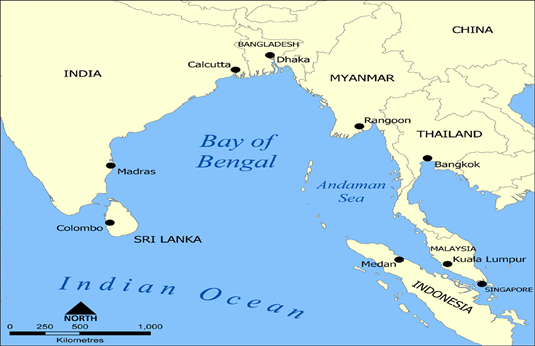
faces Piracy, illegal fishing, human trafficking in the Bay of Bengal. Although
Bangladesh Navy and Coast Guard are very active in the region, but the
perpetrators are very clever and cunning. Rohingya crisis accelerated to worsen
the situation. Various gangs are involved in these human trafficking process.
It matters increasingly. Bangladeshi people are trafficked to Malaysia,
Thailand, North Africa to Greece and Italy (Europe) through the marine route
via Mediterranean Sea.
Many
fishermen from Myanmar, India is involved in Illegal fishing in the
Jurisdictional area under Bangladesh. So Bangladesh faces economic loss to
extract marine resources. Some armed groups kidnap Bangladeshi Fisherman for
ransom. Basically, Fishing in the Sundarbans region becomes very dangerous.
Sri
Lanka has also faced an increase in heroin use within the country, as well as
becoming a transit country for trafficking destined for other places. Much of
the heroin entering Sri Lanka arrives on fishing boats or by air, often coming
through India or Pakistan. The numbers of seizures which Sri Lankan authorities
have conducted remains relatively small, meaning that the data collected is not
always reliable. Smugglers in Sri Lanka have come from a variety of countries,
including Pakistan, India, Iran and the Maldives.
Environmental
degradation in the sea is common now. Climate change, sea level rising are some
issue. Trans transnational terrorist threat is seen as a serious threat.
Bangladesh
is a rising South Asian Miracle. The country is developing under the leadership
of its premier Sheikh Hasina. She focuses on Blue economy. Bangladesh Prime Minister Sheikh Hasina inaugurated the
third ministerial conference titled Promoting Sustainable Blue Economy —
making the best use of opportunities from the Indian Ocean” of IORA at the
InterContinental Dhaka in 2019.
Not
only Bangladesh, Countries like India, Sri Lakka, Maldives including all states
across Indian ocean face the same problem. IN the disaster period, regional cooperation is much needed. In Past,
regional countries helped each other through various operation during the
disaster moment.
Now
Bangladesh got a regional platform to address these problems. To ensure better
maritime time security, all regional countries should work collaborately to
tackle the problems.
Colombo
Security Conclave is a platform. Bangladesh expect cooperation from other stake
holders and would like to help others to face the challenge.
Bangladesh with Mauritius
and Seychelles are going to become full member of regional maritime security
bloc. Media reports, currently serving as the group’s
observers, Bangladesh, Mauritius and Seychelles joined the first meeting of
national security advisers (NSA) of the CSC, hosted virtually by Sri Lanka on
August 4.
So, there are some
opportunities for Bangladesh also other partners to focus on countering
terrorism and extremism, trans-national crimes such as narcotics, weapons and
human trafficking, humanitarian assistance and disaster relief and protecting
the maritime environment.
Looking at the
way how our political parties in this country have ruined the country during
the past 69 years that was the richest in South East Asia by 1948, and are
continuing to do so alternatively even now. As for me, therefore I have no
faith or trust in any of the existing political parties as none of them have a
clear cut national policy, other than their own enrichment. They all are only
parasitic bunches of self-centered power crazy set of men and women who have no
concern for the country or the people.
Political parties in Sri Lanka can be
classified in to two broad categories, national and communal. SLFP and UNP are
the two National parties worthy of mentioning, though the UNP had been anti-
Sinhala and anti- Buddhist trough out. Although JVP is pretending to be one, in
my opinion it will never emerge as a National party in the foreseeable future
for three reasons. Firstly it does not have any jatikatvayak as it is based on
an imported concept of class struggle based on hatred and jealousy. Secondly it rejects the very foundation of
the Sinhala Buddhist society. Thirdly it also rejects local values and its
members live in a dream world of their own completely divorced from the native
social milieu. The only common thing these three parties share is they are not
communal. One can easily forget LSSP,
CP, NLSSP and Hela Urumaya as they are, though they are registered as Parties
with the Election Commissioner; they are only three or two wheelers that have
no chance of forming a government at any time. In fact they are already dead
entities.
All the rest, whether they are in the North, East, in the hill country or in Colombo, are either Tamil or Muslim communal parties that do not accept the historical reality of this nation that it was born as a Sinhala Buddhist nation in the 6th century BC and had been so for the past 2600 years. They all agitate for separate States and separate identities either within a Federal or a Quasi- Federal system looking for a distant dream of acquiring the whole Island as either EELAM by Tamils or Khalisthan by Muslims. Today there are at least 15 Tamil and 5 Muslim Parties in this country. They are a bunch extremist separatist ultra- communal parties alternately joining the national party that agrees to give their maximum demands exploiting the weaknesses of the major parties. Tamils and Muslims unlike the foolish Sinhalese behave as diehard communal groups and they look after only their own community even if they work as Ministers in any Government. It was the folly of the constitution makers in 1948 and all subsequent Governments to have failed to prohibit these Communal parties that have put the country in this unfortunate predicament.
Japan’s immigration agency said Tuesday a probe has found that an immigration center in central Japan mistreated a detained Sri Lankan woman who died in March, and it has reprimanded the facility’s top officials and supervisors.
The Immigration Services Agency of Japan’s final report on developments leading to the death of Ratnayake Liyanage Wishma Sandamali, 33, said the Nagoya Regional Immigration Services Bureau in Aichi Prefecture failed to provide appropriate medical care for her, though the probe could not determine the cause of her death.
Justice Minister Yoko Kamikawa apologized for the Nagoya facility’s treatment of Wishma that resulted in her death and pledged to reform the country’s immigration services.
“It’s impossible to imagine how lonely, anxious and hopeless she must have felt as her health deteriorated,” Kamikawa told a press conference.
Shoko Sasaki, head of the Immigration Services Agency of Japan, told a separate press conference, “The Nagoya bureau at that time lacked awareness of its responsibility to ensure the safety of people and respectfully engage with them.”
The agency reprimanded the bureau’s director and then deputy director as well as two supervisors overseeing the monitoring of detainees.
“We will take the issues raised (in the report) seriously and do our best to prevent any recurrences,” the Nagoya bureau said in a statement.
The agency had set up an investigation team and heard from third-party experts including medical professionals in examining the case of Wishma, who came to Japan in 2017 on a student visa and was taken to the facility in Nagoya in August 2020 after overstaying her visa.
She died on March 6 while in custody after complaining of stomach pain and other symptoms from mid-January. She had applied for, but was refused, provisional release for hospital treatment.
Medical personnel were not available on Saturdays, the day that she died, and staff at the facility did not make an emergency call, according to the report.
The probe has also found Wishma’s pleas for medical treatment and an examination by an outside doctor were never reported to managing staff, violating the facility’s own rule.
It pointed out that omitting to report such detainee requests for medical treatment was commonplace at immigration facilities, a practice that needs to be rectified.
One immigration officer allegedly mocked Wishma after seeing liquid come out of her nose after she was unable to swallow a drink, while others thought her complaints were exaggerated in order to secure the approval of her temporary release request, according to the probe report.
Following the release of the report, Wishma’s younger sister Wayomi, 28, said in a Tokyo press conference that she cannot understand why the immigration authorities denied provisional release for hospital treatment despite Wishma’s deteriorating health.
She described the treatment of Wishma at the immigration center as “bullying” and criticized staff at the facility for their misconduct. The sister also expressed dissatisfaction with the report’s failure to clarify the cause of Wishma’s death.
As Wishma’s family, supporters and opposition lawmakers have been demanding the disclosure of the security camera footage of her final days, the immigration agency is set to release it to her family on Thursday, Shoichi Ibusuki, a lawyer for the family, said at the press conference.
Ibusuki said the agency will show only selected parts of the footage exclusively to the family. He added that he has requested the agency release the whole footage which covers nearly two weeks of her life at the immigration center, and to allow a lawyer to attend.
Whether to release the footage of Wishma in detention was a major focus of debate in parliament, the ordinary session of which ended in June, as it deliberated on a bill to revise rules on how to handle foreigners facing deportation, including allowing those who have applied for refugee status more than twice to be deported.
File photo of India’s Prime Minister, Shri Narendra Modi with the Prime Minister of the Democratic Socialist Republic of Sri Lanka, Mr. Mahinda Rajapaksa. Photo Credit: PM India
By N Sathiya Moorthy
The well-earned publicity that the ‘Integrated Country Strategy’ for Sri Lankan missions in India has received in the Indian media is a welcome for more reasons than one. In particular, it deserves to be praised for acknowledging the ‘trust-deficit’ that has re-emerged in the bilateral relations over the past year—after a relatively smooth sail in the five years before it.
With the acknowledgement also comes suggestions for setting right many, if not all the causes for the ‘trust-deficit’. The latter has more to do with the contemporary political and economic realities, as different from the centuries-old cultural underpinning, from which both nations have unfortunately moved away over the past decades.
When cleared by the government of President Gotabaya Rajapaksa, the document could be the guiding, if not the governing principle for Sri Lankan missions in India, after the former Minister Milinda Moragoda takes over as the High Commissioner in Delhi later this month. Moragoda having authored the strategy paper along with his mission counterparts in Delhi, Chennai, and Mumbai, the authors are also the implementers – and thus, know the do’s and don’ts that lie ahead for them.
Age-old links
Naturally, the strategy paper refers to Buddhist links between the two nations, which actually dates back prior to the commonly-known era of Emperor Ashoka. In contemporary terms, the paper has proposed for Sri Lanka to send a stone from ‘Sita Eliya temple’ in Nuwara Eliya district, linked to the Indian epic, ‘Ramayan’, for the Ram temple construction at Ayodhya in north India.
Despite possible political fall-outs in India, especially in the future, the suggestion should be welcomed. It may slow down, if not set at naught, the recent efforts in Sri Lanka to establish Ravan, the antagonist in Ramayan, as a Sri Lankan sovereign independent of the Indian epic and also the earliest aviator in the world.
Transactional approach
It is, however, in the contemporary context that the paper’s acknowledgement of trust-deficit between the two South Asian/Indian Ocean neighbours assumes immediate relevance and significance. As the report candidly acknowledges, In recent years, the Indo-Sri Lanka bilateral relationship has been increasingly dominated by a transactional approach.”
There is truth in the assessment that the historic relations between the two nations have long since given place to self-centric claims, expectations and denials by both. Neither does India possess the elder brother/sister attitudeany more, nor is Sri Lanka willing to stop playing the recently-innovated ‘China card’ viz its northern neighbour.
The Team Milinda” paper, as it could be called, says that the ‘transactional approach’ is a ‘consequence of the changes in the geo-political equilibrium in the region that have resulted in a growing trust- deficit’. In diplomatic terms, this should be construed as a reference to China emerging as the bugbear in Sri Lanka’s India relations in recent years—but without naming the extra-regional power.
In real terms, China in this case is pitted more against the US than India, just as the latter pitted itself against the erstwhile Soviet Union in the Indian Ocean Region (IOR) during the Cold War era. But the end result is that the Chinese presence in and domination of the Sri Lanka scene, especially in economic and political fields—and not necessarily in that order—has nullified all efforts at improved ties between Colombo and New Delhi in the post-war era.
Investors unsure
It suffices to point out that in the aftermath of the aborted trilateral deal on the East Container Terminal (ECT), also involving Japan, after President Gotabaya took over, Indian investors, big and small, have become unsure about putting in big money in the island-neighbour. True or not, they have come to believe that a twitch of the lips in distant Beijing could push Colombo to throw them out halfway through.
The one exception is the West Container Terminal (WCT) construction concession offered to the India-based Adani group, as if in lieu of the cancelled ECT pact. The strategy paper suggests that the WCT proposal should be cleared without delay. Other Indian investors would be closely watching developments on this front before deciding to put their money in Sri Lanka. In effect, this means that Colombo cannot hope to get all, or even much of the US $256-billion Indian FDI by 2022, as the Milinda paper recalls.
Increasing protectionism
Yet, there is truth in the strategy paper’s claims on wanting to realise US $675-million Sri Lankan exports to India, again by 2022. As the study points out, export prospects at present suffer from ‘increasing protectionism (in India), limited market access, a challenging and unpredictable regulatory environment as well as the ‘Make in India’ initiative, which prioritises local business and sourcing of local raw materials and products over imports”.
True, Prime Minister Narendra Modi revived the Nehruvian ‘self-reliance’ goal in the name of ‘Make in India’ after coming to power in 2014. But no specifics have been made available for India to exempt raw material imports from Sri Lanka, as indicated. For close to two decades now, Sri Lanka has deliberately missed all opportunities to discuss Indian protectionism and non-tariff barriers with the sincerity and seriousness that they deserve as a part of larger trade negotiations, especially after the bilateral Free Trade Agreement (FTA) in 1998 had proved its worth and usefulness for both.
Long before Modi came to power, bilateral trade had suffered and a trust-deficit made an appearance, instead, after the two nations initialled the forgotten Memorandum of Understanding (MoU) on a Comprehensive Economic Partnership Agreement (CEPA) at Colombo in 2008. Sri Lanka pulled back from signing the formal pact in the aftermath of a later-day anti-ECT kind of protest. The alternative ETCA negotiations for an ‘Economic and Technology Cooperation Agreement’, proposed by the successor Wickremesinghe regime too fell by the wayside, again, as designed by Colombo.
Trouble-spots
In an altruistic fashion, Team Milinda’s strategy paper has focussed on Sri Lankan missions in India improving relations with Indian states, directly, wherever possible. It will bear fruit especially in terms of investments and large-scale trade for the Sri Lankan Consul-General in Mumbai to take up.
The real and unmentioned crux, however, lies in southern Chennai, which used to harbour strong views on the Sri Lankan ethnic issue and also the fishers’ dispute. The former is still an emotive matter, and the latter a life-and-livelihood concern in Tamil Nadu.
The strategy paper does not mention the ‘ethnic issue’, on which not only the government and people of Tamil Nadu concerned about. Then Prime Minister Rajiv Gandhi had signed the Indo-Sri Lanka Accord on the ethnic issue along with Sri Lankan President J R Jayawardene, in July 1987. Hence, the Government of India continues to have similar and at times stronger concern about the Colombo dispensation having to meet the ‘legitimate aspirations’ of the island’s Tamil population—which has not happened, as yet.
As for the fishers’ dispute, successive political dispensations in New Delhi have reaffirmed its commitment to the 1974-76 accords on International Maritime Boundary Line (IMBL), thus conceding Katchchativu islet in Sri Lankan territory. On the larger issue of Sri Lankan Tamil fishers from the North especially continuing to oppose destructive trawlers from southern Tamil Nadu in particular competing with them in the waters that New Delhi has acknowledged as theirs, the issue remains to be resolved completely.
The ‘Milinda Paper’ makes great sense in wanting the affected fisher communities in the two countries to sort it out through negotiations. The talks that commenced as a private initiative obtained governmental blessings from both sides, but got stuck in the ocean waters at Chennai, in the first half of the last decade.
However, the Jayalalithaa-led AIADMK government in the state still took up the long-pending Centre’s proposal for equipping and training Rameswaram fishers, caught in the middle in deep-sea fishing instead. The process is slow, and has also suffered owing to the rightful prioritisation of COVID pandemic management in the state.
In Sri Lanka, the Colombo government alone has all powers to negotiate on the fishers’ behalf, or facilitate such negotiations between fishing communities in the two countries. In India too, communication with foreign governments flow through New Delhi. It will, thus, be effective for the Sri Lankan government, the High Commission in Delhi, and the Deputy High Commission (DHC) in Chennai, amongst others, to continue communicating with the Tamil Nadu government and the state’s fishers through New Delhi—rather than directly.
Though unintended, Tamil Nadu Chief Minister M K Stalin seemed to remind Sri Lankan officialdom of the continuing Indian protocol in such matters, despite the political differences between Chennai and Delhi. Stalin wrote (only) to External Affairs Minister S Jaishankar—and not formally to any Sri Lankan authorities—on reports of Sri Lanka Navy (SLN) opening fire mid-sea, injuring a Tamil Nadu fisher, Kalaiselvan, in the head.
Yet, the Sri Lankan Deputy High Commission in Chennai could continue work with home office whenever Indian fishers are inconvenienced after Sri Lankan Navy (SLN) arrests them mid-sea, along with their boats. The free-wheeling facilitation by the DHC and early release of the Tamil Nadu fishers in the war years definitely created a feel-good factor in the state. In turn, it got reflected to some extent when the state’s fishers began negotiations with their brethren from across the Palk Strait—until personality-centric domestic politics derailed the process at the most recent round in Chennai, 2014.
Sri Lanka Army health workers administer Covid-19 vaccine shots at a vaccination centre in Colombo, on Aug 10, 2021.PHOTO: EPA-EFE
COLOMBO (AFP) – Sri Lanka’s government rejected on Tuesday (Aug 10) mounting calls for an immediate lockdown to contain a surge in Covid-19 cases and deaths that is severely stretching hospitals and crematoriums.
Government spokesman and Media Minister Keheliya Rambukwella said the country had not reached a critical stage even as the island nation suffers more than 100 deaths per day on average.
“Curfews or a lockdown is the last resort, but we are not there yet,” Mr Rambukwella told reporters. “Our target is to get everyone over the age of 18 vaccinated by September and thereafter it is in the hands of the gods.”
His comments came despite the Sri Lanka Medical Association (SLMA) issuing what it called a “final warning” to the government to restrict the movement of people immediately or risk a bigger catastrophe.
“We have given the final warning to the government to take urgent steps to lock down at least for two weeks,” said a spokesman for the SLMA, a professional body of medical experts.
A junior minister for health, Mr Channa Jayasumana, called the Delta variant of the virus “a powerful bomb which has exploded in Colombo and is spreading elsewhere”.
ST Asian Insider newsletter helps you stay ahead of developments in the fast-changing region Sign up
On Friday, the government tightened some restrictions, banning state ceremonies and public gatherings until Sept 1.
But most activity is allowed, with shops, restaurants and offices open and public transport still operating.
The number of deaths hit a record 111 on Monday with the daily average in the past week crossing 100 – more than double the average of 40 in the previous week.
The number of infections also more than doubled to nearly 3,000 this week.
At one morgue in Colombo on Tuesday morning, workers tested 15 corpses for Covid-19 and then cremated them to clear the way for more bodies.
A Colombo magistrate ordered the immediate disposal of 40 corpses that remained unclaimed by the next of kin.
The Colombo Municipal Council began mass cremations Sunday to clear a backlog after hospital mortuaries ran out of refrigeration space for bodies.
Just over 11.2 million people out of the population of 21 million have been given at least one vaccine jab, while 3.2 million had received both as of Monday.
Sri Lanka has recorded 5,222 deaths to date and almost 333,000 infections, according to official data.
People travelling to Dubai from India, Pakistan, Sri Lanka, Nepal, Uganda, and Nigeria do not need to produce a COVID-19 vaccination certificate on arrival, but need to register for pre-entry approval before arrival.
Emirates airline has announced that entry to foreign nationals is only limited to valid UAE visa holders, who must have a COVID-19 certificate issued at least 48 hours prior to their departing flight, the Times of Oman reported.
Only COVID‑19 PCR test reports from certified labs that issue a QR code linked to the original report will be accepted,” added the airline. Passengers must complete a COVID‑19 PCR rapid test 4 hours before the departure of their flight.”
Rapid antigen test reports will not be accepted. Another PCT test must be taken on arrival in Dubai.
UAE Nationals are exempted from the above requirements but subject to COVID‑19 PCR test on arrival in Dubai,” said Emirates guidelines. All other passengers who have been in India, Nepal, Nigeria, Pakistan, Sri Lanka and Uganda in the past 14 days will not be permitted to enter Dubai.”
The Attorney General has sent indictments to the Chief Justice to constitute a Trial-at-Bar to hear the cases against 25 suspects indicted for conspiracy over the Easter Sunday attacks.
The AG has requested the Chief Justice to hear and determine 23,270 charges filed under the prevention of Terrorism Act (PTA) including the charges of conspiracy, preparation,aiding and abetting, collection of explosives and weapons, murder and attempted murder.
The Attorney General’s Department today filed the principal indictments in the Colombo High Court against 25 accused including Naufer Mawlawi,Sajid Maulawi, Mohammed Milhan, Sadik Abdullah, Aadam Lebbe alias Gafoor Mama, Mohammed Sanasdeen and Mohammed Rizwan.
The indictments have been filed in relation to the eight attacks on St Anthony’s Church Kochchikade, St Sebastian’s Church, the Kingsbury Hotel, Shangri-La Colombo, Cinammon Grand Colombo, Zion Church and Tropical Inn (Dehiwala).