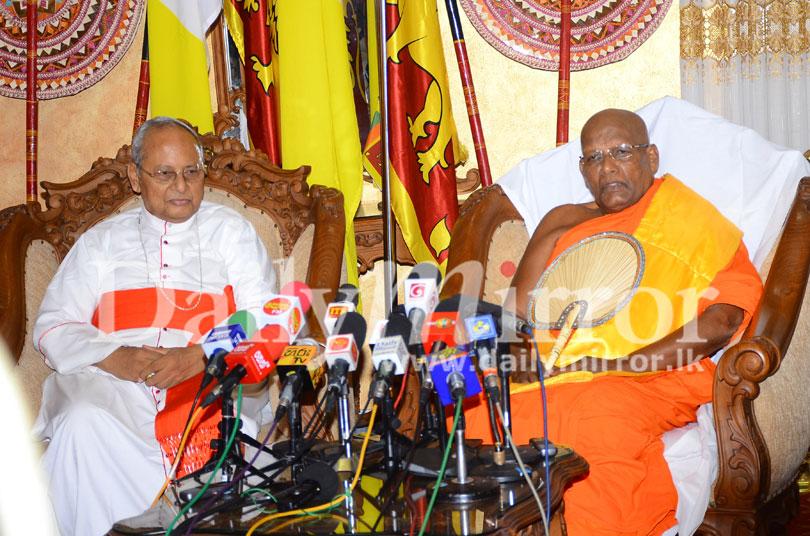
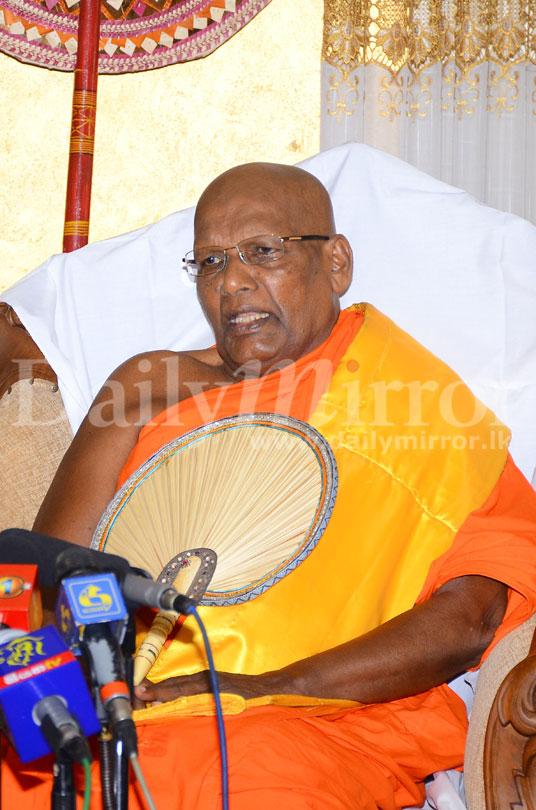
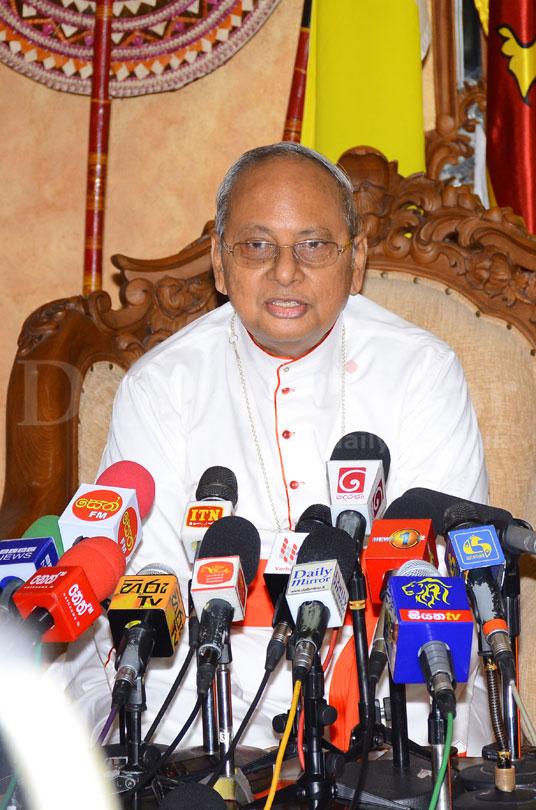
මේක බෞද්ධ ආගම මූලික කරගත්ත රටක්.. මේ රටේ තියෙන්න ඕනේ එක නීතියයි.
May 8th, 2019Web Gossip
මේක බෞද්ධ ආගම මූලික කරගත්ත රටක්.. මේ රටේ තියෙන්න ඕනේ එක නීතියයි. වෙන අයට වෙන වෙන නීති ඕනෙනම් ඒ ඒ රටවල් හොයාගෙන ගියාට කමක් නෑ..
|
|
මේක බෞද්ධ ආගම මූලික කරගත්ත රටක්.. මේ රටේ තියෙන්න ඕනේ එක නීතියයි. වෙන අයට වෙන වෙන නීති ඕනෙනම් ඒ ඒ රටවල් හොයාගෙන ගියාට කමක් නෑ..
While highlighting the importance of a united leadership in Sri Lanka, former US Ambassador Robert O Blake Jr yesterday said the incumbent government should establish a high-level group of technocrats similar to the one existed when Gotabaya Rajapaksa was the Defence Secretary, to prevent terror attacks in the country.
The former ambassador, who is now Senior Director (India and South Asia) of McLarty Associates, said this while delivering a presentation titled US Foreign Policy towards China and South Asia and what it means for Sri Lanka at the BMICH in Colombo.
The event was organised by the Pathfinder Foundation in partnership with the Joint Apparel Association Forum Sri Lanka (JAAFSL)
Mr Blake said having a high-level group of technocrats in Sri Lanka could definitely benefit the country and that Sri Lanka could learn from the mistakes the US have done before and after the 9/11 attacks.
In fact, Sri Lanka did have such a group during the war when Gotabaya Rajapaksa was Defence Secretary and he personally shared that and made sure that all different branches of the Intelligence of which there are many in this country, share information and then sharing that information up to the senior levels making sure that such attacks don’t take place.
So I think that’s a very important thing that the government should think about in establishing a group like that,” he said. (
Since that Easter Sunday, I have been wanting to pen a few words expressing my feelings towards all, who suffered. Lives of nearly three hundred worshipers, their children and scores of foreign tourists were snuffed out amidst waves of flying shrapnel and fumes of sulphur.
And each time I tried, my thoughts always lost its way, blinded by the fiery spectacle of agony, carnage and death that must have reigned at those locations, following the blasts.
Then something snapped in me as I kept reading and listening to what some of our Diyawanna oya nincompoops and their supposedly duty-bound appointees had to say about the mayhem.
I do not want to elaborate on what some of them said, for they have been on all forms of media, for almost two weeks now.
What actually infuriated me is the fact that how inconsiderate and insensitive have become the mindsets of our politicians towards people, who have put them wherever they are now.
In spite of three warnings from our big neighbour, no one seemed to have given two hoots about a possible impending disaster with people caught right in the middle of it. Some were forewarned even a week before, some were stopped from going to church by way of paternal advise, some thought that it was going to be not big enough to make a noise about and so on and so forth. Sadly, all that however, did not reach the public, the relevant religious personalities and others concerned, for which the hapless and the innocent ended up paying the ultimate price.
Aren’t all these acts of covering up and subterfuge acts of sacrilege on what one promised and his unbound duty to people, when one was elected or duly appointed by those people’s representatives?
And did we have any security-council meetings? Yes we apparently did, though without an IGP and a PM. And their excuse is that they were not invited. Isn’t it inconceivable that none of them bothered to find out why? Or that it didn’t occur to them that the safety and the security of the country and its people matter first, sits at the top, even if it means to force your way into the sessions and demand why? No. Sadly some spines are made of bone, just bare, brittle bone and nothing else.
And to see some of them chuckle, while calmly sitting on those comfy chairs holding media briefings is mind-boggling and downright ugly, few even seemingly savouring the fact that they somehow survived, so that they can continue to tell people their fairy tales, actually made me almost throw up in disgust. Or is this apparent nonchalance and pretentious (obviously) stand of showing up nerve, a facade to hide their fear and failure?
Dante in his ‘La Commedia (Divine Comedy)’ writes about hell, purgatory and heaven. The bombers were probably dreaming about the last as they blew themselves up.
And as for our own, who knew about it in advance and still did nothing about it, I am not sure how Dante would have judged them.
Laksiri Warnakula
වර්ෂ
2018 ජනවාරි 03 වන දින පත්වීම්ලාභීන්
වෛද්යවරුන් 650 කට ආසන්න ප්රමාණයක් නැවත ස්ථානගත කිරීම
සඳහා 2019. 05.
13 දින සිදු කිරීමට නියමිත
බව අප සංගමය වෙත
දැන ගැනීමට ලැබී ඇත. කරුණු
ගණනාවක් මත එම නැවත
ස්ථානගත කිරීම සම්බන්ධයෙන් අප සංගමයේ තදබල
විරෝධය මේ සමග ඉදිරිපත්
කරමු.
01. කිසිදු සාධාරණ හේතුවක් නොමැතිව තාවකාලික ස්ථාන ලබා දීම හා
නැවත ස්ථානගත කිරීම අසාධාරණ වීම.
02. මෙතෙක් පත්වීම් ලබාදීමේ ක්රමවේදය සම්පුර්ණයෙන්ම
පාහේ උල්ලංගණය වීම.
03. මේ වනවිටත් වර්ෂ 2018 පත්වීම්ලාභී වෛද්යවරුන් එම
ස්ථාන වල වර්ෂයකුත් මාස
6 ක කාලයක් තම සේවය ලබා
දී වර්ෂ 2020 මාරුවීම් සම්බන්ධව සුදුසුකම් ලබා තිබියදී මෙම
ස්ථානගත කිරීම අසාධාරණ වීම.
04. සාධාරණ හෝ යුක්ති ධර්මයේ
මුලධර්මය අනුගමනය නොකර ස්ථානමාරු සමාලෝචන
කමිටුව හරහා ගත් ඇතැම්
තීරණ ක්රියාත්මක කිරීම
සඳහා මෙම ස්ථානගත කිරීම
සිදු කිරීම.
05. එම ස්ථානමාරු සමාලෝචන කමිටුව විසින් 2019 මාරුවීම් පටිපාටිය දැඩිලෙස උල්ලංගණය සිදු කිරීම.
06. 650 කට ආසන්න දිවයිනේ විවිධ ප්රදේශ වල
සිටින සියලුම වෛද්යවරු බරපතල
අපහසුතාවයන්ට ලක් කිරීම.
07. රටේ පවතින සුවිශේෂී වාතාවරණය සැලකිල්ලට ගෙන කටයුතු නොකිරීම.
08. මෙම නොමනා ක්රියාව නැවත
නැවත පූර්වාදර්ශයක් බවට පත්කිරීමට ඇති
අවස්ථාව වැඩි වීම.
09. මෙතෙක් කරන ලද සාධාරණ
ඉල්ලීම් හා සාකච්ඡා නොසලකා
හැරීම (මේ වන තෙක්
කිසිදු සාකච්ඡාවක් හෝ හමුවීමක් සඳහා
විධිමත් අවස්ථාවක් ලබා නොදීම.)
10. වර්ෂ 2019. 03. 14 වන දින සෞඛ්ය පෝෂණ හා
දේශීය වෛද්ය අමාත්යතුමා සමග සියලු ජ්යෙෂ්ඨ නිලධාරීන්ල වෘත්තීය සමිති පුළුල් සාකච්ඡාවකින් පසුව වර්ෂ 2018 පත්වීම්
ලබාදුන් නවක වෛද්යවරුන්
සේවය කරන ස්ථාන වල
ස්ථිරවම ස්ථානගත කිරීමට ලබා දුන් තීරණය
ක්රියාත්මක නොකර ඊට විරුද්ධව
කටයුතු කිරීම.
යන කරුණු හේතුකොටගෙන ඊට විරෝධය දැක්වීම
සඳහා සහ වර්ෂ 2018 පත්වීම්ලාභී
වෛද්යවරුන් දැනට ස්ථානගත කර
ඇති ස්ථාන වලම ස්ථානගත කිරීම
සඳහා කටයුතු කරන ලෙස ඉල්ලමින්
සෞඛ්ය පෝෂණ හා
දේශීය වෛද්ය අමාත්යාංශය ඉදිරිපිට 2019. 05. 08 දින පෙරවරු 10.30 ට
රටේ ආරක්ෂිත තත්ත්වය
ද සැලකිල්ලට ගෙන සාමකාමී උද්ඝෝෂණයක්
සිදු කිරීමට අප සංගමය විසින්
කටයුතු කර ඇති බව
කාරුණිකව දන්වා සිටිනු කැමැත්තෙමු.
මෙම
ක්රියාමාර්ගය ගෙන ඇත්තේ වෙනත්
විකල්පයක් නොමැති වීම හේතුවෙන් සහ
බලධාරීන් අපගේ ඉල්ලීම් නොසලකා
හරිමින් කටයුතු කල නිසා බවද
වැඩිදුරටත් දන්වනු කැමැත්තෙමු.
මෙම උද්ඝෝෂණය පැවැත්වීමට හෝ ඊට විසදුමක් ලබා දෙන්නේ නම් මෙම උද්ඝෝෂණ ක්රියාමාර්ගය ගැනීමට අදහස් නොකරන බවද වැඩිදුරටත් දන්වා සිටිමු.
ස්තුතියි.
වෙනුවට,
ප්රධාන ලේකම්,
වෛද්ය කේ.
පී. ආර්. එස්. ගුණරත්න
අද (07) පැවැති මාධ්ය හමුවට සහභාගි වු නියෝජිතයින්
■ පාර්ලිමේන්තු මන්ත්රී ලක්ෂ්මන් යාපා අබේවර්ධන මහතා
■ පාර්ලිමේන්තු මන්ත්රී අනුර ප්රියදර්ශන යාපා මහතා
■ පාර්ලිමේන්තු මන්ත්රී එස්. එම්. චන්ද්රසේන මහතා
පාර්ලිමේන්තු මන්ත්රී ලක්ෂ්මන් යාපා අබේවර්ධන මහතා
පූර්ණ ආරක්ෂාවක් ඇතිව පාසල් යනන පුලුවන් නිසා පාසල් පසුගිය 6 වැනිදා පාසල් ආරම්භ කරන බව කියපු අධ්යාපන අමාත්යංශය ඊට පස්සේ 6 වසර සිට 12 වසර දක්වා පාසල් ආරම්භ කරන බව. ඒ අතරේ අධ්යාපන ඇමැති කියනවා සුරක්ෂා රක්ෂණය තියෙනවා පාසල් යන්නලු. මේ පණිවිඩයෙන් පස්සේ මුලු ලංකාවෙම පාසල් පැමිණීමේ ප්රතිශතය 4%ක් විතර වුනා. මෙයින් පෙන්නේ ආරක්ෂාව පිළීබද සහතිකයක් මේ රටේ ජනතාවට නැති බවයි. රුපියල් ලක්ෂයක සුරක්ෂණය දෙන නිසා දෙමව්පියන්ට දරුවෝ පාසල් යවන්න කිව්වට දෙමව්පියෝ පරික්ෂණවලට දරුවෝ යවන්නේ නැති බව ඇමැතිතුමා දැනගන්න ඕනේ. මේ ආන්ඩුවේ තියනෙ නොහැකියාව වගේම ආරක්ෂාව ගැන ජනතාව සෑහිමකට පත්වෙන්නේ නැහැ. පාසල් ආරම්භ කරන්න ඕනේ ආරක්ෂාව තහවුරු කරලයි. පාසල අවට ඉන්න දරුවෝවත් පාසලට එවන්නේ නැතිව වාහනවලින් දරුවෝ එවයිද? ආරක්ෂාව සහතික කරලා ජන ජිවිතය නැවත නගා සිටුවන්න අවශ්යයි.
විපක්ෂයක් විදියට ශ්රී ලංකා පොදුජන පෙරමුනේ නිර්මාතෘ බැසිල් රාජපක්ෂ මහතා ආරක්ෂාව සම්බන්ධයෙන් යෝජනාවලියක් ලබාදුන්නා. විපක්ෂ නායකතුමාත් හිටපු ආරක්ෂක ප්රධානීන් ගෙන්වලා ආරක්ෂාව සම්බන්ධයෙන් වාර්තාවක් ලබාදුන්නා. විපක්ෂයක් විදියට අපි අපේ සහයෝගය දෙමින් සිටිනවා.
දැනට අත් අඩංගුවේ සිටින ඊබ්රහිම් මොහොමඞ් ලංකාවේ හොදම අපනයනකරු බව රිෂාඩි බදියුදීන්ගේ පුවත්පත් සාකච්ඡාවක සදහන් වුනා. ඒ කියන්නේ ත්රස්ත ප්රහාරයේ සහෝදරවරු දෙන්නාගේ පියා. ඔවුන්ගේ පියා හොදම අපනයනකරු. ගම්මිරිස් ප්රතිඅපනයනය කිරීමේ වෙළෙද බලපත්රය දීලා තියෙන්නේ ඔහුට. ගමේ මිනිස්සුන්ගේ ආර්ථිකය සම්පූර්ණයෙන්ම විනාශකරපු මනුෂ්යාට අපි කියන්නේ හොදම අපනයනකරු කියලයි. ව්යාපාරිකයෙක් විදියටයි හදුනන්නේ. ඔහුගේ කොම්පැණිය හදුනන්නේ නැහැ කියලා ඔහු සදහන් කරලා තියෙනවා. මේ විදියට නාදුනන කෙනෙක්ට ගම්මිරිස් ප්රතිඅපනයනය කිරීමේ බලපත්රය දුන්න නිසා තමයි මේ අපරාදය වුනේ.
පහුගිය දින කිහිපයේ ආන්ඩුවේ ඇමැතිවරුන්ගේ කතාවලින් පේන්නේ රාජපක්ෂ භීතිකාව නැවත ඇතිවෙලා කියලයි. එක පැත්තකින් 2015ට කළින් මේ ඉස්ලාම් ත්රස්තවාදීන් සම්බන්ධයෙන් තොරතුරු ලැබිලා තිබුණලු. හිටපු ඇමැතිවරයෙක් කියනවා බැසිල් රාජපක්ෂ මහතා රිෂාඩි බදියුදීන් ගොඩනැගුවා කියලා. මේක ඉතාම කණගාටුදායකයි. 2017, 2018 දීත් තුර්කි තානාපතිවරයා දෙසැරයක් ආරක්ෂක අමාත්යංශයට ලිපි යවලා කියනවා තුර්කියේ ත්රස්තවාදී සංවිධායනයක සාමාජිකයින් පනස්දෙනෙක්ගේ පැමිණීම සම්බන්ධයෙන්. මොවුන් අත් අඩංගුවට අරන් භාරදෙන්න කියලත් ඉල්ලා තිබෙනවා. එතුමාගේ ලිපියට පිළීතුරු නැති නිසා ආරක්ෂක අමාත්යංශයට ගිහින් එවකට ආරක්ෂක ලේකම් හමුවෙලා මම එවලු ලිපියට පිළිතුරු නැත්තේ ඇයි කියලා විමසීමක් කරපුවාම එය ආරක්ෂක මණ්ඩලයට යවලා පියවර ගන්න බවයි කියලා තියෙන්නේ. නැවත වරක් විමසීමක් කළාම ආරක්ෂක මණ්ඩලයට දැම්මත් මුස්ලිම් දේශපාලනඥයින් දෙදෙනෙක්ගේ බලපෑම් නිසා මේ සම්බන්ධයෙන් පියවරක් ගන්න බැරිවුන බව සදහන් කර තිබෙනවා. මේ සම්බන්ධයෙන් තුර්කා තානාපතිවරයා සදහන් කරනවා. මොවුන් ඉස්ලාම් රැඩිකල්වාදය පතුරන පිරිස්. පාස්පෝට් අංක පවා දුන්නත් මේ සම්බන්ධයෙන් පරික්ෂණ වෙන්නේත් නැහැ. කිසිවෙක් අත් අංඩගුවට ගත්තේ නැහැ කියලා තුර්කි තානාපති සදහන් කරනවා. අපේ ආන්ඩුවක් තිබුණා නම් මේ වෙද්දි මොවුන් අත්අඩංගුවට පත්වෙලා. ඇමැතිවරුන් බුද්ධි අංශය නැති කලේ නැහැ කියලා මාධ්ය ඉස්සරහට ඇවිත් කිව්වාට, බුද්ධි අංශයේ ශම්මි කරුණාරත්නලා හිරේ දැම්මාට පස්සේ, මාරුකළාට පස්සේ, ගිරිතලේ සම්පූර්ණයෙන්ම වහලා දැම්මාට පස්සේ බුද්ධි අංශයේ හයයි හිරේ ඉන්නේ, අනෙක් අයට අපි හානි කරලා නැහැ කිව්වාට වැඩක් නැහැ. ඒ මාරුකරපු අය දැන් කැදවන්න. වසන්ත සේනානයක මහතා හෙළිකරපු මේ කාරණයත් එක්ක පැහැදිලි වෙන්නේ රටේ ආරක්ෂාව සම්බන්ධයෙන් ආන්ඩුවට කිසිම වැඩපිීළිවෙලක් නැති බවයි. රටවල් 180ක අන්තවාදී විදියට ඉස්ලාම් ධර්මය පතුරුවන මේ සංවිධානය රටවල් 22ක තහනම් කරලා තිබියදීත් ආන්ඩුව කිසිදු ප්රකාශයක් කලේ නැහැ. තුර්කි තානාපති දේශපාලනඥයින් දෙදෙනෙක් ගැන සදහන් කළත් මේ වන තෙක් ඔවුන්ගෙන් ප්රශ්න කරලා ප්රකාශයක් සටහන් කරගෙන නැහැ. හැබැයි පියල් නිශාන්ත මන්ත්රීවරයාගේ ප්රකාශයක් සම්බන්ධයෙන් පැය 5ක් ප්රශ්න කරනවා. ප්රධාන සැකකරුවන් විදියට මිනිස්සු සැකකරන මේ දෙපලගෙන් තවම කිසිදු ප්රශ්න කිරිමක් නැහැ.
සංචාරක ව්යාපාරිකයින් පිරිසක් හා විපක්ෂ නායකවරයා අතර සාකච්ඡාවක් පැවැත්වුනා. ඔවුන් කියන්නේ තවමත් හෝටල්වලට සංචාරකයෝ එන්නේ නැතිබවයි. මේ වන තෙක් විදේශ ඇමැතිවරයා, සංචාරක ඇමැතිවරයා වචනයක්වත් කතා කරලා නැහැ. ව්යාපාරිකයින් කියන්නේ සංචාරක ව්යාපාරය නැංවිමට ආන්ඩුවේ කිසිම දායකත්වයක් නැහැ කියලා. ඔවුන් විපක්ෂ නායකවරයාගෙන් ඉල්ලා සිටියා මේ සම්බන්ධයෙන් නායකත්වය ගන්නා ලෙසත්.
අපේ කාලයේ තිස් අවුරුදු යුද්ධයක් නිමවීමෙන් පස්සේ ලංකාවේ අයිෆා එක තිබ්බා. අපි ඒකෙන් පෙන්නුවේ අල්පෙනෙත්තක්වත් බිම වැටෙන්නැති රටක් බව. සංචාරක ව්යාපාරයට අනාරක්ෂිත කළාපයක් නොවන බව අපි ලොවට ඔප්පු කළා. අගමැතිතුමා බටහිර එක්ක හොදනම් කරුණාකරලා මේ වෙලාවේ බටහිරෙන් ප්රකාශයක් ගන්න. අද බටහිර රටවල් කියන්නේ ලංකාවට යන්න එපා කියලයි. ආන්ඩුව බටහිරට ඕනේ විදියට රට කරනවා නම් රටට තියෙන ආදායම් රැක ගන්න පියවර ගන්න ඕනේ. මේ මාස හයෙත් කරදර නොදී මැතිවරණයකට යන්න.නැත්නම් ආන්ඩුව කරන්න පුලුවන් ක්රමවේදයක් හදන්න. මේ වෙද්දි ව්යාපාරකයින්ගේ ලීසිං කරපු වාහන ගෙනියන්න පටන් අරන්. රටේ තියෙන තත්ත්වය දෙස බලා ආරක්ෂාව තහවුරු කරන්න. නැත්නම් රටට ඉදිරියට යන්න බැහැ.
පාර්ලිමේන්තු මන්ත්රී අනුර ප්රියදර්ශන යාපා මහතා
විපක්ෂයත් දුර්වලයි කියලා පහුගිය කාලයේ කිව්වා. ආන්ඩු ක්රම ව්යවස්ථාවේන් ජනතාවගේ ආරක්ෂාව සැලසීමේ බලය ලබා දීලා තියෙන්නේ විධායකයටයි. ව්යවස්ථාදායකයේ ආන්ඩු පක්ෂය හා විපක්ෂය සිටිනවා. විපක්ෂයේ අපි කරන්නේ විපක්ෂයේ කාර්යභාරයයි. වගකීම් සහිත විපක්ෂයක්විදියට අපි කටයුතු කළා. වෙන විපක්ෂයක් තිබුණා නම් මේ වෙලාවේ බොරදියේ මාලුබාන්න කටයුතු කරනවා. අපි අදත් විපක්ෂයේ කාර්යභාරය ඉටුකළා. 2015දි අපි භාරදුන්නේ දකුණු ආසියාවේ සුරක්ෂිතම රටයි. ඒ වෙලාවේ යම් යම් ආරක්ෂක විධිවිදාන ක්රියාත්මක වුනා. මර්මස්ථාන ආරක්ෂා කළා. එවකට ජෝන් අමරතුංග ඇමැතිවරයා ජනාධිපති මාවතේ තිබුණු මාර්ග බාධකය විවෘත කලේ ඒකට පයින් ගහලයි. රටේ ආරක්ෂාව සම්බන්ධයෙන් දැනුමක් තිබුණා නම් ආණ්ඩුවක් මාරුවුනා කියලා ඒ විදියට රටේ ආරක්ෂාව හැල්ලු කරන්නේ නැහැ. තරු පහේ ප්රජාතන්ත්රවාදයක් කියලා ඕනම කෙනෙක්ට ඕන දෙයක් කියන්න කරන්න ඇරලා රාජපක්ෂවරුන්ට නඩුදාන එක ගැන විතරයි බැලුවේ. අදත් ඒක පටන් අරන් තියෙන්නේ.මොන දේ වුනත් වගකියන්න ඕනේ රාජපක්ෂවරයෙක් තමයි. නමුත් මහින්ද රාජපක්ෂ මහතාගේ ආන්ඩුව රටේ තිබුණූ දරුණූම ත්රස්තවාදය පරාජය කරලා ප්රජාතන්ත්රවාදය ගෙනාවා. ඒ නිසා අලුත් ආන්ඩුවක් බලයට එන්න මාර්ගය හැදුනා. ජනතාවට අලුත් ජිවිතයක් ලබාදුන්නා. ඒ සියලු දේ අමතක කරලා මුව හමට තඩිබෑමේ කාර්යය කිරීම නිසා රටම අනාරක්ෂීත කරලා. විපක්ෂයට රටේ ආරක්ෂාව සම්බන්ධයෙන් කිසිදු වගකීමක් නැහැ. ව්යවස්ථාවෙන් රටේ ආරක්ෂාව දීලා තියෙන්නේ විධායකයටයි. රට අනාරක්ෂීතවිම වැලැක්වීමට කටයුතු කිරීමයි කළ යුත්තේ. රටේ බුද්ධී අංශවලට කරපු අපරාධය ගැන පාර්ලිමේන්තුවේදී නිරන්තරයෙන් කතා කළා. අදටත් රිමාන්ඞ් කරපු අයට මහාධිකරණයේ නඩු පවරන්න චෝදනාවක් ගොනු කරගන්න බැරිවුනා. සිද්ධ වුනු එකම දේ අපිට තොරතුරු ලැබෙන මාර්ග අවහිරවීමයි.
ඉන්දීය බුද්ධි අංශයට මේ පණිවිඩය ගියා. පහරදෙන ස්ථාන, පහර දෙන දිනය, සියල්ලම ඉන්දියාවට ලැබුණා. ඉන්දියාවේ බුද්ධි අංශවලට රජය බලපෑම් කරන්නේ නැහැ. ඉන්දියාව දුන්න තොරතුරු ගණනය කරගන්නවත් අරක්ෂක අංශවලට නොහැකි වුනා. පොලිසියේ එකම එක ඩි. අයි. ජී කෙනෙක් තමන්ට ලැබුණූ තොරතුර අදාල අංශයවලට දැනුම්දුන්නා. ඒ නිසයි ප්රභූ ආරක්ෂක අංශයට තොරතුර ලැබුනේ. එතුා ප්රභූන් ආරක්ෂා කළා නෙවෙයි. එතුමා යටතේ ප්රභූ ආරක්ෂාව තිබුණ නිසා එතුමා කලේ එතුමාගේ රාජකාරියයි. මෙවැනි අනාරක්ෂිත තත්ත්වයකට රට පත්කරපු රජයක් අපිට ඇගිල්ල දිගු කරන්නේ ඇයි. අපි රටේ සංවර්ධන වේගය වැඩිකළා. වාහන ආවා. මිනිස්සු සතුටින් හිටියා. මේවා බොරුවැඩ. ණය ගන්නවා කියලා බලයට ඇවිත් ඒ අය ගත්ත ණයවලින් කරපු දේකුත් නැහැ.
දැන් මේ ආණ්ඩුව මියගිය ආන්ඩුවක්. වෙනදා ආණ්ඩුවෙන් පණිවිඩයක් දෙනකොට මහජනතාව ඇහුම්කන් දෙනවා. දැන් පාසලකට ළමයි එවන්නේවත්නැහැ. ඇයි ඒ? මේ රජය ගැන විශ්වාසයක් නැති එක. මහජනයා විශ්වාස කරන්නේ නැහැ කියන්නේ මේ ආන්ඩුව මියගිහින්. අවසන් හුස්ම හෙලමින් සිටින්නේ. අනලස්ව වැඩකරපු රාජ්ය සේවයේ කාර්යක්ෂමතාවය බිංදුවට වැටිලා. එෆ්. සී. අයි ගෙන්වලා දක්ෂ නිලධාරීන් බංකුවල තියලා වාඩිකරලා ප්රශ්න කරනවා. පොලිසියටත් වුනා. වැඩක් කරලා ප්රශ්න දා ගන්නවාට වැඩිය වැඩ නොකර ඉන්න එක හොදයි. අද මුලු රටම එක තැන හිටලා. විශාග ආර්ථික ප්රපාතයකට රට වැටිලා තියෙන්නේ. අදටත් වැඩපිළිවෙලක් නැහැ. මේ ප්රශ්නය විදෙස් මාධ්ය අගමැතිගෙන් විමසුවාම කිව්වේ සංචාරකයෝ තමයි මේ රටට එනවාද කියලා තීන්දු කරන්න ඕනේ කිව්වා. වචනයක්වත් කිව්වේ නැහැ අපි සංචාරකයින් ආරක්ෂා කරනවා කියලා. සිද්ධියෙන් පස්සේ හිටපු ආරක්ෂක ලේකම්වරයා කොච්චිකඬේ පල්ලිය ලගදී විදෙස් මාධ්යයට කියනවා හෝටල්වලට අපි ආරක්ෂාව දෙන්නේ නැහැ කියලා. එවැනි බාල ප්රකාශ කරන අත්දැකීම් අඩු අයටයි වගකීම් භාරදීලා තියෙන්නේ. අද රජයන් දෙකක් ක්රියාත්මකයි. එක කොටසක් මේ පැත්ත බලද්දි අනිත් කොටස බලන්නේ අනිත් පැත්ත. තමන්ගේම ජනාධීපතිට කැලෑපත්තර ගහනවා. මෙහෙම රටක් තිබුණාද? මේ තරම් දුර්වල වගකීම් රහිත ආන්ඩුවක් වුනත් අපි විපක්ෂයේ කාර්යභාරය ඉටුකරලා මේ තත්ත්වයෙන් ජනතාව ගලවා ගන්න අපිට කළ හැකි කාර්යභාරය ඉටුකරනවා.
විශාල අනාරක්ෂිත තත්ත්වයක් තිබියදී අපි උත්සාහ කරන්න ඕනේ එකිනෙකා අතර මිත්රත්වය වැඩිකර ගත යුතුයි. අයි. එස්.ත්රස්තවාදයක් මේ රටේ ක්රියාත්මකයි. ඒ ත්රස්තවාදය කොපමණද කියනවා නම් මැරෙන්නේ අඹුදරුවෝ. කුසේ ඉන්න දරුවෝ ඔක්කොම එක්ක. භාර්යාව,පියා, මව, සොයුරු සොයුරියන් සේරම මැරෙනවා. ඒ තරමට මේ ත්රස්තවාදය භයානකයි. රජය නොදැන මේ රටට විදේශ විනිමය ගේන්න පුලුවන්ද? මහ බැංකුව නොදැන කිසිවෙකුට ඩොලර් 10000ට වැඩිය මේ රටට ගේන්න බැහැ. වෙන රටකට ගෙනියන්න බැහැ. මහ බැංකුවට විශාල ගණුදෙනු සම්බන්ධයෙන් දන්වන්න වෙනවා. මොවුන් රට අභ්යන්තරයෙන් සල්ලි හොයාගත්තාද?, පිටින් සල්ලි එව්වද කියලා කියන්න ඕනේ. මේ දේවල් තවදරටත් සගවන් ඉදලා හරි යන්නේ නැහැ. මුස්ලිම් ජනතාවත් මේ සිද්ධියේදී ඔත්තු දිලා තියෙනවා. ආන්ඩුව මේ විදියෙන් අපිට ඔත්තු ලැබෙන ක්රමවේදයක් සකසා ගැනිම් අවශ්යයි.
ආනයන අපනයන පාලකගේ සහතිකය නැතිව ගම්මිරිස් අපනයනය කරන්න බැහැ. ලංකාවේ එකම අමාත්යංශයේ කිසිම ඇමැතිවරයෙක් ඉදලා නැහැ. රිෂාඞ් බදියුදීන් තමයි ඒ විදියේ ඉන්නේ. ලොකු දැනුමක් තිබිලාද ඉන්නේ.ආයතන 46ක් එක පුද්ගලයෙක් අතට දීලා තියෙනවා.ඔහුගෙන් ප්රශ්න නොකළට පියල් නිශාන්ත මන්ත්රීවරයාගෙන් ප්රශ්න කරනවා වැරදි ප්රකාශයක්කිරිම ගැන.
මේ පුද්ගලයා ජනතා විමුක්ති පෙරමුනේ ජාතික ලයිස්තුවෙත් ඉන්නවා. මාධ්යයක මේ පුද්ගලයා ඉතාම හොද පුද්ගලයෙක් කියලා පළවෙනවාත් මම දැක්කා. වෙනකෙනෙක් කළා නම් එහෙම කියන්නේ නැහැ. බුද්ධි අංශ අනතුරු ඇගවීම් නොසලකා හිටියේ ඇයි කියලා අපි ආන්ඩුවෙන් අහන්නේ අදවෙද්දි සමස්ත ජනතාවම අනාරක්ෂිත වෙලා නිසයි. මේ ආන්ඩුව දෙපත් නයෙක් වගෙයි. ඔලු දෙක දෙපැත්තට අදිනවා. එක පාරක යන්න බැහැ.
අද ජනතාව අහන්නේ කාදිනල්තුමා කියන දේ විතරයි. ආන්ඩුව කියන දේ අහන්නේ නැහැ. වෙන රටක මේ විදියේ තත්ත්වයක් ඇති වුනානම් ආන්ඩුව අස්වෙලා.
පාර්ලිමේන්තු මන්ත්රී එස්. එම්. චන්ද්රසේන මහතා
අධයාපන ඇමැතියවරයාගේ දැනුම්දිම මත පාසල් ඇරඹුණා. ඇමැතිවරයාගේ ඉල්ලීමට ලැබුණු ප්රතිචාරය සිසුන්ගේ පැමිණීමෙන් පේනවා. අධ්යාපන ඇමැති කෙනෙක් වුනාම ප්රායෝගික දැනුමක්වත් තියෙන්න ඕනේ. සිසුන් රක්ෂණය කරලා නිසා බය නැතිව පාසල් යවන්නලු. ඒ කතාවෙන් පැහැදිලි වෙන්නේ දරුවෝ බිල්ලට දිලා රක්ෂණය විදියට දෙන රුපියල් ලක්ෂ දෙකක විතර මුදල ගන්න කියන එකයි.මේ කතාවෙන් පස්සේ දෙමව්පියෝ තවත් බය වුනා. රක්ෂණය ගැන මතක් වුනේ බැරෑරුම් තත්ත්වයක් තියෙන නිසා කියලා තේරුම් ගත්ත දෙමව්පියෝ දරුවෝ පාසලට එව්වේ නැහැ. ආන්ඩුවේ ප්රකාශවලට කිසිම පිළීගැනීමක් නැහැ. මේ තත්ත්වය ගැන ඇමැතිවරයා සදහන් කලේ ළමයි නැති වුනාට ගුරුවරුන්ගේ පැමැණීම හොදයිලු. ගුරුවරු එන්නේ උගන්වන්නනේ. ළමයි තමයි ඉගෙන ගන්න එන්නේ. දැන් ගුරුවරුන්ටත් ඉගෙන ගන්න වෙලා. මේ විදියට බොලද විදියට ඇමැතිවරු තවදුරටත් කටයුතු කරන්න එපා.ජනතාවට බය වෙන්නේ නැතිව රුකියාවට යන්න. දරුවෝ පාසල් යවන්න කිව්වාට අපි දැක්කා මාධ්යයේ පලවෙනවා මේ දවස්වල ඇමැතිවරු බය වෙලා අමාත්යංශවලට එන්නේ නැති බව. අවුරුදු තිහක ත්රස්තවාදයක් තියෙන කාලෙය් මහජන නියෝජිතයෝ විදියට අමාත්යංශවලට ගියා, උතුරු නැගෙනහිරට ගියා. බෝම්බ, පැති බෝම්බ තුවක්කු , බිම් බෝම්බ හැමදේම තිබුණා. මැතිවරණ ටිකත් හරියට පැවැත්වුවා. මේ ආන්ඩුවේ අකාර්යක්ෂමතාවය තමයි සියලු දෙයින් පේන්නේ.
කොළඹ සිට අනුරාධපුරයට යද්දි රටේ තත්ත්වය දැක්කාම කණගාටු හිතෙනවා. යුද්දේ කාලයේ ගුවන්තොටුපලට ගැහුවා. ගුවන් යානා පිච්චුවා. ඒ වුනත් සතියක් දෙකක් යද්දි සංචාරකයෝ ගුවන්මගින් ආවා. ඒ කියන්නේ රජය ගැන විශ්වාසයක් තිබුණා. විෂය භාර ඇමැතිවරයා භය වෙලා හිටියේ නැහැ. මේ අය වාහනයක් ඇතුළට ගන්න දෙන්නේ නැහැ. කිලෝමීටරයක් විතර පයින් යන්න සකස්වලා තිබුණා. මේවා දැක්කාම සංචාරකයෝ එන්නේ නැහැ. මේ වගේ එකමුතුවක් නැති කැබිනට් මණ්ඩලයක් නැහැ. හෝටල් ව්යාපාරකියන් කිව්වේ රටේ නායකත්වය හා ආන්ඩුවේ දුර්වලතාවය නිසා කිසිම සංවර්ධනයක් වෙන්නේ නැති නිසා රටේ වෙනසක් ඇති කරන්න කියලත් ඒ සදහා නායකත්වය ගන්න කියලත් විපක්ෂ නායකවරයාගෙන් ඉල්ලුවා. සෘජු නායකයෙක් නැති වුනොත් රට තවත් කඩා වැටෙනවා. පළාත් සභා විසුරුවලා සෑහෙන්න කාලයක් වෙනවා. ඌව විතරයි විසුරවන්න තියෙන්නේ. මේ අය ජනතාවට බයේ මැතිවරණය නොතියා ඉන්න උත්සාහ කරමින් සිටියේ. දැන් හදිසි නිතියට මුවාවෙලා මැතිවරණ ගැන කතා නොකර ඉන්නවා. ජනාධීපතිවරණයත් නොතියා ඉන්නයි අත්සාහ ගන්නේ. යුද්ධය අවස්ථාවේදීත්, ජවිපේ භීෂණ කාලයේදීත් ජනාධීපතිවරණය කල් නොදමා පැවැත්වුවා. ඒ විදියටම ජනාධපතිවරණය නිසි වෙලාවට තියන්න ඕනේ. තවත් ජනතාව පීඩාවට නොකර මහ මැතිවරණයක් මගින් ජනතාවට කැමැති පාලනයක් පත්කර ගන්න අවස්ථාව දෙන්න. ආන්ඩුව වැරදි කරලා වැරදි කරලා ජනතාව වෙනුවෙන් කරන්න තියෙන එකම යුතුකම මේකයි
Government invoked emergency with two intentions.One is to carry out raids and inspections , not only to arrest culprits but to arrest the situation of excallating violence.Secondly to keep public indoor so that skirmishes in the streets are minimised.
What happened in Negombo is a clear example, where people were trying to lake the law into their hands.
Yesterday parents decided not to comply wither government ruling that children should attend schools.Percentage of children attending schools was abmisible.
It was not a strike per say but ignoring requests by the government.
As per the laws in Sri Lanka it is a must that children artend to schools.
This may be just a start of Noncompliance with the rules and regulations because people may not be trusting what government tells.
Next action may be that people will refuse to obey rules related to day to day to life.
People may dump garbage every where.People May drive without complying traffic rules.People may not obey judiciary and law and order.People may stop paying-taxes
Government should establish trust among people..So far government has failed.
Hats off to armed forces for controlling the situation.
Yesterday we saw how His Emminence Cardinal visiting Negombo and passifying aggrieved People.
Main-idea is that People should at least listen to religious leaders rather than rulers.
But none of the politicians like crying MPs in the area dared to go to the location!
If and When there are skirmishes in the areas of predominantly Buddhist ,have you ever seen any Chief Sanganayake visiting the areas and talk to both parties to avoid excallations.
Catholics may not be trusting government but they trust religious leaders.
Cardinal just preached what Jesus Christ advocated.
As a Buddhist I am ashamed to note that most of our Buddhist Leading Monks never go to people.
They want people to come to them.
Whenever they give TV interviews ,they talk aggressively leading to more and more discontent.
It is high time for the Government to impose Emergency Law in full force and gag the press so that they do not aggravate the Non Compliance with rules and regulations.
All the prelates leading Malwatu,Asgiri ,Rammana ,Siam Nikaya’s etc should visit the areas in turns and preach non violence.
No politicians should accompany them.
I am sure that people will abide by the rules after such action.
If an attack happened in a Buddhist Area in Sri Lanka there would have been a Killing Field” like in Cambodia.
Various interviews shown in TV and radio and published newspapers should be stopped with social media gagging.
Army with the help of clergy should visit people should take the lead and let politicians sleep for few weeks”
‘The residual historical hostility against India was certainly a factor,’ says Colonel Anil A Athale (retd).

Photograph: Athit Perawongmetha/Reuters
The Indian election campaign of 2019 will go down as the most negative ever in our electoral history.
Both sides have harped more on the negatives of the other side than their own positives.
These elections have seen political parties running to the Election Commission of India virtually every other day with complaints against each other.
It reminds me of the bad old days of Indian cricket when the team, in doldrums, was fond of appealing frequently to the umpires!
Political parties have cynically vitiated the process in such a way that the Election Commission’s credibility has been eroded. This will have long-term repercussions for Indian democracy that has always prided itself on a free and fair electoral process.More from around the web
Be that as it may, one very tragic consequence of this gamesmanship has been the recent terror attack in Sri Lanka.
As a frequent visitor to and long time student of Sri Lanka’s internal dynamics, one is well aware of the undercurrent of ‘anti-Indianism’ in the Sri Lankan polity.
The roots of this go back to the first millennium CE. Emperor Rajendra Chola created a vast empire in South East Asia and invaded Sri Lanka 17 times. During these invasions he destroyed the Buddhist shrines of Anuradhapura and built a Shiva temple at the site.
Sri Lankans have never forgotten this history and were and are suspicious of Indian motives. At the peak of the Indian Peace Keeping Force operations in 1987-1988, then Sri Lankan prime minister Ranasinghe Premadasa even supplied arms and ammunition to the Liberation Tigers of Tamil Eelam to fight the Indian Army.
There was widespread belief in Sri Lanka that India would never withdraw from Sri Lanka.
The anti-Indian feeling has abated somewhat since then as India kept its pledge and withdrew its forces in 1990. It is another matter that the same Premadasa was a victim of the LTTE.
After the LTTE’s defeat 10 years ago, Sri Lanka has seen much desired peace. The terror bombing on Easter Sunday, April 21, shattered this decade of peace. The ease with which the terror attacks were carried out revealed that Sri Lanka had let its guard down.
What is shocking is that almost a month before the gruesome attacks, Indian intelligence had given a detailed warning that included the likely targets and dates. Not just that, India also provided Sri Lanka with detailed addresses and telephone numbers of the would-be suicide bombers.
This was no vague ‘alert’, but a detailed plot of the terror attacks. Sri Lankan officials completely ignored the warnings and took no action. As a result, close to 250 people lost their lives.
Why did the Sri Lankans disregard the timely warning? The residual historical hostility against India was certainly a factor.
Another equally important factor was the disarray in the Sri Lankan government apparatus due to the ongoing ‘cold war’ between the president and prime minister.
It is also a matter of record that the Sri Lankan establishment has long been hobnobbing with Pakistan and all manner of jihadi outfits to ‘balance’ the Indian influence on Sri Lanka.
Despite all that, it still begs the question as to why the Sri Lankans ignored the inputs of Indian intelligence.
The answer lies in the constant barrage of propaganda in the section of the Indian media that depicts the current Indian government as anti-Muslim.
Lending its ears to the anti-Muslim conspiracy theorists of the Indian media, the Sri Lankans assumed the warnings of impending terror attacks were part of a diabolic plan by Indian Rightists.
From this ‘conviction’ to ignoring timely inputs about the terror attack was a logical step as far as Sri Lanka was concerned.
The damage these attacks have caused to the Lankan economy is tremendous. Tourism, the mainstay of the Lankan economy, has taken a hit and it will take great efforts to recreate confidence in minds of potential tourists.
The Sri Lankan terrorists’s links to India have become visible. India can no longer view its southern parts as immune to the virus of ISIS ideology.
ISIS’s statement that the Sri Lankan attacks were revenge for what happened in Syria to ISIS is laughable to any sane individual. But to its ideologically motivated fanatic followers it makes perfect sense.
Colonel Anil A Athale (retd) has been a Sri Lanka watcher since 1989.
A young vet who swapped a life of clubbing and partying in the UK to set up a charity to help dying street dogs in Sri Lanka says she’s worried she’ll never find love.
Janey Lowes, 30, originally from Barnard Castle, County Durham, visited the country while on holiday aged 26 and was shocked by how many hounds were abandoned on the island.
The vet, who is dubbed the embodiment of ‘Dr. Dolittle’ in tonight’s Ben Fogle: New Lives in the Wild, decided to leave her life in Britain behind and move to Sri Lanka.
But despite seemingly living in paradise and running a successful charity, Janey says she feels ‘isolated’ in the country.

Janey, 30, from County Durham, appears on tonight’s episode of Ben Fogle: New Lives in the Wild. The presenter dubs the girl a modern day ‘Doctor Dolittle’

The former party girl has transformed her life by moving to Sri Lanka and setting up her own veterinary charity to treat some of the country’s millions of stray dogs
The stunning woman admits she’s single and doesn’t think anyone ‘could hack’ being in a relationship with her.ADVERTISING
She says: ‘Everyone loves the idea of an independent girl going off and doing her own thing. Guys say they find it attractive, but actually the reality of it sucks.’
She adds: ‘I don’t wanna be a crazy dog lady left on the shelf. It’s definitely a specific taste people are going to have to have.’
Janey had dreamed of being a vet from a young age, and after graduating from university, she worked for two-and-a-half years but found she didn’t feel she was doing enough to help animals.

The stunning 30-year-old admits she’s single, as she spends almost all of her time at work, and says that she doesn’t feel men ‘can hack’ her lifestyle

Janey set up the charity, which now has 17 staff, in Sri Lanka, after visiting while backpacking around the world
She admits in the programme, which airs tonight on Channel 5 at 9pm, that she used to be quite ‘self-obsessed’ and buy a new outfit to go out on the town every weekend.
While travelling for a year, she fell in love with Sri Lanka and their millions of street dogs.
Janey moved to the country and set up a charity, WECare Worldwide, buying a building on the outskirts of the town Talalla and converting it into a veterinary practice.

She admits the country has a chronic problem with their stray dogs, with an estimated one to three million animals roaming the streets
She admits that the country has a chronic problem with their stray dogs, with an estimated one to three million animals roaming the streets.
Janey revealed that street dogs often have a food source, but aren’t necessarily owned by anyone.
She is so dedicated to the work that she’s available pretty much 24/7 to the centre, admitting: ‘It’s just that here there’s not really another option. We have to be available all the time.’

The 30-year-old admitted she has loved animals from a young age, and had always dreamed of becoming a vet

Janey grew up in County Durham, but moved to Sri Lanka two years after graduating from university to set up her charity
Her charity now has 17 members of staff, including five vets, three nurses and several trainees.
While on the job she allows herself to be bitten by terrified dogs and has even contracted mange from the stray dogs she treats.
Ben is stunned by the infrastructure she has in place, given how remote Sri Lanka can feel.
He tells the camera: ‘What’s amazing is she was willing to give up everything in the UK to set this up from scratch. She’s clearly very ambitious.’

Ben is shocked by the diverse range of injuries that Janey treats, including this puppy who had been bitten by a snake

Janey moved to Sri Lanka and brought this property on the outskirts of the coastal town Talalla, in the south of the country. She converted it into a veterinary practice
The presenter joins Janey at work and is shocked by several of the cases she encounters, which he deems worse than anything he’s ever seen in the UK – including one where Janey removes more than 100 maggots from a dog’s ear.
In one scene, a puppy is brought into the veterinary clinic after being bitten by a snake.
Luckily Janey is able to identify what breed the reptile was – a hump-nosed pit viper, whose venom could be fatal to the young pup.

Janey is able to save the tiny puppy from the snake bite, and it’s not long before it’s looking more lively again

Ben is stunned by the young woman’s attitude to the animals, and dubs her a modern day ‘Dr. Dolittle’
The wounded dog requires several injections of pain relief as well as a course of antibiotics.
Janey admits she also finds the financial aspect of the business ‘a massive headache’.
Keen for the centre to live up to the rigorous standards of the UK, she reveals: ‘We haemorrhage money. It’s tough at times.

The vet also called the financial aspect of her business ‘a massive headache’ and said they can ‘haemorrhage’ money at times

Janey says she’s keen to expand her charity across other countries in Asia in an effort to help more animals
‘It’s really expensive to do things not only properly, but in a country where everyone assumes things are cheap when they’re not.’
She continues by saying she’s keen to expand her charity into other countries to help more animals across Asia.
And despite her worries, she describes the country as ‘home’, admitting: ‘I feel like the luckiest girl in the world.’
COLOMBO, May 7 (Xinhua) — Sri Lankan security forces have arrested all those directly linked to the Easter terror explosions on April 21, Acting Police Chief Chandana Wickramaratne said in a special statement here on Tuesday.
Wickramaratne said the police had identified all those involved in the terror attacks and many of them had committed suicide when security forces had attempted to arrest them.
He said the two bomb experts involved in the terrorist attacks had also been killed and forces had seized all the explosives and bombs which had been stored for future attacks.
“We request the public to resume their daily activities without fear. Search operations will continue throughout the island, but all those directly involved in the attacks have been arrested or are dead. The security forces will continue to provide security to all its citizens,” the police chief said.
He said that tight security would remain in places of worship and security forces were also conducting a program to create awareness about safety and security in all schools.
More than 250 people were killed and over 500 injured in the Easter Sunday explosions which targeted three churches and three luxury hotels.
KATTANKUDY, Sri Lanka — The ringleader of terrorist attacks that killed 257 people on Easter Sunday in Sri Lanka was a cruel and stubborn man who does not represent National Thowheed Jamath (NTJ), said his former friend and now leader of the outlawed Islamist group.
[Mohammed Zahran Hashim] has two behavioral personalities,” Mohamed Yusef Thaufeek, NTJ’s leader, told VICE News. One is stubbornness. And he has a tendency to lie. He has both behaviors. No matter what you tell, he never listens, and never accepts it. He has that type of behavior.”ADVERTISEMENT
Until Easter Sunday, NTJ was just one of many peripheral hard-line religious groups in the Buddhist-majority nation. Following a strict Wahabist interpretation of Islam, members were on the police radar due to skirmishes between other religious groups and acts of vandalism against Buddhist statues, but the group itself was not a major security concern to lawmakers and would have been unknown to most Sri Lankans.
Now, it’s been outlawed by the government and is at the center of a sprawling investigation into one of the deadliest terrorist attacks since 9/11. It can thank its founder, Mohammed Zahran Hashim, who allegedly planned the Easter attack on several churches and hotels with help from ISIS.
In claiming responsibility for the attacks, ISIS released a video in which Zahran is seen alongside eight other people pledging allegiance to the terror group. Later, authorities confirmed that Zahran was one of the suicide bombers who targeted upmarket hotels in the island nation’s capital, Colombo.
Thaufeek does not deny that the attacks were committed by the founder and former members of NTJ (Hashim established the group in 2012), or that a further suicide bomb that killed 15 people was committed by Zahran’s brothers.
He does, however, reject the idea that those attacks are representative of the group he now leads.
This is not a terrorist movement. It is an organization under Sri Lankan sovereignty. National Thowheed Jamath does religious and social services,” said Thaufeek. He pointed to a letter written in Tamil dated Dec. 24, 2017, which he claims is evidence that Zaharan was dismissed from NTJ.ADVERTISEMENT
He said it was the events leading up to Zahran’s dismissal from the group that appear to signal the beginning of his journey into violent extremism. Earlier that year, following violent riots against Sufi worshippers in Kattankudy in which several people were arrested, Zahran became a target of the police. He soon fled Kattankudy but then began releasing Facebook videos.
A few months went by, and after that, his talking style begins to change,” said Thoufeek. He starts talking against the Sri Lankan government. He said the Sri Lankan government’s parliamentary system is useless, that the court system is no longer useful. People couldn’t believe that he used to be part of their movement and is now saying all these things. There seems to be such a drastic change. So what we did was right away we joined forces and decided to officially dismiss him from the organization.”
Zahran’s Facebook rants concerned others in Colombo. Hilmy Ahmed, vice president of the Muslim Council of Sri Lanka, said he had alerted the authorities to Zahran’s violent rhetoric.
Referring to one video, Hilmy said, He is basically calling for the killing of all people who do not believe in Islam. It’s hate speech. They would have charged him if they’d found him. They couldn’t find him.”
Missed or ignored warnings by the government have been the focus of intense debate and scrutiny since the deadly attacks on Easter Sunday. In January, a warning came that radical Islamists were stockpiling weapons and detonators, then three more warnings from Indian Intelligence came in April alone. The first on April 4, followed by another on April 11, then again just hours before the bombings on the 20th. Each with more details of targets, names and even the suspects’ movements.
Was the attack on Sri Lanka an example of the Islamic State’s opportunism?
Why did the Islamic State terror group choose Sri Lanka, and a persecuted minority in it, as the target for one of its deadliest attacks ever? This question puzzles many, given that this tiny island nation has largely been non-aligned in its foreign policy and is nowhere on the global radar of the fight against terror. What’s more, Christians here have had cordial relations with the local Muslim community, which, along with the Christian minority, has been under attack by fringe Buddhist extremist groups.
This question, being raised by security analysts and experts, is perhaps presumptuous, and therefore not particularly helpful in making sense of what really happened. We should perhaps first ask, did the Islamic State, or ISIS, really look at the world map and say we need to attack Sri Lanka?”
The Sri Lankan government has blamed the attacks on a local radicalized group, called National Thowheed Jamath (NTJ), a splintered faction of the hard-line Islamist organisation Sri Lanka Thowheed Jamath. On April 21, NTJ’s nine suicide bombers, including a woman, struck two Catholic churches in and around Colombo and an evangelical church in the eastern city of Batticaloa as well as three Colombo hotels frequented by Western tourists, killing at least 257 people, mostly Christian worshipers, and injuring around 500 more.Enjoying this article? Click here to subscribe for full access. Just $5 a month.
Of course, the sophistication involved in the attacks points to external involvement, and the government has said that the NTJ had ties with ISIS, whose leader Abu Bakr al-Baghdadi has also claimed in a video message that the attacks were to avenge the recent defeat of his fighters in the eastern city of Baghouz in Syria, the outfit’s last known hideout in the Levant region.
At least one of the bombers, identified as Jameel Mohammed Abdul Latheef, went to ISIS recruiters in Syria in 2014, according to the Wall Street Journal. Perhaps Latheef reached out to the group not too long after it proclaimed itself to be a worldwide caliphate with al-Baghdadi as the caliph. At the time, its commanders and fighters were releasing videos of hostages in orange jumpsuits being beheaded. The messaging through such images was meant to attract Muslim youth for recruitment and training. ISIS reportedly trained hundreds of foreigners in Iraq and Syria when they still had a territory to rule.
However, having been driven out of Iraq and Syria four years later, thanks to a military intervention by a U.S.-led international coalition, ISIS lost its ability to carry out direct attacks. So it began using home-grown killers to carry out not-so-sophisticated attacks, such as in Europe. It also continued using encrypted messaging platforms and other online communication methods, including social media, to promote its anti-West/anti-Christian narrative and to urge its supporters around the world to launch attacks on suggested targets, irrespective of local communal dynamics in the attacker’s home country.
Therefore, a better question to ask at this stage is, why were some Sri Lankan Muslims attracted to ISIS?
This would lead us to the NTJ’s formation in 2016, when the planning for the attacks and the establishment of sleeper cells and other preparations must have begun. The bombers reportedly used a 43,500-square-foot walled terror training camp in the eastern town of Kattankudy, near the home of the prime suspect, identified as Zahran Hashim.
The terms Thowheed” and Kattankudy” should ring a bell with any Sri Lanka watcher.
In the 1980s, Salafist Islam, a version of which many believe supports violent extremism, began to spread in Sri Lanka in Kattankudy. An ultra-orthodox Salafi group is often referred to as a Thowheed,” meaning monotheism and also written as Tawhid.” Its followers in Sri Lanka initially had intra-faith tensions, including with Sufis, whom they called apostates. The worst episode of persecution of Sufis came when the property of their organization, Thareekathul Mufliheen, was vandalized and houses of more than 100 Sufis were burned down in December 2006. Possessing arms was easier during the time due to the then-ongoing civil war in the east and the north.
Preoccupied with the threat from the separatist Tamil Tigers, who had officially pulled out of peace talks indefinitely a few months earlier, Mahinda Rajapaksa, then the president of Sri Lanka, apparently saw the growth of Salafism as an unimportant matter.
Rajapaksa’s government also overlooked the potential long-term threat from an existing sense of alienation among Muslims, who had been under attack in the east and the north by the Tamil Tigers. Whether the tensions between Muslims and the Tamil Tigers were organic or organized by some previous governments remains debatable.
The International Crisis Group noted in a report in May 2017 that [s]ecurity forces were implicated in several violent confrontations between Muslims and Tamils. One of the worst was an attack on the (Tamil) village of Karaitivu in April 1985, when Muslim youths, apparently with the support of the security forces, went on a rampage, killing several people and burning hundreds of houses. Thereafter, violent incidents became relatively common between Tamil militants and Muslims. Some Muslims were armed by the government for their own protection but they were also involved in vigilante action against neighboring Tamils, provoking more reprisals.”
After the Sri Lankan government defeated the Tamil Tigers militarily in 2009, at the cost of tens of thousands of lives, according to human rights groups, tensions between Muslims and sections of Buddhists emerged.
In 2012, a Buddhist extremist group, Bodu Bala Sena (Buddhist Power Force or BBS), was created allegedly with the support of some influential politicians, apparently to promote Buddhist nationalism among the majority Singhalese community. It could be seen as an attempt to portray the government’s victory over the largely Hindu Tamil Tigers as a reason for national pride and thereby absolve those responsible for the killing of civilians. Several attacks against mosques and anti-Muslim campaigns as well as attacks on churches and Christians have been attributed to the BBS since then. At least in the initial years after the end of the war, Sri Lanka looked like an ethnocracy” with the dominion of Sinhalese Buddhists, which further deepened the sense of alienation among Muslims.
While ISIS claimed responsibility for the Easter bombings – as the bombers on their own declared allegiance to the embattled terror group – Sri Lanka’s targeting” was most likely accidental or opportunistic from the point of view of ISIS, as parts of the island nation had become a fertile ground for indoctrination. And that gives a stronger reason for the world to condemn the successive governments of Sri Lanka for allowing that to happen – and not just for ignoring warnings about the suicide bombings issued by foreign intelligence agencies prior to Easter Sunday.
Most important, India’s Muslims need leaders of substance who can guide, lead and advise.

Many think that India has escaped the wrath of ISIS due to the inherent strength of our plurality. (Photo: AP
The suicide terror bombings in Sri Lanka took that country and the entire world by utter surprise. The Islamic State (ISIS) took its time claiming responsibility, but once it did the puzzle started to fall into place. These attacks came at a time when ISIS was considered defeated in the field and vanquished as an entity; from Fallujah to Mosul and then Idlib in Syria, it lost ground but retained its networked state and ability to direct a rump campaign outside the physical precincts of its presumed caliphate”. The expected surge in Somalia and Nigeria, where the surrogate Al Shabab and Boko Haram exist, did not emerge. Neither did the efforts to find space in the Philippines in conjunction with the Abu Sayaf group. The Taliban’s hold over Afghanistan’s ungoverned parts is too strong for the ISIS to make successful incursions, as is the hold of disparate radical groups in Pakistan who don’t wish to act as surrogates. Mindful of all this, it is likely that ISIS is looking to break fresh ground in order to remain relevant. Its network-based presence remains sufficiently threatening to the world, where the vulnerability of minds continues to exist. ISIS therefore is in search of areas where unexpected emergence may help through a sufficiently clandestine setup and where the intelligence networks may yet be weak. Many believe that India has little potential for an ISIS emergence because even in its heyday four years ago, a very small ratio of India’s 180 million Muslims got radicalised enough to take the plunge to travel to the caliphate” territory. The presence of experienced Indian intelligence agencies whose track record, especially after 26/11, has largely been without blemish may also be an input into such an assumption. However, the ISIS wishlist may include a region or nation with democratic and secular principles of existence with a base of Muslim presence. That immediately enhances India’s vulnerability. The starting point from Sri Lanka, where a small minority of Muslims exists, could be commencement from the fringe. The level of penetration into India has somehow always been questioned. That may no longer be entirely valid.
While the Tamil Nadu-based Tamil Nadu Thowheed Jamath (TNTJ) may be in strict denial of any linkage to the National Thowheed Jamath, that was allegedly responsible for the Sri Lanka carnage, there can be no denial about the fact that extremist radical ideology of the ISIS type has been spreading around the world through the Internet and by word of mouth influence of unmonitored returnees, not necessarily only from the ISIS badlands. Investigations in Sri Lanka are throwing up undiscovered networks involved with word of mouth influence, although admittedly the ISIS linkage has not fully been established despite the claims made. If ISIS has been scouting for other potential locations to showcase its relevance, there can be enough locations all over India as the spread of Muslims is not restricted to any one state. Merely the presence of Muslims is not an invitation for terrorism to establish root; such belief is just as bad as labelling all Muslims as potential terrorists. Vilifying any one segment of Muslims too is counter-productive. Radicals are those who believe in the right of existence of only their ideology and sanction the use of violence to convert all others to their belief.
This is best illustrated by a captured Pakistani suicide bomber, interviewed on Geo TV, who was questioned on why he believed he was doing something for Islam when all the people killed by his potential act were also fellow Muslims. His answer sums it in the best way. He stated that none of the people who would be killed were actually Muslims because true Muslims were only those who thought and followed the faith the way he and his colleagues did. That is an actual hardcore radical of the ISIS variety which the world is battling. There are enough Muslims who are battling them too, but there are also enough confused Muslims around the world who incorrectly think that the ISIS caliphate” is a true caliphate, and that they are duty-bound to support it and fight for it.
Many think that India has escaped the wrath of ISIS due to the inherent strength of our plurality. While the safeguards due to plurality are in place and Indian intelligence agencies have largely marginalised radical groups set up by transnational crime syndicates and many by Pakistan, India is not out of the woods. Nothing signifies that more than the events in Sri Lanka. Indian Muslims are actually different. They are among the few who have had an opportunity to rub shoulders and share lunches with people of every faith. They participate in different religious festivals. There are cities where Hindus and Muslims sit together to decide the routes and timings of processions on days when their festivals clash; such inter-faith bonhomie can rarely be seen anywhere in the world.
Yet with all that, there are maverick elements on both sides who cannot rest in peace or promote the obvious strength of their nation. An organisation such as ISIS thrives on the divisiveness created by both these segments by promoting mutual fears. The politics of divisiveness will always exist in the strongest of societies, especially in open democracies. Morals can never be dictated, they have to be perceived and to expect a hundred per cent of that is utopian. There will always be a threshold dictated by international trends. Strong societies overcome that with hiccups, just as India is currently experiencing. On one hand Pakistan’s strategy works towards promoting that divisiveness in India and then there is the phenomenon of an organisation such as ISIS. Their interests are quite different, but the methodology may actually be the same.
We cannot claim India has firewalled itself against these efforts. There will be elements within who will be influenced by extraneous propaganda, made so much easier today by the existence of the social media. Fake messages and hate messages will continue to rule the ether waves and somewhere they will impact, just as it has happened in Sri Lanka. We have many more returnees from the Gulf than Sri Lanka has. Each one of them cannot be monitored effectively. Thus, sleeper cells do exist to rear their ugly head at opportune moments. We have seen it happen in Bangladesh, and we have now experienced it in Sri Lanka.
What is required is not clichéd advice but effective monitoring. The intelligence agencies have their job cut out for them. The poll rhetoric has created divisiveness and votebanks are obvious, but this cannot be allowed to convert into threats against India’s internal security. The clergy bears a greater responsibility towards the correct interpretation of the faith and there are enough sane members of it and institutions in India who can play a positive role to offset the mischief that both Pakistan and organisations such as ISIS have in mind.
Most important, India’s Muslims need leaders of substance who can guide, lead and advise. The levels of ignorance within the community are extremely high, making it vulnerable to propaganda. Considering the fact that educationally well-qualified people too are seen to be vulnerable, it will need correction from within the community. That can happen only if the absolutely uncalled-for vilification of the community on the basis of unnecessary labelling is also effectively curtailed.
Syed Ata Hasnain, a retired lieutenant-general, is a former commander of the Srinagar-based 15 Corps. He is also associated with the Vivekananda International Foundation and the Institute of Peace and Conflict Studies.

On April 21, multiple suicide attacks on churches and high-end hotels in Sri Lanka killed 253 people, including 40 foreigners, and injured at least 500 others (Sunday Times, April 28). The suicide bombings, which are among the deadliest terrorist attacks in the world since the September 11 attacks in the United States, have drawn attention to the Islamic State (IS) group’s links with local radicals in the island.
A day after the attacks, the Sri Lankan government spokesman said that a little-known local Islamist group, the National Thowheeth Jama’ath (NTJ), had carried out the suicide bombings. But the NTJ was not acting alone, he said, adding that the government would investigate whether the group had international support” (Ceylon Today, April 22).
The Easter Sunday suicide bombings were complex and displayed a high-level of co-ordination. They required resources and expertise beyond the capability of the NTJ, an outfit that until recently was known for its inflammatory rhetoric and vandalism of Buddhist statues rather than serial suicide bombings (New Indian Express, April 22). Ongoing investigations indicate that IS supported local Islamist radicals in the attacks. While the NTJ and another little-known Sri Lanka-based Islamist group, Jammiyathul Millathu Ibrahim (JMI) provided the manpower, the Islamic State’s input included ideological inspiration, expertise in bomb-making, and perhaps even resources,” a senior Sri Lankan police official told Terrorism Monitor. [1]
Islamic State Claims Responsibility
IS claimed responsibility for the attacks two days later. In a statement published by its official news agency, Amaq, it said the attackers are fighters from the Islamic State” (Sunday Times, April 23). A video was also circulated showing eight people, purportedly the Sri Lankan suicide bombers pledging allegiance to IS leader Abu Bakr al-Baghdadi. All but one of the bombers has their face covered. The unmasked individual has been identified as Zahran Hashim, the leader of the NTJ, who carried out the attack on the Shangri-La hotel in Colombo (The Hindu, April 25). IS has since identified three more people who blew themselves up during a police raid a week later in Ampara in eastern Sri Lanka (Daily Mirror, April 28).
Subsequently, IS clarified the motivation behind the serial attacks. In a propaganda video released on August 29, al-Baghdadi can be heard describing the attacks in Sri Lanka as vengeance” for its fighters, who were killed defending Baghouz in Syria (Daily Mirror, April 30).
Rising Radicalism
The Sri Lankan suicide bombings came just weeks after the fall of Baghouz. Having lost all its territory, IS was perhaps keen to signal that it remains a potent group. Sri Lanka was a suitable target in this regard. Since the end of the civil war in 2009, Colombo had lowered its guard against terrorist attacks. Further, many Westerners come to the island as tourists, and Sri Lanka has a sizeable Christian population. These factors provided the bombers with soft targets. Importantly, Islamic radicalism was growing in the island, providing IS with foot-soldiers to carry out the attacks.
As in other parts of the world, Muslims in Sri Lanka have been caught in the vortex of radicalism. Wahhabism, a conservative strain of Islam practiced in Saudi Arabia and traditionally alien to South Asian Muslims, has been making inroads into the Sri Lankan Muslim community in recent decades (Himal Southasian, April 26). The Saudis have provided scores of Sri Lankan Muslims with scholarships to study in Saudi universities. These students returned home to preach Wahhabi-Salafist teachings, enabling it to take root in the island (Colombo Telegraph, March 27, 2013).
Post-9/11, radical Sri Lankan Muslims became more assertive and more willing to use violence. However, their targets were not the island’s Buddhists, Hindus, or Christians, but Sufis and moderates within the Muslim community (Himal Southasian, April 26). The homes and shrines of Sufis were attacked and Muslims engaging in un-Islamic activity” such as gambling or drinking threatened (Colombo Telegraph, March 27, 2013). It was from this pool of radicals that Hashim and several others, who were drawn towards jihadist ideology, emerged. [2] Hashim is reported to have spent substantial” time in south India. Among his Facebook followers were IS sympathizers who were planning to assassinate political and religious leaders in India (The Hindu, April 26).
Inroads
Radical Muslims from Sri Lanka were not drawn to al-Qaeda. Indeed, according to Ajai Sahni, Executive Director of the New Delhi-based Institute for Conflict Management, there is no confirmed report of any Sri Lankan joining the al-Qaeda.” The al-Qaeda failed to make inroads in South Asian countries (except for Pakistan and Afghanistan,” he said, and Sri Lanka was no exception.” [3]
However, IS was able to draw South Asians into its fold. A section of Sri Lankan Muslim youth was inspired by its ideology and achievements. Domestic developments in the island could have pushed Sri Lankan Muslim radicals to jihadism in recent years. Since 2011, Muslims have been attacked violently by Sinhalese-Buddhist extremists. While this violence may not have prompted the recent suicide bombings—if it had been the underlying trigger the bombers would have targeted Buddhist shrines, not churches—it could be a factor in Sri Lankan Muslims being more receptive to IS since 2014 than al-Qaeda in the previous decade. Indeed, the NTJ emerged in 2014, the same year that IS gained global prominence.
Joining the Jihad
Social media appears to have played a major role in Sri Lankan Muslims being drawn to volunteer as fighters. A Facebook group Seylan Muslims in Shaam” (Sri Lankan Muslims in the Levant) urged Sri Lankans to join the jihad. In 2014, when al-Baghdadi called on Muslims to immigrate to the caliphate,” several Sri Lankans heeded his call. Among them was Mohamed Muhsin Sharfaz Nilam (a.k.a. Abu Shurayh al-Silani), who left the island in January 2015, along with his family of six children, his pregnant wife, and parents, to join the fighting in Syria. His martyrdom” in a U.S.-led coalition airstrike in Raqqa in July that year was announced by another Sri Lankan jihadist and subsequently by Dabiq, IS’ online magazine (Terrorism Monitor, December 2, 2015).
In 2016, Sri Lanka’s Defense Secretary Karunasena Hettiarachchi said that 36 Muslims had gone to Syria to join the Islamic State (Daily News, January 5, 2016). They came from four families that are well-connected and respected, Sri Lanka’s Minister of Justice, Wijeyadasa Rajapakshe, told parliament (Colombo Telegraph, November 19, 2016). Several scores more joined them thereafter. While many may have died in the fighting there, others would have returned to the island when IS started losing territory. They would have inspired, indoctrinated and trained others to become jihadists”. [4]
Investigations into the recent suicide bombings have determined that two of the suspects are Islamic State returnees from Syria and Iraq.” While their exact role in planning and executing the suicide bombings remains unclear, Sri Lankan intelligence has established that the two men were Islamic State-trained.” [5]
The intelligence wings of the Sri Lankan security forces have also found that Nizam, the first leader of JMI and a barrister in England, went to Syria in 2012 and was trained by IS. He subsequently returned home to Sri Lanka and took around 45 people to Syria for training. After training in Syria, these men are believed to have returned to the island.” JMI is now reported to have 139 members” who have been trained in making bombs. Six of the suicide bombers” who carried out the recent attacks were members of this organization.” [6]
Conclusion
The Easter Sunday bombings in Sri Lanka were possible because IS collaborated with local Islamic radicals of the NTJ and JMI. The latter two were able to transform themselves from rhetoric-spewing groups engaging in vandalism to deadly suicide bombers thanks to the expertise, resources and training provided by IS. While it was IS that enabled local Sri Lankan radicals to make the deadly transition, the process of transmission has not been a one-way street. As the example of Hashim shows, his incendiary rhetoric and other expertise could have inspired IS supporters in India and elsewhere.
Notes
[1] Author’s interview with a senior Colombo-based Sri Lankan police official, April 28.
[2] Ibid.
[3] Author’s Interview with Ajai Sahni, counterterrorism expert and executive director of the New Delhi-based Institute for Conflict Management (April 29).
[4] Author’s interview with a senior Colombo-based Sri Lankan police official, April 28.
[5] Author’s Interview with Ajai Sahni, counterterrorism expert and executive director of the New Delhi-based Institute for Conflict Management (April 29).
[6] Ibid.
General Secretary of the SLFP, former minister Dayasiri Jayasekara made an appeal to Saudi Arabia and Qatar yesterday to not let extremist groups in those countries to finance Muslim fundamentalists in Sri Lanka like National Thawheed Jamaath (NTJ), who carried out the Easter Sunday carnage.
He told reporters that there was firm evidence to prove that religious extremists in Saudi Arabia, Qatar and the IS (Islamic State) terrorists had funded the Muslim fundamentalists in Sri Lanka for several years. I believe that the armed forces, the Special Task Force (STF) and the police had hit the nerve center of Muslim extremists.
But we must not let complacency take the upper hand. We must be vigilant on possible acts of terrorism round the clock and round the year – until religious fundamentalism is fully annihilated,” Mr. Jayasekara stressed.
Mr. Jayasekara said the SLFP was fully supportive of the banning of the face veil worn by Muslim women that hinders the identification of the person who wears it.
He also added that a representation made to President Maithripala Sirisena by Jamaithulla Ulemas had approved the ban and also requested the President to bring Madrasasa and other religious schools under the supervision of the Education Ministry. There must be strict monitoring of Muslim preachers who arrive in Sri Lanka on tourist visas and give speeches on religious fundamentalism at Madrasas to radicalise Muslim youths.
This has to be stopped forthwith and a comprehensive monitoring system is vital to control the mushrooming of Madrasas, grouping of extremists as Muslim religious organisations and opening of mosques in a haphazard manner,’ he stressed. Mr. Jayasekara praised the armed forces, the STF and the police for their commendable service and added not a single bomb explosion or terrorist act took place after 22nd of April.
The law enforcement authorities have uncovered tonnes of explosives, arms and ammunition which were kept to carry out acts of terrorism. The country is returning to normalcy surely and fast. Therefore, parents must not get scared to send their children to schools and public servants and employees of the private sector to their workplaces,” he added.
Mr. Jayasekara said the SLFP was fully against the introduction of counter-terrorism legislations after repealing the Prevention of Terrorism Act (PTA) and added the need of the hour was to further strengthen the PTA with necessary amendments to fight religious terrorism influenced by extremist ideology. (
Sri Lanka was still under threat from global terrorists though the country was fast returning to normal after the Easter Sunday carnage, Prime Minister Ranil Wickremesinghe today.
Making a special statement in Parliament, the Prime Minister said new laws such as Counter-Terrorism Bill was needed to fight global terrorism.
One should remember that Sri Lanka is yet to overcome the terrorist threats. This is because Sri Lanka had become a victim of global terrorism,” he said.
These terrorists will try different tactics to harm Sri Lanka through the locals who have associated with them have been apprehended. We should crush these terrorists. This is a challenge which we should overcome. It is necessary to bring in new laws such as Counter-Terrorism Bill to overcome it,” the Prime Minister said.
We have already received support the several international intelligence services. We need such help. Some allege that we are planning to get military support. This is not going to happen,” he added.
The Government has taken all possible steps to restore normalcy. Turnout in schools has been low on Monday. I have asked the Minister of Education to provide a report on it to me. We hope the situation in schools would be back to normal soon. Services were held in some churches during the last few days. Prayers were held in mosques as well. Security will be provided to all these institutions,” he also said.
There are some Sri Lankans who had migrated to Syria after IS leader Abu Bakr Al Baghdadi declared an Islamic State and wanted the Muslims to migrate to Syria and Iraq.
They have travelled to Syria through Turkey. Mohamed Mushin Ishaq Ahamed, Mohammed U Mohammed Ameen, Mohammed Zuhair Mohammed Aroos, have migrated to Syria and had joined ISIS.
There are no reports of Sri Lankan Muslims who had trained in ISIS camps in Afghanistan. However, there have been reports on Sri Lankan Muslims going to Syria and undergoing military training in and returning to the island. Intelligence units, security forces and police are conducting investigations on it. Mohammed Ibrahim, Sadith Abdul Haq who had been arrested had revealed that he had gone to Syria and had undergone training,
Abdul Latif Mohammed Jameel who blew himself up in Dehiwala had also returned to Sri Lanka after travelling to Turkey with the objective of reaching Syria,” he revealed.
It has been also revealed that the first Sri Lankan to join ISIS Mohammed M. Safras had gone to Syria together with his aged parents. They have returned to Sri Lanka in 2016. Intelligence units are currently carrying out investigations on their activities.
He said basic compensation has been paid to the relatives of 102 persons who died and 42 persons who were injured in the Katuwapitiya, Batticaloa and Kochchikade church explosions. The churches are being renovated by the security forces.(
A large number of terrorists had already been arrested, out of which, 12 were hard-core members, President Maithirpala Sirisena told Parliament today.
He said that 13 safe houses belonging to those who were responsible for the Easter Sunday carnage had been taken over by the security forces, while 41 bank accounts belonging to the terror group have been freezed.
Speaking during the debate on Easter Sunday attacks in the House, the President said that all terrorists who were connected to the Easter Sunday attacks would be arrested within the next three days.
The President also revealed that the terror groups had paid Rs 2 million to each, who had provided minimum support to them. He said forces had recovered a total of Rs 18 million of these funds.
I have done the maximum to enable security forces to carry out operations after the attacks on April 21 2019. I have taken steps to reorganize the intelligence services and the Police,” he said.
Police did not have the power even to confiscate illicit liquor before I took over the Law and Order Ministry under my purview,” he said.
The President lauded his predecessor, Leader of Opposition Mahinda Rajapaksa, for providing proposals on reorganizing the security establishments.
He said other political leaders should also provide proposals on the action that could be taken to crush terrorism. He said it is time to stop pointing fingers at each other.
Some attack me as if I am the leader of the terror groups, which wreaked havoc on Easter Sunday. Everyone should understand that I am the sixth Executive President of this country. It should be noted that bombs went off even during the tenures of five former Executive Presidents. We lived through bomb explosions during the 30-year old war,” he said.
President recalled that it took some time for him to get to know that the Easter Sunday attacks had been carried out by an international terror group.
I spoke to my Secretary from Singapore as soon as I was told about the attacks and briefed him what to do. I also talked to the Prime Minister over the phone that day. I summoned the Security Council meetings several times and invited Prime Minister and religious leader such as Cardinal Malcolm Ranjith to participate,” he further said.
Mr Sirisena mentioned that the world was facing terrorism today and it was not an issue faced by Sri Lanka alone.
No one can predict as to when global terrorists would strike. Not even President Trump, President Putin or Prime Minister Modi could predict when the global terrorists strike,” he stressed.(
The Police has arrested the Assistant Director of the Langama Pasala Hodama Pasala project of the Ministry of Education,Marikkar Dilshan Muhammad, for allegedly encouraging Islamic extremism and the Islamic State (IS).
The suspect was arrested in Norochcholai on 4 May evening, according to the list of persons, provided by the office of the Inspector General of Police, of those who assisted the terrorist group and the Sunday Easter (21 April) carnage.
Norochcholai Police said that the search operation was conducted according to the list and later it was revealed that the suspect currently works as an Assistant Director at the Ministry of Education.
The Police Media Unit said that after arresting the suspect, the Norochcholai Police had searched the suspect’s personal computer and his documents at his workplace, adding that the workplace was not sealed.
Ministry spokesman Kalpa Gunaratne said he is not aware whether the workplace was sealed or not.
The State Ministry of Defence has addressed a letter to the President of All Ceylon Jamiyyathul Ulama (ACJU) As-Sheikh Rizwe Mufthi denying a statement made by him at the all-religious leaders’ meeting held recently.
The Secretary of the ministry N.K.G.K. Nammawatta says, the President of ACJU had stated that he had handed over all information and documents regarding the IS-affiliated Islamist extremist in Sri Lanka to State Minister of Defence Ruwan Wijewardene in 2015.
The letter denies this claim, however, acknowledges the fact that As-Sheikh Rizwe Mufthi had met with the State Minister in 2015.
The State Ministry of Defence has urged As-Sheikh Rizwe Mufthi to rectify this misleading and misrepresentation of facts” and emphasized that legal actions would be taken against him if he fails to comply.
ACJU President As-Sheikh Rizwe Mufthi had made this statement at the all-religious leaders’ meeting held under the patronage of President Maithripala Sirisena on April 26th.

A 25-acre land plot in Riditenna area of Valaichchenai police division has been identified as a site occupied by the terrorist group responsible for the suicide bombings on Easter Sunday.
The Criminal Investigation Department, officers of Valaichchenai Police Station and the Police Special Task Force had carried out the search yesterday (06).

Said land plot had been used by the terrorist for various activities, according to the security forces.
On April 23rd, the owner of this 25-acre land was arrested by the Valaichchenai Police and later handed over to the CID for further investigations.
Interrogations into the suspect had led the security forces to search this piece of land, where 220 sticks of gelignite, a motorcycle and other equipment were also seized.
Complying with the request made by the security forces, 15 swords have been handed over to the Beruwala Police Station today (07).
On May 4th, the police requested the public to hand over the illegal swords, kris knives and sharp dagger to the nearest police station by Sunday (May 5th).
However, on Monday (06), the police spokesperson announced that the time period to surrender illegal weapons currently in their possession to the police would be extended by another 48 hours.
Meanwhile, during search operations conducted by the officers of Beruwala Police Station, 15 swords were seized and the haul is to be produced before the Kalutara Magistrate’s Court.
In a separate search in Rathna Udagama and Kirikanduruwatte areas in Rathgama yesterday (06), three suspects were arrested along with 8 swords.
Preliminary investigations have uncovered that these swords had been used by the suspects for various criminal activities.
The suspects were to be produced before the Galle Magistrate’s Court today.
Rathgama Police is conducting further investigations into the incident.
The safe houses used by the suicide bombers in Easter Sunday terror attacks and bank accounts owned by them will be confiscated, says President Maithripala Sirisena.
The President stated this addressing the parliamentary session commenced this afternoon (07).
Accordingly, 13 safe houses and 41 bank accounts belonging to the suicide bombers are to be confiscated.
A person has been arrested in Negombo while in possession of 8 cell-phone jamming devices, the Police Spokesperson SP Ruwan Gunasekara said.
The suspect is a resident of Negombo area.
SP Gunasekara stated this addressing a press conference held in Colombo today (07).
A cache of anti-aircraft bullets have been recovered from Alagalla area in Vavuniya last evening (06), says Irattaperiyakulam Police.
Accordingly, 85 anti-aircraft bullets were found by Irattaperiyakulam police officers, who acted on a tip-off received from the residents of the area.
The Irattaperiyakulam Police had searched the area further with the help of police dogs, however, no other explosives were recovered from the site.
The security forces stated that the area in which the said cache of ammunition was found had been previously held by the LTTE organization.
The recovered anti-aircraft bullets are to be defused by the Police Special Task Force.
Irattaperiyakulam Police is conducting further investigations into the incident.
Meanwhile, in another search operation at Eluttur in Mannar, 6 casings used for mortar bombs were recovered from the garden of a house.
The Mannar Police is probing the incident further.
A set of clothing similar to the uniform of the Sri Lanka Army has been found in a garbage pile behind the main bus stand in Hatton.
Employees of the Hatton-Dickoya Municipal Council had discovered the clothing set inside an abandoned polythene bag and had informed authorities on the matter.
The pair of trousers and the cap similar to Army uniforms found in this manner have been taken into the custody of security forces.
Hatton Police and security forces are carrying out further investigations.
Meanwhile, the Police Special Task Force (STF) has discovered 15 CDs containing lectures of the National Thowheed Jamaath (NTJ) during a search operation carried out in the Hapugasthalawa area in Nawalapitiya.
The CDs have been handed over to the Nawalapitiya Police for further investigations.
Two swords, 02 atlases containing the Sri Lanka map, and several other magazines were retrieved from Kotambapitiya Tank in Panduwasnuwara. The search mission conducted by Hettipola Police officers has also found pieces of clothes similar to military uniforms, a box made for holding ammunition, CDs and mobile phones in the waters of the Tank.
A search based on a suspicious parcel in a paddy field near Parakum Village on Diyasenpura-Medirigirya road has led to the discovery of 02 live hand grenades.
The grenades were been properly disposed of by the bomb disposal squad of the Minneriya Army Camp.
Deny, delay, evade, confuse, mislead and if everything fails, cry!”
Be careful when questioning Islamists! They are permitted by the Koran to lie unashamedly to deceive anyone who they consider to be their opponents or enemy. It is called Taqiyya.
Be careful of artful deception and deceit – they are masters at the game and well versed in debating! At the recent talk-shows after the Easter Sunday Massacre, it is clear how Muslims and Muslim Clerics respond to the line of questioning by the moderators as well as from other participants.
The moderators have a set of questions they have planned to ask. Many are in a hurry to go through one and to get to the other. There is no concerted attempt to follow one question till an acceptable reply or explanation is received.
Islamists are experts in the art of evading the question, confusing the moderator, the interlocutor and taking the main line of questioning to an area where he is most comfortable. These are some of the tactics they use. If everything fails ‘tears’ – The tears in the eyes of the Moulavi on 24 April at the Aluth Parlimentuwa, Derana TV program are so real that it brings tears to any listener! These tears appeared in another TV program exactly in the same fashion and in same order – they were so real till we begin to understood the gist of what is happening!
This is what Militant Islam is about. The fact that it is about world domination is not a secret anymore. The Caliphate declared by Baghdadi is to include the whole of India and Sri Lanka. The number of weapons found all over Sri Lanka, including mosques in the aftermath of the Easter Sunday killings – bombs, bomb making materials, guns, swords, knives and other apparatus for killing are a clear indication of what was lying in store for the Sinhalese in particular and for others who are not Muslim in the island. The number of swords and how these would have been used is unthinkable and bring shudders to any sane human being. When the Minister of Muslim Affairs was asked about the swords his explanation was that they were to be used for ‘cutting grass’ in their cemeteries! A classic example of Taqiyya!
They will point out one part of the Koran which is outwardly peaceful in order to hide a vast majority of sayings which are absolutely hate-filled and anti-social. At one point the Prophet has said that the killing of one human being is equivalent to the killing of the whole of humanity. Elsewhere it says to kill the non-believer if he does not convert to Islam.
The Koran must be understood in its totality and not in parts to declare whether it is a document that promotes peace in the world. What the Prophet preached to the Meccans in the early years of his life is different from that was preached in Medina at a later stage. This is what is called the Medina Agenda which is more warlike and used for warfare, which was the beginning of the Caliphate that finally led to the Ottoman Empire in the Middle East, Mogul Empire in India and other conversions to Islam by less warlike activities – mainly deception in South East Asia. These ideas are now followed by Wahabbis throughout the world for the same purpose as before – world domination!
World Governments are guilty of this overlook or rather wilful ‘overlook’ because of the lure of Oil and riches these resources entail! Today thousands of young men are taking up arms following this call to kill the INFIDEL as per the Medina Agenda, while conveniently forgetting that killing one human being is equivalent to killing the whole of humanity as preached to the Meccans!
Exposing the truth about the Koran, is an undertaking for the world governments before they are all fooled into believing what is stated in this holy book in full. Young Muslim children the world over are drilled in this ideology in Islamic Schools called Madraasas the world over. What is taught and drilled into these children at an impressionable age and who are the teachers are not closely monitored by governmental authorities anywhere in the world. Even if they are told that they are Muslims and that they are different from the others who are not Muslim – is good enough to turn a child later into a young terrorist capable of killing Non-Muslims!
In Sri Lanka, Middle Eastern money and Muslim votes play a major part in the political thinking and resulting action. For the moment, the Muslim vote bank is a crucial part in the composition of the votes any single political party can muster and hence the outcome at an election! The current government will lose her majority in the parliament if the Muslim parties deny their support. The extent to which the current – ‘here there and mostly nowhere’ government will take action to bring to book the real leaders – other than the simple radicalised Muslim is yet to be seen. All what is seen are actions of the Security Forces in the island and not concerted actions of a responsible government.
A Buddhist priest is languishing in jail sentenced for 19 years with hard labour for merely shouting at a witness at a court of law. Sri Lankan people are witnessing the completely asymmetrical way the Sinhalese, especially the Sinhala Buddhists are treated and how others are treated. How politics will metamorphose in the coming days and months will be very interesting!
Listen to Ayaan Hirsi Ali a former Muslim about Taqiyya.
Easter Sunday. 8am. Out of the blue, my dad received a text from one of his friends asking if our family were safe. Safe from what?” A pause. Switch on the news”, the next text grimly informed us. We all bundled into a room and switched on Sky News. Emblazoned on the screen was the breaking news that Sri Lanka had been bombed by terrorists. Colombo, the capital, had been attacked four times.
Panic is a strange thing. I’d always assumed I felt it before – during exams I hadn’t fully revised for; before giving presentations in class; that moment in a job interview where you forget everything about yourself, including your name. But I was wrong. Panic is more than feeling a bit sweaty and nervous – it grapples your insides, stops you breathing. It makes you vomit. It is every fear, every choking terror you’ve ever had, revealing itself in vivid colour.
My entire family lives in Colombo. My parents migrated to the UK in the 80s, but my grandparents, aunts, uncles, and scores of cousins are dotted around Colombo. Everyone I love and hold dear lives there. The news reporter chimed on adding that three churches in Colombo had been bombed and we all lurched, no one having the words to express the horror we were feeling. My aunt and uncle are devout Christians and we knew they were attending communion that day.
There are no words to express the horror and the dread of having to pick up the phone to see if your family are still alive”
After a tragedy, there are some things which are hard to talk about. And some things which are just impossible. There are no words to express the horror and the dread of having to pick up the phone to see if your family are still alive. Of hearing the dialing tone endlessly beep on. The feeling of being so disconnected and far away, useless. Knowing that if something had happened, you would be the last to find out, because who would tell you? You’re nearly 6,000 miles away and oceans apart. You’re not really part of it, you’re not a main character here: sit back down.
Being part of a diaspora is complex. On the one hand, we’re as English as they come. I was born and bred in Kent and went to university in Cambridge – a cliché picture of an English upbringing. Yet, there’s still a deep, unshakeable connection to my homeland. It’s the place of love, where we all come together and connect – last summer, my family threw a graduation party for me in the Shangri La Hotel. The same Shangri La was one of the buildings bombed on Sunday.
However, while Sri Lankans are grieving, across the world it seems that our pain is only felt by a few. On the day Notre Dame burned, my entire Facebook feed was filled with statuses. Instagram was teeming with people posting pictures of their trips to Paris, mourning the cathedral. It trended on Twitter for days on end.
Where is that energy for Sri Lanka? Within a few days of the fire, a cool 1 billion dollars was raised for Notre Dame. Although there isn’t a definitive figure, we know that the Sri Lanka Red Cross Society has garnered less than £100,000, whilst just over £70,000 has been raised on the main GoFundMe initiative for Sri Lankan victims. The contrast is astounding – Malcolm Turnbull called for an Australian fund for the restoration of Notre Dame. But Sri Lanka? Oh, just love and sympathy”. Al Jazeera also stated that Google searches for the cathedral outnumbered Sri Lanka attacks 7:1.
Malcolm Turnbull called for an Australian fund for the restoration of Notre Dame. But Sri Lanka? Oh, just ‘love and sympathy’”
Currently, 250 people have been confirmed dead and over 500 injured. That’s 250 people who had lives, ambitions, quirks, dreams, hopes, goals. Hotel workers frying eggs and bacon. Little kids impatient to break their fast and finally eat some chocolate. People impatiently lining up for the buffet at the Cinnamon Grand Hotel hoping that they don’t run out of hoppers. Families, who were just praying.
The people who died could have been my family – in fact, I feel as though they were. Sri Lanka is the home of my family, my friends and people who look like me. For every picture of the dead I see, I feel a jolt. They have those same familiar features that you only see in a Sri Lankan, features I see when I look in the mirror. Every girl who died feels like my sister, every boy feels like my brother. I grieve for them. I grieve for my home that I cannot really call home.
Shynie Jananjalie Hewavidana
Undoubtedly, all Srilankans are shocked and devastated by the unprecedented, widespread acts of terrorism on the EASTER Sunday (April 21, 2019), inflicted on Srilanka, it’s population, the catholic community and the tourists in particular. Srilankans, both within and outside Srilanka are much grieved by the death toll and those seriously injured.
Freed of terrorism for nearly a decade, Srilanka had surged ahead with tourism and development in general, becoming one of the topmost attractions to tourists and visitors worldwide. For reasons known and unknown, Srilanka has now become a target of viciously inflicted terrorism, though the exact underlying reasons for the current attacks are only now surfacing through relentless investigations. .
We have known many countries across the globe, who have been subject to terrorism, ultimately gaining freedom from the coils of this terrorist menace and achieving stability, progress and development. Srilanka though unlucky to be subjected to terrorism repeatedly within the last few decades, has shown the capacity to recover and surge ahead. Only a few years ago it was nominated by the New York Times as the most attractive tourist destination in the world. 300 % growth in tourism was evident in the 6 years after terrorism ceased in 2009.
Most Srilankans seem exasperated after Easter Sunday’s bombings, many resigning themselves to a period of rapid deterioration economically for many years. Srilankans, tourists and visitors who enjoyed the freedom of travel, accommodation and the resorts are certain to see a decline in standards in the years ahead. Needless to say that immediate and timely remedial measures would slow down and /or prevent the possible down-slide in the economy and in the living standards. Responsible Srilankans both within and outside the country need to contemplate and map out a scheme and implement all urgent measures towards an urgent recovery, without leaving such matters purely in the hands of incompetent Lawmakers in Parliament and POLITICIANS in general, who have mismanaged much of the affairs of the country leading towards a state of utter disorder and chaos.
Even though what happened on Easter Sunday and, what could ensue in the years immediately ahead are likely to be damaging to the well-being of the country, all Srilankans need to summon the required guts, grit and the courage to face up to the disastrous impact on the country, and contribute in every possible way to steer the country towards a state of well-being free of deadly violence. . How could this then be achieved ?
Paths to recovery of the economy
The FIRST step would be the need for a solid commitment on the part of expatriate Srilankans towards their country of birth, even though most of them are residents / citizens in their countries of adoption. To most of us our country of birth provided our education, learning, training and the experience, that paved the way for our well-being and advancement in the countries of adoption. No doubt, most of us achieved and progressed much higher and further, with the subsequent learning and training made available to us in the countries of adoption, by virtue of the levels of expertise we held on arrival in these countries. Yet, our allegiance to our country of birth cannot be disregarded or undermined, regardless of the period of residence overseas.
The Second step would be to convey our condolences to the Srilankan victims, Catholic/Christian devotees, members of our security forces and families of the tourists who have lost their lives due to the vicious bomb attacks. No doubt all Srilankans are deeply grieved by the loss and injuries sustained by the several hundreds of victims.
The THIRD, but more difficult step is the creation of a large-scale, influential and ‘Resurrect Sri Lanka’ lobby including Sri-lankans and other well wishers, within and outside the country, that would enhance and promote the furthering of all possible measures to ensure the welfare/well-being of Srilanka. This is easier said than done. The expatriate Srilankan lobby that sought negotiations with Srilankan Policy-makers in connection with the recent Constitutional Amendments did not seem to have been favourably received by the said Policymakers, and hence their success seemed questionable. However, considering the large numbers of Srilankans who have expressed various views on-line and the social media in response to the Easter Sunday Disaster, we could assume that most of them would be willing to play a greater pro- active role within a Srilanka revival Lobby. All Expatriate service organisations should be invited warmly to play a major role in helping Srilanka, in this hour of crisis.
For a Srilankan lobby to be effective, it must be able to command a membership of at least 100,000 persons. We can confidently say that we are assured of a 100,000 or more strong lobby of competent, committed persons, within and outside the country. The major challenge we face is the creation of an infra-structure secretariat, required to co-ordinate, manage and liaise with others, first within the lobby and, secondly with Srilanka’s Policymakers.
OSLONU
We need to take our minds back to the establishment of the first-ever World-wide ‘Overseas Sri Lankans’ Organisation for National Unity’ (OSLONU) in Melbourne in July 1983 in the wake of the civil unrest caused by the ambush and killing of 13 Army soldiers while on patrol in Thirunelvely in Jaffna by the LTTE on July 23, 1983. OSLONU was formed using the good offices and active participation of persons of the calibre of the late World Court Judge Christie Weeramantry, Mr. H.L.D. Mahindapala, Mr Senaka Weeraratna and the writer Dr. Ranjith Hettiarachi. The management of affairs amongst member groups in Australia, New Zealand, Toronto, London, etc, became formidable with the concurrent increase in activities of the Tamil expatriate dis – information and terrorism network.
The question needs to be raised as to whether the creation of a Srilankan Lobby is feasible, appropriate and practical with a view to supporting Srilanka to get over its bad periods, since there are no other dependable sources Srilanka can look up to.
The FOURTH step is how exactly an INDIVIDUAL Srilankan could contribute towards the well-being of the country, when it is going through a bad period. Based on the available statistics that Srilankans are the second largest expatriate population in the world (3 million), and that they remit in excess of a 5 billion US dollars per year to Srilanka, if they have the capacity to continue doing so, Srilanka’s foreign exchange earnings would be substantial. Acknowledging a clear loss of earnings from tourism for an unforeseen period, all expatriate Srilankans could make up for some part of the loss by at least making an annual visit to the country. A Srilankan Lobby earlier referred to could promote expatriate travel back to the country on a large scale.
The FIFTH step is to pool all well directed efforts to raise the living standards of the locally resident Srilankan population and contribute to their well-being within the country.
The SIXTH Step is the replacement of a pre – existing degenerate Political Structure. This is an indispensable priority and challenge for Citizens of Srilanka. Well- wishers need to consider their own balanced, realistic and realisable options/alternatives. Maintenance of an elaborately set-up National Security system seems paramount at all times. There cannot be any lapses or excuses for such lapses by uncaring rulers, solely pre-occupied with their own political and material advancement, hook or by crook.
CONCLUSIONS
All well-wishers of Srilanka need to step-in and play a pro – active role in the rescue of the country reeling under a savage blow by terrorists. While it is natural to make recriminations and retaliatory threats, in the initial phase of such crisis due to shock, anger and despair, all sensible Srilankans eventually must roll up their sleeves to work together for the common cause of salvaging the country.
The various steps listed above are only some of those one could envisage at this early stage, but there would be many others that can be envisioned by our intelligentsia. Some of them may seem theoretical, but by strength of sheer commitment to the country, the most relevant and practical measures can be implemented, seeking both immediate and long term benefits for the country including an early recovery.
Finally, Let us all be Reminded not to become victims of our own TOLERANCE.
RANJITH HETTIARACHI – MELBOURNE, AUSTRALIA..
May 03, 2019
Revised 15.5.19
The brilliant execution of the Easter Sunday bomb blasts clearly indicated a foreign hand said experts. There is an international force behind this, said Cardinal Malcolm Ranjith. A foreign entity, most likely a foreign state or state intelligence agency was behind the attacks. The locals are merely pawns, said analysts.
The target selection and attack type indicated that this could not have been carried out by a local group without outside involvement,” said Amarnath Amarasingam, a specialist at the Institute for Strategic Dialogue, a counterterrorism research group based in London. Given the level of sophistication, this was probably the work of al-Qaeda or Islamic State, announced analysts.
Therefore let us look at al-Qaeda” and Islamic State”. From 2007 the United States, with the help of the CIA, has been arming, funding, and supporting various Muslim terrorist organizations. Al-Qaeda, under Osama Bin Laden, was developed by the USA in 2003 as a counter to Soviet invasion of Afghanistan. USA’s role in creating al-Qaeda is well known. It is not a secret. It is now a part of mainstream American history. CIA’s role in this is recorded in first person accounts of USA foreign policy. These are readily available on the Internet.
Al-Qaeda” became Islamic Emirate of Iraq” which thereafter became today’s Islamic State of Iraq and Syria” (ISIS). ISIS is nothing more than a name change for al-Qaeda” said analysts. The movement became ISIS in 2013 under the leadership of Abu Bakr al-Baghdad. The movement was supported and developed in Turkey, a NATO country, with arms and funds from CIA, routed through Saudi Arabia and Qatar. It was officially known as Islamic State (IS) or by its Arabic language acronym, Daesh.
Al-Qaeda and ISIS follow the Wahabi or Salafi ideology of Islam. Wahabism is the official religion of Saudi Arabia. Wahabism is disliked by other Muslims. Wahabi is an extreme sect which supports war against anyone and everyone who is outside their brand of Islam. Wahabism was developed in Saudi Arabia and exported to other countries from there. Saudi Arabia has spent billions of dollars over several decades propagating the Wahabi version of militant Islam, said experts.
Saudi Arabia started this, because USA asked Saudi Arabia to help counter Soviet Union influence during the Cold War, said Crown Prince Mohammed bin Salman in a confidential interview with Washington Post in 2018 . Saudi Arabia’s Western allies had urged the country to invest in mosques and madrasas overseas, to prevent Russia getting into Muslim countries. However, Today, Saudi funding is done mostly by Saudi “foundations,” rather than Saudi government, he said.
The Wahabi movement in Sri Lanka is also supported by Saudi Arabia. Wahhabis in Sri Lanka work through Thawheed organizations and their madrasas. There are around 600 foreigners teaching at these madrasas today. The first Thawheed organization, Sri Lanka Thawheed Jamat (SLTJ) was founded in 1947 by Hameed Al Makry in Paragahadeniya, (Faslan and Vanniasinkam Fracturing community. ICES 2015 p 15). Thowheed Jamath has prayer centers. They are not Jummah mosques but they are numerous and are established in ordinary buildings.
After the Easter bombings, SLTJ strenuously denied that they had anything to do with the Easter Sunday bombings. .”Sri Lanka Thawheed Jamat would like to point out that Sri Lanka Thawheed Jamat has no connection whatsoever with the bombings and has no connection with the organization suspected to have
[been]
involved in the incident,” it said in a statement.
However, Sri Lanka Thawheed Jamat spawned several breakaway groups. These had their bases in Kattankudy, Batticaloa, Dehiwela, Dematagoda and elsewhere. There are six Thawheed groups in Sri Lanka at the moment, said Rohan Guneratne in April 2019. These are ‘cult groups’. The most important of these is the National Thawheed Jamaat.
National Thawheed Jamaat (NJT) which carried out the Easter Sunday bombing is a Wahabi organization, set up in 2011. It is a splinter group of the Sri Lanka Thawheed Jamaat. The most active branch is the National Thawheed Jamaat in Kattankudy. NJT has been described as a right-wing Islamic extremist outfit with a presence mainly in the eastern province of Sri Lanka. It preaches ‘Wahabi’ Islamic teachings to its followers. It aggressively promotes Sharia law, building of mosques, and makes its women wear the burqa which hides the whole face except the eyes.
The person in charge of spreading extremist Islamic ideology in Sri Lanka was Mohammad Zaharan Hashim. Zaharan used social media to publicly call for the death of non-Muslims. He has been lecturing everywhere. Zaharan and his brother had conducted lectures for youths in mosque set up in the house of Kuliyapitiya coordinator of the NTJ. A moulavi, who was a lecturer at the Islamic Religious Centre in Hettipola said Zaharan had lectured there.
Zaharan had foreign contacts.”All his videos have been uploaded from India. He used boats of smugglers to travel back and forth from southern India, said an informant. Hashim was considered a menace by the local Muslim community. He had caused trouble at Kattankudy’s Thawheed mosque. Zahran went underground in 2017 March after a clash in Kattankudy town. For years, Sri Lanka’s Muslim community had warned authorities about Zahran Hashim, said analysts in 2019.
The Rajapaksa regime, unlike Yahapalana took note of extremist Muslim activity. In 2011 Gotabhaya Rajapaksa, then Secretary of Defence had set up a military intelligence cell of 5,000 people, some of them with Arabic language skills, to track the extremist Muslims in the Eastern province. This was closed down by Yahapalana.
In 2012, 161 foreign Islamic missionaries who were in Sri Lanka to preach Islam were ordered to leave the country. Most left, as the matter was handled very firmly by the authorities. Majority of them were Pakistani, Indian and from the Gulf. They had not followed proper visa procedures and had not told the government what their real purpose was. There had been widespread allegations from sections of the Muslims that these foreign preachers were mainly preaching a radical Islam that was hostile even to Muslims following a more moderate form of Islam.
In 2013 Gotabhaya Rajapaksa stated that several Muslim extremists (fundamentalist) groups were active in the east. These fundamentalist groups are operating under the guise of Islamic sects and are conducting religious discourses, he said. Terror groups such as ‘Osama’ ‘Knox’ and ‘Jetty ‘which operated in pre 2010 period seem to have become active again.
In 2014 a group called the “Peace Loving Moderate Muslims in Sri Lanka” published a statement in Daily Mirror denouncing NTJ and warning that it was “fast becoming a cancer” within Sri Lanka’s Muslim community.
The statement warned that members of the group were making mosque attendance compulsory, forcing a strict implementation of Islamic law above Sri Lankan law and forcing women to cover their faces and wear long robes in place of traditional saris.”We fear that these activities. If left unchecked by the authorities would create a situation in which the majority of Muslims in Sri Lanka may have to face the wrath of other religions,” the statement said prophetically.
In 2014, Champika Ranawake said that radical elements of Muslims are now entering Sri Lanka from Malaysia, Pakistan, India, especially Tamilnadu. Thawheed Jamat movement is here and our local extremists Muslims have participated in conventions held in Tamilnadu. They are trying to destabilize the country and turn it into another Afghanistan.
ISIS had a brief period of glory in the Middle East starting from 2014. It gained global prominence in 2014 by its capture of Mosul in Iraq. In 2016 it held a large area extending from western Iraq to eastern Syria, containing an estimated 8 to 12 million people, where it enforced Sharia law. It looked very strong and promising. Sri Lanka Muslims were impressed. They were encouraged to go and join.
Sri Lanka’s Directorate of Military Intelligence (DMI) first learned that there were locals fighting with the Islamic State (ISIS) in Syria from Israeli intelligence in 2013. 37-year-old school principal from Galewela called Mohamed Muhsin Sharhaz Nilam had left for Mecca in mid-2013. Nilam who was given the name Abu Shurayh As-Silani in Syria died in an air raid in 2015. His elder brother went to Syria first. Nilam followed with his wife, six children, wife’s parents and two of his wife’s brothers.Initially, there were 36 Sri Lankans from three families in Syria. This later went above 40.
In 2016, Wijedasa Rajapaksha, Minister for Justice said in Parliament that 32 Sri Lankan Muslims from ‘well-educated and elite’ families had joined ISIS in Syria. They have been influenced by foreign extremist teachers at Muslim international schools in Beruwela, Kalmunai, Kala Eliya and Kurunegala. He also said that some Jihad groups functioning in Sri Lanka have connections with ISIS. All this was strongly objected to by Muslim MPs. AHM Azwer denied this and asked for the names of the four wealthy families. Rauff Hakeem said that there were no such teachers in schools.
From July 2017, ISIS started losing the territory it was ruling over in the Middle East. In March 2019, ISIS lost its last sliver of territory, which was in Syria. Experts then warned that the defeat of ISIS in the Middle East did not mean that ISIS was dead or defeated. ISIS was operational in 18 countries across the world, including Afghanistan and Pakistan, with “aspiring branches” in Mali, Egypt, Somalia, Bangladesh, Indonesia and the Philippines.
ISIS is now moving to Africa and Asia, analysts said. There will now be a ‘pop-up’ ISIS emerging there, experts warned, often in states where they can exploit a vacuum. Analysts specifically warned of attacks in South-east Asia. Foreign fighters from countries such as Sri Lanka will now be returning home, they said. Military Intelligence Director, Brigadier Chula Kodituwakku said that Sri Lanka is included in the ISIS map as part of its territory.
In 2019, months before the blast, a delegation from the All Ceylon Jamiathul Ulema, the main organization of Muslim clerics, met President Sirisena to warn him and the government of the impending danger from terrorist groups backing the ISIS. They named Mohamed Cassim Mohamed Zahran, as the leader of the local group and gave a detailed memorandum listing their activities. President Sirisena handed over the information to Secretary of Defence, Fernando, who it appears, did nothing about it.
The Easter Sunday bomb blasts were definitely the work of ISIS said Rohan Guneratne, a specialist in terrorism studies. There is a heavy ISIS buildup in Sri Lanka now, he said. There’s no reason for local extremist groups to attack churches, and tourists, said Amarnath Amarasingam. But ISIS has a history of staging attacks against Christians on holy days, notably Christmas and Easter. They see this as a historical struggle between Christianity and Islam, dating back to the Crusades, The question of why hotels were included has not been satisfactorily answered by the analysts.
It is now accepted that the Easter Sunday bomb blasts was done by ISIS using local cadres. The local Muslims who carried out the attack on behalf of ISIS were from National Thowheed Jamath (NTJ) and the Jamiyathul Millana Ibrahim Fi Sellani (JMI). Zahran Cassim head of NTJ has been the mastermind of all the attacks.
Jamiyathul Millana Ibrahim Fi Sellani (JMI) has started in 2015. In 2015 Sri Lankan intelligence found an outpouring of support for ISIS among some Sri Lankan social media users. Soft copies of ISIS propaganda was shared mainly on chatting platforms, particularly Telegram. The users also created their own applications with secret enclosures within that space this was how the grooming predominantly took place, intelligence sources said. This group became Jamathei Millathu Ibraheem (JMI), led by a man named Umair from Colombo 10. Some JMI members had wanted to migrate with their families to Syria.
A key player in JMI was a man in Aluthgama named Adhil who was a computer wizard. Adhil, like others in this movement, was young and well-educated. He adopted different personas on the internet. it later transpired that this Adhil Ameez was known to Indian intelligence The Indian investigators had been monitoring Aadhil since 2016 and named him in two charge sheets filed in Indian courts.
Jamiyathul Millana Ibrahim Fi Sellani (JMI) is an organization known only to the Defence sector. It had has started in 2015. In 2015 Sri Lankan intelligence found an outpouring of support for ISIS among some Sri Lankan social media users. Soft copies of ISIS propaganda was shared mainly on chatting platforms, particularly Telegram. The users also created their own applications with secret enclosures within that space this was how the grooming predominantly took place, intelligence sources said. A key player was a man in Aluthgama named Adhil who was a computer wizard. Adhil, like others in this movement, was young and well-educated. He adopted different personas on the internet. This group became Jamathei Millathu Ibraheem (JMI), led by a man named Umair from Colombo 10. Some JMI members had wanted to migrate with their families to Syria.
Zahran Cassim head of NTJ has been the mastermind of all the attacks. Experts said that for such simultaneous bomb attacks in different locations, a large team was required. Even a single successful suicide bombing requires a logistical tail” involving many people, such as recruiters, who need to radicalize and maintain the resolve of the bombers, skilled bomb makers, and operatives to survey targets. This is a formidable undertaking only accomplished by people with considerable expertise and a good organizational network, they said. The event would have been planned months ahead.
There are about 140 individuals linked to ISIS in Sri Lanka, said the Directorate of Military Intelligence. National Thawheed Jamath is the local branch of the ISIS. Evidence of payments from ISIS has emerged. ISIS has cells in places such as Kalmunai, Mawanella, Anuradhapura, Trincomalee, Polonnaruwa and Puttalam. ISIS CDs, ISIS literature, ISIS uniforms and ISIS posters were found in many places during army investigations. There was an ISIS center in a housing scheme at Kotahena. CDs which contained lectures and ideologies of ISIS terrorists were found there.
The bombings were done by a band
of nine, well-educated suicide bombers, including a woman, from well-to-do
families. Zaharan Hashim, it is said, had worked for
months in private chat rooms to persuade them six easterEaster
Sunday bombers to sacrifice themselves. At least five foreign trained cadres
have been assigned to each suicide cadre. They included an electronics expert,
a chemical expert and a bomb maker.
Intelligence estimates place the suicide cadre team strength at around 170. Some had been trained in Syria. Training the others in Sri Lanka had taken months and was done in complete secrecy. They have trained in four houses at Sainthamaru, Addalachchenai, Samanthurai and Nintavur.
Unlike in the JVP and the LTTE, whole families were involved in ISIS related activities. Fathers, sons, brothers, wives, sisters were all in it together. The families were not poor either. Two of the suicide bombers were the sons of spice trader Mohammad Yusuf Ibrahim, ‘one of Sri Lanka’s richest men’. His two sons, Imsath (33) and Ilham (31) were the two suicide bombers of Shangri-La and Cinnamon Grand hotels. Mohammad Yusuf Ibrahim’s estate in Vanathavillu was the main centre for the bomb blast project.
When the police went to Mohammad Yusuf Ibrahim’s home in Dematagoda, Ilham’s wife Fathima set off a bomb killing herself, her three children and three policemen. The house was probably an operational cell of the ISIS. It was booby trapped with explosives. The police now suspect the involvement of other family members and are investigating the extended family.
An interesting feature in these ISIS bombings is that all those who took the initiative in the Easter Sunday projects were made to die. Zaharan died at Shangri La, the two sons of spice trader Mohammad Yusuf Ibrahim also died in the hotel blasts.
Some idea of the planning for these bomb blasts is emerging. Investigators have found that the Easter Sunday’s massacres were linked to the three-day long incidents that occurred in Mawanella area from December 23. 2018. Buddhist shrines and Buddha statues were damaged in four different places in Mawanella – Randiwela Junction, Miriskudu Handiya, Hingula and Lindulawatte in the Pahala Kadugannawa region. This was after Zahran had preached hate and exhorted those who attended Friday’s Jumma prayers to attack Buddha statues in temples and crosses in churches.
Villagers caught two attackers. Six more suspects were arrested. They were members of an extremist Islamic group and were being trained to carry out violent attacks against those of other faiths, reported the media. The Mawanella group had been led by two brothers identified as Siddiq Abdulla and Shahid Abdul Haq. They went missing. Their father Fazir Mohamed Ibrahim was arrested and released.
The telephone numbers found in a mobile phone of a suspect in the Mawanella group led the investigators Lacktowatta estate, to a 75-acre coconut plantation in Wanathavillu, Puttalam, owned by spice trader Mohammad Yusuf Ibrahim. They found 150 kilogrammes of explosives and 100 detonators. It is now believed that the Easter Sunday attackers were trained on this coconut estate. The explosive devices were prepared at Colossus Copper, a factory owned by Imsath and Ilham, the sons of Mohammad Yusuf Ibrahim. The police also arrested four suspects. Two of them had been in the team that defaced Buddha statues in Mawanella.
Following the seizure of the supplies in Wanathavillu a fresh stockpile was put together in Sainthamaruthu, Kalmunai, near Hashim’s home-town, inside a jihadist hideout. Following a tip-off that people linked to the attacks were in the town, security forces tried to storm the house. A one-hour long gun battle ensued. Three men inside then set off explosives that killed themselves, three women and six children. Fifteen people including six children died in a battle between Sri Lankan security forces and suicide bombers who blew themselves up in their hideout in Sainthamaruthu, Kalmunai reported the media. (Continued)
Revised 17.5.19
Jihadist radicals in the East and elsewhere were closely monitored for years by Sri Lankan intelligence, said analysts. Yahapalana tried to crush the intelligence sector of the military, by imprisoning its best men. But, in spite of this, the military had obtained prior intelligence relating to these attacks and conveyed the information to higher authorities, said Mahinda Rajapaksa, speaking after the bomb blast.
The Economist too, noted that the intelligence apparatus was on the trail of jihadist groups including NTJ until around 2016. National Security Council, under Rajapaksa, had met once a week but meetings became less and less under Yahapalana, until it became ‘pointless’, said Economist.
Directorate of Military Intelligence confirms this. Until 2015, a meeting of the Intelligence Coordinating Committee took place every Tuesday at the Ministry of Defence. There was the National Security Council (NSC) discussion on Wednesday, too. After 2016, the NSC meeting dropped to once a fortnight, sometimes once in three weeks. And the focus continued to be on the LTTE, not other dangers. Directorate of Military Intelligence had suggested that they should be allowed to infiltrate certain organizations and the state should introduce laws to reel them. Once Yahapalana government came in none of them were interested, said the military. This is ‘national mindset’ versus ‘liberal mindset” said critics.
But the military seems to have quietly continued its surveillance functions, because when the bomb blasts occurred they were ready with the necessary information. In 2015, the Directorate of Military Intelligence had set up a separate ‘ISIS Cell’ to monitor activities of those working for ISIS in Sri Lanka .This was done after they noted an increase in the Facebook posts.
This yielded results and Military Intelligence was able to identify the network of the pro ISIS terror groups, their leaders and areas of operations. They were able to immediately name the two organizations responsible, National Thawheed Jamath (NTJ) and Jammiyathul Millathu Ibrahim (JMI).
The Directorate of Military Intelligence ‘possessed ‘a detailed list of local operatives and within hours of the bombing, the military and police swooped down on at least 24 suspects, suggesting that they knew exactly where the group had been operating. They were quickly able to locate their safe houses.
A veritable arsenal of weapons is being recovered by police commandos and intelligence who obviously know exactly where to go and what ‘safe houses’ to pinpoint, said Kishali Pinto Jayawardene.
What surprised and angered many people was the lightning speed with which police and security forces began arresting suspects, and arresting them in stunningly large numbers. Obviously, police had information on these suspects and when a warning was given about impending attacks targeting churches and hotels, it should have been obvious to anyone to connect the two dots said Rajan Philips.
Within 24 hours of the blast, detonators and explosives emerged from houses, ditches, bus stands. A large stock of explosives and detonators were found in a house near Nochchiyagama filling station. 87 low explosive detonators abandoned at the private bus stand in Bastian Mawatha, Colombo.
There was deep anger as well as grief, over the bomb blasts and the grinning indifferent Yahapalana government had no alternative but to declare a state of emergency and ask the security forces to go into action. Sri Lanka military is a well trained and very experienced force. It has successfully crushed two JVP insurgencies in 1971 and 1989 and defeated the LTTE in 2009. They knew exactly how to flush out the operatives in this Jihad operation,
The response of the armed forces to the bomb blast was most impressive. Once a state of emergency was declared, the military ‘poured troops onto the streets’ to back up the police as they searched for suspects. Cordon and search operations were set up all over the country. Roadblocks, vehicle checks, raids on suspicious spots, screening of certain locations, were done. A combined raid was carried out by Police, Navy and the Air Force at Mandulkuda, Kalpitiya.A combined Police, STF and Army search operation in Kalmunai. By 2.5.2019 they had arrested 120 persons.
The public gave many tip offs to the military. Police Commandos had detected 12 kilos of high explosives and electronic devices from a forest area in Shanthipuram, Mannar, following information provided by a resident of the area.
Panadura South Police following information received searched a ‘safe house’, in Panadura, belonging to the Sri Lanka Hashimi Foundation of Muslim Refugees run by Pakistani and Afghan Nationals. Prayers were conducted there in the night. Residents in the area also handed over a petition against the suspicious conduct of prayers in the building, to the Panadura Urban Council.
The suicide bomber group had money. CID found over Rs. 140 million in cash, and other assets worth over Rs. 7 billion belonging to the Easter Sunday bombers. There were 41 bank accounts. Helpers in the bomb blasts were each paid Rs 2 million.
The suicide bombers had rented seven houses in several areas including Mahawila, Kochchikade, Badalgama and Lucky Plaza in Kollupitiya. They had also rented seven vehicles for their use.
17 safe houses were found. They were at Katuwapitiya-Negombo, Sarikkamulla-Panadura, Wanathawilluwa, Enderamulla-Wattala, Saindamarudu nine, Malwana, Kalagedihena-Thihariya, Daluwakotuwa-Kochchikade, Walachchna-Ridiyatenna, Subarathipura-Kuliyapitiya, Hettipola, Katupotha, Nindavur, Samanthurai and at St. Anthony’s Road-Colombo 3, Mayura Place-Colombo 06.
The police also found seven training centers at Wanathawilluwa, Hambantota, Nuwara Eliya, Aruppola, Malwana, Kattankudy and Walachchenai. The Kattankudy centre was disguised as a farm. It was 15 acres in extent and had a firing range. The training centre maintained by the National Tawheed Jamath (NTJ) at Black Pool, Nuwara Eliya had trained 38 persons. Zaharan Hashim too had trained there. The last rehearsal of the Easter Sunday bombings was held at Black Pool, on April 17. It was supervised by Zaharan.
The Blackpool raid yielded a bonus. Police found details pertaining to the local members of the ISIS terrorist network in a laptop found at Blackpool .The intelligence services confirmed that the information saved in the laptop were original.
The security forces looked at those with links to ISIS. CID questioned the parents of a powerful local ISIS member, who is in Syria. They said that they visited their son in Syria and stayed there for about one and a half years. He is living there with his family and spending a luxury life, they said.
Welikada Police arrested a Councilor of the Kotte Sri Jayewardenepura Municipal Council and his brother for distributing materials in support of the ISIS terrorist organization. Swords and manna knives were also seized during the arrest. ( Daily News 8.5.19 p 4) the Assistant Director of the Langama Pasala Hodama Pasala project of the Ministry of Education was arrested for allegedly encouraging Islamic extremism and the Islamic State.
A Moulavi has been arrested in the Nawala area with CD’s containing extremist preaching and pictures of the Kochchikade church. He had been chased away by Muslims two months back after he conducted extremist preaching at a mosque in the Nawala area. After the incident he is said to have rented a house in the Nawala area and had extremist preachings recorded in CDs to be distributed among Muslims.
The security forces arrested a youth in Ethalawatunuwewa, Kahatagasdigiliya on a tip-off. He had arrived in the area a few days ago. The police found books containing distorted Buddhist and Catholic literature in his car.
797 Compact Disks (CDs) containing recorded religious sermons and scenes inciting violence were found in the houses of the President and Treasurer of a mosque in Moragoda, Galle. One compact disc had the title apita ayath ratak’.
On the 7th May, the chief Operating officer at Pelawatte Sugar Company, Shiras Abdeen had held a two hour private discussion with 13 Muslim employees. Others had been chased away. The employees got worked up, the police were called in, and Shiraz was put into a van and taken away amidst the hoots of the huge number assembled there. (Derana news 7.5.19 )
An ‘in-service advisor’ at the Bibile Zonal Education Office had been arrested for allegedly having links to the National Thawheed Jamath, and released on bail. When he reported to work all officers walked out. The Education Ministry of the Uva Provincial Council suspended him till the investigations are completed. The officers resumed work.
This movement has established itself island wide. The widespread nature of the movement emerged with the searches. Cells, training centers, hideaways , weapons and other items of significance were found in Akurana, Alutgama, Anuradhapura Badulla, Balapitiya, Bandaragama, Bandarawela ,Beruwela, Bibile, Bulathkohupitiya, Colombo ( Battaramulla ,Dehiwela, Dematagoda, Slave island, Wellawatte) Daulagala, Dickwella, Dummalasuriya, Enderamulla, Ettampitiya, Erakkandi, Eravur, Galkiriyagama, Galle, Gampola, Hambantota , Hakmana, Horowpotana, Jaela, Kadawata, Kaduwela, Kahatagasdiliya, Kalutara, Kalmunai, Kalpitiya. Kantalai, Katugastota, Kebethigollewa, Kegalle, Kekirawa, Kurunegala, Kinniya, Kiriella, Koswatta, Kotiyakumbura, Kuliyapitiya, Mabola, Madampe, Mandalkuda, Mannar, Marawila, Maskeliya, Matale, Matara, ,Mawanella, Medirigiriya. Moneragala, Moragollagama, Moratuwa, Mundalama, Nacchaduwa, Nawalapitiya, Negombo, Nikaveratiya, Nintavur, Nittambuwa, Panama, Panduwasnuwara pasyala Peradeniya, Poddala, Pothuvil, Pulmoddai, Puttalam, Raddolugama, Ragama, Ratgama, Ratmalana, Samanthurai, Serunuwara, Tangalle. Telwatte, Tihariya, Trincomalee, Udunuwara, Ukuwela, Vavuniya, Veyangoda, Weligama, Welikanda, Welimada, Welipenna, Welisara, Wellawaya and Yatiyantota.
Security searches revealed large stocks of detonators, explosives, gelignite , switches , water gel, petrol bombs, safety fuses (each about 12.5ft in length) grenades and weapons such as axes, daggers, guns, swords, knives, pistols and ammunition. suicide vests, walkie –talkies, hi-tech equipment , army uniforms, camouflage uniforms. Weapons were found in Hamilton canal Negombo and the Kelaniya river. Weapons were also found hidden inside almirahs, in wells and on the top of roofs.
CDs and DVDs containing extremist propaganda emerged in the searches. The military also found video recordings of the Easter Sunday bombings, photographs of Zaharan Hashim and photos and videos of the Wanathavilluwa training camp. Bogus degree certificates, bogus IDs, bogus passports, savings books of Bank of Ceylon were also found. 15 identity cards belonging to Muslims wrapped in a plastic bag and placed on a plate, were found in an abandoned house in Salambakulam. The bag also held NICs, driving licences and office identity cards of Muslims.
The military found many detonators and explosives island wide in their searches. It is believed that large stocks of explosives were smuggled to Sri Lanka through the Mannar coast. several influential persons In the Mannar area have helped in this exercise, talking to the Police when arrests or inquiries are made. At Pulmoddai they found 89 detonators, water gel etc hidden in a house.
Here is an account of one large haul. Acting on a tip-off, the Kuda Oya police, raided a farm, where a large consignment of arms and ammunition and including sniper guns had been buried, and arrested the owner of the owner of the property, Jezley Abdul Cassim, a businessman, living in the US, holding dual citizenship. He was arrested at his Dehiwala residence, where the police recovered another stock of arms and ammunition.
Among the items taken into custody in Kuda Oya were four sniper guns, a galkatas (locally manufactured firearm) two repeater gun, three 12 bore guns, two M 77 weapons, three telescopes used for guns, a communication set, a pen drive, SIM cards, a book containing details about sophisticated firearms. The police also recovered 342 rounds of T-56 ammunition, 163 cartridges used for 12 bore guns, 430 cartridges (long) used for two bore guns, 21 cartridges of No. 16 used for 12 bore guns, 110 M 16 cartridges, 75 cartridges used for 9 mm pistols, 169 cartridges used for 7 mm pistols, five smoke bombs, a handcuff, 14 kris knives and razor blades, two machetes, four boxes containing cartridges used for air rifles and 2,773 REM cartridges.
Two children who went to the farm in search of bamboo spotted some suspicious boxes lying there and alerted their parents. The elders who rushed to the farm promptly informed the police after seeing the arms and ammunition in the boxes. ( (Island 14.5.19)
We know what they are getting ready for, said Cardinal Malcolm Ranjith. Security forces have found swords and daggers in mosques. They are preparing for a Jihad attack. Jihad is a holy war waged on behalf of Islam as a religious duty. Their enemy is the Christians, Buddhists and Hindus.
All over the country, swords were found, in huge quantities, brand new, stacked together and waiting. The number of knives and swords seized stood at 13,000 in May, 2019, reported the media. 300 unused, Chinese made swords were found at Slave island, Colombo. 56 swords unused and still in their sheaths were found in a well in Maligawatte, Colombo. Swords were found hidden in the sugar cane plantation in Pelawatte. Five swords had been buried on a coconut estate at Alakandupitiya, Darga Nagar. 50 swords had been distributed in Beruwala. Swords were found in several houses in Ratgama. 300 large knives used for cutting sugarcane had gone missing from the Hingurana Sugar factory stores. Dummalasuriya Arabic College had a logo of two crossed swords. The coconut trees in the compound had been used for knife practice. The school boys were being trained to kill.
Swords were found in many mosques, such as Maskeliya Jumma mosque, The swords were of various lengths, clearly to suit different heights of persons. A stock of 46 swords was found hidden under the bed of the Moulavi of Kadil Jumma Mosque near the Defence College, in Slave Island, 46 swords, and a small gun which was loaded, were found in a well in close proximity to a mosque near the Khettarama grounds in Maligawatte.. 20 camouflage military uniforms were recovered from a mosque, near Temple Trees. A suicide west was also found in Kadil Jumma Mosque near the Defence College, in Slave Island.
Saharan’s wife and Katuwapitiya church bomber Hasthun’s wife had bought nine sets of white clothing, nine blouses, skirts and under garments. They will be needed in the future, they had said. Fabrics similar to saffron robes worn by Buddhist monks were also found. Clearly they were planning to bomb Buddhist temples. That would have been part of the jihad.
But this movement was not confining itself to sporadic jihads. This movement was clearly planning something much bigger than jihad. This movement was preparing for a full blown war. The Muslims were getting ready to take over the whole country. This is shown in the military preparations.
A communication signal jammer so powerful that they could disrupt walkie talkie communications was found in Negombo . At Vavuniya, they found a digital tape which can be used to launch a laser attack. At Epitamulla, Mirihana they found a rocket propelled grenade. at Mannar they found an unregistered drone. In Navanthurei in Jaffna an underground bunker had been constructed with funds from a Muslim organization .The owner had been told to construct prison cells in the bunker. Two men who were taking video footage of a security post in Hijragama along the Horowpathana road were arrested.
The movement also possessed large collections of military uniforms. Army uniform, camouflage uniforms, the uniforms of Air force, STF and police were found in the searches. 456 army uniforms were found in one cache. Over 1,000 uniforms worn by security forces personnel (STF), were found in Thalapitiya, Galle. ( continued)
Copyright © 2026 LankaWeb.com. All Rights Reserved. Powered by Wordpress