සිසු විරෝධතාවලට මගේ කාලෙ නම් කිරි දුන්නා.. කෑම දුන්නා.. දැං කොහොමද.. – මහින්ද [Video]

October 30th, 2015

lanka C news

සිසු විරෝධතාවලට මගේ කාලෙ නම් කිරි දුන්නා.. කෑම දුන්නා.. දැං කොහොමද.. – මහින්ද [Video]සරසවි සිසුන්ගේ විරෝධතා පෙලපාලියට අමානුෂික ලෙස පහර දී එය අවම බලය පාවිච්චි කිරීමක් යයි පවසන බවත් එම පහර දීම් සිදු කලේ අවම බලයෙන් නම් ඉදිරිය ගැන සිතාගත හැකි බව හිටපු ජනාධිපති මහින්ද රාජපක්‍ෂ මහතා පවසයි.

තමන්ගේ කාලයේ නම් පෙලපාලියේ එන සිසුනට කිරි බොන්න දී කන්නත් දුන් බවත් ඔහු කියා සිටියේය.

මහා පරිමාණ වංචා දුෂණ සොයන ජනාධිපති කොමිසම ඉදිරියේ ඊයේ දිනයේ පෙනී සිටීමෙන් පසු මාධ්‍ය අමතමින් ඔහු මෙසේ අදහස් පල කලේය.

2,749 Viewers

ලංකාවේම ජනතාව පොහොසතුන් කරනවා.. දුප්පත්කම නැති කරනවා..

October 30th, 2015

President Sirisena

මෙරට ජනතාව දුප්පත්කමින් මුදා ගැනීම තමන් රට පාලනය කරන කාලය සිදු කරන බව ජනාධිපති මෛත්‍රීපාල සිරිසේන මහතා පැවසීය.

ජනාධිපතිවරයා මෙසේ කියා සිටියේ රන්බිම ඉඩම් හිමිකම් බලපත්‍ර ප්‍රදානය කිරීම වෙනුවෙන් ඌරුබොක්ක, පස්ගොඩ ප්‍රදේශයේදී පැවති උත්සවයක් අමතමිනි.

අද වන විට ලංකාව හමුවේ ඇති ප්‍රබලම අභියෝගය දුප්පත්කම වන බවත් එය තුරන් කිරීම සඳහා ඉඩම් ගැටළුව විසඳීම ප‍්‍රමුඛ බවද කී ඔහු ඒ වෙනුවෙන් නව ඉඩම් ප්‍රතිපත්තියකින් ජනතාවගේ ඉඩම් අයිතිය තහවුරු කරන බවද කියා සිටියේය.

සිසුන්ට පහරදුන්නේ ආරක්ෂක ඇමතිගේ නියෝගයෙන්

October 30th, 2015

LNW

ඊයේ උසස් තාක්ෂණ (එච්එන්ඩීඒ) උපාධි පාඨමාලාවට හිමි වටිනාකම නැවත බලාත්මක කිරීම, උසස් තාක්ෂණ සිසුන්ටද මහපොළ වාරිකාය වැඩි කිරීම, මුදලට උපාධි විකිණීම නතර කිරීම හා ශිෂ්‍ය මර්දනය නැවතීම යන ඉල්ලීම් ඉටු කරන ලෙස ඉල්ලමින් විරෝධතාවයේ නිරතවූ සිසුන්ට සියලුම නීති කඩකරමින් එලවා එලවා පහරදුන්නේ ආරක්ෂක අමාත්‍ය ජනාධිපති මෛත්‍රීපාල සිරිසේන මහතාගේ නිළ නිවේදනය ලැබිමෙන් පසුව බව පොලිස්පතිවරයා අනාවරණය කර තිබේන බව රජයේ අභ්‍යන්තර තොරතුරු වාර්තාකරණයේ යෙදෙන අප විශේෂ වාර්තාකරු සදහන් කළා.

කොළඹ ප්‍රදේශයේ අධික වාහන තදබදයක් පවතින බවට තොරතුරු ලැබි ඇති බවත් වහාම එයට හේතුව සොයා වාර්තාකරන ලෙස ආරක්ෂක ලේකම්වරයා ඉල්ලා සිටි බවත් පසුව උද්ඝෝෂණය සම්බන්ධයෙන් දැනුවත් කිරිමෙන් පසුව සුලු වේලාවකට පසුව ආරක්ෂක අමාත්‍යංශයේන් ලැබුනු නිර්දේශ මත කැරලි මර්දණ එකක යොදවා සිසුන්ට පහරදුන් බව පොලිස්පතිවරයා සදහන් කර තිබේ. 

මේ අතර ඊයේ පහරදිමට නියෝග නිකුත් කිරිම සම්බන්ධයෙන් මේ වනවිට ආරක්ෂක අමාත්‍යාංශය තුල අර්බුදකාරිත්වයක් හටගෙන තිබේන බවද වාර්තා වේ.

මේ අතර ආයුධ ගත් කැරැල්ලක් මර්දණය කරන ආකාරයට යහපාලන ආණ්ඩුව මේ දගලන්නේ …..සිය අවසන් කාලය සනිටුහන් කිරිමටද?

හිතක් පපුවක් නැතිව ගැහැණු දරුවෙක්ව මහ පාරේ දණ ගස්සවලා ඔළුව පලනවා. මේ ත්‍රස්තවාදියෙක් නෙමෙයි, විශ්ව විද්‍යාල අධ්‍යාපනය ලබන දරුවෙක්, ඇගේ මහපොළ වාරිකය ඉල්ල ගන්නයි මේ කෑ ගහන්නේ කියල මේ මුරුගයන්ට තේරෙන්නේ නැති හැටි.

වේසිගේ පුතාලා කියමින් පහරදුන් මෛත්‍රී-රනිල් ISIS පොලිසිය

October 30th, 2015

LNW

පෞද්ගලික විශ්වවිද්‍යාල වලට අසිමාන්තික නිදහස ලබාදෙමින් රටේ නිදහස් අධ්‍යාපණය වළදාමින් සිටින යහපාලන ආණ්ඩුවට එරෙහිව සටන් කරන අහිංසක සිසුන්ට අටේ පන්තියද අසමත් මෛත්‍රීපාල සිරිසේන සහ ඇඟපුරාම මොළයම පමණක් ඇතැයි කී ටොයියන්න්ගේ රාජ්‍යයේ පිං අගමැතිගේ ISIS පොලිස් බත් බැලයන් අද මරාන්තික මැර ප්‍රහාරයක් එල්ල කළා.

උසස් තාක්ෂණ (එච්එන්ඩීඒ) උපාධි පාඨමාලාවට හිමි වටිනාකම නැවත බලාත්මක කිරීම, උසස් තාක්ෂණ සිසුන්ටද මහපොළ වාරිකාය වැඩි කිරීම, මුදලට උපාධි විකිණීම නතර කිරීම හා ශිෂ්‍ය මර්දනය නැවතීම යන ඉල්ලීම් ඉටු කරන ලෙස ඉල්ලමින් ඔවුහු විරෝධතාවයේ නිරතවූ අතර යහපාලන ISIS පොලිස් බත් බැලයන් එම සිසුන් ට සිය බැටන් පොලු කැඩෙනතුරු පහරදි තිබේ.

AttackNews_LNW

වේසිගේ පුතාලා කියමින් පහරදුන් මෛත්‍රී-රනිල් ISIS

කොළඹ කොටුවේ සිට පෙළපාළියකින් කොළඹ වෝඩ් පෙදෙසේ විශ්වවිද්‍යාල ප්‍රතිපාදන කොමිෂන් කාර්යාලය වෙත ගොස් ඒ ඉදිරිපිට උද්ඝෝෂණයේ යෙදුණු අතර ඔවුන් පළවා හැරීම සඳහා පොලිසිය ජල ප්‍රහාර හා කඳුළු ගෑස් එල්ල කල අතර සිසුන් පසුපස එලවා ගිය පොලිසිය මැරයන් මෙන් කිලෝමීටර් 1කට වැඩි දුරක් එලවා ගොස් පහරදෙනු අප විශේෂ වාර්තාකරුවන් පවා දැක තිබේ.

අන්තර් විශ්වවිද්‍යාලයීය ශිෂ්‍ය බලමණ්ඩලයේ සාමාජිකයෙකු අප සමග දුරකථනයෙන් සම්බන්ධ වෙමින් සදහන් කළේ

සිද්ධියෙන් සුළු තුවාල ලැබූ ශිෂ්‍යයන් සිව් දෙනෙකු සිටින තුවාල ලැබූ ශිෂ්‍යයින් අතර සිසුවියන් දෙදෙනෙකුද වන බවයි.මිට අමතරව හිසේ දරුණු ලෙස තුවාල සිදුවු සිසුන් 5 දෙනෙකු සිටින බවත් ඔහුන්ට ප්‍රතිකාර කිරිමට පෙර පොලිසිය බලහත්කාරයෙන්ම රැගෙන ගොස් තිබේන බවයි.පොලිසිය හමුදුරුවන්ට ….වේසිගේ පුතාලා යනුවෙන් කෑ ගසමින් බිම දමා පහරදුන් බවද ඔහු අනාවරණය කළ.  මේ වනවිට පොලිසිය සිසුන් 40 දෙනෙකු අත් අඩංගුවට ගෙන තිබේ.

මේ අතර සිදුවිම සිදුව පැයක් ගතවන්නට මත්තෙන් එක්සත් ජතික පක්ෂයේ තවත් අට අසමත් පක්කලි ඇමතිවරයෙකු වන පොන්න හැරිසන් සිසුන්ට පහරදිම ගැන තමන් පස්වනක් ප්‍රීතියට පත්වු බව දක්වමින් තමන්ගේ FACEBOOK නිළ පිටුවේ සටහනක් තබා තිබේ.

Pharison

ATTCK

Baton reaction

October 30th, 2015

Courtesy The Daily Mirror


A female student who was engaged in the protest march by the Inter Student Collective for the Protection of Higher National Diploma in Accountancy (HNDA) being attacked with a baton by a police officer near Town Hall today. The students were on their way to the University Grants Commission (UGC) urging the authorities to enhance the HNDA to a degree status again. Pix by Pradeep Dilrukshana


– See more at: http://www.dailymirror.lk/93157/baton-reaction12#sthash.aCdgCE1o.dpuf

SRI LANKA: The AHRC condemns the attack on students by the Riot Police

October 30th, 2015

A Statement by the Asian Human Rights Commission

The Asian Human Rights Commission is seriously concerned about the attack by the on the students of Inter Student Collective for the Protection of the Higher National Diploma in Accountancy (HNDA), who have gathered to present a petition to the Minister of Higher Education at the University Grants Commission, in Colombo yesterday, 29th October 2015.

According to the spokesperson for the Students Collective, a group of around 500 students had gathered at the University Grants Commission, at Ward Place in Colombo and have requested a meeting with the Minster of Higher Education Lakshman Kiriella to present a Petition and to discuss about the status of the Diploma Course that they have been following. Initially, they were promised a meeting with the Minister of Higher Education but within minutes, they were asked to disperse, by a group of officer from The Riot Police who have used water cannons with tear gas to disperse the students. The students complained that even after they dispersed the riot police followed them and continued to brutally assault them.

A large number of photographs have appeared in the media that show the manner in which, these students have been dispersed and also showing the police attacking some students. The student leaders also complained that 39 students have been taken away by the riot police, and their whereabouts are not known. Despite of repeated inquiries as to the whereabouts of these students, their families have not been able to obtain any information.

According to information available so far, the following questions arise, regarding this incident;

  1. What made the University Grant Commission authorities, call for the riot police to disperse the gathering of students who have come to express a legitimate grievance, to Minister of Higher Education?
  2. Was it not the duty of the security authorities of the University Grants Commissions well as the officers of the local police stations to provide protection to the students who were exercising their constitutional rights?
  3. Was there any role at all, for the Riot Police, on an occasion such as this?
  4. In any case, what procedure did the Riot Police follow, before the use of tear gas and otherwise use of force, against the students?
  5. Why did the Riot Police pursue the students and attack them, even after they have dispersed?
  6. What was the manner in which the Riot Police conduct the arrests of the students; were each of the students arrested, informed about the reason for their arrest, and about their right for protection while under arrest, including their right to receive the help of a lawyer?
  7. Did the arresting police officers inform anyone, as to where the arrested students have been taken and are being held?

All this and many more very fundamental questions have arisen about the conduct of the Riot Police on this occasion. Given, the record of the Riot Police’s behaviour during the recent past, particularly during the period of the last government, a credible inquiry needs to be conducted by the Government on the behaviour of the Riot Police on this occasion. In the recent past the Riot Police have on many occasions acted in a violent manner and there were reports of even incidents of shooting which resulted in the death of some persons. During the last elections, the Opposition which is now in Government, publicised such events as manifestations of violence used on citizens by the former regime.

The Asian Human Rights Commission is of the view that time has come for a serious review of the manner in which the Riot Police is deployed and what the Riot Police does when they are so deployed.

To participate in peaceful protest is a constitutional right in Sri Lanka, it is also a right recognised under the International Covenant on Civil and Political Rights of which Sri Lanka is a signatory. When the citizens engage in a protest, the duty of the police is to provide protection for the protestors. However, this notion of protecting a peaceful assembly of citizens has been lost in the previous years, where, every protestor has been treated as an ‘enemy of the state’.

Now that the National Human Rights Commission and the National Police Commission, have been appointed, it is their duty to conduct a thorough inquiry into this particular incident and take appropriate action against those who have violated the law.

What is even more important is, to lay down rules relating to the engagement of Riot Police, with the view to stop the kind of conduct of the Riot Police, as was witnessed during the previous regime.

# # #

About AHRC:The Asian Human Rights Commission is a regional non-governmental organisation that monitors human rights in Asia, documents violations and advocates for justice and institutional reform to ensure the protection and promotion of these rights. The Hong Kong-based group was founded in 1984.

Read this Statement online

Visit our website with more features at www.humanrights.asia.

2015.10.29 දින උසස් අධ්‍යාපන අමාත්‍යාංශය ඉදිරිපිටදී පොලිසිය විසින්, HNDA සිසුන්ට එල්ල කළ මිලේච්ඡ ප්‍රහාරයට එරෙහිව පැවැත්වීමට නියමිත උද්ඝෝෂණය සම්බන්ධවයි.

October 30th, 2015

ප්‍රවෘත්ති අධ්‍යක්ෂ/කර්තෘ

මහත්මයාණෙනි/මහත්මියනි,

2015.10.30

 2015.10.29 දින උසස් අධ්‍යාපන අමාත්‍යාංශය ඉදිරිපිටදී පොලිසිය විසින්, HNDA සිසුන්ට එල්ල කළ මිලේච්ඡ ප්‍රහාරයට එරෙහිව පැවැත්වීමට නියමිත උද්ඝෝෂණය සම්බන්ධවයි.

 HNDA පාඨමාලාවට හිමිව තිබූ උපාධි සමානතාව අත්තනෝමතිකව අහෝසි කිරීම, ඇතුළු ඉල්ලීම් කිහිපයක් මුල්කරගෙන එරෙහිව  2015.10.29 දින උසස් අධ්‍යාපන අමාත්‍යාංශය ඉදිරිපිටදී පැවැත්වූ විරෝධතා පාගමනට ,පොලිසිය හා පොලිස් කැරලි මර්දන ඒකකය විසින් HNDA සිසුන්ට එල්ලකල මි‍ලේච්ඡ ප්‍රහාරයට එරෙහිව  දෙහිවල උසස් තාක්ෂණ ආයතනයේ සියලුම සිසුන්ගේ සහභාගිත්වයෙන් අද දින දහවල් 12.30 ට , දෙහිවල උසස් තාක්ෂණ ආයතනයේදී උද්ඝෝෂණයක් පැවැත්වීමට නියමිතයි. ඒ සඳහා ඔබ මාධ්‍ය ආයතනයේ මාධ්‍ය සහෘදයකු සහභාගී කරන ලෙස කාරුණිකව ඉල්ලා සිටිමි.

 නිදහස් අධ්‍යාපනය සුරැකීම සහ නගා සිටුවීම, සිසු අයිතීන් සුරැකීම ඇතුඵව ප‍්‍රජාතන්ත‍්‍රවාදය තහවුරු කිරීම වැනි පොරොන්දු ගණනාවක් ලබා දෙමින් බලයට පත් වර්තමාන ආණ්ඩුව ගමන් කරමින් සිටින්නේද පසුගිය රාජපක්‍ෂ ආණ්ඩුව ගමන්කළ මාවතේම බව මෙම ම්ලේච්ඡ ප‍්‍රහාරය ජනතාවට තහවුරු කර ඇත. පසුගිය රජයේ වැරදිකරුවන් ආරක්‍ෂා කරන්නාක් සේම එම රජය විසින් සිදු කළ කප්පාදුකිරීම්ද වත්මන් රජය විසින් ආරක්‍ෂා කරමින් සිටින්නේ ලබා දෙනවා කියූ ප‍්‍රජාතන්තව‍්‍රාදය වෙනුවට මර්දනය හරහා ජනතා ඉල්ලීම් යටපත් කිරීමට උත්සාහ කරමිනි. 

HNDA සිසුන්ට සාධාරණ විසඳුමක් නොලැබීම හේතුවෙන් 2015.10.29  එනම් ඊයේ දින පැවැත්වූ විරෝධතාවයේදී ශිෂ්‍ය ශිෂ්‍යාවන්ට එල්ල කළ අමානුෂික පොලිස් ප්‍රහාරය තරයේ හෙලා දකින අතරම, ඉදිරියේදී කුමන බාධාවීම් පැමිණියද HNDA පාඨමාලාවට හිමි උපාධි සමානතාවය නැවත බලාත්මක කරන තුරු අඛණ්ඩව මෙම අරගලය දියත් කරන බව ප්‍රකාශ කර සිටිමු.

 ස්තුතියි.

මෙයට

විශ්වාසී,

ධම්මික රුවන් කුමාර

(කැඳවුම්කරු)

පොලිසියට පෙර අධ්‍යාපන බලධාරීන් ගැටළු විසඳිය යුතුයි ! කුරිරු මර්ධනකාරී පොලිස් ප්‍රහාරය ශ්‍රී ලංකා මානව හිමිකම් කේන්ද්‍රය හෙළා දකියි

October 30th, 2015

– ශ්‍රීලංකා මානව හිමිකම් කේන්ද්‍රයේ විධායක අධ්‍යක්ෂ කීර්ති තෙන්නකෝන් 

ප්‍රතිපත්ති සම්පාදකයින් සහ අධ්‍යාපන බලධාරීන් විසින් විසඳිය යුතු ප්‍රශ්න පොලිසිය විසින් විසඳීමට ඉදිරිපත්වීම  බරපතල තත්වයක් බව ශ්‍රීලංකා මානව හිමිකම් කේන්ද්‍රය අවධාරණය කරයි. මේ හේතුවෙන්  නැවත වරක් උසස් අධ්‍යාපන ක්ෂේත්‍රයේ ගැටුම්කාරී සහ අස්ථාවර පරිසරයක් ගොඩනැගී ඇති බව ශ්‍රී ලංකා මානව හිමිකම් කේන්ද්‍රය නිවේදනයක් නිකුත් කරමින් කියා සිටියි.

ඊයේ (ඔක්තෝබර් 29) දින කොළඹ විශ්ව විද්‍යාල ප්‍රතිපාදන කොමිෂන් සභාව ඉදිරිපිට දී උසස් ජාතික ගණකාධිකරණ ඩිප්ලෝමා සිසුන්ගේ සාමකාමී උද්ඝෝෂණයට පොලිසිය විසින් එල්ල කළ  කුරිරු සහ මර්ධනකාරී ප්‍රහාරය දැඩි ලෙස හෙළා දකින බව ශ්‍රී ලංකා මානව හිමිකම් කේන්ද්‍රයේ සහ කැෆේ සංවිධානයේ විධායක අධ්‍යක්ෂ කීර්ති තෙන්නකෝන් මහතා  සඳහන් කරයි. උද්ඝෝෂණ පැවැත්වීමකින් තොරව තම ප්‍රශ්ණ කෙරෙහි අවධානය යොමුකරගත නොහැකි තත්වයකට පත්ව ඇති ක්ෂේත්‍ර අතර උසස් අධ්‍යාපන ක්ෂේත්‍රය මේ වනවිට ප්‍රමුඛ ස්ථානයකට පත්ව ඇති බව ඒ මහතා පෙන්වා දෙයි.

policebrutality1

ඉතා දිගු කලක් දැඩි ලෙස නොතකා හරින ලද සහ සිසුන් සහ අදහස්  මර්ධනය ම පමණක් එකම විසඳුම ලෙස තෝරා ගැනීම හේතුවෙන් දශකයකට වැඩි කාලයක් මෙරට උසස් අධ්‍යාපන ක්ෂේත්‍රය රාජ්‍ය ප්‍රතිපත්තියක් නොමැති තත්වයකට පත්ව ඇත. මේ සඳහා සියුම් සහ තිරසාර විසඳුම් ජාතික මට්ටමින් ලබාදිය යුතුව ඇති බව ශ්‍රීලංකා මානව හිමිකම් කේන්ද්‍රයේ විධායක අධ්‍යක්ෂ වරයා අවධාරණය කරයි.

එවැනි ප්‍රවේශයක් ලබා නොගන්නා තෙක් පීඩනයට සහ දිගුකාලීන මර්ධනයට ලක්වු ශිෂ්‍ය කණ්ඩායම් හි විරෝධතා සහ උද්ඝෝෂණ නොවැලැක්විය හැකි වනු ඇත. පසුගිය රජය පැවති සමයේ අදහස් ප්‍රකාශ කිරීමේ නිදහස , රැස්වීමේ නිදහස සහ සාමකාමී විරෝධතා දැක්වීමේ නිදහස තිරස්චීන ලෙස මර්ධනය කර  තිබු  අතර එම තත්වය  සමස්ත සමාජයේ පිළිකුළට සහ කෝපයට  හේතු වු බව අමතක නොකළ යුතුව ඇත.

එසේ තිබියදී දිගු කාලීන ඉල්ලීම් සහිත කණ්ඩායමක් පැවැත්වු උද්ඝෝෂණයකට උපරිම බලය යොදමින් පහරදීම හේතුවෙන් අද වනවිට ජාතික විශ්ව විද්‍යාල 6ක විරෝධතා ව්‍යාපාර පැවැත්වීමේ ප්‍රවණතාවක් මතුව ඇති බව ශ්‍රී ලංකා මානව හිමිකම් කේන්ද්‍රය සඳහන් කර සිටියි.මේ තුල සමස්ත විශ්ව විද්‍යාල  අධ්‍යයන ක්ෂේත්‍රයම කැළඹීමට පත්ව ඇත.මර්ධනයට ලක් නොවී සාමකාමී උද්ඝෝෂණ පැවැත්වීමේ සිසුන්ගේ අයිතියට ශ්‍රී ලංකා මානව හිමිකම් කේන්ද්‍රය ගරු කරන අතර එම අයිතිය රැක  ගැනීම සදහා පෙනී සිටින බව ශ්‍රී ලංකා මානව හිමිකම් කේන්ද්‍රය සඳහන් කරයි.

බිම වැටී සිටි සිසුවියන්ට පවා බැටන් ප්‍රහාර එල්ල කිරීම ශිෂ්ට සමාජයකට  තරම් නොවන බවත් මෙම ප්‍රහාරය පිළිබඳව සෑම ක්ෂේත්‍රයකින්ම විරෝධය මතුවෙමින් ඇති බවත් අප අවබෝධකොට ගත යුතුව ඇත. නැවත වරක් උසස් අධ්‍යාපන ක්ෂේත්‍රයේ සෑම අංශයක්ම කළඹන අර්බුදකාරී තතවයක් ඇති නොවිමට වග බලාගැනීම උසස් අධ්‍යාපන ක්ෂේත්‍රයට සම්බන්ධ  සියලුම බලධාරීන්ගේද, ආරක්ෂක අංශවල ද දැඩි වගකීමක්  බව ශ්‍රී ලංකා මානව හිමිකම් කේන්ද්‍රය අවධාරණය කර සිටියි.

මාධ්‍ය ඒකකය

ශ්‍රී ලංකා මානව හිමිකම් කේන්ද්‍රය


2015 ඔක්තෝබර් 30

Top Buddhist Clergies in Sri Lanka presented Holy Qur’an Sinhala Translation.

October 30th, 2015

Abdul Aziz – Press Secretary. AHMADIYYA  MUSLIM  JAMA’AT – SRI LANKA

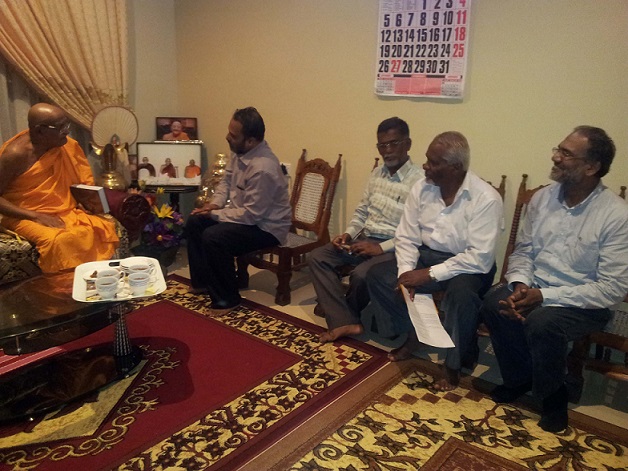
The Sinhala Translation with Arabic Text of the Holy Qur’an being presented to Most Venerable Galagama Sri Aththadassi Mahanayake Thero – Asgiriya Chapter by Ahmadiyya Muslim Jama’at – Sri Lanka. A four member delegation met him at his temple in Kandy yesterday –  29 October 2015. Venerable Thero said, I will read the Qur’an and tell others what Islam says. He also very much pleased to know the Qur;an, translated in Sinhala by the Ahmadiyya Community is in very simple language so that any one could be able to understand well.

During the visit, the Sinhala Translation with Arabic Text of the Holy Qur’an also presented to Most Venerable Tibbatuwawe Sri Siddhartha Sumangala Mahanayake Thero- Malwatta Chapter at his temple in Kandy.

Quran1

This top Buddhist Clergies very respectfully accepted this Holy Book as it is translated in their own language, in a simple manner.

Peace Messages in Sinhala as well as in English were also presented.

Paradise Kashmir cries out for justice

October 30th, 2015

Ameen Izzadeen Courtesy The Daily Mirror

Why is the crisis in Kashmir not on the BBC, CNN, al-Jazeera or other international media? Mind you, the crisis is far from over.  Supporters worldwide marked, this week, the international day of solidarity with the Kashmiris.

Why do some conflicts in the world get all the media attention and some do not?  The answer lies in the media value each conflict carries. The media value of a conflict increases when leaders of powerful countries talk about it or try to intervene to solve it by means of war or peace.  With world leaders now preoccupied with the war in Syria and the refugee crisis in Europe, the other conflicts, including the conflicts in Tibet and Kashmir, have lost their media value. In deference to the influence China and India wield internationally, Western leaders do not even mention Tibet or Kashmir in passing nowadays.

Weeks ahead of Chinese President Xi Jinping’s recent visit to Britain, Prime Minister David Cameron, avoided a meeting with the visiting Dalai Lama, the Tibetan spiritual leader and icon of the independence struggle.  Obviously, Britain feels it stands to lose inby supporting the independence struggle of the Tibetans at the expense of antagoinsing China. This self-centred logic applies to Kashmir.

kashmirgirl2

Kashmiris shout slogans during the funeral procession of a suspected rebel in a village near Srinagar on Tuesday. AFP 

kashmirgirl

Typical Kashmiri girl in 1960 ( From film Kashmiri ki Kali)

United States President Barack Obama during the 2008 presidential campaign vowed to solve the Kashmir crisis. This was to make Pakistan fully involved in the war on terror.  But in the face of strong opposition from India, a huge market for the US and potential military ally, Obama abandoned this policy and, ever since, has not mentioned the ‘K’ word in public. At the recently concluded United Nations General Assembly sessions in New York, no country other than Pakistan and India raised the Kashmir issue.

Pakistan did so because it feels it is its responsibility to free Kashmir from India’s occupation. India raised the issue in response to Pakistan’s speech. The world powers see the Kashmiri people’s suffering as not their problem but a problem to be sorted out between India and Pakistan.  That the world leaders do not show much interest in the 68-year crisis in Kashmir does not mean that the wolf is dwelling with the lamb and the tiger with the kid in the region referred to as paradise on earth. On Monday, two suspected rebels and one Indian army soldier were killed during an encounter.

Regular ceasefire violations along the Line of Control (LOC) have brought the two nuclear-power neighbours to the brink of war on numerous occasions in recent months.    There are three compelling reasons for the Kashmiri issue to be on the international agenda.

First, it is about the people, their suffering, their dignity and their right to self-determination. The Kashmiri people have suffered long since Maharaja Hari Singh ceded the territory to India in 1947 against the wishes of his state’s Muslim majority subjects who longed for a union with Pakistan. South Africa’s visionary leader Nelson Mandela, who inspired freedom fighters around the world by his exemplary life and resilience, recognised the Kashmiri people’s right to self-determination — and that was why he raised the Kashmir issue at the 1998 Non-Aligned Movement (NAM) Summit in Durban, although he knew his remarks would make India unhappy. He told the summit that he believed the Kashmir issue, which remained a concern for all of us,” should be resolved through peaceful negotiations.

Secondly, since both India and Pakistan are nuclear armed countries, the international community must redouble its efforts to help the two countries sort out any contentious issue that could trigger a major war.  Some may argue that the two countries will not go to war because nuclear weapons are a deterrent in preventing a major confrontation. They may point to the self-restraint shown by the two nations since the Kargil war in 1999. But such assumptions offer no guarantee that the two nations would not resort to nuclear warfare.

The threat looms large with extremist ideologies gaining political recognition.  Just as Islamic extremism is a threat to Pakistan’s stability, the Hindutva ideology which the Bharatiya Janatha Party and its allies such as Rashtriya Swayamsevak Sangh (RSS) promote is a threat to India’s stability.  With Prime Minister Narendra Modi concentrating largely on making India economically strong, the values for which India was once hailed as an exemplary nation are being trampled on by RSS bigots. Beef eaters are hacked to death.

In the Kashmir assembly, a Muslim lawmaker was attacked by BJP members because he served beef at a function. Muslims and Christians are increasingly being treated like second class citizens and some RSS ‘unholy’ men even urge their supporters to rape dead Muslim women.  With the RSS given free rein by Modi, India is fast straying away from Gandhi’s India.

South Asian studies expert Jon P. Dorschner writing for the American Diplomacy sees a parallel between Hitler’s Germany and Modi’s India. He says:  The BJP was founded as a Hindu nationalist party by right wing Indians who were great admirers of Adolf Hitler….. Hitler portrayed the Germans as the pure Aryans, and the master race. He blamed Germany’s problems on the Jews. He unleashed storm troopers on the Jews, and any group that opposed his agenda. Modi’s BJP characterizes Hindus as the pure Aryans” and scapegoats Muslims and Christians as outsiders and agents of foreign powers.

As Modi cements his hold on power, the RSS and other Hindu fanatics have increased their attacks on religious minorities and critics of Modi and the BJP agenda.” The rise of Gandhi killers in Modi’s India must be a cause for concern for the international community. Imagine a bigot becoming India’s prime minister and wants to nuke Pakistan. Thirdly, the region as a whole will prosper through free trade among South Asian countries only if India and Pakistan solve the Kashmiri issue peacefully.

Modi sent positive signals for close cooperation with Pakistan when he invited Prime Minister Nawaz Sharif for his inauguration in May 2014. But soon after, the relations between the two countries soured with accusation of ceasefire violations and promotion of terrorism.  It is not too late. Sharif in his UN address offered a peace plan. The ball is now in India’s court.

India cannot cite the Kashmiri people’s participation in assembly elections as an endorsement by them of India’s sovereignty. On the contrary, the heavily militarised region is still under the Armed Forces Special Powers Act that allows the security forces to act with impunity. Besides, the region is still a no-go zone for the international media and human rights activists. All this shows that Kashmir is a troubled region. India should not fight shy of holding a UN-recommended plebiscite in Kashmir to decide the fate of the region.

– See more at: http://www.dailymirror.lk/93227/paradise-kashmir-cries-out-for-justice#sthash.8GcHsmjb.dpuf

For a better future

October 30th, 2015

Afira Faleel Canada Courtesy Island


The idea of a French Hindu or a Canadian Sinhalese sounds so out of the ordinary. It is absurd to even think for a moment that any member of these nations would be identified as anything other than their nationality. That is, they are either French or Canadian.

So, why is it true for our country that identifying someone as a Sri Lankan Tamil, or a Sri Lankan Muslim, is so commonplace? Certainly, it cannot be the case that the prevalence of these religions in other countries makes it necessary for an individual living in our country who has openly declared their faith to be so identified? If this were the case, then no Indian would be just an Indian and no Singaporean would be just a Singaporean!

article_image

The association of a person’s national identity with their faith is uncalled for. Labelling people based on their faith is only another way to create division and unrest in the country.

Foreign invaders made it a point to prevent us being united. They used our differences to turn us against each other while pretending to be superior to us. No developed country identifies its citizens by their religious faiths. The nations that focus on the religious faith of their citizens are the least economically developed, and least socially recognized in the world today.

Groups of people are unreasonably made accountable for the actions of others who have similar religious beliefs.

The long held belief that Sri Lankan citizens practising certain religions have roots in other countries, and as such, that they are not real Sri Lankans, is one that is preposterous to say the least.

Surely, an entire nation of people belonging to a certain religion did not simply pack up and move altogether with their fathers and forefathers and settled in our country.

Then how can the existence of different religions in our country be explained? Quite simply, small groups of people belonging to the different faiths came to Sri Lanka to spread what they believed in. Those beliefs were then accepted by some people who lived in this country.

The people who belong to the different religions are the descendants of those Sri Lankans. They do not belong to any other country.

When the label of religious belief is removed from the Sri Lankan identity, there will be unity.

A united Sri Lanka free of division between its people has nothing holding it back from becoming a great nation. It is time we realized our potential as a people. The first step is for every woman, every man, and every child of this country to relearn our identity. We are Sri Lankans, and we are all Sri Lankans.!

Afira Faleel

Canada


UN engagement in post-conflict Sri Lanka

October 30th, 2015

By Neville Ladduwahetty  Courtesy Island

With the co-sponsoring by Sri Lanka of the UNHRC Resolution “Promoting reconciliation, accountability and human rights in Sri Lanka” dated September 29, 2015, a chapter has come to a close. This closure marks the beginnings of a new chapter which is the implementation of the undertakings in the resolution. It is being speculated whether Sri Lanka is obligated to implement the provisions strictly as stated in the resolution on grounds of being a co-sponsor or whether there is room for flexibility in its implementation.

article_image

For instance, Paragraph 4 of

the Resolution states:

“Welcomes…the proposal by the Government to establish a commission for truth, justice, reconciliation and non-recurrence, an office of missing persons and an office for reparations, further welcomes the willingness of the Government to give such mechanisms the freedom to obtain financial, material and technical assistance from international partners, including the Office of the High Commissioner…”.

Similarly Paragraph 6 states:

“…the recognition by the Government of Sri Lanka that accountability is essential…notes with appreciation the proposal of the Government of Sri Lanka to establish a judicial mechanism with a special counsel to investigate allegations of violations and abuses of human rights and violations of international humanitarian law, as applicable; affirms that a credible justice process should include independent judicial and prosecutorial institutions led by individuals known for their integrity and impartiality; and also affirm in this regard the importance of participation in a Sri Lankan judicial mechanism, including the special counsel’s office, of Commonwealth and other foreign judges, defence lawyers and authorized prosecutors and investigators”.

Several other paragraphs in the Resolution require the government of Sri Lanka to address issues that have a bearing on the national security and internal affairs of a sovereign State. If the UNHRC is of the view that issues relating to human rights entitle them to intervene in internal affairs of a State, the UN should start by securing a mandate from all member States to revise Article 2 Clause 7 of the UN Charter. This article clearly does NOT authorise the UN or its Agencies “…to intervene in matters which are essentially within the domestic jurisdiction of any state…”. Therefore, the UN has to first secure a mandate from the General Assembly in order to intervene, prior to claiming jurisdictions over matters it currently does not have.

COMMENT on PARAGRAPHS 4 and 6.

For instance, “…the freedom to obtain financial, material and technical assistance from international partners, including the Office of the High Commissioner…” (para. 4) for the functioning of a commission for truth, justice, reconciliation and non-recurrence may or may not impact on the Constitution depending on the manner it is organized. If organized to meet the degree of freedom envisaged by the OHCHR, it could entail a revision to the Constitution. On the other hand, if organized within the framework of the Constitution, it may not meet the degree of freedom sought by OHCHR. Therefore, there is a need for the Government to bring to the attention of the OHCHR the stakes involved. Professors & Politicians Gather To Warn Us About The New World Order (NWO)

Similarly, paragraph 6 that addresses accountability has 3 components. (1) A mechanism with a special counsel to investigate; (2) A credible judicial process that SHOULD (emphasis added) include “independent judicial and prosecutorial institutions” ; (3) The PARTICIPATION (emphasis added) in a Sri Lankan judicial mechanism including Commonwealth and other foreign judges, defence lawyers, prosecutors and investigators. Fulfilling the degree of foreign involvement cited above in the accountability processes that include prosecution would mean revising the Constitution. Furthermore, amending the Constitution to accommodate the provisions envisaged in paragraph 6, in particular the provision to involve foreign judges and prosecutors would set in place a separate judicial system for those associated with the armed conflict concurrently with existing judicial systems. This would violate Article 12 that states: “All persons are equal before the law and are entitled to the protection of the law”. Therefore, the only realistic option is to limit the judicial process to investigation and inquiry under the Commission of Inquiry Act with foreign participation in advisory capacity ONLY to establish a prima facie case that could be tried under existing domestic judicial systems for any crimes committed.

Since the government is committed to operate within the Constitution the engagement of any foreign personnel must necessarily be in an advisory capacity, and without legal status in the accountability processes. Such an approach is offered as a valid option in paragraph 617 of the Paranagama Commission report. This paragraph states: “In the event Sri Lanka were to set up a purely domestic tribunal without the participation of any foreign judges, it is the view of this Commission that there should be international technical assistance and observers”. Therefore, the Government should endeavour to come to an understanding with the OHCHR regarding the need for flexibility if revisions to the Constitution are to be avoided.

Whoever sanctioned co-sponsoring the Resolution should have been aware of the implications involved in fulfilling most of the provisions in the Resolution. The fact that the government went ahead and co-sponsored the Resolution must mean that it was confident that the OHCHR would be sufficiently flexible to permit Sri Lanka to fulfil the provisions in the Resolution within the framework of the existing Constitution. If such an understanding does not exist, the government is obligated to live by the full scope in the Resolution. This would mean amending the Constitution and subjecting the country to the serious consequences that would follow. Since amendments to the Constitution would involve a 2/3 majority in Parliament and a referendum, the government should persuade the OHCHR to cooperate by being flexible in order to avoid complexities that inevitably are associated with amending the Constitution.

GROUNDS for COPERATION

The process of accountability started with the joint statement signed between the Secretary General of the UN and the former President Mahinda Rajapaksa on May 23, 2009 that stated: “The Secretary-General underlined the importance of an accountability process for addressing violations of international humanitarian and human rights law.  The Government will take measures to address those grievances”. In keeping with this commitment Sri Lanka set up the Lessons Learnt and Reconciliation Commission (LLRC) on May 15, 2010. Five weeks later, UNSG engaged a Panel of Experts (PoE) on June 22, 2010 led by Marzuki Darusman to address issues of accountability in complete disregard to the initiative taken by Sri Lanka as if the Sri Lankan initiative did not exist thereby trivializing the efforts of the government.


Although the report by the PoE was meant to be an internal document for use only by the UNSG under the rules of the General Assembly, it was made available to the public on March 31, 2011. Although the LLRC report was still in the making, the PoE report stated as long as 8 months before the LLRC report was published (November 15, 2011), that: “In sum, the LLRC is deeply flawed, does not meet international standards for an effective accountability mechanism and, therefore, does not and cannot satisfy the joint commitment of the President of Sri Lanka and the Secretary-General to an accountability process” (p. v. Executive Summary). Such prescience reflects a patently evident prejudice against the domestic process. This conduct is a disgrace to the UN as an institution.

On July 14, 2014 the Paranagama Commission’s mandate was expanded (2nd mandate) to look into allegations of war crimes and other violations of international law committed during the conflict. The report covering the 2nd mandate was completed on August 15, 2015.

Paragraph 10 of the Human Rights Council’s Resolution on Sri Lanka specifically states: “…the need for an international inquiry mechanism in the ABSENCE (emphasis added) of a credible national process…”. Therefore, since a national process was under way the OHCHR should NOT have initiated a process of its own. Despite this stipulation, the OHCHR set up “a special investigating team within the OHCHR in Geneva… (and) its core seven-member staff became fully operational by mid-August” – 1 month AFTER the national process in Sri Lanka took effect. This was a violation of the OHCHR’s own commitment. Such conduct disgraces the Human Rights Council as an institution.

It is evident from the foregoing that on two occasions, the first with regard to the LLRC and the second with regard to the Paranagama Commission, the UN and its Agency initiated actions as if Sri Lanka’s national processes did not exist when in fact they were to do so ONLY IN THE ABSENCE of such national processes. The measures resorted to by the UN and its agency the OHCHR violate concepts that are required to guide the work of the Council such as “impartiality, objectivity and non-selectivity, and cooperation with a view to enhancing the promotion and protection of human rights” that the OHCHR is expected to exercise as per paragraph 4 of the General Assembly Resolution that set up the Human Rights Council in 2006. While these indiscretions are a slur on the institutions represented by the UN Secretary General and the OHCHR, one cannot ignore the fact they also reflect a degree of their disingenuousness that should be a matter of deep concern for all member States regarding the manner in which the UN and its Agencies are being manipulated.

ACCOUNTABILITY MECHANISMS

While paragraph 4 recommends addressing accountability issues through “a commission for truth, justice, reconciliation and non-recurrence” the focus of paragraph 6 is on investigations, justice through prosecutorial process and a Sri Lankan judicial mechanism together with the participation of foreign experts. The proposal of the OHCHR with emphasis on prosecution is influenced by the views expressed in the Darusman report because its main thrust is to investigate and prosecute (Paranagama report, para. 563). On the other hand, there is a substantial body of State practices and international opinions that do not assign such weight to prosecution over other mechanisms. For instance, Article 6.5 of Additional Protocol II states: “At the end of hostilities, the authorities in power shall endeavour to grant the broadest possible amnesty to persons who have participated in the armed conflict, or those deprived of their liberty for reasons related to the armed conflict, whether they were interned or detained”. Therefore, the focus should be on investigations to seek the truth, and not for the purpose of prosecutions. Furthermore, the report adds: “Similarly recognized is that the duty to prosecute in all circumstances has not yet crystallized as an international norm or become part of customary international law…” (Ibid, para. 576).

Para. 604 of the Paranagama report states: “The course that has been embarked upon by the GoSL has placed proper emphasis on the need for investigation and the establishment of the truth, as well as accountability for those responsible for the commission of any serious violations of international law. This is entirely in accordance with international standards, as explored above, for transnational justice”.

Para. 606 of the Paranagama report states: “The mandate of the Paranagama Commission of Inquiry is rooted in the victims of the protracted conflict knowing the truth as well as being able to be part of a stable society, free of conflict, in which reconstruction and reconciliation are priorities”. In view of the opinions expressed above, the Government of Sri Lanka should formulate a domestic judicial mechanism with clear guidelines and objectives based on the fundamentals of seeking the truth through comprehensive investigations with the objective of granting “the broadest possible amnesty to persons who have participated in the armed conflict” as stated in Article 6.5 in Additional Protocol II. A fact that is not sufficiently recognized and duly acknowledged is that such an approach was adopted and implemented by the former administration when they rehabilitated hundreds of Tamil child soldiers and thousands of their combatants who participated in the armed conflict. The tendency to ignore the positive and highlight the negative has characterized the actions of the OHCHR.

CONCLUSION

The engagement of the UN in post-conflict Sri Lanka has been troubling. It started with the UNSecretary General appointing the Panel of Experts headed by Marzuki Darusman as if the functioning LLRC did not exist. Next was the OHCHR investigation with no regard to the existence of the Paranagama Commission already functioning under the 2nd mandate despite the commitment in the 2014 OHCHR Resolution that it would initiate an investigation ONLY IN THE ABSENCE of a national process. By doing so, the OHCHR has compromised the credibility of the 47 member Human Rights Council. In fact if the Council is aware of the background to the resolution, it would invalidate the report of the OISL for the sake of its own honour and credibility. The fact that the Sri Lankan Governments have failed to bring these matters to the attention of the Council and sought relief has enabled the OHCHR to exploit a situation in violation of its own commitments.

The thinking in Sri Lanka is that bringing such matters that amount to bullying, to the attention of Agencies such as the UN might amount to non-cooperation. Consequently the tendency is to accept whatever is dished out. What happened in Geneva is a perfect example of this attitude. Therefore, even at this late stage, if Sri Lanka is to reclaim its dignity despite the fact that the Government has co-sponsored the resolution, every effort should be made to seek as much relief as possible from the constraints imposed on Sri Lanka so that Sri Lanka is in a position to fashion its own accountability mechanisms with a view to fostering reconciliation for the sake of a sustainable peace.

මව්බිම බේරගන්න විදෙස් ඇමැතිතුමා ඇයි ඇත්ත කිව්වේ නැත්තේ? – දිනේෂ් ගුණවර්ධන

October 29th, 2015

“Why didnt the Foreign Minister tell the truth to defend Our Motherland ?” – Hon Dinesh Gunawardena

“ඇයි මව්බිම බේරගන්න විදෙස් ඇමැතිතුමා ඇත්ත කිව්වේ නැත්තේ ?” – ගරු දිනේෂ් ගුණවර්ධන මැතිතුමා
“Why didnt the Foreign Minister tell the truth to defend Our Motherland ?” – Hon Dinesh Gunawardena

40000ක් සමූලඝාතන කථාව බොරු කිරීමට සාක්ෂි සහිතව පරණගම වාර්තාවට සහ ශ්‍රීමත් ඩෙස්මන් ද සිල්වා වාර්තාවට හැකිවී ඇත
both Paranagama report & Sir Desmond de Silvas report have
strong evidence in disproving the myth of 40000 annihilation

පැහැදිලිවම දෙමුහුන් අධීකරණයකට එකඟ වෙලා තිබෙනවා
very clearly have agreed to a Hybrid court

යස්මින් සූකා සහ සහ ටී.එන්.ඒ. යූරෝපීය හවුලේ මුදල් එකතුව තවත් වාර්තාවක් ලංකාවට විරුද්දව හදලා තියෙන කොට ඔවුන් ස්වාධීනයි කියන්නේ කොහොමද?
Yasmin Sooka & TNA were spondored by EU money to produce yet another report against Sri Lanka, how can they be independent & impartial?

ජිනීවා ප්‍රඥ්ඥප්තිය අනුව පැහැදිලිවම රටක ස්වෛරීභාවය භෞමික අඛණ්ඩතාවය ජාතික ඒකාග්‍රතාවය සුරැකීමට සම්පූර්ණ අයිතිය රාජ්‍ය සතුයි
Nothing in this Protocol shall be invoked for the purpose of affecting the Sovereignty of a State or the responsibility of the government or to defend national unity and territorial integrity of the State.

හමුදාව මුලින්ම යැව්වේ ජේ.ආර්. ජයවර්ධන ඉන්පසුව ආර්. ප්‍රේමදාස ඩී.බී. විජේතුංග චන්ද්‍රිකා කුමාරණතුංග හමුදාව යැව්වා, මහින්ද රාජපක්ෂ ජයග්‍රහණය උදාකළා
Forces were first sent by JR Jayawardena, then R. Premadasa DB Wijetunga Chandrika Kumaranatunga, and Mahinda Rajapaksha ushered in victory

වෙනම රටක් කඩාගන්න ජාත්‍යන්තර නීතිය අනුව ක්‍රමාන්විත රාජ්‍ය මැදිහත්
වීමකින් සමූලඝාතන සිදුකරන බව ඔප්පුකරන්න බොරු චෝදනා සකසනවා
Genocide & System Crimes accusations are fabricted to satisfy international laws to carveout a separate state

අපිට ඇයි ජාතිවාදී කියන්නේ? දේශීය පරික්ෂණයක් කරන්න. අපේ නීතිය
අනුව ව්‍යවස්ථාවට අනුකූලව අපේ අධිකරණය තුල ඕන පරික්ෂණයක් කරන්න
Why are we called extremists? We are not against a local inquiry.
Inquire Constitutionally, within our leagl & justice system

නමුත් අපේ හමුදාවේ නිදොස් බව හොඳින් ඔප්පු කිරීමට පරණගම
ඩෙස්මන්ඩ් ද සිල්වා වාර්තා වලට හැකිවී තිබෙනවා
Paranagama & Desomnd de Silva reports have clearly exposed
false allegations against our forces

මෙවරත් රුසියාව චීනය පකිස්ථානය ඉන්දියාව වියට්නාමය කියුබාව දිගින් දිගටම ලංකාවේ ස්වෛරී නිදහස හා නොබැඳී පිළිවෙත සුරැකීමට උත්සහ කලා
Russia China Pakistan India Vietnam Cuba continued to help Sri Lanka protect its sovereignty and Non Aligned policy

ඉතිහාසයේ මුල්වරට ජිනීවා සමුළුව එහි මානව හිමිකම් සීමාවන් ඉක්මවා
ගොස් ඇතිබව මානව හිමිකම් කුමාරයාම පිළිගනී !!!
Prince himself admits that UNHRC has gone beyond its mandate
on human rights and into humanitarian aspects!!!

ජිනීවා ගිවිසුම පිළිබඳව ශ්‍රී ලංකා පාර්ලිමේන්තුවේදී
on Geneva Agreement at Sri Lanka Parliament

මේ මෙරට බිහිසුණුම –දුර්දාන්තම ආණ්ඩුවයි – නීතිඥ කල්‍යාණන්ද තිරාණගම

October 29th, 2015

සටහන : දර්ශන යූ මල්ලිකගේ යුතුකම සංවාද කවය

සැබෑ විපක්ෂයේ හඬ නිහඬ කරමින් , ආන්ඩුක්‍රම ව්‍යවස්ථාව උල්ලංඝණය කරමින් ,විරුද්ධ මතධාරීන් මර්ධනය කරමින් ,රට අධිරාජ්‍යවාදයට පාවාදෙමින් මේ තිබෙන්නේ ඉතිහායස පුරාම මෙරට පැවති බිහිසුණුම ,දුර්දාන්තම ,ද්‍රෝහීම ආණ්ඩුව බවනීතිඥ  කල්‍යාණන්ද තිරාණගම මහතා පෙන්වා දෙයි.

ඒ නිසා බය නොවී මේවාට මුහුණ දෙමු.මේ රට බේරා ගැනීමට වැඩ කරමු කියන කාරණයයි මම ඔබට කිව යුත්තේ.

පසුගියදා ජාතික පුස්තකාල ශ්‍රවණාගාරයේදී යුතුකම සංවාද කවය සංවිධානය කළ බිල්ලො ඇවිත් සම්මන්ත්‍රණයේ විශේෂ දේශනයක් පවත්වමින් ඔහු මේ බව අවධාරණය කළේය.

එහිදී වැඩිදුරටත් අදහස් දැක්වූ කල්‍යාණන්ද තිරාණගම මහතා:

මේ ආණ්ඩුව මේ රටේ පහල වුණු බිහිසුණුම ආණ්ඩුව. මොකද ආණ්ඩුවක් කරන්න ඕනෑ පළවෙනි දේ තමයි ආණ්ඩුක්‍රම ව්‍යවස්ථාවට ගරු කිරීම.මේ ආණ්ඩුව පටන් ගත්තෙම ආණ්ඩුක්‍රම ව්‍යවස්ථාව උල්ලංඝණය කරලා.දිගින් දිගටම මේ ආණ්ඩුව ආණ්ඩුක්‍රම ව්‍යවස්ථාව උල්ලංඝණය කරමින් සිටිනවා.ජනාධිපතිවරයා දිවුරුම් දීපු අවස්ථාවේ ඉඳලම ආණ්ඩුක්‍රම ව්‍යවස්ථාව උල්ලංඝණය කරනවා.ඒ වගේම පාර්ලිමේන්තුව නිහඬ කරන්නට උත්සාහ ගන්නවා,පාර්ලිමේන්තු මන්ත්‍රීවරුන්ට කතාකරන්න දෙන්නේ නෑ.පාර්ලිමේන්තු බලතල උදුරගන්න උත්සාහ කරනවා. මේ සියල්ල කරන්නේ ඇයි?

එසේම තව දෙයක් කිව යුතුයි , මේ කතාකරපු ප්‍රජාතන්ත්‍රවාදය, යහපාලනය, දූශණය පිටු දැකීම කියන එකක්වත් මේ ආණ්ඩුව තුල නෑ.

මම මේ කියන කාරණා සනාත කරන්න පුලුවන් කරුණු මගෙ ලඟ තියෙනවා, නිසා මට කියන්න පුලුවන් බයක් සැකක් නැතුව. පොඩි උදාහරණයක් අරන් බලන්න,නීතිය පාවිච්චි කරනවා දේශපාලන පළිගැනීම උදෙසා ආණ්ඩුවේ නායකත්වයට එරෙහිව කතාකරන සහ කරුණු දක්වන අය නිහඬ කිරීමට.

පොඩ්ඩක් ඔබ කල්පනා කරල බලන්න ජනක බණ්ඩාර තෙන්නකෝන් මහත්මයා රිමාන්ඩ් කිරීමේ සිද්ධිය. ඔහුව රිමාන්ඩ් කරේ මොකටද? 1999 වසරේ වෙච්ච වරදක් නිසාලු. 1999 වසරේ වරදක් උනානම්, එහෙම මිනී මැරුමක් උනා නම්, 2001 සිට 2004 වසර දක්වා එක්සත් ජාතික පක්ශ ආණ්ඩුවක් තිබුනා.ඒ එක්සත් ජාතික පක්ශ ආණ්ඩුව මේ ගැන කටයුතු කලේ නෑ. කරන්න බැරි නිසාද?

එහෙනම් මොකද්ද මේ කරේ?ජනාධිපති මෛත්‍රීපාල සිරිසේන මහතා ශ්‍රී ලංකා නිදහස් පක්ශයේ බලතල උදුරගන්නකොට ඊට විරුද්ධව කතාකරපු මිනිහා තමයි ජනක බණ්ඩාර තෙන්නකෝන්. ඔහුගෙන් පලිගැනීම සඳහා කරන වැඩයි මේ. මේවා රටක සිදු නොවිය යුතු දේවල්.මේකෙන් පේනවා කොහෙටද මේ රට ගෙනියන්න හදන්නේ කියලා. සියලු විරුද්ධවාදීන්ගේ කට වහලා බලහත්කාරයෙන් මේ රට විජාතික කරණය කිරීමේ වැඩ පිලිවෙල තමයි මේ ක්‍රියාත්මක කරන්නේ.මේ ක්‍රමය දිගටම පැවතුනොත්, මට තේරෙන විදියට 2020 වෙනවිට ශ්‍රී ලංකාද්විපය කියන එක ඉතුරුවෙන එකක් නෑ.

එකක් ,ඉන්දියාවත් සමග ඔය කියන පාලම සහ උමග හැදුවොත්,මේ රට තව දුරටත් ද්වීපයක් වෙන්නෙ නෑ, එතකොට ද්වීපය ඉවරයි. ඉතිහාසයේ මුලුල්ලේම පැවතිලා අපේ රටේ අනන්‍යතාව ආරක්ශා උනේ පෝක් සමුද්‍ර සන්ධිය නිසා.ඒක නැති කරල මේ රටවල් දෙක එකතු කරන්න හදනකොට,ඉන්දියාවේ ඊලඟ ප්‍රාන්ත රාජ්‍ය ශ්‍රී ලංකාව වීම වලක්වන්න බෑ. ඒ විතරක් නෙවෙයි, ඒත් සමගම මේ රට තව කෑලි තුනකට හතරකට කැඩීම වලක්වන්න බෑ ,පැහැදිලියි ඔය ජිනීවා යෝජනා වල ඉලක්කයත් ඒක.ආණ්ඩුව සමග හවුල් වෙලා ඉන්න බොහෝ දේශපාලන බලවේග වල ඉලක්කයත් ඒක.

එතකොට තවදුරටත් මේ ශ්‍රී ලංකාද්වීපය ඒකීය රටක් වශයෙන් පවතිනෙ නෑ, ඒ විතරක් නෙවෙයි තව බොහෝ දේ අහිමි වෙනව අපිට.ඔබ දන්නවාදැයි මම දන්නෙ නෑ, 2002 දී රනිල් වික්‍රමසිංහ මහත්තයගෙ ආණ්ඩුව නීතියක් ගෙනාවා ලංකාවේ ජල සම්පත විකුනලා දාන්න. ඒ වෙලාවෙදි මම ශ්‍රේෂ්ඨාධිකරණයට ගියා ඒ පනතට විරුද්ධව. ඒකෙදි කොළඹ තියෙන IWMI ( International Water Management Institute ) කියන ආයතනය වාර්ථාවක් ඉදිරිපත් කලා.ඒ ආයතනය එකදහස් නවසිය අනූ ගනන් වල ඇමරිකාවෙ පිහිටවපු එකක්. මොකද්ද ඒ වාර්ථාවෙන් කියන්නෙ, වසර 2020 වෙනකොට ආසියාවේම බීමට සුදුසු පිරිසිදු ජලය ඉතිරිවෙන්නෙ ලංකාවේ පමණයි.

එතකොට ජල සම්පත තෙල් වලට වඩා වටින දෙයක් වෙනවා.ඒ වටිනාකම කලින්ම දැකලා මොවුන් ඒ සඳහා පර්යේශණ කිරීමේ මධ්‍යස්ථානයක් ලංකාවේ පිහිටෙවුවා. ඒ මධ්‍යස්ථානය මගින් සැලැස්මවල් හදලා ඒ සම්පත කොල්ලකෑම සඳහා කල් ඇතුවම ලෑස්ති උනා.

ඒ වගේමයි අපේ ජෛව සම්පත කොල්ලකෑමට ලෑස්තිවීම.සිංහරාජ වනය කියන්නෙ ලෝකෙටම වටින ජෛව සම්පත අතින් අනූන වනාන්තරයක්.2003වසරෙදි රනිල් වික්‍රමසිංහ මහත්තයගෙ ආණ්ඩුව කාලෙ සිංහරාජෙ ඇතුලෙ සියලුම ලඳු කැලෑ තිස් අවුරුද්දකට ඇමරිකාවට බදු දීමට වැඩපිලිවෙලක් ලක ලෑස්ති උනා.ඒක කරන්න ලැබුනේ නෑ රටේ ජනතාවගෙන් එල්ල වුනු විරෝධය නිසාත් 2004වසරේදී ආණ්ඩුව පෙරලුනු නිසාත්.

අන්න ඒ වගේ මේ රටේ පැවැත්මට ඉතාම භයානක විදියට බලපාන දේවල් සිදුවේගන යනවා මේ ආණ්ඩු කාලය තුලත්.

ඒ නිසා මේ ආණ්ඩුව ගෙනයන මේ වැඩපිලිවෙල පරාජය කිරීමට කටයුතු කිරීම මේ රටේ සකල දේශප්‍රේමී ජනතාවගේ යුතුක්මක්,වගකීමක්.ඇත්තවශයෙන්ම ඒ සම්බන්දයෙන් කරන්න බොහෝ දේවල් තියෙනවා.තියෙන කනගාටුවට කාරණය වන්නේ ඒ සම්බන්දයෙන් යමක් කල යුතු ,කල හැකි පිරිස් එ සම්බන්දයෙන් කිසිවක් නොකර සිටීම.

උදාහරණයක් වශයෙන් ගත්තොත් , අර අල්ලස් කොමිසම ඉදිරිපිට උද්ඝෝෂනයක් කලා කියල අපේ ස්වාමීන් වහන්සේලා 14 නමකුත්, තවත් මංත්‍රීවරු ඇතුලු පිරිසකුත් අත් අඩංගුවට ගත්තා.ඇත්ත වශයෙන්ම මේක පොලීසිය කරපු අත්තනෝමතික ක්‍රියාවක්, පොලිසියට එහෙම කරන්න බෑ.මම ඒ අවස්ථාවේ එතන හිටපු නාමල් වගේ මංත්‍රී වරුන්ගෙන් ඇහුව ඇයි ඔයගොල්ලෝ මේවට නිහඬව ඉන්නේ, මේ පොලීසියෙ ඔ අයි සී ට විරුද්ධව දාන්න මූලික අයිතිවාසිකම් නඩුවක්,මොකද එක තැනක පෙලපාලි තියන්න දෙනවා, තව තැනක වලක්වනවා උසාවි නියෝග අරගෙන. නීතිය භුක්ති විඳීමේ සමාන අයිතිවාසිකම කඩ වෙනවා එතන.

එහෙම කරන්න ඉඩ දෙන්න බෑ.මේක වලක්වන්න තිබුනා.ඒ විතරක් නෙවේ, මෛත්‍රීපාල සිරිසේන මහත්තයා ශ්‍රීලංකා නිදහස් පක්ශයේ මධ්‍යම කාරක සභාව රැස් වෙන එක වලක්වලා උසාවි නියෝගයක් ගත්තා,ඊට පසුවෙනිදම උසාවි ගිහින් ඒකට උත්තර බඳින්න තිබුනා, ඒව කරේ නෑ. පක්ශෙ ලේකම් එලියට දානකොට ඒකට විරුද්ධව කටයුතු කලේ නෑ.ඒ වගේ කලයුතු දේවල් වෙලාවට කලානම් මේ ගොඩක් දේවල් වලක්වගන්න තිබුනා.තියෙන අවාසනාව තමයි දේශපාලනයට සම්බන්ද නීතීඤ්ඥයන් ඉන්නවා, ඔවුන්ට මේවායේ පෙරමුණ ගන්න තිබුනා, මේවා වලක්වගන්න තිබුනා,. අපේ උසාවි වල තවමත් සෑහෙන ස්වාධීනත්වයක් තිබෙනවා.ඒවා පාවිච්චි කරන්න තිබුනා, මොකද එක පොලිස් නිලධාරියෙක් අත්තනෝමතික විදියට වැරදි දෙයක් කලානම්, ඒකට පියවර ගත්තනම්, ඊළඟ නිලධාරියා ඒ වගේ දෙයක් කරන්න කලින් දෙපාරක් හිතනවා.

ඒ නිසා මට කියන්න උවමනා, මේවට බය වෙන්න අවශ්‍ය නෑ. නඩු දානවා කියල බය කරාට බය වෙන්න ඕනෙ නෑ.නඩු දානවනම් ඕන තරම් නඩු දාන්න පුලුවන්.නඩුව ගෙනියන්න පුලුවන් ඊළඟ ආන්ඩුව වෙනස් වෙනකම්.මොකද ලංකාවෙ නඩු අහන පිළිවෙලට අවුරුදු දහයක් පහලවක් යනවා නඩුව අහලා ඉවර වෙන්න,එතකොට රටේ පාලන තන්ත්‍රය වෙනස්වීමත් එක්ක නඩු දාපු මිනිස්සුන්ටත් විරුද්ධව නඩු දාන්නට කාරණා එකතුවෙලා තියේවි.

ඒ නිසා බය නොවී මේවාට මුහුණ දෙමු.මේ රට බේරා ගැනීමට වැඩ කරමු කියන කාරණයයි මම ඔබට කිව යුත්තේ.


සටහන : දර්ශන යූ මල්ලිකගේ

යුතුකම සංවාද කවය

https://www.lankaleadnews.com/speech

Chicken nuggets are tasty but do you know what’s in them?

October 29th, 2015

Dr Hector Perera       London

I cannot believe if anyone said that they haven’t eaten any takeaways. In the past in Sri Lanka there were hardly any such places even in small towns but now, they are all over. Now you just pick up a phone to get the takeaways delivered to your doorstep, if you find too busy to get a takeaway. One can view the list of the menu on the internet so the technology has changed the ways to shop. When we go out shopping quite often we tend to eat out from takeaways. The list of things to eat are plenty but fish and chips, fried chicken and chips, burgers and chips then chicken nuggets are some of the favourites. I am not in favour to eat chicken nuggets because I read somewhere what they can include in them that put me off eating chicken nuggets. The list of chemicals and additives added in making chicken nuggets put me off eating them. I am not sure if they use all of these chemicals and additives but very likely to use most of them in making chicken nuggets.

What are in the chicken nuggets?

Some of the things that might include in them are white Boneless Chicken, water, food Starch-Modified, salt, seasoning (Autolyzed Yeast Extract, salt, wheat starch, natural flavouring [Botanical Source], safflower oil, dextrose, citric acid), sodium phosphates, natural flavour (Botanical Source). battered and breaded with: water, enriched flour (Bleached Wheat Flour, niacin, reduced Iron, thiamine mononitrate, riboflavin, folic acid), yellow corn flour, bleached wheat flour, food starch-modified, leavening (Baking Soda, sodium acid pyrophosphate, sodium aluminium phosphate, monocalcium phosphate, calcium lactate), spices, wheat starch, dextrose, corn and starch.

Then Meat glue” is used to hold chicken nuggets together. A chemical called Transglutaminase, referred to by some as meat glue,” is an enzyme sold for almost two decades that is used mostly in food service to bind pieces of meat together, such as a beef tenderloin or a strip of bacon to a filet.  It is not used to make chicken nuggets.  It is unnecessary – protein is extracted with salt and phosphate, then breast or thigh meat is ground or chopped and then easily formed into a nugget shape. The breading helps hold the nugget together, as well.

Some people believed that Retired Egg Layers” are used to make chicken nuggets but they are not used for making chicken nuggets. Cage layers possess little meat and many of them are not processed for meat at all.  The birds that produce the eggs that become broilers (which are not kept in cages and do not produce eggs for the table) usually become stewing hens” or go into soup or other products that involve long cooking.

Some leading takeaway chain shops use Autolyzed yeast extract (which contain free glutamate, similar to MSG or Ajina Motto), Sodium phosphates and Sodium aluminium phosphate.

But that’s not the freaky part. According to one leading website, some chicken nuggets are also made with: “hydrogenated soybean oil with TBHQ and citric acid added to preserve freshness” and “Dimethylpolysiloxane added as an antifoaming agent.”

At least two of these ingredients are artificially synthesized industrial chemicals. TBHQ, a petroleum derivative, is used as a stabilizer in perfumes, resins, varnishes and oil field chemicals. An aromatic organic compound, is TBHQ or tert-Butylhydroquinone or tertiary butylhydroquinone is a type of phenol. Chemically TBHQ is a derivative of hydroquinone, substituted by the tert-butyl group. Laboratory studies have linked TBHQ to stomach tumours. “At higher doses, it has negative health effects on lab animals, such as producing precursors to stomach tumours and damage to DNA. A number of studies have shown that prolonged exposure Dimethylpolysiloxane, a type of silicone, is used in caulks and sealants, as a filler for breast implants, and as key ingredient in Silly Putty, says Wikipedia. Would you like a some chicken nuggets? I have my doubt if anyone said, Yes please”.
Polydimethylsiloxane (PDMS) belongs to a group of polymeric organosilicon compounds that are commonly referred to as silicones. PDMS is the most widely used silicon-based organic polymer, and is particularly known for its unusual rheological (or flow) properties. PDMS is optically clear, and, in general, inert, non-toxic, and non-flammable. It is also called dimethicone and is one of several types of silicone oil (polymerizedsiloxane). Its applications range from contact lenses and medical devices to elastomers; it is also present in shampoos (as dimethicone makes hair shiny and slippery), food (antifoaming agent), caulkinglubricantskinetic sand , and heat-resistant tiles. This chemical called “PDMS is also used as a component in silicone grease and other silicone based lubricants, as well as in defoaming agents, mould release agents, damping fluids, heat transfer fluids, polishes, cosmetics, hair conditioners and other applications. PDMS has also been used as a filler fluid in breast implants, although this practice has decreased somewhat, due to safety concerns. PDMS is used variously in the cosmetic and consumer product industry as well. For example, PDMS can be used in the treatment of head lice.” Back in Sri Lanka, I have noticed some ladies use coconut oil then comb the hair to get rid of head lice or Thadi”.

Not that the other ingredients are any better. Because cotton is not regulated as a food crop, cottonseed oil may contain chemical pesticides that are banned in food production. It is also almost always genetically modified. Hydrogenated oils, of course, typically contain trans fats, the artificially produced fats that are unusable by the body and that studies have linked to a number of detrimental health problems. And autolyzed yeast extract is a chemical taste-enhancing ingredient containing free glutamate that manufacturers use as a friendlier-looking replacement for MSG.

And what about the chicken in some leading farms to used in making chicken nuggets? It’s factory-farmed chicken, not free-range chicken. So it’s the kind of chicken that’s typically treated with vaccines and hormones while being fed conventional feed products that are medicated with pharmaceuticals and grown with pesticides.

Yum!! Don’t forget to ask for extra dipping sauce with chicken nuggets. We haven’t even talked about what you’ll find in there.

We’ve known for a long time that fast food chicken nuggets aren’t healthy, but new research is showing just what these fast food favorites are really made of, and it includes high amounts of partially hydrogenated oils, GMO oils or genetically modified oils. There are plenty of chemicals such as sodium, other” ingredients and numerous chemicals.

A recent study published in the American Journal of Medicine has found that 60% of the meat” in a chicken nugget is actually fat, blood vessels, ground bone and gristle. If you consider that only 50% of the nugget itself is made up of chicken that means that only 20% of a chicken nugget is actually meat so what makes up the other 80%?  You’re about to find out.

What’s Really In a Chicken Nugget?

According to the ingredients listed on a leading website they also put these suspect ingredients into their chicken nugget mix:

TBHQ

Autolyzed Yeast Extract (often contains MSG)

GMO Corn

Dimethyl Polysiloxane Anti-foaming Agent

Hydrogenated Soybean Oil

Sodium

Bleached Wheat (gluten)

Sugar (dextrose)

These ingredients are downright scary at best and dangerous to your health and your families’ health.

Overall Nutritional Composition May Surprise You

Ten nuggets served without sauce gives you 22 grams protein, 30 grams carbohydrates, 2 grams dietary fiber, 30 grams fat, 270 calories, and 900 mg sodium.  The protein isn’t bad but the large amount of hydrogenated fat and sodium are extremely high for the amount of calories.


Unhealthy Hydrogenated Oil

Most everyone in the health industry agrees that hydrogenated oils cause disease and obesity. The 30 grams of fat in these nuggets are sure to cause heart disease and inflammation throughout the body.

The different types of genetically modified oils in nuggets include canola oil (banned in Europe), soybean oil, genetically modified oil (GMO), corn oil (GMO), partially hydrogenated soybean oil (this is trans fat!), cottonseed oil, monoglycerides, diglycerides, and hydrogenated soybean oil (soon to be banned). None of the fats are saturated and stable; they are all highly reactive to heat, generating a hefty load of free radicals into the food.

A Frightening Amount of Sodium

The salt content (salt, sodium phosphates) is quite frightening if you’re salt-sensitive and you can blow up like a balloon with too much sodium intake. The recommended intake of sodium is 2000 mg to 3000 mg per day for those with high blood pressure.  10 Nuggets alone contain nearly 1000 mg of sodium.  Part of the problem is that there’s no potassium in chicken nuggets to balance the sodium.

TBHQ and Dimethlypolysiloxane

No fast food nugget get’s created without its share of added chemicals. You’ll find dimethylpolysiloxane, tert-butylhydroquinone (TBHQ); a preservative and anti-foaming agent, respectively.

TBHQ is a petroleum-based preservative that extends shelf life.  According to the Consumer’s Dictionary of Foods Additives, one gram of TBHA can cause nausea, vomiting, tinnitus, and delirium.  And as reported by animal studies, TBHQ has been linked to these health issues including:

Liver damage (low doses)

Cellular mutation

Biochemical changes (low doses)

Reproductive effects (high doses)

Dimethylpolysiloxane (PDMS) is a silicone based ingredient used in cosmetic products and silicone based lubricants. PDMS has also been used as a filler in breast implants although its use has decreased because of safety concerns.

The Wheat Content Alone Can Damage Your Health

Really, it’s a lot easier than you might think to make your own real chicken nuggets at home. For the breading, you can use gluten free flour and coconut shreds that won’t raise blood sugar levels. Why not use it instead of genetically-modified wheat flour or wheat gluten and modified food starch, created from GMO-derived foods? That way you can control the spices you add, not relying on yeast or dextrose used in the food industry to make foods taste better. Or, if you prefer wings, check out my healthy gluten-free buffalo wing recipe.

The wheat flour and gluten can also damage your health according to William Davis, M.D., NY Times bestselling author, Wheat Belly. This cardiologist tracked the development of modern-day wheat and found a complete change in the chromosomes. Ancient wheat had only 14 chromosomes; modern day wheat has 42.

Modern day wheat has been hybridized and now has double the gluten and higher levels of starch.  Over 300 different diseases are linked to gluten intolerance.  Today’s wheat also contains endorphins (appetite stimulators), which are chemicals that give you a ravenous hunger for more and more nuggets!

Chicken nuggets from fast food restaurants aren’t really what I consider food” nor do they contain very much chicken for that matter. They’re a fake food that can make you fat, sick and toxic. You still want to eat chicken nuggets? Your comments are welcomed perera6@hotmail.co.uk

කොණ්ඩයා වෙනුවට ක්රිස්තුස් හමුවීම

October 29th, 2015

වෛද් රුවන් එම් ජයතුංග 

konndaya

දුටුවෙමි මිනිසුන් පසුපස පන්නන
තවත් මිනිසෙකු දිගටි කොණ්ඩයකින් යුතු

ගහපිය මරපිය එල්ලපිය​
එල්ලුම් ගස ගෙනෝ ගෙනෝ
අපි මූ එල්ලන්නම් කියමින් පන්නන
මිනිසුන්ගෙන් පණ බේරාගෙන දුවන
දිගටි කොණ්ඩයකින් යුත් මිනිසෙකු දුටුවෙමි

කොණ්ඩයා නම් මූය
ළමුන් දූෂණය කොට මරා දමන
මරා දැමිය යුතුය මූ දුටුතැන
වහකි පිළිකාවකි මහාමාරිය සේ
දුරින් දුරු කළ යුතු වසංගතයකි මූ

දුවන මිනිසා එකහින්ම නැවතිනි
ඔහුගේ දිගු කොණ්ඩය දුටිමි

මා දුටුවේ කොණ්ඩයා නොව
ශුද්ධවන්තයන් ගේ ගල් කැට මුගුරු
පහරින් මුහුණ තැලී තොල් පැලී
අනේක විධ දුක් වේදනා විඳි
යේසුස් ක්‍රිස්තුන්ය


“ආයෝජනයකට ගිවිසුම් අත්සන් කරන විට තිබෙන ප්‍රතිපත්තිය මුදල් ලැබෙන විට නෑ. කර්මාන්තය ආරම්භ කරන විට තිබෙන්නේ ඊටත් වඩා වෙනස් ප්‍රතිපත්තියක්“ – හිටපු ජනාධිපති උපදේශක මනෝ තිත්තවැල්ල

October 29th, 2015

මාධ්‍ය ඒකකය කැෆේ / ශ්‍රිලංකා මානව හිමිකම් කේන්ද්‍රය

ආර්ථිකය සම්බන්ධයෙන් වන ප්‍රතිපත්ති නිතර නිතර වෙනස්වන බවත් ආයෝජකයින් ගිවිසුම් අත්සන් කරන වෙලාවේදී තිබෙන ප්‍රතිපත්තිය මුදල් ලැබෙන විට වෙනස්වී තිබෙන බවත්  මෙය රටේ ආර්ථිකයට අයහපත් බවත් හිටපු ජනාධිපති උපදේශක මනෝ තිත්තවැල්ල පැවසීය.

‘අය වැයෙන් අපේක්ෂා කරන්නේ කුමක්ද” යන මැයෙන් ශ්‍රී ලංකා පදනම් ආයතනයේදී පැවති ප්‍රවෘත්ති සාකච්ඡාවකට එක්වෙමින් ඔහු මේ බව සදහන් කළේය.

ප්‍රතිපත්ති වෙනස්වීම ගැටලු රැසක් මතුකරන බවත් කාලයක් වෙනස් නොවන ප්‍රතිපත්ති සකස් කිරීමට අවධානය යොමු කළ යුතුව ඇතැයිද ඔහු පැවසුවේය.

ප්‍රවෘත්ති සාකච්ඡාවේදී අදහස් දැක්වු මනෝ තිත්තවැල්ල මෙසේද පැවසුවේය.

කර්මාන්ත හා සේවා ප්‍රවර්ධනය කිරිමට හැකි ප්‍රතිපත්ති තිබෙනවානම් රට ඇතුලෙන්ම ආයෝජන මතුවිය හැකියි. එම ප්‍රතිපත්ති ප්‍රසාරණය කරමින් විදේශ ආයෝජන ‍රට තුළට ගෙන්වාගත යුතුයි. විදේශ රටවලින් මුදල් ගෙන්වා ලංකාවේ ආයෝජනය කරන පරිසරයක් නිර්මාණය කළ යුතුයි.

 ඒ සදහා නොවෙනස් ප්‍රතිපත්ති තිබිය යුතුයි. කිසියම් ආයෝජනයක් ලංකාවට ගෙන ඒමට පියවර ගන්නා විට තිබෙන්නේ එක ප්‍රතිපත්තියක්. ආයෝජන මණ්ඩලය සමග ගිවිසුම් අත්සන් කරන විට තිබෙන්නේ තවත් ප්‍රතිපත්තියක්. රට ඇතුළට මුදල් එන විට තිබෙන්නේ තවත් ප්‍රතිපත්තියක්. කර්මාන්තශාලාව ආරම්භ කරන විට තිබෙන්නේ ඊටත් වඩා වෙනස් ප්‍රතිපත්තියක්. මේ තත්වය වෙනස් වුනේ නැතිනම් අයෝජකයෝ ලංකාවට එන්නේ නැහැ. අවුරුදු පහක් දහයක් තුළ ප්‍රතිපත්ති වෙනස් නොවිය යුතුයි. ඒ වගේම තමයි එම ප්‍රතිපත්ති වෙනස් වෙන්නේ නැහැ කියන සහතිකය ලබාදෙන්න ඕන. වෙනස් නොවෙන ප්‍රතිපත්ති තිබෙනවානම් බදු සහන ලබාදී ආයෝජකයින් ගෙන්වාගැනීමේ අවශ්‍යතාවයක් මතුවෙන්නේ නෑ. මේ අයවැයෙන් ඒ සදහා අවශ්‍ය පදනම දැමිය යුතුයි.

 ඒ වගේම අලාභ ලබන රාජ්‍ය ආයතන ලාභ ලබන ආයතන බවට පත් කිරිමට අවශ්‍ය පියවරත් අය වැය මගින් ගත යුතු වෙනවා. රජයේ හිමිකාරීත්වයක් ඇති ව්‍යාපාර ලාභදායී ආයතන බවට පත් කරන්නේ නැ‍තොත් එම අලාභය ගෙවන්න සිදුවන්නේ ජනතාවටයි. අලාභදායී ආයතන තිබෙන විට ඒවා පත්වාගැනීමට මුදල් ඉතිරිවන්නේ නෑ. අලාභ ලබන රාජ්‍ය ආයතන පවත්වාගෙන යන්න වසරකට රුපියල් බිලියන 300ක් විතර වැයවෙනවා. මේ මුදල ඉතිරි කරන්න පුලුවන්නම් අධ්‍යාපනය වෙනුවෙන් වැය කරන මුදල සියයට දෙකකින් ඉහළ දාන්න පුලුවන්.

මෙම මාධ්‍ය හමුවට එක්වු කැෆේ සංවිධානයේ සහ ශ්‍රිලංකා මානව හිමිකම් කේන්ද්‍රයේ  විධායක අධ්‍යක්ෂ රජිත් කීර්ති තෙන්නකෝන් අදහස් දක්වමින් මෙසේ පැවසීය.

වත්මන් රජය තුළ පසුගිය කාල සීමාව තුළ පරිසර ක්ෂේත්‍රය සම්බන්ධයෙන් වන ප්‍රතිපත්ති වෙනස් වුනා. කසල කළමනාකරණය, ඉන්ධන සම්බන්ධයෙන් නිසි ප්‍රතිපත්තියක් නෑ. අපිට පරිසරය සම්බන්ධයෙන් තිරසාර ප්‍රතිපත්තියක් නොමැතිනම් ආර්ථික සංවර්ධනයක් ළගාකරගැනීමටත් හැකියාවක් නැහැ. මේ හා බැදුණ පුලුල් ක්ෂේත්‍රයක් තිබෙනවා. ඒ තමයි ප්‍රවාහනය. මේ වන විට කොළඹ නගරයේ වාහන ධාවන වේගය පැයට කිලෝමීටර දොළහ දක්වා පහළ වැටී තිබෙනවා. මේ ගැටලුවට විසදුමක් ලබාදෙන්නේ නැතිනම් ඉදිරි වසර දෙක ඇතුළත මෙම වේගය පැයට කිලෝමීටර අට දක්වා අඩුවිය හැකි බවට ඒ සම්බන්ධයෙන් අවධානය යොමුකරන විශේෂඥයින් පෙන්වා දෙනවා.

 ව්‍යාපාරික අගනරයක තිබිය යුතු පරිසරය ප්‍රවාහන හා පරිසර ක්ෂේත්‍රවල මතුවී නැහැ. මේ සම්බන්ධ ගැටලුව හදුනාගෙන ඇතත් එයට අදාල ප්‍රතිපත්ති නිර්මාණය වී නැහැ. මේ ගැන ප්‍රතිපත්තිමය සංවාදයක් ගොනැගී නැහැ.

සෑම ආර්ථිකයකම බලවේගය බවට පත්වන්නේ කුඩා හා මධ්‍ය පරිමාණ කර්මාන්තයි. මේ සම්බන්ධයෙන් වන ප්‍රවේශයන් නිවරදිව හදුනාගෙන නැහැ.

 අපේ රටේ ආයෝජන පිළිබද තත්වය වර්ධනය වන්නේ ඉතාමත් සුළුවෙන්. නව ආණ්ඩුව බලයට පත්වීමෙන් පසුව ආයෝජන රට තුළට ගලා ඒම සම්බන්ධයෙන් විශාල බලාපො‍රොත්තුවක් තිබුණා. සෘජු විදේශ ආ‍යෝජන ගෙන්වාගැනීම සදහා වන යටිතල පහසුකම් ගොඩනැගීමේ අර්බුදය අපි පසුගිය කාලයේදී දුටුවා. එක් එක් ව්‍යාපෘති තෝරාගෙන ඒ වෙනුවෙන් අවශ්‍ය යටිතල පහසුකම් ගොඩනැගීම පමණක් දක්නට ලැබුණා. රජයක වගකීම වන්නේ ආර්ථිකයකට නිශ්චිත ගමන් මාර්ගය ප්‍රකාශයට පත් කිරීමයි. එහෙත් ඒ සදහා වන ගමන් මාර්ගය රජය විසින් හදුන්වා දී නැහැ.

 අය වැය වාර්තාව පාර්ලිමේන්තුවට ඉදිරිපත් කිරීමට තවත් දින විසිපහයි තිබෙන්නේ. එහෙත් ආර්ථික ප්‍රතිපත්ති සම්බන්ධයෙන් ආණ්ඩුව හා ව්‍යාපාරික ප්‍රජාවසිවිල් සමාජය අතර කතිකාවක් ගොඩනැගී නැහැ. වෙනත් වසරවලදී අය වැය ඉදිරිපත් කිරීමට පෙර ඒ පිළිබද මාස ගණනාවක් සාකච්ඡා කරනවා. අගෝස්තු මාසයේදී මැතිවරණයක් පැවැත්වීම නිසා මේ කතිකාව සම්බන්ධ හිඩසක් ඇතිව තිබෙනවා. අය වැය ඉලක්ක කරගෙන මෙම සංවාදය අපි ගෙනයන්නේ මේ නිසයි

මෙම මාධ්‍ය හමුව සඳහා ශ්‍රි  ජයවර්ධන පුර විශ්ව විද්‍යාලයේ වන හා පාරිසරික විද්‍යා අධ්‍යනාංශයේ මහාචාර්ය හේමන්ති රණසිංහ මහත්මිය‍  සහ සභාපති ජාතික සමුද්‍ර කටයුතු කමිටුව සහ SEMA ආයතනයේ  විධායක නිලධාරි  ක්‍රිස් ධර්මකීර්ති මහතා ද   එක්ව සිටියහ.

මාධ්‍ය ඒකකය

කැෆේ / ශ්‍රිලංකා මානව හිමිකම් කේන්ද්‍රය

Government of China must not fund renovation costs of Thewatta Roman Catholic Church, Ragama

October 28th, 2015

Shenali D Waduge

Several local newspapers announced in July 2015 that the Government of China planned to allocate as aid a sum of Rs.300m to renovate the Basilica at Thewatta, Ragama following a request by the former Minister of Law & Order and Christian Affairs. When the wealth of the Vatican runs into accountable and unaccountable billions it is unfortunate that China is coming forward to fund a renovation of a Christian Church plagued in controversy over diabolical attempts to re- write Sri Lanka’s Buddhist history.

 We cannot ignore the subtle attempts being made to distort and erase the Buddhist history of Sri Lanka. Buddhist nomenclature is now being used by Christians & Islam alike, copying of Buddhist architecture, writers being paid to promote commonalities between these two faiths and Buddhism, Buddhist cultures, events, pageants all being followed with the long term plan to show people that there is no difference in what Buddhism has to offer and what they are offering – thus the rise in conversions.

 Nevertheless, what cannot be overlooked is that Sri Lanka (originally known in pre-colonial history as ‘Sinhale’) was held together within a Buddhist cultural fold where the Kings followed the dasa raja dhamma and the populace too lived following the tenets of Buddhism. It was these Buddhist principles that helped defend the nation while it was the Christian colonial conquistadors and their accomplices i.e. Christian missionaries, that strove to break the Buddhist hold on the nation by slowly introducing elements that would divide and destroy the Sinhala Buddhists and their ability to defend their nation.

 Evil designs of Colonial countries

 Christianity did not enter as a religion of peace to Sri Lanka. Christianity came hand in hand with colonial conquistadors who held a Bible in one hand and gun in the other. Their goal was to destroy Buddhism and replace Buddhism with Christianity. This was why the education offered was to people who converted, who gave up living as per Buddhist values and adopted western living, western cultures and Christianity. This was the objective of the Missionary educators and not much different from the western government funded Christian NGOs posing as charities and humanitarian aid workers. What the missionaries did during colonial rule the NGOs are now doing instead.

 Historian Dr. Tennakoon Wimalananda says They were all united in the effort to completely destroy Buddhism in our country. As the Portuguese were in possession of the sea coast of Ceylon, the Buddhists could not communicate with any sympathetic power outside Ceylon for help at that hour. Thus, the Roman Catholic Church embarked upon a campaign of destruction and bloodshed unopposed by any political power”.  While another historian P E Peiris says the missionary could see in Buddhism nothing but the abhorrent creation of the devil; he did not stop to inquire what were the principles which were taught by the sages, nor what the ideals after which its lofty philosophy struggled. ……..Buddhism was not Christianity………. Buddhism must be wiped out of existence”.  

 The Portuguese ransacked and burnt Buddhist temples, Hindu kovils and Muslim mosques. The reason why there are no temples more than 150 years old in coastal areas is because the Portuguese destroyed them. Examples of Buddhist and Hindu temples destroyed by the Portuguese include : ‘thousand pillar’ temple in Devundara, Trincomalee, Saman Devale in Ratnapura, Sunethra Devi Pirivena in Kotte, Vidagama Pirivena in Raigama and Wijebahu pirivena near Hikkaduwa. Temples at Nawagamuwa, Kelaniya, Mapitigama and Wattala were all plundered.

 This hardly boasts of Christian humanity to non-Christians and shows that the converted Christian is being used as a battering ram for imperial expansion. It was part of this policy after destroying the Buddhist temples to use the material to build churches on top of these very sites adding insult to the injury. The Roman Catholic churches in Kalutara, Thotagamuwa, Keragala, Wattala etc were all formerly Buddhist temples. Evidence is provided by Portuguese historian Queyroz in his book The Temporal & Spiritual Conquest of Ceylon’ which actually lists all the Roman Catholic churches built by the Portuguese on top of sites of destroyed Buddhist viharas and monasteries.

 What would world reaction have been if Buddhists or Hindus had done such to Christian or Islamic places of religious worship?

 If it was a Western Christian colonial policy to systematically destroy the nerve centre of the natives and replace with Christian religious symbols what difference is it when the same Western nations are today indirectly funding NGOs to build the foundation to do the same and the interim period is being camouflaged by the notions of ‘multiculturalism’ & ‘inter – faith’ which have underlying overtones of Christian hegemony.

 The Thewatta Church

 Before distortions end up as facts it is important to place the facts in perspective. Firstly the Basilica is not a historical monument. It is a church built in 1950 and opened in 1974. This Church has copied architectural features of the stupa in Kushinagar, India where the Buddha attained Parinirvana.  

 The most alarming feature of the Basilica are the murals displayed all over the walls in this building. It represents a total distortion of the history of this country. It endeavours to re-write Lanka’s history by creating a bogus story that Christianity existed for around 2000 years in the island. This is not supported by credible historical evidence. The view of the reputed scholars is that Christianity was first brought by the Portuguese and then imposed on the people of Sri Lanka beginning in 1505. Various scholars and learned writers have written extensively refuting the idea that there was a prior existence of Christianity before the entry of the Portuguese.

 The other deceitful piece is the Museum adjoining the Basilica which has an architectural design resembling a traditional Buddhist temple. All this is being done to deceive the gullible that there is no real difference between Buddhism and Christianity and therefore Buddhists should embrace Christianity. The Government of China should not be a party to such a well – manipulated scheme. 

 China must not help the Catholic Church to deliberately and calculatingly twist the well established national history of Sri Lanka. It will produce ramifications that will far outweigh any benefits that China is seeking to gather from such an unwise move. It will hurt immensely the feelings of the Sinhala Buddhist public of Sri Lanka and cause irreparable damage to the good relations between the two countries.  

 It is in the light of these realities that the Buddhists of Sri Lanka are questioning China’s motives in collaborating to fund a renovation that can easily be done via the Vatican or the Christian West.

 China’s Buddhist links with Sri Lanka

 China’s Buddhist links with Sri Lanka cannot be forgotten. We have dealt with China for 2 millennia before even the birth of Christianity. Our nuns established the order of Bhikkunies in China. Chinese monk Fa Hsien arrived in Sri Lanka in the 5th century AD and took back valuable texts on Buddhism. Therefore, when Sri Lanka’s last defense lines are being ruptured using every means of Western imperial pressure possible it is an affront particularly to the Sinhala Buddhist people of this country which comprise 70% of this country’s population to have a traditional friend like China agreeing to fund and renovate a church that is engaged in a diabolical plan to distort the well established Buddhist history of Sri Lanka.  

 When China is guarding itself against Western imperialism and has controls in place upon the Chinese Christians with clear instructions that while Christianity can be practiced the allegiance of the Chinese Christians must be foremost to the Chinese sovereign and not the sovereign in the State of Vatican, we are more than puzzled at the decision of the Chinese government to fund this particular church in Thewatta which is known for attempting to re-write history and build a fictitious notion that if allowed to go without protest in future there is more than likelihood for people to say Sri Lanka was a Christian country eliminating the Buddhist history in toto.

 People cannot rule out this belief as imaginary for the same occurred in Maldives following the Islamic takeover and the current history of Maldives omits reference to the Buddhist civilization that existed. Similarly, South Korea whose population was 90% Buddhist in the 1950s today stands at less than 30% having converted Buddhists to Christianity and South Korea today is one of Vatican’s proud show pieces. Korean Christian missionaries are now being used by the Vatican to convert Buddhists in Mongolia to Christianity.

 The Buddhist world will always be closer to China because of long standing historical religious and cultural links. The same cannot be said of the Christian world which saw China as a target for invasion, plunder and colonial occupation in the past.

 Sri Lanka’s Buddhists are very concerned to see that the same fate that befell Buddhism in South Korea not happen to Buddhism in Sri Lanka. The Government of China must therefore discontinue this ill-advised move to renovate a building of a Catholic Church that has conspiratorial designs to subvert and undermine the historical status of Buddhism as the foremost religion in this country.

Gajaman Nona – The plight of a Poetess

October 28th, 2015

Dr. Ruwan M Jayatunge

Gajaman Nona was a famous Sinhala poetess who lived during the Dutch and the British Colonial periods. She was born in 1746 in Kollupitiya. Her real name was Dona Isabella Cornelia. Her father Don Francisco Senaratna Kumara Perumal was a government servant and he predominantly worked in Matara District.  Therefore she grew up in Matara.

From very young age Cornelia showed her aptitude in poetry. She had the ability of reciting impromptu Sinhala poetry in appropriate occasions. She studied under the famous Karatota Dhammarama Thero in Weragampitiya Temple in Matara. Cornelia was a bright student and she had exceptional talents in language.

gajamannona

During that time period girls’ education was not very much tolerated, also co-education in temples was prohibited. Therefore young Cornelia had to disguise herself as a boy to receive the education from Dhammarama Thero. However later she revealed her true identity and asked for forgiveness from Dhammarama Thero.

According to Mahagama Sekara the modern Sinhala poetry began from Matara era and Gajaman Nona (Dona Isabella Cornelia) was one of the pioneers. She is best remembered as a romantic poetess who had outstanding language skills and poetic ability. Her talents were profoundly appreciated by Sir John D’Oyly- the British Colonial Administrator.  Sir John D’Oyly bestowed a land in Ambalantota to Gajaman Nona’s in appreciation of her poetry. This land became known as Nonagama.

Gajaman Nona wrote narrative poems. One long narrative poem titled Dedi Soka Malaya contained 206 verses. In addition Denipitiye Nuga Ruka Vanuma (the banyan tree in Denepitiya), Poetical petition to Sir John D’Oyly became popular among people. The poetry of Gajaman Nona is characterised by human emotions, romanticism and eroticism. Also women attitudes were marked in her poems sometimes challenging patriarchy. In a way Gajaman Nona was a revolutionary who challenged the Victorian society. She had liberal ideas and Gajaman Nona was advanced than the women of her era.

She was beautiful and intelligent, also had a charming personality. She dressed elegantly and the aristocrats adored her. Elapatha Mudaliyar of Ratnapura District wrote to her constantly in attractive verse. She became the brightest star among the Matara poets. Poetesses Ranchagoda Lamaya and other poets were envious of Gajaman Nona’s glory and started spreading rumors about her. Gajaman Nona replied them with witty and sardonic poems.

She got married in very young age to Thalpe Merenchegei Garadiya Arachchi but he died within two years. She became a widow at about twenty two. After a few years, again she was married to Hendrick Siriwardena Wijaya Wimalasekera.  Less than eight years her second husband died leaving young Cornelia with four little children. Gradually life became an immense struggle for her.

In 1801 her father Don Francisco Senaratna Kumara Perumal succumbed to an elephant attack. It was an unbearable devastating event in her life. However her poetic activity did not come to an end. She used poetry to express her grief and emotional pain.

In later years Gajaman Nona was stricken by poverty. The premature deaths of her children left her immensely sad and destitute. She became isolated. Probably she suffered from Major Depressive Disorder. Feelings of helplessness and hopelessness started hounding her. She became utterly disheartened and took her own life in 1814. She was 57 years old at the time of her death.

පියල් ගමෙන් ගිය පසු නන්දාට හටගත් සත්ය රෝගය කුමක්ද ?

October 28th, 2015

වෛද්‍ය රුවන් එම් ජයතුංග​

මාටින් වික්‍රමසිංහයන්  ගම්පෙරළිය ලියන්නේ 1944 වසරේදීය.  එම  කෘතියේ පවුල් දෙකක විස්තර සඳහන් වේ. නන්දා කොග්ගල ගමෙහි ඉතා පැරැණි පරපුරක් ඇති පවුලක තරුණියකි. පියල් පසුව තරමක් වත්පොහොසත් කමක් ඇතිකොට ගත් ධනපතියකුගේ පුතෙකි. ඉංග්‍රීසි උගතකු වූ පියල් නන්දාට ද ඇගේ සොහොයුරියට ද ඉංග්‍රීසි ඉගැන්වීමට ඔවුන්ගේ ගෙදරට ආවේය. නන්දා කෙරෙහි ආලය කරන්නා වූ පියල් නන්දාට විවාහ යෝජනාව කළේය. තමන්ගේ දෙමවුපියන් විවාහය අනුමත කරතොත් තමා ඔහු හා විවාහ වීමට කැමැති බව නන්දාගේ පිළිතුර විය.  උන්ට කවුද හිර දෙන්නෙ” යනු විවාහ යෝජනාව ගැන ඇසූ නන්දාගේ මවගේ හෙවත් මාතර හාමිනේගේ මුවින් නිතැතින් නිකුත් වූ පිළිතුර විය ( ගම්පෙරළිය  විචාරය ජී. බී. සේනානායක )

පියල් දුන් හසුන්පත නන්දා අල්මාරියට විසි කළාය. නන්දා ගෙන් බහක් නොලැබූ නිසා පියල්  කොළඹ රැකියාවකට යයි. පියල් කොග්ගල උපන් මුහන්දිරම් හා සම කුල ඇති ඉංගී්‍රසි උගත් තරුණයෙකි. ඔහු ගම හැර යන්නේ නන්දා හා බැඳුණු ප්‍රේමය කඩ වීමෙනි. ඔහුගේ ඒ ක්‍රියාව පියල් මව ද අනුමත කරන්නේ මුහන්දිරම් පළි ගන්නා සුළු කෲර පුද්ගලයකු බැවින් තම පුතු ද ගමෙහි විසීම විනාශයට හේතු විය හැකි යෑයි කල්පනා කළ බැවිනි (ගම් පෙරළිය ගම් පෙරැළියක්‌ද ?  වීරසේන අල්ගෙවත්ත).
පියල් ගමෙන් පිටවී යාමෙන් පසු නන්දා අසනීප වේ. පියල් විසින් නන්දාට අඳුනක්  කවන ලද බවට කයිසාරුවත්තේ මුහන්දිරම් සහ ඔහුගේ බිරිඳ මාතර හාමිනේ විශ්වාස කරති. පියල් ගමෙන් ගිය පසු නන්දාට හටගත් සත්‍ය​ රෝගය කුමක්ද ? 
දෙමාපියන් ගේ කුළ මානය නිසා නන්දා පියල්ට අකමැත්ත පෙන්නුවත් පියල් ගමෙන් ගිය පසු  ඇය වියෝග කාංසාවකට ( separation anxiety) ලක්වේ. මෙම තත්වය එක්තරා ආකාරයක සමායෝගී ආබාධයකි (Adjustment Disorder). කාංසාව හා ක්ලමථ තත්වයන් නිසා සමායෝගී ආබාධයකට ලක් වන නන්දාට ප්‍රතිකාර කිරීම සඳහා  කයිසාරුවත්තේ මුහන්දිරම් විශාල මුදලක් වියදම් කොට තොවිලයක් කරයි. මෙයින් ඔහුගේ ආර්ථික අසීරුකම් තව තවත් වැඩිවේ. 
සමායෝගී ආබාධය පිළිබඳ විස්තර මෙසේය​. 
An adjustment disorder (AD) (sometimes called exogenous, reactive, or situational depression) occurs when an individual is unable to adjust to or cope with a particular stress or a major life event. Since people with this disorder normally have symptoms that depressed people do, such as general loss of interest, feelings of hopelessness and crying, this disorder is sometimes known as situational depression. Unlike major depression the disorder is caused by an outside stressor and generally resolves once the individual is able to adapt to the situation.  One hypothesis for adjustment disorder is that it may represent a sub-threshold clinical syndrome.

The Paranagama & The Geneva Reports: Attempts To Mislead The Public

October 28th, 2015

Prof. Rajiva Wijesingha

I have refrained thus far from getting involved in the debate over the Geneva Resolution for a number of reasons. One is a commitment to finalize a few books, and in particular an account of what Sri Lanka did right, in winning the war, and then did wrong in losing the peace.

Secondly, I had long felt that the last government was destroying the country by its ostrich approach to the allegations made against us. As I told Al Jazeera on the day I expressed publicly my support for the Maithripala Sirisena candidacy, when hardly any one else who was part of the previous government took the plunge, I felt that a continuation of the Rajapaksa Presidency would lead to disaster. I was glad someone who had stood foursquare behind the President during the war years was the challenger, because while I hoped he would correct the faults that had arisen after the war, I assumed he would stand by the achievement of the first Rajapaksa Presidency in eradicating terrorism from Sri Lanka.

I was deeply disappointed that the new government did not embark on the reforms it had promised, and also disappointed that it did not move swiftly towards transparency on the question of accountability. I proposed at my first Parliamentary Group meeting that we should publish the Udalagama Commission Report, because I believed its findings would make clear that our judiciary was perfectly capable of conducting a credible inquiry. I had also long argued that justice needed to be done for the boys killed in Trincomalee, and had repeated urged the President to ensure that indictments were made.

The Prime Minister said he would look into the matter, but it was not even minuted – as opposed to mechanisms to find vehicles and provide jobs for supporters – and after I left the group it was forgotten. The same seems to have happened to the Paranagama Report, to which, belatedly, the Rajapaksa government had added value through the advice of international lawyers who were aware, unlike the Foreign Ministry, of the danger of the charges made against us.

Just as, alone of Parliamentarians, I had two years ago signed a petition about the killings at Weliveriya, I signed this year a petition asking the President to ensure that justice was done to our forces by publicizing the Report. While I had no doubt that, like the LLRC, it would demand accountability with regard to events as to which there was prima facie evidence of abuse, it would make it clear that the worst charges against us were incorrect.

Sadly my detailed defence of the errors in the Darusman Report was completely ignored by decision makers in the last government, except for the one person who understood the importance of our image. When nothing was done and we subscribed to a resolution that detracts from the very principles on which the UN had been established, I feared that the same lack of intelligence was now affecting our decision makers and those advising them. The consequences to the country will be equally disastrous. But to go on telling decision makers they are being silly did not help in the last few years, and I did not think one should continue beating one’s head against yet another brick wall.

However what seems to be subterfuge in Parliament makes me wonder whether I am wrong to assume just incompetence, and whether I should worry about an agenda that will strip this country of all self respect. After all, eight years ago, I recall those now in authority trying to stop our defeat of terrorism by invoking foreign assistance.

I have therefore engaged in some study of the issues through experts on the subject, and would like to bring the following facts into the public domain, through a simple question and answer exercise

Question 1:

Do you accept the statements made by the Government in relation to the 1st and 2nd mandate reports issued by the Presidential Commission to Investigate Missing Persons, otherwise known as the Paranagama Commission?

Answer :

No, because the statements made are misleading, and in large measure lacking in truth. They strike at the very heart of good governance, especially when Parliament and the country as a whole are seeking to discover the truth.

It is essential that the Government briefs Parliament correctly about the various allegations made against the Government of Sri Lanka and our Armed Forces by two key UN reports known as the Darusman Report” and the OISL Report”. The Government also has the duty to inform the nation about what it has committed to implement in terms of a judicial mechanism in the co-sponsored UN resolution. The fact that these important reports were not translated into our National languages Sinhala and Tamil, and also there was no effort made to make them available widely, through both the release of an electronic soft copy version of it and printed versions, appears to be a deliberate strategy to keep the public in the dark.

The Government failed during the Parliamentary debate to truthfully point out the positive aspects of the recommendations contained in the 2nd mandate report of the Paranagama Commission and how the conclusions of the international experts consulted by the Paranagama Commission have exonerated the armed forces of Sri Lanka from the suggestion of genocide” that maligned our country after the release of the Darusman Report. The Paranagama Report also refutes the crimes against humanity charges against Sri Lanka.

Question 2:

Is it true or false that the Paranagama Commission recommended a hybrid court similar to the Gambian Model to be implemented in Sri Lanka as suggested by the Government?

Answer:

It is false. The Paranagama Commission’s Second Mandate report that was tabled in Parliament proposed ONLY a pure domestic mechanism and not a hybrid court. Under Chapter 8 of the Report, paragraph number 625 and 626, it explicitly explains this mechanism.

In order to deal with an accountability mechanism suitable to Sri Lanka, it was incumbent upon the Commission to embark upon a review of measures taken in other countries before proposing a specific mechanism for Sri Lanka.

In paragraph 624, the Paranagama Commission lists out several different options available to the Government to consider, providing a review of all the mechanisms. In paragraph 625, the Paranagama Commission sets out the proposed mechanism under the sub-heading Proposed Mechanism”. The Mechanism that the Paranagama Commission had recommended here is wholly domestic and coupled with a TRC that makes it a unique mechanism for Sri Lanka.

Thus the reference to the Gambian example being advocated by the Paranagama Commission is misleading, especially when a clear mechanism, purely of a domestic kind, without foreign judicial intervention of any kind had been proposed by the Paranagama Commission.

In Paragraph 616 of the Report, The Commission says In the event Sri Lanka was to set up a purely domestic tribunal without the participation of any foreign judges, it is the view of the Commission, that there should be international technical assistance and observers”. International technical assistance does not equal foreign judges sitting in judgement over Sri Lankan citizens.
At paragraph 625 under the heading, A proposed Mechanism”, the Commission goes on to set out a mechanism without reference to foreign judges, foreign investigators or foreign prosecutors. The actual process of a trial is dealt with at paragraph 625.V. (d), where the trial process is set out as follows, The matter will proceed in the same way as any other criminal trial within the jurisdiction of Sri Lanka”.

Thus, there is no reference to a foreign judge component. There is Latin legal maxin Expressio unius est exclusion alterius” meaning the express mention of a thing, person or method implies the exclusion of all others.

Question 3:

Is it true or false that the conclusions and the recommendations contained in the Paranagama Commission Report are worse than the Geneva OISL Report on Sri Lanka as alleged by the Government?

Answer :

This is not true. On the contrary, it is the OISL report prepared by the Office of the High Commissioner for Human Rights (OHCHR) that makes the most damning condemnation of Sri Lanka and it is the UNHRC resolution that the Government co-sponsored that binds our country to foreign judicial personnel participation and to untenable compliance obligations.
For instance, paragraph 113 of the Geneva OISL Report issued by the OHCHR says as follows:

The sheer number of allegations, their gravity, recurrence, and the similarities in their modus operandi, as well as the consistent pattern of conduct they indicate, all point towards system crimes.”
To anyone who knows anything about international law, this is an allegation of crimes against humanity, because such crimes are described in international humanitarian law as crimes which are widespread or systematic”.

This is one of the gravest allegations that can be made against a Government or the armed forces, and it has been made by the OISL report. By co-sponsoring the UNHRC resolution, the Government has in effect, failed to rebut the allegations of crimes against humanity, when, in fact, the Paranagama Report, in paragraph 49, provides a robust rebuttal of these grave allegations. The Government had the report at their disposal from August 15th onwards to submit to the UN, but for some unexplained reason did not do so.

Question 4:

Thus, for the Government, to argue that the Paranagama Report is worse than the OISL report, does that mean that they had not read paragraph 49 of the Paranagama report or not understood the implications of the OISL report? Or is it that they have realized their inexcusable mistake and are now attempting to cover it up by misleading Parliament and the country by making unwarranted accusations against the Paranagama Report?

Answer:

The President may have to call for an inquiry into this matter, as it is very serious. It begs the question, as to whether vested interest groups deliberately kept the Paranagama Report away from the UNHRC in order to allow these grave allegations to remain intact and damage Sri Lanka.

If the OHCHR had the benefit of reading the Paranagama Commission’s 2nd mandate report, they may have revised their conclusions and also, applied far less severe measures upon Sri Lanka, especially because the OISL investigative team would have had the benefit of considering the key conclusions of the Paranagama report, which had drawn upon the considerable experience of its international advisory panel (well known to the OHCHR) that contributed Opinion papers to it.

A most significant reference is provided in the Paranagama Commission report, which explicitly states that in a US diplomatic cable, dated 15th July 2009, the US Ambassador Clint Williamson, clears the Sri Lankan army of Crimes Against Humanity during the Wanni offensive.

Question 5:

The Government alleged that the Paranagama Report has named names of the armed forces in their report. Is this true?

Answer:

There is no mention of any names of individual officers of the armed forces in the 2nd Mandate Paranagama report. The Commission prepared the second mandate report with the advice and the inputs of the international advisory council chaired by Sir Desmond de Silva, Q.C. that dealt with only the last phase of the conflict.

However the OISL report, which the Government embraced by co-sponsoring the Geneva UNHRC resolution, made the clear allegation of crimes against humanity against Sri Lanka, and went into great detail from paragraphs 105 onwards (page 23 of OISL report) to list the names of every single senior officer in the armed forces, including mid ranking officers and their functions, and to whom they were answerable during each different phase of the conflict period. The need to do this in such detail would only be relevant if there is an intention by Geneva to point a guilty finger at some of these named individuals for crimes against humanity.

Question 6:

If that is so, has the Government completely misunderstood the principal allegation against the Government of Sri Lanka and the armed forces as stated in the OISL report?

Answer:

Sadly, this would appear to be the case.

Question 7:

If the Government has failed to understand this principal allegation made in the OISL report about crimes against humanity, does it mean that it appears to have accepted the commission of such terrible crimes by the Armed forces of Sri Lanka, thus endangering officers in the armed forces?

Answer:

Unfortunately, a valuable opportunity to present a robust defence of the Armed Forces has been lost.

Question 8:

How does the Paranagama Commission deal with the overall conduct of the armed forces of Sri Lanka and this grave allegation that crimes against humanity were committed as alleged in the OISL report?

Answer:

The Paranagama Commission’s 2nd Mandate report rejects that there was any overall scheme by the armed forces or the Government to kill civilians deliberately, thus rejecting the concept of crimes against humanity and indeed system crimes.

Question 9:

What does the Paranagama Report say about the allegation of Genocide as applied to the last stages of the war in 2009, which prompted the Northern Provincial Council led by the Chief Minister Wigneswaren to pass a resolution stating that genocide took place in Sri Lanka?

Answer:

The Paranagama Commission’s 2nd Mandate Report has carefully analysed the notion of genocide as a matter of law at paragraphs 48-50. The Commission has found no support for the allegation of genocide. They have even cited recent international judicial decisions to completely refute this preposterous allegation of genocide against Sri Lanka.

It is a mystery to me as to why the Government did not use this Paranagama Commission’s 2nd Mandate Report in Geneva to once and for all clear Sri Lanka’s good name on the genocide charge, as reconciliation with the Tamil community can only begin to happen once they have been provided with facts to come to the realization that all these years they have been misled to hate the Sri Lankan Government and the Armed forces on this allegation of Genocide.

It is vital that this preposterous allegation of genocide is shown to be an absurdity by the application of the principles of international law, most recently underlined in the case of Croatia versus Serbia in the International Court of Justice.

Question 10:

The Government has alleged that the Paranagama Report agrees with the Channel 4 video allegations. Is that true?

Answer:

Not at all. It is a deliberate misreading of the Paranagama Report. At paragraph 428, the Paranagama Report states explicitly the authenticity of the video footage is not an issue that the Commission can resolve…”.

If, of course, the authenticity of the video is proved, that would establish a prima facia case. The Paranagama Commission goes on to advocate that there should be a proper judicial inquiry.

Indeed the very same was suggested by the LLRC report, which called for an independent investigation. Thus to say that the Paranagama Commission has validated the genuineness of the Chanel 4 footage is false. Because if it had, what would be the necessity to call for an inquiry to ascertain the authenticity of the footage? Indeed the Paranagama Commission criticizes Chanel 4 in paragraph 432 (page 105) for failing to supply the original film footage. Why would the Paranagama Commission do this, if it had accepted the film footage as authentic?

Question 11:

What is the link between the OISL report and the Darusman Report with respect to the gravity of the allegations made against Sri Lanka?

Answer:

The answer to this question is to be found in paragraph 22 (page 8) of the OISL report which reads as follows: Another key source of information was the United Nation’s Secretary General’s panel of experts headed by Mazuki Darusmann with experts Yasmin Sooka and Steven Ratner.”

Thus, it is quite clear, that the OISL report is firmly grounded in the grave allegations made by the Darusman Report. Therefore it raises the question as to why the Paranagama Commission 2nd Mandate Report which dealt with most of the allegations in the Darusman Report was not tabled in Geneva by the Government.

In addition to that, the OISL report has been prepared during a period when the co-author of the Darusman Report, Yasmin Sooka has also provided additional independent reports against the present Government of Sri Lanka, under the heading of Torture and Sexual Abuse Under the New Government in Sri Lanka”. The reason to target both the past and present Government of Sri Lanka is a deliberate strategy by those wanting to establish a separate state in Sri Lanka, as they want to use the UN process to create the impression that regardless of who is in power, the minority community is targeted deliberately as part of an overarching plan to intimidate, torture, and kill civilians. Once again it underlines the question, why did the Government not table the Paranagama 2nd Mandate Report in Geneva, when it also addressed this very issue in a very neutral and detached way.

Question 12:

When the Darusman Report alleged the killing of upto 40,000 civilians in the final stages of the war and the 2nd Paranagama Mandate Report deals with this so effectively, the question is raised once again as to why the Government failed to table the Paranagama Report in Geneva?

Answer:

The most explosive allegation in the Darusman Report is that upto 40,000 civilians may have been killed in the last phase of the conflict in Sri Lanka. This is a genocidal figure. The Paranagama Report from paragraph 115 (page 19) to paragraph 128 (page 21) completely proves that this allegation in the Darusman report was wrong in fact. Thus for the Government to suggest that the Paranagama Report was far worse than the OISL report, without even once referring to the positively balanced aspects of the Paranagama Report in dealing with the allegations of genocide and crimes against humanity to portray the correct position with respect to the last phase of the conflict, was yet another attempt to mislead the country.

Question 13:

The impression given by the Government to Parliament was that the OISL report is in no way damaging to Sri Lanka and there was nothing to fear. Is this true?

Answer:

If this is true, what is the need to set up an accountability mechanism with or without foreign judges, with or without foreign investigators, and with or without foreign prosecutors? And what is the need to have the whole process monitored by Geneva as the resolution purports to do?

The onerous judicial mechanism imposed on Sri Lanka that was included in the UNHRC resolution would not have arisen if the Darusman Report, which is the principal document upon which the OISL report was based, was shown to be mistaken in both its findings on facts and in relation to the application of the proper law to those facts. The tabling of the 2nd Mandate Report of the Paranagama Commission in Geneva would have achieved that, and it is a matter of grave concern to me as to why the Government went to great lengths to prevent its circulation at the UNHRC.

Question 14:

Can the Government at this late stage, having co-signed and passed the resolution, now go back and submit the 2nd Mandate Paranagama Report for the consideration of the OHCHR and OISL?

Answer:

Of course we still can table it. They must do that. It is never too late to submit reports to the UNHRC, as the intention of the proposed judicial mechanism is to arrive at the truth and ascertain what happened during the conflict. Although it was a historic mistake on the part of the Government to have failed to table the report earlier, i.e. prior to the passing of the Geneva resolution, it would have a considerable influence in bringing about a more positive outcome for Sri Lanka, even now.

The report is still a relevant and important document for the UN to consider. After all, the 2nd Mandate Paranagama Report prepared with inputs from the International Advisory Council chaired by Sir Desmond De Silva Q.C. was directed at answering the very questions that needed to be answered to arrive at a fair minded conclusion as to what the truth is, having applied the correct laws of armed conflict to the circumstances of the war.

I have no doubt that they would have greatly appreciated the benefit of reading the Paranagama 2nd Mandate report and revisiting their previous conclusions that were largely influenced by the inaccurate Darusman Report. Getting to the truth of the matter is the foremost objective of any UN official and to have denied them the benefit of the Paranagama Report will go down in our history as a lost opportunity. I hope the Government realize this and send this report to all the members of the UNHRC and its High Commissioner, without any further delay

Eight compelling reasons for resisting implementation of Geneva Resolution

October 28th, 2015

By Prof. G. L. Peiris

Surveying the events of the last ten days, it seems to me that the need of the hour is to penetrate the fog of misinformation and fantasy with regard to the consequences of the Geneva Resolution on Sri Lanka, and to make a realistic appraisal of the situation. The point of departure is a clear understanding of the facts.

Right-click here to download pictures. To help protect your privacy, Outlook prevented automatic download of this picture from the Internet.
article_image

I would like to set out here eight very compelling reasons why the Government’s action in this regard is, without a shadow of doubt, gravely detrimental to the national interest of Sri Lanka, and why implementation of this Resolution should be resisted with all vigour.

I. Needless and Irresponsible Acceptance of Guilt: Impulse Towards Self-Destruction

The Report of the Human Rights Council contains the strongest possible strictures against the Armed Forces of our country. These are hardly matters of a trivial nature; on the contrary, the Report imputes responsibility to our security forces and police for the most serious crimes recognized by international law. These include mass murder of civilians, rape and gender based offences on an extended scale, kidnapping and abduction leading to unlawful killings, deliberate starvation of the population of the North, and recruitment of children for deployment in war.

The Resolution “takes note with appreciation” of the contents of the Report and “encourages the Government of Sri Lanka to implement the recommendations contained therein”. The Resolution also demands that we give “guarantees of non-recurrence”.

What seems incredible to us is that the Government of Sri Lanka has thought it proper to adopt this Resolution, which inflicts irreparable damage on our Armed Forces and the nation as a whole, as a Resolution of the Sri Lankan Government itself and, for good measure, to call on all Member States of the Human Rights Council to support it. This is precisely what the Government of Sri Lanka has done by co-sponsoring the Resolution.

II. Blame Imputed to the Armed Forces on the Basis of Anonymous and Prejudiced Testimony

The danger to security and police personnel must not be underestimated. The Report which the Government has explicitly associated itself with, calls for “the full range of judicial measures including individual prosecutions”.

No greater travesty of justice is imaginable. We are told that witnesses have testified against our Armed Forces; and the effect of that testimony is as damaging as it could possibly be. And yet, their names, faces and voices are hidden from the world. They remain anonymous; their identity is protected against disclosure. The basic rules of natural justice and fairness are thereby contravened, since those who are accused of the most heinous crimes are denied the opportunity of confronting their accusers and exposing the falsity and iniquity of their charges.

III An Intolerable Indignity Inflicted on the Nation’s Judiciary

The reference in the Resolution to “participation in a Sri Lankan judicial mechanism of Commonwealth and other foreign judges” is a gratuitous insult to the established Judicature of Sri Lanka. A nation which is rightly proud of its legal heritage, and the quality of its judicial expertise, certainly deserves better. It must be noted that foreign involvement is not confined to judges but extends to “authorised prosecutors and investigators” who can also be drawn from foreign personnel.


The question before the public is whether we are content to allow the fate of those who have delivered us from terror, to be decided by the very forces that have pursued this nation relentlessly over three consecutive years.

IV Obvious Bias and Partisanship

The plainest indications of a prejudiced and one-sided approach are manifest on the face of the Report, the implementation of which has been recommended by the Government of Sri Lanka.

While the Government is taken to task for delays in connection with the re-settlement of internally displaced persons, the complexities occasioned by the LTTE’s intricate network of landmines receive only cursory mention. This lack of even-handedness is again demonstrated by the strictures passed on the Armed Forces for “persecution” of civilians in the North, while the LTTE’s atrocities in a range of activities involving “human shielding” are passed over lightly. The Report, moreover, contains the preposterous assertion that the LTTE did not use hospitals and similar facilities in the North for military purposes.

An astonishing degree of malice and vindictiveness characterizes the recommendation in the Report, addressed to the United Nations system and to all Member States, that they should “apply stringent vetting procedures to Sri Lankan police and military personnel identified for peacekeeping, military exchanges and training programmes” – an explicit instance of selective and invidious treatment.

V. A Uniquely Intrusive Approach to Sri Lanka’s Internal Affairs

Going far beyond the Mandate of the Human Rights Council, the Report purports to intrude into vital areas of our domestic policy to such an extent as to make our own Parliament virtually redundant. Among the recommendations to the Government of Sri Lanka are those relating to the nature and scope of deployment of the military in the Northern and Eastern Provinces, total repeal of the Prevention of Terrorism Act and significant modification of the Public Security Ordinance, the abolition of Presidential Commissions appointed by a sovereign country, overhaul of the command structures of the military, far-reaching land reforms, distribution of political and administrative powers within the country, and the establishment of special courts.

Little wonder, then, that the United Nations High Commissioner for Human Rights himself directly conceded, at a media briefing in Geneva, that the Report on Sri Lanka is “rather unique” and “it is for the first time” that a Report of this nature has been prepared by his Office. This is hardly surprising, since no self-respecting country would, even for a moment, contemplate accepting such a Report, let alone co-sponsoring a Resolution based on it.

VI Direct Targeting of the Armed Forces

The contents of the Report and Resolution put Sri Lanka’s Armed Forces in a position of exceptional peril in the most unfair and unprincipled manner. This happens in three ways.

(a) Retrospective Application of the Criminal Law

Robust dislike of retrospective criminal laws, which impose punishment for acts which were not criminal at the time they were committed, is a feature of all legal systems. Nevertheless, to our dismay, the Report goes so far as to recommend the creation, within our country’s penal system, of entirely new offences which specifically target military and police personnel. Cause for particular anxiety is occasioned by the call to “enact various modes of criminal liability, notably command or superior responsibility”.

This is totally unjust, from a moral and ethical standpoint, and is in no way justified by provision in Article 13(6) of the Constitution which, far from permitting criminal sanctions against military personnel who eradicated terrorism, is intended for use in such contexts as the Sepala Ekanayake case involving hijacking of aircraft.

(b) Creation of Ad Hoc Tribunals

It is both sad and ironical that the Government has given its unqualified blessings to the demand for the establishment of special judicial mechanisms to try our military and police personnel. They are, of course, subject to the Rule of Law, but they are entitled, if charged, to be tried by the regular established courts of the land.

(c) Discriminatory Use of Administrative Procedure

We are aghast at the recommendation in the Resolution that, even in the absence of evidence of a quality which would be acceptable in judicial proceedings, there should still be scope for removal of security personnel by resorting to an administrative process. It is even more astonishing that the Government has found no difficulty in accepting this proposal.

VII A Disastrous Global Precedent

If ever there was a Resolution which was deliberately and avowedly country specific, the Resolution on Sri Lanka indisputably falls into this category. Last year, when the Government of President Mahinda Rajapaksa placed before the international community Sri Lanka’s case without fear or inhibition, we secured the result that 24 Member States of the Human Rights Council found themselves unable to endorse the United States Resolution against Sri Lanka (12 voting against, and 12 abstaining), while only 23 supported it.

This year, regrettably, the Sri Lankan Government itself has silenced all the countries which stood by our nation through thick and thin, by taking the initiative of co-sponsoring the Resolution.

VIII Clear Politicization of the Human Rights Council Process

Undue politicization of the Geneva process, detracting substantially from its reliability, has been candidly acknowledged at the highest levels of the United Nations system. A former Secretary-General of the United Nations, Mr. Kofi Annan, made this comment on the Human Rights Commission, the predecessor of the Human Rights Council: “The Commission’s declining credibility and professionalism cast a shadow on the reputation of the U.N. system, as a whole”. He particularly regretted the “credibility deficit” and insisted on compliance in the future with “principles of impartiality, objectivity and non-selectivity”. U.N. Watch observed, in an assessment of the Commission’s successor, the Council: “The Council’s first few years have gone from bad to worse, showing even more selectivity and politicization than that which marred the Commission”.

Conclusion

The cumulative effect of all these considerations underlines the serious damage done to the national interest of Sri Lanka, by the Government’s action in co-sponsoring the Resolution. However, implementation is a matter for the future, and in this regard Parliament and, indeed, the People have a vital role to play. It is devoutly to be wished that they will not be found wanting in this national cause.

War crimes probe: Relevance of leaked US cables and UK court case Foreign experts highlight previous government’s failure

October 28th, 2015

By Shamindra Ferdinando Courtesy The Island

The report on the Second Mandate of the Presidential Commission of Inquiry Into Complaints of Abductions and Disappearances, aka the Paranagama Commission, highlighted the relevance of Wikileaks cables in assessing the accountability issues in Sri Lanka.

The Norwegian government underlined the relevance of Wikileaks revelations, pertaining to Sri Lanka, in Sept. 2011. A comprehensive report, titled Pawns of Peace: Evaluation of Norwegian peace efforts in Sri Lanka, stressed the importance of Wikileaks. In fact, the authors of the report deeply regretted their failure to examine the entire set of Wikileaks cables on the wartime situation (2006-2010). The authors said: “As the report was being published, new material of relevance for assessing Norwegian peace efforts in Sri Lanka was released by Wikileaks. Unfortunately, it came too late for a evaluation.”

article_image

The previous government never made an effort to examine Wikileaks. In fact, the government ignored the urgent need to explore the possibility of using them for Sri Lanka’s defence, even after Norway underscored the importance of classified US diplomatic cables, released by Wikileaks. Those who had been responsible, during the previous administration, for Sri Lanka’s defence in the face of growing war crimes accusations, failed pathetically in their duty. The External Affairs Ministry never bothered even to study Wikileaks, in spite of Norway revealing the importance of the US cables. The Norwegian report revealed that in addition to about 120 persons, interviewed in aid of the evaluation process, relevant Wikileaks cables, released at that time, proved useful.

If not for the former President Mahinda Rajapaksa’s much delayed decision to expand the scope of the Paranagama Commission, on July 15, 2014, to accommodate a team of international legal and military experts, to assist the domestic mechanism, Sri Lanka would never have received the benefit of Wikileaks revelations. The international team comprised Sir Desmond de Silva, QC, Chairman of the legal advisory council (UK), Professor Sir Geoffrey Nice QC. (UK), and Professor David M. Crane (USA), They were backed by Rodney Dixon, QC. (UK/ South Africa), Professor Michael Newton (USA), Commander William Fenrick (Canada), Professor Nina Jorgensen and Major General John Holmes, DSO, OBE, MC (UK) former Commanding Officer of the Special Air Service (SAS) Regiment, Paul Mylvaganam (UK) and Victoria de Silva and Delarney Uyangodage, for their research.

Former President Rajapaksa established the Paranagama Commission, on Aug. 15, 2013. However, the Paranagama Commission ignored a statement made, in Colombo, on June 1, 2011, by the then US Advisor, in Sri Lanka, Lt. Col. Lawrence Smith, who earned the wrath of the US State Department by denying claims of a bid to arrange surrender of LTTE cadres going awry. Most probably the previous government had failed to bring it to the notice of the international experts.

While clearing the government, and the Army, of seeking to annihilate the Vanni population, the Commission called for a domestic judicial investigation, backed by international technical assistance, under foreign observers.

The Island, on several occasions, highlighted the relevance of Wikileaks to Sri Lanka’s defence. The previous government, for some strange reason, refrained from even referring to Wikileaks. Instead, the previous government squandered millions of US dollars on expensive US public relations firms, in a foolish bid to influence US decision makers. Thanks to international experts, the Paranagama Commission took up the issue of Wikileaks. The following points, contained in the Paranagama Commission, in no uncertain terms, highlighted the importance of Wikileaks cables, pertaining to Sri Lanka. Point No 11: In addition, the Commission had available to it via WikiLeaks, contemporaneous and classified cables from the US embassy in Colombo. The Commission is aware that in the judgement in the case of The Queen (on the application of Louis Oliver Bancoult) v. Secretary of State for Foreign and Commonwealth Affairs, the English Court of Appeal held that the evidence of these cables was admissible as it did not violate the archive and documents of the diplomatic mission which sent the cables, since they had already been disclosed to the world by a third party. The Commission has relied on the reasoning in that judgement. Point No 65: This Commission seeks to document chronologically some of the salient events that occurred during the final phase of the war in Sri Lanka and to analyse the thinking and conduct of both individuals and states whose interaction helped shape the outcome of the events both before and after the end of Asia’s longest running civil war. The Commission makes no apology for having delved into diplomatic cables that have come to be disclosed by WikiLeaks to shed light on matters hitherto unknown or only guessed at. On 23 May, 2014, the Court of Appeal, in the UK, upheld the principle that the contents of WikiLeaks cables could be admissible as evidence in court.

The previous government never sought to use Wikileaks revelations to establish battlefield situation or ascertain the stand taken by the US, Norway, UN, ICRC, as well as India. The Paranagama Commission pointed out a US diplomatic cable, dated July 15, 2009, authored by US Ambassador in Geneva, Clint Williamson, cleared the Army of crimes against humanity during the Vanni offensive. In addition to clearing the Army of crimes against humanity, according to Ambassador Williamson, during the Vanni offensive, Jacques de Maio, head of ICRC operations, in South Asia, stated that any serious violations of the international humanitarian law that may have been committed by the military did not amount to genocide. On the basis of available information, including Wikileaks revelations, the Commission asserted that the Army couldn’t have received any military advantage by deliberately targeting the Vanni civilian population. US diplomatic cable quoted Jacques de Maio, head of ICRC operations, in South Asia as having said that while the Army regarded its military objectives as paramount, the Army was, ‘open to adapting its actions to reducing casualties’.

Contrary to unsubstantiated allegations, directed at the Army as regards indiscriminate military action, on the Vanni front, leaked US diplomatic cables revealed the true position on the ground. The Maithripala Sirisena-Wickremesinghe government should ensure that those responsible for Sri Lanka’ defence, at the proposed war crimes court, use US diplomatic cables to counter baseless accusations. It would be pertinent to mention that US cables can counter allegations pertaining to the massacre of over 40,000 Tamil civilians on the Vanni front. Contrary to claims, the Army earned praise from the then US Ambassador, in Colombo, in January, 2009. The cable, dated January 27, 2009, referred to US Ambassador stressing the need to minimise loss of civilian lives.

‘The Government has gained considerable credit until this point for conducting a disciplined military campaign, over the past two years, that minimized civilian casualties. We are concerned by statements from several Government Ministers that the “[GoSL] will fully occupy the Vanni by your independence day, on February 4. Given the recent high civilian casualties, we urge that you not tarnish your reputation for minimizing civilian casualties in your haste to end hostilities by February 4.”

The US position was subsequently endorsed by the UN Resident Coordinator, in Sri Lanka. The Colombo-based UN chief told the Foreign Minister, on 7 February, 2009: ‘We [the UN] recognise that throughout the military, campaign during 2008, the level of civilian casualties was minimal especially considering the scale of the military operation. This was in large part due to the actions and caution of the Sri Lankan forces. However, since the first week of January, despite the best efforts, there has been a rapid increase in civilian casualties as the areas within which they are concentrated shrinks, and we have raised our concerns to the Government of Sri Lanka, both publicly and privately, in this regard. We have also highlighted publicly a number of times the grave responsibility the LTTE has for this terrible situation…’.

On the basis of information, obtained from the ICRC, the US established the LTTE use of civilians to enhance its battlefield strategy. A US diplomatic cable relayed information obtained from the Head of ICRC Operations for South Asia, Jacques de Maio, where: ‘De Maio said that the LTTE commanders’ objective was to keep the distinction between civilian and military assets blurred. They would often respond positively when the ICRC complained to the LTTE about stationing weapons at a hospital, for example. The LTTE would move the assets away, but as they were constantly shifting these assets, they might just show up in another unacceptable place shortly thereafter.’

Wikileaks cables, which dealt with Sri Lanka, exposed some of those who had been shedding crocodile tears for the Vanni civilian population. Among those exposed were high ranking British politicians, as high as the then Foreign Secretary, David Miliband, who worked overtime to throw a lifeline to the sinking Tigers, for political reasons. Wikileaks also dealt with the assassination of the then Foreign Minister, Lakshman Kadirgamar, in Aug 2005, in the run-up to the eelam war IV. Wikileaks also revealed India seeking US assistance to ascertain Chinese projects in Sri Lanka. But, unfortunately, the previous government turned a blind eye to this trove of information. Cables, pertaining to Sri Lanka, dealt with the then government obtaining weapons from North Korea and even the Eelam People’s Democratic Party (EPDP) supplying prostitutes to the Sri Lankan military. Sri Lanka cables included many on the political situation. One of the most interesting was the one which dealt with SLMC Chairman, Basheer Segu Dawaood, discussing a political strategy to defeat Mahinda Rajapaksa.

The US cables, in early 2009, revealed the US awareness of the LTTE holding the Vanni population hostage. The Paranagama Commission pointed out the US reaction to the LTTE’s move. When the LTTE ignored the then President Rajapaksa’s January 29, 2009 call ‘to allow free movement of civilians. to ensure their safety and security’, the US Ambassador, stated in a secret cable to Washington: ‘The LTTE had refused to allow civilians to leave because the LTTE needs the civilians as human shields, as a pool for forced conscription, and as a means to try to persuade the international community to force a ceasefire upon the government, since that is the LTTE’s only hope’. The then Norwegian Ambassador, Tore Hattrem, too, asserted, in February, 2009, that the LTTE was unlikely to release civilians. Hattrem expressed his concerns, in a letter dated, February 16, 2009, addressed to presidential advisor, Basil Rajapaksa. The Island recently revealed the existence of the hitherto unknown Norwegian note, headlined ‘Offer/Proposal to the LTTE’, personally signed by Ambassador Hattrem. The Norwegian envoy was writing to Basil Rajapaksa, on behalf of those countries, trying to negotiate a ceasefire between the government and the LTTE, to facilitate the release of civilians, held hostage by the latter.

The following is the text of Ambassador Hattrem’s letter, addressed to Basil Rajapaksa: “I refer to our telephone conversation today. The proposal to the LTTE on how to release the civilian population, now trapped in the LTTE controlled area, has been transmitted to the LTTE through several channels. So far, there has been, regrettably, no response from the LTTE and it doesn’t seem to be likely that the LTTE will agree with this in the near future.”

Co chairs to Sri Lanka’s peace process, namely the US, EU, Norway and Japan can help the proposed war crimes court to establish the efforts made by them to arrange a ceasefire to pave the way for the LTTE to surrender.

The Paranagama Commission explained the situation, on the basis of a US diplomatic cable, dated April 17, 2009, originating from Colombo. The cable dealt with information provided by a priest who had managed to escape from the LTTE. The Commission said: “. The priest asserted that all the civilians in the LTTE controlled area would leave if they could but with only three villages left, under LTTE control, it was now much more difficult for civilians to evade detection by the LTTE when attempting to escape. The same diplomatic cable made reference to the Tamil National Alliance (‘TNA’) sending four TNA Members of Parliament, to Delhi, to explain that India had to tell the GoSL that if it could not protect civilians then India would have a responsibility to do so. In the view of this Commission, this must have appeared to the GoSL as a possible repeat of the events, of 1987, when India intervened and halted the advance of the SLA.”

Just five weeks before the war ended, the US embassy, according to a leaked diplomatic cable, placed the number of casualties, from January 20, 2009 to April 20, at 6,432 killed and 13,946 wounded. The figures, quoted by the US, were provided by a UN information gathering network active in the Vanni. The UN network halted its project on May 13, 2009, six days before the conclusion of the war. The UN estimated the number of dead at 7,721 and 18,461 wounded though the UNSG Panel of Experts (PoE) declined to accept the figures provided by the wartime UH mission in Sri Lanka.

On 24 April, 2009, a cable from the US Embassy, in Colombo, records UN casualty estimates between 20 January and 20 April as being 6,432 killed and another 13,946 wounded. ‘Embassy considers these to be the most reliable figures available’.

Let me end this piece with the Paranagama Commission’s assertion of Wikileaks cables on the Vanni war: “By the last stages of the war, in 2009, US diplomatic cables acknowledged that the LTTE was pursuing a monstrous campaign of cannibalising its own people, particularly children. Even apparent opponents of the GoSL corroborate the fact that the dragooning of Tamil civilians into the front line by the LTTE was to increase the scale of Tamil civilian deaths so as to force some form of international intervention in response to a humanitarian disaster. It is significant that Prabhakaran continued to sacrifice his own people, right up to 16th May 2009, when the ruling party of Tamil Nadu – Dravida Munnetra Kazhagam – which he believed might have intervened, and ensured his survival, lost out in the Indian general election. Prabhakaran’s hopes for the election, in Tamil Nadu, of a party supportive of the LTTE, were dashed when the Congress Party of India secured a majority without the need to accommodate pro-LTTE parties in the central Government.”

To be continued on Nov. 4

Treacherous path from UN ad hoc tribunals to hybrid courts – I

October 28th, 2015

By Dr. Kamal Wickremasinghe Courtesy The Island

Examining the true intentions behind the US- UN imposition of the hybrid court mechanism to investigate the alleged war crimes by the Sri Lankan armed forces is an onerous task indeed. But, the task becomes a fair deal easier when viewed against the context that gave rise to the development of the UN hybrid court mechanism; essentially, the hybrid court system has its origins in the UN infrastructure put in place by the US neocons in the 1990s, during their hectic campaign to become masters of the unipolar world they anticipated following the dissolution of the Soviet Union.

The purpose here is to traverse the path that led to the UN hybrid courts, together with a look into some of the crevices in the rationale for such mechanisms.

The neocon scheme to gain global supremacy was based on a suit of measures aimed at the weakening of nation states as the world new them, and attacks on the almost sacred concept national sovereignty: their efforts were aimed at relegating national governments to the state of useless appendages of poor societies by systematically denigrating the duly elected national governments, especially those led by strong developing country leaders. In parallel, they engaged in promoting the role of the so-called NGOs by lavishly financing a global network of employees operating under different guises.

The appointment of the Ghanaian diplomat, Kofi Annan, who had strong political and marital connections to the international neocon community as UN Secretary General (1997-2007) was a key measure that helped oversee the transition of UN’s institutional infrastructure to serve the neocon agenda.

Like with all such movements throughout history, the push was accompanied by ideological substructures, cynically emotive in this particular instance: the neocons chose to place heavy emphasis on ‘universal human rights protection’, beginning with the creative reinterpretation of the UN Charter as forestalling “peace through justice”. Then came the next logical step of establishing a draconian human rights enforcement mechanisms composed of international tribunals with powers to punish “individual criminal responsibility” couched in clearly disingenuous concerns about the need to “bring justice for victims”.

Kofi Annan set the tone for this “brave new world” when he proclaimed, in his 1999 Annual Report to the UN General Assembly, that “the core challenge to the United Nations Security Council in the next century will be to forge unity behind the principle that massive and systematic violations of human rights must be punished, wherever they may take place”.

This new ideology conveniently ignored the centuries-old definition of international law as the law governing “relations between sovereign states” and that international law did not provide for the prosecution of “individuals”, no matter how horrendous the alleged crimes – a concern expressed by such honourable German anti-Nazi activists of the calibre of Bishop von Galen, who questioned the jurisdiction of the Nuremberg and Tokyo trials of the Nazis on that basis.

A shady INGO collective financed by the neocon hedge fund billionaire George Soros (the International Crisis Group, Human Rights Watch and The Open Society Justice Initiative) propelled the neocon moves. Their strategy seemed to be to focus media and political attention in North America and Europe on selected theatres of domestic unrest, invariably in poor countries, to highlight alleged “human rights abuses” and to clamour for Western government intervention through the UN to penalise the governments fighting to maintain their national and territorial integrity.

The necessary infrastructure was put in place to enforce a reinvigorated UN Human Rights regime through a new mechanism named “Special Procedures of the Human Rights Council” that involved engaging “independent human rights experts” – largely derived from among global NGO vassals- with mandates to report and advise on human rights along “thematic” and country-specific lines. The reformed Human Rights Council enforced the mechanism by emphasising the obligation of States to cooperate with the Special Procedures and vouched for its integrity and independence. (Currently there are 41 thematic and 14 country mandates operational).

The judiciary that formed part of the new regime consisted of ad hoc tribunals established as subsidiary organs of the UN, with specific territorial and temporal jurisdictions. The International Criminal Tribunal for the Former Yugoslavia (ICTY) and the International Criminal Tribunal for Rwanda (ICTR), established in 1993 and 1995 respectively, were the first of this kind. The ICTY was asked to prosecute crimes committed on the territory of the former Yugoslavia since 1991 and ICTR the crimes committed in the territory of Rwanda and neighbouring States between 1 January 1994 and 31 December 1994.

Nearly a decade of operation of these two ad hoc Tribunals gave enough reasons for Russia and China at the United Nations Security Council (UNSC) to question the motives behind the establishment and utility of these tribunals. This decline of support at the UNSC led to the adoption of a “completion strategy”for the tribunals by 2010,irrespective of whether they had fulfilled their mandates. Both ICTR and ICTY wound up operations by 31 December 2014, transferring any unfinished work to a newly created UN structure named “International Residual Mechanism for Criminal Tribunals”.

The failure of the ad hoc tribunals, however, did not deter the neocon’s plans to use charges of war crimes and crimes against humanity etc as a tool of gaining control over the developing world under the pretext of pursuing “justice”. The International Criminal Court (ICC)had been founded for this “worthy” objective, in 2002, under the “Rome Statute”negotiated at a global conference.

After a decade of operations, the ICC also became untenable due to a number of factors including the serious undermining by the US administration of George W. Bush, who panicked that their crimes in Iraq and Afghanistan might be investigated. But it was the resistance of the African Union (AU) against the pursuit of African countries exclusively (Uganda, Mali, Ivory Coast, the Central African Republic, and the Democratic Republic of Congo)by the ICC that sealed its fate. The name of the chief prosecutor of the ICC for the first nine years – Luis Moreno-Ocampo of Argentina – who seemed to take delight in issuing arrest warrants against African leaders, without solid evidence,became a dirty word throughout Africa.

The AU had always held the view that the true intention of this new push for transnational criminal justice under universal jurisdiction was an instrument of neo-colonialists. As the Kenyan President Uhuru Kenyatta put it, the ICC “stopped being the home of justice the day it became the toy of declining imperial powers.” In retaliation, the AU adopted a policy of non-enforcing ICC arrest warrants by its member countries. By late 2014, lack of progress on the planned genocide case against the Sudanese President Hassan Ahmad Al Bashir and the dropping of charges against President Kenyatta marked huge setbacks for the authority of the ICC.

Any remaining doubts about the insincerity of the Tribunal and ICC project were removed by their inaction on several well documented cases of war crimes outside Africa: these include the 1999 NATO bombing of the Federal Republic of Yugoslavia, without the approval of the UNSC, during which over 2000 civilians including 88 children were killed, and thousands more injured. The former Prosecutor of the ICTY, Louise Arbour of Canada – a vocal critic of Sri Lanka – decided against a criminal investigation into any aspect of NATO’s 1999 air campaign, on the advice of prosecutor Carla Del Ponte.

Equally flabbergasting was the ICC’s reticence regarding the widely publicised US war crimes in Afghanistan, a signatory to the Rome Statute since 2003. While reports of estimates of more than 10,000 civilian killings since 2011 and widespread human rights abuses by the US and NATO forces in Afghanistan kept accumulating, the ICC failed to initiate a proper investigation; It was only after Ms Fatou Bensouda of Gambia assumed duties as the ICC’s prosecutor in 2012 that a report on Afghanistan finally saw the light of day, in December 2014. The prosecutor’s statement on US detainee abuse was the first explicit ICC reference to possible war crimes by US nationals. However, the report determined that there was no evidence of “intentional” harm to civilians through US airstrikes.

The so-called “hybrid” courts were born out of the neo-colonialists’ plans to use the UNSC to devise other “international criminal justice mechanisms”following the failure of attempts to impose “totally foreign” mechanisms on the developing world: The hybrid courts model anticipates “grafting on” varying degrees of international involvement on to national judicial systems; They are an attempt to sidestep the odiousness of purely international courts such as the ICTY, ICTR and the ICC. The cynicism of the most fervent proponents of the hybrid model, like Laura A. Dickinson of the University of Connecticut Law School, revealed itself with the remark in one of her academic papers that hybrid courts would be better at”norm penetration”- the penetration of acceptance barriers to international norms in traditional societies.

A comparison of the establishment histories of the ad hoc tribunals, the ICC and the hybrid courts show a clear evolution during which the developing country resistance to UNSC imposition of external mechanisms have yielded positive results for the targeted countries: The ICTY and the ICTR were established unilaterally by the UNSC invoking Chapter 7 of the UN Charter (Action with respect to threats to the peace, breaches of the peace, and acts of aggression), setting parameters for the tribunals’ jurisdiction, retaining powers to refer cases and secure compliance of targeted countries,and creating a pool of judges. The next form, the ICC, was established as a multilateral, treaty based, permanent court with the status of an independent international organisation separate from UN. The ICC was given prospective jurisdiction only, to deal with acts occurring after July 2001 without being confined by temporal or geographic jurisdictions.

(Part II will appear tomorrow)

Talks on fait accompli

October 28th, 2015

Courtesy The Island

Last week’s all-party conference on the Geneva resolution has been hailed as a success in some quarters. True, the best way to settle a vexed national issue is to adopt a collective approach and reach a consensus among all stakeholders. But, the question is why the government did not care to hold such a lekgotla before deciding to go out of its way to co-sponsor the resolution at issue. In fact, there was a pressing need for an imbizo as well for the government to consult the public before undertaking to implement the UNHRC recommendations.

Now, the Geneva resolution is a fait accompli, especially for those who do not subscribe to the involvement of foreign judges, prosecutors and lawyers in what has been made out to be a domestic war crimes investigation. It is only wishful thinking that the all-party process will reach fruition though it seems to have got off to a positive start. What we saw last Thursday was only a curtain raiser and not the play proper.

All-party conferences are not of recent origin. The previous ones, too, had much-publicised grand inaugurations, but did not yield the desired results. Therefore, we are afraid that it is naive to be euphoric at the present juncture. Hope springs eternal and one may be optimistic—but cautiously. For, the stakeholders who attend all-party conferences act like the seven proverbial wayfarers who met at an ambalama at night and prepared a ‘pot of porridge’. Each one of them agreed to put a fistful of rice into a pot of water, but all of them only pretended to so. In the end there was only boiling water for dinner.

Meanwhile, the question of how Sri Lanka should respond to or carry out the Geneva resolution does not arise because the government has, as a proud co-sponsor, undertaken to implement the recommendations therein. So, one may ask what is there to be discussed among political parties.

The government insists that the resolution is favourable to Sri Lanka and the war crimes probe will be within the confines of the country’s Constitution. If it is confident that the course of action it has undertaken is good for the country what prevents President Maithripala Sirisena, who is the leader of the SLFP, and Prime Minister Ranil Wickremesinghe, who leads the UNP, from, as the Americans say, going the whole nine yards to ensure the full implementation of the Geneva resolution? Is it that the government’s resolution has faltered vis-à-vis emerging resistance to the proposed war crimes probe which is hybrid in all but name, and wants to wheedle other stakeholders into going to the mat with it?

The SLFP is now under President Sirisena’s thumb and, therefore, cannot publicly oppose the Geneva resolution; only some of its dissidents have had the intestinal fortitude to voice their dissent and campaign against it. The UNP does as its Working Committee says and the Working Committee does as Prime Minister Wickremesinghe says. The TNA which officially leads the Opposition is all for a war crimes probe. Only the JVP can act independently; it has already struck a discordant note though it attended the inaugural session of the all-party conference on Thursday and its General Secretary shook hands with President Sirisena. Having rejected foreign involvement in the proposed war crimes probe the JVP now wants the government to reveal its position on the issue. The outfit knows which side its bread is buttered and is sure to flog the issue to gain maximum political mileage to shore up its image in time for the next election.

In implementing the Geneva resolution recommendations the government has no alternative but to work within the parameters already set by the UNHRC at the behest of the US etc. It may have discussions with other stakeholders and invite their suggestions, but there is no way it can change those parameters on any grounds. The implementation of the resolution is fraught with huge political risks though the ruling politicians are trying to paint a rosy picture of it. All-party powwows in this country are symptomatic of lack of confidence or unwillingness on the part of governments to make tough political decisions. It looks as if the incumbent dispensation wanted to share the responsibility for implementing the resolution with others through an all-party mechanism. But, the chances of its efforts reaching fruition are remote.


හැමදාම නෑ.. හැමතැනම නෑ.. හිරු ‘බලය’ට පේ‍්‍රක්‍ෂකයකුගෙන් අති විශිෂ්ඨ ප‍්‍රශ්ණයක්

October 27th, 2015

October 27, 2015 at 12:01 am | lanka C news

හැමදාම නෑ.. හැමතැනම නෑ.. හිරු ‘බලය’ට පේ‍්‍රක්‍ෂකයකුගෙන් අති විශිෂ්ඨ ප‍්‍රශ්ණයක්හිරු රූපවාහිනියේ අවසන් වරට පැවති ‘බලය’ දේශපාලන වැඩසටහනෙන් සාකච්චා වූයේ ජිනීවා යෝජනාවේ ගුණ දොස්ය. පේ‍්‍රක්‍ෂකයින්ට සාකච්චා මණ්ඩපයෙන් පැන විමසන්නට ඉඩ දුන් එක් අවස්ථාවන එක් මැදහත් පේ‍්‍රක්‍ෂකයෙකු විසින් අසන ලද ඉතා සාධාරණ පැනයකට විද්වත් මඩුල්ලේ සහ නිවේදකයාගේ පවා ප‍්‍රසාදය පල විය.

හිරු රූපවාහිනියේ අවසන් වරට පැවති ‘බලය’ දේශපාලන වැඩසටහනෙන් සාකච්චා වූයේ ජිනීවා යෝජනාවේ ගුණ දොස්ය. පේ‍්‍රක්‍ෂකයින්ට සාකච්චා මණ්ඩපයෙන් පැන විමසන්නට ඉඩ දුන් එක් අවස්ථාවන එක් මැදහත් පේ‍්‍රක්‍ෂකයෙකු විසින් අසන ලද ඉතා සාධාරණ පැනයකට විද්වත් මඩුල්ලේ සහ නිවේදකයාගේ පවා ප‍්‍රසාදය පල විය.

පැනය යොවු වූයේ දේශහිතෛෂී ජාතික ව්‍යාපාරයේ මහ ලේකම් වෛද්‍ය වසන්ත බණ්ඩාර මහතා වෙතයි.

සම්පූර්ණ වැඩසටහන මෙතනින්

43,582 Viewers

පැනය යොවු වූයේ දේශහිතෛෂී ජාතික ව්‍යාපාරයේ මහ ලේකම් වෛද්‍ය වසන්ත බණ්ඩාර මහතා වෙතයි.

සම්පූර්ණ වැඩසටහන මෙතනින්

Video: Many dangerous operative paragraphs in resolution-MR

October 27th, 2015

Courtesy Daily Mirror

Claiming that there are many dangerous operative paragraphs in theGeneva resolution on Sri Lanka, Former President Mahinda Rajapaksa today said that all Sri Lankans should be vigilant about what some powerful forces are trying to achieve by jailing thewar heroes, sacking through an administrative process those who cannot be jailed, and breaking the back of the nation.

Issuing a statement during a press conference at the Abhayaramaya, Narahenpita, the former President said that according to operative paragraph 6 of the Geneva resolution the government has agreed to establish a judicial mechanism to try war crimes. They have also agreed to the participation of foreign judges, prosecutors, investigators and lawyers in that judicial mechanism. What this means in effect is the setting up of an entirely new parallel criminal justice system in this country outside the existing system.

According to operative paragraph 4 of the Geneva resolution, the Sri Lankan government has already agreed to allow these mechanisms that are to be set up to ‘deal with the past’ to obtain financial assistance from foreign countries. What this means is that the mechanisms that will be set up to look into allegations of war crimes and other matters will be paid for and maintained by the Western powers.

If the Geneva resolution is implemented, the countries that sponsored resolutions against Sri Lanka in the Human Rights Council, will be the same countries that provide funding for the judicial mechanisms set up under that resolution and who provide the judges, prosecutors, investigators and lawyers to man those mechanisms. These will also be the same countries that tried their level best to stop the final phase of the war and failed. By what stretch of the imagination are we to believe that the cause of justice will be served by such an arrangement?

The government has been putting forward various arguments to justify their decision to implement the Geneva resolution. The appointment by Mrs Sirima Bandaranaike of an Egyptian judge to the Commission of Inquiry to probe the S.W.R.D. Bandaranaike assassination is taken as an example of a foreign judge participating in the Sri Lankan judicial system.

However Mrs Bandaranaike appointed that Egyptian judge to a Commission of Inquiry appointed under the Commissions of Inquiry Act and not to a court of law. The criminal case relating to the Bandaranaike assassination was heard in the ordinary courts of the country. Similarly the instance of the Commission of Inquiry into Missing Persons (Maxwell Paranagama Commission) appointed by me, being allowed to seek the legal opinions of several foreign experts in the law of armed conflict is also mentioned as a precedent for the participation of foreign legal experts in a Sri Lankan legal process.

My government did make arrangements for the Maxwell Paranagama Commission to obtain written legal opinions from several foreign experts on a written request made by the Chairman of that Commission.  Sir Desmond de Silva QC, Sir Geoffrey Nice QC, Professor David Crane, Professor Michael Newton and Rodney Dixon – all experts in the law of armed conflict – and Major General John Holmes formerly of the British SAS provided some very valuable written opinions to the Paranagama Commission. It should be borne in mind that we are referring here not to the Maxwell Paranagama Commission Report which was tabled in parliament recently, but to the legal opinions provided to it by the foreign experts.  The government should have circulated the written opinions of these international experts to the members of the UN Human Rights Council. There was plenty of time to do so before the UNHRC sessions but the government deliberately refrained from doing so.”

Various views were expressed about the report of the Maxwell Paranagama Commission appointed to look into Complaints of Missing Persons during the recent debate in parliament. I heard this commission being referred to as Rajapaksa’s Commission”. I saw some politicians trying to justify their own plans by saying that Rajapaksa’s own commission had made such and such recommendation. I appointed the Paranagama Commission to look into Complaints of Missing Persons in August 2013. After January this year it has functioned under the present government. It is now a commission of the present government. From January this year the incumbent President had the power to make any changes he wanted in the functions of this Commission. So it is not correct to say that was a ‘Rajapaksa commission’. In any event what is of importance to us here are the implications of the Geneva resolution.

The involvement of foreign judges, prosecutors, investigators and lawyers implies the creation of a new criminal justice system parallel to the existing one. I am totally opposed to any such arrangement.  I regard that very suggestion to be an insult to our courts system, legal profession, Attorney General’s Department and investigative bodies.

Through operative paragraph 8 of the Geneva resolution, the government has already agreed to remove from office members of the armed suspected of having committed human rights violations   through an ‘administrative process’ even if there is no evidence against him that can be placed before a court of law. Some ministers claimed in parliament that there is no such recommendation in the Geneva resolution. I state with the utmost responsibility that operative paragraph 4 of the resolution requires exactly that and nothing else.

However, one of the most sacrosanct principles of criminal law is that a deed that was not a crime when it was committed should not be declared a crime through new legislation and punishment meted out retroactively. Even though the constitution allows retroactive legislation, this is never resorted to except in the most extreme circumstances.

The last time retroactive legislation was passed in was in the 1980s when SepalaEkanayake hijacked an Alitalia plane. At that time hijacking a plane was not an offence in our law. So the government at that time had to bring in retroactive legislation to make hijacking a crime and to punish Ekanayake. But there is no such issue here. If any member of the armed forces has committed murder there are laws against that in our country. Likewise if there are allegations, of torture, assault, rape or threatening of people against any member of the armed forces, all those crimes can be dealt with under our law.

If any of these crimes can be punished in our law, many would be left wondering why new criminal laws would be necessary at all. If new laws are introduced, that will be for only one purpose – to water down the evidentiary requirements and to enable the expeditious jailing of our war heroes. This is similar to wanting to remove from office through an administrative process even those members of the armed forces against whom there is no evidence, but are suspected of having violated human rights. The evidentiary rules in international war crimes tribunals have a lower benchmark than in our courts and the national legal systems of most countries. Life sentences can be handed down on little evidence.

This is one of the main reasons why the United States of America has prohibited international war crimes tribunals from ever trying any of its citizens. In 2002 the American government passed the American Servicemen’s Protection Act” which empowers the American president to use force if necessary to obtain the release of any American citizen taken before an international war crimes tribunal. That is how the Americans protect their war veterans and other citizens. But what we see here are politicians falling over one another in their eagerness to betray our war heroes. One of the main reasons why the Americans are against any of its citizens being taken before these international war crimes tribunals is because of the glaring shortcomings in the international law relating to  war crimes and the procedures of the war crimes tribunals.   

The present attempt being made in this country is to introduce these faulty laws and procedures to Sri Lanka and to jail our war heroes expeditiously. No self-respecting citizen should allow this to happen. If any member of the armed forces has done anything wrong, he should be tried according to our law and only in our courts.

It is my belief that we as a nation are now faced with the most perilous moment since independence in 1948. We are all duty bound to come forward on behalf of the nation at a time like this.

Full statement as follows;

I address you thus, at a time of great peril to our nation. Various views have been expressed about the resolution passed against Sri Lanka in the Human Rights Council in Geneva. There was a debate in parliament about it as well. Some contentious points have been raised with regard to this resolution and as the former President and Commander in Chief I am duty bound to explain to the public my views on this resolution. The people of this country should be aware of the challenge confronting the country as a result of the government co-sponsoring the Geneva resolution against Sri Lanka.

I must first draw your attention to the operative paragraphs in the Geneva resolution which will have the most serious implications for this country. There are many dangerous operative paragraphs in this resolution. I wish to draw your attention to three of the most serious and unacceptable recommendations.

According to operative paragraph 6 of the Geneva resolution the government has agreed to establish a judicial mechanism to try war crimes. They have also agreed to the participation of foreign judges, prosecutors, investigators and lawyers in that judicial mechanism. What this means in effect is the setting up of an entirely new parallel criminal justice system in this country outside the existing system.

According to operative paragraph 4 of the Geneva resolution, the Sri Lankan government has already agreed to allow these mechanisms that are to be set up to ‘deal with the past’ to obtain financial assistance from foreign countries. What this means is that the mechanisms that will be set up to look into allegations of war crimes and other matters will be paid for and maintained by the Western powers.

If the Geneva resolution is implemented, the countries that sponsored resolutions against Sri Lanka in the Human Rights Council, will be the same countries that provide funding for the judicial mechanisms set up under that resolution and who provide the judges, prosecutors, investigators and lawyers to man those mechanisms. These will also be the same countries that tried their level best to stop the final phase of the war and failed. By what stretch of the imagination are we to believe that the cause of justice will be served by such an arrangement?

The government has been putting forward various arguments to justify their decision to implement the Geneva resolution. The appointment by Mrs Sirima Bandaranaike of an Egyptian judge to the Commission of Inquiry to probe the S.W.R.D. Bandaranaike assassination is taken as an example of a foreign judge participating in the Sri Lankan judicial system.

However Mrs Bandaranaike appointed that Egyptian judge to a Commission of Inquiry appointed under the Commissions of Inquiry Act and not to a court of law. The criminal case relating to the Bandaranaike assassination was heard in the ordinary courts of the country. Similarly the instance of the Commission of Inquiry into Missing Persons (Maxwell Paranagama Commission) appointed by me, being allowed to seek the legal opinions of several foreign experts in the law of armed conflict is also mentioned as a precedent for the participation of foreign legal experts in a Sri Lankan legal process.

My government did make arrangements for the Maxwell Paranagama Commission to obtain written legal opinions from several foreign experts on a written request made by the Chairman of that Commission.  Sir Desmond de Silva QC, Sir Geoffrey Nice QC, Professor David Crane, Professor Michael Newton and Rodney Dixon – all experts in the law of armed conflict – and Major General John Holmes formerly of the British SAS provided some very valuable written opinions to the Paranagama Commission. It should be borne in mind that we are referring here not to the Maxwell Paranagama Commission Report which was tabled in parliament recently, but to the legal opinions provided to it by the foreign experts. The government should have circulated the written opinions of these international experts to the members of the UN Human Rights Council. There was plenty of time to do so before the UNHRC sessions but the government deliberately refrained from doing so.

The Island” web edition published all these legal opinions in full some months ago. If the contents of those well-argued legal opinions had been taken into account the war crimes project against Sri Lanka orchestrated by some western countries would have come to an end before it even got off the ground.

The Commission on Missing Persons is also a commission appointed under the Commissions of Inquiry Act and not a court of law. Furthermore the legal experts I mentioned earlier, only provided written legal opinions in an advisory capacity to this commission. All these opinions were very favourable to Sri Lanka. The difference between obtaining advisory opinions about the arguments that can be made in our favour from foreign experts and appointing foreign judges to hear court cases against our war heroes should be clear to everybody.

Various views were expressed about the report of the Maxwell Paranagama Commission appointed to look into Complaints of Missing Persons during the recent debate in parliament. I heard this commission being referred to as Rajapaksa’s Commission”. I saw some politicians trying to justify their own plans by saying that Rajapaksa’s own commission had made such and such recommendation. I appointed the Paranagama Commission to look into Complaints of Missing Persons in August 2013. After January this year it has functioned under the present government. It is now a commission of the present government. From January this year the incumbent President had the power to make any changes he wanted in the functions of this Commission. So it is not correct to say that was a ‘Rajapaksa commission’. In any event what is of importance to us here are the implications of the Geneva resolution.

The involvement of foreign judges, prosecutors, investigators and lawyers implies the creation of a new criminal justice system parallel to the existing one. I am totally opposed to any such arrangement.  I regard that very suggestion to be an insult to our courts system, legal profession, Attorney General’s Department and investigative bodies.

Through operative paragraph 8 of the Geneva resolution, the government has already agreed to remove from office members of the armed suspected of having committed human rights violations   through an ‘administrative process’ even if there is no evidence against him that can be placed before a court of law. Some ministers claimed in parliament that there is no such recommendation in the Geneva resolution. I state with the utmost responsibility that operative paragraph 4 of the resolution requires exactly that and nothing else.

When the Human Rights Commissioner addressed the UNHRC on 30 September the matter on which he placed the most emphasis was the need to remove from office through an administrative process member of the armed forces suspected of having violated human rights. The government has agreed even to implement this patently unfair recommendation. If there is insufficient evidence to place before a court of law, no one can be declared a wrongdoer according to our legal system. On what principle of justice are such individuals to be removed from office through an administrative process? This is nothing but a project to persecute our war heroes.

There is another ethical issue here. This war was fought in Sri Lanka. If our war heroes are to be punished for war crimes, many things that were not crimes according to our law during the time of the war will have to be entered into our laws as crimes and given effect retroactively. Our constitution does permit retroactive legislation especially to give effect to international law in this country.

However, one of the most sacrosanct principles of criminal law is that a deed that was not a crime when it was committed should not be declared a crime through new legislation and punishment meted out retroactively. Even though the constitution allows retroactive legislation, this is never resorted to except in the most extreme circumstances.

The last time retroactive legislation was passed in was in the 1980s when SepalaEkanayake hijacked an Alitalia plane. At that time hijacking a plane was not an offence in our law. So the government at that time had to bring in retroactive legislation to make hijacking a crime and to punish Ekanayake. But there is no such issue here. If any member of the armed forces has committed murder there are laws against that in our country. Likewise if there are allegations, of torture, assault, rape or threatening of people against any member of the armed forces, all those crimes can be dealt with under our law.

If any of these crimes can be punished in our law, many would be left wondering why new criminal laws would be necessary at all. If new laws are introduced, that will be for only one purpose – to water down the evidentiary requirements and to enable the expeditious jailing of our war heroes. This is similar to wanting to remove from office through an administrative process even those members of the armed forces against whom there is no evidence, but are suspected of having violated human rights. The evidentiary rules in international war crimes tribunals have a lower benchmark than in our courts and the national legal systems of most countries. Life sentences can be handed down on little evidence.

This is one of the main reasons why the United States of America has prohibited international war crimes tribunals from ever trying any of its citizens. In 2002 the American government passed the American Servicemen’s Protection Act” which empowers the American president to use force if necessary to obtain the release of any American citizen taken before an international war crimes tribunal. That is how the Americans protect their war veterans and other citizens. But what we see here are politicians falling over one another in their eagerness to betray our war heroes. One of the main reasons why the Americans are against any of its citizens being taken before these international war crimes tribunals is because of the glaring shortcomings in the international law relating to  war crimes and the procedures of the war crimes tribunals.

The present attempt being made in this country is to introduce these faulty laws and procedures to Sri Lanka and to jail our war heroes expeditiously. No self-respecting citizen should allow this to happen. If any member of the armed forces has done anything wrong, he should be tried according to our law and only in our courts.

In ruling a country governments do come under pressure from overseas. The government of the day has to find ways and means of dealing with that. There is no need for a government if we are going to agree to everything said by other countries.

The government has co-sponsored the Geneva resolution without considering its implications and without informing parliament and appraising the people about it. If a separate criminal justice apparatus is to be set up with foreign judges, prosecutors and investigators, our ordinary law as well as the constitution itself will have to be amended. Last week in an interview with The Straits Times in Singapore, the Prime Minister had said that foreign judges will in fact be involved in war crimes trials here.

The laws will be changed in this manner for the sole purpose of punishing our war heroes. Changing the constitution itself to punish the war heroes who brought an end to terrorism which had been stalking this land for forty years and which embroiled the country in a raging internal war for 30 years is a dastardly act. People belonging to all communities are now able to live in peace in this country because of the sacrifices made by our war heroes.

If we change the law to enable foreign judges, prosecutors and investigators to serve in our legal system, what happens after they finish jailing our war heroes? If the amendments to the law continues to remain even after jailing the war heroes, foreign judges, prosecutors, investigators and especially lawyers will continue to work in Sri Lanka and that may pose a major problem for the legal profession. There are many lawyers in parliament. I too am a lawyer.

One of the matters under discussion in this country with regard to the CEPA agreement with India was the provision made for Indian professionals of all categories including lawyers to work in Sri Lanka. If the laws are amended as envisaged to punish our war heroes, one of the unintended consequences of that will be the opening up of the Sri Lankan legal profession to foreigners even without CEPA.

If however, the law is changed only to punish our war heroes and after all the war heroes are jailed the laws are amended once again to restore the status quo ante, then it will become obvious to the people that this government amended the law only to punish our war heroes. That is not an acceptable situation at all.

The government has been engaged in an attempt to justify the position they have taken. One argument they have brought forward is that everything that is happening now had been agreed to in the joint statement made by the UN Secretary General and myself on May 23, 2009. They have been misquoting the final paragraph of that joint statement to find justification for their own actions. That final paragraph went as follows:

Sri Lanka reiterated its strongest commitment to the promotion and protection of human rights, in keeping with international human rights standards and Sri Lanka’s international obligations. The Secretary-General underlined the importance of an accountability process for addressing violations of international humanitarian and human rights law.  The Government will take measures to address those grievances.”

Joint statements contain the ideas of both parties signing it. The positions taken by Sri Lanka and the UN Secretary General are clearly stated. Sri Lanka has accepted that she is committed to upholding human rights to an international standard and we are doing that. We have a whole chapter on fundamental rights in our constitution. The UN Secretary General speaks about the need for an accountability process. We never accepted that. All that we did was to look into any grievances in that regard.

We never undertook to set up war crimes tribunals or to man them with foreign judges and prosecutors or to sack members of the armed forces who have not been proven guilty of any wrongdoing through an administrative process. As per the pledge we made we appointed the Lessons Learnt and Reconciliation Commission and the Commission to look into Complaints of Missing Persons.

These plans that are being made to persecute members of our armed forces cannot be implemented without amending the law. Parliament has the power to thwart all these plans being made to victimise our war heroes who sacrificed so much in the war against terror. I appeal to all Members of Parliament regardless of party affiliation, not to allow the passage of any legislation aimed at persecuting members of our armed forces. This is a matter that goes beyond politics and is about our country, our nation, our sovereignty and our self-respect.

The people should be vigilant about what these powerful forces are trying to achieve by jailing our war heroes, sacking through an administrative process those who cannot be jailed, and breaking the back of this nation. It is my belief that we as a nation are now faced with the most perilous moment since independence in 1948. We are all duty bound to come forward on behalf of the nation at a time like this.

Video by Buddhi – See more at: http://www.dailymirror.lk/92527/many-dangerous-operative-paragraphs-in-resolution-mr#sthash.x1UiI3Bc.dpuf

Allegations and probes

October 26th, 2015

EDITORIAL  The Daily Mirror

Right-click here to download pictures. To help protect your privacy, Outlook prevented automatic download of this picture from the Internet.
t is taken as a fact that Lakshman Kadirgamar — Foreign Minister from 1994 to 2005 with a three-year break in-between — was Sri Lanka’s best diplomat who played a major role in getting the LTTE banned as a terrorist group in the United States and the European Union. His outstanding diplomatic skills helped Sri Lanka to go through some of the worst years of the war and win international support from the United States and Western Europe, India, Russia and China till he was assassinated on August 12, 2005.

In Parliament last Friday, Prime Minister Ranil Wickremesinghe dropped a bombshell relating to the assassination of former foreign minister Kadirgamar by the LTTE. Speaking during the two-day debate on the Geneva Resolution, the Prime Minister charged that about three months after the assassination of Mr. Kadirgamar a huge amount was paid to the LTTE to prevent several hundred thousand North-Eastern people from voting at the November 2005 presidential election. Mr. Wickremesinghe who lost this election to Mahinda Rajapaksa by about 150,000 votes charged that the deals with the LTTE had paved the way for the Rajapaksa victory. He asked whether there was a link between the Kadirgamar assassination and the payment of the huge sum to the LTTE.
The Prime Minster challenged former president Rajapaksa to respond to the disclosures or allegations he was making. The former president, now the UPFA’s Kurunegala district parliamentarian, was allocated 15 minutes to respond to the charges, but he did not turn up in parliament.Right-click here to download pictures. To help protect your privacy, Outlook prevented automatic download of this picture from the Internet.
The Prime Minister during the debate also made other serious allegations against what he described as a so-called patriotic group around the former president. The premier referred to last week’s visit of Japan’s Moto Noguchi who was in charge of the victims’ fund of the International Criminal Court and was Special Prosecutor in the Prosecutor’s Office in Japan. The Japanese prosecutor had been invited to come on January 10 this year, after the presidential election, to help investigate alleged war crimes. Mr. Wickremesinghe said the former President’s coterie had been accusing him, President Maithripala Sirisena and former President Chandrika Bandaranaike of acting like traitors. But the premier said that he was now disclosing details and would disclose more for the people to see who indeed were acting like traitors.

Referring to the white-flag issue, Mr. Wickremesinghe claimed, this issue came up when the LTTE leaders and others were coming with white flags. The Commanding Officers on the spot should have decided whether that was a genuine surrender or a ploy to carry out an assault. But in this instance, the decision came from Colombo and was passed down to the Army. It was not a decision taken on the battlefield. Why did that happen? Whom did they want to rescue? They wanted to safeguard Pulidevan who made that deal of taking money in exchange for the LTTE telling the people to boycott the 2005 presidential elections. We will speak the truth. Who gave money to save Pulidevan? Who put the deal through during the presidential election of 2005? There are people here who are aware of it. The Tamil National Alliance (TNA) members are aware of it. What is the truth? What was the need for Pulidevan to be rescued? But Pulidevan should be held responsible for the destruction caused to the Tamils. If Pulidevan was not there Mr. Rajapaksa could not have come into power. It should have been a decision of the Army to accept the surrender or not to accept those coming with white flags.”
The Prime Minister also charged that it was the former president who was responsible for the initiation of the international inquiry. When the United Nations Secretary General Ban Ki-Moon visited Sri Lanka soon after the war ended, he and the former President had signed an agreement saying they would inquire into allegations on violations of human rights and international humanitarian law.
The Prime Minister made this disclosure within the confines of parliamentary privileges. The former president has a duty and responsibility to respond in parliament. In any case such serious allegations need to be properly probed.

– See more at: http://www.dailymirror.lk/92729/allegations-and-probes-editorial#sthash.bOJ5uEj4.dpuf

The emerging two-tier food system and Dr. Mercola’s write up on “How GMOs and Glyphosate Impact Soil Biology”

October 26th, 2015

by Chandre Dharmawardana (posted: October 2015)

 The fear that what you eat is poisoned” and it is not good for you have produced a two-tier market with the top tier, made up of  organic foods”  catering to the rich, while the poor have to eat the food from the large warehouse sales centers, US examples being  Costco and Wall-mart. The clout of the rich social segment is such that its campaign is likely to endanger the food market of the poor, especially in developing countries where safe pesticides and fertilizers have been banned by  frightened politicians who are faced with various illnesses whose origins are often ill-understood, and hence simply blamed on poisoned farming”. In Canada, a small group of people from Sri Lanka were trying to sell their “traditional rice” packets, and also collect money for their NGO, claiming that normal Sri Lankan rice is contaminated with arsenic (although there is no evidence to support such a claim).
I decided to write this some what general article after reading some of Dr. Mercola’s write ups on GMOs and Glyphosate. Dr. Mercola is known to have glibly swallowed the article” by Anthony Samsel and  Dr. Stephanie Seneff, published in the pay-and-publish anything  (PPA)  journal”  named Entropy” (see http://articles.mercola.com/sites/articles/archive/2013/06/09/monsanto-roundup-herbicide.aspx). This can be taken as a companion to my article about Glyphosate and its alleged capacity to cause Kidney disease that I put out as a response to Dr. Jeff Ritterman’s article on the mis-normed truthout.com” publication (see http://dh-web.org/health/RitterTruthout.html) claiming that a group of Californian scientists have provided credible evidence that glyphosate causes kidney disease. Ritterman based himself on another speculative article published in another PPA journal, where the lead author was not Californian, but Dr Jayasumana, of Sri Lanka.  An account of these predatory” for-profit PPA journals which are not peer-reviewed, and not run by learned societies, see http://www.sciencemag.org/content/342/6154/60.summary.
Recently, when the WHO classified Glyphosate (in the same class as cell-phone radiation) as an agent that can probably” cause cancer, there has been a flurry of public activity, with internet writers like Dr. Mercola cashing in on public apprehensions. An excellent, valid scientific discussion of all this can be fond in a TV-Ontario discussion (see https://www.youtube.com/watch?v=pE_vjC0z-z4 ) which involved some of the leading researchers working on the toxicity  of Glyphosate. The new write up by Dr. Mercola adds nothing new. He says that Glyphosate inhibits protein synthesis needed for plant growth, and suppresses mineral uptake by plants. Indeed, the plants concerned are the weeds that we wish to eliminate, and we don’t eat the weeds, so to argue that When minerals are bound to glyphosate in the plant, they will not be available to your body when you eat it” is misleading . If Dr. Mercola and others are worried about the parts-per-billion amounts of Glyphosate residues found in the environment, they should first of all worry about the parts per million amounts of petroleum, diesel, plastic  toxins and coal-burning emissions found every where, and we should begin by banning the motor car. When you have cholera, you don’t worry about an in-growing toe-nail.
Dr. Mercola is  well-known for his writings about health, and matters that  impact on human health, usually espousing a view favoured by the Californian alternative lifestyle” movements. This readership tends to be somewhat idealist, anti-establishment  urbanites who have little experience with the realities faced by the farmer, or feeding the 7.3 billion people crowded on a planet with finite resources. Ranjith Mulleriyava has been writing to the Island Newspaper, and arguing with Dr. Ranil Senanayake on this very topic ( Island article ).
Much of the problems in modern agriculture arise due to the incorrect, un-informed use of agro-chemicals. The soil is a living eco-system teeming with micro-organisms vital to the health of the soil. However, even these organisms need the minerals inputs for their existence, but an excess will kill them. The solution is not going back to out-dated methods which were discarded because they failed, but learning modern agricultural and chemical science. You cannot rely on the village general store to sell the agrochemicals and also provide the safe technical know how, while working under free-market conditions. Agrochemicals must be sold in the same way as medicine is sold by prescription, where a farmer gets the chemical prescription after soil tests by an agricultural scientist. Instead of using informed agriculture and setting up the infra-structure for it, we have activists who want to throw out the baby with the bathwater.
Many who oppose modern agricultural practices consider it fashionable” to be skeptical about the green revolution” and the fruits of technological progress. They are likely to regard main-stream medicine and psychiatry in the manner that such practice is depicted in the  movie One flew over a cuckoo’s nest”, based on Ken Kesey’s  novel. They view atomic energy within the China syndrome” paradigm, and want organic food totally free of contaminants”! They blame big agri-business, Monsanto being a typical target.  India, Sri Lanka and other Asian countires have their share of the prophets of doom and gloom who have no real solutions. Sarath Fernando of MONLAR used to claim that “Poisoned agriculture will slowly kill the world, while Shiva Vandana in India has made herself a career by protest action against GMO foods in India, preventing the introduction of golden rice” (engineered to contain Vitamin A sources),  that could have saved millions.
However, while the California activists are worried about the activities of the food industry and agri-business, they insist on market competition and getting the best value for their dollar. Today they want milk in the US at less than a dollar per litre, an egg at less than a quarter (25 cents), a kilo of beef at less than $10, and a kilo of potatoes at less than $3! This has to pay the retailers, middlemen and finally the farmer, ensuring that the small farmer is dead!
The consumer and the current model of free markets are forcing on us industrial mass production. The same consumer has a lifestyle where  s/he wants his/her fruits extra sweet, food well salted, flavoured  and delivered extra fast, with extra ketchaup and pickel. That the uncontrolled consumption of salt and sugar is  largely poisonous is ignored. So a vast industry has arisen to carter to them, where we see even traditional Asian cultures embracing the fast-food franchises of the industrial nations they imitate.
However, unlike in the West where the population is stable or even dwindling, the developing countries” have  population growths which usually exceed their rates of economic growth. Even more explosively, developing nations have aspirations of life-styles acquired from glamor TV shows which depict families living in 5000 sq. ft homes with designer toilets,  swimming pools and multi-car garages, consuming vast amounts of water and energy.  Naturally, the developing nations also want highways, fly-overs and the convenience of plastic wrap. They will consume vast amounts of energy within the next decades.
Today,  every person’s blood contains significant amounts of gasoline (petrol) residues, pharmaceuticals and plastic residues from the use of automobile and  plastics. Each discarded computer, cell phone or fluorescent light adds arsenic, mercury and other toxins to the environment. The pharmaceuticals consumed by individuals to control cholesterol, hypertension, fertility and so on end up in sewers discharged into the water table, becoming toxic to the biosphere. No government insists that the manufacturers take back their used products, as each nation’s  market wants to be competitive against other nations. This frenzied human activity is reflected even in our climate which is  just giving up”. The developing nations blame the West for high consumerism per capita, while the developed nations blame the poor but highly populated nations for high consumption in toto. Nobody really obeyed the Kyoto accord.
Those familiar with any Asian capital will remember how leisurely  houses with large gardens” in residential areas” have been replaced by rabbit warrens of flats” and apartments that now teem with humans. Palm trees and forest cover and even marshes have disappeared and taken over for  human habitations. Wild animals have no place to go and  are threatened with extinction by loss of habitat and poachers. If human populations and their greed have grown to the bursting point, and if the governments, usually run by men who care only for the vote do nothing, the only option is to look for the best technological solutions that will provide a solution to the existing mess caused by human greed and excessive fecundity.
One of the great successes in this sense was the discovery of a method of converting atmospheric nitrogen into Ammonia by Fritz Haber (Nobel laureate, 1918) enabling us to make synthetic fertilizers.
Most of the modern Nitrogen fertilizers  are made via the Haber process”, and this is a chemical reaction which absorbes some  heat. Thus the energy cost of this fertilizer is minimal compared to the energy costs of production of most alternative fertilizers, contrary to the claims of some writers  who write  that fossil fertilizers” require a lot of energy to produce them (The phosphates needed  in fertilizer mixes has  to be mined, be it manually or using modern methods).
 It is this single advance by Haber that has enabled the human kind to feed itself in the face of the phenomenal rise in human population since the discovery of the origin of many diseases, and their control by vaccines, antibiotics and the increasing availability of clean water and hygiene.
The human life span has more than doubled compared to the 19th century, infant mortality dropped, and most dreaded diseases of our grand-parents are now a matter of memory. All this adds to the rapid rise in populations.
 Then came the Green revolution of Borlaug (Nobel laureate 1970, and World-Food prize), and modern varieties of high-yield rice, followed by methods in genetic engineering. Ignoring that that these advances are the main stay of our food supply that feeds billions (while a lot of people in Africa who use traditional agriculture   still remain hungry), we now have the organic lobby” wanting to go back to traditional agriculture” using traditional seeds.
Organic farming
Proponents of organic farming” want to use compost as their fertilizer. Of course, compost  and the labour force needed are hard to find. Compost pits are notorious for emitting green-house gasses injurious to the climate. As plants accumulate metals and other toxins, the re-use of plant matter in  compost” needs to be done in tandem with chemical analysis. Different soils need different fertilizer mixtures, and this cannot be easily done except by high-tech methods. Furthermore, traditional seeds need more water, more land, longer periods of growth, more manual work, and finally give poor  yields. I remember a series of articles in the Island Newspaper, Colombo, where Dr. Ranil Senanayake, when asked to present data on yields and profitability, presented some theoretical computer-model estimates from a group in California (http://www.island.lk/index.php?page_cat=article-details&page=article-details&code_title=87824). If I understand him right, Dr. Senanayake went on to argue that traditional agriculture” can feed the world and that there is no other choice.
However, Sri Lankan agricultural scientists have made actual field studies giving a clearer picture of the present situation. For instance, Dr. KMC Bandara  from the Rice research Institute in Batalagoda and colleagues from the Peradeniya University (GRMD. Gunawardane and LHP. Gunaratne) published an Evaluation of relative performances of organic rice cultivation based on experimental evidence” (Proceedings of the Peradeniya University Research Sessions, Sri Lanka, Vol. 14, 3rd December 2009, p403), where they used a traditional variety known as Sudu Heenati as a comparison against the popular hybrid seed BG360, with compost-fertilizer and mineral-fertilizer approaches used in the comparison. They conclude that:
Both traditional and improved varieties had better performances with inorganic
fertilizer compared to that with organic practices. The highest yield was
recorded by conventionally grown improved variety which was 6.93 t/ha whereas
the lowest yield was given by organically grown improved variety which was 3.39
t/ha. Conventionally grown traditional variety recorded a higher yield than
organically grown traditional variety (5.30 t/ha vs. 4.45 t/ha).
The breakdown of the total cost of cultivation revealed that the highest cost
component was the labour, irrespective of the variety or fertilizer applied.
The organic practices were more labour intensive than modern practices due to
organic inputs, transportation costs, and use of buffaloes in land preparation.
The analysis further revealed that conventionally grown improved variety
outperforms all with respect to the yield, revenue and the profit thus
rejecting the claims of organic rice promoters. Analysis of benefit-cost ratios
and break-even prices corroborate the same. Organically grown improved
varieties did not perform well due to inadequate supply of nutrients as these
improved varieties are unable to grow well under organic fertilizers which
release nutrients slowly.”
Although these are the facts, various organizations, often sphere-headed by respected Buddhist monks, Hindu Kururals or evangelicals operate in Sri Lanka, India and other Asian countries, pushing the agenda of traditional seeds”. Mnay NGOs do contract planting for niche markets. A few scientists, often without any training in agriculture, chemistry or any such relevant disciplines come forward as”   Champions” of these causes, and provide credence to beliefs which are often only a little better than urban myths. We see this phenomenon even among some electrical engineers who have come forward to oppose the setting up of cell-phone transmission aerials,  claiming that the strong radiation will cause cancer in the neighboring populace. In electromagnetic waves, the energy or strength” is determined by the frequency, and not by the power” of the signal, as Einstein proposed in 1905 in his theory of the photo-electric effect. No exception what so ever to this law has ever been found, except in the minds of those who believe that the use of cell-phones will give them brain cancer. There are always PPA journals” willing to publish such claims.  Even the WHO was politically influenced to classify cell-phone radiation as a possible cause” of cancer, as it takes off their responsibility from the issue, even though over 10 billion Wi-Fi devices have now been used in the world for over a decade, with not one properly substantiated case of cancer caused by Wi-Fi radiation.
 
 Our Conclusion
The concern over glyphosate, pesticides etc  is totally mis-directed given that much more serious environmental threats at some three orders of magnitude higher in intensity exist in our environment, our food and water. It is similar to the red-herring concerns about Wi-Fi and cell-phone radiation. On the other hand, the use of gasoline vehicles, many types of plastics, glues, fire-retardants and paints have to be curtailed, and better methods for the disposal of electronic waste have to be developed,  long before we worry about parts per billion presence of glyphosate in the environment. A push to severely restrict the intake of sugar and salt, roughly on the lines of the anti-tobacco effort has to be launched. Consumption of meat is ecologically hard to defend, and technology has solutions to feed those carnivorous” individuals  and save the ecosystem.
The push for organic agriculture is largely a movement catering to  the worried wealthy social strata   who want custom-made” design food, organic beef” (and perfect bodies at any cost, including cosmetic surgery). These can provide  niche markets for specialized agriculture and specialized services, but it cannot ever serve the whole populace. Sustainable agriculture” has no meaning in a world where even the existing population has rapidly increasing insatiable demands due to unsustainable aspirations for greedy life-styles. This earth, with its limited supply of water, phosphate and other crucial minerals cannot ever support these demands via traditional agriculture”, unless we have a method of reducing the world’s population back to what it was in the 19th century.

ome to forward this mail to anyone interested.)

සුද්දන් කියන දේ කරන්න ආණ්ඩු මොකටද.. ජිනීවා යෝජනාවට අත නොඋස්සනු.. ජාතිය අධි අවදානම් මොහොතකයි.. – මහින්දගෙන් අභීත ප‍්‍රකාශයක්

October 26th, 2015

October 26, 2015 at 12:01 am | lanka C news

සුද්දන් කියන දේ කරන්න ආණ්ඩු මොකටද.. ජිනීවා යෝජනාවට අත නොඋස්සනු.. ජාතිය අධි අවදානම් මොහොතකයි.. – මහින්දගෙන් අභීත ප‍්‍රකාශයක්ජිනීවා යෝජනාව නිසා රට ඉදිරියේ ඇති අනතුර

(හිටපු ජනාධිපති මහින්ද රාජපක්‍ෂ මහතා 2015 ඔක්තෝබර් 25 ඉරිදා දින, කොළඹ අභයාරාම විහාරස්ථානයේ පවත්වන ලද දේශනයේ පිටපත.)

ආයුබෝවන්,

අති පූජනීය සංඝයාවහන්ස, සියලු ආගම්වල පූජකතුමනි,මිත්‍රවරුනි,

මට මෙලෙස ඔබ ඇමතීමට ලැබීම ගැන සතුටට පත්වෙනවා. මම ඔබ සැම මෙලෙස අමතන්නේ මේ රට හමුවේ බරපතල උවදුරක් ඇති අවස්ථාවකයි. ජිනීවා මානව අයිතීන් කවුන්සිලය තුල ලංකාවට එරෙහිව මෑතකදී සම්මත වූ යෝජනාව ගැන විවිධ අදහස් අපට ඇහෙනවා. පාර්ලිමේන්තුව තුලත් ඒ ගැන අදහස් පලවුනා. ඒ පලවූ අදහස් සම්බන්ධයෙන් මතබේදයට තුඩුදෙන කාරනා තිබෙන නිසාත්, මේ රටේ හිටපු ජනාධිපති හා හිටපු සේනාධීනායක හැටියට ජිනීවා යෝජනාව සම්බන්ධයෙන් මාගේ අදහස් ජනතාව ඉදිරියේතැබීම මගේ යුතුකමක් වන නිසාත් මෙලෙස මම ඔබ සැම ආමන්ත්‍රණය කරනවා.

ජිනීවා යෝජනාවට ලංකාවේ ආණ්ඩුව පක්‍ෂ වීම හේතුවෙන් අප ඉදිරියේ ඇති අභියෝගයේ සැබෑ ස්වරෑපය ගැන මහජනතාව දැනුවත් විය යුතුයි. ජිනීවා යෝජනාවේ වැඩියෙන්ම අවධානයට යොමු විය යුතු යැයි මම සිතන ක්‍රියාන්විත ඡේද ගැන යමක් මුලින්ම කියන්න ඕන. මේ යෝජනාවේ භයානක නිර්දේශ ගණනාවක්ම තියෙනවා. ඉන් බරපලතලම නිර්දේශ තුනක් පමණක් මෙහි ගෙන හැර දැක්වීමට මම කැමතියි.

ජිනීවා යෝජනාවේ හයවන ක්‍රියාන්විත ඡේදයට අනුව ලංකවේ ආණ්ඩුව විසින් ඊනියා යුද අපරාධ විමර්ශනය කිරීමටයුද අපරාධ අධිකරණයක් පිහිටුවීමට බාරගෙන තියෙනවා. එසේ පිහිටුවනු ලබන අධිකරණ යාන්ත්‍රනය තුල විදේශීය විනිශ්චයකරුවන්, පරිචෝදකයන්, විමර්ශන නිලධාරීන් හා නීතීඥයන් සහභාගී කරගැනීමටආණ්ඩුව දැනටමත් එකග වී තියෙනවා.

විදේශීය විනිශ්චයකාරවරුන්, පරිචෝදකයන්, විමර්ශන නිලධාරීන් හා විදේශීය නීතිඥයන් පවා ගෙන්වීමට එකග වීමෙන් අදහස් කරන්නේ, දැනට මේ රටේ පවතින යුක්තිය පසිදලන ආයතන සියල්ලටම පරිභාහිරව තවත් යුක්තිය පසිදලීමේ ආයතන පද්ධතියක් ඇති කිරීමයි. මේ අනුව අපේ විමර්ශන නිලධාරීන් වෙනුවට විදෙස් විමර්ශකයනුත්, අපේ නීතිපති  දෙපාර්තමේන්තුව වෙනුවට විදෙස් පරිචෝදක කාර්යාලයකුත්, අපේ උසාවි වෙනුවට විදෙස් විනිශ්චයකාරවරුන්ගෙන් සමන්විත උසාවිත් පිහිටුවීමට සිදුවෙනවා.

ජිනීවා යෝජනාවේ සිව්වන ක්‍රියාන්විත ඡේදයට අනුව යටගියාව ගැන” සෙවීමට ආණ්ඩුව විසින් මේ ආකාරයට පිහිටුවීමට බලාපොරොත්තු වන යාන්ත්‍රනයන් වලටපිටරටින් මුදල් ප්‍රතිපාදන ලබා ගැනීමට ඉඩදීමට ලංකාවේ ආණ්ඩුව දැනටමත් එකග වී තිබෙනවා.මේ අනුව ලංකාවේ සිදුවූවා යැයි කියන යුද අපරාධ ඇතුලු කාරණා සොයා බැලීමට පිහිටුවන යාන්ත්‍රන බටහිර රටවල මුදල් වලින් නඩත්තුවන තත්වයක් ඇති වෙනවා.

ජිනීවා යෝජනාව ක්‍රියාත්මක කලොත්, ලංකාවට එරෙහිව මානව හිමිකම්  කවුන්සිලය  තුලචෝදනා ගෙන එන්නේත්, ඒ යෝජනා අනුව පිහිටුවන නව අධිකරණ යාන්ත්‍රනවලට මුදල් සපයන්නේත්, මේ අධිකරණ වල විනිශ්චයකාරවරුන්, පරිචෝදකයන් හා විමර්ශන නිලධාරීන් සපයන්නේත් ලංකාවේ යුද්ධයේ අවසන් අදියර නැවැත්වීමට උත්සාහ ගත් රටවල් සමූහයමයි. මානව හිමිකම් කවුන්සිලය තුල ලංකාවට එරෙහිව යෝජනා ගෙන එන රටවල් විසින්ම ලංකාවේ යුද අධිකරණයක් නඩත්තු කරන්නේ නම් මෙතනදී යුක්තියක් ඉටුවේ යැයි සිතිය හැකිද?

ආණ්ඩුව  මෙවැනි යෝජනාවකට එකග වීම සාධාරණීකරනය කිරීමට විවිධ තර්ක ඉදිරිපත් කරමින් සිටී. එස්.ඩබ්.ආර්.ඩී. බණ්ඩාරණායක මහතා ඝාතනය වීමෙන් පසු එම ඝාතනය ගැන සොයා බැලීමට පත්කරන ලද කොමිසමට ඊජිප්තු ජාතික විනිශ්චයකාරවරයකු  සිරිමා බණ්ඩාරනායක මැතිනිය විසින් පත්කිරීම ලංකාවේ අධිකරණ පද්ධතිය තුල විදේශීය විනිශ්චයකරුවන් යෙදවීමට පූර්වාදර්ශයක් හැටියට ගෙනහැර දක්වා තිබෙනවා.

බණ්ඩාරනායක මැතිනිය විසින් එම ඊජිප්තු ජාතික විනිසුරුතුමා පත්කරනු ලැබුවේ විමර්ශන කොමිසම් පනත යටතේ පත්කරන ලද විමර්ශන කොමිසමකට මිස අධිකරණයකට නොවේ. බණ්ඩාරනායක මහතාගේ ඝාතනය පිළිබද නඩුව අසනු ලැබුවේ සාමාන්‍ය අධිකරණ පද්ධතිය තුලය. එමෙන්ම අතුරුදහන් වූවන් පිළිබද සොයා බැලීමට මාගේ ආණ්ඩුව විසින් පත් කරනු ලැබු මැක්ස්වෙල් පරණගම කොමිසමට විදේශීය නීති විශාරදයින්ගේ ලිඛිත අදහස් දැක්වීම් ලබා ගැනීමට ඉඩදීමද විදේශිකයන් ලංකාවේ නීතිමය ක්‍රියාවලියට සහභාගී කරවා ගැනීමට”  පූර්වාදර්ශයක් හැටියට හුවා දැක්වෙනවා.

මගේ ආණ්ඩුව විසින් මහාධිකරණ විනිසුරු මැක්ස්වෙල් පරණගම මහතාගේ ප්‍රධානත්වයෙන් අතුරුදහන් වූවන් සම්බන්ධයෙන් ජනාධිපති කොමිසමක් පත්කරාට පස්සෙ, පරණගම මහතාගේ ලිඛිත ඉල්ලීම පරිදි ඒ කොමිසමට ජාත්‍යන්තර යුධ නීතිය පිළිබද  විශේෂඥයන් කිහිපදෙනෙකුගෙන් ලිඛිත නීතිමය මත විමසීම් ලබා ගැනීමට මාගේ ආණ්ඩුව සැලැස්සෙව්වා. ශ්‍රීමත් ඩෙස්මන්ඩ් ද සිල්වා, ශ්‍රීමත් ජෙෆ්රි නයිස්, මහාචාර්ය ඩේවිඩ් ක්‍රේන්, මහාචාර්ය මයිකල් නිවුටන්හා රොඩ්නි ඩික්සන් වැනි නීත විශාරදයින්  සහ මේජර් ජෙනරල් ජෝන් හෝම්ස් වැනි යුද විශේෂඥයින් ඉතාම වටිනා විග්‍රහයන් ඒ කොමිසමට ලබා දුන්නා.මා මේ කතා කරන්නේ මැක්ස්වෙල් පරණගම වාර්ථාව ගැන නොව, එම කොමිසමට විදේශීය විද්වතුන් ලබලා දීල තියෙන ලිඛිත අදහස් දැක්වීම් ගැන බව මතක තබා ගත යුතුයි. මේ සියලුම ජාත්‍යන්තරයුද නීති විශේෂඥයන්ගේ මතයන් මානව හිමිකම් කවුන්සිලයේ සාමාජිකයන්ට ලබා දීමට යහපාලන ආණ්ඩුවට යුතුකමක් තිබුණා. ඒක කරන්න ඕනෑතරම් වේලාවත් තිබුණා. නමුත් ආණ්ඩුව එසේ කිරීම සිතාමතාම පැහැර හැරියා.

මා ඉහත සදහන් කලනීති විශාරදයන්ගේ මත මුලුමනින්ම ද අයිලන්ඩ්” පුවත්පතේ පල වූ අතර, එම මතයන් සැලකිල්ලට ගතහොත් ඇතැම් බටහිර බලවතුන් ලංකාවට එරෙහිව ගෙන යන මේ යුද අපරාධ ව්‍යාපෘතිය පටන් ගැනීමටත් පෙර නවතා දැමීමට සිදුවෙනවා.

මැක්ස්වෙල් පරණගම කොමිසමද විමර්ශන කොමිසන් සභා පනත යටතේ පත්කරන ලද විමර්ශන කොමිසමක් මිස අධිකරණයක් නොවේ. එමෙන්ම මා පෙර සදහන් කල ජාත්‍යන්තර යුද නීතිය පිළිබද විශේෂඥයන් සිදු කලේ එම කොමිසමට ජාත්‍යන්තර යුද නීතිය සම්බන්ධයෙන් උපදේශන මට්ටමෙන්ලිඛිත අදහස් දැක්වීම්  පමණි. එපමණක් ද නොව ඒ හැම අදහස් දැක්වීමක්ම අපේ රටට වාසිදායක වීම මෙහි විශේෂත්වයක් බව කියන්න ඕන. විදේශීය නීති විශාරදයින්ගෙන් අපේ පැත්තට කීමට ඇති කරුණු ලබා ගැනිමත් විදේශීය විනිශ්චයකාර වරුන් ලවා අපේ රටේ රණවිරුවන්ට එරෙහිව නඩු විභාග පැවැත්වීමත් අතර වෙනස ඕනෑම කෙනෙකුට පැහැදිලි විය යුතුය.

මානව හිමිකම් කවුන්සිලයේ ලංකාවට එරෙහි යෝජනාව ගැන පාර්ලිමේන්තුවේ සිදුවූ විවාදයේදී, අතුරුදහන් වූවන් පිළිබදව සොයා බැලීමට පත්කල මැක්ස්වෙල් පරණගම කොමිසමේ වාර්ථාව ගැනද විවිධ අදහස් පලවුණා. මේ කොමිසම රාජපක්‍ෂගේ කොමිසමක්” ලෙස හදුන්වනු මා ඇසුවා. රාජපක්‍ෂගේ කොමිසම විසින්ම අසවල් නිර්දේශ කර තිබෙනවාය කියමින් තමන්ගේ හිතේතිබෙන සැලසුම් සාධාරණීකරනය කිරීමට ඇතැම් දේශපාලඥයන් උත්සාහ කරන හැටි මම දැක්කා. අතුරුදහන් වූවන් පිළිබදව සොයා බැලීමට මැක්සවෙල් පරණගම කොමිසම මා විසින් 2013 අගෝස්තු මාසයේදී පත් කලා. නමුත් මේ වසරේ ජනාවාරි මාසයෙන් පස්සේ ඒක පැවතියේ යහපාලන ආණුඩව යටතේ. ඒක දැන් වත්මන් ආණ්ඩුවේ කොමිසමක්. මේ වසරෙ ජනවාරි සිට අලුතින් පත් වූ ජනාධිපතිතුමාට එම කොමිසම සම්බන්ධයෙන් ඕනම වෙනසක් කරන්න බලය ලැබුණා. එම නිසා එය රාජපක්‍ෂගේ කොමිසමක්” කියලා කියන එක වැරදියි. කොහොම වුනත්, අපිට මෙතනදී වැදගත් වෙන්නේ ජිනීවා යෝජනාව නිසා වෙන්නේ කුමක්ද යන්නයි.

විදේශීය විනිශ්චයකාරවරුන්, පරිචෝදකයන් හා විමර්ශන නිලධාරීන් පවා පිටරටින් ගෙන්විය යුතුයැයි කීමෙන් අදහස් වන්නේ රටේ දැනට පවතින යුක්තිය පසිදලන ආයතනවලට පරිභාහිරව වෙනම ආයතන පද්ධතියක් බිහිකිරීමයි. මෙයට මම එකහෙලාම විරුද්ධ වෙමි.  මේ යෝජනාව ඒනයින්ම අපේ උසාවි පද්ධතියටත්, නීතීඥ වෘත්තියටත්, නීතිපති දෙපාර්තමේන්තුවටත්, අපරාද විමර්ශන සිදු කරන ආයතන වලටත් කල ඍජු අපහාසයක් හැටියට මම සලකමි.

ජිනීවා මානව හිමිකම් කවුන්සිලයේ අටවන ක්‍රියාන්විත ඡේදයෙන් සිදුකිරීමට බලාපොරොත්තු වන්නේ මානව අයිතීන් උල්ලංඝනය කලා යැයි උසාවියක නඩු පැවරීමට ප්‍රමාණවත් තරම් සාක්‍ෂි නැති රණවිරුවන් පවා පරිපාලනමය ක්‍රියාදාමයකින්” සේවයෙන් නෙරපා හැරීමයි.මෙවැනි ඡේදයක් ජිනීවා යෝජනාවේ නැති බව ඇතැම් ඇමතිවරු පාර්ලිමේන්තුවේ කියනවා මට ඇහුනා. ජිනීවා යෝජනාවේ සිවුවන ක්‍රියාන්විත නිර්දේශය ලෙස මේ කාරණය තිබෙන බව මම වගකීමෙන් කියමි.

ඉකුත් සැප්තැම්බර් 30 වන දා මානව හිමිකම් කොමසාරිස්වරයා මානව හිමිකම් කවුන්සිලය ආමන්ත්‍රනය කල අවස්තාවේදීද ඔහු වැඩියෙන්ම අවධාරණය කල කාරණය වූයේ මේ අකාරයට මානව හිමිකම් උල්ලංඝනය කල බවට සැක කරන අය ආරක්‍ෂක අංශවලින් නෙරපිය යුතු බවයි. මේ අතිශයින්ම අසාධාරණ යෝජනාවටද ආණ්ඩුව වග විභාගයකින් තොරව එකගත්වය පලකොට තියෙනවා. උසාවියක නඩු පැවරීමට තරම් සාක්‍ෂි නැති අයෙක් අපේ නීතියේ හැටියට වරදකරුවකු නොවන අතර එවැනි පුද්ගලයන් හුදුසැකයක් මත ආරක්‍ෂක හමුදා වලින් නෙරපා හරින්නේ මොන යුක්ති ධර්මයකට අනුවද ? මේක රණවිරුවන් දඩයම් කිරීමට පිඹුරුපත් සකස් කිරීමක් මිස වෙන කුමක්ද?

මෙතන තවත් සදාචාරත්මක ප්‍රශ්නයකුත් තිබෙන බව කියන්න ඕන. මේ යුද්ධය සිද්ධ වුනේ ලංකාවේ. රණවිරුවන්ට දඩුවම් දීමට නම්,  යුද්ධය සිදුවෙන අවස්ථාවේ අපේ රටේ නීතියට අනුව අපරාධයක් නොවු බොහෝ දේවල් අපරාධ හැටියට නීතියට ඇතුල්කරලා  එම නීති ආපස්සට ක්‍රියාත්මක  කිරීමට සිදුවෙනවා.  අපේ රටේ ව්‍යවස්තාවට අනුව ඕන නම් ආපස්සට ක්‍රියාත්මක වෙන නීති හදන්න පුළුවන්. විශේෂයෙන්ම ජාත්‍යන්තර නීති මෙරටේ ක්‍රියාත්මක කිරීමට එසේ කල හැකි බව ව්‍යවස්තාවේ සදහන් වෙනවා. නමුත් අපරාධ නීතියේ තිබෙන ඉතාමත්ම පූජනීය මූලධර්මයක් වන්නේ, යමක් සිදුවෙන අවස්ථාවේ දී නීතියෙන් අපරාධයක් නොවේ නම් ඒ සම්බන්ධයෙන් පසුව නව නීති හදා ආපස්සට බලපැවැත්වෙන පරිදි දඩුවම් නොදිය යුතුය යන්නයි. ආපස්සට ක්‍රියාත්මක වෙන නීති හදන්න  ව්‍යවස්තාවෙන් බලය තිබුණත්, නොකරම බැරි අවස්ථාවක් හැරුණ විට එවැන්නක් සමාන්‍යයෙන් කරන්නේ නැහැ.

අවසන් වරට එවැන්නක් සිදුවුනේ සේපාල ඒකනායක ඉතාලි ගුවන් යානයක් පැහැරගත්ත අවස්ථාවේ. ලංකාවේ නීතියට අනුව ඒකාලේ ගුවන් යානයක් පැහැර ගැනීම දණ්ඩ නීති සංග්‍රහයේ නොතිබුණු නිසා, ඔහුට දඩුවම් කිරිමට අලුත් නීති ගෙනල්ලා ඒවා අපස්සට ක්‍රියාත්මක කරන්න ඒ කාලේ ආණුඩුවට සිද්ධවුණා. නමුත් අපේ රණවිරුවන් සම්බන්ධයෙන් තියෙන්නේ ඒ වගේ ප්‍රශ්නයක් නොවෙයි. අපේ රටේ මිනීමැරුමක් සිදුවී තිබෙනවානම් ඒකට අපිට නීති තිබෙනවා. වධ බන්ධන පමුනුවා තිබෙනවානම් එයටත් නීති තියෙනවා. රණව්රුවෙක් කාට හෝ තර්ජනය කර තිබෙනවානම් එයටත් නීති තියෙනවා. අපහාස කරලා තියෙනවානම් ඒකටත් නීති තියෙනවා. ඉතින් රණවිරුවෙක් වැරද්දක් කරලා තියෙනවානම් ඒ නීති අනුව අපේ උසාවි වලට කටයුතු කරන්න පුළුවන්.

ඕනම වැරුද්දකට දඩුවම් කිරීමට අපේ රටේම නීති තියෙද්දි, අලුතෙන් නීති ගේන්නේ මොනවටද කියලා බොහෝ අයට ප්‍රහ්නයක් තියෙන්න පුළුවන්. මේ ආකාරයට අළුත් නීති ගේන්නේ අඩු සාක්ෂි සාධන භාරයක් මත රණවිරුවන්ට පහසුවෙන් දඩුවම් නියම කිරීමටයි. උසාවියට ගෙනයන්න තරම් සාක්‍ෂි නැතුව වුනත් පරිපාලන ක්‍රියාදාමයකින්” හෝ රණවිරුවන් දොට්ට දැමිය යුතු යැයි ජිනීවා යෝජනාවේ කියලා තියෙනවා වගේ වැඩක් තමයි ඒකත්. ජාත්‍යන්තර යුද අපරාධ අධිකරණවල සාක්‍ෂි සාධන භාරය අපේ උසාවිහා සාමාන්‍යයෙන් ඕනෑම රටක ජාතික උසාවි වලට වඩා පහලින් තියෙන්නේ. ඒ කියන්නේ අඩු සාක්‍ෂි මත වුනත් ජීවිතාන්තය දක්වා හිර දඩුවම් දෙන්න පුළුවන්.

ඇමරිකා එක්සත් ජනපදය ඒ රටේ පුරවැසියෙක් කිසිම හේතුවකටවත් ජාත්‍යන්තර යුද අපරාධ අධිකරණයක් ඉදිරියට ගෙන යාම සම්පූර්ණයෙම්ම තහනම් කරලා තියෙන්නෙත් මේ හේතුවටමයි. 2002 දී ඇමරිකාව ඇමරිකානු සෙබළුන් ආරක්‍ෂා කිරීමේ පනත” සම්මත කරගත් අතර මෙයට අනුව කුමක් හෝ ජාතයන්තර අධිකරනයකින් ඇමරිකානු සෙබලෙක් හෝ වෙනත් පුරවැසියෙක් හිරභාරයට ගතහොත්, බලහත්කාරය යොදවා හෝ එම පුද්ගලයා බේරා ගැනීමට ඇමරිකානු ජනාධිපතිට බලය පැවරෙනවා. ඇමරිකානු ආණ්ඩුව තමන්ගේ මිනිස්සු ආරක්‍ෂා කරන්නේ ඒ ආකාරයට. නමුත් අපේ රටේ නම් පේන්නේ අපේ රණවිරුවන් පාවලා දෙන්න එකා මත ඒකානැගීගෙන පොරකන තත්වයක්.  ඇමරිකාව තමන්ගේ පුරවැසියන් ජාත්‍යයන්තර යුද අධිකරණ ඉදිරියට ගෙන යන්න ඉඩ නොදෙන්න ප්‍රධානම හේතුවක් වෙන්නේ මේ ජාත්‍යන්තරයුද අපරාධ නීතියේ හා උසාවි ක්‍රියාපටිපාටියේ ඇති බරපතල අඩුපාඩු නිසා. දැන් මේ පිඹුරුපත් සකස් කරන්නේ ඒ කැකිල්ලේ නීති ලංකාවට හදුන්වා දීල අපේ රණවිරුවන් ඉක්මනට හා පහසුවෙන්ම හිරේ දමන්න. ආත්මගරුත්වයක් ඇති කිසිම රටවැසියෙක් මේ වගේ දේකට ඉඩ නොදිය යුතුයි කියලා මම කියනවා. සෙබලෙක් වරදක් කරල තියෙනවනම් ඒ ගැන හොයලා බලන්න ඕන අපේ නීතියට අනුව විතරයි.

රටක් පාලනය කරන කොට විවිධ විදේශිය බලවතුන්ගෙන් බලපෑම් එනවා. ඒවාට මුහුණ දීමට පාලකයන් දැනගෙන ඉන්න ඕන.   පිටරටින් කියන හැම දෙයක්ම කරනවනම් මේ රටට ආණ්ඩුවක් මොනවටද?

මෙවැනි ලියවිල්ලකට කිසිදු වගවිභාගයකින් තොරව, පාර්ලිමෙන්තුවෙන් වත් නොවිමසා ජනතාවට කරුණු දක්වන්නේත් නැතුව එකග වීමෙන් ආණ්ඩුව කර ඇත්තේ කුමක්ද?මේවා ගැන ඔවුන් හරි හැටි සිතා බලා තියෙනවාද? විදේශීය විනිශ්චයකරුවන්, පරිචෝදකයන් හා විමර්ෂන නිලධාරීන්ගෙන් යුත් වෙනම යුක්තිය පසිදලීමේ පද්ධතියක් ඇති කරනවානම් ඒ සදහා අපේ සාමාන්‍ය නීතිය මෙන්ම ආණ්ඩුක්‍රම ව්‍යවස්තාවද වෙනස් කිරීමට සිදුවෙනවා. පසුගිය සතියේ අගමැතිවරයා සිංගප්පූරුවේ ස්ට්රේත් ටයිම්ස්” පුවත්පත සමග කල සාකච්ඡාවේ දී මෙරටේ යුද අපරාධ අධිකරණයට විදෙස් විනිශ්චයකාරවරුන් බදවා ගන්නා බව කියලා තිබුණා.

මේ ආකාරයට අපි නීතියත් ආණ්ඩුක්‍රම ව්‍යවස්තාවත් වෙනස් කරන්නේ අපේ රණවිරුවන්ට දඩුවම් දිමට පමණක්ම මිස වෙන කුමකටද ? දශක හතරක් පුරා ලියලමින් වැඩී, අවුරුදු තිහක් පමණ මුලුල්ලේ මුළු රටම වෙලාගත් ත්‍රස්තවාදය පරාජය කල රණවිරුවන්ට දඩුවම් කිරිම සදහාම රටේ ව්‍යවස්තාව පවා වෙනස් කිරීම මොනතරම් සාහසික ක්‍රියාවක්ද? රටට සාමය ගෙන දුන් රණවිරුවන්ට දඩුවම් දීමට පක්‍ෂව අත එසවීමට හැක්කේ කාටද ? අද මේ රටේ සෑම ජන කොට්ඨාශයකටම සාමකාමී වාතාවරනයක් තුල ජීවත් වීමට පුළුවන් වෙලා තියෙන්නේ ඒ රණවිරුවන් කල කැපවීම නිසා නොවේද ?

රණවිරුවන්ට දඩුවම් දීම සදහා විදේශිය විනිශ්චයකාරවරුන්ටත්, පරිචෝදකයන්ටත්, විමර්ශන නිලධාරීන්ටත් මේ රටතුල යුක්තිය පසිදලීමට හැකිවන ආකාරයට අපි සාමාන්‍ය නීතියත් රටේ ව්‍යවස්තාවත් වෙනස් කලායැයි කියා මොහොතකට සිතමු. රණවිරුවන් හිරේ දමා අවසන් කල පසු ඒ වෙනස් කල නීතිය එලෙසම තියෙන්න ඉඩ තබනවාද? විදේශිකයන්ට විනිශ්චයකරුවන්, පරිචෝදකයන්, විමර්ශන නිලධාරීන් හා නීතීඥයන් හැටියට දිගටම මේ රටේ කටයුතු කිරීමට හැකිවෙනවානම්, එය මේ රටේ නීති ක්‍ෂේත්‍රයටම ප්‍රශ්නයක් වෙනවා. පාර්ලිමේන්තුවෙත් නීතිඥයන් බොහෝ ගණනක් ඉන්නවා. මමත් නීතීඥයෙක්.

ඉන්දියාව සමග ඇති කිරීමට යන සීපා ගිවිසුමයටතෙත්, ඉන්දීය නීති වෘත්තිකයන්ට ලංකාවේ කටයුතු කිරීමට ඉඩ ලැබීමක් ගැන පසුගිය වකවානුවෙ කතා වුනා. රණවිරුවන්ට දඩුවම් දීමට කියා පෙර කී ආකාරයට අපේ ව්‍යවස්තාවත් නීති  පද්ධතියත් වෙනස් කලොත්, එයින් සිදු වන්නේ සීපා ගිවිසුම නැතුව වුනත් මුලු නීති ක්‍ෂේත්‍රයම විදේශීකයන්ට විවෘත කර දීමක් නොවේද? රණවිරුවන්ට දඩුවම් කිරීමට පමණක් අපේ නීති පද්ධතිය වෙනස් කොට සියලුම රණවිරුවන් බන්ධනාගාර ගත කිරීමෙන් පසු ඒ සදහා ගෙන ආ විශේෂ නීති අවලංගු කර ලංකාවේ නීති පද්ධතිය නැවත තිබුණ ආකාරයටම ප්‍රතිසංශෝධනය කරනවානම්, එතකොට මේ ආණ්ඩුව මුලු නීති පද්ධතියම වෙනස් කර තියෙන්නේ රණවිරුවන් හිරේ දැමීමට පමණක්ය යන්න කාරණය ජනතාව ඉදිරියේ තහවුරු වෙනවා. එවන් තත්වයක් පිළිගත හැක්කේ කාටද?

ආණ්ඩුව මේ ගෙන යන වැඩපිළිවෙල ජනතාව ඉදිරියේ සාධාරණීකරනය කිරීම සදහා ඔවුන් විවිධ කාරණා ගෙනහැර දක්වමින් ඉන්නවා. ඔවුන්ගේ එක තර්කයක් වන්නේ අද මේ කරන හැම දේකටම මම 2009 මැයි 23 වන දා එක්සත් ජාතීන්ගේ සංවිධානයේ මහලේකම් බැන්කී මූන් ලංකාවට පැමිණි ආවස්ථාවේදී අත්සන් කරන ලද ඒකාබද්ධ ප්‍රකාශයෙන් එකගත්වය පලකර තිබූ බවයි. ඒ සම්බන්ධයෙන් ඔවුන් ගෙනහැර දක්වන්නේ එම ලිපියේ අවසන් ඡේදයයි.  එම ඡේදය මෙහෙමයි තිබුණේ.

Sri Lanka reiterated its strongest commitment to the promotion and protection of human rights, in keeping with international human rights standards and Sri Lanka’s international obligations.  The Secretary-General underlined the importance of an accountability process for addressing violations of international humanitarian and human rights law.  The Government will take measures to address those grievances.”

මෙවැනි ඒකාබද්ධ ප්‍රකාශන වල දෙපාර්ශවයේම අදහස් සදහන් වෙනවා. මෙහිදී ලංකා ආණ්ඩුව කියා ඇත්තේ කුමක්ද, බැන්කී මූන් මහතා කියා ඇත්තේ කුමක්ද යන්න පැහැදිලිව සදහන් වෙනවා. ලංකාව ජාත්‍යන්තර ප්‍රමිතීන්ට අනුව මානව හිමිකම් ප්‍රවර්ධනය කිරීමට බැදී සිටින බව කියා තිබේ. ඒක ප්‍රශ්නයක් නැහැ. අපි කවුරුත් මානව අයිතීන් පිළිගන්නවා පමණක් නොව අපේ ව්‍යවස්තාවෙත් මූලික අයිතීන් පිළිබද පරිච්ඡේදයක්ම තියෙනවනේ.

ඉන් පසු බැන්කී මූන් මහතා මානව අයිතීන් උල්ලංඝණය වීම සම්බන්ධයෙන් වගවීමේ ක්‍රියාවලියක් නැතිනම් accountability process”එකක් ගැන කතා කරයි. අපි ඒකට එකග වුනේ නැහැ. අපි එකග වුනේ ඒ සම්බන්ධයෙන් ඇති දුක්ගැනවිලි එනම් grievances” ගැන සොයා බැලීමට පමණයි.

යුධ අපරාධ අධිකරණ ඇති කිරීමටත් ඒවාට විදේශීය විනිශ්චය කරුවන් හා පරිචෝදකයන් යෙදවීමටත් උසාවියෙන් වරදකරුවන් හැටියට ඔප්පු නොවු රණවිරුවන් පවා පරිපාලන ක්‍රියාවලියකින්” සේවයෙන් දොට්ට දැමීමටත් අප එකග වුනේ නැහැ. තිබෙන්නා වූ දුක්ගැනවිලි ගැන සොයා බැලීමට මාගේ ආණ්ඩුව විසින් පෙරොන්දු වූ පරිදිම උගත් පාඩම් හා සංහිදියා කොමිසමත් අතුරුදහන් වූවන් ගැන සොයා බැලීමට මැක්ස්වෙල් පරණගම කොමිසමත් පත්කරනු ලැබුවා.

රණවිරුවන් දඩයම් කිරීමට මේ සකසා ඇති පිඹුරුපත් ලංකාවේ නීතිය වෙනස් නොකොට ක්‍රියාවට නැංවිමට බෑ. මේ රටේ පොදු මහජනතාව වෙනුවෙන් ජීවිත පරදුවට තබා ත්‍රස්තවාදීන් සමග සටන තුල ඇස්, ඉස්, මස්, ලේ දන් දුන් රණවිරුවන්ට එරෙහිව මේ කරන සියලු සැලසුම් ව්‍යාර්ථ කිරීමට පාර්ලිමේන්තුවට බලය තිබෙනවා. රණවිරුවන් දඩයම් කිරීම අරමුණු කරගෙන පාර්ලිමේන්තුවට ඉදිරිපත් කරන කිසිදු පනතක් සම්මත කිරීමට ඉඩ නොතබන මෙන් මම සියලුම ගරු පාර්ලිමේන්තු මන්ත්‍රීවරුන්ගෙන් පක්‍ෂ භේදයකින් තොරව ඉල්ලා සිටිනවා. මෙය කුමක් හෝ එක් දේශපාලන පක්‍ෂයකට සීමා වූ කාරණයක් නොව රටත් ජාතියත් අපේ ස්වාධිපත්‍යයත්, ආත්මගරුත්වයත් පිළිබද ප්‍රශ්නයක්.

අපේ රණව්රුවන් හිරේ දමලා, හිරේ දමන්න බැරි අය පරිපාලනමය ක්‍රියාදාමයකින්” ආරක්‍ෂක හමුදා වලින් දොට්ට දමලා, ජාතියේ කොදු නාරටිය බිදලා මේ බලවතුන් සැරසෙන්නේ කුමටද කියලා රටේ මහජනතාවත් අවදියෙන් සිටිය යුතුයි. අපි මේ සිටින්නේ 1948 නිදහස ලැබීමෙන් පසු ජාතියක් හැටියට වඩාත්ම අවදානම් සහගත මොහොතේය යන්න මගේ මතයයි. මේ මොහොතේ මව්බිම වෙනුවෙන් පෙරට ඒම අපි කාගේත් යුතුකමක් වෙනවා.

අපේ රටටත්, ජාතියටත් මම ජය පතනවා.
ඔබ සැමට තුරුණුවන්ගේ ආශිර්වාදය ලැබේවා!

මහින්ද රාජපක්‍ෂ
හිටපු ජනාධිපති

39,022 Viewers

Copyright © 2026 LankaWeb.com. All Rights Reserved. Powered by Wordpress